CAC for Ecommerce: How to Cut Acquisition Cost in 2026
Rising ad prices are crushing ecommerce margins. Here's how to calculate CAC for ecommerce correctly, benchmark it, and pull it down without starving growth.
Customer acquisition cost is the metric that quietly decides whether your ecommerce brand compounds or bleeds. When CAC creeps past what a customer is worth, every new sale digs the hole deeper — and most founders don't notice until the cash flow statement screams.
This guide breaks down how to calculate CAC for ecommerce the right way, what a healthy number looks like in 2026, and the concrete levers that pull it down.
TL;DR#
- CAC for ecommerce = total sales and marketing spend divided by new customers acquired in the same window. Most brands undercount the spend and overstate the result.
- A healthy LTV:CAC ratio is roughly 3:1; below 1:1 you lose money on every order, and above 5:1 you're probably underinvesting in growth.
- Paid acquisition is the single biggest CAC inflator — blended CAC hides how expensive your worst channel really is.
- The fastest CAC wins come from higher conversion, better retention, and owned channels (email, organic, referral) rather than more ad spend.
- Building first-party prospect data with tools like a bulk email finder shifts spend away from rented audiences and structurally lowers CAC.
What is CAC for ecommerce?#
Customer acquisition cost is what you pay, fully loaded, to turn a stranger into a paying customer. Think of it like the price of a fishing trip: it's not just the bait (ad spend), it's the boat, the fuel, the guide's wages, and the gear. Count only the bait and you'll swear fishing is free right up until you go broke.
For an ecommerce brand, CAC includes paid media, agency and freelancer fees, the salaries of your marketing team, software subscriptions, creative production, and any discounts or incentives used to close the first order. The formula is simple; the discipline is in what you include.
CAC = (Total sales + marketing spend in a period)
      ÷ (New customers acquired in that period)
If you spent $40,000 across ads, tools, and team in March and acquired 1,000 new customers, your CAC is $40. The trap is excluding the $12,000 in salaries and the $3,000 in software — that omission turns a real $55 CAC into a fantasy $25.
Blended CAC vs. paid CAC#
These two numbers tell very different stories, and confusing them is how brands overspend for months.
- Blended CAC divides all acquisition spend by all new customers, including the ones who found you organically. It flatters your performance because free traffic subsidizes the paid number.
- Paid CAC isolates the customers who came specifically from paid channels, divided by paid spend only. This is the number that tells you whether Meta and Google are actually working.
- Channel CAC breaks it down further — TikTok CAC, Google Shopping CAC, affiliate CAC — so you can kill the losers and feed the winners.
- New vs. returning matters too: paying to "acquire" a customer who would have repurchased anyway is wasted budget dressed up as growth.

Wait — ignore that. Here's the meme that fits:
)
How do you calculate CAC for ecommerce accurately?#
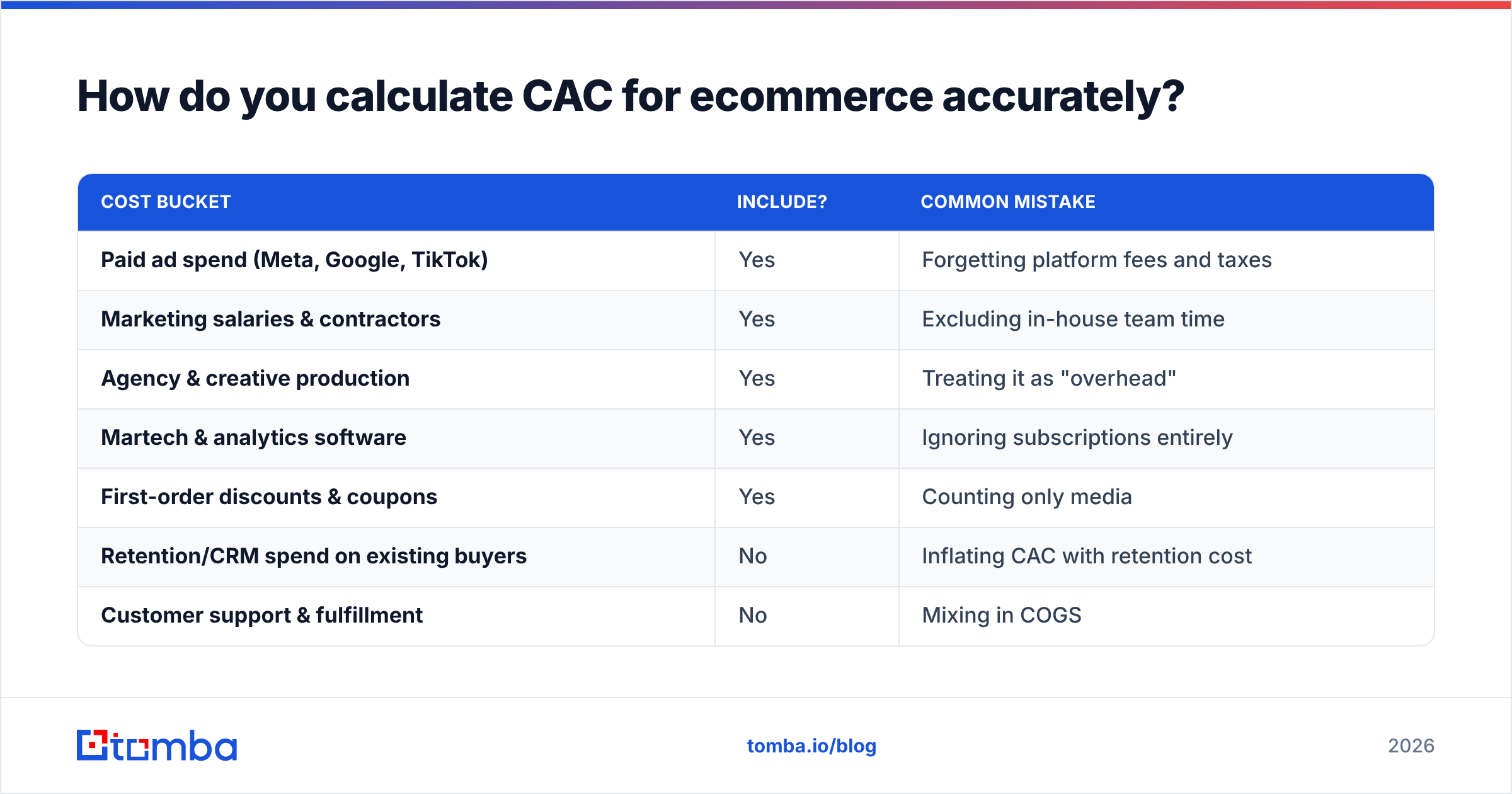
Accurate CAC starts with an honest cost ledger. Pull a fixed window — monthly works for most DTC brands — and total every line that touches acquisition.
| Cost bucket | Include? | Common mistake |
|---|---|---|
| Paid ad spend (Meta, Google, TikTok) | Yes | Forgetting platform fees and taxes |
| Marketing salaries & contractors | Yes | Excluding in-house team time |
| Agency & creative production | Yes | Treating it as "overhead" |
| Martech & analytics software | Yes | Ignoring subscriptions entirely |
| First-order discounts & coupons | Yes | Counting only media |
| Retention/CRM spend on existing buyers | No | Inflating CAC with retention cost |
| Customer support & fulfillment | No | Mixing in COGS |
Once the numerator is honest, divide by new customers only. Returning buyers don't belong in CAC — they belong in your retention math. Tag first-time orders in Shopify or your data warehouse so the denominator stays clean.
A practical cadence: calculate blended CAC monthly for the board, paid CAC weekly for the growth team, and channel CAC whenever you're deciding where the next dollar goes. According to Shopify's commerce research, acquisition costs have climbed sharply as paid platforms saturate, which makes this hygiene non-negotiable.
What is a good CAC for ecommerce in 2026?#
There is no universal "good" CAC — only a good CAC relative to customer lifetime value. A $120 CAC is fantastic for a furniture brand with $900 LTV and catastrophic for a $30 phone-case store.
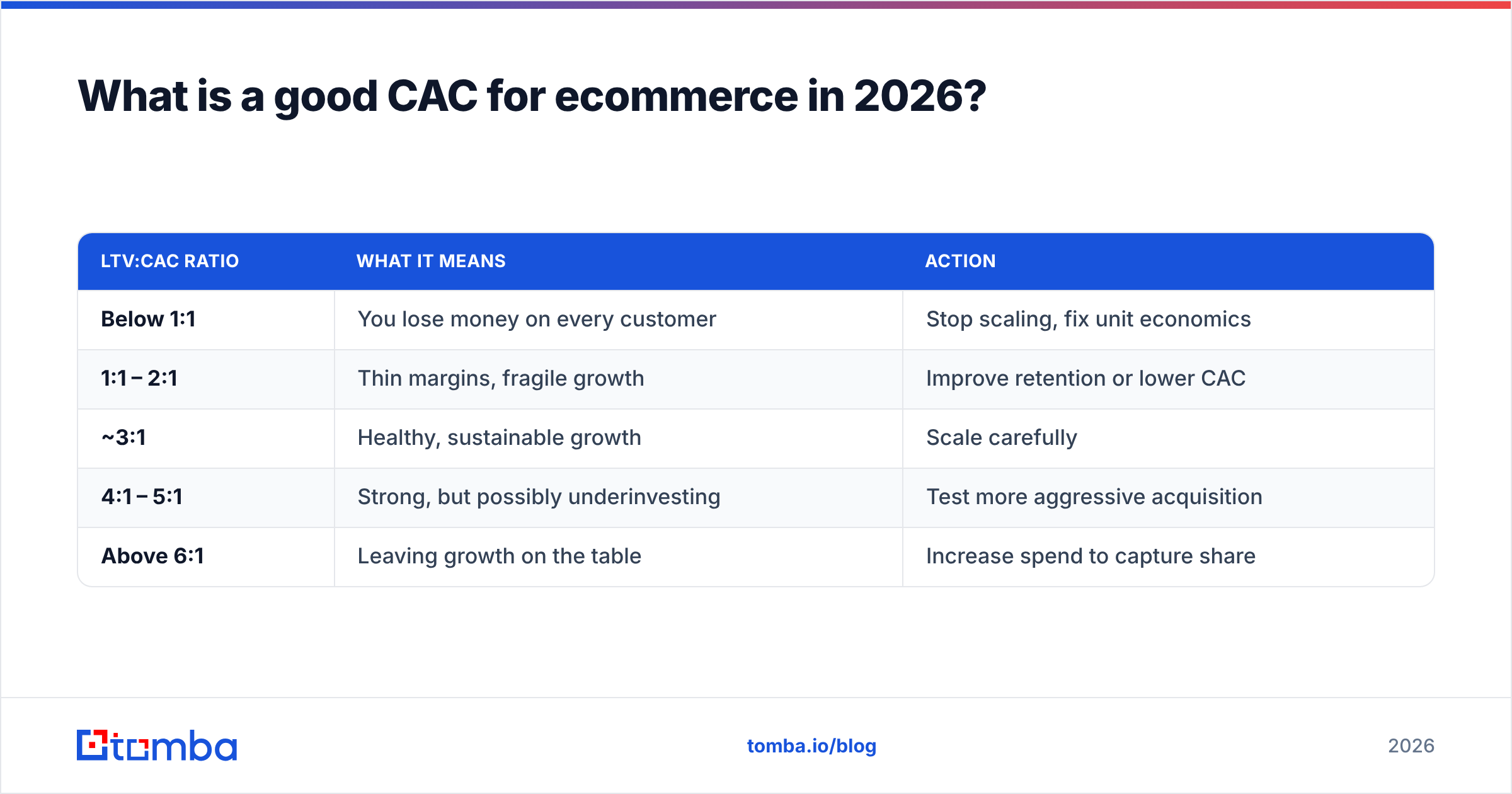
The benchmark that actually governs health is the LTV:CAC ratio:
| LTV:CAC ratio | What it means | Action |
|---|---|---|
| Below 1:1 | You lose money on every customer | Stop scaling, fix unit economics |
| 1:1 – 2:1 | Thin margins, fragile growth | Improve retention or lower CAC |
| ~3:1 | Healthy, sustainable growth | Scale carefully |
| 4:1 – 5:1 | Strong, but possibly underinvesting | Test more aggressive acquisition |
| Above 6:1 | Leaving growth on the table | Increase spend to capture share |
Equally important is CAC payback period — how many months of margin it takes to recoup acquisition cost. DTC brands generally want payback under 6–12 months; subscription ecommerce can tolerate longer because retention is predictable. HubSpot's benchmark data consistently shows that brands tracking payback alongside the ratio make sharper budget decisions than those chasing a single CAC figure.
Why is ecommerce CAC rising, and what inflates it?#
CAC is climbing for structural reasons, not because your team got worse.
- Ad auction saturation. More advertisers bidding on the same finite attention pushes CPMs up every year.
- Signal loss. Privacy changes (ATT, cookie deprecation) degraded targeting, so platforms waste more impressions to find buyers.
- Discount dependency. Brands that train customers to wait for promos quietly raise their effective CAC on every first order.
- Single-channel reliance. Putting 80% of budget into one platform means you pay that platform's rising rate with no leverage.
- Poor conversion. A slow, cluttered, or untrustworthy storefront makes every click more expensive because fewer convert.
The pattern underneath all of these: renting audiences is getting more expensive, while owning them is getting more valuable. That's the strategic pivot most CAC-reduction work comes back to.
)
How do you reduce CAC for ecommerce?#
Lowering CAC isn't one move — it's a stack of compounding improvements across conversion, retention, and channel mix. Here are the seven highest-leverage ones.
1. Raise conversion rate before raising spend#
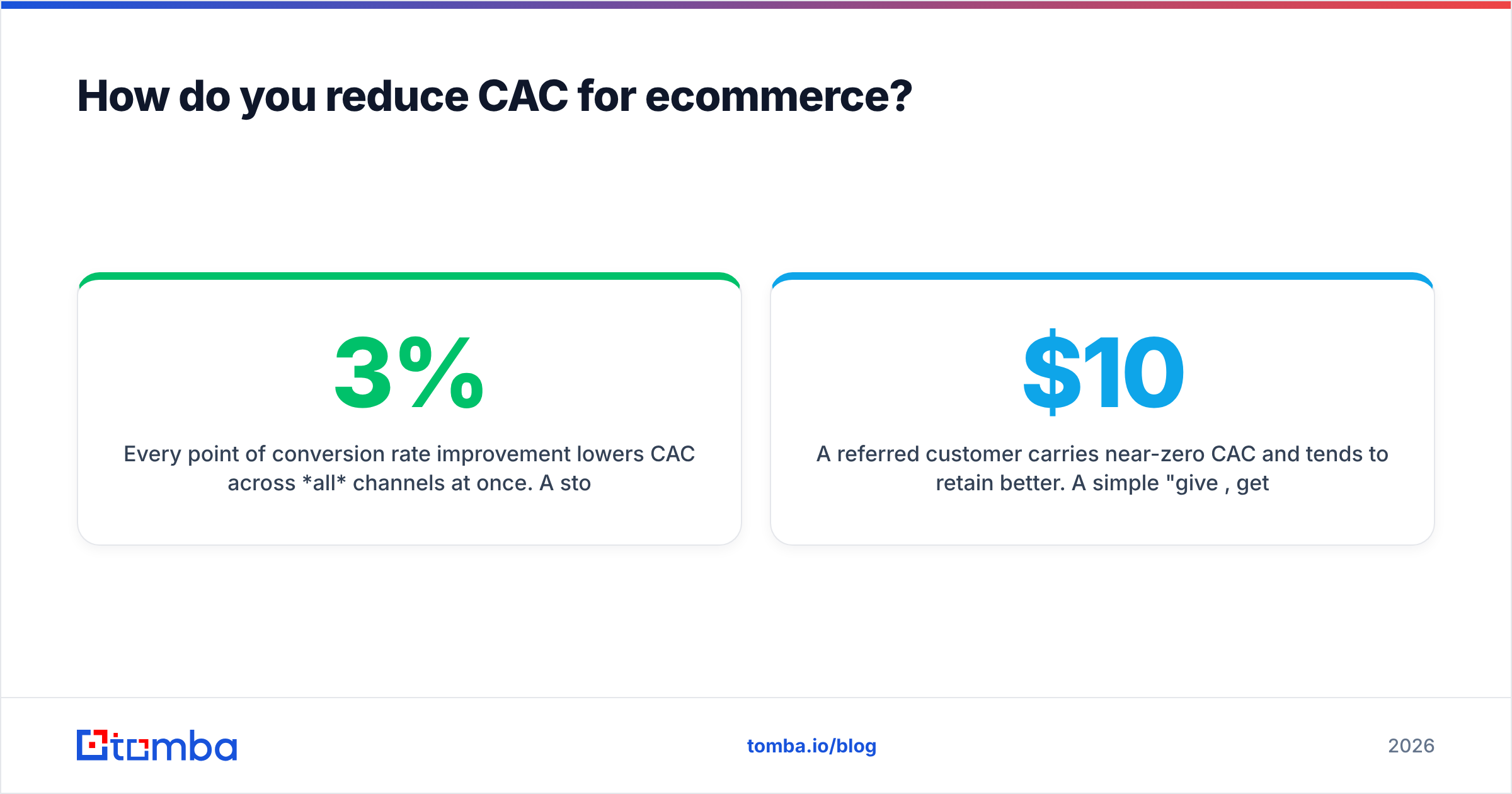
Every point of conversion rate improvement lowers CAC across all channels at once. A storefront that converts at 3% instead of 2% cuts effective CAC by a third with zero extra ad budget. Audit page speed, mobile checkout friction, trust signals, and the clarity of your offer first.
2. Shift budget toward owned channels#
Email and SMS cost a fraction of paid media per conversion and don't inflate over time. Building a real email program — welcome flows, abandoned cart, post-purchase — turns one-time buyers into repeat revenue that drags blended CAC down. Pair it with data enrichment so your list carries the context to personalize, not just blast.
3. Build first-party prospect data#
Instead of paying platforms to re-find your audience, capture it. For B2B and wholesale ecommerce especially, finding decision-maker contacts directly with an email finder or domain search lets you reach buyers without bidding against competitors in an ad auction. Outbound built on accurate, verified emails routinely beats paid CAC on high-AOV products.
4. Improve retention and LTV#
You can lower the ratio from either side. Doubling repeat purchase rate has the same effect on LTV:CAC as halving acquisition cost — and it's often easier. Subscription options, loyalty perks, and replenishment reminders all extend lifetime value.
5. Lean into referral and word of mouth#
A referred customer carries near-zero CAC and tends to retain better. A simple "give $10, get $10" mechanic turns your existing base into an acquisition channel that scales with your customer count, not your ad budget.
6. Tighten targeting and creative testing#
Most paid waste comes from showing the wrong creative to the wrong audience. Systematic creative testing — not random boosts — finds the angles that convert cheaply. Kill underperforming ad sets fast; let winners run.
7. Verify your data to stop wasted sends#
Bounced emails and dead contacts inflate the cost of every outreach campaign. Running lists through a bulk verify step protects sender reputation and ensures spend reaches real inboxes. Clean data is the cheapest CAC lever almost nobody prioritizes.
CAC reduction tactics compared#
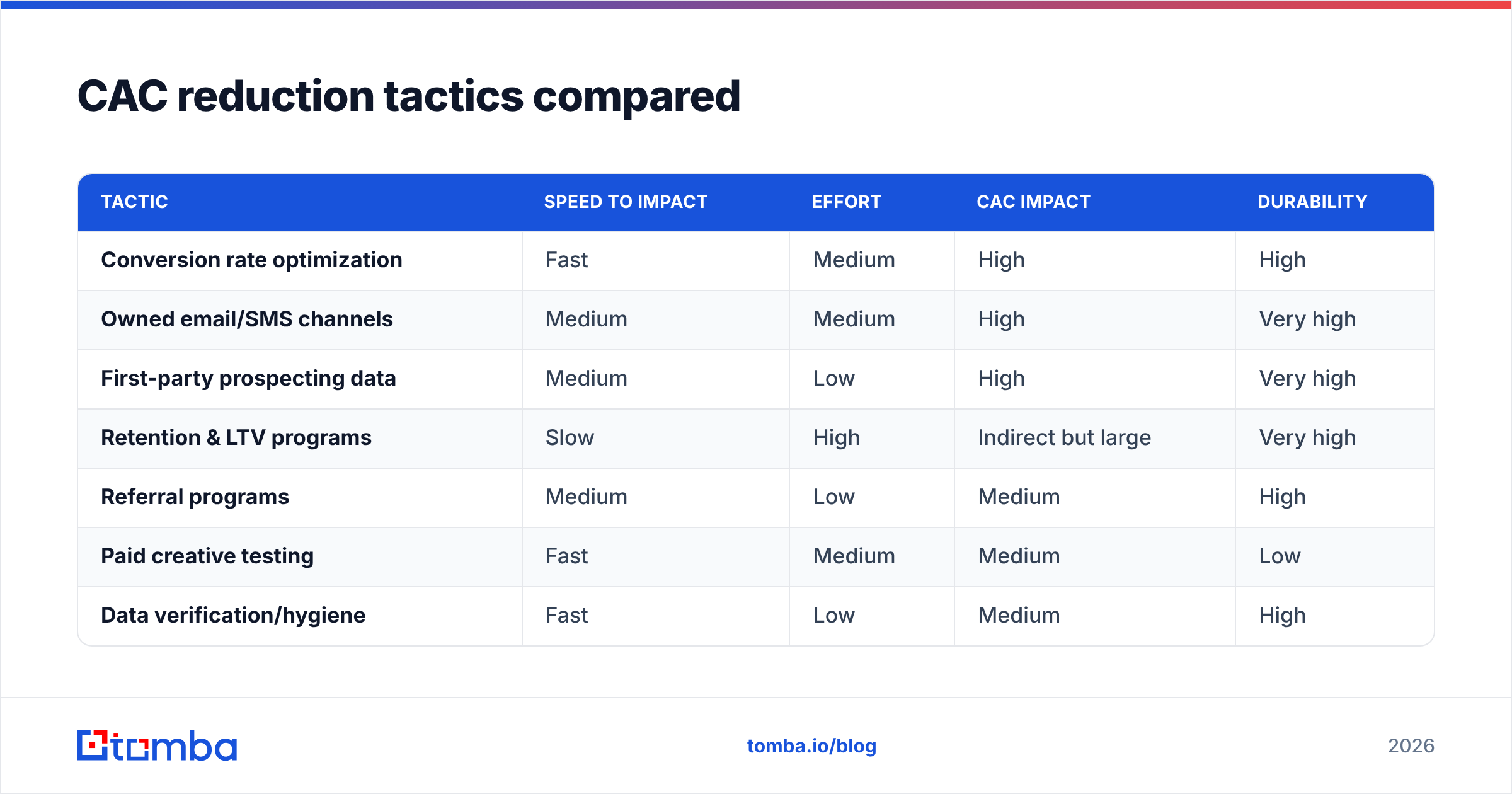
Not every lever delivers on the same timeline. Here's how the major moves stack up.
| Tactic | Speed to impact | Effort | CAC impact | Durability |
|---|---|---|---|---|
| Conversion rate optimization | Fast | Medium | High | High |
| Owned email/SMS channels | Medium | Medium | High | Very high |
| First-party prospecting data | Medium | Low | High | Very high |
| Retention & LTV programs | Slow | High | Indirect but large | Very high |
| Referral programs | Medium | Low | Medium | High |
| Paid creative testing | Fast | Medium | Medium | Low |
| Data verification/hygiene | Fast | Low | Medium | High |
The durable winners — owned channels, first-party data, retention — are exactly the ones that reduce dependence on rented audiences. Paid creative testing helps, but its gains evaporate the moment you stop, which is why it sits at the bottom on durability.
How does first-party data lower CAC structurally?#
First-party data lowers CAC because you stop paying a middleman to reach people you could reach directly. When Meta is your only path to a customer, you pay Meta's rising rate forever. When you own the contact — an email, a verified company domain, a direct phone line — the marginal cost of the next touch approaches zero.
For wholesale, B2B, and high-AOV ecommerce, this is transformative. Identifying the buyer at a target account and reaching them with a relevant offer costs a fraction of running broad prospecting ads. A workflow that pairs find email addresses with contact enrichment builds an acquisition engine you own outright — one that gets cheaper as your data compounds, not more expensive as auctions heat up.
This doesn't replace paid media; it diversifies away from it. The brands with the lowest blended CAC in 2026 aren't the ones with the best ad accounts — they're the ones least dependent on ad accounts. Gartner's marketing research has repeatedly flagged first-party data strategy as the defining advantage as third-party signals disappear.
Frequently asked questions#
What costs should be included in ecommerce CAC?#
Include all sales and marketing spend tied to acquiring new customers: paid media, marketing salaries and contractors, agency fees, creative production, martech subscriptions, and first-order discounts. Exclude retention spend on existing customers, fulfillment, and customer support — those are COGS or retention costs, not acquisition.
What is a good LTV to CAC ratio for ecommerce?#
Roughly 3:1 is the healthy benchmark. Below 1:1 you lose money on every customer and should stop scaling. Above 5:1 you may be underinvesting in growth and leaving market share to competitors.
Is blended CAC or paid CAC more useful?#
Both. Blended CAC tells you overall efficiency for the board; paid CAC tells you whether your ad channels are actually pulling their weight. Optimizing only blended CAC hides expensive paid channels behind free organic traffic.
How can a small store lower CAC without a big budget?#
Start with conversion rate optimization and owned channels — both lower CAC with little or no extra spend. Then build first-party prospect data and a referral loop so acquisition scales with your customer base instead of your ad budget.
Lower your CAC with owned, verified data#
The cheapest customer is the one you reach without paying a platform to find them. Tomba's Email Finder helps ecommerce and B2B teams build first-party prospect lists — accurate, verified, and yours — so you can shift acquisition away from ever-rising ad auctions and toward channels you control. Start on the free tier (25 searches a month) and scale on a plan that fits; see full Tomba pricing when you're ready to grow. Lower CAC isn't about spending more — it's about depending less on rented audiences.
// get started
Find, verify and enrich your first contacts today
Start on the free plan with 25 searches a month, then scale when your team is ready.
Free plan · No credit card required · GDPR & CCPA
// about the author