CAC Payback Period in 2026: The B2B SaaS Benchmark Guide
CAC payback tells you how many months it takes to earn back what you spent winning a customer. Here's the 2026 formula, benchmarks, and how to shorten it.
TL;DR
- CAC payback period is the number of months it takes to recover the cost of acquiring a customer from their gross-margin-adjusted revenue.
- The 2026 median for B2B SaaS sits around 12–18 months; best-in-class teams recover CAC in under 12.
- The formula is simple:
CAC ÷ (Monthly Recurring Revenue × Gross Margin). The hard part is feeding it clean inputs. - The fastest levers are higher win rates, lower acquisition cost, and less wasted spend on bad-fit or unreachable leads.
- Cutting wasted prospecting spend — paying to find and email people who don't exist or never reply — is the most overlooked way to shorten payback.
What is CAC payback period?#
CAC payback period is the time it takes to earn back what you spent to win a customer. Think of it like a vending machine that costs you a dollar to stock: payback is how long until that slot has sold a dollar's worth of soda back. Until then, you're underwater on that customer.
In B2B SaaS terms, you spend money on ads, sales salaries, tools, and data to close a deal. That total is your customer acquisition cost. The customer then pays you every month. CAC payback answers: how many of those monthly payments do you need before the deal is cash-flow neutral?
It matters because it's a liquidity metric, not a profitability one. LTV:CAC tells you whether a customer is worth winning over their lifetime. CAC payback tells you how long your cash is tied up before you can reinvest it. A company with great LTV:CAC but a 30-month payback can still run out of money, because growth burns cash faster than customers return it.
How do you calculate CAC payback?#
The core formula is short:
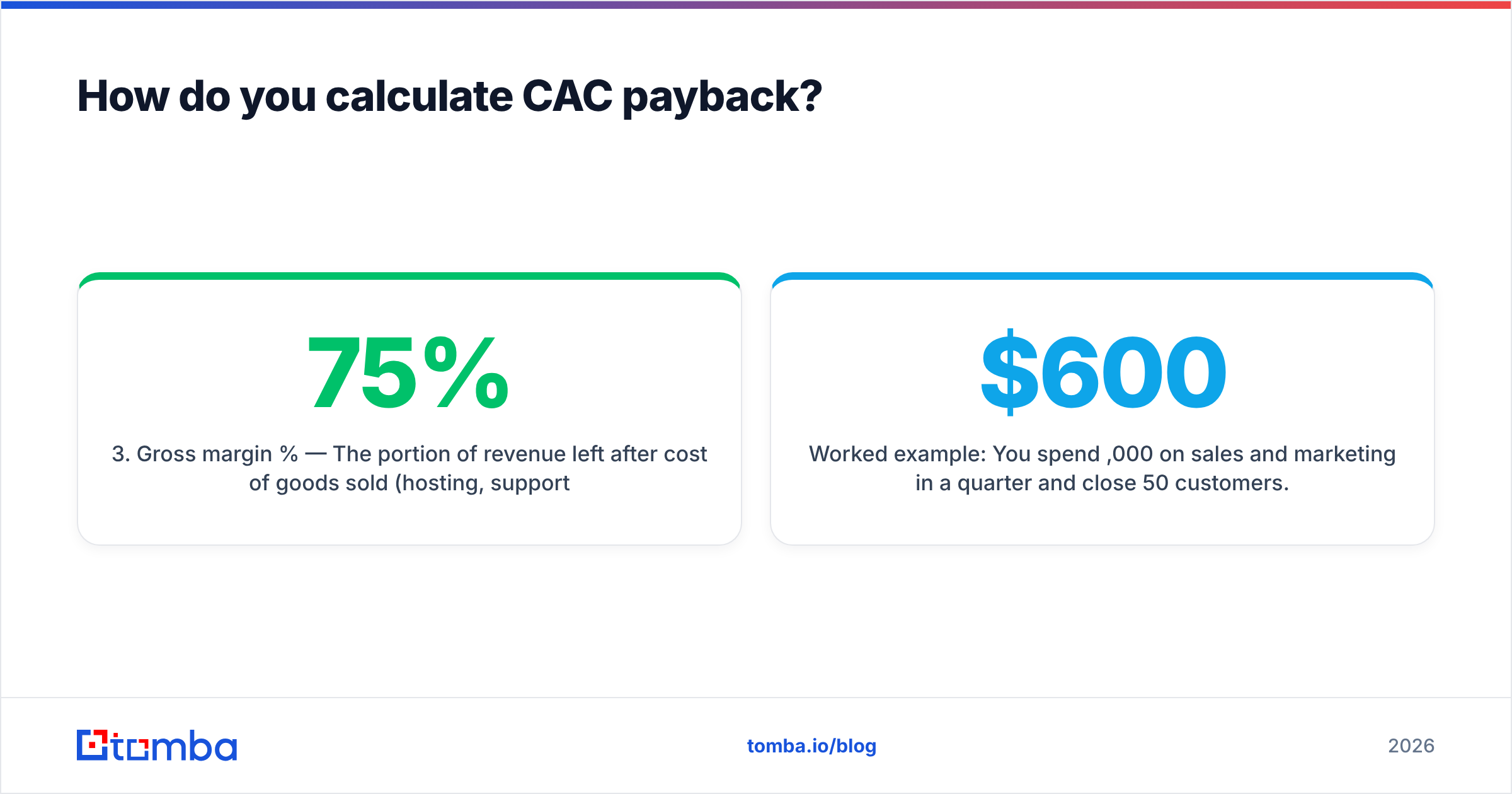
CAC Payback (months) = CAC ÷ (New MRR per customer × Gross Margin %)
Here's what each input means and where teams get it wrong:
- CAC — Total sales and marketing spend in a period divided by new customers won in that period. Include salaries, commissions, ad spend, software, and data costs. Excluding fully-loaded headcount is the most common way to flatter this number.
- New MRR per customer — The monthly recurring revenue a new customer brings. Use the actual booked amount, not list price.
- Gross margin % — The portion of revenue left after cost of goods sold (hosting, support, payment fees). Skipping this overstates how fast you recover cash. A 75% margin is typical for SaaS.
- Period consistency — Match the period of your spend to the period of your wins. Spend in Q1 often closes deals in Q2; lagging your numerator and denominator avoids a distorted result.
Worked example: You spend $600,000 on sales and marketing in a quarter and close 50 customers. CAC is $12,000. Each pays $1,500/month at a 75% gross margin, so each contributes $1,125 in monthly gross profit. Payback is $12,000 ÷ $1,125 = 10.7 months. That's healthy for 2026.
If you want a refresher on how this metric fits into the broader operating model, the revenue operations discipline is where CAC payback, pipeline, and forecasting all converge.
What is a good CAC payback period in 2026?#
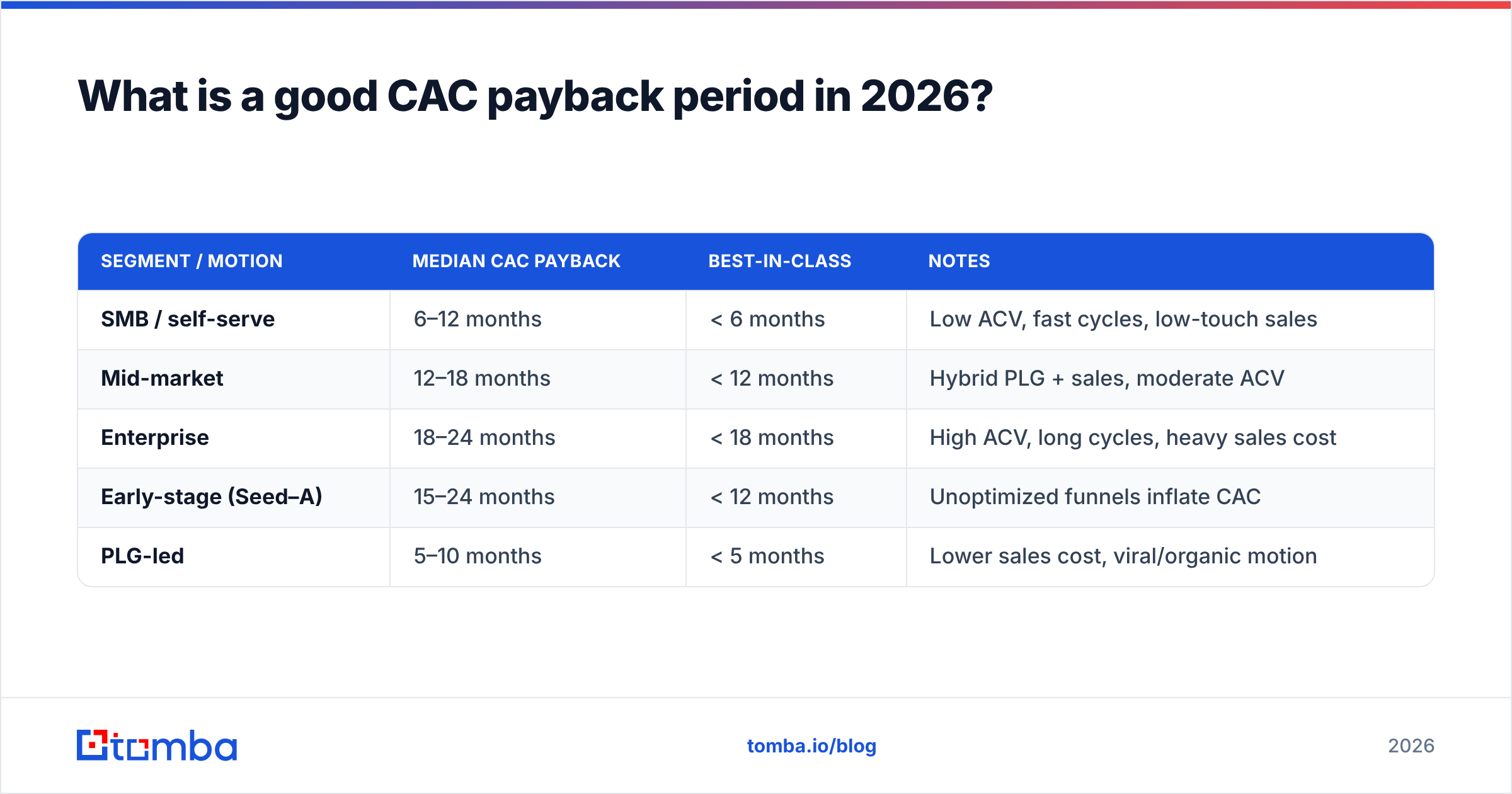
Conclusion first: under 12 months is strong, 12–18 is acceptable, and over 24 is a warning sign for most B2B SaaS businesses. But context changes the bar — deal size, motion, and segment all move the goalposts.
| Segment / motion | Median CAC payback | Best-in-class | Notes |
|---|---|---|---|
| SMB / self-serve | 6–12 months | < 6 months | Low ACV, fast cycles, low-touch sales |
| Mid-market | 12–18 months | < 12 months | Hybrid PLG + sales, moderate ACV |
| Enterprise | 18–24 months | < 18 months | High ACV, long cycles, heavy sales cost |
| Early-stage (Seed–A) | 15–24 months | < 12 months | Unoptimized funnels inflate CAC |
| PLG-led | 5–10 months | < 5 months | Lower sales cost, viral/organic motion |
Two benchmarks worth bookmarking: investors like Bessemer have long treated a sub-12-month payback as the gold standard for efficient SaaS, and buyer-review platforms such as G2 make it easier to see how category leaders price and package — which directly shapes the MRR side of your equation. For a broader operating view of acquisition costs, HubSpot publishes useful SaaS benchmark studies you can sanity-check your numbers against.
A caveat: a very short payback isn't automatically a win. If your payback is 3 months but you're capping ad spend to keep it there, you may be under-investing in growth. The metric is a guardrail, not a target to minimize at all costs.
Why does CAC payback get worse over time?#
CAC payback tends to drift upward as a company scales, and it usually traces back to four causes:
- Channel saturation. Your cheapest, highest-intent audience gets exhausted first. Each additional customer comes from a more expensive, lower-intent pool, pushing CAC up.
- Rising competition. More bidders on the same keywords and the same buyers raises ad and outbound costs across the board.
- Funnel decay. Win rates slip as you move beyond your sharpest ICP. A lower win rate means more spend per closed deal.
- Wasted prospecting spend. Reps burn hours and tool credits chasing contacts who bounced, churned roles, or never existed. Every undeliverable email and dead phone number is CAC with zero return.
That last one is where many teams quietly bleed efficiency. If 20% of your outbound list is invalid, you've inflated your effective cost-per-reply by 25% before a single email lands.

How do you shorten CAC payback?#
There are only three mathematical levers: spend less to acquire, win more per dollar, or earn more per customer faster. Everything else is a tactic underneath one of those.
1. Raise win rate on existing spend. Better targeting beats more volume. Tightening your ICP and routing reps to accounts that actually convert lowers cost per closed deal without spending an extra dollar.
2. Cut waste from your data layer. This is the most immediate lever and the least glamorous. Stop paying — in tool credits, sending reputation, and rep time — to contact people you can't reach. Verifying contacts before outreach means more of your fixed cost converts into conversations. Tomba's email verifier and catch-all verifier exist for exactly this: keep bounce rates low so deliverability and reply rates stay high.
3. Increase deal velocity. Shorter sales cycles recover cash faster, which directly shrinks payback. Enriching leads up front — so reps open with relevant context instead of discovery busywork — compresses the cycle. Tomba's data enrichment fills in firmographic and role data the moment a lead enters your CRM.
4. Improve gross margin. Renegotiate infrastructure costs, automate support tiers, and push self-serve onboarding. A jump from 70% to 80% margin shortens payback by more than most people expect.
5. Expand revenue per account. Upsells and cross-sells raise new MRR per customer. They don't change historical CAC, but they pull future payback periods down.
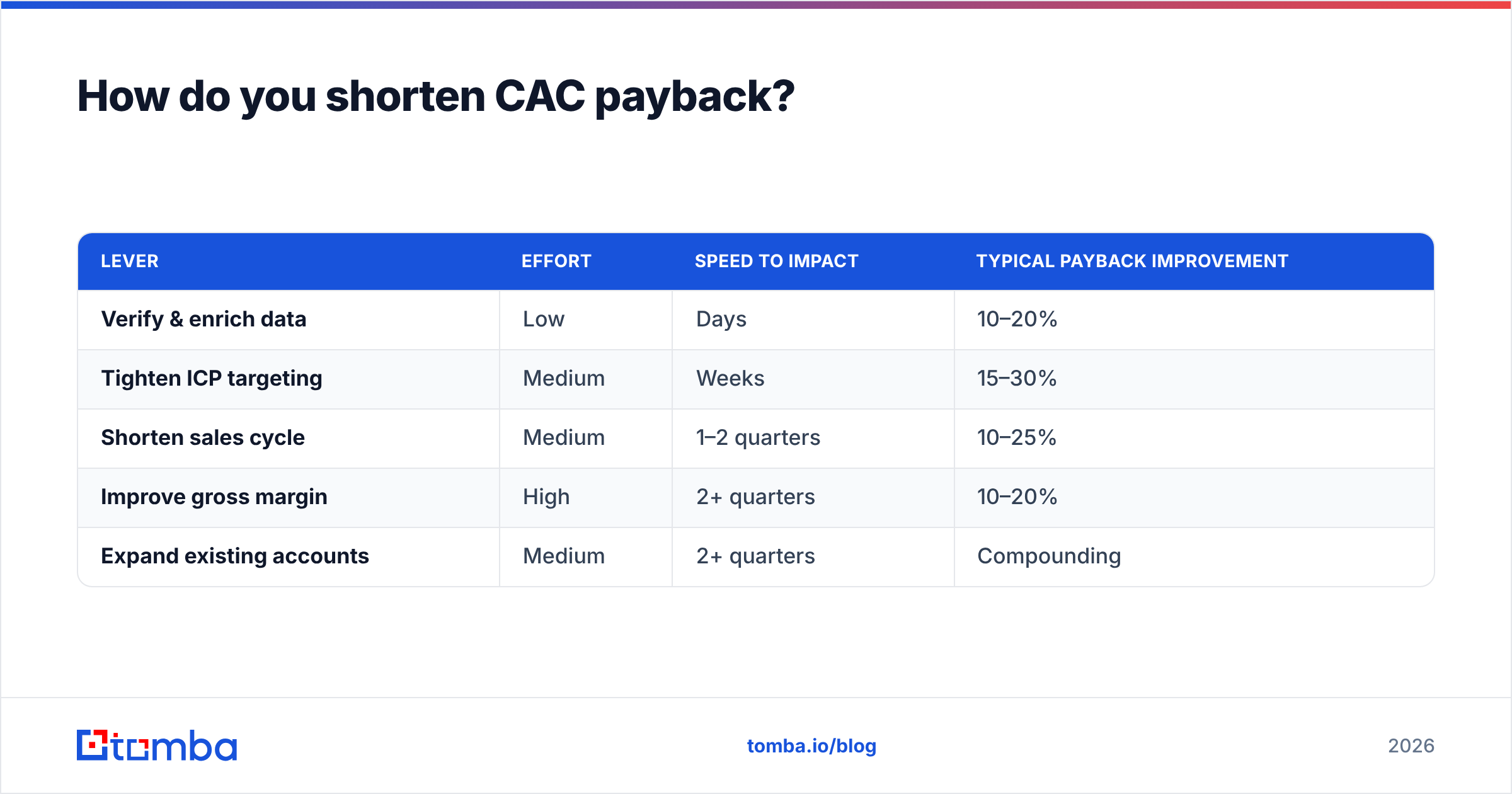
A quick efficiency comparison#
| Lever | Effort | Speed to impact | Typical payback improvement |
|---|---|---|---|
| Verify & enrich data | Low | Days | 10–20% |
| Tighten ICP targeting | Medium | Weeks | 15–30% |
| Shorten sales cycle | Medium | 1–2 quarters | 10–25% |
| Improve gross margin | High | 2+ quarters | 10–20% |
| Expand existing accounts | Medium | 2+ quarters | Compounding |
The top row is deliberately first: data hygiene is the cheapest, fastest change with a measurable effect on CAC, and it's the one most teams skip.
How does lead quality affect CAC payback?#
Lead quality sits upstream of every other lever, so small improvements there ripple through the whole equation. If your reps spend a third of their week on unreachable or mis-targeted contacts, you're paying full salary for two-thirds of a rep's output. That inflated cost lands squarely in your CAC numerator.
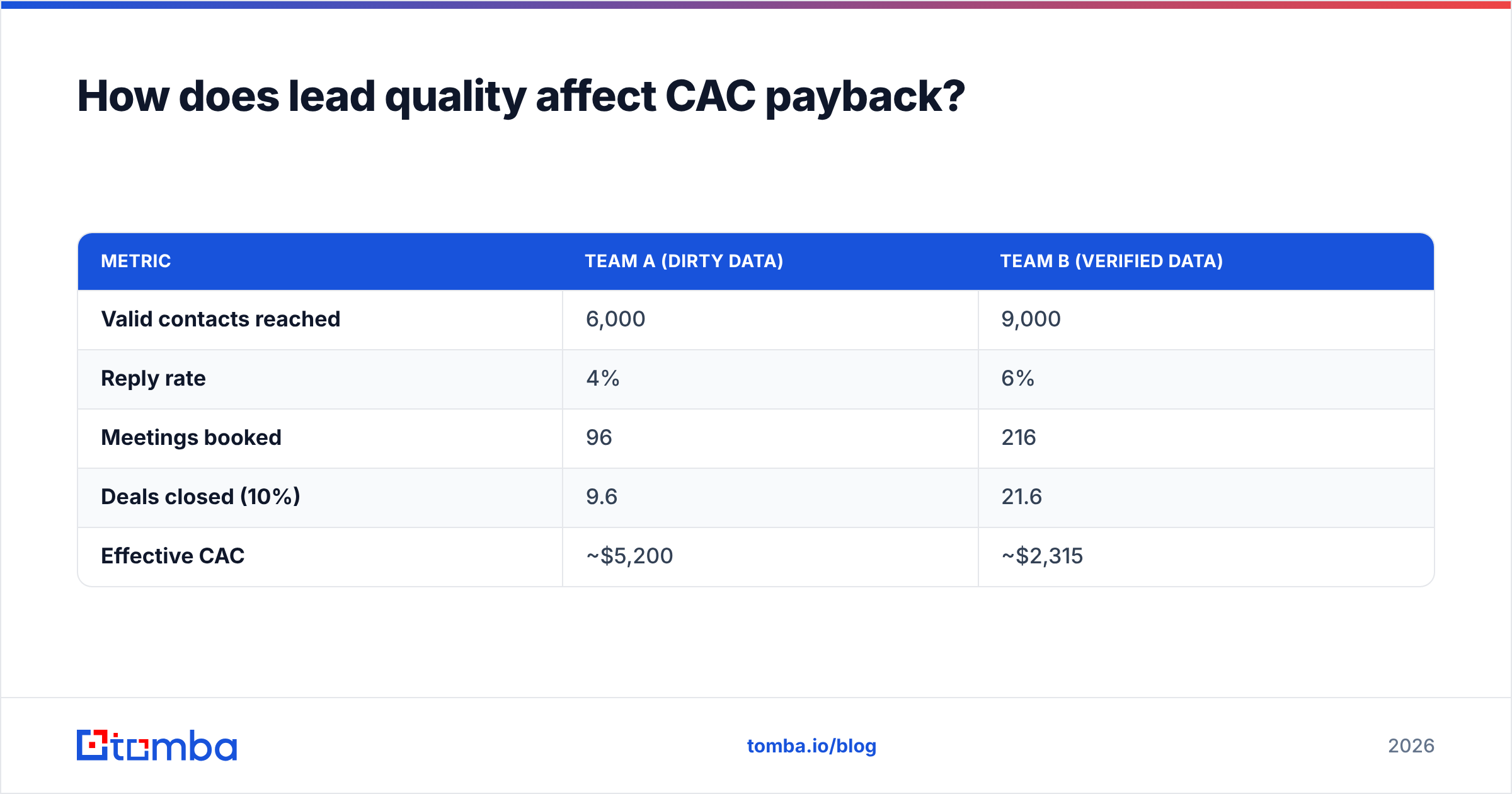
Consider two teams with identical $50,000/month outbound budgets:
| Metric | Team A (dirty data) | Team B (verified data) |
|---|---|---|
| Valid contacts reached | 6,000 | 9,000 |
| Reply rate | 4% | 6% |
| Meetings booked | 96 | 216 |
| Deals closed (10%) | 9.6 | 21.6 |
| Effective CAC | ~$5,200 | ~$2,315 |
Same spend, less than half the CAC — purely from cleaner inputs and a tighter list. That's why accurate contact data isn't a "nice to have" line item; it's a direct multiplier on payback. Finding the right person fast with an email finder, then confirming the address is live, removes the single biggest source of silent waste in outbound.
This is also where tool choice shows up in the math. You can review Tomba pricing against credit-burn from bounces: a plan that costs $99/month but cuts your invalid-contact rate in half often pays for itself in recovered rep hours within the first week.
How often should you measure CAC payback?#
Measure it monthly as a trend and review it quarterly as a decision input. Monthly snapshots are noisy because deal timing skews any single period, so watch the rolling three-month average rather than reacting to one bad month.
Tie the metric to action with simple triggers:
- Payback rising 3 months in a row → audit channel mix and data quality before adding budget.
- Payback under target with healthy pipeline → you likely have room to increase spend and grow faster.
- Payback diverging by segment → reallocate toward the motion that recovers cash fastest.
- New channel launch → track its standalone payback separately; blended numbers hide a failing channel.
The point of measuring often isn't to obsess over the number. It's to catch efficiency decay early, while it's still a cheap fix instead of a board-meeting problem.
The bottom line#
CAC payback is the clearest read on whether your growth engine is funding itself or quietly draining cash. The formula is easy; the discipline is in feeding it clean data and acting on the trend. Of every lever available, fixing your data layer is the fastest and cheapest — it shrinks CAC the same week you do it.
If wasted outreach is inflating your payback, start at the source. Tomba Email Finder helps you find verified, professional email addresses by name, company, or domain — so more of your acquisition budget turns into real conversations instead of bounces. Start on the free tier (25 searches/month), and when the math proves out, the Starter plan at $49/month scales with your pipeline. Lower waste, lower CAC, faster payback.
// get started
Find, verify and enrich your first contacts today
Start on the free plan with 25 searches a month, then scale when your team is ready.
Free plan · No credit card required · GDPR & CCPA
// about the author