CAC SaaS in 2026: How to Calculate and Cut Acquisition Cost
CAC for SaaS quietly decides whether your growth is profitable or just expensive. Here's how to calculate CAC, benchmark it, and cut it in 2026 without slowing pipeline.
Customer acquisition cost is the number that decides whether your SaaS growth is a business or a bonfire. You can triple new logos and still go broke if each one costs more than it returns. This guide breaks down CAC for SaaS in 2026 — the formula, the benchmarks that actually matter, and the levers that move the number down without choking your pipeline.
TL;DR#
- CAC SaaS is total sales and marketing spend divided by new customers won in the same period. Simple to write, easy to miscalculate.
- The two ratios that matter more than raw CAC are LTV:CAC (aim for 3:1 or better) and CAC payback period (aim for under 12 months).
- Blended CAC hides problems. Split it by channel — paid, organic, outbound, referral — or you optimize blind.
- The fastest CAC wins in 2026 come from better targeting and cleaner data, not bigger ad budgets. Wasted outreach is wasted spend.
- Cutting CAC is mostly removing waste: bad-fit leads, bounced emails, slow follow-up, and channels that look cheap but convert poorly.
What is CAC in SaaS?#
CAC, or customer acquisition cost, is the average amount you spend to win one new paying customer. Think of it like a fishing trip: CAC is the total cost of the boat, fuel, bait, and your time divided by the number of fish you actually bring home — not the number of times you cast a line.
For SaaS specifically, CAC matters more than in most industries because revenue arrives slowly over months of subscription, while acquisition costs hit upfront. You pay for the ad click, the SDR's salary, and the demo today; you earn it back one monthly invoice at a time. If you don't know your CAC, you don't know how long you're underwater on every deal.
The formula is straightforward:
CAC = (Total Sales Spend + Total Marketing Spend) ÷ New Customers Acquired
over the same time window. The trouble is almost never the division — it's deciding what counts as "sales and marketing spend" and which customers count as "acquired." Get sloppy with the inputs and you'll report a CAC that's half the real number, then wonder why the bank account disagrees with the dashboard.
)
How do you calculate CAC for SaaS correctly?#
Most CAC mistakes come from leaving costs out. A defensible CAC calculation should include the items below — and exclude the ones that don't belong.
- Paid media — ad spend across Google, LinkedIn, Meta, retargeting, and sponsorships.
- Salaries and commissions — the fully loaded cost of marketing and sales headcount, including SDRs, AEs, and their bonuses.
- Tools and software — your CRM, sales engagement platform, data and enrichment vendors, and analytics stack.
- Agencies and contractors — freelance content, paid-media management, design, and outsourced SDR teams.
- Onboarding tied to acquisition — only the portion of onboarding required to convert a buyer, not ongoing customer success.
- Exclude — customer success for existing accounts, R&D, and overhead like rent or finance salaries that aren't acquisition-specific.
Here's a worked example. Say in Q1 you spent $90,000 on ads, $120,000 on sales and marketing salaries, and $30,000 on tools and agencies. That's $240,000 in total acquisition cost. You closed 80 new customers. Your CAC is $240,000 ÷ 80 = $3,000 per customer.
That single number means little on its own. To know whether $3,000 is healthy, you need to compare it to what each customer is worth and how fast you recover the spend.
What is a good CAC payback period and LTV:CAC ratio?#
A good CAC is one you recover quickly and multiply over the customer's lifetime. The two benchmarks that define "good" are CAC payback period and the LTV:CAC ratio.
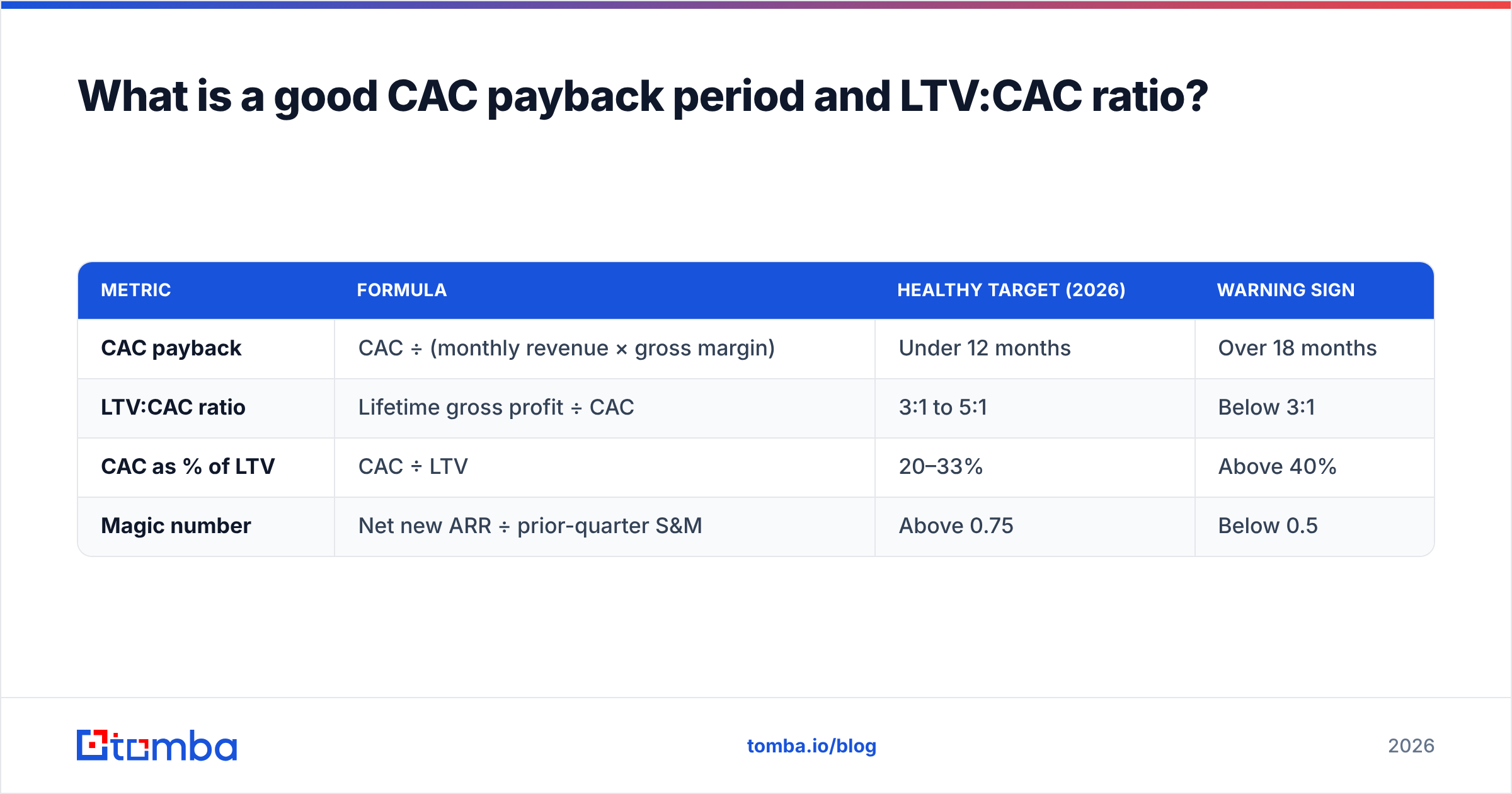
CAC payback period is how many months of gross-margin-adjusted revenue it takes to earn back what you spent acquiring a customer. LTV:CAC compares the total gross profit a customer generates over their lifetime to what you paid to acquire them. According to widely cited SaaS benchmarks from firms like Bessemer Venture Partners and operator surveys, the healthy targets look like this:
| Metric | Formula | Healthy target (2026) | Warning sign |
|---|---|---|---|
| CAC payback | CAC ÷ (monthly revenue × gross margin) | Under 12 months | Over 18 months |
| LTV:CAC ratio | Lifetime gross profit ÷ CAC | 3:1 to 5:1 | Below 3:1 |
| CAC as % of LTV | CAC ÷ LTV | 20–33% | Above 40% |
| Magic number | Net new ARR ÷ prior-quarter S&M | Above 0.75 | Below 0.5 |
A few notes on reading this table. An LTV:CAC ratio far above 5:1 isn't a trophy — it usually means you're underinvesting in growth and leaving market share on the table. Sub-12-month payback keeps you cash-efficient, which matters even more in a tighter funding environment than it did a few years ago. And gross margin belongs in the math: a dollar of SaaS revenue at 80% margin is not the same as a dollar of services revenue at 30%.
For deeper definitions of the surrounding metrics, the Tomba B2B glossary is a useful reference when you're aligning sales and finance on what each term actually means.
Why is blended CAC misleading?#
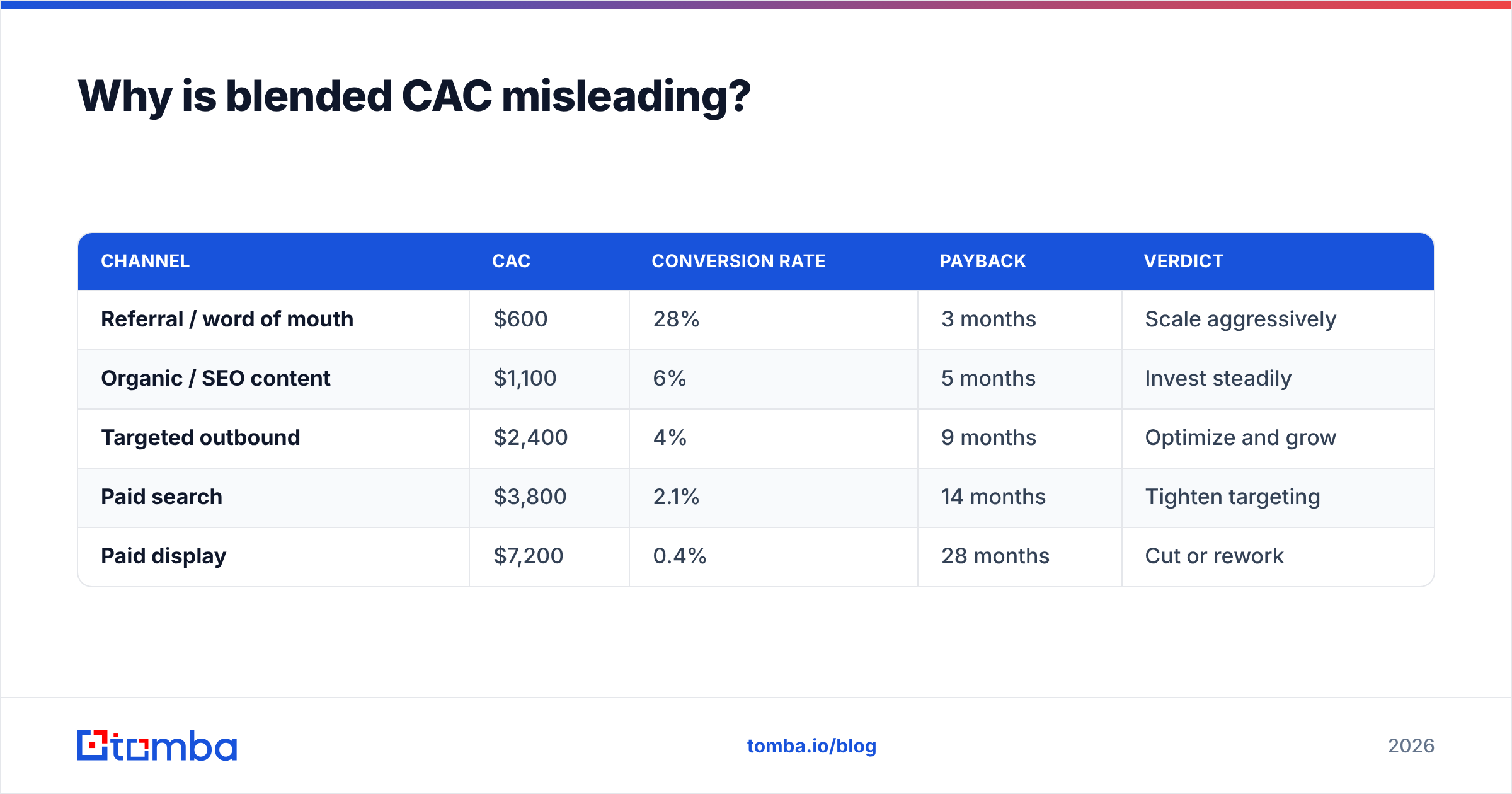
Blended CAC averages every channel into one number, and that average lies. Picture two channels: referrals that cost almost nothing and convert at 30%, and a paid display campaign that costs a fortune and converts at 0.4%. Blend them and you get a "reasonable" CAC that masks one channel quietly torching your budget.
Channel-level CAC is where the real decisions live. Splitting it out shows you where to pour more budget and where to pull back. Here's a typical breakdown for a mid-market SaaS:
| Channel | CAC | Conversion rate | Payback | Verdict |
|---|---|---|---|---|
| Referral / word of mouth | $600 | 28% | 3 months | Scale aggressively |
| Organic / SEO content | $1,100 | 6% | 5 months | Invest steadily |
| Targeted outbound | $2,400 | 4% | 9 months | Optimize and grow |
| Paid search | $3,800 | 2.1% | 14 months | Tighten targeting |
| Paid display | $7,200 | 0.4% | 28 months | Cut or rework |
Once you see CAC this way, the strategy writes itself: feed the channels with short payback, fix or kill the ones bleeding cash. This is the core of healthy revenue operations — connecting spend to outcomes channel by channel instead of trusting a single blended average.
What drives CAC up in SaaS?#
CAC rises for predictable reasons, and most of them are fixable. The biggest culprits:
- Bad-fit targeting. Casting too wide fills your funnel with people who'll never buy. Every demo with a non-buyer is pure cost.
- Dirty contact data. Bounced emails, wrong job titles, and dead phone numbers waste SDR hours and ad budget on contacts who can't convert.
- Slow follow-up. HubSpot research and decades of lead-response studies show conversion drops sharply when first response slips past the first hour.
- Channel concentration. Relying on one expensive paid channel means you pay auction-inflated prices with no cheaper backstop.
- Long, manual sales cycles. Every extra week an AE spends nudging a deal adds loaded salary cost to that customer's CAC.
Notice how many of these trace back to data quality and targeting rather than ad spend. You can't out-budget a list full of bounces. That's why the highest-leverage CAC work in 2026 starts upstream, at the moment you decide who to contact.
)
How do you reduce CAC without slowing growth?#
Lowering CAC is mostly about removing waste, not spending less for its own sake. The goal is to win the same or more customers for fewer dollars — which means tightening every step between "we found a prospect" and "they paid."
1. Tighten your ideal customer profile. Narrow targeting feels counterintuitive, but a sharper ICP raises conversion rates, which is the single fastest way to lower CAC. Fewer wrong conversations, more right ones.
2. Verify contact data before you spend on it. Sending sequences to invalid addresses inflates CAC and wrecks email deliverability, which then drags down every future campaign. Running lists through an email verifier before outreach removes the bounces that quietly waste SDR time and sender reputation.
3. Find decision-makers directly instead of buying broad ad reach. Reaching the right five people at a target account is far cheaper than paying for thousands of untargeted impressions. Tools that turn a company domain into verified contacts — a domain search or bulk email finder — let outbound teams build precise lists instead of renting expensive paid attention.
4. Enrich leads so reps don't waste cycles researching. When every lead arrives with verified title, company size, and contact details, AEs spend their time selling, not Googling. Automated data enrichment cuts the hidden labor cost baked into CAC.
5. Speed up follow-up. Route leads instantly and contact them while intent is fresh. Faster response lifts conversion at zero extra acquisition spend, which mechanically lowers CAC.
6. Double down on low-CAC channels. Use your channel breakdown to shift budget from long-payback paid channels into referral, content, and targeted outbound.
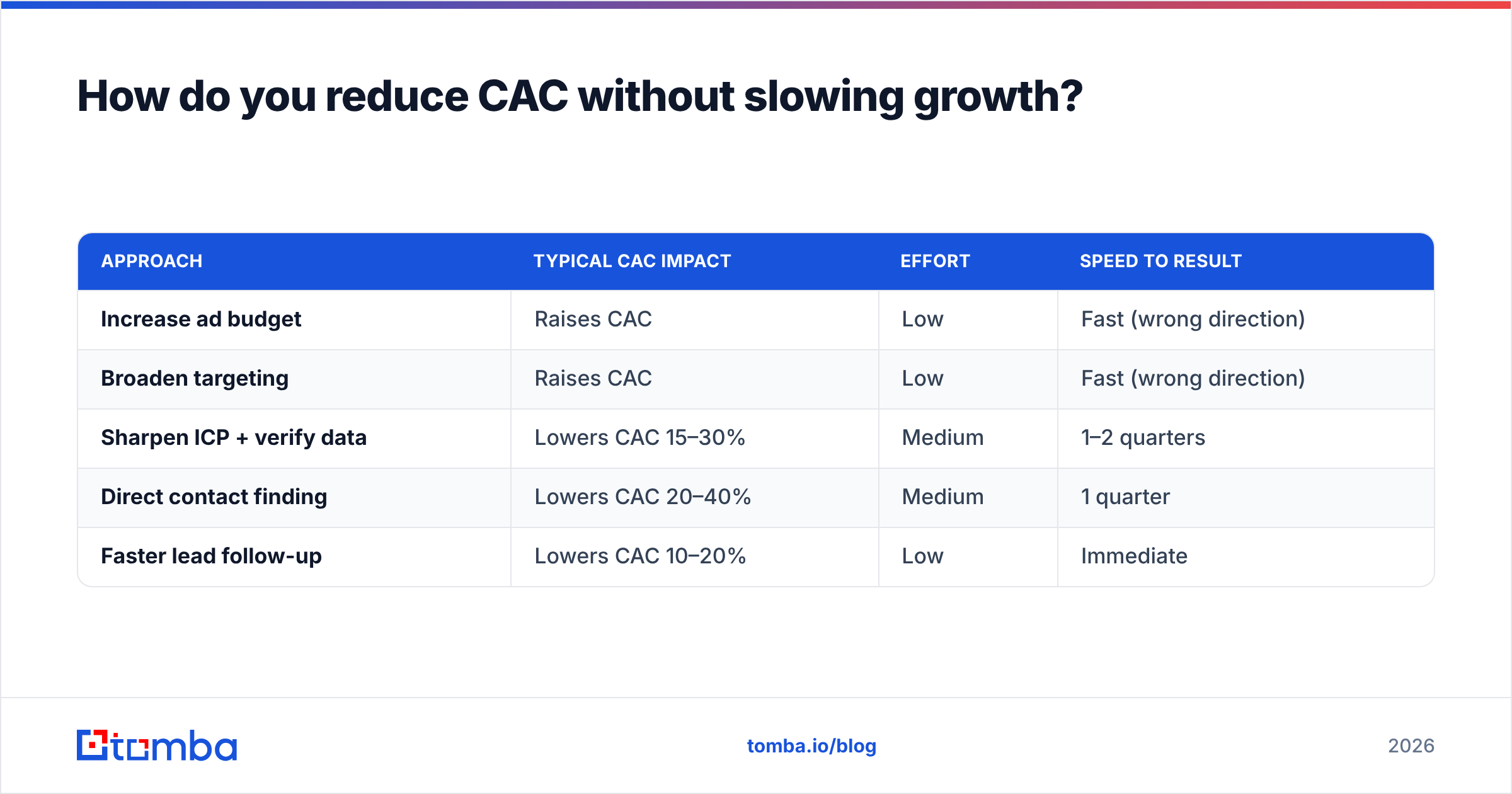
A quick comparison of where teams spend versus where the efficient wins actually are:
| Approach | Typical CAC impact | Effort | Speed to result |
|---|---|---|---|
| Increase ad budget | Raises CAC | Low | Fast (wrong direction) |
| Broaden targeting | Raises CAC | Low | Fast (wrong direction) |
| Sharpen ICP + verify data | Lowers CAC 15–30% | Medium | 1–2 quarters |
| Direct contact finding | Lowers CAC 20–40% | Medium | 1 quarter |
| Faster lead follow-up | Lowers CAC 10–20% | Low | Immediate |
The pattern is clear: spending more rarely fixes CAC, and precision almost always does.
How does data quality affect SaaS CAC?#
Data quality is the most underrated CAC lever because its cost is invisible until you measure it. A 25% bounce rate doesn't show up as a line item — it shows up as SDRs working a list that's a quarter dead, ad audiences full of stale records, and a sender domain slowly sliding toward the spam folder.
Run the math. If an SDR costs $6,000 a month fully loaded and spends a quarter of their time chasing invalid or wrong-fit contacts, that's $1,500 a month of pure waste per rep — multiplied across your team and added straight onto CAC. Clean data doesn't just feel nicer; it removes a recurring tax on every acquisition dollar.
This is why finding and verifying contacts at the source beats cleaning up later. When you start with accurate, deliverable contact data, you avoid the bounces, the wasted sequences, and the reputation damage that compound into higher CAC over time. Comparing vendors on accuracy and coverage — using independent reviews on G2 and Gartner — pays for itself quickly when the alternative is paying SDR salaries to email the void.
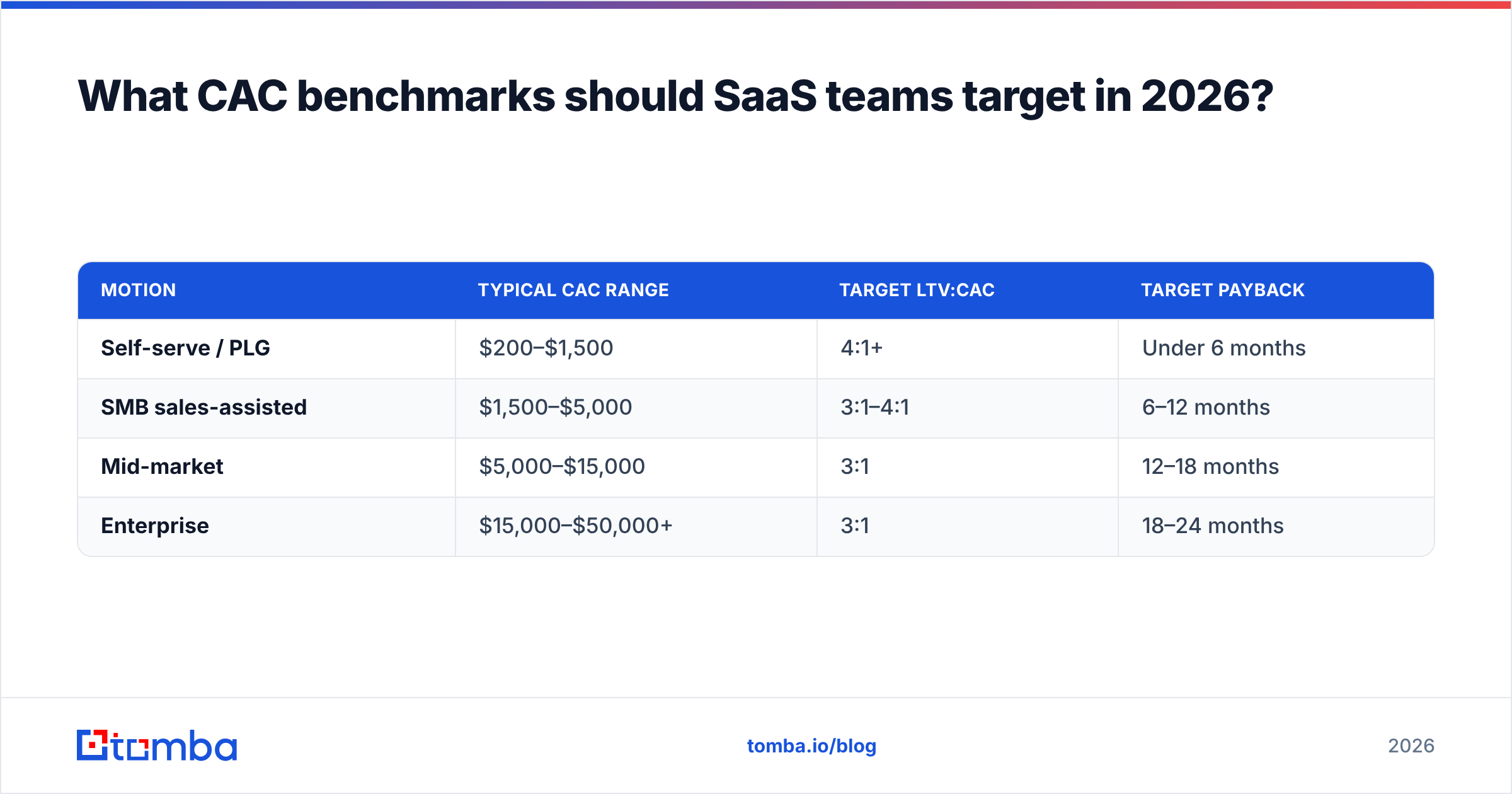
What CAC benchmarks should SaaS teams target in 2026?#
Benchmarks vary by motion, but here's a practical 2026 reference for the metrics that finance and the board will ask about:
| Motion | Typical CAC range | Target LTV:CAC | Target payback |
|---|---|---|---|
| Self-serve / PLG | $200–$1,500 | 4:1+ | Under 6 months |
| SMB sales-assisted | $1,500–$5,000 | 3:1–4:1 | 6–12 months |
| Mid-market | $5,000–$15,000 | 3:1 | 12–18 months |
| Enterprise | $15,000–$50,000+ | 3:1 | 18–24 months |
Use these as guardrails, not gospel. A PLG product with a 24-month payback has a problem; an enterprise deal with an 18-month payback is normal. What never changes is the principle: know your CAC by channel, recover it quickly, and earn back a healthy multiple over the customer's life. For context on how these metrics fit into the broader category, the SaaS metrics overview on Wikipedia is a reasonable neutral primer.
Frequently asked questions about CAC SaaS#
Is CAC the same as cost per lead? No. Cost per lead measures spend per lead generated; CAC measures spend per customer won. CAC is always higher because not every lead converts.
Should CAC include customer success costs? Only the onboarding portion required to convert and activate a new customer. Ongoing success and retention costs belong to your retention and net revenue retention metrics, not CAC.
How often should I recalculate CAC? Monthly for operational decisions and quarterly for board-level reporting. Watch the trend line, not just the snapshot — a CAC creeping up two quarters in a row signals a channel or targeting problem.
What's the single fastest way to lower CAC? Improve targeting and data quality. Both raise conversion rates, and higher conversion is the most direct path to lower CAC without cutting growth.
Lower your SaaS CAC with better contact data#
Most CAC problems aren't budget problems — they're precision problems. You don't need to spend more; you need to stop spending on bounced emails, wrong-fit leads, and contacts who were never reachable in the first place. That's exactly where the Tomba Email Finder earns its place in a lean acquisition stack: it turns a name or company domain into verified, deliverable contact details so your team spends its budget on real buyers, not dead records.
Start free with 25 searches a month, then scale into a paid plan when the unit economics prove out — see Tomba pricing for the Starter ($49/mo), Growth ($99/mo), and Pro ($249/mo) tiers. Find the right people, reach them on the first try, and watch your CAC fall where it should: through precision, not spend.
// get started
Find, verify and enrich your first contacts today
Start on the free plan with 25 searches a month, then scale when your team is ready.
Free plan · No credit card required · GDPR & CCPA
// about the author