CAC Sales Metric: How to Calculate and Cut It in 2026
CAC is the sales metric that quietly decides whether your growth is profitable. Learn how to calculate it, benchmark it, and cut it in 2026.
CAC Sales Metric: How to Calculate and Cut It in 2026
TL;DR
- CAC (Customer Acquisition Cost) is total sales and marketing spend divided by the number of new customers won in the same period. It tells you what each customer actually costs to acquire.
- A healthy business pairs CAC with LTV (lifetime value). The rule of thumb is an LTV:CAC ratio of 3:1 or better, with CAC payback under 12 months for most B2B SaaS.
- CAC creeps up silently — bloated paid spend, long sales cycles, and bad-fit leads are the usual culprits.
- The fastest lever to lower CAC is cleaner top-of-funnel data: accurate contacts mean fewer wasted touches, lower bounce rates, and shorter cycles.
- Tools like the Tomba Email Finder cut the cost of building accurate prospect lists, which directly shrinks the acquisition cost baked into every deal.
What is the CAC sales metric?#
CAC, or Customer Acquisition Cost, is the average amount you spend to turn a stranger into a paying customer. Think of it like the price of admission for each new logo: if you spent $50,000 on sales and marketing in a quarter and closed 100 customers, your admission price was $500 per customer.
That single number does a lot of quiet work. It decides whether a growth channel is worth scaling, whether your pricing covers your go-to-market costs, and whether investors see a business or a money furnace. Two companies can grow revenue at the same rate, but the one with lower CAC keeps more of every dollar — and survives longer when the market tightens.
CAC is a core part of how teams measure efficiency in revenue operations. It sits next to win rate, sales cycle length, and pipeline coverage as one of the numbers a board actually reads.
)
How do you calculate CAC?#
The basic CAC formula is simple:
CAC = Total Sales & Marketing Spend ÷ Number of New Customers Acquired
Pick a period (a month, quarter, or year), add up everything you spent acquiring customers in that window, then divide by how many new customers you won. The discipline is in deciding what counts as "spend."
A defensible CAC calculation includes:
- Ad spend — paid search, social, retargeting, sponsorships.
- Salaries and commissions — the loaded cost of your sales and marketing headcount, including SDRs, AEs, and marketers.
- Tooling and software — CRM, sequencing tools, data providers, your email finder, and analytics.
- Content and creative — agencies, freelancers, design, and production.
- Overhead allocated to GTM — the slice of general costs that supports acquisition.
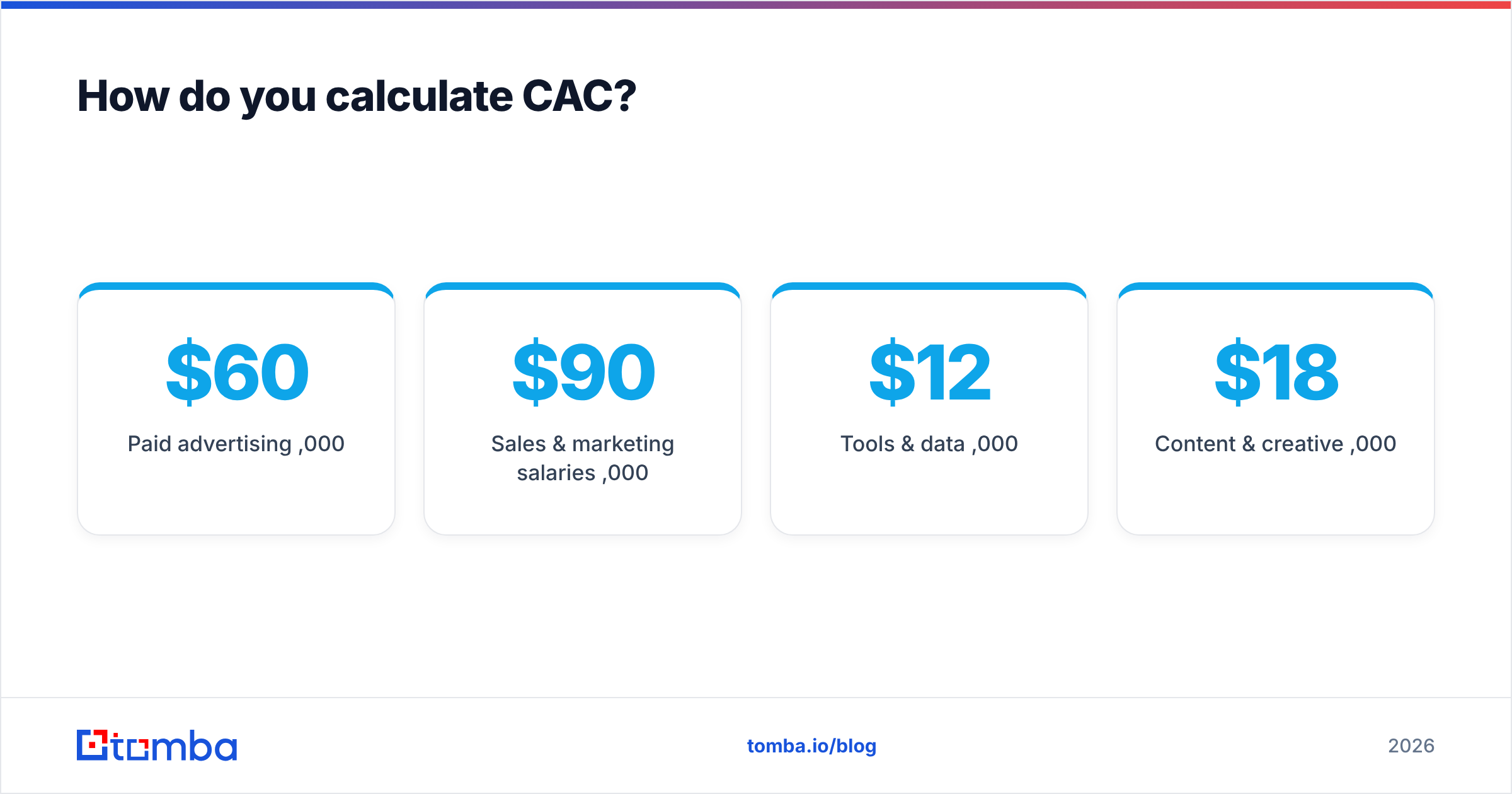
Here is a worked example. Suppose a quarter looks like this:
| Cost bucket | Quarterly spend |
|---|---|
| Paid advertising | $60,000 |
| Sales & marketing salaries | $90,000 |
| Tools & data | $12,000 |
| Content & creative | $18,000 |
| New customers won | 120 |
Total spend is $180,000. Divide by 120 new customers and your CAC is $1,500. If half those customers came from organic and referral channels that cost almost nothing, your paid CAC is far higher than your blended CAC — which is exactly why you should segment it.
Blended CAC vs. paid CAC: what's the difference?#
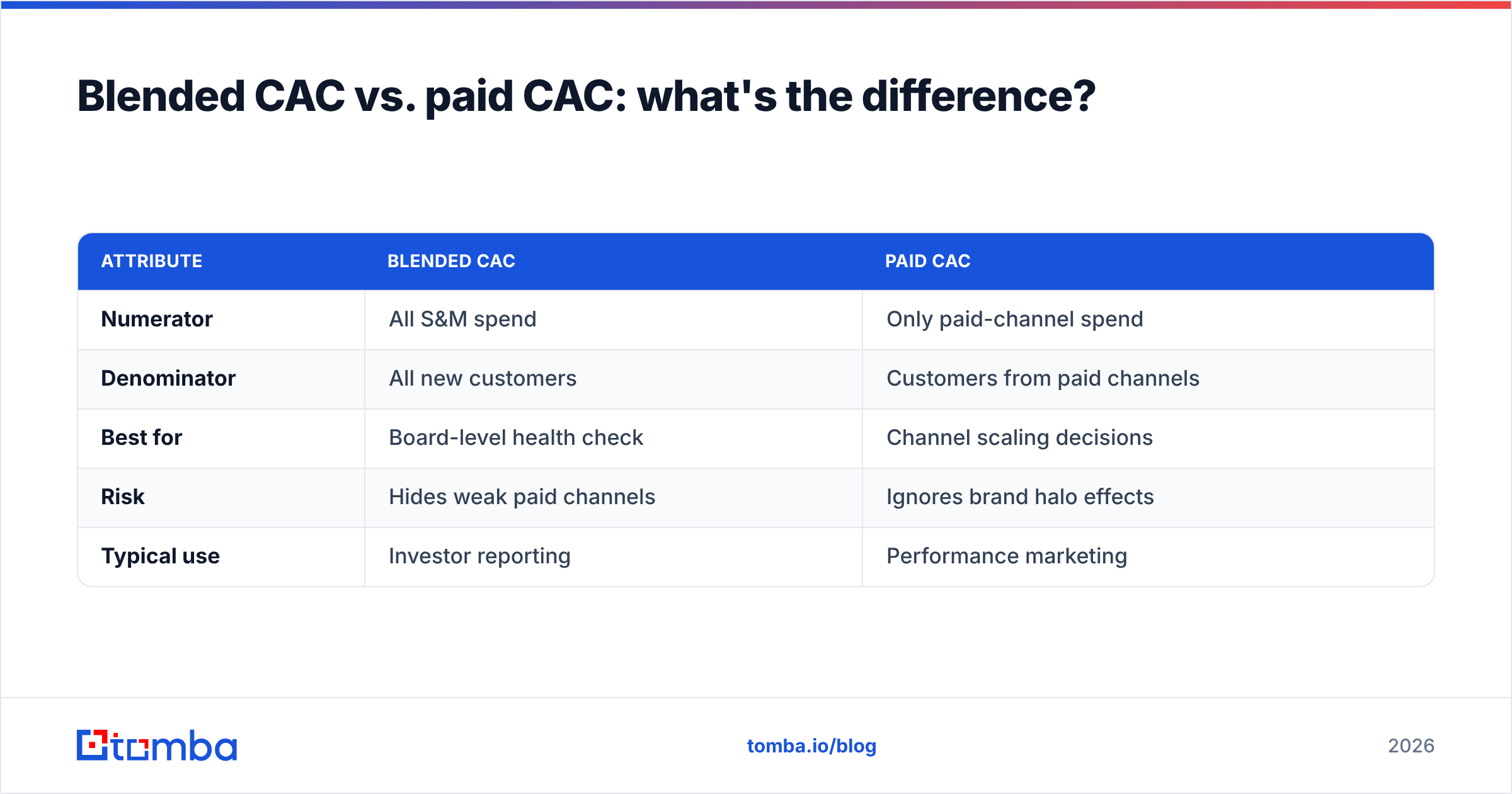
Blended CAC divides total spend by all new customers, including the ones who found you organically. Paid CAC divides paid-channel spend by only the customers that paid channels produced. Blended CAC flatters you; paid CAC tells you the truth about whether your paid engine is profitable.
| Attribute | Blended CAC | Paid CAC |
|---|---|---|
| Numerator | All S&M spend | Only paid-channel spend |
| Denominator | All new customers | Customers from paid channels |
| Best for | Board-level health check | Channel scaling decisions |
| Risk | Hides weak paid channels | Ignores brand halo effects |
| Typical use | Investor reporting | Performance marketing |
Use both. Blended CAC is your headline number for GTM reporting, and paid CAC is the operating metric you optimize week to week.
What is a good CAC, and how does LTV fit in?#
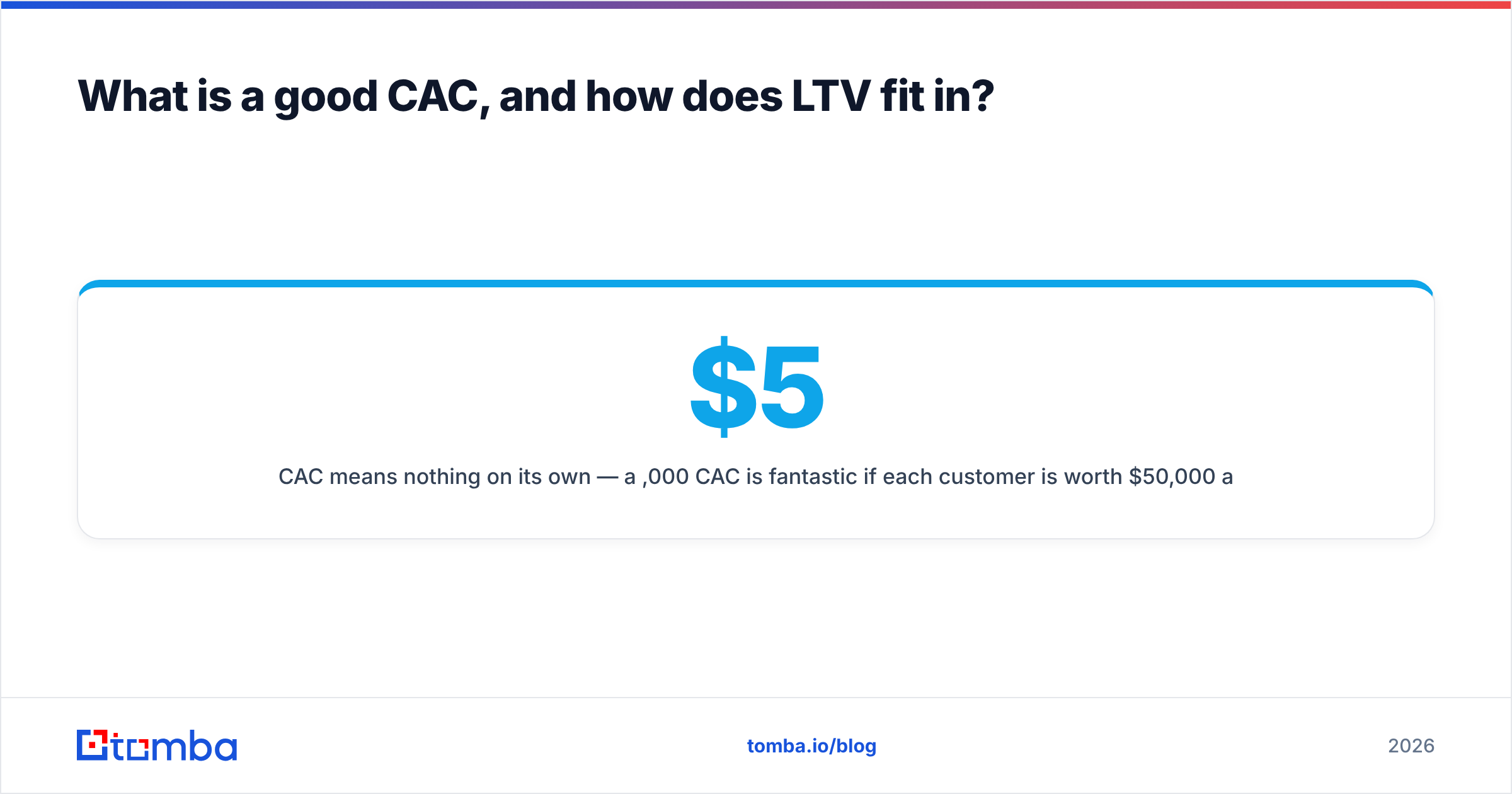
CAC means nothing on its own — a $5,000 CAC is fantastic if each customer is worth $50,000 and terrible if they're worth $4,000. That is why CAC is always read alongside LTV (Customer Lifetime Value).
The two benchmarks that matter:
- LTV:CAC ratio. Aim for 3:1 or higher. Below 1:1 you lose money on every customer. At exactly 3:1 you have a sustainable engine. Above 5:1 you may actually be under-investing in growth and leaving market share on the table.
- CAC payback period. How many months of gross margin it takes to earn back the CAC. Best-in-class B2B SaaS recovers CAC in under 12 months; many healthy businesses sit in the 12–18 month range.
According to widely cited SaaS benchmarks from HubSpot and analyst data published on G2, the 3:1 LTV:CAC target has held up as the practical floor for venture-backed software. If your ratio is sliding toward 1:1, it is a signal that either acquisition is getting more expensive or your customers are not sticking around long enough.
)
Why is your CAC rising?#
CAC almost never spikes overnight. It drifts upward while everyone is busy hitting quota, and you notice only when margins thin out. The common causes:
- Paid channel saturation. You've captured the cheap intent; every incremental click costs more. Ad platforms reward early movers and tax latecomers.
- Bad-fit leads. Reps burn hours chasing prospects who were never going to buy. This is a data quality problem masquerading as a sales problem.
- Long sales cycles. Every extra week a deal stays open adds loaded rep cost to its acquisition price.
- Wasted outreach. Bounced emails, wrong phone numbers, and stale contacts inflate cost per touch and quietly torch your sender reputation, which then drags down deliverability and forces even more outreach.
- Tool sprawl. A dozen overlapping subscriptions you forgot to cut.
The thread connecting most of these is the quality of the data entering your funnel. Garbage contacts produce garbage pipeline, and garbage pipeline is the single most expensive thing a sales team can chase.
How do you lower the CAC sales metric?#
The reliable way to cut CAC is to remove waste from the front of the funnel before it compounds into wasted rep hours at the back. Here are the highest-leverage moves.
1. Fix your contact data first. If 20% of your outreach bounces, you are paying full price for 80% delivery. Using accurate data enrichment and verified contacts means more of every dollar lands. Verify before you send with an email verifier so bad addresses never enter a sequence.
2. Tighten your ICP. Acquiring the wrong customer is worse than acquiring none — they churn fast, drag your LTV down, and wreck the ratio. Score leads harder and let reps spend time only on fits.
3. Shorten the cycle with better targeting. When you reach the right person on the first try, deals move faster. A focused domain search to map the actual buying committee beats spraying a whole company and hoping.
4. Lean on lower-cost channels. Referrals, organic content, and warm intros carry near-zero marginal CAC. Shift budget from saturated paid channels toward channels where the next customer is cheap.
5. Automate the repetitive top-of-funnel work. Building lists by hand is expensive labor. A bulk email finder or the Tomba API lets one person assemble what used to take a team, slashing the labor cost folded into CAC.
How tooling cost shapes CAC#
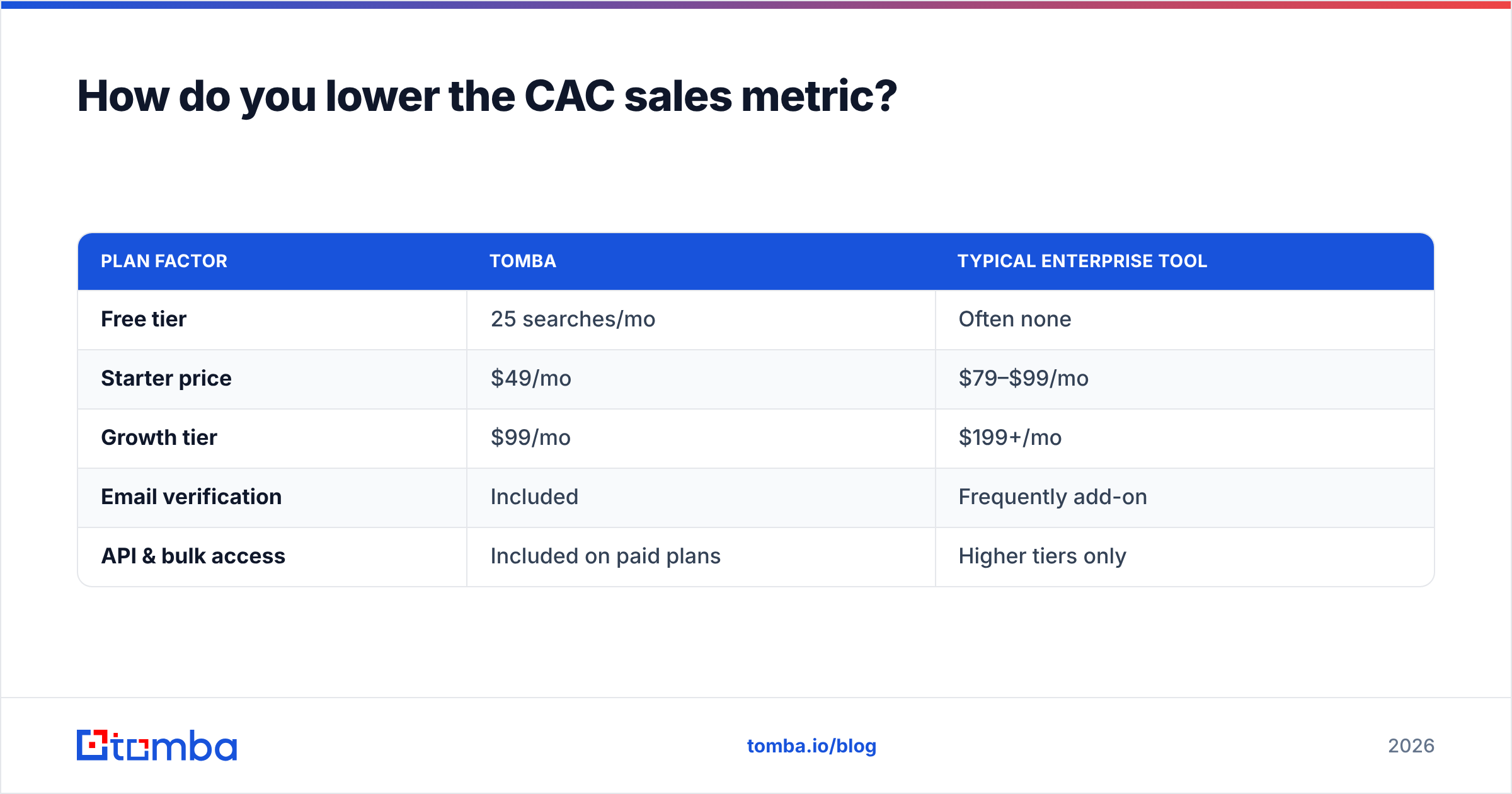
Your data and prospecting stack is a line item inside CAC, so its price matters. Here is how a representative prospecting budget compares at the entry tier:
| Plan factor | Tomba | Typical enterprise tool |
|---|---|---|
| Free tier | 25 searches/mo | Often none |
| Starter price | $49/mo | $79–$99/mo |
| Growth tier | $99/mo | $199+/mo |
| Email verification | Included | Frequently add-on |
| API & bulk access | Included on paid plans | Higher tiers only |
You can see the full breakdown on the Tomba pricing page. The point is not that the cheapest tool wins — it's that an accurate, well-priced data layer reduces both the tooling line and the wasted-effort line inside CAC at the same time.
How often should you measure CAC?#
Measure blended CAC monthly for trend-spotting and quarterly for board reporting. Track paid CAC weekly if you run active performance campaigns, because paid channels can degrade fast and you want to catch a rising cost-per-acquisition before you've burned a month of budget.
Set up a simple dashboard with three lines: CAC, LTV, and the LTV:CAC ratio over time. When the ratio dips for two consecutive periods, treat it as an alarm, not a blip. Pair it with leading indicators — bounce rate, reply rate, and response rate — because those move before CAC does and give you time to react.
Common CAC mistakes to avoid#
- Excluding salaries. CAC that counts only ad spend is vanity. Loaded headcount is usually the biggest bucket.
- Mixing time periods. Spend from this quarter divided by customers from a campaign that closed last quarter gives a meaningless number. Match the windows.
- Ignoring the sales cycle lag. In long-cycle B2B, money spent in Q1 wins customers in Q3. Account for the delay or your CAC will look artificially high in growth months.
- Optimizing CAC in isolation. Cutting CAC by starving growth is easy and usually wrong. The goal is a healthy ratio, not the lowest possible CAC.
- Trusting dirty data. Every metric downstream of a bad contact list is wrong. Clean inputs are non-negotiable.
Frequently asked questions#
What is the CAC sales metric in one sentence? CAC is the total sales and marketing spend required to acquire one new customer, calculated by dividing acquisition spend by new customers won in the same period.
What is a good LTV:CAC ratio? 3:1 or higher is the practical target. Below 1:1 means you lose money per customer; far above 5:1 may mean you are under-investing in growth.
Is CAC the same as cost per lead? No. Cost per lead measures the cost of a lead; CAC measures the cost of a closed, paying customer. CAC is always higher because most leads never convert.
How does data quality affect CAC? Directly. Bounced and inaccurate contacts inflate cost per touch, lengthen cycles, and harm deliverability — all of which raise CAC. Verified, accurate data is one of the cheapest ways to bring it down.
Cut the data waste hiding inside your CAC#
The quickest CAC win most teams ignore is the wasted spend at the very top of the funnel — outreach to people who don't exist, jobs that have changed, or inboxes that bounce. Tighten that, and every downstream cost falls with it.
Start with the Tomba Email Finder to build accurate, verified prospect lists by domain, name, or company. The free tier gives you 25 searches a month to test it against your own pipeline, and paid plans from $49/mo add bulk lookups, verification, and API access. Find the right person on the first try, stop paying for bounces, and watch the acquisition cost baked into every deal shrink. Lower CAC isn't a magic channel — it's cleaner data, applied consistently.
// get started
Find, verify and enrich your first contacts today
Start on the free plan with 25 searches a month, then scale when your team is ready.
Free plan · No credit card required · GDPR & CCPA
// about the author