CAC for Startups in 2026: Benchmarks, Math, and How to Cut It
CAC quietly decides whether a startup survives. Here's how to calculate customer acquisition cost, what good looks like in 2026, and the fastest ways to bring it down.
Customer acquisition cost is the number that decides whether your growth is a flywheel or a leak. For startups burning a fixed amount of runway, CAC is not a vanity metric you check quarterly — it is the dial that tells you how many months you have left and whether your next funding round will be a celebration or a fire drill.
This guide breaks down what CAC means for startups specifically, how to calculate it without fooling yourself, what "good" looks like in 2026, and the concrete levers that bring it down.
TL;DR#
- CAC = total sales and marketing spend ÷ new customers acquired over the same period. Most startups under-count by ignoring salaries, tools, and contractor costs.
- The ratio that matters is LTV:CAC. Aim for 3:1 or better, with CAC payback under 12 months for SMB and under 18 for enterprise.
- Blended CAC hides problems. Split CAC by channel (paid, organic, outbound, referral) or you will keep funding your most expensive channel.
- The fastest CAC cuts come from targeting, not budget. Better lead data, tighter ICP, and higher conversion shrink CAC more reliably than spending less.
- Outbound CAC is mostly a data problem. Clean, verified contact data raises connect and reply rates, which is where outbound CAC quietly bleeds.
What is CAC for a startup, and why does it matter more here?#
CAC, or customer acquisition cost, is the total amount you spend to win one new paying customer. The Wikipedia definition is simple, but for startups the stakes are different from a mature company.
A profitable enterprise can absorb a bad quarter of inefficient spend. A seed-stage startup cannot. When you have 14 months of runway, a CAC that is 40% too high doesn't just dent margins — it shortens your life expectancy and weakens your negotiating position with investors. CAC is the closest thing startups have to a vital sign.
It matters for three reasons:
- It gates fundraising. Investors read CAC and payback period as a proxy for whether your go-to-market actually works or whether you are buying revenue at a loss.
- It sets your growth ceiling. If CAC exceeds the gross profit a customer generates, scaling spend just accelerates the cash burn.
- It exposes channel reality. Blended numbers feel fine until you discover one channel is carrying a CAC three times the others.

How do you calculate CAC correctly?#
The formula is deceptively simple, and that is exactly why startups get it wrong. Here is the honest version, step by step.
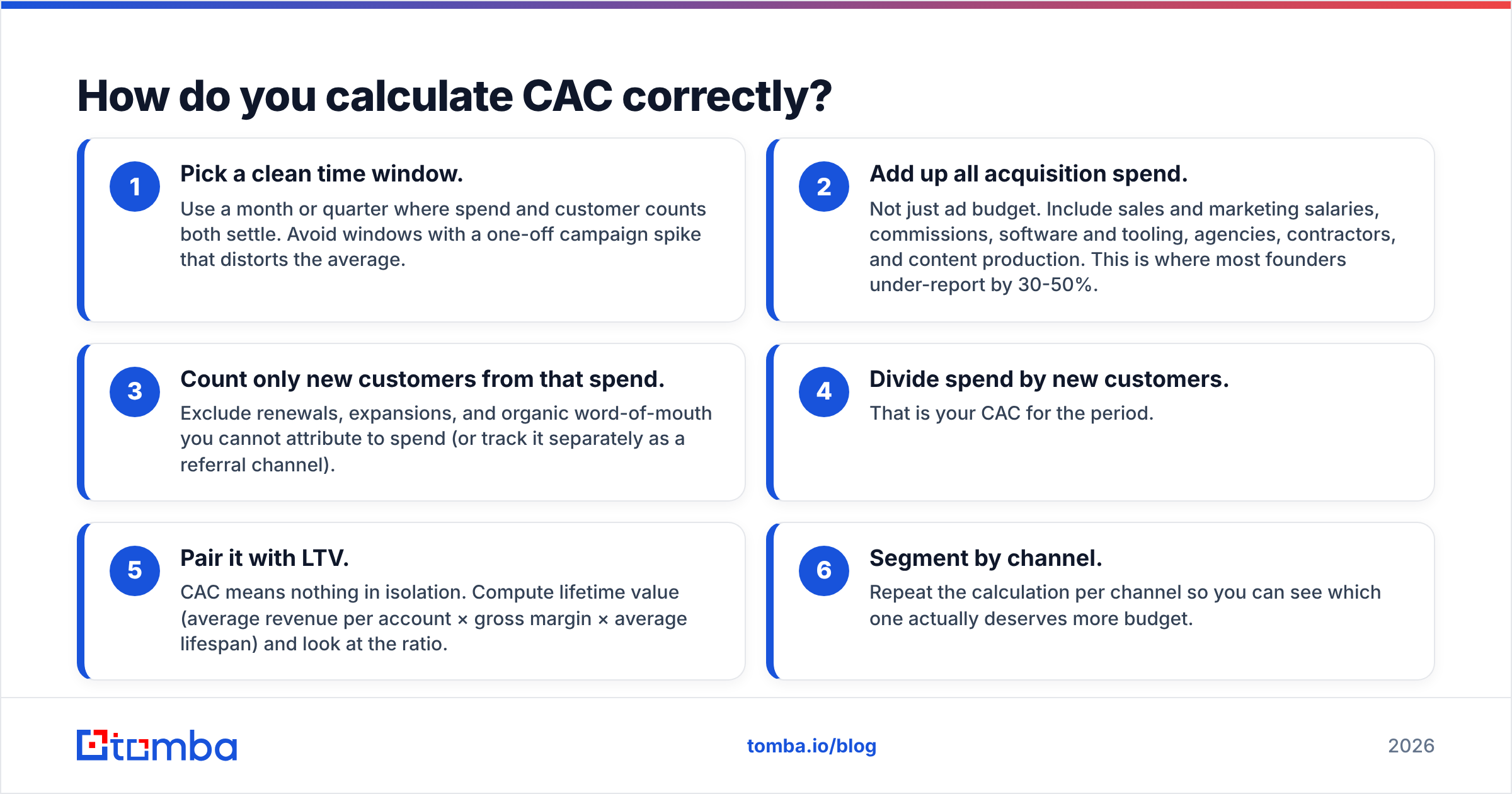
- Pick a clean time window. Use a month or quarter where spend and customer counts both settle. Avoid windows with a one-off campaign spike that distorts the average.
- Add up all acquisition spend. Not just ad budget. Include sales and marketing salaries, commissions, software and tooling, agencies, contractors, and content production. This is where most founders under-report by 30-50%.
- Count only new customers from that spend. Exclude renewals, expansions, and organic word-of-mouth you cannot attribute to spend (or track it separately as a referral channel).
- Divide spend by new customers. That is your CAC for the period.
- Pair it with LTV. CAC means nothing in isolation. Compute lifetime value (average revenue per account × gross margin × average lifespan) and look at the ratio.
- Segment by channel. Repeat the calculation per channel so you can see which one actually deserves more budget.
The trap is "blended CAC" — dividing total spend by total customers and calling it a day. It feels efficient and it hides the channel that is quietly destroying your unit economics. Treating revenue operations as a discipline, not an afterthought, means instrumenting attribution before you scale spend.
What is a good CAC:LTV ratio in 2026?#
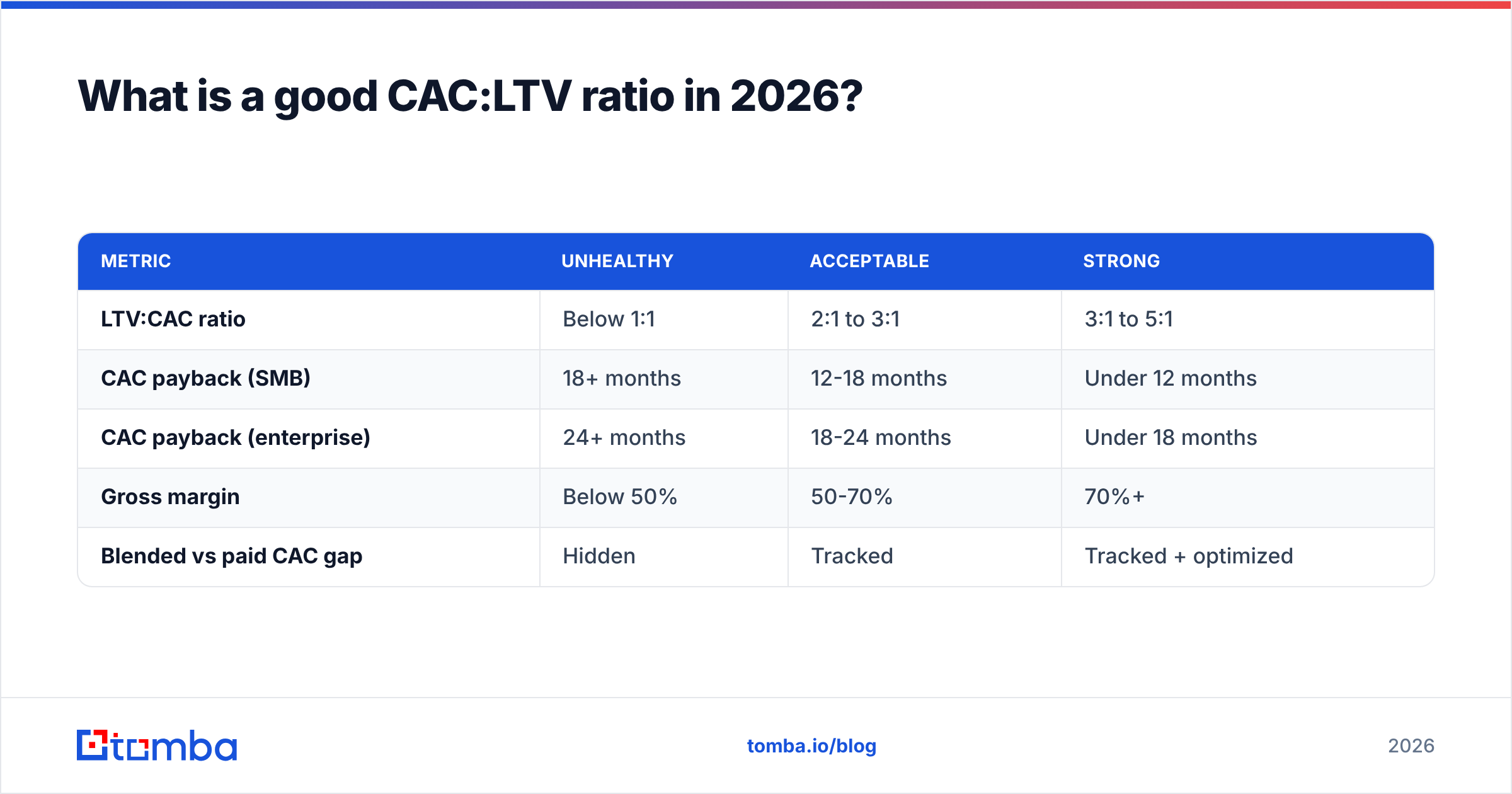
The benchmark most operators converge on is LTV:CAC of 3:1. Below 1:1 you are losing money on every customer. Around 3:1 you have a healthy, fundable business. Far above 5:1 often means you are under-investing in growth and leaving market share on the table.
CAC payback period — how many months of gross margin it takes to recover CAC — is the companion metric. HubSpot's sales and marketing benchmarks and most SaaS investors look for payback under 12 months for SMB motions and under 18 for enterprise.
| Metric | Unhealthy | Acceptable | Strong |
|---|---|---|---|
| LTV:CAC ratio | Below 1:1 | 2:1 to 3:1 | 3:1 to 5:1 |
| CAC payback (SMB) | 18+ months | 12-18 months | Under 12 months |
| CAC payback (enterprise) | 24+ months | 18-24 months | Under 18 months |
| Gross margin | Below 50% | 50-70% | 70%+ |
| Blended vs paid CAC gap | Hidden | Tracked | Tracked + optimized |
Use these as directional, not gospel. A vertical SaaS tool with 90% gross margins can tolerate a longer payback than a low-margin marketplace. The point is to compare yourself against your own trend line every month, not just against an industry average.
Which acquisition channels have the lowest CAC?#
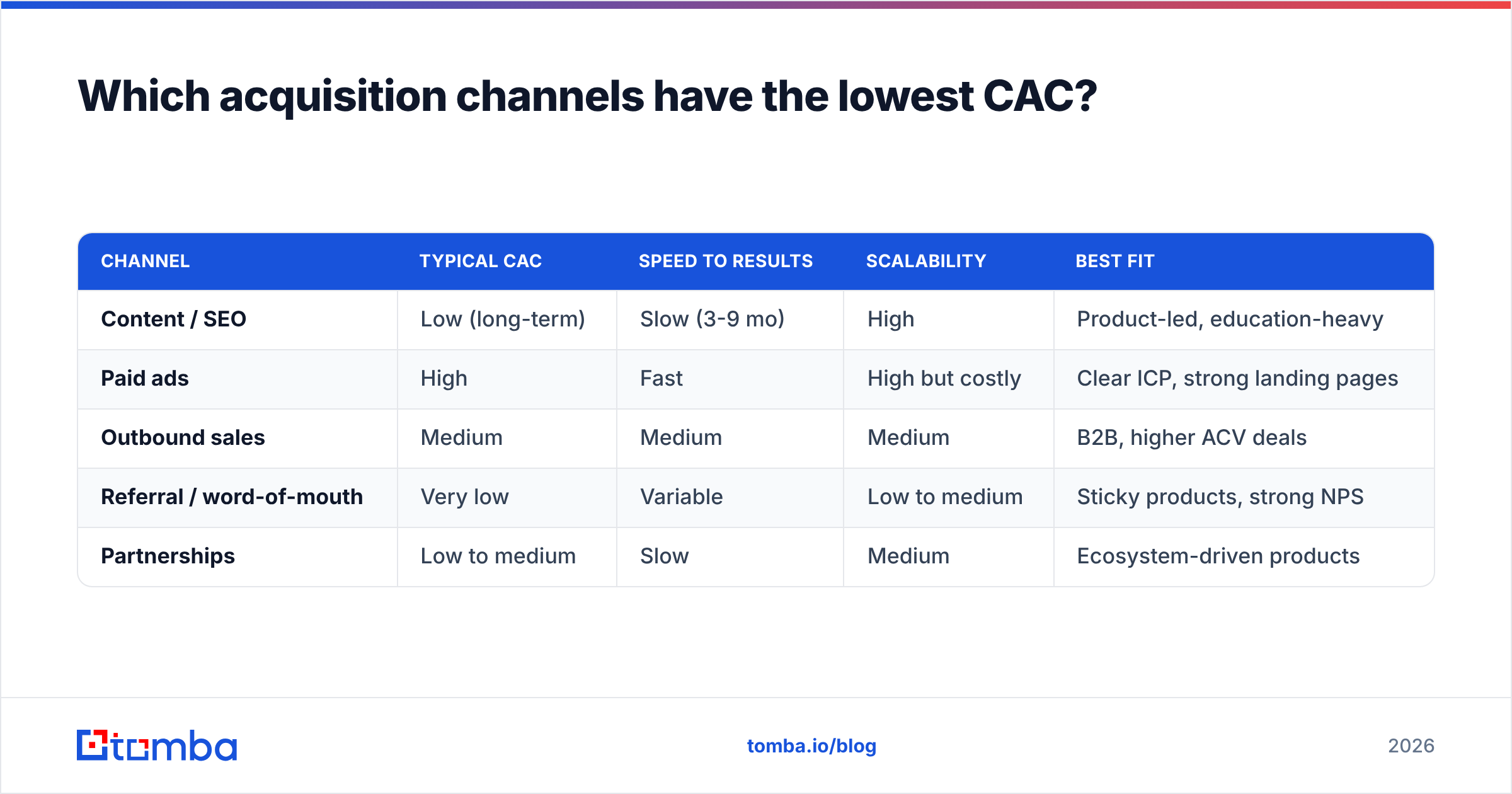
There is no universal cheapest channel — it depends on your ICP, price point, and motion. But the shape of the trade-offs is consistent. Here is how the main startup channels compare on the dimensions that drive CAC.
| Channel | Typical CAC | Speed to results | Scalability | Best fit |
|---|---|---|---|---|
| Content / SEO | Low (long-term) | Slow (3-9 mo) | High | Product-led, education-heavy |
| Paid ads | High | Fast | High but costly | Clear ICP, strong landing pages |
| Outbound sales | Medium | Medium | Medium | B2B, higher ACV deals |
| Referral / word-of-mouth | Very low | Variable | Low to medium | Sticky products, strong NPS |
| Partnerships | Low to medium | Slow | Medium | Ecosystem-driven products |
Most startups should not chase the single lowest-CAC channel. The durable play is a portfolio: a slow-but-cheap engine (content, referral) compounding underneath a fast-but-pricey engine (paid, outbound) you can throttle. When runway tightens, you lean on the cheap engine; when you raise, you scale the fast one.
Why is outbound CAC really a data problem?#
Outbound is where startups most often misdiagnose CAC. They assume the problem is the message, the cadence, or the rep — when the real culprit is the list.
Think of outbound like fishing. You can have the best rod, bait, and technique, but if you are casting into an empty lake, you catch nothing and burn the whole day. Bad contact data is an empty lake: bounced emails, wrong job titles, disconnected numbers, and decision-makers who left the company a year ago. Every one of those is wasted rep time and wasted sending reputation, which inflates CAC without showing up as a line item.
The math is brutal. If 30% of your list bounces or is mistargeted, you have effectively raised your outbound CAC by roughly 40% before a single reply lands. Cleaning that up is usually cheaper and faster than hiring another SDR.
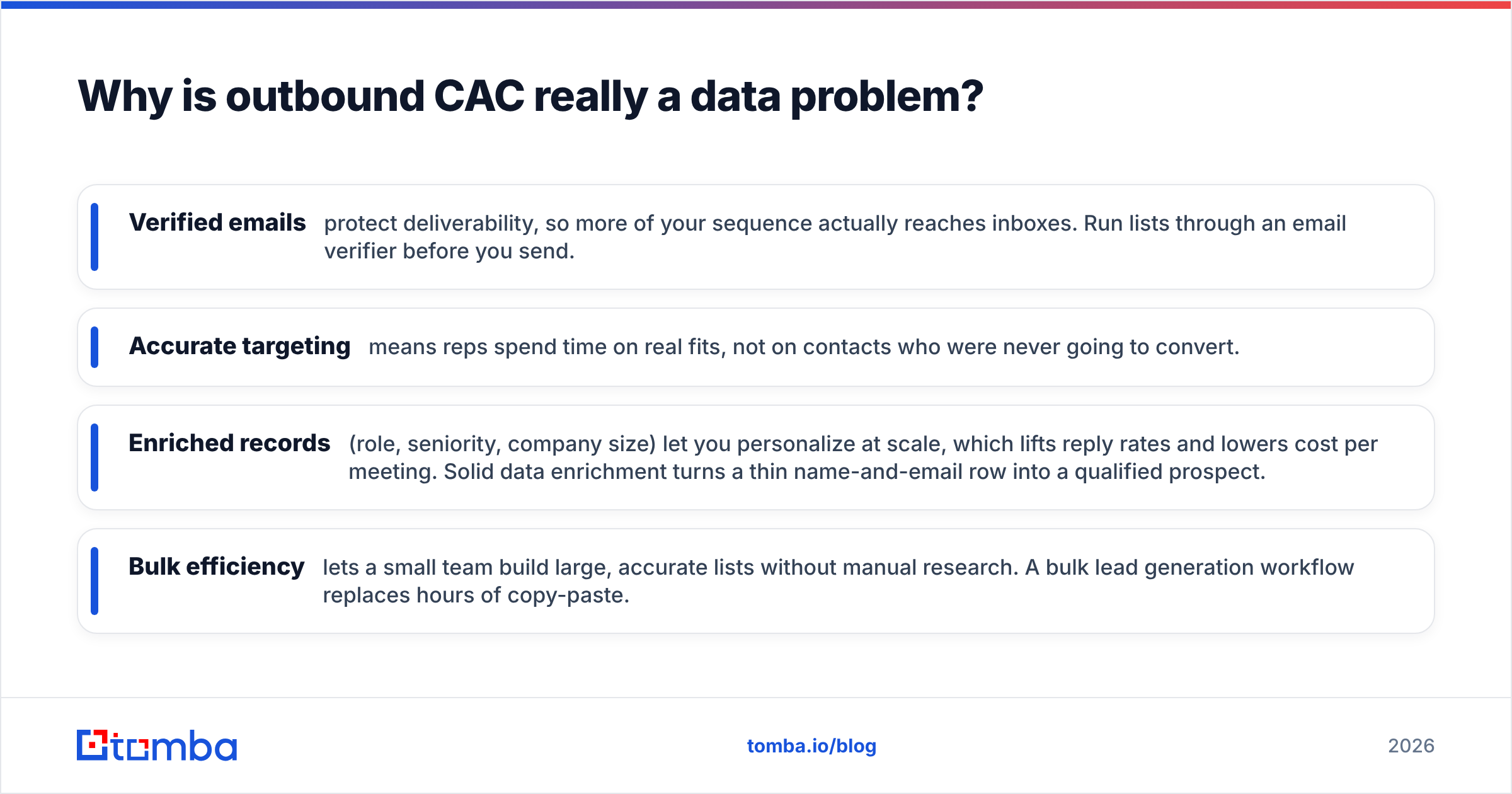
This is why lead data quality is a CAC lever, not a tooling detail:
- Verified emails protect deliverability, so more of your sequence actually reaches inboxes. Run lists through an email verifier before you send.
- Accurate targeting means reps spend time on real fits, not on contacts who were never going to convert.
- Enriched records (role, seniority, company size) let you personalize at scale, which lifts reply rates and lowers cost per meeting. Solid data enrichment turns a thin name-and-email row into a qualified prospect.
- Bulk efficiency lets a small team build large, accurate lists without manual research. A bulk lead generation workflow replaces hours of copy-paste.

How do you actually lower startup CAC?#
The instinct when CAC is too high is to cut spend. That usually backfires — you starve growth and CAC stays flat because the inefficiency was structural, not budgetary. Pull these levers instead.
Tighten your ICP first. A vague ideal customer profile spreads spend across people who will never buy. Narrowing the ICP raises conversion at every stage, which is the single biggest CAC multiplier. Every dollar now lands on someone closer to a yes.
Fix conversion before you fix traffic. Doubling landing page or demo-to-close conversion halves CAC without spending a cent more on acquisition. Audit the funnel for the worst-converting step and fix that first.
Improve lead data quality. As covered above, verified and enriched data raises reply and connect rates, which directly lowers cost per meeting and per customer. This is the highest-leverage fix for outbound-heavy startups.
Shift mix toward compounding channels. Reallocate a slice of paid budget into content, SEO, and referral programs. They are slow, but their CAC trends down over time while paid CAC trends up as you saturate audiences.
Shorten the sales cycle. Faster deals mean less rep time per customer and lower CAC. Better qualification, clearer pricing, and tighter follow-up all compress the cycle.
Instrument attribution. You cannot lower what you cannot see. Per-channel CAC reporting tells you where to cut and where to double down — guessing keeps you funding the wrong engine.
If you are building outbound lists, the cheapest CAC win is often the most overlooked: stop paying reps to chase dead contacts. An accurate email finder and a verification step routinely cut wasted outbound effort by a third, and that shows up directly in your cost per customer.
Common CAC mistakes startups make#
- Counting only ad spend. Salaries and tools are real acquisition costs. Leaving them out gives you a comforting fiction.
- Using lifetime blended CAC. Old efficient months mask a recent spike. Look at trailing 1-3 month windows.
- Ignoring payback period. A great LTV:CAC ratio with a 30-month payback still drains runway you may not have.
- Treating organic as free. Content and SEO cost time and salaries; track them so you know true channel CAC.
- Scaling a channel before it is profitable. Pouring budget into a channel with negative unit economics just speeds the burn.
Comparing tools and plans on a cost basis matters here too — review Tomba pricing and similar vendors against the rep hours they save, not just the sticker price. A $49/mo tool that saves a rep ten hours a month pays for itself many times over in lowered CAC.
How does data quality change the CAC equation?#
Step back and the pattern is clear: most of the CAC levers a startup can pull route through data. Targeting is data. Conversion depends on reaching the right person with the right context, which is data. Outbound efficiency is almost entirely data. Even paid performance improves when you feed platforms accurate audiences built from a clean B2B database.
This is why mature go-to-market teams treat contact data as infrastructure rather than a one-time purchase. They verify continuously, enrich on ingest, and measure CAC per channel so the next dollar goes to the most efficient engine. According to most analyst coverage of GTM efficiency, including ongoing research from firms like Gartner, data hygiene and attribution maturity are among the strongest predictors of sustainable acquisition cost.
For a startup, the takeaway is practical: before you hire another rep or raise another ad budget, make sure the data feeding your funnel is accurate. It is the cheapest CAC reduction available to you.
Final word: treat CAC as a system, not a number#
CAC is not one metric you optimize once. It is the output of your ICP clarity, your conversion rates, your channel mix, and — underneath all of it — your data quality. Startups that win on CAC do not have secret cheaper channels; they have tighter targeting, cleaner funnels, and verified data that keeps every acquisition dollar working.
If your outbound CAC is the problem, start where the leak is biggest: the list. Use the Tomba Email Finder to build accurate, verified prospect lists by domain, name, or company, so your reps spend their time on real buyers instead of bounced addresses. Lower waste, higher reply rates, and a CAC that finally trends the right way — start free with 25 searches a month and scale on the Starter plan at $49/mo when you are ready.
Ready to find emails that actually work?
Join 150,000+ professionals who stopped guessing and started sending. Free credits on signup — no credit card required.
Get the Tomba newsletter
Practical outbound tactics and product updates — once every two weeks.
About the author