Cadence Meaning in Business: Your 2026 Sales Playbook
What does cadence really mean in business? A plain-English breakdown of sales cadences, meeting rhythms, and operating tempo — plus how to build one that actually closes deals in 2026.
Cadence Meaning in Business: Your 2026 Sales Playbook
If someone on a sales call drops the word "cadence" and you nod along without being sure what they mean, you are not alone. The term gets used three different ways in most companies, and people rarely stop to say which one they mean. This guide fixes that.
TL;DR#
- Cadence in business means a deliberate, repeating rhythm — of outreach, meetings, or operational reviews — that you can plan around and measure.
- The three most common uses are sales cadence (a sequenced series of touches to a prospect), meeting cadence (how often a team syncs), and operating cadence (the company-wide rhythm of planning and reporting).
- A good sales cadence blends channels (email, phone, LinkedIn), spaces touches over 2–4 weeks, and stops when it should.
- Cadence only works when the data feeding it is accurate — bad contact data wastes every touch in the sequence.
- You can build a working cadence in an afternoon with a spreadsheet, a sequencing tool, and a reliable source of verified contacts.
What Does Cadence Mean in Business?#
Cadence means a structured, repeating rhythm of activity that you set on purpose rather than leaving to chance. Borrowed from music — where cadence is the pattern that tells your ear a phrase is ending — the business version is about predictable tempo. Instead of resolving a melody, you are resolving a process: a deal, a decision, a quarterly review.
Think of cadence like a heartbeat. A healthy heart does not beat randomly; it keeps a steady, measurable rhythm, and when that rhythm breaks, something is wrong. A business cadence works the same way. When your outreach, your meetings, and your reporting all run on a known tempo, the organization stays healthy and you can spot problems early.
The word shows up in three distinct contexts, and conflating them is where confusion starts:
- Sales cadence — the sequence of touchpoints a rep uses to reach a single prospect: day 1 email, day 3 call, day 5 LinkedIn message, and so on.
- Meeting cadence — how frequently a group meets: a daily standup, a weekly pipeline review, a monthly board update.
- Operating cadence — the company-level rhythm that ties planning, execution, and review together across departments and quarters.
The rest of this guide unpacks each one, with the heaviest focus on sales cadence, since that is where most people first hear the term and where it has the biggest revenue impact.
What Is a Sales Cadence?#
A sales cadence is a predefined sequence of outreach touches, across multiple channels, spaced over a set period, aimed at starting a conversation with a prospect. It is the playbook a rep follows so that "following up" is not a vague intention but a scheduled, repeatable action.
A typical B2B cadence runs 8–12 touches over two to four weeks. Each touch has three variables you control:
- Channel — email, phone, LinkedIn, SMS, or video.
- Timing — the gap between touches (usually 1–4 days early, widening later).
- Message — what the touch actually says, and how it builds on the last one.
The reason cadences beat one-off emails is simple math. Most replies do not come on the first message. Industry research consistently shows that a large share of conversions happen on the fourth touch or later, yet many reps quit after one or two. A cadence removes the decision to give up too early by scheduling persistence in advance.
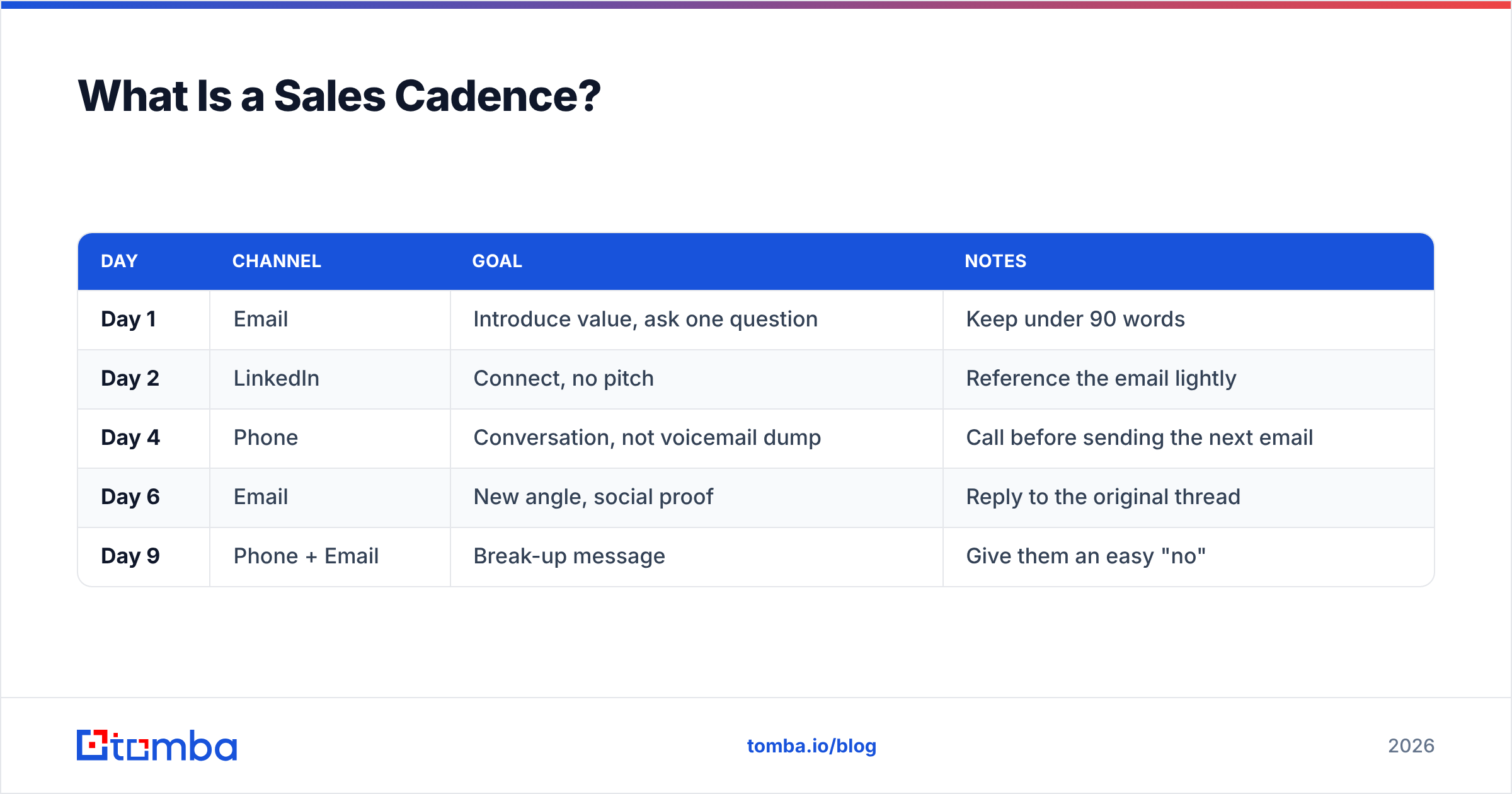
Here is what a straightforward five-business-day cadence looks like before you expand it:
| Day | Channel | Goal | Notes |
|---|---|---|---|
| Day 1 | Introduce value, ask one question | Keep under 90 words | |
| Day 2 | Connect, no pitch | Reference the email lightly | |
| Day 4 | Phone | Conversation, not voicemail dump | Call before sending the next email |
| Day 6 | New angle, social proof | Reply to the original thread | |
| Day 9 | Phone + Email | Break-up message | Give them an easy "no" |
Notice the cadence widens the gaps as it goes and ends with a clear break-up touch. A cadence that never stops is just spam with a calendar.
Why Does Cadence Matter for Revenue?#
Cadence matters because consistency, not intensity, is what compounds in sales. A rep who sends 20 perfectly timed touches across 10 prospects will almost always beat a rep who blasts 200 emails once and never follows up.
Three concrete payoffs:
- Predictability. When every rep runs the same cadence, you can forecast how many touches produce one meeting, then plan headcount and pipeline against it. This is the backbone of a healthy sales process and pipeline discipline.
- Coaching. A documented cadence turns "be more persistent" into a specific, reviewable behavior. You can see exactly where a rep dropped off.
- Channel coverage. Multi-channel cadences reach people email alone never would. Some prospects answer the phone; others only respond on LinkedIn. According to HubSpot's sales research, blended outreach consistently outperforms single-channel sequences.
But cadence has a hard dependency that most playbooks gloss over: data quality. Every touch in your sequence assumes the email address is valid, the phone number connects, and the person still works there. If 30% of your list is wrong, you are not running a 10-touch cadence — you are running a 7-touch cadence and burning sender reputation on bounces. We will come back to this.
Sales Cadence vs Sales Sequence vs Workflow: What's the Difference?#
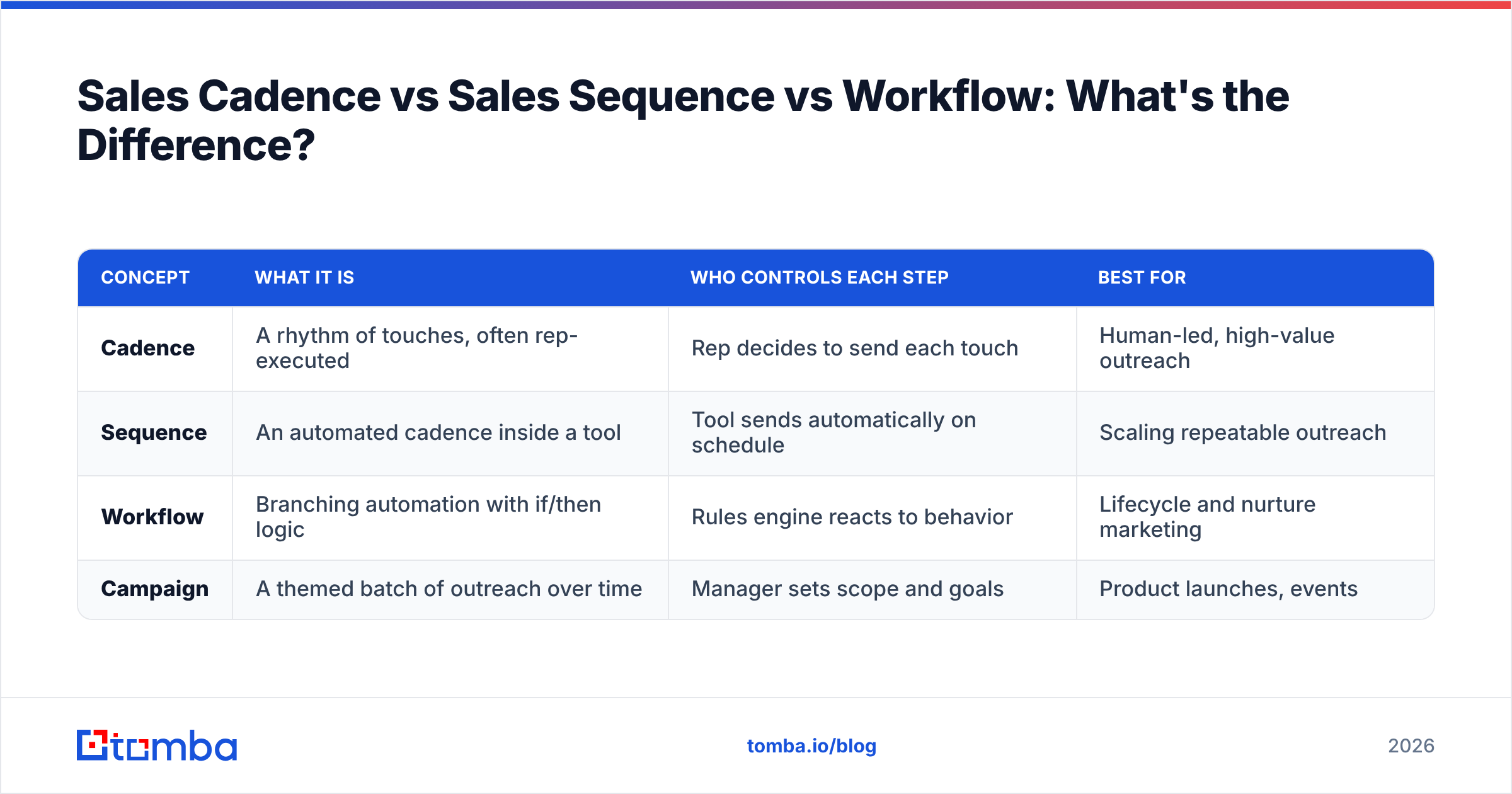
People use these three terms interchangeably, but they are not the same thing. Here is a clean comparison.
| Concept | What it is | Who controls each step | Best for |
|---|---|---|---|
| Cadence | A rhythm of touches, often rep-executed | Rep decides to send each touch | Human-led, high-value outreach |
| Sequence | An automated cadence inside a tool | Tool sends automatically on schedule | Scaling repeatable outreach |
| Workflow | Branching automation with if/then logic | Rules engine reacts to behavior | Lifecycle and nurture marketing |
| Campaign | A themed batch of outreach over time | Manager sets scope and goals | Product launches, events |
The practical takeaway: a cadence is the strategy (the rhythm and the messaging), and a sequence is usually the software that executes it. You design the cadence once; the sequence runs it a thousand times. A workflow adds branching — "if they opened twice but didn't reply, do X" — which is powerful but easy to over-engineer.
What Is Meeting Cadence?#
Meeting cadence is how often a team gathers to coordinate, and at what altitude each meeting operates. Get it right and meetings feel like a heartbeat. Get it wrong and they feel like a tax on actual work.
A well-run revenue team usually layers cadences by time horizon:
- Daily — a 10-minute standup on today's priorities and blockers.
- Weekly — a pipeline review: what moved, what stalled, what's at risk.
- Monthly — a metrics and forecast review with leadership.
- Quarterly — a business review (QBR) on strategy, targets, and resourcing.
The principle that keeps this from becoming meeting overload: the shorter the interval, the more tactical the agenda. Daily standups are about today. Quarterly reviews are about direction. When a weekly meeting drifts into strategy debates, it balloons and people stop showing up prepared. Protecting that boundary is one of the simpler levers in revenue operations.
What Is Operating Cadence?#
Operating cadence is the company-wide rhythm that connects planning, execution, and review so the whole organization moves in sync. If meeting cadence is one team's heartbeat, operating cadence is the circulatory system tying every team's rhythm to the same clock.
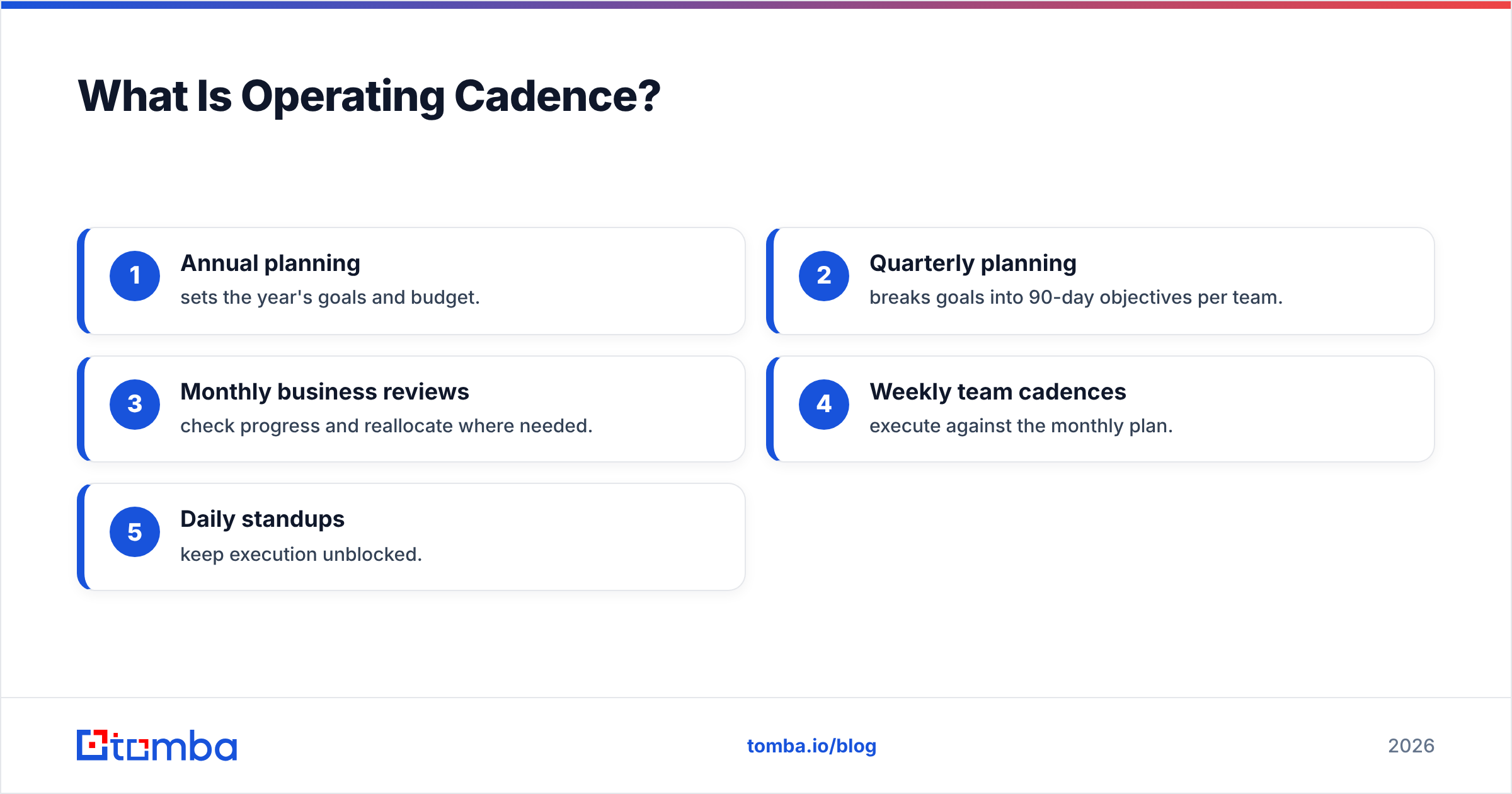
A typical annual operating cadence looks like this:
- Annual planning sets the year's goals and budget.
- Quarterly planning breaks goals into 90-day objectives per team.
- Monthly business reviews check progress and reallocate where needed.
- Weekly team cadences execute against the monthly plan.
- Daily standups keep execution unblocked.
The magic is in the nesting. Each layer rolls up to the one above it, so a daily blocker can — if it matters enough — surface all the way to the quarterly conversation. Companies that run a tight operating cadence rarely get surprised, because the rhythm forces information upward on a schedule instead of waiting for a crisis.
How Do You Build a Sales Cadence in 2026?#
Build a cadence by deciding the segment, the channels, the timing, and the exit — in that order — then load it into a sequencing tool with verified contact data. Here is the step-by-step.
1. Define the segment#
A cadence for a VP of Engineering at a 2,000-person company should not look like a cadence for a founder at a 10-person startup. Match touch count, tone, and channel mix to the persona. Tighter segments produce sharper messages and better reply rates.
2. Source accurate contacts#
This is the step that quietly determines whether everything downstream works. You need verified email addresses and direct phone numbers, not guesses. Pull them with an email finder to get the address, run them through an email verifier to strip out invalids before they bounce, and grab direct lines with a phone finder for the call steps. If you are working a whole company, a domain search returns every reachable contact at once.
3. Choose your channels and order them#
Lead with the channel your persona actually answers. For most B2B buyers in 2026 that is still email first, with phone and LinkedIn reinforcing it. Alternate channels rather than stacking three emails in a row.
4. Set the timing#
Space early touches 1–3 days apart, then widen to 4–7 days as the cadence matures. The goal is to stay present without becoming annoying. Front-loading too aggressively gets you marked as spam; spacing too far makes you forgettable.
5. Write a break-up touch#
Always end with a clear, low-pressure exit: "Should I close your file?" This single message routinely outperforms earlier touches because it triggers a response from people who meant to reply and forgot.
6. Measure and prune#
Track reply rate per touch and per channel. Cut the touches that produce nothing. A cadence is a living thing — review it monthly, the same way you would any other part of your operating rhythm.
What Does a Good Multi-Channel Cadence Look Like?#
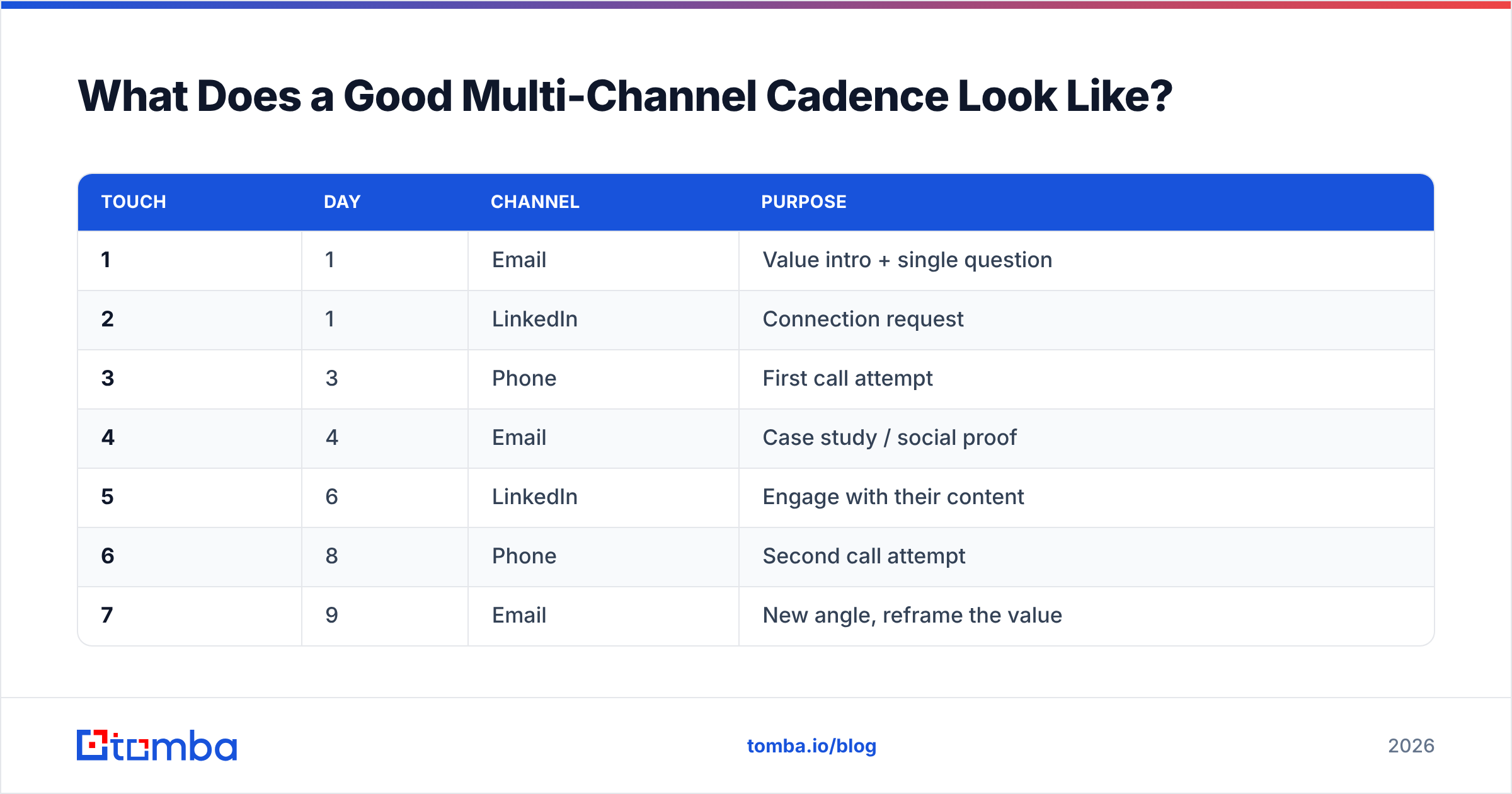
Here is a fuller 12-touch, three-week cadence you can adapt. It assumes a verified email and a direct phone number for each prospect.
| Touch | Day | Channel | Purpose |
|---|---|---|---|
| 1 | 1 | Value intro + single question | |
| 2 | 1 | Connection request | |
| 3 | 3 | Phone | First call attempt |
| 4 | 4 | Case study / social proof | |
| 5 | 6 | Engage with their content | |
| 6 | 8 | Phone | Second call attempt |
| 7 | 9 | New angle, reframe the value | |
| 8 | 12 | Phone | Third call + voicemail |
| 9 | 14 | Short nudge on the thread | |
| 10 | 17 | Direct message | |
| 11 | 19 | Phone | Final call attempt |
| 12 | 21 | Break-up message |
Twelve touches across three weeks, four of them calls, never two of the same channel back to back, and a clean exit. That structure converts because it is persistent without being frantic — and because every phone and email touch lands on data that has been verified instead of guessed.
What Are the Most Common Cadence Mistakes?#
Even teams that adopt cadences trip over the same things:
- Skipping verification. Bouncing emails wreck your sender reputation and quietly tank deliverability for your good prospects too. Verify before you send.
- Single-channel tunnel vision. Email-only cadences leave replies on the table from people who only answer the phone.
- No exit. Cadences that loop forever annoy prospects and clog rep pipelines with dead leads.
- Identical messaging. If every touch says the same thing louder, you are nagging, not following up. Each touch needs a fresh angle.
- Ignoring the data. A cadence run on a stale list is a cadence with most of its touches landing nowhere. Refresh and enrich your contacts on a schedule.
The thread connecting all five: a cadence is only as strong as the data and the variety behind it. The rhythm is necessary but not sufficient.
How Does Cadence Connect to the Rest of Your Sales Stack?#
Cadence is the choreography; your tools are the dancers. The sequence engine schedules the touches, the CRM records the outcomes, and the data layer keeps every contact accurate. For a deeper look at how rhythm fits into pipeline management, the frameworks from Salesforce's sales resources and analyst guidance from G2's category research are worth reading alongside your own playbook.
The non-negotiable input across all of it is contact data you can trust. You can have the most elegant 12-touch cadence ever designed, but if the email bounces and the phone number is three jobs out of date, the rhythm plays to an empty room.
Start Your Cadence on a Foundation of Real Data#
A cadence is a rhythm, and rhythm only works when every beat lands. The fastest way to make sure your beats land is to build the cadence on verified, current contact data instead of guesses. Tomba's Email Finder gives you accurate professional email addresses by name, domain, or company — and pairs with Tomba's verifier and phone finder so every email and call step in your sequence reaches a real person. Start free with 25 searches a month, scale up on the $49/mo Starter plan when your cadence is humming, and check the full Tomba pricing when you are ready to grow. Set the rhythm; let Tomba make sure someone is there to hear it.
Ready to find emails that actually work?
Join 150,000+ professionals who stopped guessing and started sending. Free credits on signup — no credit card required.
Get the Tomba newsletter
Practical outbound tactics and product updates — once every two weeks.
About the author