Calendly vs Chili Piper 2026: Best Meeting Scheduler
Calendly vs Chili Piper in 2026: which scheduler actually books more qualified meetings? A neutral breakdown of routing, pricing, speed-to-lead, and fit.
TL;DR
- Calendly is a lightweight, universal scheduling link that anyone — sales, recruiting, support, founders — can adopt in minutes. Chili Piper is a revenue-focused routing engine built to qualify and book inbound demos in real time.
- If you mostly need clean booking links and calendar automation, Calendly wins on price and simplicity. If you run high-volume inbound and care about speed-to-lead, Chili Piper's routing and instant handoff justify its higher cost.
- Calendly starts free and tops out around $16/seat/mo for most teams; Chili Piper's qualifying product starts near $22.50/seat/mo and climbs fast with add-ons.
- Neither tool finds or verifies the contact data that feeds your forms and outreach — that's an upstream job for an email finder and enrichment layer.
- Pick Calendly for breadth and budget, Chili Piper for inbound conversion velocity. Many teams run Calendly for one-to-one booking and Chili Piper for marketing-driven demo flow.
What's the real difference between Calendly and Chili Piper?#
Calendly sells time. Chili Piper sells speed to revenue. That one sentence explains most of the price gap and most of the confusion buyers run into.
Think of it like airport travel. Calendly is the self-service kiosk: you walk up, pick a slot, print your boarding pass, done. It works for everyone and costs almost nothing. Chili Piper is the priority concierge who meets you at the curb, checks whether you're flying business class, and walks you straight to the right gate before you can wander off. The concierge costs more — but for your highest-value passengers, the difference between "booked" and "gone" is exactly that handoff.
Technically, Calendly is a scheduling platform: shareable booking links, round-robin distribution, calendar sync, reminders, and a large integration catalog. Chili Piper is a demand conversion platform: it qualifies a lead the instant a form is submitted, routes it to the right rep based on territory or account ownership, and offers a calendar inside the form so the prospect books before the tab ever closes.
You can force Calendly to behave a little like Chili Piper, and you can use Chili Piper for simple booking. But you'll be paying for the wrong strengths if you do.

How do Calendly and Chili Piper compare on features and price?#
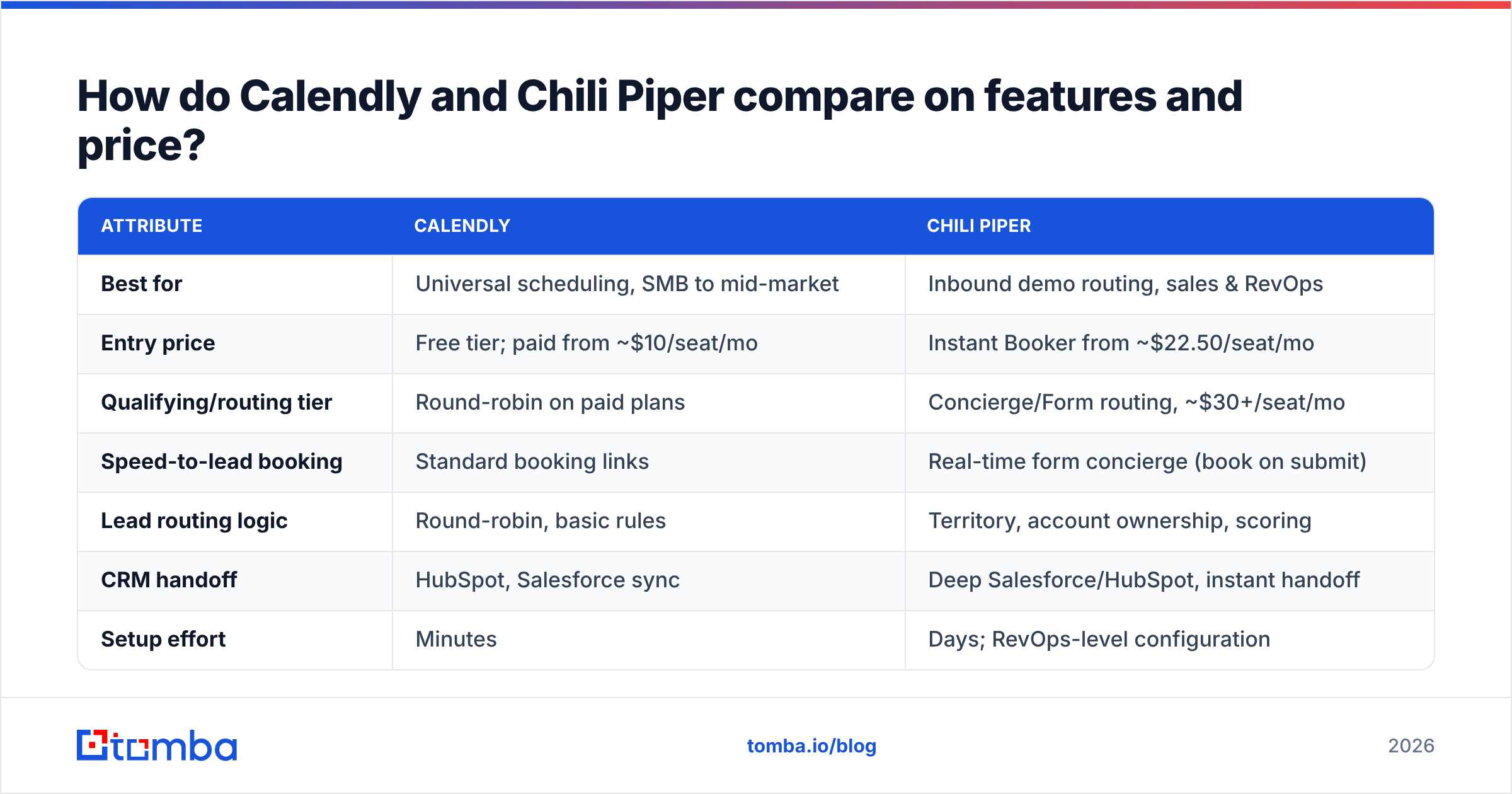
Here's the head-to-head. Prices reflect publicly listed 2026 plans and can shift with annual billing and add-ons, so treat them as directional.
| Attribute | Calendly | Chili Piper |
|---|---|---|
| Best for | Universal scheduling, SMB to mid-market | Inbound demo routing, sales & RevOps |
| Entry price | Free tier; paid from ~$10/seat/mo | Instant Booker from ~$22.50/seat/mo |
| Qualifying/routing tier | Round-robin on paid plans | Concierge/Form routing, ~$30+/seat/mo |
| Speed-to-lead booking | Standard booking links | Real-time form concierge (book on submit) |
| Lead routing logic | Round-robin, basic rules | Territory, account ownership, scoring |
| CRM handoff | HubSpot, Salesforce sync | Deep Salesforce/HubSpot, instant handoff |
| Setup effort | Minutes | Days; RevOps-level configuration |
| No-show reduction | Reminders, follow-ups | Reminders, reassignment, live handoff |
| Free plan | Yes | No |
The pattern is consistent: Calendly is cheaper, faster to deploy, and broader in use case. Chili Piper is purpose-built for the moment a marketing-qualified lead raises a hand, and it monetizes that moment.
A few honest caveats. Calendly does offer round-robin and reassignment on its Teams and higher plans, so it isn't purely one-to-one. And Chili Piper can issue plain booking links, so it isn't only for inbound forms. The question isn't "can it do X" — it's "what is each tool optimized for, and what are you overpaying for if you pick wrong."
When is Calendly the better choice?#
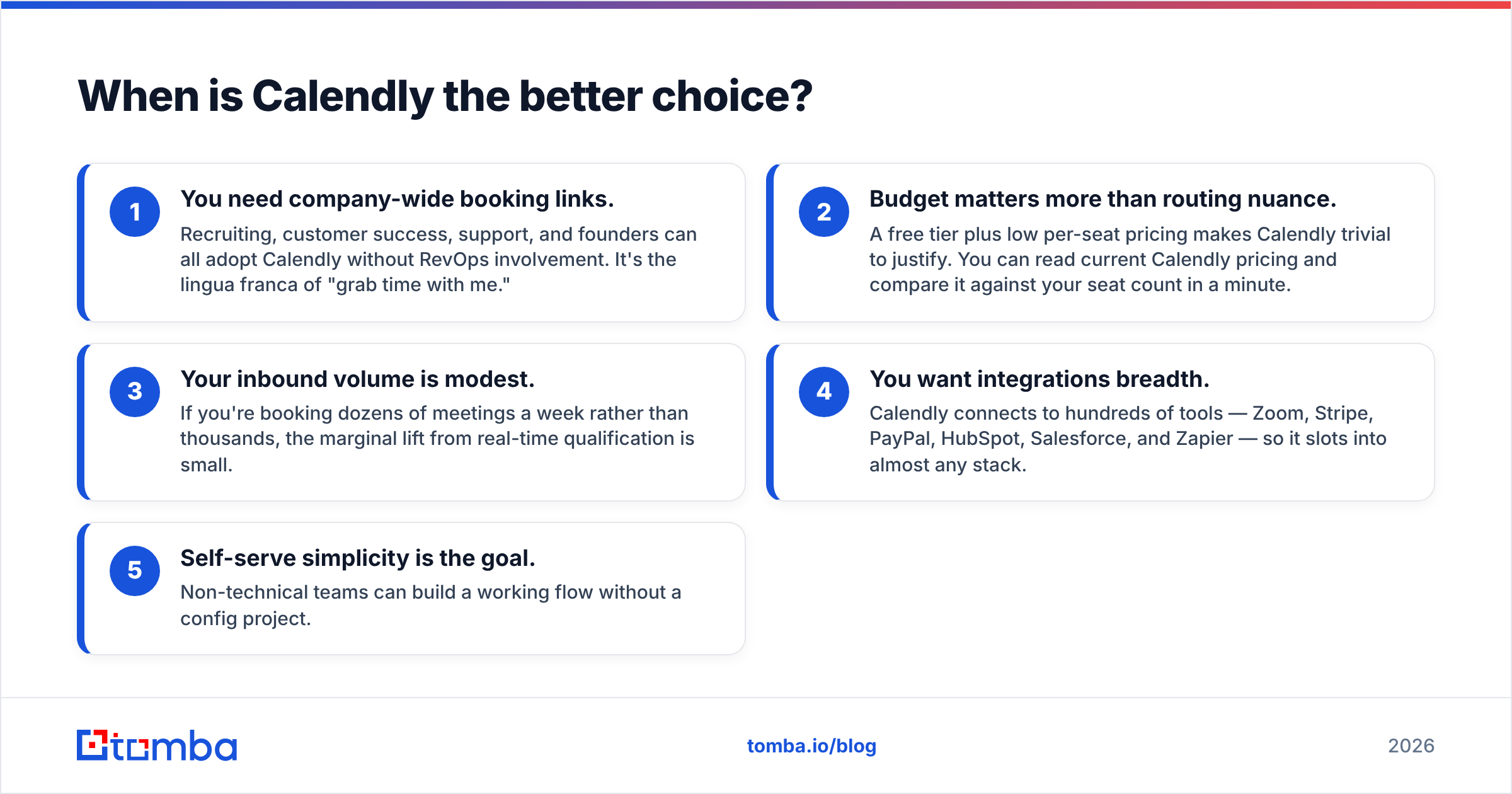
Calendly wins when scheduling is a feature, not your whole funnel. Choose it if:
- You need company-wide booking links. Recruiting, customer success, support, and founders can all adopt Calendly without RevOps involvement. It's the lingua franca of "grab time with me."
- Budget matters more than routing nuance. A free tier plus low per-seat pricing makes Calendly trivial to justify. You can read current Calendly pricing and compare it against your seat count in a minute.
- Your inbound volume is modest. If you're booking dozens of meetings a week rather than thousands, the marginal lift from real-time qualification is small.
- You want integrations breadth. Calendly connects to hundreds of tools — Zoom, Stripe, PayPal, HubSpot, Salesforce, and Zapier — so it slots into almost any stack.
- Self-serve simplicity is the goal. Non-technical teams can build a working flow without a config project.
Where Calendly gets stretched thin is complex inbound routing. If you need to route a lead to its existing account owner, fall back to a pooled SDR if that owner is offline, and do it in under two seconds while the prospect is still on the page — that's outside Calendly's core design.
When is Chili Piper worth the premium?#
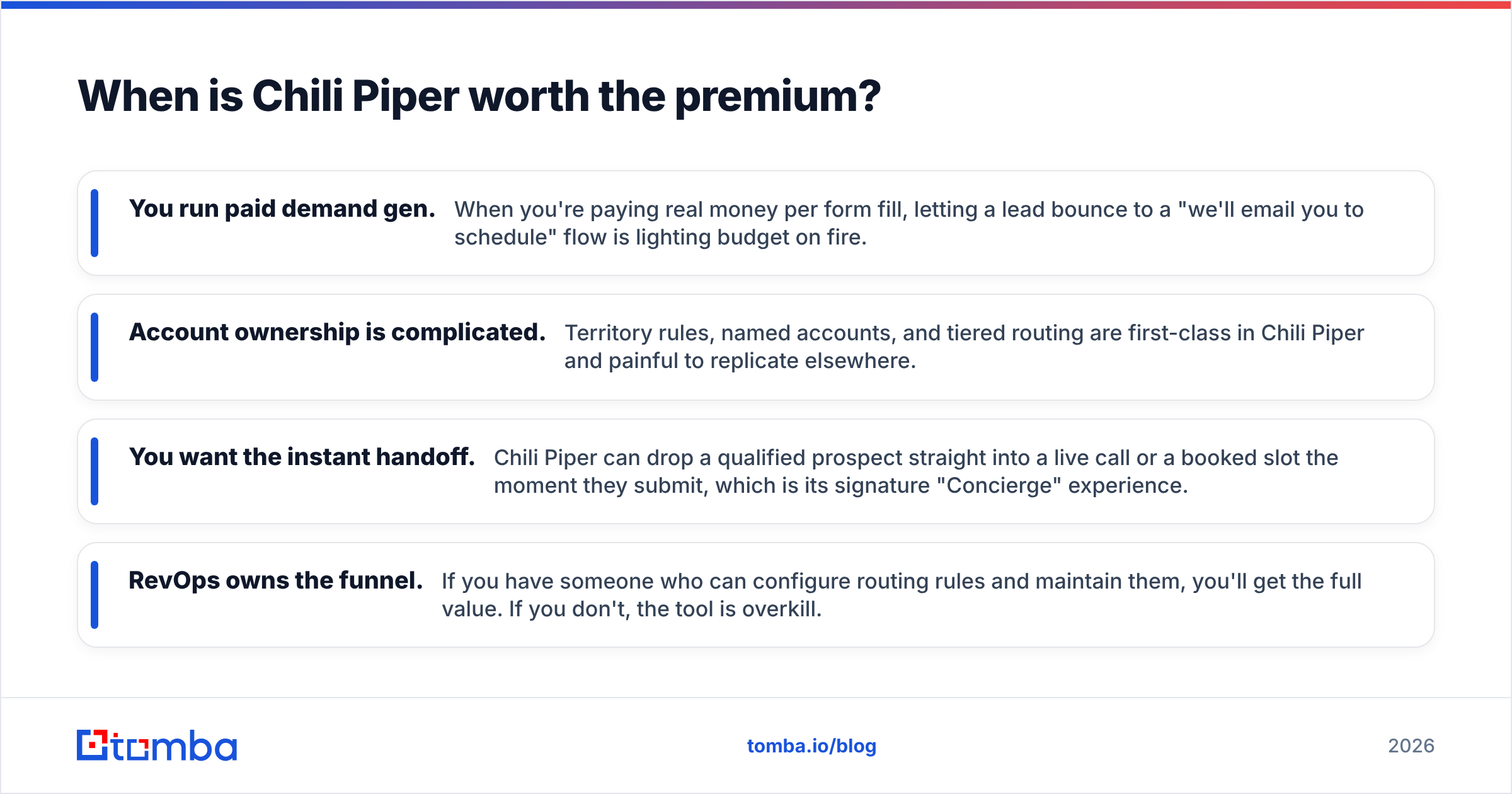
Chili Piper wins when every inbound lead is expensive and speed-to-lead is a KPI. The classic research finding — that contacting a lead within the first few minutes dramatically increases qualification odds — is the entire thesis of the product. Choose Chili Piper if:
- You run paid demand gen. When you're paying real money per form fill, letting a lead bounce to a "we'll email you to schedule" flow is lighting budget on fire.
- Account ownership is complicated. Territory rules, named accounts, and tiered routing are first-class in Chili Piper and painful to replicate elsewhere.
- You want the instant handoff. Chili Piper can drop a qualified prospect straight into a live call or a booked slot the moment they submit, which is its signature "Concierge" experience.
- RevOps owns the funnel. If you have someone who can configure routing rules and maintain them, you'll get the full value. If you don't, the tool is overkill.
The cost is real. Beyond the higher per-seat price, Chili Piper rewards configuration effort. A booking router with no maintenance behind it is an expensive Calendly. Industry analysts on G2 consistently note this split: reviewers love Chili Piper's conversion lift and flag its setup and price as the trade-off.

Is Chili Piper just an expensive Calendly?#
No — and assuming so is the most common buying mistake. They overlap on the surface (both put a calendar in front of a prospect) but optimize for different metrics.
Calendly optimizes for friction-free booking across many use cases. Chili Piper optimizes for inbound conversion rate and rep utilization on high-intent traffic. If you judge Chili Piper purely on "does it make a booking link," it looks overpriced. If you judge Calendly purely on "does it route a named account to the right AE in real time with a live handoff," it looks underpowered. Both judgments are unfair because each tool is being measured against the other's job.
A useful tiebreaker: where does the meeting originate? Outbound reps sending one-to-one links lean Calendly. Inbound marketing funnels with paid traffic and SLAs lean Chili Piper. Pipeline-heavy orgs often run both, and that's a legitimate, not redundant, setup. If you're mapping this against your broader sales process and pipeline, the scheduler is just one stage — the routing logic matters most where lead cost is highest.
What do both tools assume you already have?#
Here's the gap nobody on either product page mentions: a scheduler only works after a real person with a real, reachable contact record shows up. Calendly and Chili Piper both assume the lead, the email, and the CRM record already exist and are accurate. Garbage in, polished-booking-link out.
This is where the funnel quietly leaks before scheduling even enters the picture:
- Bad form emails. Prospects mistype addresses or use throwaways. If you're not running email verification on submission, your reminders and follow-ups bounce and your no-show rate climbs for reasons that look like scheduling problems but aren't.
- Missing routing fields. Chili Piper routes on company, title, and territory. If those fields are blank, routing degrades to round-robin guessing. Data enrichment fills them so the right rep actually gets the lead.
- Outbound with no contacts. Calendly links are only useful if you can reach the prospect to send them. For cold pipeline, you need verified contacts first — that's an email finder and bulk lead generation job, not a scheduler's.
Neither Calendly nor Chili Piper does any of this. They're the last mile. The data layer is the first mile, and a broken first mile makes even the best scheduler look like it's underperforming.
How should you decide between Calendly and Chili Piper?#
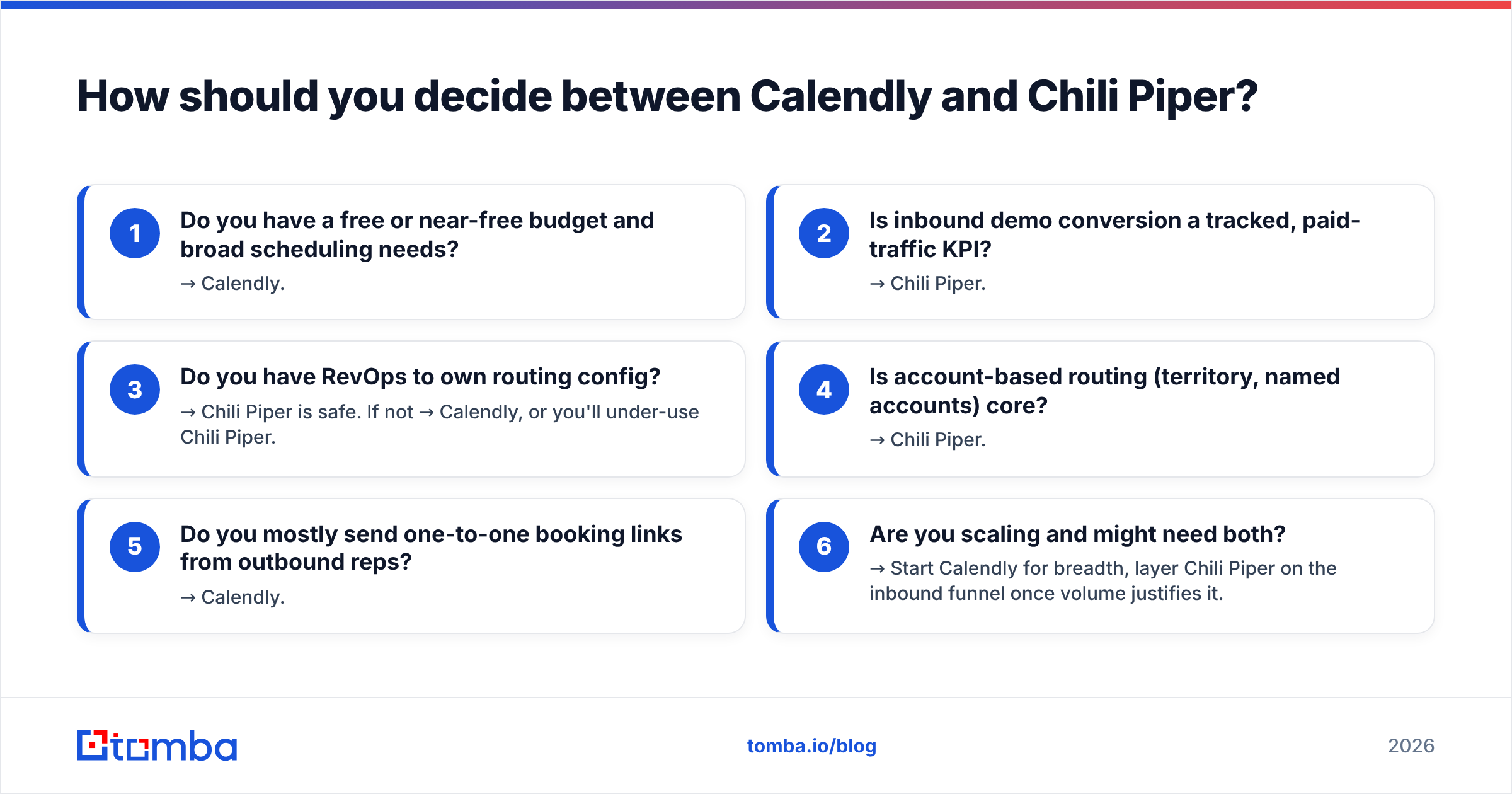
Run your situation through this quick decision list:
- Do you have a free or near-free budget and broad scheduling needs? → Calendly.
- Is inbound demo conversion a tracked, paid-traffic KPI? → Chili Piper.
- Do you have RevOps to own routing config? → Chili Piper is safe. If not → Calendly, or you'll under-use Chili Piper.
- Is account-based routing (territory, named accounts) core? → Chili Piper.
- Do you mostly send one-to-one booking links from outbound reps? → Calendly.
- Are you scaling and might need both? → Start Calendly for breadth, layer Chili Piper on the inbound funnel once volume justifies it.
A rough rule: under a few hundred inbound meetings a month, Calendly's simplicity usually wins on total cost of ownership. Above that, with paid demand gen and real SLAs, Chili Piper's conversion lift typically pays for itself. Validate against your own numbers — book-rate, show-rate, and cost-per-lead — rather than a blog's opinion, including this one.
What about no-shows and follow-up?#
Both tools fight no-shows with reminders and easy rescheduling, and both reduce them meaningfully versus manual back-and-forth email. Chili Piper adds live reassignment — if a rep is offline, the lead can be rerouted instead of dropped — which matters most for high-intent inbound where a 10-minute delay loses the deal.
But the highest-leverage no-show fix happens before the meeting is booked: making sure the contact details are real. A verified email and a valid phone number mean your confirmations, reminders, and reschedule links actually land. Pair your scheduler with a phone finder for a second confirmation channel, and your show-rate improves without touching either Calendly or Chili Piper's settings. The scheduler closes the loop; clean data is what lets the loop close at all.
The bottom line: Calendly vs Chili Piper in 2026#
Calendly is the better default for most teams — cheap, universal, and live in minutes. Chili Piper earns its premium when inbound conversion velocity is the metric you're paid to move and you have the RevOps muscle to configure it. Neither is a mistake; picking the wrong one for your funnel shape is.
Whichever scheduler you choose, the meetings are only as good as the contacts behind them. Before a single booking link goes out, make sure those records are real, complete, and routable. Tomba's Email Finder finds and verifies professional email addresses by name, domain, or company — so the leads flowing into Calendly or Chili Piper are reachable, enrichable, and ready to route. Start free with 25 searches a month, scale to the Starter plan at $49/mo when you're ready, and see full Tomba pricing for higher tiers. Fix the first mile, and your scheduler finally gets to do its job.
Ready to find emails that actually work?
Join 150,000+ professionals who stopped guessing and started sending. Free credits on signup — no credit card required.
Get the Tomba newsletter
Practical outbound tactics and product updates — once every two weeks.
About the author