Calendly vs OnceHub 2026: Which Scheduling Tool Wins?
Calendly vs OnceHub, compared head-to-head on pricing, routing, automation, and team workflows — so you pick the right meeting scheduler in 2026.
Picking a meeting scheduler sounds trivial until your pipeline depends on it. The booking link sits between a warm prospect and a sales call, and the wrong tool quietly leaks meetings through clumsy routing, no-shows, and timezone math gone wrong. Calendly and OnceHub are the two names that come up most when teams outgrow a shared Google Calendar, and they solve the same core job in very different ways.
This is a straight comparison. No tool is "the best" for everyone — the right pick depends on how complex your routing is, how big your team is, and how much you want to pay per seat.
TL;DR — Calendly vs OnceHub in 30 seconds#
- Calendly wins on simplicity, polish, and adoption. If you want a clean booking link live in five minutes, it's the default for a reason.
- OnceHub wins on depth — complex routing, qualification forms, panel/round-robin logic, and chatbot-style booking flows for high-intent leads.
- Pricing favors Calendly at the low end (a genuinely usable free tier) and gets closer to OnceHub as you add routing and team seats.
- For sales teams, OnceHub's lead-routing and CRM-rules engine is stronger; for marketing, support, and solo operators, Calendly's speed-to-value is hard to beat.
- A scheduler only matters if the meeting is with the right person — pair either tool with accurate contact data so you're booking decision-makers, not dead inboxes.
What is Calendly and what is OnceHub?#
Calendly is the category-defining scheduling tool. You connect a calendar, set your availability, and share a link. Invitees pick a slot, it drops onto both calendars, and reminders go out automatically. Over the years it has layered on team scheduling, round-robin, routing forms, workflows, and integrations — but the heart of the product is still that one-click booking link anyone can use without a manual.
OnceHub (formerly ScheduleOnce) targets a more demanding buyer. It treats scheduling as part of a lead-conversion engine: capture, qualify, route, and book in one flow. Its "booking pages" and conversational routing ("BookWithMe" plus its chatbot and form tooling) are built for teams that want to screen and direct prospects before a slot is ever offered.
Think of it like coffee makers. Calendly is the pod machine — press a button, get a reliable cup, no fuss. OnceHub is the espresso setup with a grinder and pressure gauge: more knobs, a steeper learning curve, and noticeably better results once you've dialed it in.

How do Calendly and OnceHub compare feature by feature?#
Here's the head-to-head on the attributes that actually change your workflow.
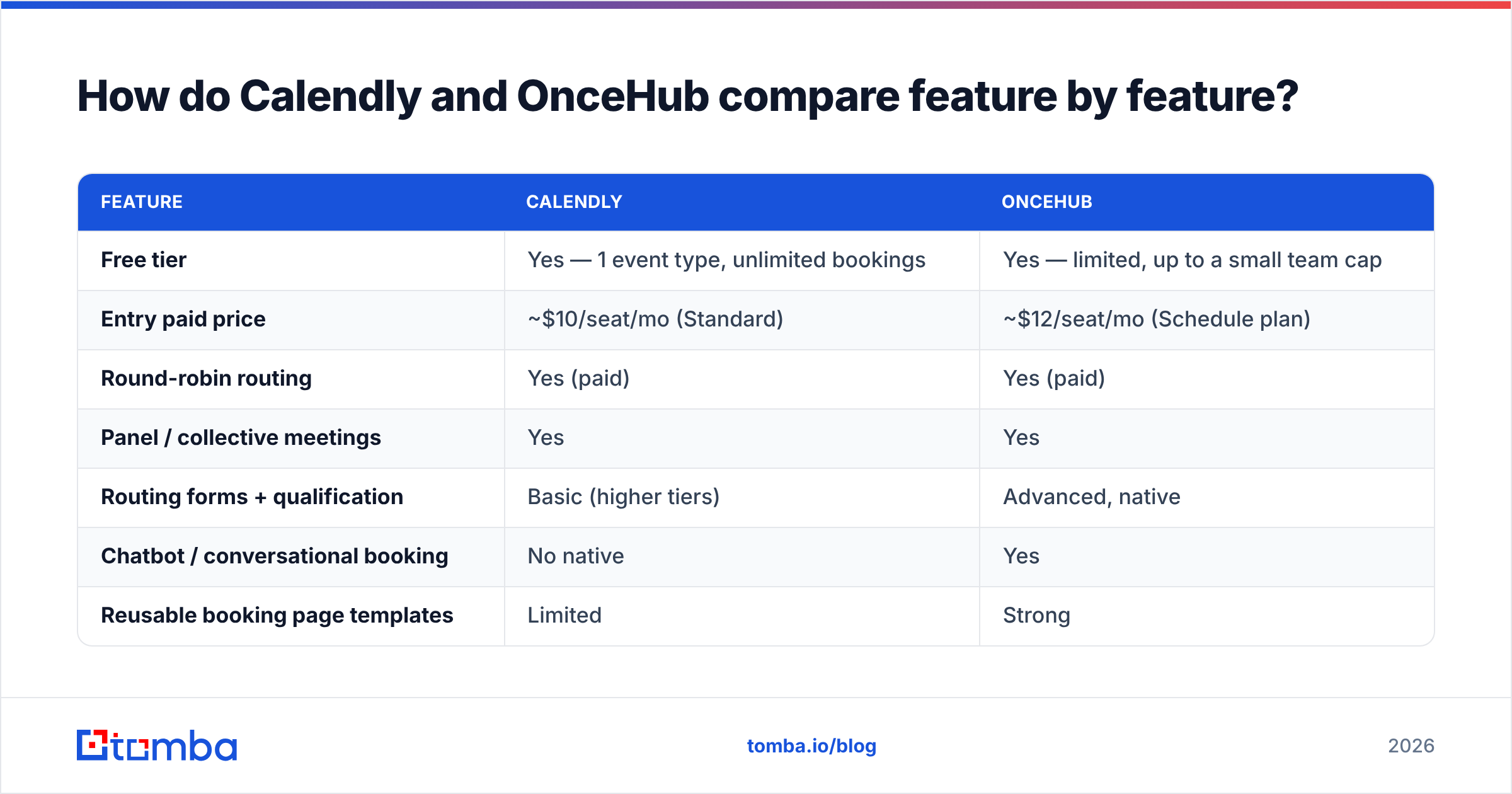
| Feature | Calendly | OnceHub |
|---|---|---|
| Free tier | Yes — 1 event type, unlimited bookings | Yes — limited, up to a small team cap |
| Entry paid price | ~$10/seat/mo (Standard) | ~$12/seat/mo (Schedule plan) |
| Round-robin routing | Yes (paid) | Yes (paid) |
| Panel / collective meetings | Yes | Yes |
| Routing forms + qualification | Basic (higher tiers) | Advanced, native |
| Chatbot / conversational booking | No native | Yes |
| Reusable booking page templates | Limited | Strong |
| CRM integrations | HubSpot, Salesforce, more | HubSpot, Salesforce, more |
| Reminders + workflows | Yes (paid) | Yes |
| Ease of setup | Very high | Moderate |
| Best for | Solo, marketing, support | Sales ops, complex routing |
The pattern is consistent: Calendly gives you 90% of what most people need with almost no setup, while OnceHub gives you the remaining 10% that complex sales motions actually live or die on.
Is Calendly better than OnceHub for sales teams?#
It depends on how much routing intelligence your funnel needs.
If your inbound leads are roughly homogeneous — a demo request is a demo request — Calendly's round-robin will distribute them across reps cleanly and your AEs will adopt it without complaint. Adoption is a real feature. A scheduler nobody uses is worse than no scheduler at all, and Calendly's familiarity means reps stop resisting it fast.
If your funnel branches — enterprise vs SMB, region-based routing, territory rules, "send qualified leads to the senior AE and everyone else to the SDR pool" — OnceHub's rules engine is built for exactly that. You can attach qualification questions, score responses, and route accordingly before a meeting is offered. That's the difference between booking a meeting and booking the right meeting with the right rep.
A useful way to decide:
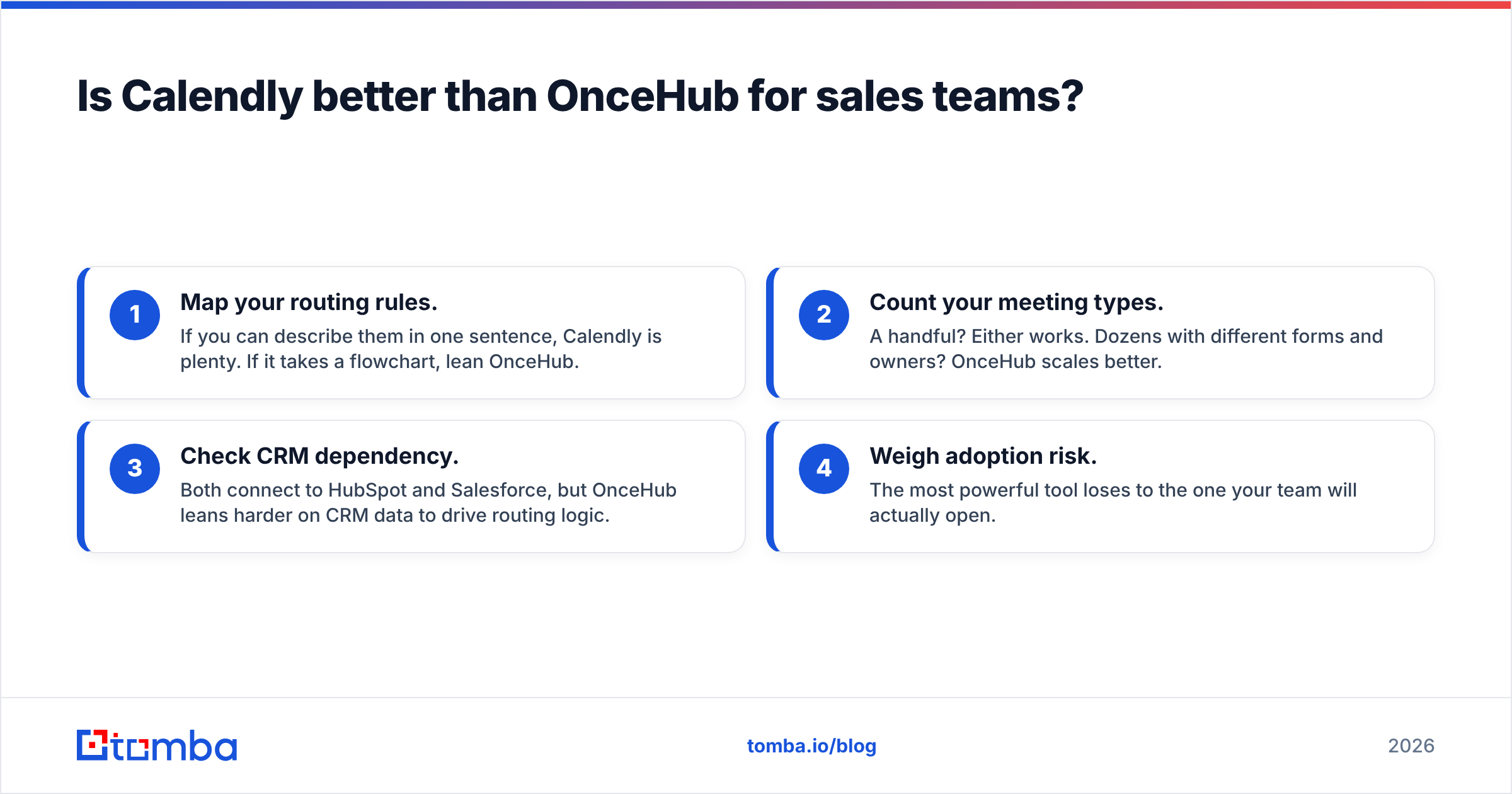
- Map your routing rules. If you can describe them in one sentence, Calendly is plenty. If it takes a flowchart, lean OnceHub.
- Count your meeting types. A handful? Either works. Dozens with different forms and owners? OnceHub scales better.
- Check CRM dependency. Both connect to HubSpot and Salesforce, but OnceHub leans harder on CRM data to drive routing logic.
- Weigh adoption risk. The most powerful tool loses to the one your team will actually open.
Most teams underestimate point four and over-invest in routing complexity they never use.
How much do Calendly and OnceHub cost in 2026?#
Pricing is where the two tools trade blows depending on which tier you land on.
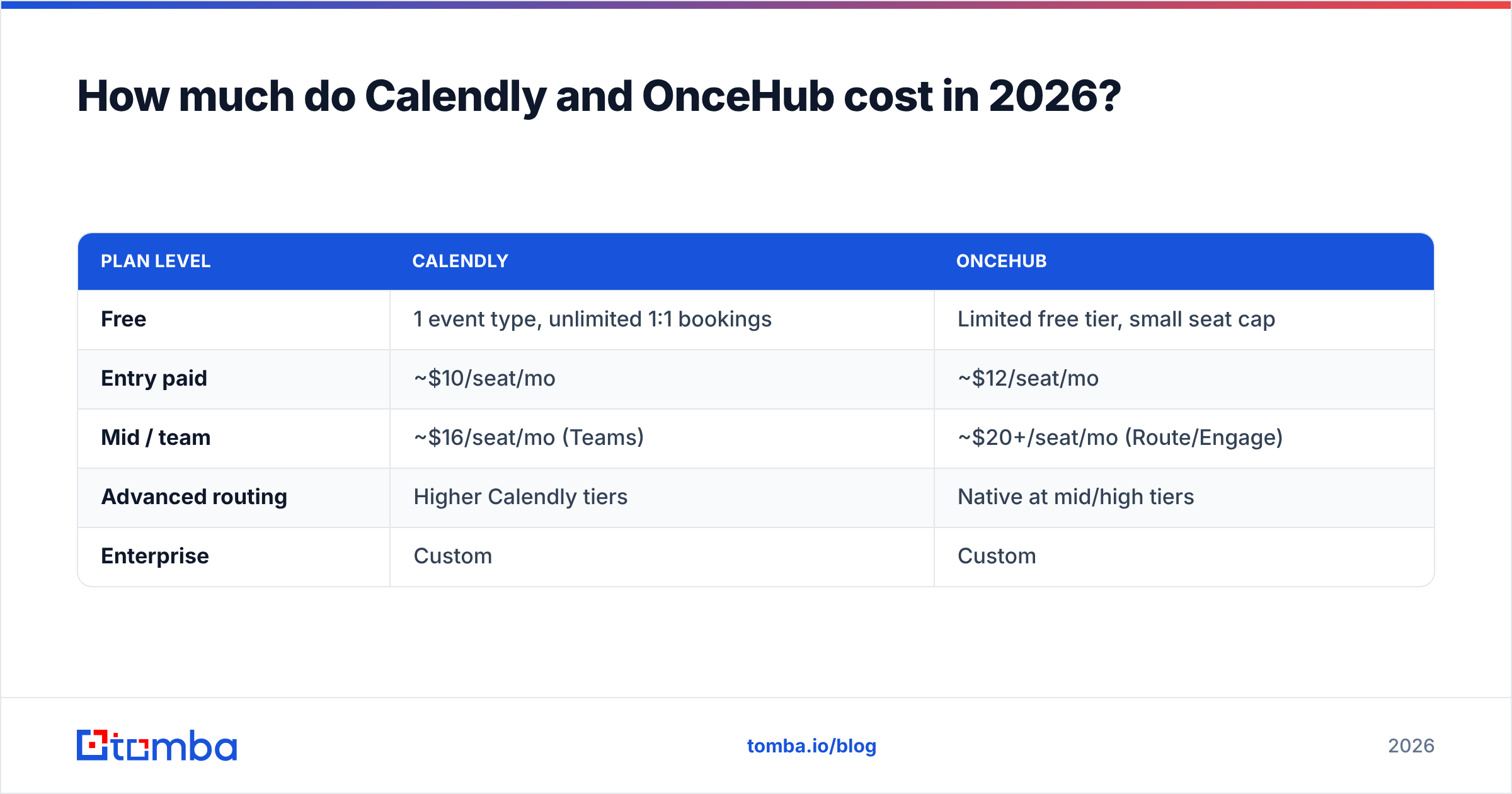
| Plan level | Calendly | OnceHub |
|---|---|---|
| Free | 1 event type, unlimited 1:1 bookings | Limited free tier, small seat cap |
| Entry paid | ~$10/seat/mo | ~$12/seat/mo |
| Mid / team | ~$16/seat/mo (Teams) | ~$20+/seat/mo (Route/Engage) |
| Advanced routing | Higher Calendly tiers | Native at mid/high tiers |
| Enterprise | Custom | Custom |
Two honest caveats. First, prices shift — always confirm current numbers on calendly.com and oncehub.com before you budget. Second, "cheaper per seat" is not the same as "cheaper for the outcome." If OnceHub's routing converts 15% more inbound leads into booked calls, a few extra dollars per seat is trivial against the pipeline it generates.
For a solo founder or a five-person support team, Calendly's free and Standard tiers are genuinely hard to beat on value. For a 30-rep revenue org with territory rules, the per-seat gap narrows and OnceHub's capabilities start justifying themselves.
What do real reviews say about Calendly vs OnceHub?#
Patterns from public review sites like G2 are remarkably stable:
- Calendly praise: intuitive, fast, "just works," strong mobile experience, wide integration ecosystem.
- Calendly gripes: advanced features gated behind higher tiers, routing forms feel bolted-on, per-seat cost adds up for big teams.
- OnceHub praise: powerful routing, flexible booking pages, excellent for qualifying and directing leads, conversational flows.
- OnceHub gripes: steeper learning curve, dated-feeling UI in spots, more setup time before value.
Neither tool has a fatal flaw. The complaints are predictable trade-offs of their design philosophies: Calendly optimizes for simplicity and pays for it in ceiling; OnceHub optimizes for control and pays for it in onboarding.
Which scheduler should you choose?#
Match the tool to your situation rather than to a leaderboard.
Choose Calendly if you:
- Want a booking link live today with near-zero training
- Run marketing, support, recruiting, or solo consulting workflows
- Value polish and adoption over deep configurability
- Have simple or no routing rules
Choose OnceHub if you:
- Route inbound leads through qualification before booking
- Need territory, panel, or rules-based assignment at scale
- Want conversational or form-driven booking experiences
- Have a sales ops function that will own and tune the setup
Consider neither (yet) if your real bottleneck isn't scheduling at all — it's not having enough qualified meetings to schedule. A perfect booking flow does nothing for an empty pipeline.
Why the scheduler is only half the equation#
Here's the part both vendors won't tell you: a booking page converts demand, it doesn't create it. The link only works once a prospect already wants to talk to you. Everything upstream — finding the right contact, confirming the email is real, and reaching out — determines whether anyone ever clicks "book a time."
That's where most scheduling setups quietly fail. Teams polish their Calendly or OnceHub flow, then send outreach to stale or guessed email addresses that bounce. The meeting never gets a chance to be booked.
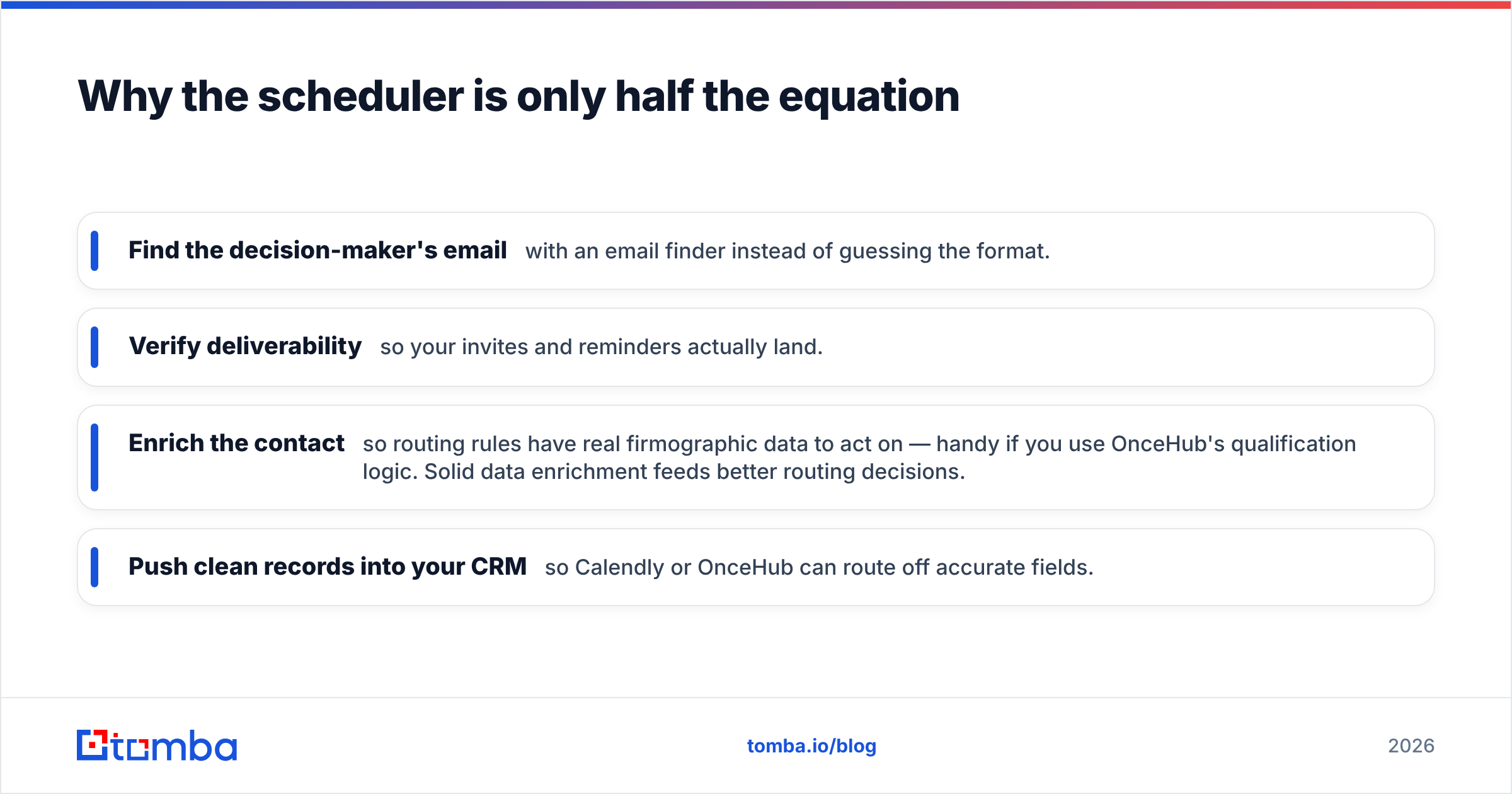
Before the scheduler ever matters, you need to:
- Find the decision-maker's email with an email finder instead of guessing the format.
- Verify deliverability so your invites and reminders actually land.
- Enrich the contact so routing rules have real firmographic data to act on — handy if you use OnceHub's qualification logic. Solid data enrichment feeds better routing decisions.
- Push clean records into your CRM so Calendly or OnceHub can route off accurate fields.
Get that foundation right and either scheduler performs dramatically better, because the meetings you're routing are with people who exist, want to talk, and can sign.
Frequently asked questions#
Is Calendly or OnceHub easier to set up? Calendly, clearly. Most users have a working booking link in minutes. OnceHub asks for more configuration up front, which is the cost of its deeper routing.
Can both tools do round-robin? Yes, both support round-robin and collective/panel meetings on paid plans. OnceHub's assignment rules are more granular.
Do they integrate with my CRM? Both connect to major CRMs including HubSpot and Salesforce, plus Pipedrive and others. OnceHub relies on CRM data more heavily for routing.
Which is cheaper? Calendly at the entry level, especially with its free tier. The gap narrows at team and advanced-routing tiers, where you're paying for OnceHub's added capability.
Can I switch later? Yes. Both export bookings and integrate with the same downstream tools, so migrating is mostly about rebuilding event types and re-sharing links.
The bottom line#
Calendly is the right default for speed, simplicity, and adoption. OnceHub is the right pick when routing complexity and lead qualification are core to how you sell. Neither will fail you outright — pick based on the complexity of your funnel and the appetite your team has for setup.
But remember what the booking link can't do: it can't find your buyer. Before you optimize a single scheduling flow, make sure you're reaching real, verified decision-makers. Start with the Tomba Email Finder to turn names and domains into accurate, deliverable contacts — then let Calendly or OnceHub do what it does best and get the meeting on the calendar. Check Tomba pricing to see how it fits your stack.
// get started
Find, verify and enrich your first contacts today
Start on the free plan with 25 searches a month, then scale when your team is ready.
Free plan · No credit card required · GDPR & CCPA
// about the author