Call Cadence Meaning: How to Build a Winning Cadence in 2026
Call cadence meaning, explained without fluff: what it is, why timing beats volume, and the exact multi-touch sequence top reps use to book more meetings in 2026.
TL;DR
- Call cadence meaning: a planned, repeatable sequence of outreach touches — calls, voicemails, emails, and social steps — spaced over a fixed window to reach a prospect at the right moment.
- A cadence is about timing and consistency, not raw dialing volume. Most connects happen on touch 4–8, yet most reps quit at touch 2.
- A strong B2B cadence runs 10–14 touches over 14–21 days, blending phone, email, and LinkedIn.
- Cadence performance collapses when your contact data is wrong. Bad numbers and dead emails kill connect rates before timing ever matters.
- Pair a disciplined cadence with verified phone numbers and emails to turn the same effort into more conversations.
What is the call cadence meaning?#
A call cadence is the schedule behind your outreach. Think of it like a workout plan: random gym visits get you nowhere, but a structured program — specific exercises, on specific days, repeated for weeks — produces results. A cadence does the same for prospecting. It tells a rep exactly who to contact, through which channel, on which day, with what message.
The word "call" in call cadence is a bit misleading in 2026. Modern cadences are multi-channel by default. Phone is the anchor because it still drives the highest-quality conversations, but the calls are surrounded by emails, voicemails, and social touches that keep you visible between dials. The "cadence" part is the rhythm — the spacing and order of those touches.
Here is the core idea in one line: a cadence converts effort into a system, so results stop depending on which rep happens to be motivated that day.
Why does the structure matter so much? Because buyers rarely respond to a single attempt. Industry research from groups like HubSpot and Salesforce consistently shows that most deals require multiple touches before a prospect engages, yet a large share of reps stop after one or two tries. The gap between "what works" and "what reps actually do" is exactly the gap a cadence closes.
What are the core components of a call cadence?#
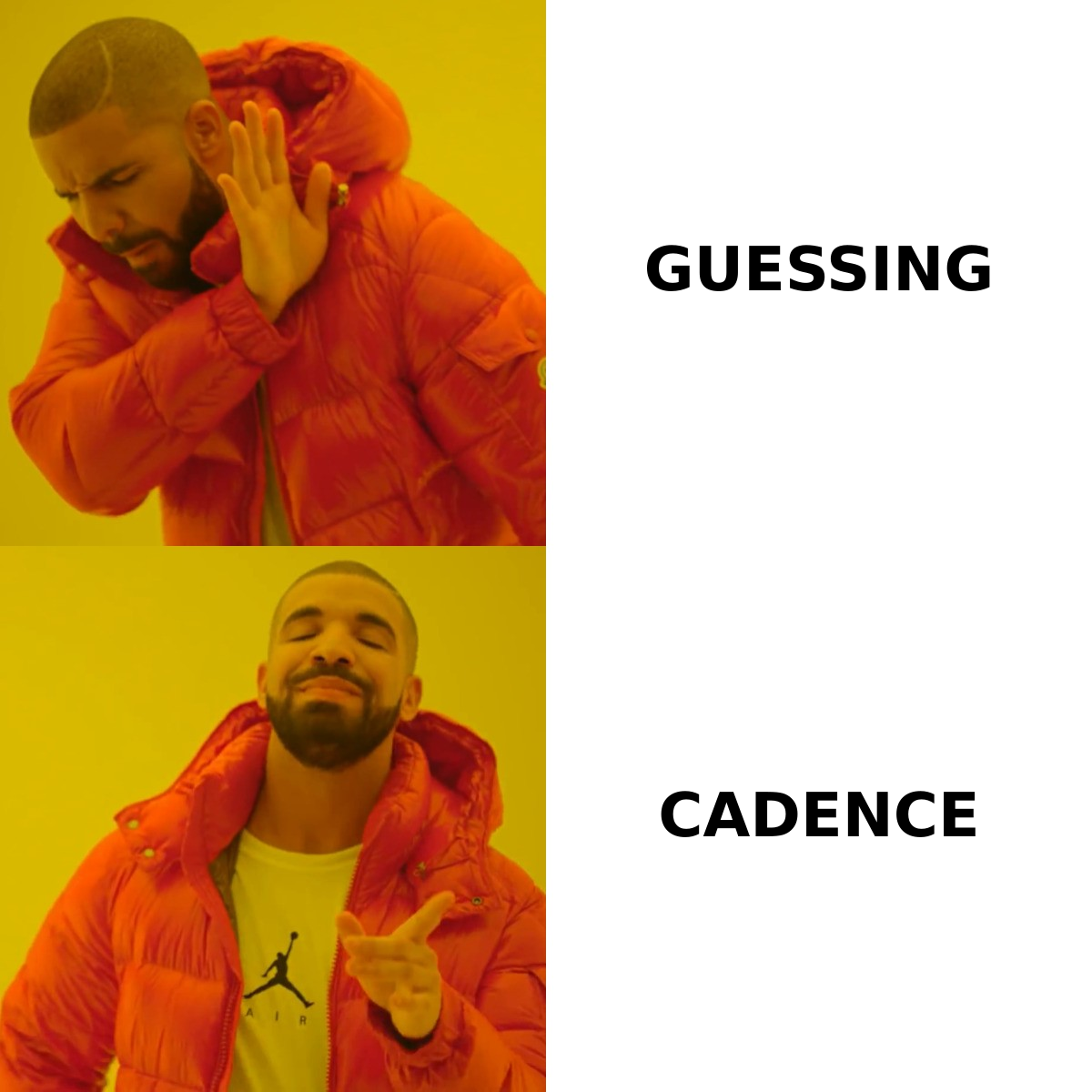
Every effective cadence is built from the same building blocks. Get these right and the schedule almost writes itself.
- Channels — The mix of touchpoints you use: phone calls, voicemails, emails, LinkedIn, and sometimes SMS. Phone-first cadences lead with calls; email-first cadences warm the prospect before you dial.
- Touches — The individual attempts. A touch is one action: one call, one email, one connection request. Total touch count usually lands between 8 and 16.
- Spacing (the cadence itself) — How many days sit between touches. Early touches are tight (every 1–2 days); later touches stretch out (every 3–5 days) to avoid fatigue.
- Duration — The full window, typically 14–21 business days, after which the prospect exits to nurture or recycle.
- Messaging — What you say at each step. Every touch should add a new angle: a trigger event, a case study, a question, a teardown.
- Exit rules — When to stop. A reply, a meeting booked, an explicit "no," or the end of the sequence all trigger an exit.
When teams skip even one of these — usually spacing or exit rules — the cadence degrades into "call whenever you remember," which is the thing a cadence exists to prevent.
Why does a call cadence outperform random dialing?#
Because consistency compounds, and timing is unpredictable for any single prospect but reliable across many.
You can't know which day a specific buyer will be at their desk, between meetings, and ready to talk. But across hundreds of prospects, a spaced multi-touch sequence dramatically raises the odds that each contact gets reached during one of those windows. Random dialing concentrates your attempts; a cadence spreads them.
There is also a credibility effect. A prospect who sees your name on a call, then an email, then a relevant LinkedIn comment starts to recognize you. By touch five you are no longer a cold stranger — you are "that rep who keeps showing up with useful things." That familiarity is what lifts reply rates over time, and it is also why your response rate climbs as the cadence matures rather than decaying.
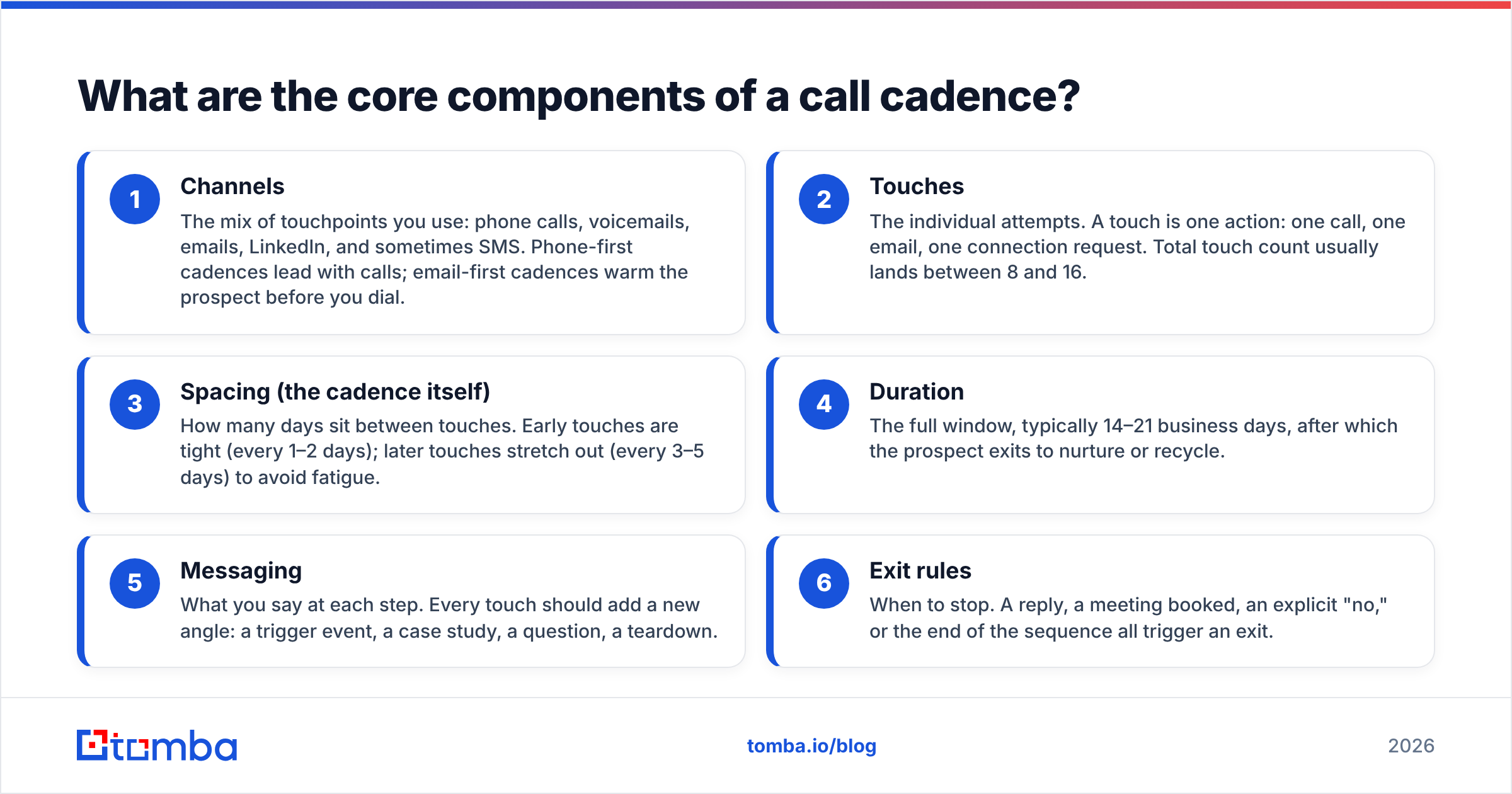
Here is the contrast in plain terms:
| Dimension | Random dialing | Structured call cadence |
|---|---|---|
| Touches per prospect | 1–2, then forgotten | 10–14 over a fixed window |
| Channel mix | Phone only | Phone + email + social |
| Connect rate | Low, luck-dependent | Higher, timing spread across days |
| Rep consistency | Varies by mood | Same play every prospect |
| Reporting | Hard to measure | Clear per-step metrics |
| Follow-up discipline | Drops after touch 2 | Enforced by the sequence |
The right-hand column is not more work — it is the same work, sequenced. That is the entire value proposition of cadence thinking.
What does an ideal B2B call cadence look like in 2026?#
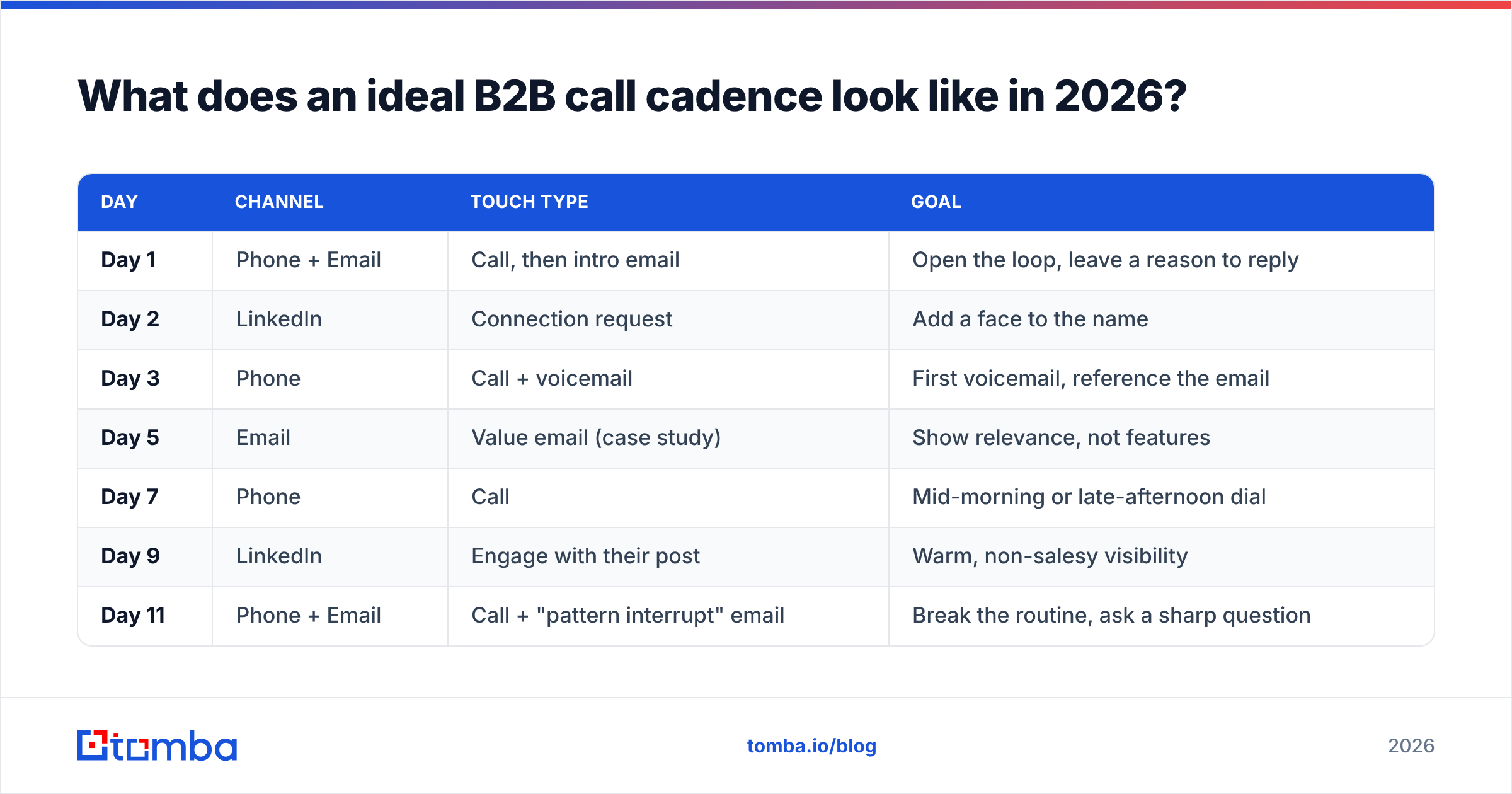
A reliable starting template runs 14 touches across roughly three weeks. Treat it as a baseline to tune, not gospel — your segment, deal size, and persona will shift the numbers.
| Day | Channel | Touch type | Goal |
|---|---|---|---|
| Day 1 | Phone + Email | Call, then intro email | Open the loop, leave a reason to reply |
| Day 2 | Connection request | Add a face to the name | |
| Day 3 | Phone | Call + voicemail | First voicemail, reference the email |
| Day 5 | Value email (case study) | Show relevance, not features | |
| Day 7 | Phone | Call | Mid-morning or late-afternoon dial |
| Day 9 | Engage with their post | Warm, non-salesy visibility | |
| Day 11 | Phone + Email | Call + "pattern interrupt" email | Break the routine, ask a sharp question |
| Day 14 | Break-up email | Create urgency, prompt a yes/no |
Notice the rhythm: dense early, spaced later, multi-channel throughout. The phone carries the heavy lifting, but the emails and social touches keep you present on the days you do not call.
A few tuning rules that hold up across teams:
- Front-load the calls. Your best connect odds are in the first week while the trigger that put this prospect on your list is still fresh.
- Vary the message every touch. Repeating "just following up" trains prospects to ignore you. Each step needs a new reason to engage.
- Mind the clock and calendar. Early morning and late afternoon tend to beat midday; mid-week tends to beat Monday and Friday. Test against your own data.
- Respect the exit rules. A cadence that never lets prospects out becomes spam, and spam wrecks your sender reputation on the email side.
How does data quality make or break your cadence?#
A perfect cadence aimed at the wrong number is a perfect waste of time. This is the part most "cadence guides" skip, and it is the part that quietly destroys results.
Every touch in your sequence assumes one thing: the contact details are correct. If the phone number is stale, your dials hit dead lines. If the email bounces, your carefully written value email never lands — and the bounce itself damages deliverability for every other prospect on that domain. Cadence discipline cannot fix a broken dataset; it just executes the mistake more reliably.
That is why the highest-performing outbound teams treat contact data as a first-class input, not an afterthought. Before a single touch fires, they make sure:
- The phone number is current and routes to the prospect, not a defunct desk line. A B2B phone finder and a phone validator handle the discovery and the check.
- The email is real and deliverable, confirmed with an email verifier so soft and hard bounces never enter the sequence.
- The contact actually works where you think they do. Job changes are constant; enrichment keeps titles and companies accurate.
Run the math. If 30% of your numbers are wrong and 20% of your emails bounce, then a third of your phone touches and a fifth of your email touches are pure noise — before timing, messaging, or talent enter the picture. Cleaning the list often produces a bigger lift than rewriting the script.
This is the unglamorous truth of cadence work: the best optimization is usually upstream of the cadence. You can find verified contacts at scale with an email finder, then verify before you load anyone into the sequence.
What tools support a modern call cadence?#
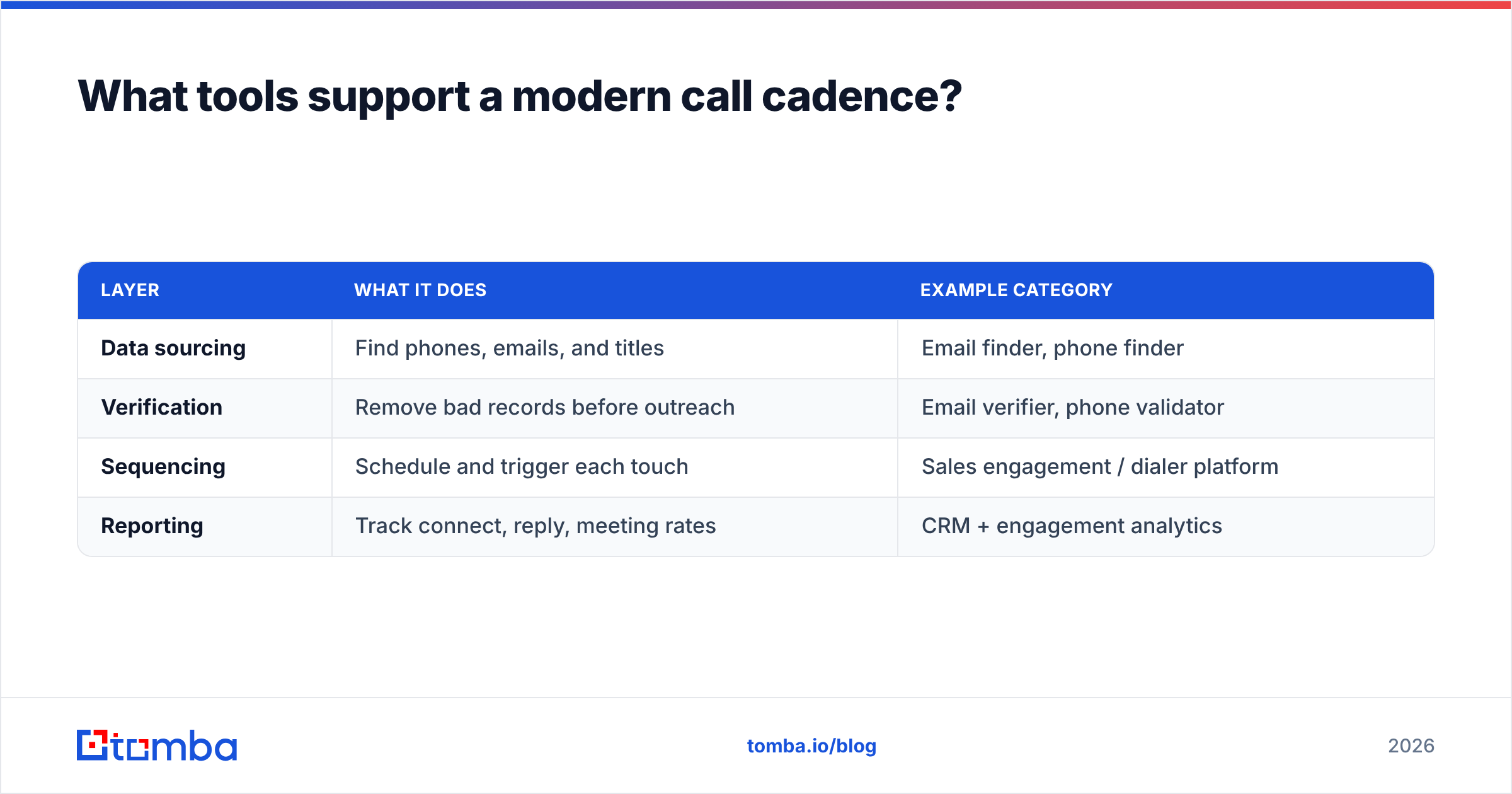
A cadence has three jobs to fill: source accurate contacts, sequence the touches, and measure what happens. Most teams stitch together a data layer and an execution layer.
| Layer | What it does | Example category |
|---|---|---|
| Data sourcing | Find phones, emails, and titles | Email finder, phone finder |
| Verification | Remove bad records before outreach | Email verifier, phone validator |
| Sequencing | Schedule and trigger each touch | Sales engagement / dialer platform |
| Reporting | Track connect, reply, meeting rates | CRM + engagement analytics |
You don't need a single suite that does everything. You need a clean handoff: verified data flowing into your sequencer, and outcomes flowing back into your CRM so you can see which steps actually produce meetings. Plenty of teams compare sales engagement platforms on G2 before committing to a sequencer — the data layer underneath it matters just as much.
A practical setup for most B2B teams in 2026:
- Build the list with verified emails and direct dials.
- Verify and enrich so every record is real on day one.
- Load into your sequencer and run the 14-touch template above.
- Review weekly — which touch drives connects, where prospects drop, what the break-up email recovers.
- Refine spacing and messaging based on the numbers, not opinions.
If you want to wire data straight into your existing stack, Tomba's integrations push verified contacts into the CRM and sequencer you already use, so the data layer and execution layer stay in sync.
How do you measure if your call cadence is working?#
Track four numbers per cadence, and watch them per step, not just in aggregate.
- Connect rate — Percentage of dials that reach a live prospect. Low connects usually mean bad numbers or bad timing, not a bad script.
- Reply rate — Email and LinkedIn responses across the sequence. This should rise through the middle touches as familiarity builds.
- Meeting rate — The number that pays the bills: meetings booked per prospect entered. This is your true cadence efficiency.
- Cadence completion rate — How many prospects actually receive every scheduled touch. If this is low, your reps are skipping steps and the cadence is theoretical.
Per-step reporting is what separates a real optimization process from guesswork. If connects spike on Day 7 calls and crater on Day 11, you move more dials toward that Day 7 window. If the break-up email recovers 8% of dead prospects, you protect it. The cadence is a hypothesis; the metrics tell you which parts are true.
One caution: never optimize a cadence on top of dirty data. A "low connect rate" caused by wrong numbers looks identical in the dashboard to one caused by bad timing — but the fixes are opposite. Verify the data first, then trust the metrics.
Common call cadence mistakes to avoid#
- Quitting too early. The meeting is often on touch 6, and the rep stopped at touch 2.
- Same message, every touch. Repetition without new value trains prospects to ignore you.
- Single channel. Phone-only or email-only cadences leave easy connects on the table.
- No exit rules. Endless follow-up becomes spam and burns your domain reputation.
- Skipping verification. Loading unverified contacts guarantees wasted touches and bounce damage.
- Optimizing on dirty data. You can't read your metrics if a third of the list is wrong.
Conclusion: cadence is a system, fueled by clean data#
The call cadence meaning comes down to this: a planned, repeatable, multi-channel sequence that replaces luck with a system. Timing beats volume, consistency beats intensity, and the rep who shows up on touch six wins the meeting the rep who quit on touch two never had a shot at.
But every cadence rests on one assumption — that the contact details are correct. The fastest way to lift connect and reply rates is rarely a new script; it is feeding the sequence verified phones and emails so none of your touches are wasted on dead records.
Start there. Use the Tomba Email Finder to build accurate, verified contact lists by name, company, or domain, then drop those clean records into the 14-touch cadence above. Check the Tomba pricing plans — the free tier gives you 25 searches a month to test the workflow before you scale. Get the data right, run the cadence with discipline, and the meetings follow.
Ready to find emails that actually work?
Join 150,000+ professionals who stopped guessing and started sending. Free credits on signup — no credit card required.
Get the Tomba newsletter
Practical outbound tactics and product updates — once every two weeks.
About the author