CapitalConnectorAI vs Apollo.io: 2026 B2B Tool Comparison
CapitalConnectorAI vs Apollo.io in 2026: a neutral look at pricing, data accuracy, niche fit, and which tool actually moves pipeline for your team.
Choosing between a niche, vertical AI tool and a sprawling all-in-one sales platform is one of the more confusing buying decisions in B2B right now. CapitalConnectorAI and Apollo.io sit at opposite ends of that spectrum: one is a focused engine built around capital and investor intelligence, the other is a 275M-contact database bolted onto a full sales-engagement suite. They overlap just enough to look like competitors, and differ just enough that picking wrong wastes a quarter of budget.
This guide breaks down what each tool actually does, where the data comes from, what you pay, and — honestly — when neither is the right call.
TL;DR — CapitalConnectorAI vs Apollo.io#
- CapitalConnectorAI is a narrow, vertical tool aimed at fundraising, investor mapping, and capital-market signals. It shines if your "ICP" is funds, GPs, family offices, or capital allocators — and it's overkill (or simply off-target) for general B2B sales.
- Apollo.io is a horizontal all-in-one: a large contact/company database plus email sequencing, dialer, and CRM-lite workflow. Strong breadth, but accuracy and deliverability degrade at the edges, and the platform gets pricey as seats and credits scale.
- Pricing reality: Apollo runs roughly $49–$149/user/month with credit caps; CapitalConnectorAI is quote-driven and skews toward annual contracts.
- The honest third option: if what you really need is accurate, verified contact data feeding your existing stack, a focused data tool like Tomba's email finder often beats paying platform tax for features you won't use.

What is CapitalConnectorAI?#
CapitalConnectorAI is a vertical intelligence tool built around capital flows — investors, funds, allocators, and the relationships between them. Think of it less like a sales database and more like a specialized map of who funds whom. Where a generic prospecting tool tells you "here are 4,000 SaaS VPs of Sales," a capital-focused tool tells you "here are the 40 limited partners likely to back a fund in your stage and sector."
That focus is the whole pitch. The tool typically layers AI-driven matching on top of structured investor data, so a fundraising team or a capital-markets sales rep can shortcut weeks of manual research. It is genuinely useful inside that lane and largely irrelevant outside it.
The trade-off is the trade-off of every niche tool: depth in one vertical, near-zero coverage everywhere else. If your motion is "sell software to mid-market ops teams," capital intelligence does nothing for you.
What is Apollo.io?#
Apollo.io is one of the best-known all-in-one B2B sales platforms. It pairs a very large contact and company database (the marketing claim hovers around 275M contacts) with execution tooling: email sequences, a built-in dialer, LinkedIn workflows, basic CRM features, and enrichment. The appeal is consolidation — find a prospect, sequence them, and track replies without leaving one tab.
Breadth is Apollo's strength and its weakness. A database that wide is assembled from many sources and inevitably carries stale rows, role changes, and unverified emails. Reviews on G2 consistently praise the all-in-one value while flagging data accuracy and deliverability as the soft spots — exactly what you'd expect from a horizontal platform optimized for coverage over precision.
CapitalConnectorAI vs Apollo.io: side-by-side comparison#
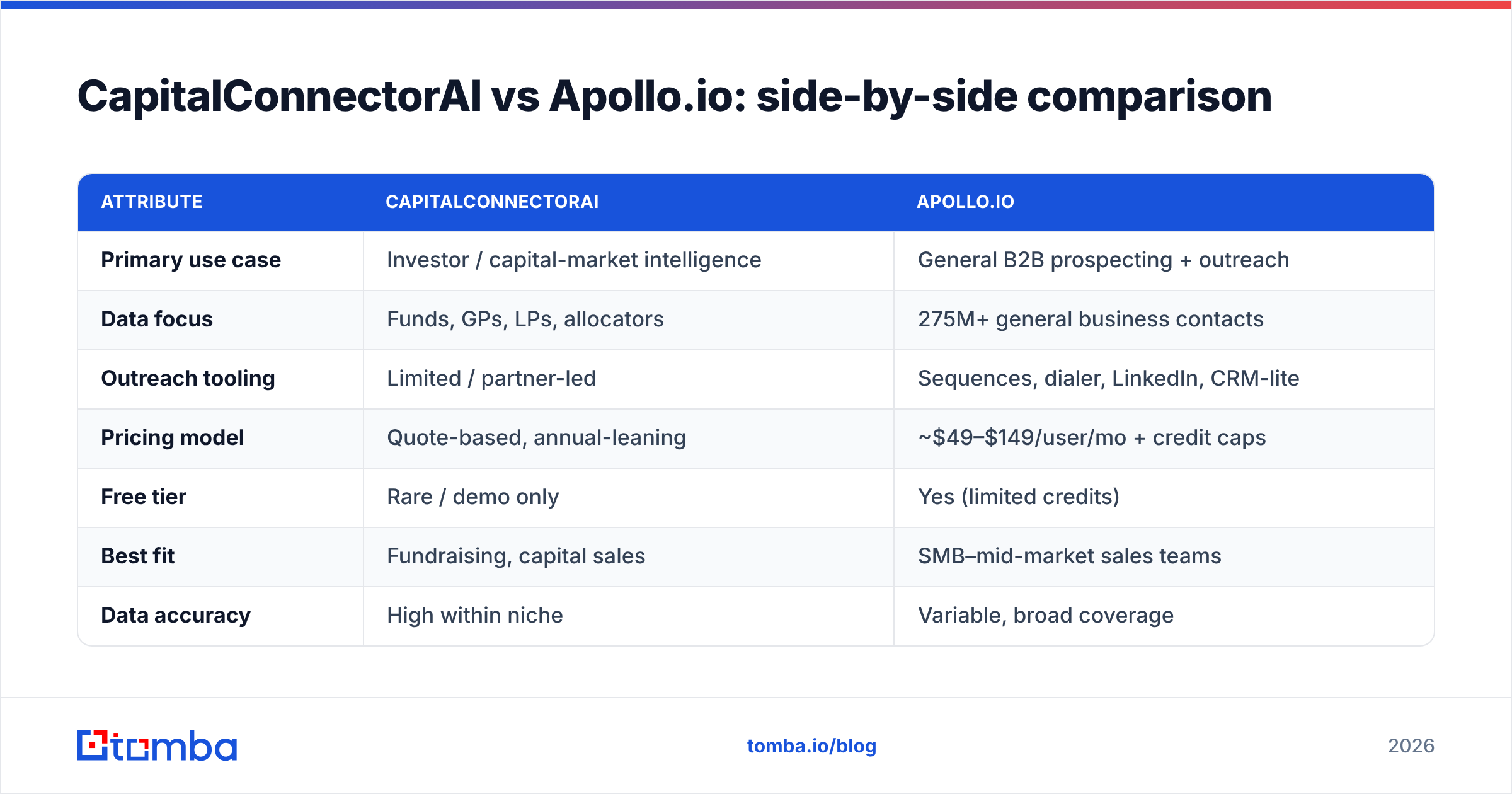
Here's the core decision laid out. Treat the pricing as directional — both vendors move plans frequently, and CapitalConnectorAI is quote-driven.
| Attribute | CapitalConnectorAI | Apollo.io |
|---|---|---|
| Primary use case | Investor / capital-market intelligence | General B2B prospecting + outreach |
| Data focus | Funds, GPs, LPs, allocators | 275M+ general business contacts |
| Outreach tooling | Limited / partner-led | Sequences, dialer, LinkedIn, CRM-lite |
| Pricing model | Quote-based, annual-leaning | ~$49–$149/user/mo + credit caps |
| Free tier | Rare / demo only | Yes (limited credits) |
| Best fit | Fundraising, capital sales | SMB–mid-market sales teams |
| Data accuracy | High within niche | Variable, broad coverage |
| Weak spot | No general coverage | Stale rows, deliverability |
The pattern is clear: these tools barely compete. One is a scalpel, the other is a Swiss Army knife. The right question usually isn't "which of these two," it's "which category do I actually need."
Which tool fits which buyer?#
Use this as a quick filter before you sit through a single demo:
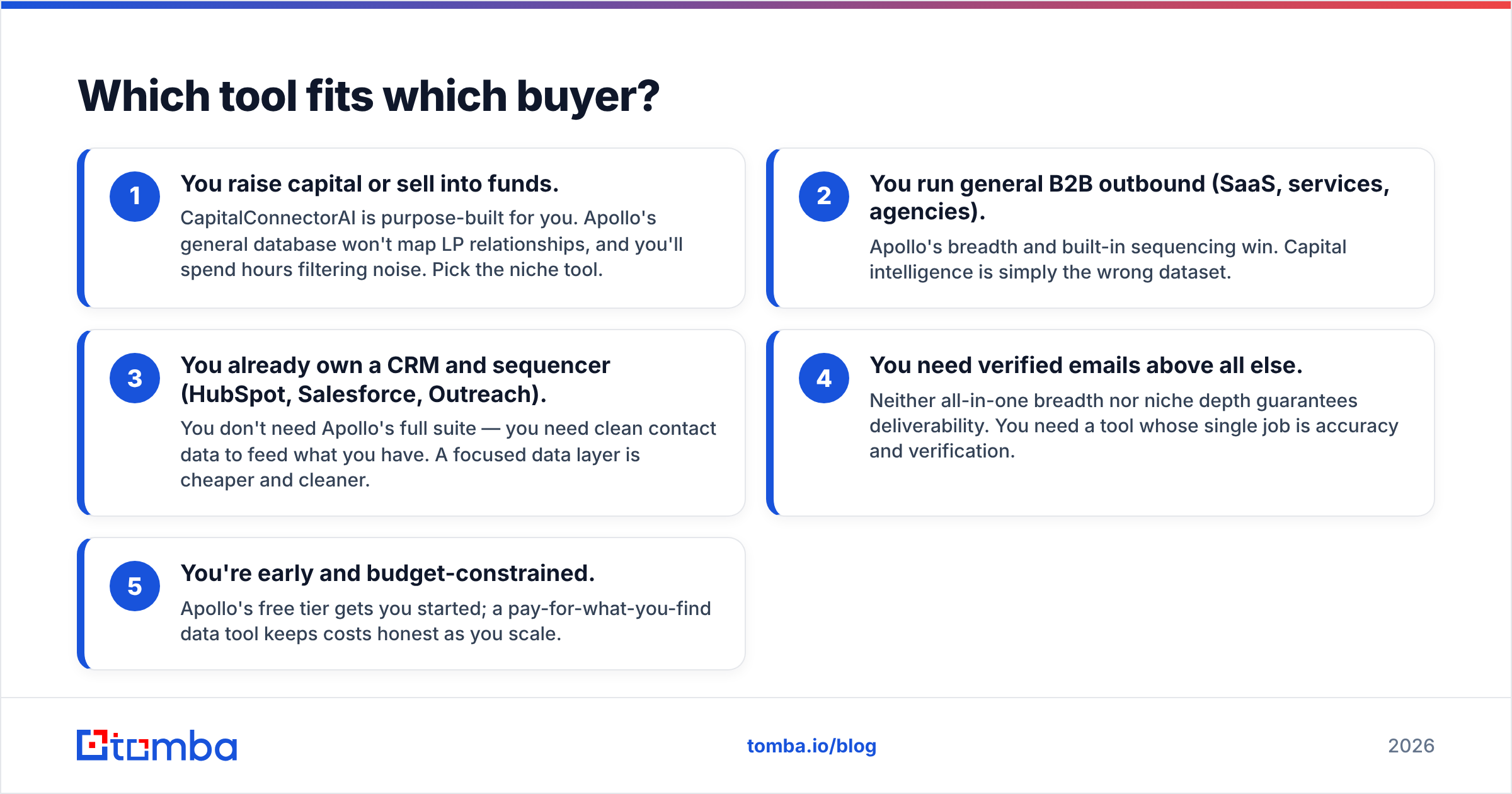
- You raise capital or sell into funds. CapitalConnectorAI is purpose-built for you. Apollo's general database won't map LP relationships, and you'll spend hours filtering noise. Pick the niche tool.
- You run general B2B outbound (SaaS, services, agencies). Apollo's breadth and built-in sequencing win. Capital intelligence is simply the wrong dataset.
- You already own a CRM and sequencer (HubSpot, Salesforce, Outreach). You don't need Apollo's full suite — you need clean contact data to feed what you have. A focused data layer is cheaper and cleaner.
- You need verified emails above all else. Neither all-in-one breadth nor niche depth guarantees deliverability. You need a tool whose single job is accuracy and verification.
- You're early and budget-constrained. Apollo's free tier gets you started; a pay-for-what-you-find data tool keeps costs honest as you scale.
Notice how often the honest answer is "neither, exactly." That's the real takeaway of any niche-vs-platform comparison.
How accurate is the data, really?#
Data accuracy is where most of these decisions get won or lost — and where the marketing numbers mislead. A database advertising hundreds of millions of contacts is averaging across freshness. Some segments are immaculate; others are full of people who changed jobs 18 months ago. Apollo's coverage is genuinely impressive in volume, but "we have the record" and "the email still works" are different claims.
CapitalConnectorAI inverts this. Its dataset is small but curated, so accuracy within capital markets tends to be high. Outside that vertical, there's nothing to be accurate about.
For any outbound team, the metric that matters isn't contact count — it's bounce rate. A 12% bounce rate torches your sender reputation and drags every future campaign down with it. That's why mature teams treat sourcing and verification as two separate steps: pull contacts from wherever, then run them through a dedicated email verifier before anyone hits send. No all-in-one platform verifies as aggressively as a tool built only to verify.

What about pricing and hidden costs?#
On paper, Apollo is the cheaper, more transparent option — public tiers, a free plan, and per-seat pricing in the $49–$149 range. CapitalConnectorAI is quote-driven and tends toward annual commitments, which is normal for vertical tools with a smaller buyer pool.
But the sticker price hides two cost traps:
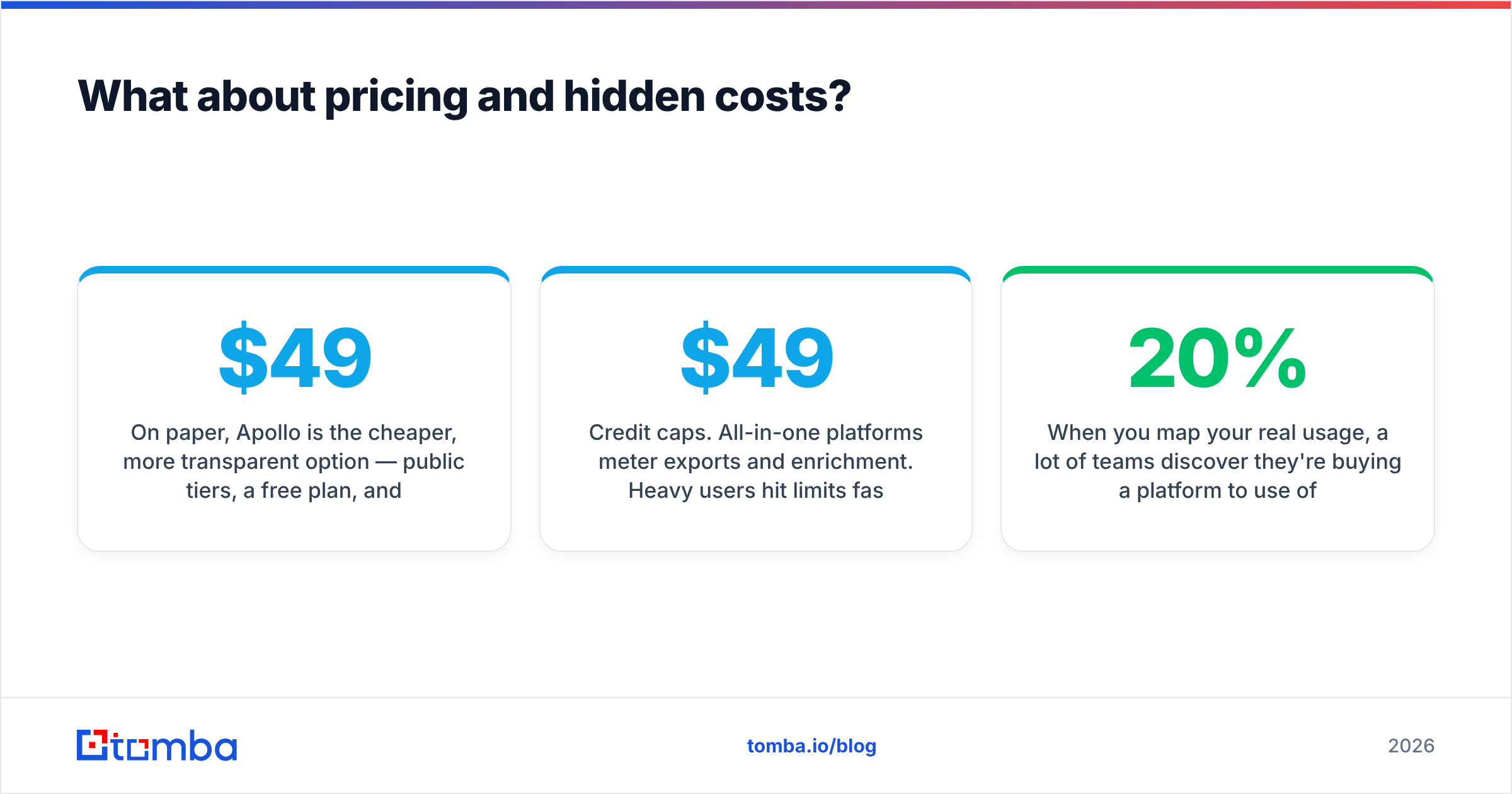
- Credit caps. All-in-one platforms meter exports and enrichment. Heavy users hit limits fast and get nudged into the next tier, so the "$49 plan" quietly becomes the $149 plan.
- Feature tax. If you adopt Apollo for its database but already own a sequencer and dialer, you're paying for an entire execution suite you'll never open. Niche tools have the opposite problem — you pay a premium for depth in one lane.
When you map your real usage, a lot of teams discover they're buying a platform to use 20% of it. That's the moment to look at unbundled, usage-based pricing. Tomba's transparent pricing — a free tier with 25 searches/month, then Starter at $49/mo, Growth at $99/mo, and Pro at $249/mo — is built around the find-and-verify job specifically, with no seat-locked execution suite attached.
Is there a better-fit alternative for most teams?#
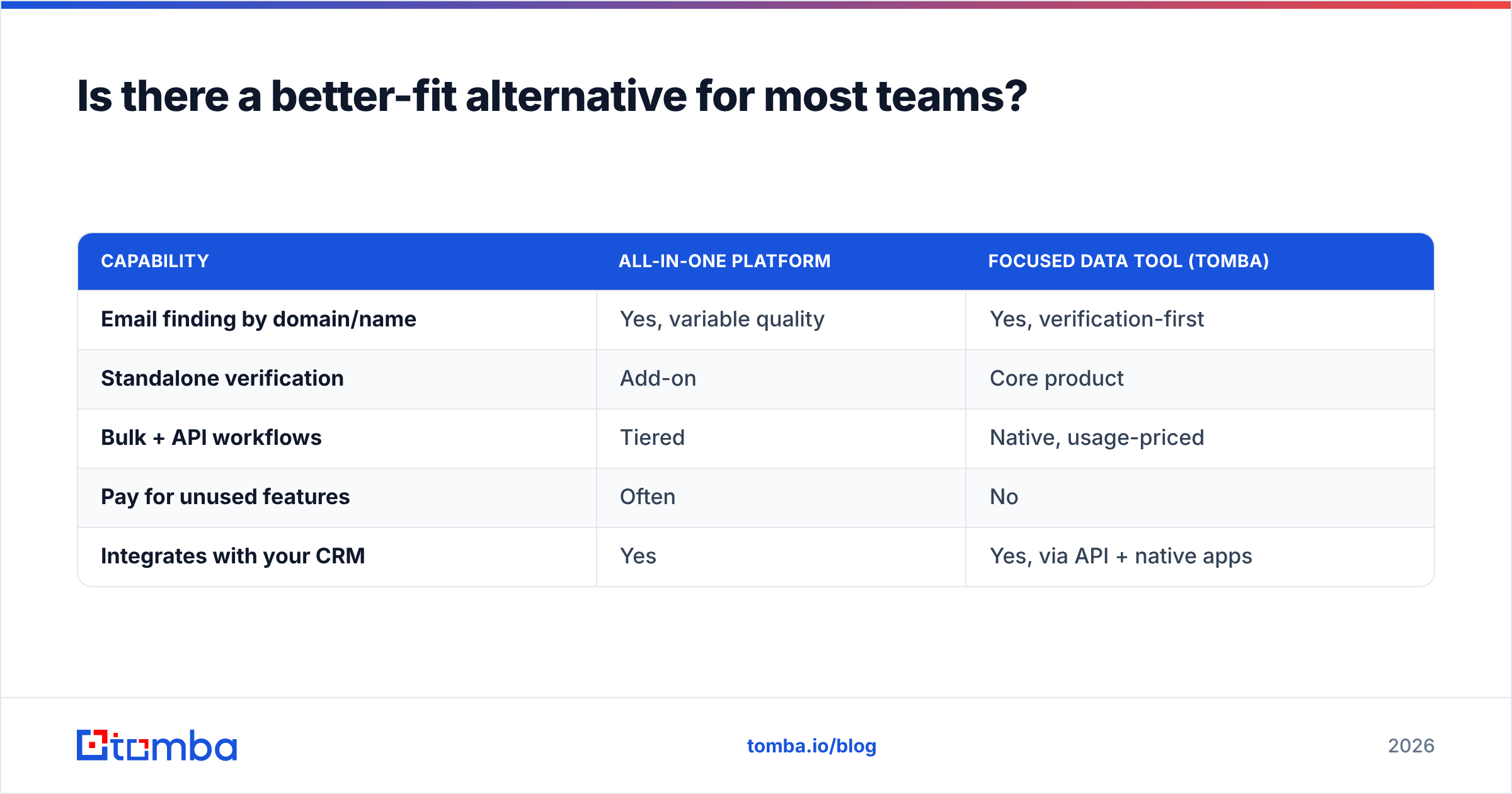
For the large middle of the market — teams that need accurate contact data feeding tools they already run — a focused data platform usually beats both options here. This is exactly the gap that drives people to look at an Apollo alternative in the first place.
Here's how a focused approach compares to the all-in-one model:
| Capability | All-in-one platform | Focused data tool (Tomba) |
|---|---|---|
| Email finding by domain/name | Yes, variable quality | Yes, verification-first |
| Standalone verification | Add-on | Core product |
| Bulk + API workflows | Tiered | Native, usage-priced |
| Pay for unused features | Often | No |
| Integrates with your CRM | Yes | Yes, via API + native apps |
The philosophy difference matters. An all-in-one wants to be your stack. A focused data tool wants to strengthen the stack you chose. If you've already invested in HubSpot, Salesloft, or Instantly, the second model is almost always the better economic and deliverability decision. You can use domain search to map a target account, pull verified contacts, and push them straight into your sequencer via the Tomba API without paying for a second sequencer you don't need.
How should you actually decide?#
Skip the feature-checklist trap. Run this three-step test instead:
- Name your dataset. Is your ICP capital allocators or general businesses? This single answer eliminates one of the two tools immediately. Capital → CapitalConnectorAI. Everything else → not CapitalConnectorAI.
- Audit what you already own. List your current CRM, sequencer, and dialer. Every one you already have is a reason not to pay for an all-in-one and a reason to buy data à la carte.
- Test on your own list. Pull 100 real prospects from your target market in each tool, send to a verifier, and measure the bounce rate. Data quality on your segment beats any vendor's headline accuracy number. G2 and Capterra reviews are a useful sanity check, but your own bounce test is the only score that counts.
Most teams who run this honestly land in one of three buckets: niche fundraising teams keep CapitalConnectorAI, all-in-one-curious SMBs trial Apollo, and the large remainder — anyone with an existing stack and a deliverability problem — adopt a dedicated find-and-verify layer.
The bottom line#
CapitalConnectorAI and Apollo.io aren't really rivals; they're answers to different questions. CapitalConnectorAI wins if your world is capital and investors. Apollo wins if you want one tab for everything and can tolerate variable data quality. But if your actual need is accurate, verified contact data that plugs into the tools you already run, you're better served by a focused platform than by either a vertical niche tool or a feature-heavy suite.
That's the niche Tomba was built for. Start with the Tomba Email Finder to source contacts by domain, name, or company, lean on built-in verification to protect your sender reputation, and keep your existing CRM and sequencer exactly where they are. The free tier gives you 25 searches a month to bounce-test your own list before you commit a cent — which is the only comparison that ever really mattered.
// get started
Find, verify and enrich your first contacts today
Start on the free plan with 25 searches a month, then scale when your team is ready.
Free plan · No credit card required · GDPR & CCPA
// about the author