CapitalConnectorAI vs DiscoverOrg: 2026 B2B Data Showdown
CapitalConnectorAI vs DiscoverOrg: which B2B data platform actually fits your pipeline in 2026? A neutral breakdown of accuracy, pricing, coverage, and the cheaper alternative most teams overlook.
CapitalConnectorAI vs DiscoverOrg: Which B2B Data Platform Wins in 2026?
TL;DR
- CapitalConnectorAI is the newer, AI-first play: predictive intent scoring, automated account research, and signal-based prospecting aimed at fast-moving GTM teams.
- DiscoverOrg (now folded into ZoomInfo) is the legacy heavyweight: deep org charts, human-verified contact data, and enterprise-grade coverage — at an enterprise-grade price.
- Pick CapitalConnectorAI if you want AI signals and a lighter contract; pick DiscoverOrg/ZoomInfo if you need exhaustive org mapping and don't mind a five-figure commitment.
- Neither is cheap. If your real need is accurate emails and phone numbers per domain, a focused tool like Tomba covers 80% of the job at a fraction of the cost.
- Always pair any database with an email verifier — stale data is the silent killer of cold outreach, no matter who you buy it from.
What Are CapitalConnectorAI and DiscoverOrg?#
The short version: both sell you the same thing — the ability to find and reach the right people at the right companies — but they come at it from opposite eras.
CapitalConnectorAI is a modern sales-intelligence platform built around machine learning. Its pitch is that raw contact lists are a commodity; the value is in timing. It layers intent signals (hiring spikes, funding rounds, tech-stack changes, web activity) on top of a contact database and scores accounts so reps chase the warmest ones first. Think of it as a GPS that not only knows the roads but tells you which highways are about to clear up.
DiscoverOrg is the original enterprise database. For years it was the gold standard for org charts — knowing not just an email, but who reports to whom, who controls budget, and who the real decision-maker is inside a 4,000-person company. It was acquired and merged into ZoomInfo, so when you "buy DiscoverOrg" today you're really buying ZoomInfo's enterprise data tier. Its strength is depth and human verification; its weakness is cost and contract rigidity.

If you only remember one distinction: CapitalConnectorAI optimizes for when to reach out, DiscoverOrg optimizes for who to reach and how they're connected. Most teams need a bit of both — which is exactly why a layered stack often beats betting everything on one platform.
How Do CapitalConnectorAI and DiscoverOrg Compare Head-to-Head?#
Here's the side-by-side on the attributes that actually change your win rate and your invoice.
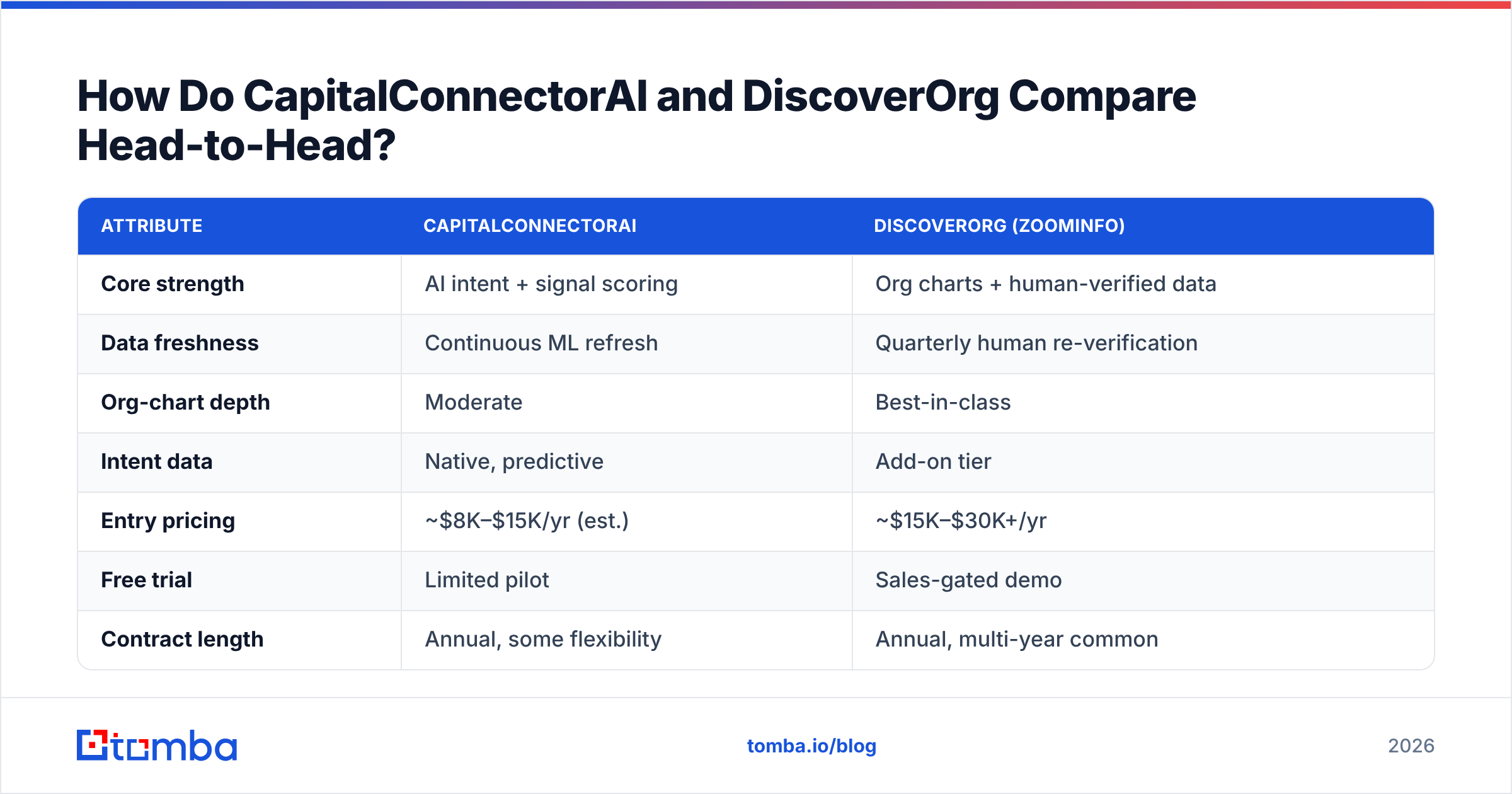
| Attribute | CapitalConnectorAI | DiscoverOrg (ZoomInfo) |
|---|---|---|
| Core strength | AI intent + signal scoring | Org charts + human-verified data |
| Data freshness | Continuous ML refresh | Quarterly human re-verification |
| Org-chart depth | Moderate | Best-in-class |
| Intent data | Native, predictive | Add-on tier |
| Entry pricing | ~$8K–$15K/yr (est.) | ~$15K–$30K+/yr |
| Free trial | Limited pilot | Sales-gated demo |
| Contract length | Annual, some flexibility | Annual, multi-year common |
| Best fit | AI-driven SMB/mid-market GTM | Enterprise ABM teams |
| Setup complexity | Low–medium | Medium–high |
| API access | Yes | Yes (enterprise tier) |
A few honest caveats on that table. Public pricing for both is opaque — neither publishes a clean price page, so the ranges above are based on widely reported deal sizes, not a published rate card. Treat them as planning estimates, then push hard in negotiation; both vendors discount more than their first quote suggests.
The bigger takeaway is structural: you are comparing a focused AI tool against a broad enterprise suite. DiscoverOrg/ZoomInfo will almost always "win" on raw coverage simply because it's a larger machine. CapitalConnectorAI competes on relevance and speed-to-value, not breadth.
Which One Has Better Data Accuracy?#
Accuracy is where these comparisons get won or lost, because a database is only as good as the percentage of records that don't bounce.
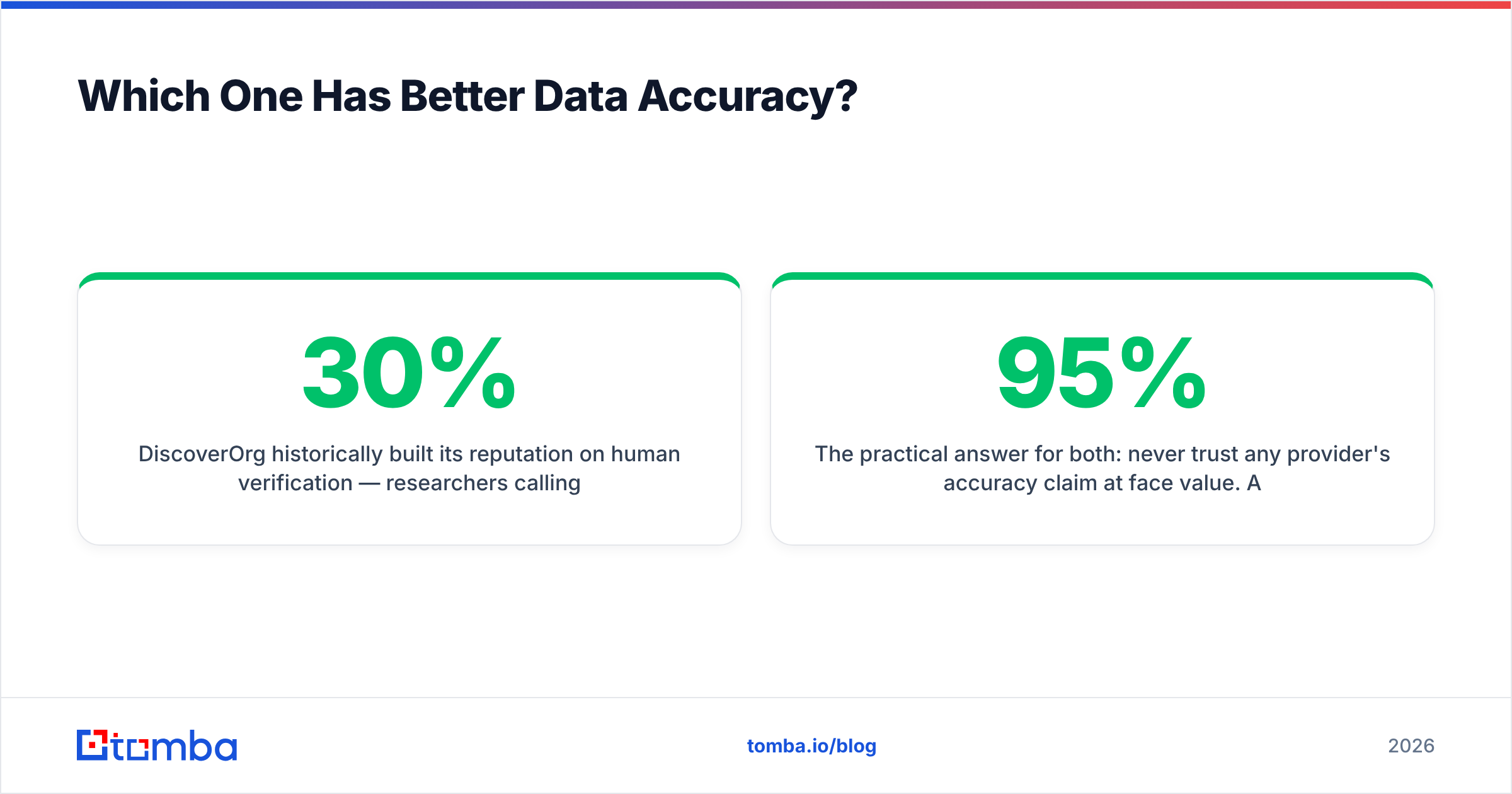
DiscoverOrg historically built its reputation on human verification — researchers calling and confirming records on a rolling cycle. That produces excellent accuracy at a moment in time, but B2B data decays fast: roughly 30% of contacts change roles or companies every year. Quarterly re-verification can't fully outrun that decay, which is why even premium databases ship with stale rows.
CapitalConnectorAI leans on continuous machine refresh — crawling signals and re-scoring constantly. That keeps the intent layer fresh, but ML-inferred emails can carry more guesswork than human-verified ones. The trade-off is breadth and recency versus per-record certainty.
The practical answer for both: never trust any provider's accuracy claim at face value. A "95% accurate" badge on a marketing page is measured under the vendor's own ideal conditions. Before you load a list into your sequencer, run it through independent email verification to catch the 10–25% that went stale since the database last refreshed. If you sell into mid-market and enterprise, also screen for catch-all domains with a catch-all verifier — those inflate "valid" counts and quietly torch your sender reputation.
This is the unglamorous truth nobody in a demo wants to admit: data quality is a process, not a purchase. Whichever platform you choose, verification at the point of use matters more than the freshness date on the invoice.
Is CapitalConnectorAI Better Than DiscoverOrg for Pricing?#
For most teams under 200 reps, yes — but "cheaper" and "better value" aren't the same thing.
DiscoverOrg/ZoomInfo's enterprise positioning means contracts frequently start in the $15K–$30K+ range and climb with seats, credits, and add-on modules like intent. Multi-year deals are common, and so is the dreaded mid-contract upsell. You're buying a platform, and platforms are sticky by design.
CapitalConnectorAI's annual cost typically lands lower and with more flexibility, which makes it attractive to teams that can't justify a five-figure-plus commitment for a database they'll use seasonally. But watch the credit model — AI-enrichment platforms often meter usage, and heavy prospecting months can blow past your allotment.
Here's the reframe most buyers miss. Ask what you're actually paying for:
- Org-chart intelligence — genuinely hard to replicate; worth premium dollars if ABM is your motion.
- Intent signals — valuable, but increasingly available from cheaper point tools and your own product analytics.
- Contact records (email + phone) — the part both platforms charge the most for, and the part that's most commoditized.
If line three is 80% of why you're buying, you're overpaying. A dedicated email finder plus phone finder covers that need directly. Compare the math: Tomba's pricing runs a free tier (25 searches/mo), Starter at $49/mo, Growth at $99/mo, and Pro at $249/mo — annualized, the Pro plan costs less than a month of an enterprise data contract.
Who Should Choose Each Platform?#
Match the tool to your motion, not to the loudest sales rep.
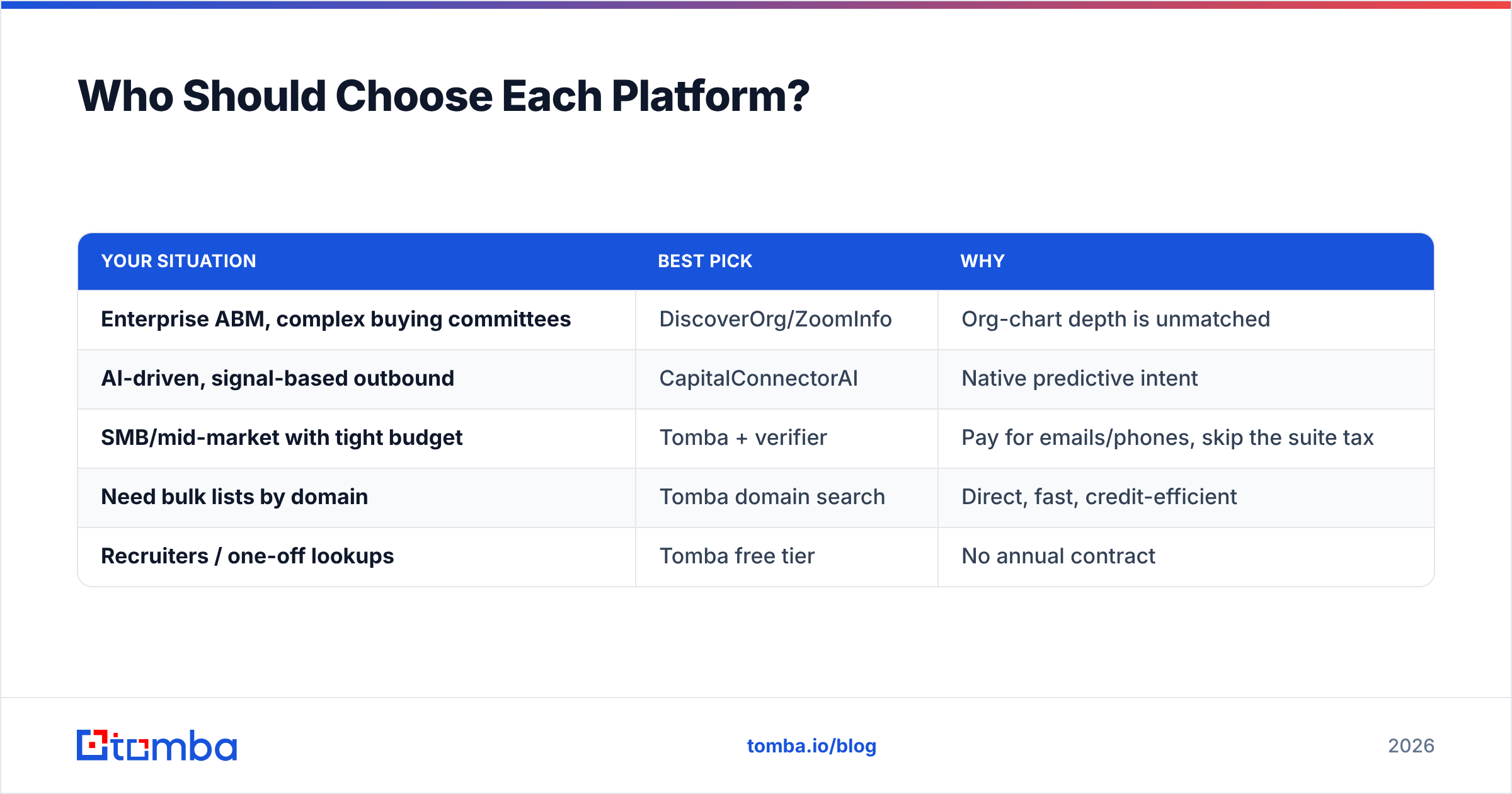
| Your situation | Best pick | Why |
|---|---|---|
| Enterprise ABM, complex buying committees | DiscoverOrg/ZoomInfo | Org-chart depth is unmatched |
| AI-driven, signal-based outbound | CapitalConnectorAI | Native predictive intent |
| SMB/mid-market with tight budget | Tomba + verifier | Pay for emails/phones, skip the suite tax |
| Need bulk lists by domain | Tomba domain search | Direct, fast, credit-efficient |
| Recruiters / one-off lookups | Tomba free tier | No annual contract |
Choose DiscoverOrg/ZoomInfo if you sell six-figure deals into large organizations where knowing the reporting structure changes your strategy. The price hurts, but mapping a 12-person buying committee correctly can pay for the whole contract with one closed deal.
Choose CapitalConnectorAI if your team lives and dies by timing — you'd rather call 50 warm accounts than 500 cold ones, and you want the AI to tell you which 50. It's a strong fit for modern, data-literate GTM teams that don't need exhaustive enterprise org charts.
Choose a focused stack if, like most teams, your bottleneck is simply getting accurate contact info into your sequencer without a procurement battle. That's where buying the database outright is overkill.
What's the Smarter Alternative for Most Teams?#
A layered, pay-for-what-you-use stack beats a monolithic contract for the majority of sales orgs — and it's the option vendors least want you to consider.
The logic is simple. Enterprise suites bundle org charts, intent, contacts, and analytics into one expensive package because bundling raises switching costs. But you can assemble the parts you actually use:
- Contacts — find verified emails with an email finder and reach mobile numbers with a phone finder.
- Account lists — pull every contact at a target company via domain search.
- Scale — run thousands of lookups through a bulk email finder instead of burning enterprise credits.
- Enrichment — fill gaps in your CRM with data enrichment on demand.
- Hygiene — keep deliverability high with ongoing email verification.
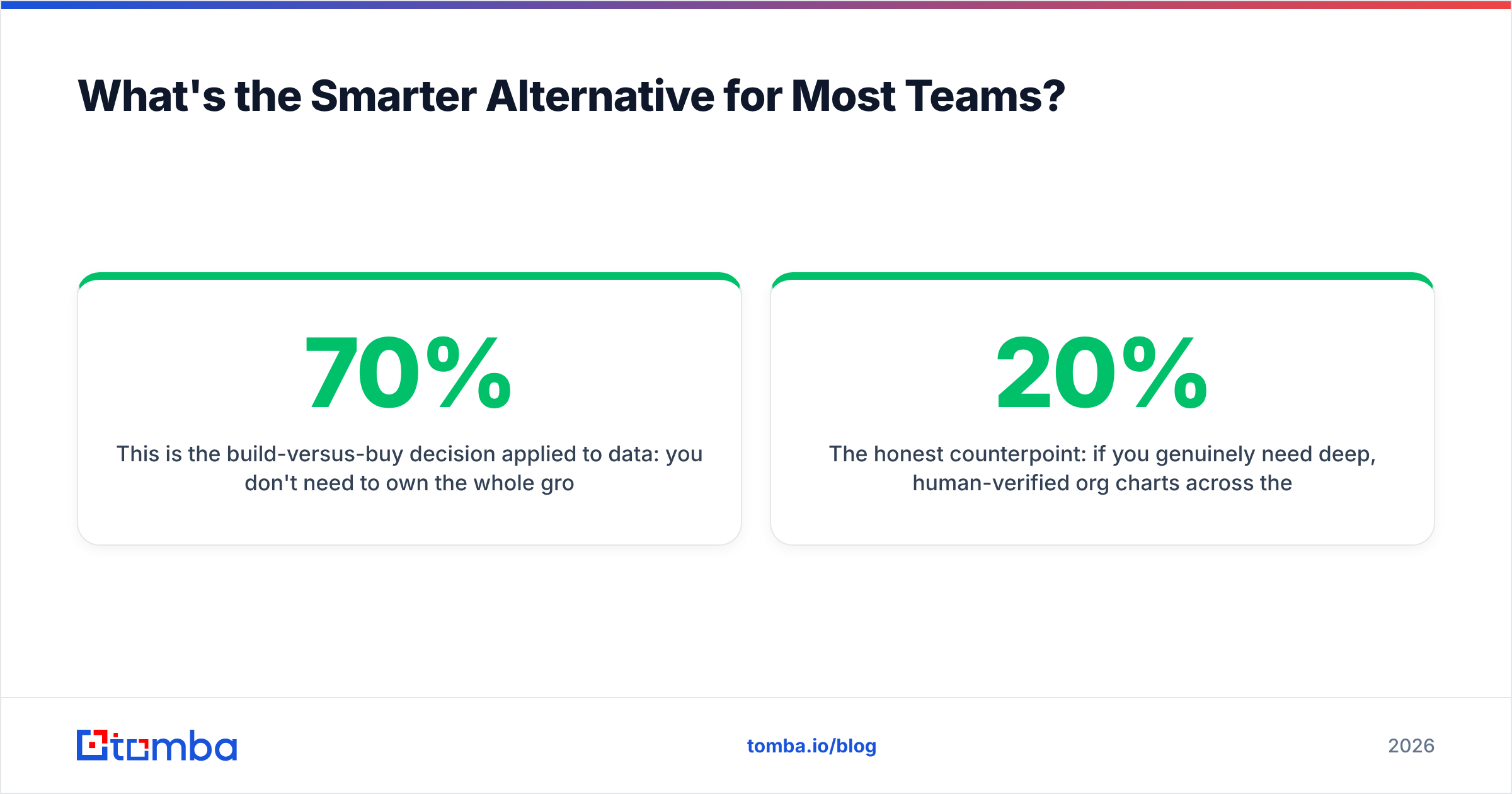
This is the build-versus-buy decision applied to data: you don't need to own the whole grocery store when you only came for milk and eggs. For intent signals specifically, your own product analytics, website visitor data, and a handful of cheap point tools often replicate 70% of what the premium intent add-on delivers — at a tenth of the cost.
The honest counterpoint: if you genuinely need deep, human-verified org charts across the Fortune 1000, no stitched-together stack matches DiscoverOrg/ZoomInfo. That depth is real and hard to fake. But be ruthless about whether you need it or just like the idea of it. Most teams discover, after one renewal cycle, that they used 20% of the platform and paid for 100%.
For deeper context on how providers source and maintain records, it's worth reading independent reviews on G2 and Capterra rather than vendor case studies — real users are blunt about coverage gaps and support quality in a way the sales deck never is. You can also see where a focused provider gets its data on Tomba's data sources page.
How Do You Test Either Tool Before Committing?#
Run a real pilot, not a guided demo — the demo always uses the vendor's cleanest accounts.
A fair head-to-head takes about an afternoon:
- Pick 100 real target accounts from your actual ICP, not a sample list.
- Pull contacts from each platform for the same accounts.
- Run every record through an independent verifier so you measure real deliverability, not claimed accuracy.
- Calculate true valid-rate — valid emails divided by total returned, per platform.
- Compare cost-per-valid-contact, which is the only pricing metric that matters.
When you do this, you'll often find the "premium" database and the budget tool land within a few percentage points of each other on valid-rate — at wildly different prices. That gap is your negotiating leverage, or your reason to switch entirely.
If you want a zero-commitment baseline, start with Tomba's free tier and a quick domain search on five target companies. You'll see exactly how complete and accurate the results are before any sales call, which is more transparency than either enterprise vendor offers upfront.
The Bottom Line#
CapitalConnectorAI and DiscoverOrg are both legitimate tools that solve real problems — but they solve them for a specific buyer with an enterprise budget. CapitalConnectorAI wins on AI-driven timing and flexibility; DiscoverOrg/ZoomInfo wins on org-chart depth and human verification. Between the two, the "right" answer depends entirely on whether your motion is signal-led or committee-led.
For everyone else — the SMB, the mid-market team, the recruiter, the founder running outbound themselves — the most expensive option is rarely the smartest one. You need accurate emails, valid phone numbers, and clean lists, not a five-figure platform you'll use a fifth of.
Start there. Use the Tomba Email Finder to pull verified, deliverable contacts by name, company, or domain — free for your first 25 searches, no contract, no sales call. Layer in the email verifier before every send, and you'll get most of what a $20K database promises for the price of a team lunch. Prove the value on your own accounts first, then decide if you ever need the enterprise suite at all.
// get started
Find, verify and enrich your first contacts today
Start on the free plan with 25 searches a month, then scale when your team is ready.
Free plan · No credit card required · GDPR & CCPA
// about the author