CapitalConnectorAI vs Generect: Lead Data Compared (2026)
CapitalConnectorAI targets investor intros; Generect sells real-time B2B lead data. We compare coverage, accuracy, pricing, and where a dedicated email finder beats both in 2026.
Choosing between CapitalConnectorAI and Generect comes down to one question: are you raising capital, or building a repeatable outbound machine? They get lumped together because both promise "better contacts, faster," but they solve different problems. This breakdown shows where each one fits, where each one breaks, and why a verified email finder usually sits underneath whichever you pick.
TL;DR#
- CapitalConnectorAI is built for founders and capital-raisers — it focuses on matching you with investors and warm introductions, not bulk prospecting.
- Generect is a real-time B2B data provider — LinkedIn-sourced leads, company filters, and API access aimed at SDR and growth teams.
- Neither is a pure email finder; CapitalConnectorAI optimizes for fit, Generect for volume, and both leave verification as your problem.
- For accuracy-sensitive outbound, pairing either tool with a dedicated email verifier cuts bounce rates more than switching platforms.
- If your core need is finding and verifying business emails at scale, a focused tool like the Tomba Email Finder is cheaper and more accurate than buying a broad data suite.
What is CapitalConnectorAI?#
CapitalConnectorAI is a fundraising-focused matching tool. Instead of dumping a list of 10,000 contacts on you, it tries to connect founders with relevant investors — VCs, angels, and family offices — based on stage, sector, check size, and thesis fit. The pitch is quality of match over quantity of records.
That framing matters. If you are a seed-stage founder who needs 30 well-targeted investor conversations, a volume database is the wrong tool. You do not want 50,000 generic contacts; you want the 40 funds that actually write checks into your category. CapitalConnectorAI leans into that "right door, warm intro" model.
The trade-off: it is narrow. It is not designed for SDRs prospecting into 5,000 mid-market accounts, and it is not a general-purpose source of work emails for cold outreach. Outside fundraising, its dataset and workflow stop being useful fast.
What is Generect?#
Generect is a B2B lead data platform. It sources contact and company records — heavily from LinkedIn — and exposes them through search filters and an API. The use case is classic outbound: define an ICP (industry, headcount, title, geography), pull matching people, push them into your sequencer or CRM, and start emailing.
Generect's selling point is "real-time" lookups rather than a stale, pre-scraped dump. When you query, it attempts to fetch current data, which in theory reduces the decay problem every static B2B database suffers from. For teams running high-volume outbound, that freshness claim is the main reason to look at it over an older list vendor.
The catch is the same one every data provider faces: a returned email is a guess until something verifies it. Real-time sourcing helps with job-change churn, but it does not guarantee the address is deliverable today.

CapitalConnectorAI vs Generect: how do they actually differ?#
The cleanest way to see the gap is by job-to-be-done. These tools barely overlap once you get past "they both give you contacts."
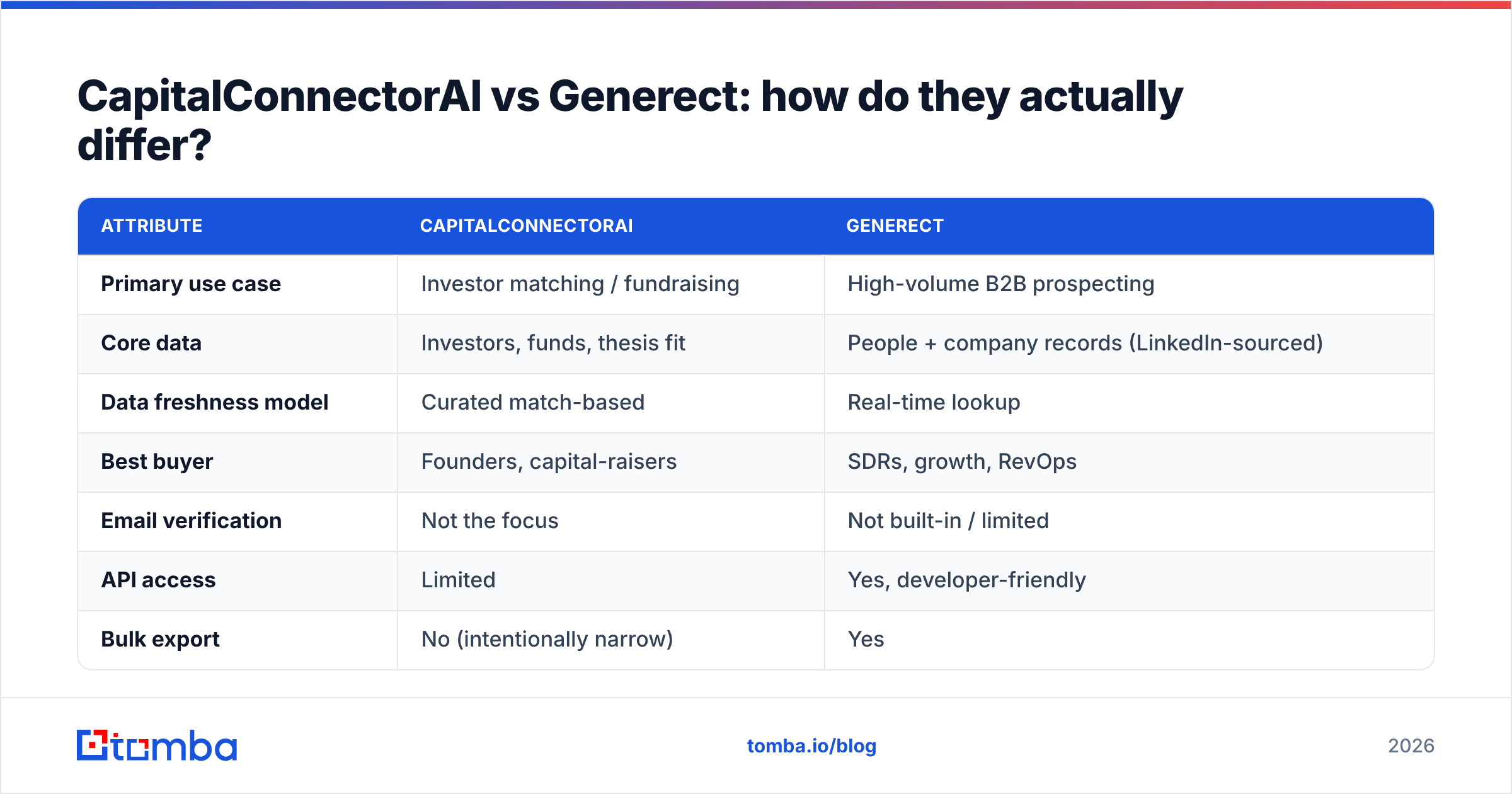
| Attribute | CapitalConnectorAI | Generect |
|---|---|---|
| Primary use case | Investor matching / fundraising | High-volume B2B prospecting |
| Core data | Investors, funds, thesis fit | People + company records (LinkedIn-sourced) |
| Data freshness model | Curated match-based | Real-time lookup |
| Best buyer | Founders, capital-raisers | SDRs, growth, RevOps |
| Email verification | Not the focus | Not built-in / limited |
| API access | Limited | Yes, developer-friendly |
| Bulk export | No (intentionally narrow) | Yes |
| Pricing model | Fundraising-tier / custom | Credit / subscription |
Read that table top to bottom and the decision almost makes itself. You are not really comparing two competitors — you are choosing which problem you have this quarter.
When should you pick CapitalConnectorAI?#
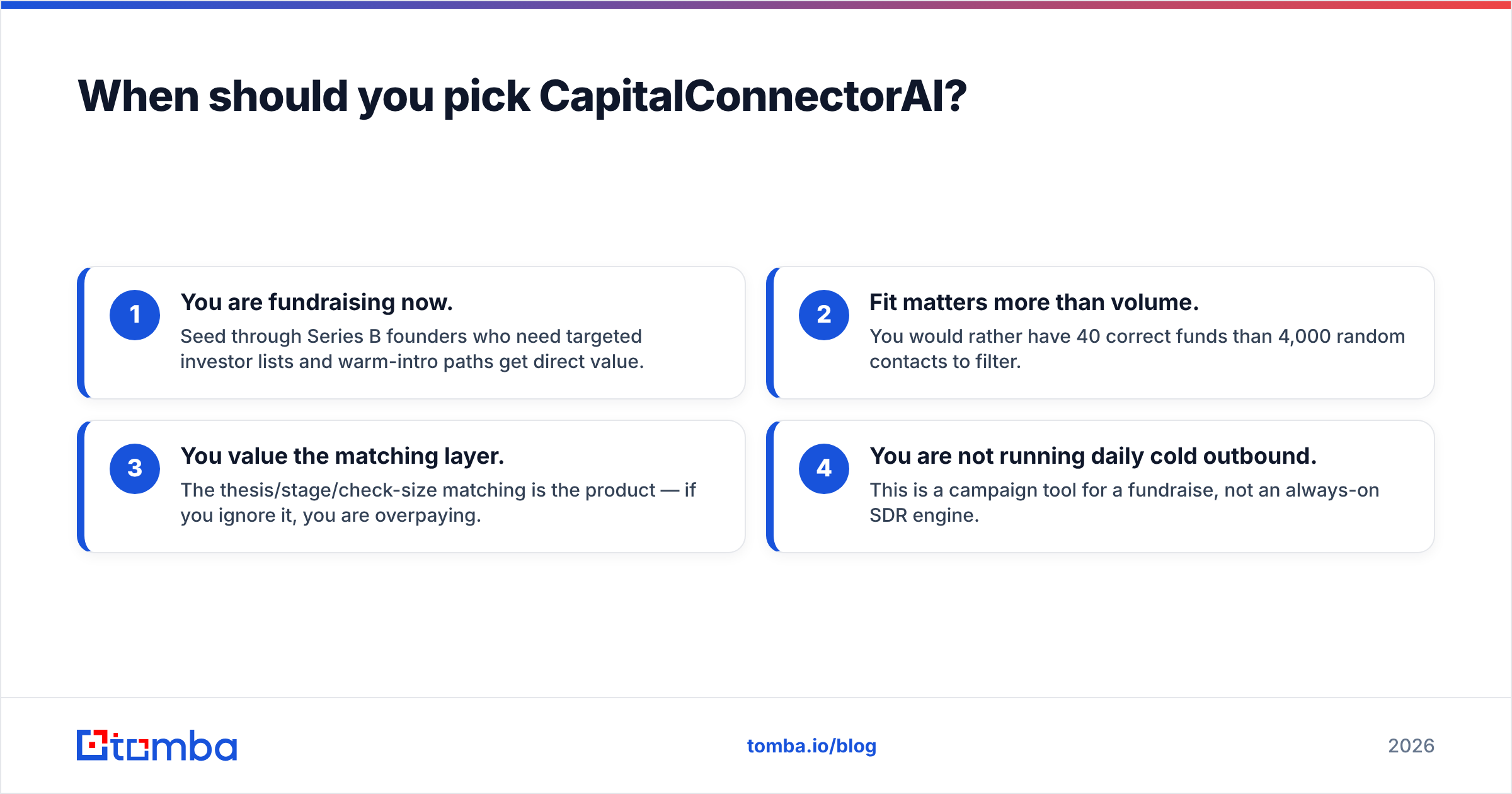
Pick CapitalConnectorAI when raising money is the actual goal, not generic pipeline. Use these signals:
- You are fundraising now. Seed through Series B founders who need targeted investor lists and warm-intro paths get direct value.
- Fit matters more than volume. You would rather have 40 correct funds than 4,000 random contacts to filter.
- You value the matching layer. The thesis/stage/check-size matching is the product — if you ignore it, you are overpaying.
- You are not running daily cold outbound. This is a campaign tool for a fundraise, not an always-on SDR engine.
If you are an SDR team trying to book demos with VPs of Engineering at 500-person SaaS companies, CapitalConnectorAI is simply the wrong shape. There is no shame in that — it was never built for you.
When should you pick Generect?#
Pick Generect when you are building repeatable outbound and need a steady supply of fresh, filterable B2B contacts.
- You run sequences and need to refill your list every week.
- You have a developer who wants to pull leads via API into your own stack.
- Your ICP is well-defined and you want LinkedIn-grade firmographic filters.
- You care about job-change freshness because your last static list rotted.
Generect competes with the broader pack of data tools, and like most of them, its weakest link is what happens after the export. A list is only as good as its deliverability, and that is where most teams quietly lose 20-30% of a campaign to bounces they could have caught.
Why does email verification decide the winner?#
Here is the conclusion first: neither tool wins your outbound for you — verification does. You can buy the freshest data on the market and still tank your sender reputation if a chunk of those addresses bounce.
Think of a prospect list like fresh produce. CapitalConnectorAI hands you a small, hand-picked basket. Generect hands you a full crate, restocked daily. But neither one washes the fruit. Send to unverified addresses and your bounce rate climbs, mailbox providers flag you, and even your good emails start landing in spam. One bad campaign can poison the inbox placement of the next ten.
This is why a dedicated verification step pays for itself. Running every address through an email verifier — and screening risky catch-all domains before you send — protects the sender reputation you spend months building. According to G2 reviews across the data-tooling category, "bounce rate" and "data accuracy" are the two complaints that show up most, regardless of which vendor's logo is on the box.

How do CapitalConnectorAI and Generect compare on price and value?#
Pricing is where the use-case split becomes a budget question. CapitalConnectorAI's value is concentrated in a single fundraising window — you may use it intensely for three months and then not at all. Generect is an ongoing operational cost that scales with how much you prospect.
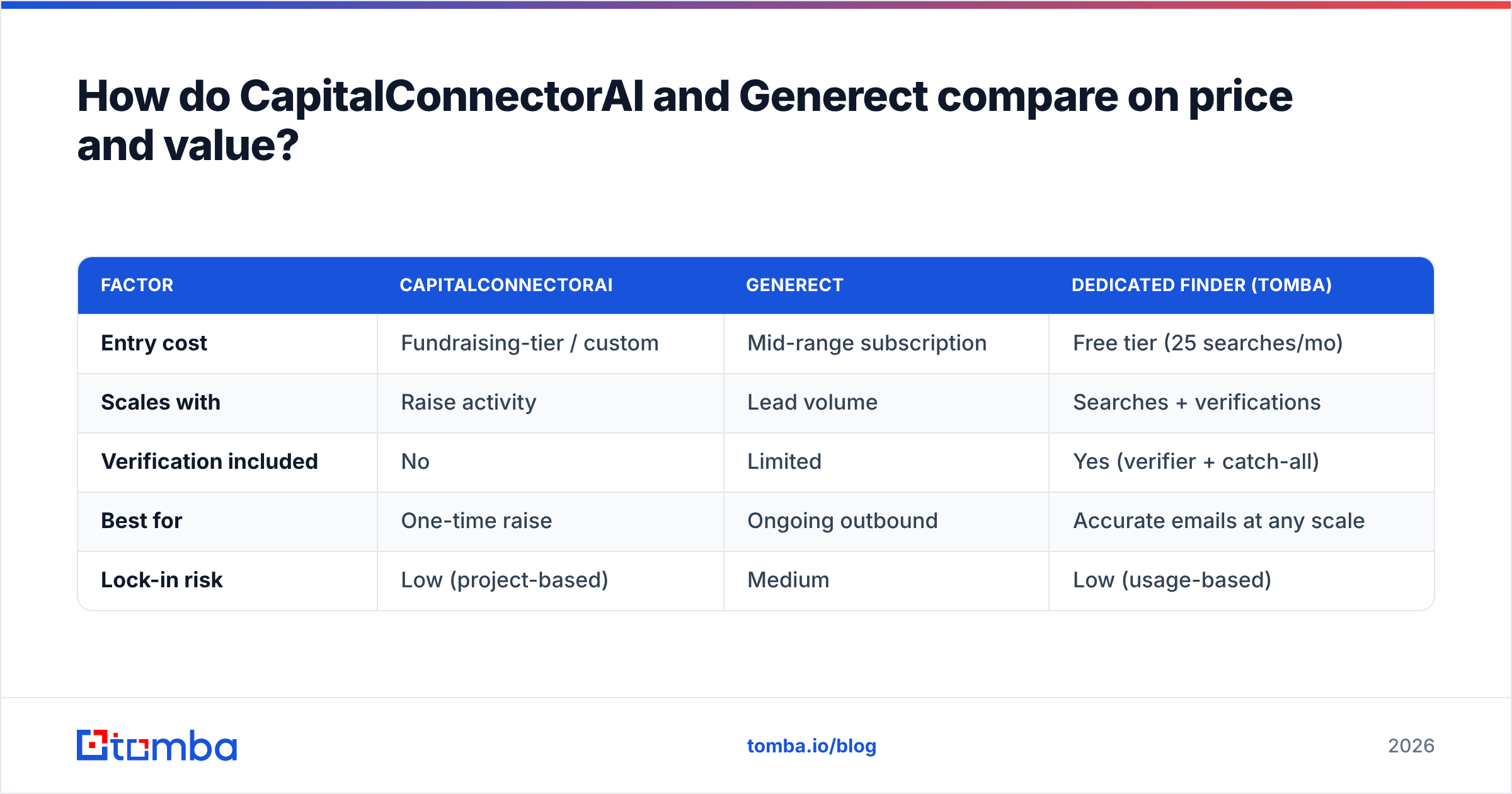
| Factor | CapitalConnectorAI | Generect | Dedicated finder (Tomba) |
|---|---|---|---|
| Entry cost | Fundraising-tier / custom | Mid-range subscription | Free tier (25 searches/mo) |
| Scales with | Raise activity | Lead volume | Searches + verifications |
| Verification included | No | Limited | Yes (verifier + catch-all) |
| Best for | One-time raise | Ongoing outbound | Accurate emails at any scale |
| Lock-in risk | Low (project-based) | Medium | Low (usage-based) |
The honest read: if your spend is justified by a fundraise, CapitalConnectorAI is a focused bet. If you prospect continuously, Generect is a reasonable data layer — but you will still want a verification and enrichment step beneath it. And if "I just need correct work emails" is the whole job, neither broad platform is the cheapest path to it. A focused finder with transparent Tomba pricing — Starter at $49/mo, Growth at $99/mo — often replaces the part of these suites you actually use every day.
Where does a dedicated email finder fit alongside them?#
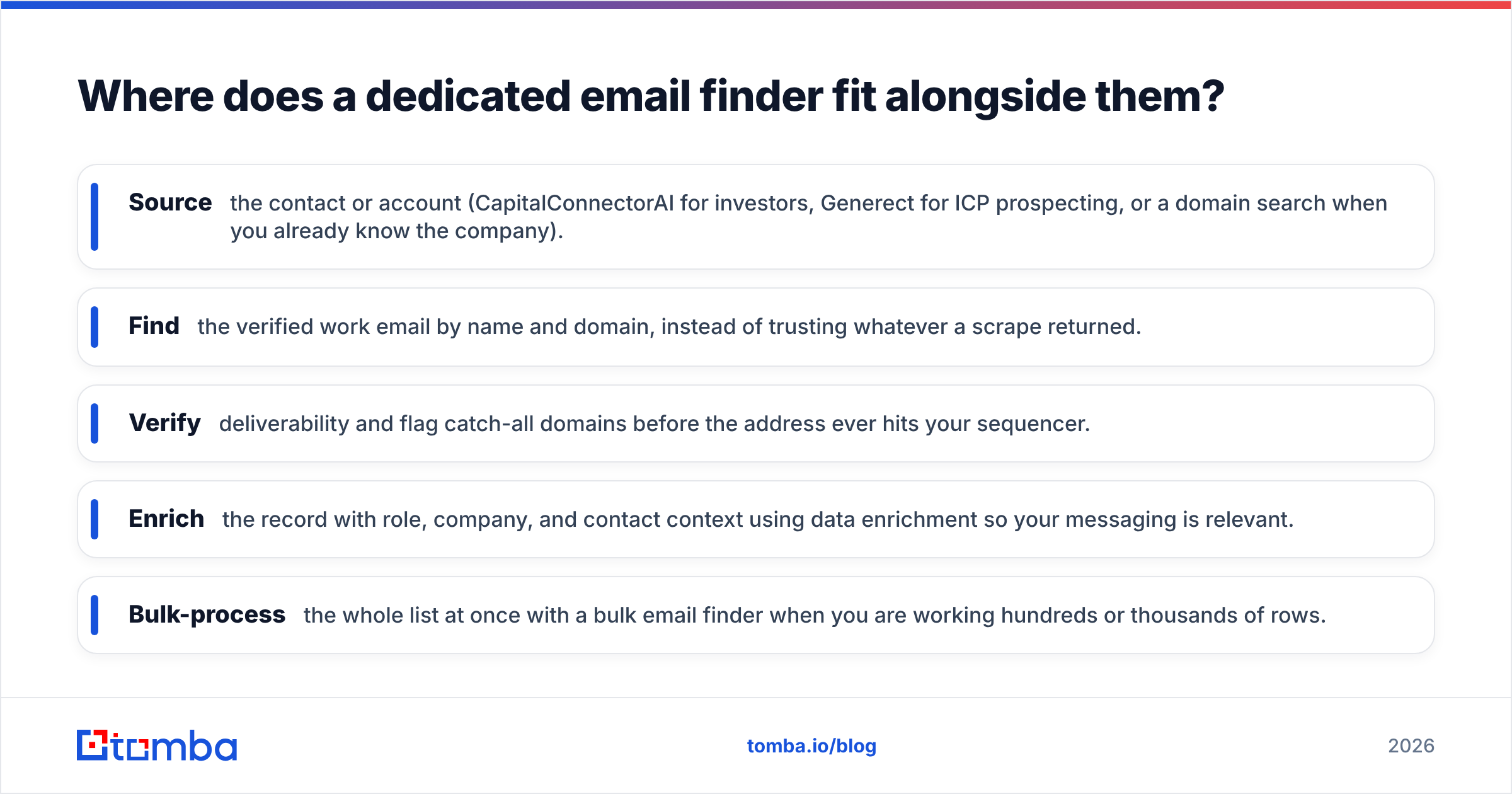
A dedicated finder is the layer that makes either platform safe to send from. The workflow most disciplined teams converge on looks like this:
- Source the contact or account (CapitalConnectorAI for investors, Generect for ICP prospecting, or a domain search when you already know the company).
- Find the verified work email by name and domain, instead of trusting whatever a scrape returned.
- Verify deliverability and flag catch-all domains before the address ever hits your sequencer.
- Enrich the record with role, company, and contact context using data enrichment so your messaging is relevant.
- Bulk-process the whole list at once with a bulk email finder when you are working hundreds or thousands of rows.
That stack is tool-agnostic on purpose. Whether your top-of-funnel is CapitalConnectorAI, Generect, or a manual LinkedIn list, the find-verify-enrich middle is what controls bounce rate and reply rate. Tomba is built specifically for that middle, with a documented email finder API so you can wire it into the same automated flow Generect users already favor.
Is CapitalConnectorAI or Generect better for cold email deliverability?#
Neither, directly — and that is the point. Deliverability is downstream of three things they don't fully own: list hygiene, sender reputation, and authentication (SPF/DKIM/DMARC). CapitalConnectorAI's small, curated lists are naturally lower-risk because you are sending to fewer, more relevant people. Generect's volume is higher-reward but higher-risk precisely because scale multiplies any accuracy gap.
If you are optimizing for inbox placement, your leverage is in the verification and warmup layer, not the data vendor. Verify before you send, throttle new domains, and keep your bounce rate under control. Industry guidance from sources like HubSpot consistently ties reply rates to list quality far more than to which database the list came from.
Which tool should you choose in 2026?#
Decide on identity, not feature lists:
- You are a founder raising a round → CapitalConnectorAI. Its matching layer is the product, and warm investor intros are worth more than raw volume.
- You are a sales or growth team running outbound → Generect for fresh, filterable data — but budget for a verification step on top.
- You mainly need accurate, deliverable work emails → skip the broad suite tax and use a dedicated finder. You will spend less and bounce less.
Most teams discover the answer is "and," not "or." Use the right sourcing tool for your motion, then run every address through a finder and verifier so the inbox — not the spam folder — is where your outreach lands.
The bottom line#
CapitalConnectorAI and Generect are not really rivals; they are tools for two different jobs. CapitalConnectorAI wins for focused fundraising. Generect wins for high-volume B2B prospecting. But whichever you choose, the deliverability of your emails is decided after the data leaves the platform — by verification, enrichment, and list hygiene.
If your real bottleneck is finding correct, verified business emails and keeping bounce rates low, start with the part of the stack that does exactly that. Try the Tomba Email Finder — find professional email addresses by domain, name, or company, verify them in the same flow, and start on the free tier (25 searches/month) before you commit a dollar. It is the cheapest insurance your outbound budget can buy.
Ready to find emails that actually work?
Join 150,000+ professionals who stopped guessing and started sending. Free credits on signup — no credit card required.
Get the Tomba newsletter
Practical outbound tactics and product updates — once every two weeks.
About the author