CapitalConnectorAI vs LeadzenAI: 2026 Lead Tool Showdown
CapitalConnectorAI vs LeadzenAI compared head-to-head for 2026: data quality, pricing, workflows, and which lead intelligence tool actually fits your outbound motion.
Choosing between CapitalConnectorAI and LeadzenAI comes down to one question most buyers skip: do you need a relationship-and-capital matching engine, or a high-volume B2B prospecting database? They get lumped together as "AI lead tools," but they solve different jobs. This breakdown shows where each one wins, where each one leaks budget, and how to make sure the contacts you pull actually land in an inbox.
TL;DR — Which one should you pick?#
- CapitalConnectorAI leans toward investor, partner, and capital-introduction workflows — it's strongest when your "lead" is a fund, an LP, or a strategic partner, not a cold SaaS buyer.
- LeadzenAI is a broader B2B prospecting and contact-discovery platform built for volume outbound — think list-building, intent signals, and real-time lead search.
- Neither tool is a substitute for a dedicated verification layer; both can hand you stale or risky addresses that quietly wreck deliverability.
- Pair whichever you choose with a verification and enrichment step. A clean email verifier pass before send is the cheapest insurance in your stack.
- If your core need is simply finding and confirming work emails at scale, a focused tool like Tomba often beats paying for a heavyweight platform you'll half-use.
What is CapitalConnectorAI?#
CapitalConnectorAI positions itself around capital and relationship intelligence — matching companies with investors, partners, and decision-makers who control budget or funding. Instead of treating every contact as an identical row in a CSV, it weights signals like funding stage, mandate fit, and warm-path connections.
That framing matters. If you're a founder raising a round, an agency chasing enterprise partnerships, or a corp-dev team mapping acquisition targets, "the right 40 contacts" beats "40,000 contacts" every time. CapitalConnectorAI is built for that narrow-but-high-value motion.
The tradeoff is breadth. A capital-matching engine is not optimized to spit out 10,000 verified SDR-ready emails for a cold sequence. Its value lives in fit and context, not raw record count.
What is LeadzenAI?#
LeadzenAI is a B2B lead-generation and prospecting platform. Its pitch is real-time lead search, contact discovery across companies and roles, and enrichment that turns a thin name into a usable record with title, company, and contact details. You can read user impressions on directories like G2 and Capterra before committing.
LeadzenAI is the more familiar shape for outbound teams: build a list by filters (industry, geography, role), pull contacts, push to your sequencer or CRM. It competes in the same category as the mainstream prospecting databases, with an AI layer on search and scoring.
The catch is the one every database shares: coverage and freshness vary by region and seniority, and "found an email" is not the same as "that email is deliverable today."

How do CapitalConnectorAI and LeadzenAI differ at the core?#
Here's the fastest way to tell them apart before you read another feature list:
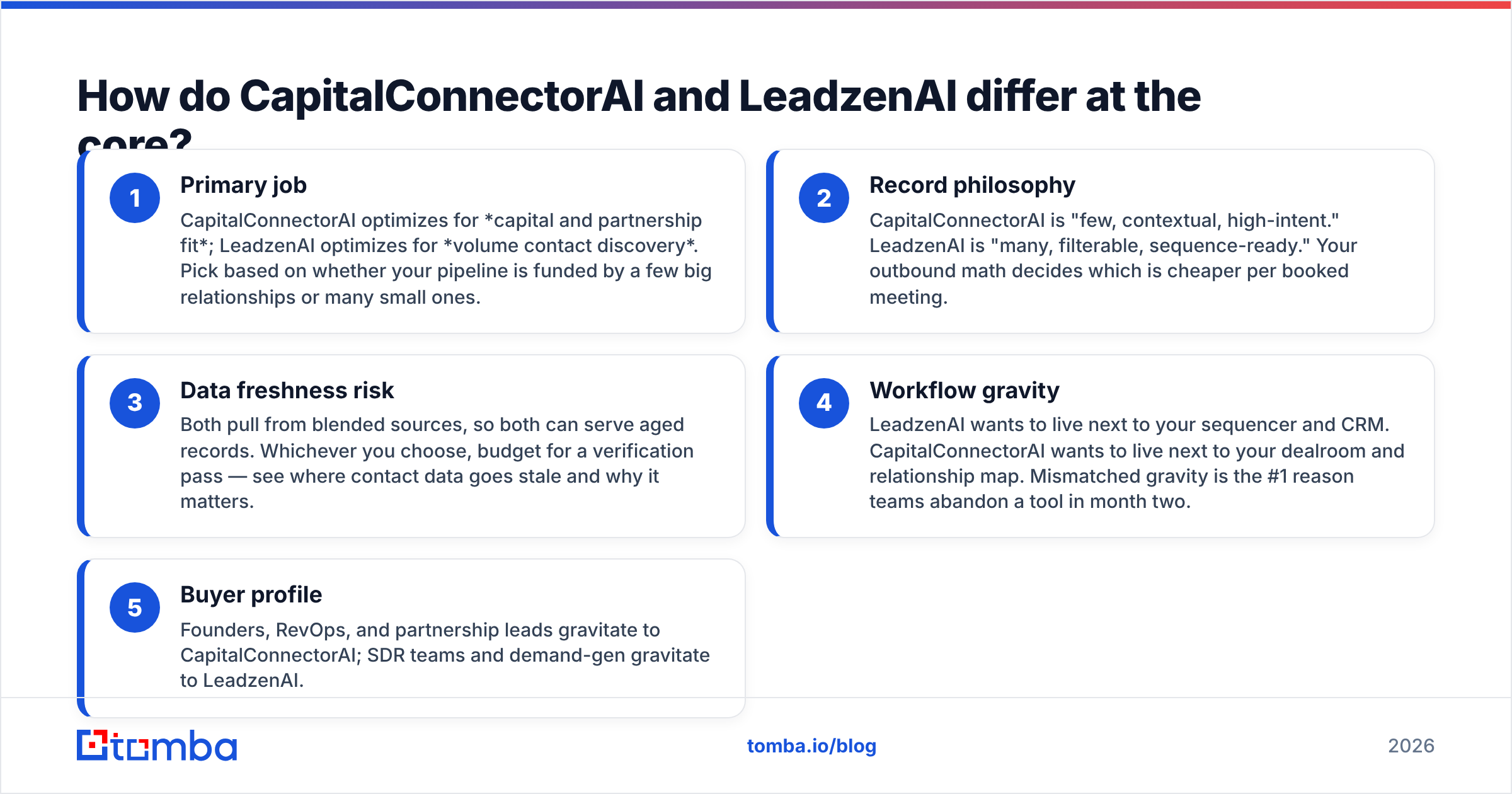
- Primary job — CapitalConnectorAI optimizes for capital and partnership fit; LeadzenAI optimizes for volume contact discovery. Pick based on whether your pipeline is funded by a few big relationships or many small ones.
- Record philosophy — CapitalConnectorAI is "few, contextual, high-intent." LeadzenAI is "many, filterable, sequence-ready." Your outbound math decides which is cheaper per booked meeting.
- Data freshness risk — Both pull from blended sources, so both can serve aged records. Whichever you choose, budget for a verification pass — see where contact data goes stale and why it matters.
- Workflow gravity — LeadzenAI wants to live next to your sequencer and CRM. CapitalConnectorAI wants to live next to your dealroom and relationship map. Mismatched gravity is the #1 reason teams abandon a tool in month two.
- Buyer profile — Founders, RevOps, and partnership leads gravitate to CapitalConnectorAI; SDR teams and demand-gen gravitate to LeadzenAI.
If you can answer "what is one lead worth to me, and how many do I need this quarter," you've basically already chosen.
CapitalConnectorAI vs LeadzenAI: side-by-side comparison#
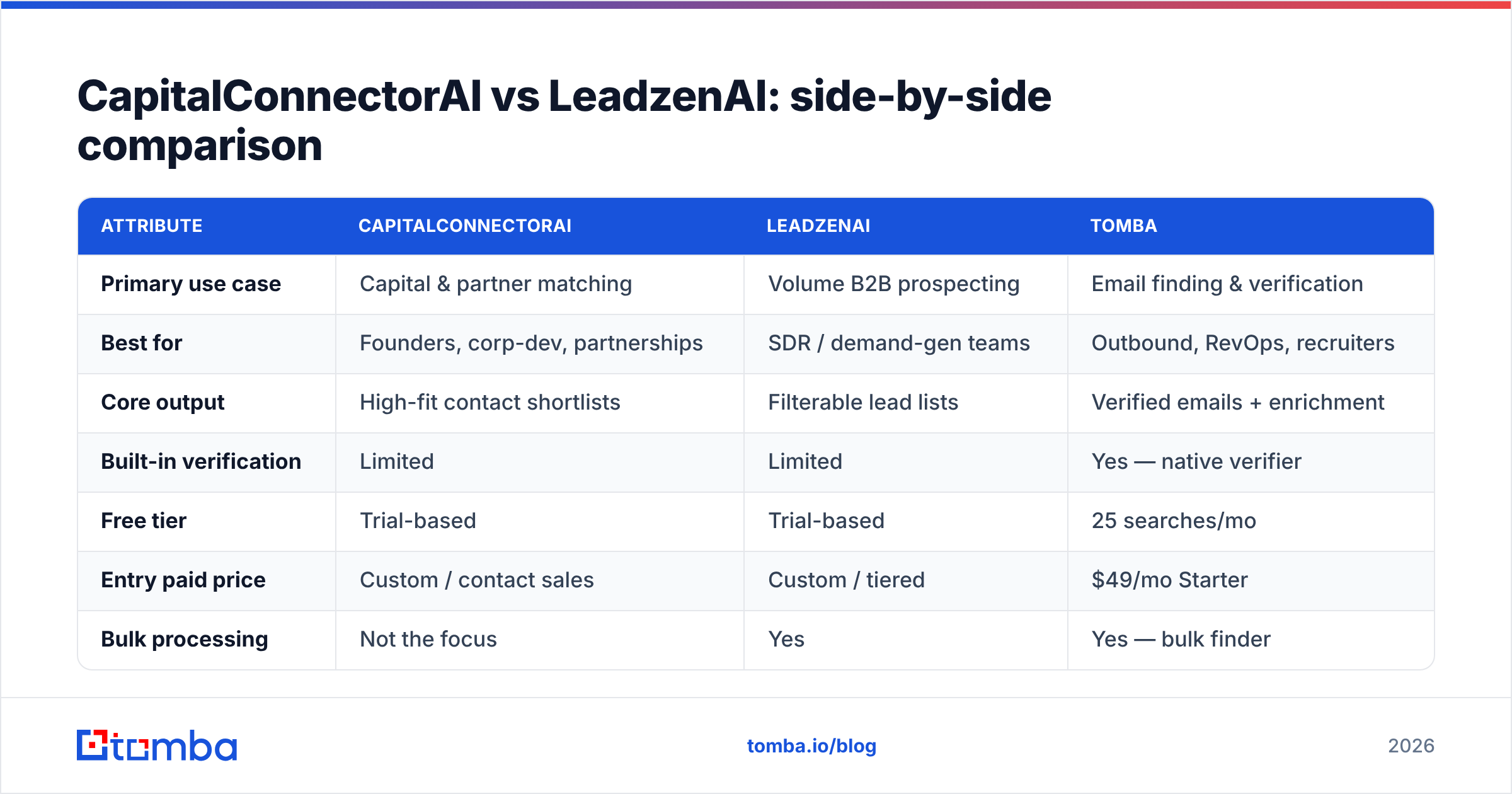
Pricing and limits below reflect the publicly positioned shape of each tool at the time of writing — always confirm current numbers on each vendor's own pricing page, since AI-tool plans change fast. Tomba is included as the focused alternative for teams whose real need is finding and verifying work emails.
| Attribute | CapitalConnectorAI | LeadzenAI | Tomba |
|---|---|---|---|
| Primary use case | Capital & partner matching | Volume B2B prospecting | Email finding & verification |
| Best for | Founders, corp-dev, partnerships | SDR / demand-gen teams | Outbound, RevOps, recruiters |
| Core output | High-fit contact shortlists | Filterable lead lists | Verified emails + enrichment |
| Built-in verification | Limited | Limited | Yes — native verifier |
| Free tier | Trial-based | Trial-based | 25 searches/mo |
| Entry paid price | Custom / contact sales | Custom / tiered | $49/mo Starter |
| Bulk processing | Not the focus | Yes | Yes — bulk finder |
| API access | Varies | Varies | Yes — documented API |
| Catch-all handling | Not specialized | Not specialized | Dedicated catch-all tools |
The pattern is clear: the two named platforms are discovery tools, and neither makes verification its headline. That gap is exactly where deliverability problems start.
Is data accuracy better with CapitalConnectorAI or LeadzenAI?#
Neither tool publishes an independently audited, head-to-head accuracy benchmark, so treat any single "95% accurate" marketing claim with caution. Accuracy in this category is contextual: it swings hard by region, company size, and how senior the contact is. A platform that nails US mid-market VPs can miss badly on EMEA ICs.
What actually protects your sender reputation is the step after discovery. Whatever a tool hands you, run it through verification before it touches a live sequence:
- Confirm the mailbox exists with an email verification pass, not just a syntax check.
- Screen catch-all domains separately — a domain that accepts everything tells you nothing until you test it with a catch-all verifier.
- Enrich and de-dupe before import so you're not paying to email the same person twice; a clean data enrichment step pays for itself in list hygiene.
- Monitor bounce rate per source so you can tell which tool is quietly degrading.
Skipping this is how a "great list" turns into a sender reputation problem that takes weeks to repair.

Which tool fits your workflow?#
Map the tool to the motion, not the hype.
Pick CapitalConnectorAI if:
- Your pipeline is a handful of high-value relationships (investors, channel partners, enterprise accounts).
- Context and warm paths matter more than raw volume.
- You measure success in meetings with the right people, not emails sent.
Pick LeadzenAI if:
- You run a volume outbound motion and need fresh, filterable lists weekly.
- Your SDRs live in a sequencer and want fast list-to-CRM handoff.
- You're comparing it against mainstream prospecting databases and want an AI-search angle.
Pick a focused finder + verifier (like Tomba) if:
- Your real bottleneck is "I have names and companies, I just need the right verified email."
- You want predictable per-credit costs instead of an all-in-one platform fee.
- You need clean data piped into existing tools rather than another dashboard. Tomba's integrations cover HubSpot, Salesforce, Sheets, and more, so the data lands where you already work.
Many teams end up running two layers: a discovery tool for who, and a verification tool for is this real and safe to send. That's not redundancy — it's the difference between a 2% bounce rate and a 12% one.
How much should you actually pay?#
Platform pricing for AI lead tools is increasingly "contact sales," which makes budgeting hard and lock-in easy. Before signing an annual deal, pressure-test the cost per booked meeting, not the sticker price.
A quick framework:
- Estimate usable records per month. Discount the vendor's claimed database size by your real ICP filter rate — it's usually a tiny fraction.
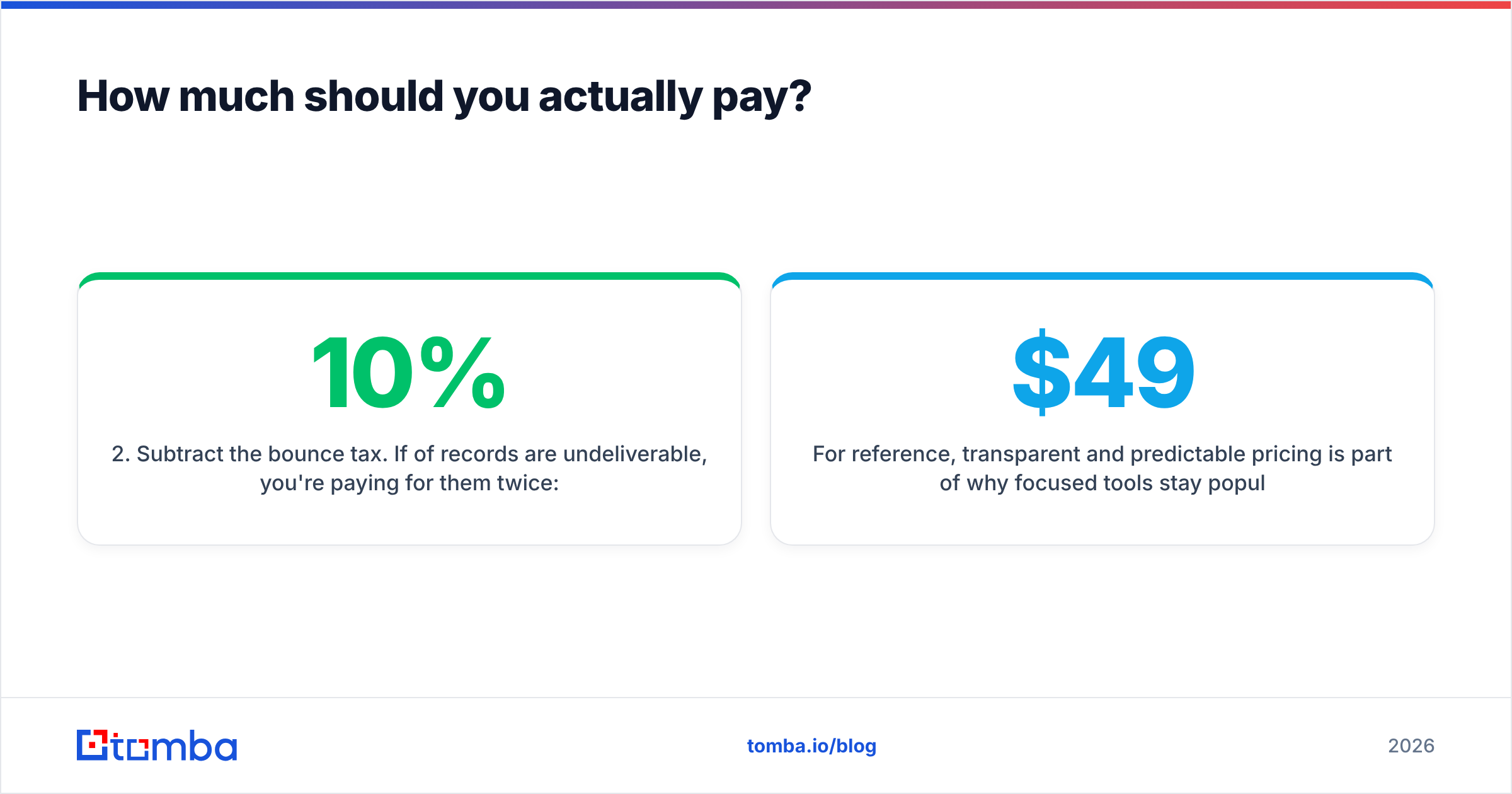
- Subtract the bounce tax. If 10% of records are undeliverable, you're paying for them twice: once in fees, once in reputation damage.
- Add the verification line item. It's small relative to a platform seat and it protects everything downstream.
- Compare to a focused stack. Sometimes a discovery tool plus an affordable finder/verifier beats a single enterprise contract you'll only half-use.
For reference, transparent and predictable pricing is part of why focused tools stay popular — you can see exact tiers on the Tomba pricing page (Free at 25 searches/mo, Starter at $49/mo, Growth at $99/mo, Pro at $249/mo) instead of negotiating a black-box quote. For a deeper look at how vendors structure data costs, HubSpot's resources on sales prospecting are a solid neutral primer.
What are the main pros and cons?#
| Pros | Cons | |
|---|---|---|
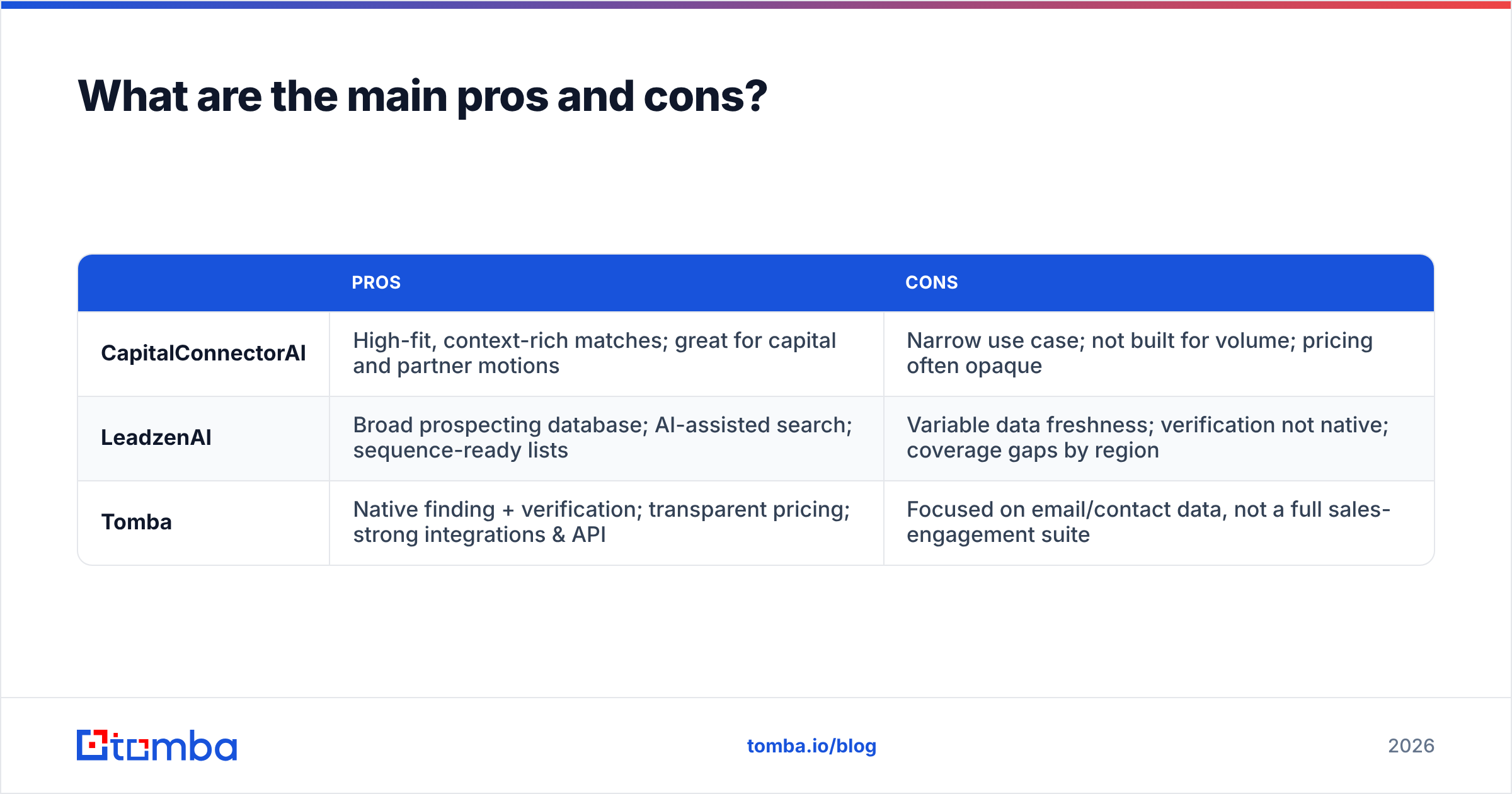
| CapitalConnectorAI | High-fit, context-rich matches; great for capital and partner motions | Narrow use case; not built for volume; pricing often opaque |
| LeadzenAI | Broad prospecting database; AI-assisted search; sequence-ready lists | Variable data freshness; verification not native; coverage gaps by region |
| Tomba | Native finding + verification; transparent pricing; strong integrations & API | Focused on email/contact data, not a full sales-engagement suite |
The honest takeaway: CapitalConnectorAI and LeadzenAI are discovery engines aimed at different ends of the market, and both leave verification as an exercise for the buyer. Whichever you choose, don't let the contact data ship unchecked.
How do you make either tool's data actually convert?#
Discovery is step one of five, and the other four decide your reply rate:
- Verify before send. Always. A bulk verify pass on every imported list is non-negotiable for sender health.
- Warm the domain. New sending domains need ramp time before volume — check your readiness with a warmup calculator.
- Fix your records. Publish proper SPF, DKIM, and DMARC so verified emails don't land in spam anyway.
- Personalize on the enriched fields. The whole point of enrichment is relevance — use the title, company, and signal data, don't waste it.
- Track response, not just opens. Optimize toward response rate, the only metric that ties to pipeline.
Do these and a "B-grade" list outperforms an "A-grade" list that someone blasted raw. The tool you pick matters less than the hygiene you wrap around it.
The bottom line#
CapitalConnectorAI and LeadzenAI aren't really rivals — they're different answers to different questions. If your growth depends on a few funded relationships, CapitalConnectorAI's fit-first approach is compelling. If you need a steady flow of filterable B2B leads for outbound, LeadzenAI is the more natural shape. But both share the same blind spot: the contact data is only as good as the verification step you add after it.
If your actual bottleneck is finding and confirming the right work email — fast, at a predictable price, with the verification built in — start with the Tomba Email Finder. Find emails by domain, name, or company, verify them in the same workflow, and push clean records straight into your CRM. Run a discovery tool for who to contact, and let Tomba make sure those contacts actually reach an inbox. Spin up the free tier (25 searches/mo, no card) and test it against any list your current platform exports — your bounce rate will tell you everything.
// get started
Find, verify and enrich your first contacts today
Start on the free plan with 25 searches a month, then scale when your team is ready.
Free plan · No credit card required · GDPR & CCPA
// about the author