CapitalConnectorAI vs Pubrio: B2B Data Compared (2026)
CapitalConnectorAI vs Pubrio: a neutral, side-by-side look at data coverage, accuracy, pricing, and which lead-gen platform actually fits your outbound motion in 2026.
Choosing between CapitalConnectorAI and Pubrio comes down to one question most comparison posts dodge: do you need a niche relationship-mapping tool aimed at capital and investor outreach, or a broad B2B prospecting database that feeds an everyday outbound machine? They are not the same product, and picking the wrong one wastes a quarter of pipeline.
This is a straight, vendor-neutral breakdown. Where one tool genuinely wins, it gets credit. Where a leaner stack beats both, that gets said too.
TL;DR — CapitalConnectorAI vs Pubrio at a glance#
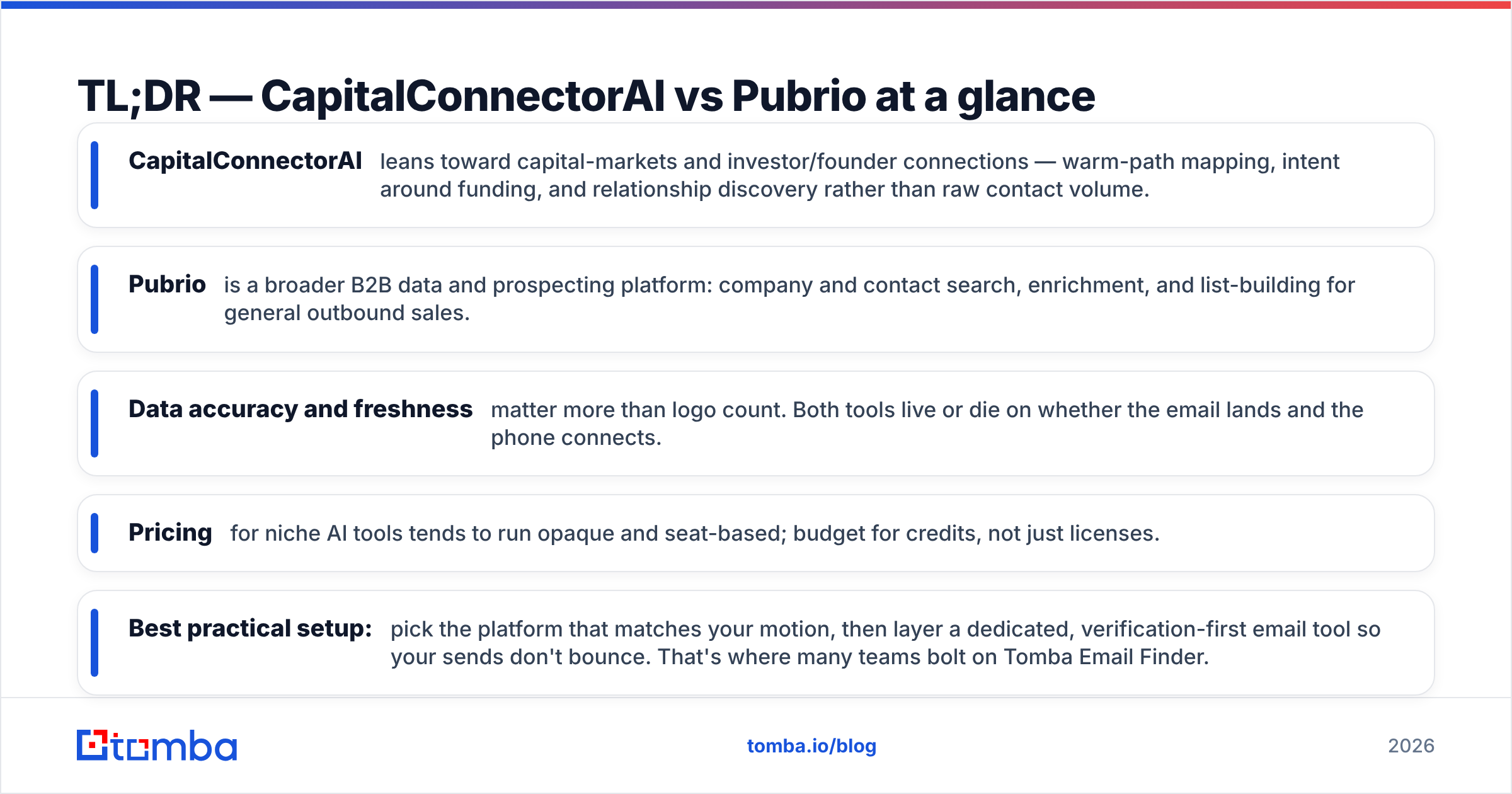
- CapitalConnectorAI leans toward capital-markets and investor/founder connections — warm-path mapping, intent around funding, and relationship discovery rather than raw contact volume.
- Pubrio is a broader B2B data and prospecting platform: company and contact search, enrichment, and list-building for general outbound sales.
- Data accuracy and freshness matter more than logo count. Both tools live or die on whether the email lands and the phone connects.
- Pricing for niche AI tools tends to run opaque and seat-based; budget for credits, not just licenses.
- Best practical setup: pick the platform that matches your motion, then layer a dedicated, verification-first email tool so your sends don't bounce. That's where many teams bolt on Tomba Email Finder.
What is CapitalConnectorAI?#
CapitalConnectorAI positions itself as an AI layer for capital-oriented relationship building — think founders looking for investors, agencies chasing funded accounts, or business-development teams that care about who is connected to whom and which companies just raised. Its value proposition is less "here are 200 million contacts" and more "here is the warm path to the person who controls the budget."
That focus shapes everything. If your sales motion is built on timing (a company closes a round, then needs vendors), and on relationship proximity (a mutual connection beats a cold list), a tool tuned for that signal can outperform a generic database — for that one job.
The trade-off is breadth. A specialist built around capital signals is rarely the best tool for, say, prospecting 5,000 mid-market SaaS ops managers who have nothing to do with fundraising.
What is Pubrio?#
Pubrio is a general-purpose B2B prospecting and data platform. The core jobs are familiar: search for companies and people by filters, build targeted lists, enrich records with firmographic and contact data, and export into your CRM or sequencer. It competes in the same arena as the well-known sales-intelligence suites, and reviewers on directories like G2 and Capterra tend to evaluate these platforms on coverage, accuracy, and ease of export.
Pubrio's pitch is "all-in-one" — you find, enrich, and organize without leaving the tool. That convenience is real, but all-in-one platforms historically trade depth for breadth: the bundled email and phone data is often thinner than a dedicated finder-and-verifier, and you pay for modules you may not use.
If you want a deeper look at how the broad-suite category behaves, our breakdown of Apollo alternatives covers the same all-in-one trade-offs that apply to Pubrio.
CapitalConnectorAI vs Pubrio: how do they compare?#
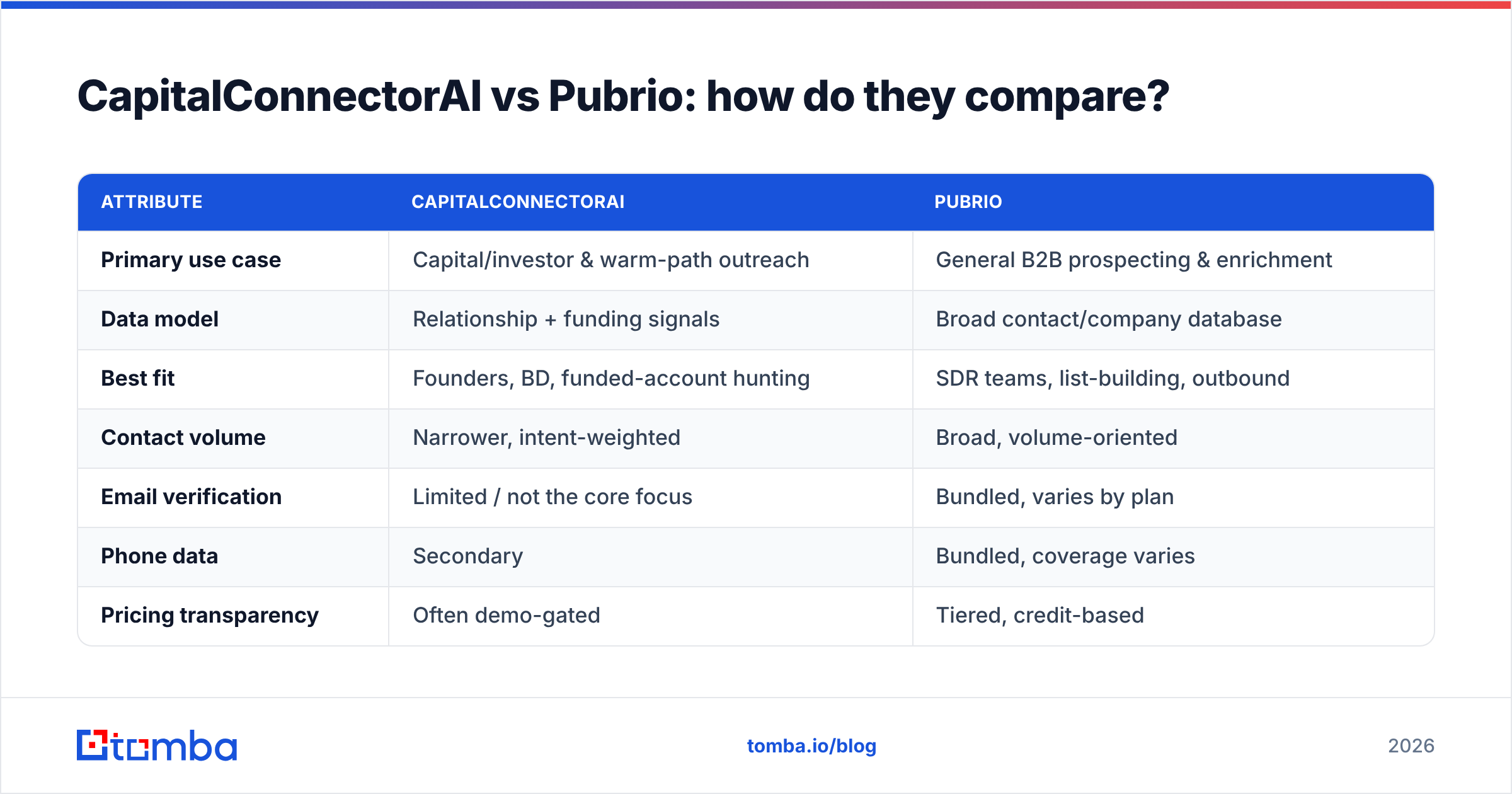
Here is the side-by-side. Treat pricing as directional — niche AI vendors change tiers often and frequently hide numbers behind a demo call, so confirm on the vendor's own site before you buy.
| Attribute | CapitalConnectorAI | Pubrio |
|---|---|---|
| Primary use case | Capital/investor & warm-path outreach | General B2B prospecting & enrichment |
| Data model | Relationship + funding signals | Broad contact/company database |
| Best fit | Founders, BD, funded-account hunting | SDR teams, list-building, outbound |
| Contact volume | Narrower, intent-weighted | Broad, volume-oriented |
| Email verification | Limited / not the core focus | Bundled, varies by plan |
| Phone data | Secondary | Bundled, coverage varies |
| Pricing transparency | Often demo-gated | Tiered, credit-based |
| CRM/export | Varies | Native exports + integrations |
The honest summary: these tools serve different buyers. CapitalConnectorAI wins when who is connected and who just got funded is the signal that closes deals. Pubrio wins when volume and self-serve list-building is the job. Neither is a drop-in replacement for the other.

Which one is more accurate?#
Accuracy is the only metric that survives contact with a real send. A list of 10,000 records is worthless if 30% bounce — you torch your sender reputation and land the rest in spam.
Three things decide whether either tool's data actually works:
- Source diversity. Data assembled from many corroborating sources beats single-source scraping. Ask each vendor where the data comes from and how often it refreshes.
- Verification at point of use. A record that was valid six months ago may be dead. The platforms that verify at export outperform those that verify at ingest.
- Catch-all handling. Many corporate domains accept every address, so a naive "valid" check passes garbage. A real catch-all verifier is what separates a usable list from a bounce farm.
Neither CapitalConnectorAI nor Pubrio publishes independently audited accuracy rates that you should take at face value — almost no vendor in this space does. The practical move is to verify before you trust: run a sample of either tool's output through a dedicated email verifier and measure the real bounce rate yourself before committing budget.
What about pricing and value?#
Niche AI tools and all-in-one suites price very differently, and both categories tend to be more expensive than a focused finder-plus-verifier once you add seats and credits.
- CapitalConnectorAI typically uses a demo-gated or seat-based model. Specialist intent tools justify premium pricing on timing — if catching a funding event early is worth a deal, the cost math works. If not, you're overpaying.
- Pubrio uses tiered, credit-based pricing common to prospecting databases. Watch the credit burn: enrichment and reveal actions consume credits fast, and the entry tier rarely covers a full SDR team's monthly volume.
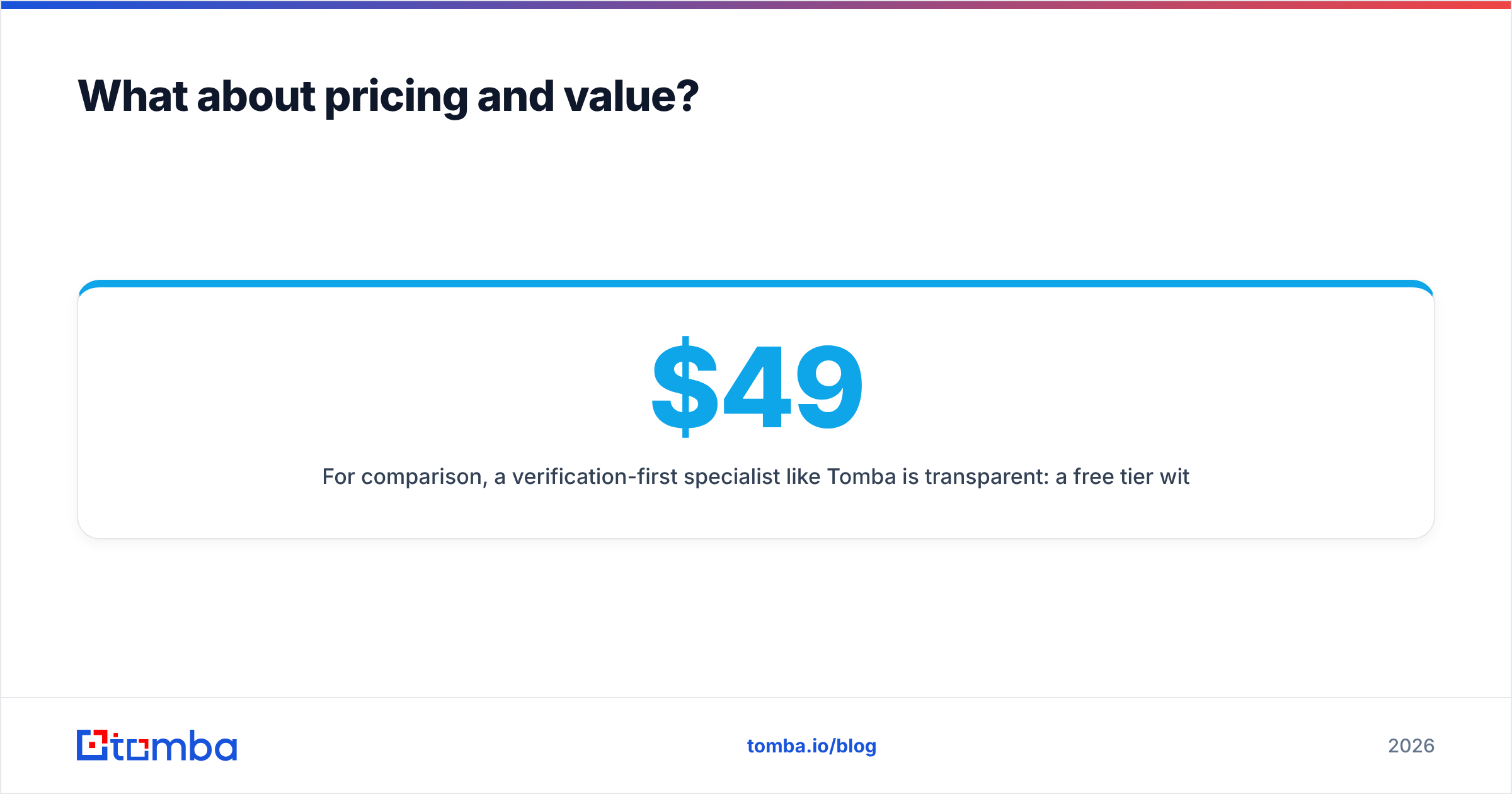
For comparison, a verification-first specialist like Tomba is transparent: a free tier with 25 searches per month, then Starter at $49/mo, Growth at $99/mo, and Pro at $249/mo. You can see the full Tomba pricing breakdown without a sales call. The point isn't that cheaper always wins — it's that you should be able to model cost-per-verified-contact before you sign, and opaque pricing makes that impossible.

Can you just use one tool for everything?#
Usually not — and trying to is where teams overspend. The realistic stack pattern looks like this:
- If your motion is capital-driven (funded accounts, investor intros), a specialist signal tool earns its place at the top of funnel. But you still need a finder/verifier underneath it to get the actual deliverable address.
- If your motion is volume outbound, an all-in-one like Pubrio handles discovery, but you'll often want a dedicated verification pass before sending to protect email deliverability.
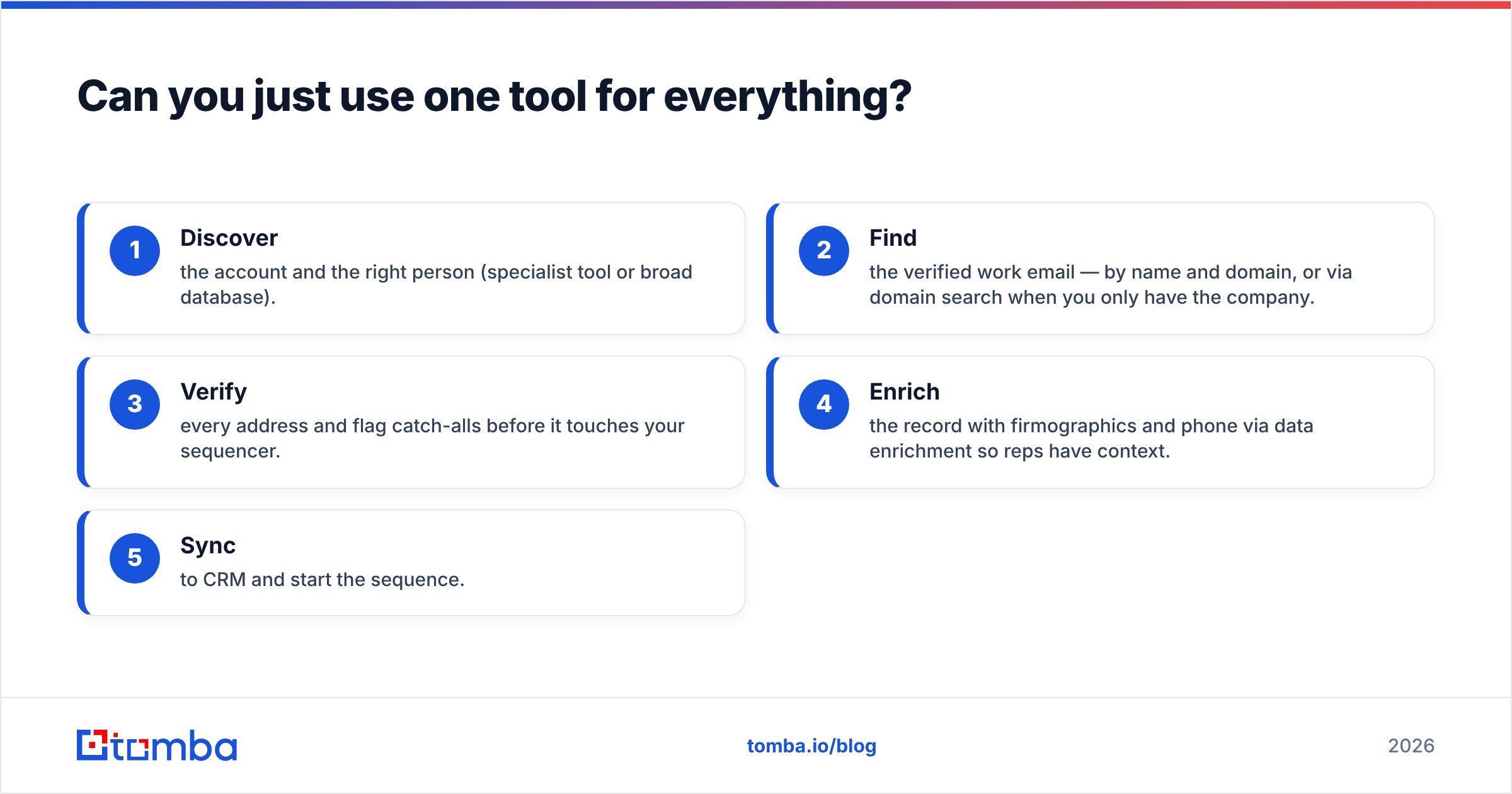
A clean reference architecture for either path:
- Discover the account and the right person (specialist tool or broad database).
- Find the verified work email — by name and domain, or via domain search when you only have the company.
- Verify every address and flag catch-alls before it touches your sequencer.
- Enrich the record with firmographics and phone via data enrichment so reps have context.
- Sync to CRM and start the sequence.
Most "vs" debates ignore steps 2 and 3 — which is exactly why so many well-sourced lists still bounce. Industry analysts at Gartner consistently note that data decay (people changing jobs, companies restructuring) is the silent killer of outbound performance; verification at point of use is the only durable fix.
Who should pick CapitalConnectorAI?#
Choose CapitalConnectorAI if:
- Your pipeline is genuinely capital-aware — you sell to funded startups, target investors, or your edge is warm-path introductions.
- Timing around funding events materially changes your win rate.
- You can quantify the value of a single well-timed, well-connected intro, because you'll pay a premium for that signal.
Skip it if you need to prospect at volume across industries that have nothing to do with fundraising. You'd be paying for intelligence you can't use.
Who should pick Pubrio?#
Choose Pubrio if:
- You want a self-serve, all-in-one prospecting database and don't want to stitch tools together.
- Your team values one login over best-of-breed depth.
- You're comfortable running your own verification pass to compensate for bundled-data thinness.
Skip it if your priority is the highest possible deliverability per dollar — bundled email data rarely beats a dedicated finder-and-verifier on accuracy, and the credit model can get expensive at scale.
What's the smarter setup for most teams?#
Match the discovery tool to your motion — then put a verification-first finder under it. That's the recommendation that holds regardless of which of these two you lean toward.
Whatever surfaces the account, you still need a deliverable, verified email at the moment a rep is ready to send. That's the gap Tomba Email Finder is built to close: find professional emails by name, domain, or company, verify them in the same flow, handle catch-all domains honestly, and push clean records to your CRM through the Tomba API or native integrations. Start on the free tier, run your CapitalConnectorAI or Pubrio output through it, and compare the real bounce rate — let the numbers, not the marketing, decide your stack.
Frequently asked questions#
Is CapitalConnectorAI a replacement for Pubrio? No. CapitalConnectorAI is a capital/relationship-focused specialist; Pubrio is a broad prospecting database. They overlap only at the edges.
Which has better email accuracy? Neither publishes audited rates worth trusting blindly. The reliable approach is to verify a sample of each tool's output yourself before buying.
Do I still need a separate email verifier? In most cases, yes. Bundled verification rarely matches a dedicated email verifier, especially on catch-all domains.
What's the cheapest way to test fit? Pull a small sample list from each tool, verify it, and measure bounce rate and connect rate. Tomba's free tier lets you do that pass at no cost.
Ready to find emails that actually work?
Join 150,000+ professionals who stopped guessing and started sending. Free credits on signup — no credit card required.
Get the Tomba newsletter
Practical outbound tactics and product updates — once every two weeks.
About the author