Captain Verify vs Apollo.io 2026: Which Email Tool Wins?
Captain Verify only cleans lists; Apollo.io is a pricey all-in-one. Here's how they stack up on accuracy, pricing, and fit in 2026, plus a leaner alternative.
Choosing between Captain Verify and Apollo.io feels like comparing a pressure washer to a pickup truck. One does a single job well. The other hauls everything but costs more and asks you to learn a whole platform. Picking the wrong one wastes budget and bounces emails.
TL;DR#
- Captain Verify is a focused email verification tool. It cleans lists, checks syntax, flags catch-alls, and detects disposables. It does not find new contacts.
- Apollo.io is an all-in-one sales platform: a 270M+ contact database, email finder, sequencer, and CRM. Verification is a side feature, not the core.
- They solve different problems. If you already have a list, Captain Verify is cheaper. If you need to build lists from scratch, Apollo does more.
- Accuracy is the real battleground. Apollo's database emails skew stale; Captain Verify only validates what you feed it. Neither leads the pack on verified deliverability.
- A leaner middle path exists. Tomba combines a finder, verifier, and catch-all checker starting at $49/mo, so you are not paying platform tax for one job.
What is Captain Verify?#
Captain Verify is a pure-play email verifier. You upload a list, and it returns a clean version with each address tagged as valid, invalid, risky, or unknown. Think of it as a spell-checker for your contact database: it does not write the document, it just catches the mistakes before you hit send.
Its checks cover the standard verification stack: syntax validation, MX record lookups, SMTP handshake testing, disposable-domain detection, role-account flagging (info@, sales@), and catch-all identification. The company is based in France, which makes it a common pick for European teams that care about GDPR proximity.
What Captain Verify does not do is generate contacts. There is no prospecting database, no sequencer, no CRM. If your list is empty, Captain Verify has nothing to clean. That focus is a strength when verification is all you need and a hard limit when it is not.
What is Apollo.io?#
Apollo.io is a sales intelligence and engagement platform. Its pitch is end-to-end: find prospects in a large B2B database, enrich them, write sequences, dial them, and track everything in a built-in CRM. Verification exists, but it is bundled inside the broader find-and-engage workflow rather than offered as a standalone, tunable product.
Apollo's scale is its headline. The database advertises hundreds of millions of contacts and companies, sourced from a mix of public web crawling, user contributions, and third-party feeds. That breadth is genuinely useful for top-of-funnel list building. The trade-off is freshness: large crowd-sourced databases accumulate stale records, job-change drift, and emails that were valid two years ago but bounce today.
)
So the honest framing is not "which is better" but "which problem do you have." Captain Verify cleans. Apollo finds, then loosely cleans. Let us put them side by side.
Captain Verify vs Apollo.io: how do they compare?#
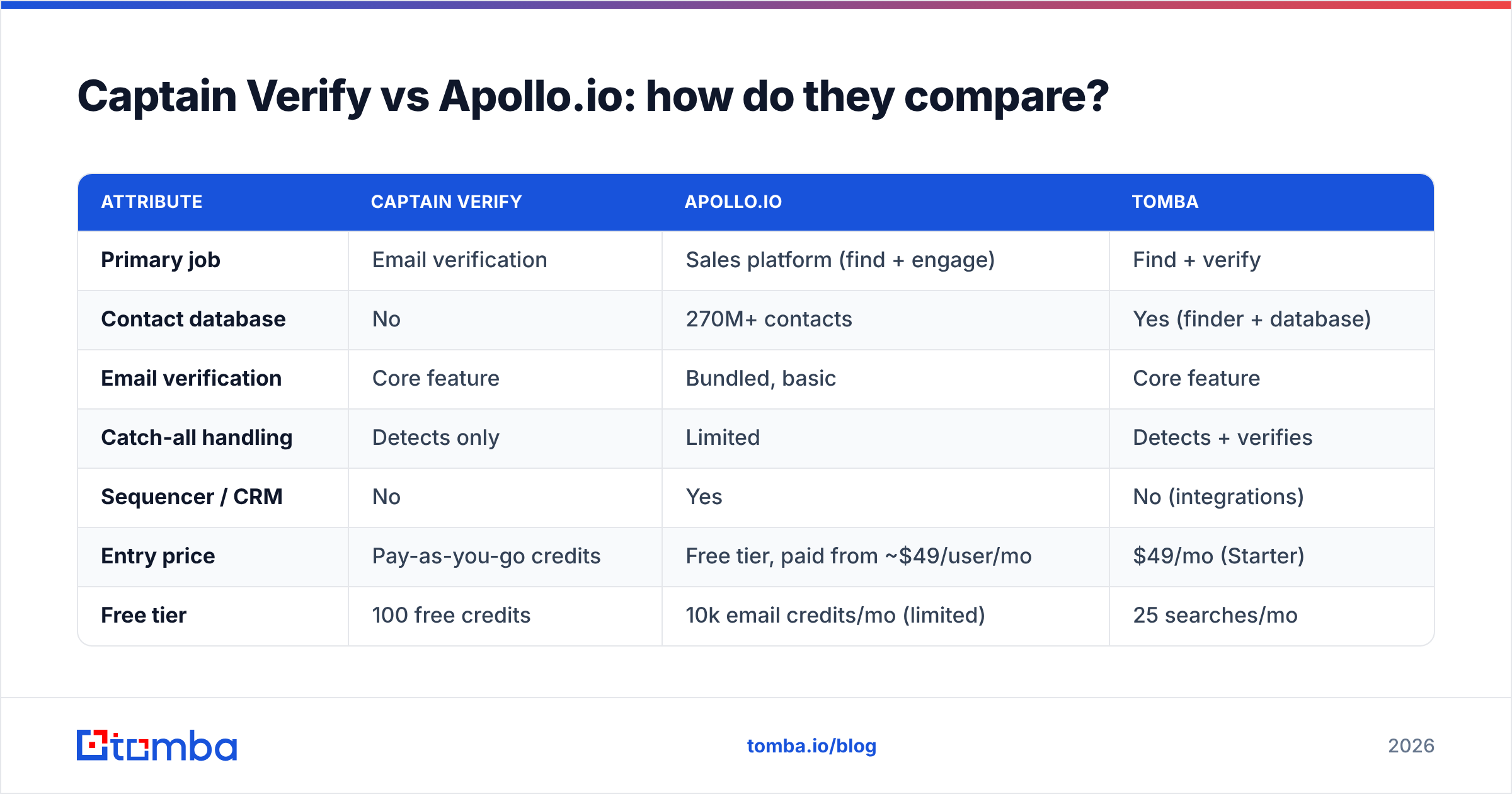
Here is the core comparison across the attributes that actually change your bounce rate and your bill.
| Attribute | Captain Verify | Apollo.io | Tomba |
|---|---|---|---|
| Primary job | Email verification | Sales platform (find + engage) | Find + verify |
| Contact database | No | 270M+ contacts | Yes (finder + database) |
| Email verification | Core feature | Bundled, basic | Core feature |
| Catch-all handling | Detects only | Limited | Detects + verifies |
| Sequencer / CRM | No | Yes | No (integrations) |
| Entry price | Pay-as-you-go credits | Free tier, paid from ~$49/user/mo | $49/mo (Starter) |
| Free tier | 100 free credits | 10k email credits/mo (limited) | 25 searches/mo |
| Best for | Cleaning existing lists | Full outbound motion | Accurate list building + cleaning |
| API access | Yes | Yes | Yes |
A few rows deserve unpacking, because the table flattens some real nuance.
Which one is more accurate?#
Accuracy depends on which half of the job you mean. For verifying a list you already own, Captain Verify and Tomba both run real SMTP checks and will give you cleaner results than Apollo's lighter verification layer. For finding new emails, Apollo's depth helps you discover contacts, but its database freshness is the weak point, so you should re-verify anything you export before sending.
This is the most common mistake teams make with Apollo: they treat database emails as send-ready. They are not. A contact pulled from any large crowd-sourced database needs an independent verification pass, or you inherit every stale record as a bounce. That bounce rate then drags down your sender reputation, which hurts every campaign after it.
Captain Verify avoids that trap by design, because it never pretends to find emails. But it also means Captain Verify alone cannot build a list. You need a finder upstream of it, which is exactly the seam where a combined tool saves you a subscription.
The structured reality of where each tool earns its accuracy:
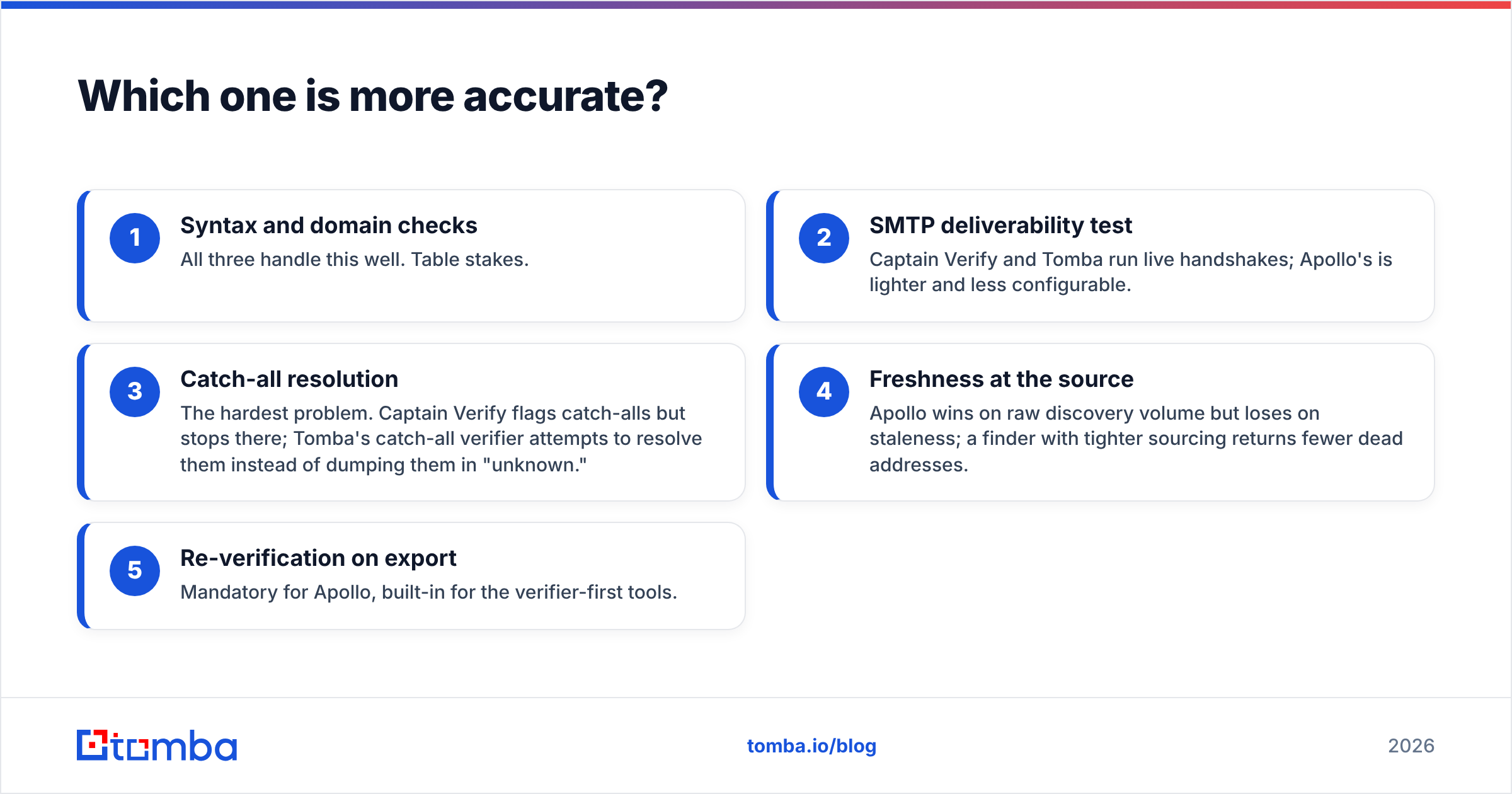
- Syntax and domain checks — All three handle this well. Table stakes.
- SMTP deliverability test — Captain Verify and Tomba run live handshakes; Apollo's is lighter and less configurable.
- Catch-all resolution — The hardest problem. Captain Verify flags catch-alls but stops there; Tomba's catch-all verifier attempts to resolve them instead of dumping them in "unknown."
- Freshness at the source — Apollo wins on raw discovery volume but loses on staleness; a finder with tighter sourcing returns fewer dead addresses.
- Re-verification on export — Mandatory for Apollo, built-in for the verifier-first tools.
What about pricing?#
Captain Verify is cheaper for pure cleaning; Apollo costs more because you are buying a platform. Captain Verify sells verification credits on a pay-as-you-go or subscription basis, so a one-time list scrub can cost very little. Apollo charges per user per month, and the meaningful prospecting features sit behind paid tiers that climb quickly as you add seats and credits.
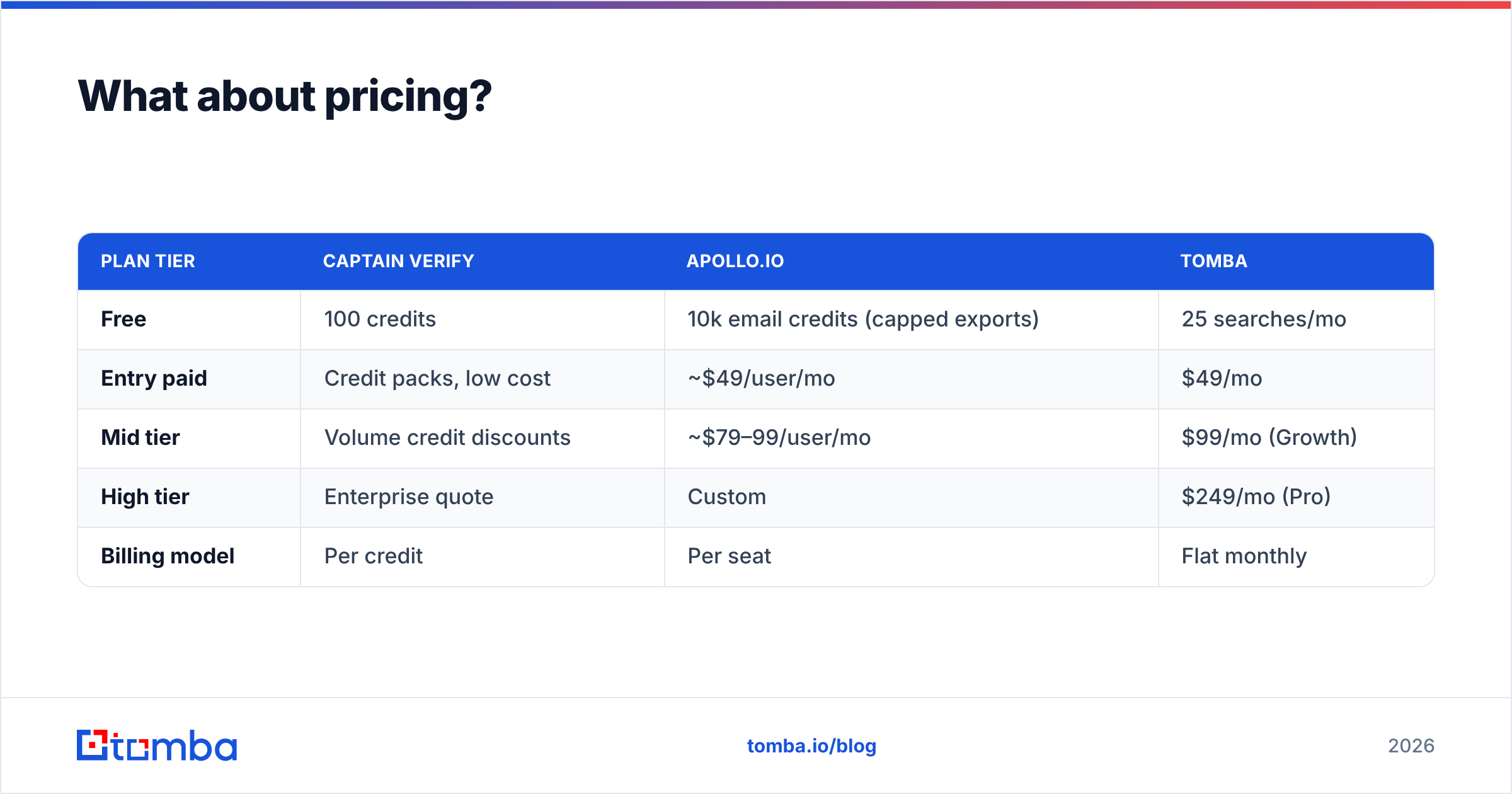
The pricing comparison that matters:
| Plan tier | Captain Verify | Apollo.io | Tomba |
|---|---|---|---|
| Free | 100 credits | 10k email credits (capped exports) | 25 searches/mo |
| Entry paid | Credit packs, low cost | ~$49/user/mo | $49/mo |
| Mid tier | Volume credit discounts | ~$79–99/user/mo | $99/mo (Growth) |
| High tier | Enterprise quote | Custom | $249/mo (Pro) |
| Billing model | Per credit | Per seat | Flat monthly |
The seat-based model is where Apollo gets expensive. A four-person SDR team on a mid Apollo tier can run several hundred dollars a month before you add credit overages. Captain Verify, by contrast, only bills for what you verify. If verification is your single need, that gap is real money. You can compare full Tomba pricing to see where a flat monthly plan lands against per-seat billing as your team grows.
Who should pick Captain Verify?#
Pick Captain Verify if you already have lists and just need them clean. Classic fits:
- You bought or inherited a contact list and need to scrub it before importing to your ESP.
- You run a newsletter and want to cut bounces before a big send.
- You are a European team that prefers an EU-based verification vendor for GDPR comfort.
- You need an occasional, low-volume clean and do not want a monthly platform commitment.
Captain Verify is honest about its lane, and that honesty is worth something. You will not pay for sequencer seats you never open. The catch is that the moment you need new contacts, you are back to shopping for a finder, and now you are managing two tools.
Who should pick Apollo.io?#
Pick Apollo if you want one platform to run the entire outbound motion and you accept the trade-offs. Good fits:
- A funded SDR team that lives inside one tool for prospecting, sequencing, and dialing.
- An org that wants its CRM, contact data, and engagement under one login.
- Teams doing high-volume discovery where database breadth outweighs per-record freshness concerns.
The honest caveats: Apollo's verification is not its strong suit, so re-verify exports. Per-seat pricing scales with headcount, not usage. And consolidating everything in one vendor creates lock-in. If Apollo changes pricing or data policy, you are deeply embedded. Plenty of teams shop the Apollo alternative market for exactly that reason.
)
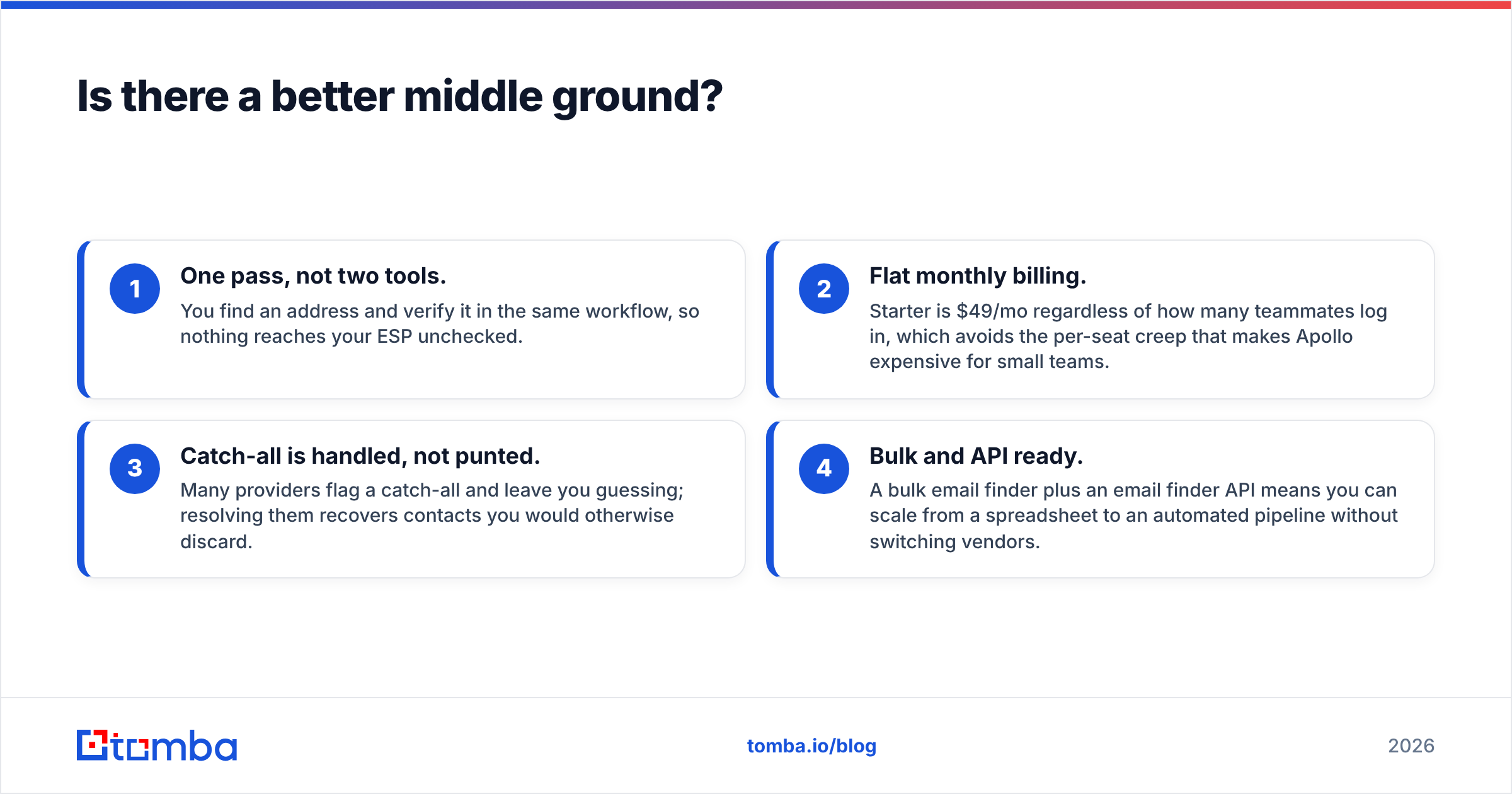
Is there a better middle ground?#
Yes, if your real need is "find good emails and keep them clean" without buying a full sales suite. That is the gap Tomba targets. Instead of a verifier that cannot find, or a platform that finds loosely and bills per seat, Tomba pairs an accurate email finder with a real verifier and catch-all resolution in one flat-priced plan.
Why this combination matters in practice:
- One pass, not two tools. You find an address and verify it in the same workflow, so nothing reaches your ESP unchecked.
- Flat monthly billing. Starter is $49/mo regardless of how many teammates log in, which avoids the per-seat creep that makes Apollo expensive for small teams.
- Catch-all is handled, not punted. Many providers flag a catch-all and leave you guessing; resolving them recovers contacts you would otherwise discard.
- Bulk and API ready. A bulk email finder plus an email finder API means you can scale from a spreadsheet to an automated pipeline without switching vendors.
Tomba is not trying to be a CRM or a dialer. If you need a full engagement platform, Apollo's breadth is genuinely larger. But if your bottleneck is "I keep bouncing emails" or "I need verified contacts without a four-figure monthly bill," the all-in-one verifier-plus-finder is usually the cheaper, cleaner answer.
How do you decide in five minutes?#
Run this quick decision tree against your actual situation:
- I have a list, I just need it clean → Captain Verify (cheapest) or Tomba (if you will also need finding).
- I need to build lists and run sequences from one platform → Apollo.io, and re-verify every export.
- I need accurate new contacts plus verification without platform tax → Tomba.
- I am a solo founder or small team watching budget → Avoid per-seat pricing; a flat plan wins.
- I send high volume and live or die by deliverability → Whatever you find, verify it independently before sending.
The thread running through all of these is the same: discovery and verification are two jobs, and the cost of confusing them is bounced mail and a damaged domain. Captain Verify nails verification. Apollo nails discovery breadth. The question is whether you want to pay for, and manage, two specialists or one tool that does both jobs well enough that your bounce rate stays low.
You can sanity-check any vendor's claims against third-party reviews on G2 before committing, and read each tool's own documentation at apollo.io and captainverify.com for current limits. Vendor pages move fast, so verify pricing at the source rather than trusting any comparison post, including this one.
The bottom line#
Captain Verify and Apollo.io are not really competitors. One verifies, one prospects. Forcing a winner between them is the wrong frame. The right question is which job is your bottleneck, and whether buying two narrow tools beats buying one that covers both.
For most B2B teams the answer is a combined finder-and-verifier, because that is where the actual pain lives: getting real, deliverable addresses into your pipeline without overpaying for seats you do not use. Try the Tomba Email Finder on its free tier, run a list through the verifier, and watch your bounce rate before you commit a dollar. If it cleans up your sends, you just replaced two subscriptions with one.
Ready to find emails that actually work?
Join 150,000+ professionals who stopped guessing and started sending. Free credits on signup — no credit card required.
Get the Tomba newsletter
Practical outbound tactics and product updates — once every two weeks.
About the author