Captain Verify vs LeadGenius 2026: Which Tool Wins?
Captain Verify cleans your list; LeadGenius builds it for you. We break down pricing, accuracy, and fit so you pick the right B2B data stack in 2026.
You are comparing two tools that barely play the same sport. Captain Verify is an email validation engine — you bring a list, it tells you which addresses are safe to send. LeadGenius is a managed B2B data service — a human-plus-machine team builds custom prospect lists and enriches accounts for you. Picking between them isn't really "which is better"; it's "which problem do I actually have."
This guide settles the Captain Verify vs LeadGenius question with concrete pricing, accuracy expectations, and use-case fit — then shows where a self-serve platform like Tomba beats both for teams that want to find and verify without a procurement call.
TL;DR#
- Captain Verify = cheap, fast, pay-as-you-go email and phone verification. Great for cleaning lists, weak at sourcing new contacts.
- LeadGenius = premium managed-service data and enrichment with a human research layer. Great for ABM and hard-to-find roles, but slow to onboard and quote-only.
- They solve opposite halves of the funnel: one cleans data, the other builds it.
- Neither gives you a fast, self-serve "find the email + verify it now" loop — that's where a tool like the Tomba Email Finder fits.
- If budget and speed matter, you can replace most of both with one platform under $100/mo.
What is Captain Verify?#
Captain Verify is a French-built email verification service focused on list hygiene. You upload a CSV or hit the API, and it runs syntax checks, MX-record lookups, SMTP probes, and disposable/role-account detection to flag risky addresses before you send.
Its strengths are simple: it's inexpensive, it processes large lists quickly, and it also handles phone number validation. It works on a credit model rather than a subscription, which suits teams with occasional bulk-cleaning needs.
What Captain Verify does not do is find new contacts. If you don't already have an email address, it has nothing to check. It's a quality gate, not a sourcing engine. For deeper hygiene work you'd pair it with something like a dedicated email verifier or a catch-all verifier when catch-all domains skew your results.

A note on catch-all domains: every verifier struggles here because the mail server accepts everything at the SMTP layer, so no tool can confirm a specific inbox exists by probing alone. Captain Verify will return "accept-all" / "unknown" verdicts that you still have to interpret. Accuracy claims north of 98% always come with that asterisk.
What is LeadGenius?#
LeadGenius sits at the opposite end of the spectrum. It's a managed B2B data and intelligence provider that combines automation with a global team of human researchers to deliver custom-built contact and account lists, intent signals, and enrichment.
Instead of buying seats and self-serving, you scope a data project: "I need VP-of-Engineering contacts at Series B fintechs in EMEA with verified mobile numbers." LeadGenius researchers go find them. That human layer is the differentiator — it surfaces niche roles, non-obvious accounts, and fields that pure-database tools miss.
The trade-offs are predictable for a premium managed service:
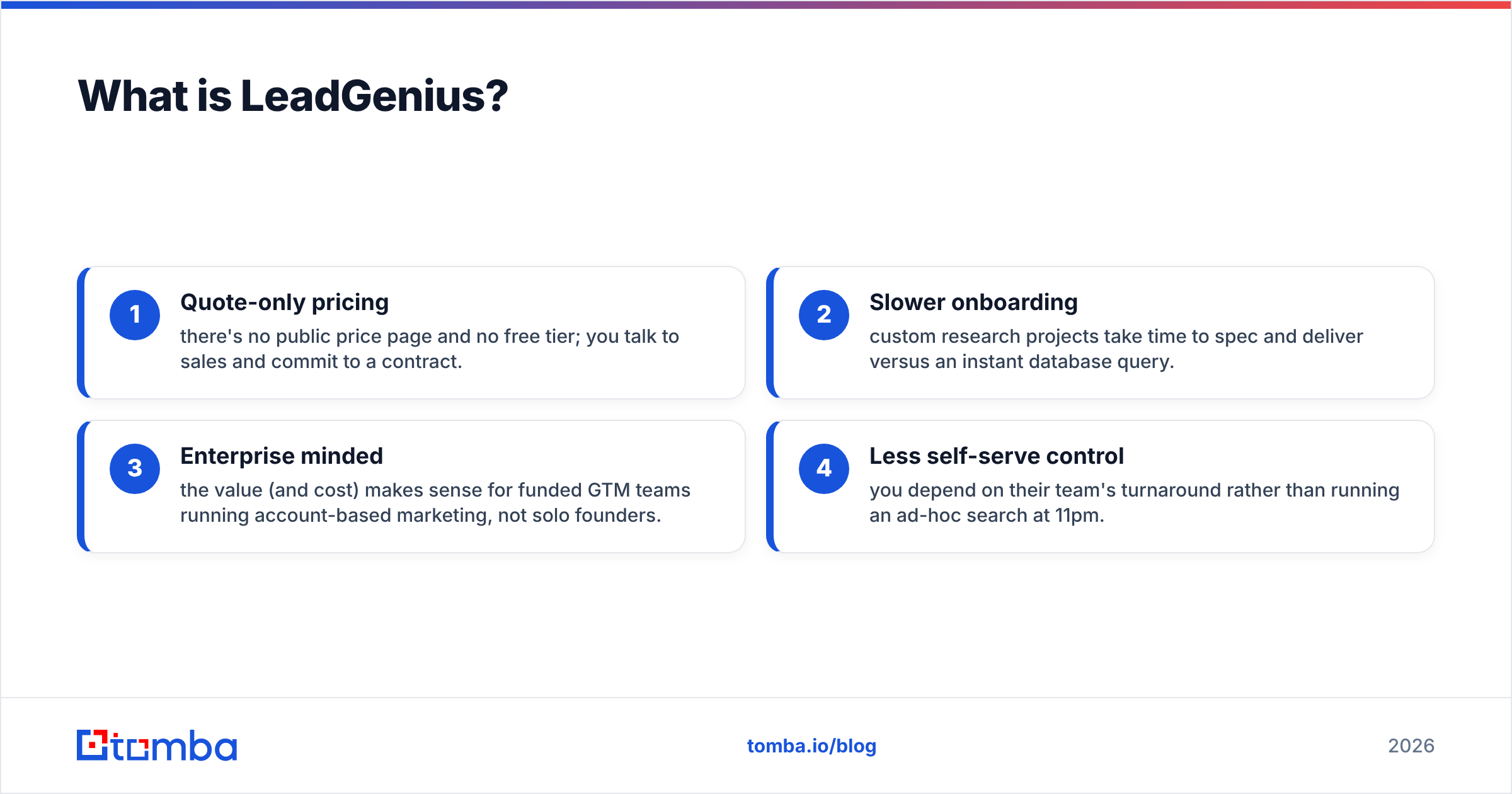
- Quote-only pricing — there's no public price page and no free tier; you talk to sales and commit to a contract.
- Slower onboarding — custom research projects take time to spec and deliver versus an instant database query.
- Enterprise minded — the value (and cost) makes sense for funded GTM teams running account-based marketing, not solo founders.
- Less self-serve control — you depend on their team's turnaround rather than running an ad-hoc search at 11pm.
LeadGenius is genuinely good at what it does. It's just a different purchase — closer to hiring a research firm than buying software. You can read more about its positioning on G2.
Captain Verify vs LeadGenius: how do they compare?#
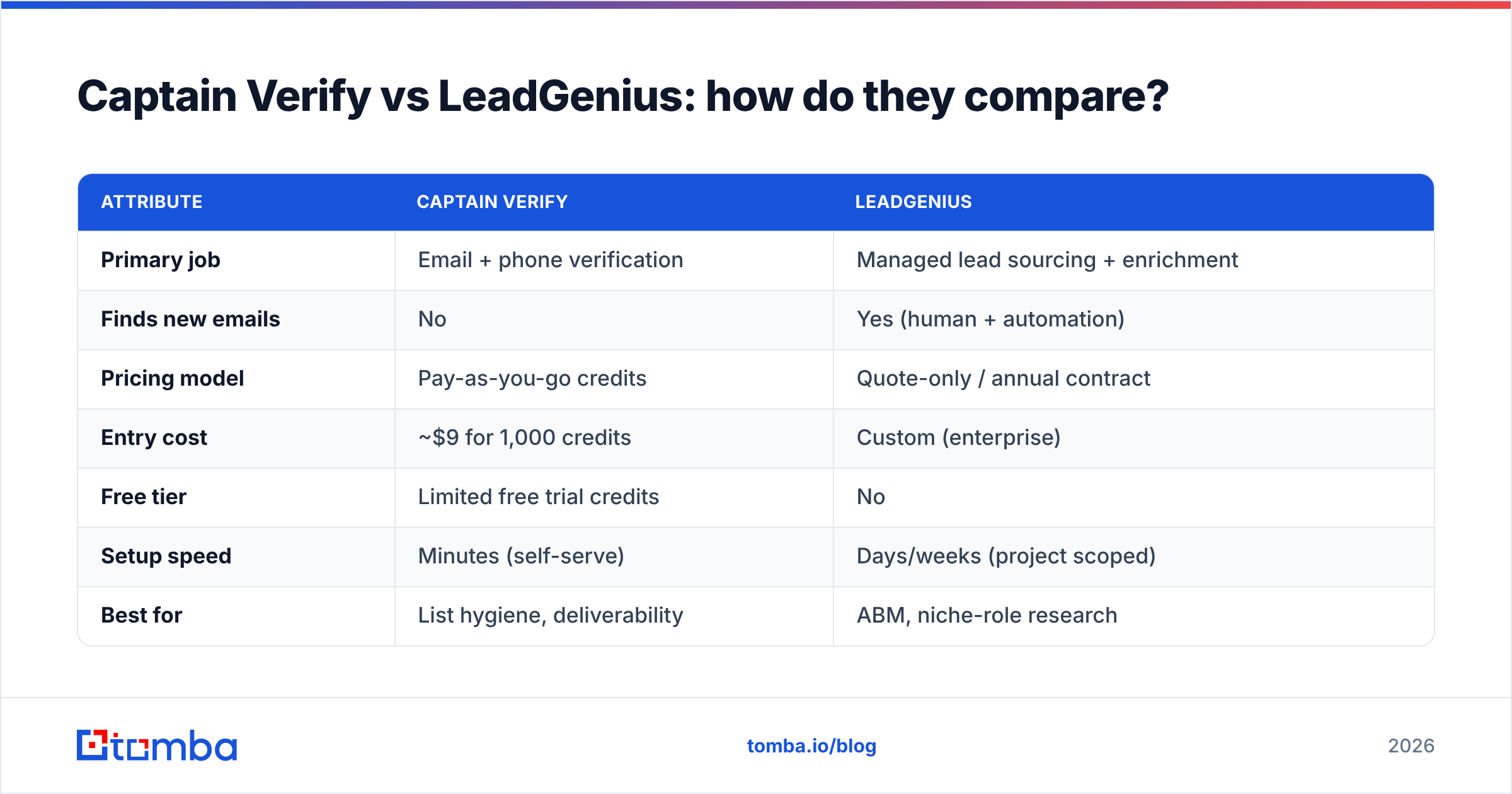
Here's the head-to-head on the attributes that actually drive a buying decision.
| Attribute | Captain Verify | LeadGenius |
|---|---|---|
| Primary job | Email + phone verification | Managed lead sourcing + enrichment |
| Finds new emails | No | Yes (human + automation) |
| Pricing model | Pay-as-you-go credits | Quote-only / annual contract |
| Entry cost | ~$9 for 1,000 credits | Custom (enterprise) |
| Free tier | Limited free trial credits | No |
| Setup speed | Minutes (self-serve) | Days/weeks (project scoped) |
| Best for | List hygiene, deliverability | ABM, niche-role research |
| Human research layer | No | Yes |
| API access | Yes | Yes (enterprise) |
| Catch-all handling | Flags as unknown | Researcher-verified |
The pattern is obvious: Captain Verify is a low-cost tool you operate; LeadGenius is a high-touch service that operates for you. If you put them side by side expecting a winner, you're really choosing between "clean my existing list cheaply" and "build me a premium list from scratch."

Which one should you choose?#
Match the tool to the gap in your funnel.
Choose Captain Verify if you already have lists — from events, signups, scraped sources, or an old CRM — and you mostly need to scrub bounces before a campaign. It's the budget-friendly hygiene layer. You'll still need a separate way to find contacts.
Choose LeadGenius if you're an enterprise GTM team chasing hard-to-source segments, you have budget for managed research, and you value a human guaranteeing data on roles that databases routinely miss. Expect a sales cycle and a contract.
Choose neither if what you actually want is the everyday motion most sales and marketing teams run: find a decision-maker's verified email by name or company, right now, without a quote or a CSV round-trip. That's a self-serve email-finder job, and it's the most common reason people end up comparing these two and walking away unsatisfied.
Where does Tomba fit between them?#
Tomba collapses the find-and-verify loop into one self-serve platform — the middle ground these two tools leave open. Where Captain Verify only checks addresses you supply and LeadGenius hands you a finished list on its timeline, Tomba lets you source and validate on demand.
- Find emails by domain, name, or company with the email finder, then verify them in the same workflow.
- Search a whole company with domain search to pull every public address and pattern for a target account.
- Clean what you import with a built-in email verifier and catch-all verifier — covering Captain Verify's core job.
- Enrich and scale through data enrichment, the bulk email finder, and a documented Tomba API for engineering teams.

Crucially, you don't trade away accuracy to get speed. Tomba runs the same verification stack — syntax, MX, SMTP, role and disposable detection — that a standalone verifier uses, and is transparent about where the data comes from. You get the verification rigor of Captain Verify and a sourcing engine that doesn't require a LeadGenius-style contract.
Pricing reality check#
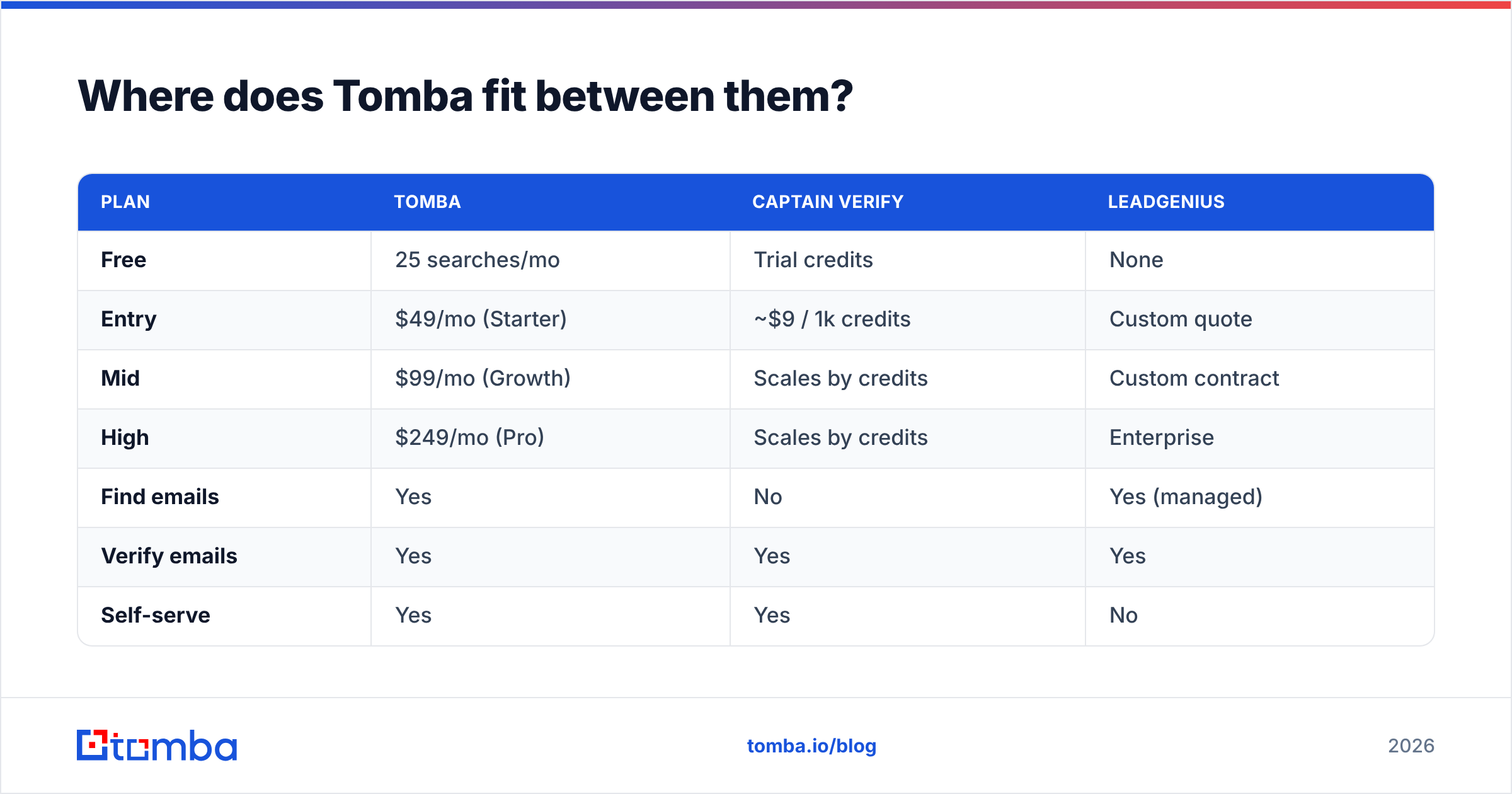
This is where self-serve wins on predictability. Tomba publishes its plans openly — no quote needed.
| Plan | Tomba | Captain Verify | LeadGenius |
|---|---|---|---|
| Free | 25 searches/mo | Trial credits | None |
| Entry | $49/mo (Starter) | ~$9 / 1k credits | Custom quote |
| Mid | $99/mo (Growth) | Scales by credits | Custom contract |
| High | $249/mo (Pro) | Scales by credits | Enterprise |
| Find emails | Yes | No | Yes (managed) |
| Verify emails | Yes | Yes | Yes |
| Self-serve | Yes | Yes | No |
See full Tomba pricing for credit limits per tier. The headline: for the price of a mid-size verification credit pack, you get sourcing and verification in one seat — and you skip the enterprise procurement loop entirely.
What about accuracy and deliverability?#
Accuracy is the real reason any of this matters. A finder that returns guesses or a verifier that mislabels catch-alls will tank your sender reputation and inflate bounce rates.
Three things to demand from whichever tool you pick:
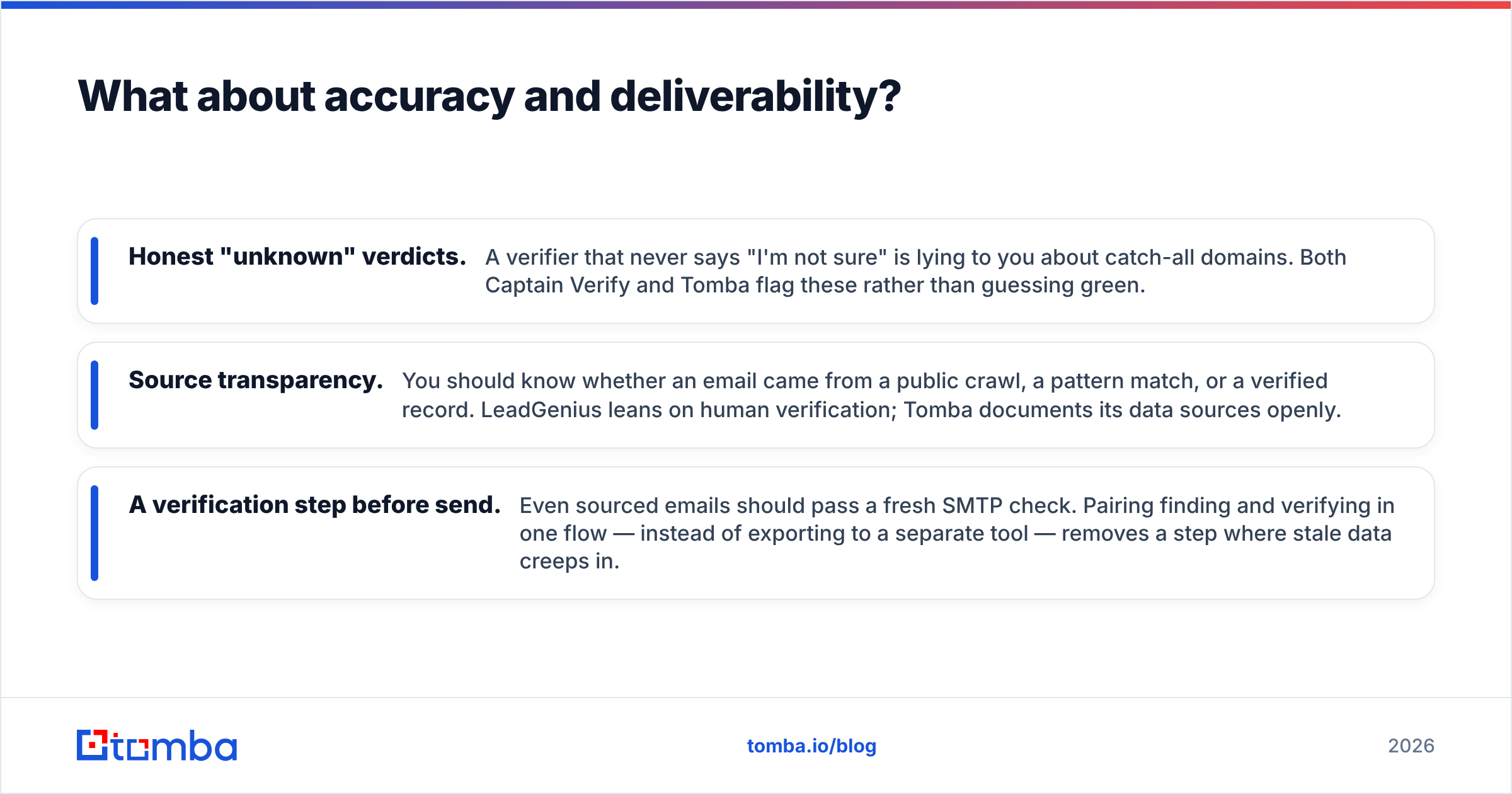
- Honest "unknown" verdicts. A verifier that never says "I'm not sure" is lying to you about catch-all domains. Both Captain Verify and Tomba flag these rather than guessing green.
- Source transparency. You should know whether an email came from a public crawl, a pattern match, or a verified record. LeadGenius leans on human verification; Tomba documents its data sources openly.
- A verification step before send. Even sourced emails should pass a fresh SMTP check. Pairing finding and verifying in one flow — instead of exporting to a separate tool — removes a step where stale data creeps in.
For a deeper primer on the mechanics, the concept of email deliverability is worth understanding before you scale any outbound program. Vendor-neutral benchmarks from sites like Capterra can also sanity-check accuracy claims across categories.
Frequently asked questions#
Is Captain Verify or LeadGenius better for cold email? Neither alone. Captain Verify cleans the list but can't build it; LeadGenius builds it but isn't a fast self-serve tool for daily outreach. A combined find-and-verify platform fits cold email best — you source the address and validate it before it ever hits a sequence.
Does Captain Verify find email addresses? No. It only verifies addresses you already have. To find new ones you need an email-finder or a managed data provider.
Why is LeadGenius quote-only? Because it's a managed service with a human research team, pricing is scoped per project and segment rather than sold as flat seats. That's why there's no free tier or public price page.
Can one tool replace both? For most small and mid-market teams, yes. A self-serve platform that finds, enriches, verifies, and exposes an API covers the everyday version of both jobs without an enterprise contract.
The bottom line#
Captain Verify and LeadGenius aren't really rivals — they're two ends of the data pipeline. One scrubs the list you bring; the other builds a premium list you couldn't find alone. The "winner" depends entirely on which half of the problem you have, and how much you want to pay to outsource it.
If you'd rather not stitch a cheap verifier to an expensive research firm, run the whole motion yourself. Start with the Tomba Email Finder to source verified, decision-maker emails by name or domain — then verify, enrich, and export in the same place, on a plan that starts at $49/mo with a free tier to test first. Find it, verify it, send it. No quote call required.
Ready to find emails that actually work?
Join 150,000+ professionals who stopped guessing and started sending. Free credits on signup — no credit card required.
Get the Tomba newsletter
Practical outbound tactics and product updates — once every two weeks.
About the author