Captain Verify vs Smarte: Best Email Tool in 2026?
Captain Verify cleans your list; Smarte builds it. We compare accuracy, pricing, and use cases so you can pick the right contact-data stack in 2026.
TL;DR
- Captain Verify and Smarte solve different problems. Captain Verify is a bulk email verification service that cleans lists you already own. Smarte (SMARTe) is a B2B sales-intelligence platform that builds contact lists from a database.
- If you need to validate a list, Captain Verify is the cheaper, simpler pick. If you need net-new contacts with firmographics and intent, Smarte is the heavier (and pricier) option.
- Neither does both jobs well at once. Most teams end up paying for two tools — one to find contacts, one to verify them.
- Tomba covers find + verify + enrich in a single workflow, with a free tier and a transparent $49/mo starter price, which is why it shows up so often as the consolidation move.
- Use this guide to map each tool to your actual outbound stage, then decide whether you need one tool or three.
If you have ever paid for a "data tool" only to discover it does half of what you needed, this comparison is for you. The phrase captain verify vs smarte sounds like a head-to-head, but the honest answer is that these two products barely overlap — and understanding why saves you money.
What is Captain Verify?#
Captain Verify is a French email verification service built for one job: take a list of email addresses and tell you which ones are safe to send to. You upload a CSV, it pings mail servers, checks syntax, detects disposable domains, flags role accounts (like info@), and returns a clean file with deliverability statuses.
Think of it like a metal detector at airport security. It does not give you passengers — it inspects the ones already in line and pulls out the risky ones. Captain Verify does not find new contacts. It assumes you already have a list from somewhere else (a CRM export, a scraped sheet, an event signup form) and your goal is to protect your sender reputation before you hit send.
Its strengths are price and simplicity. Pay-as-you-go credits, a clean dashboard, an email verification API, and fast bulk processing. For a solo founder or a small agency cleaning a few thousand addresses a month, it is genuinely useful.

What is Smarte (SMARTe)?#
Smarte is a completely different animal. It is a B2B sales-intelligence and prospecting platform — closer to ZoomInfo or Apollo than to a verifier. Smarte sells access to a contact database: company firmographics, job titles, direct dials, business emails, and technographic/intent signals you can filter to build a target account list from scratch.
Where Captain Verify cleans, Smarte creates. You define an ideal customer profile ("VP of Marketing at SaaS companies in North America, 50–500 employees"), and Smarte returns matching contacts with enrichment attached. It is aimed at outbound and ABM teams who need volume and segmentation, and it is priced like an enterprise data product — quotes, seats, and annual contracts rather than a self-serve credit pack.
So comparing the two directly is a bit like comparing a car wash to a car dealership. Both touch "vehicles," but you go to them for opposite reasons.

Captain Verify vs Smarte: the core difference#
Here is the cleanest way to hold the distinction in your head:
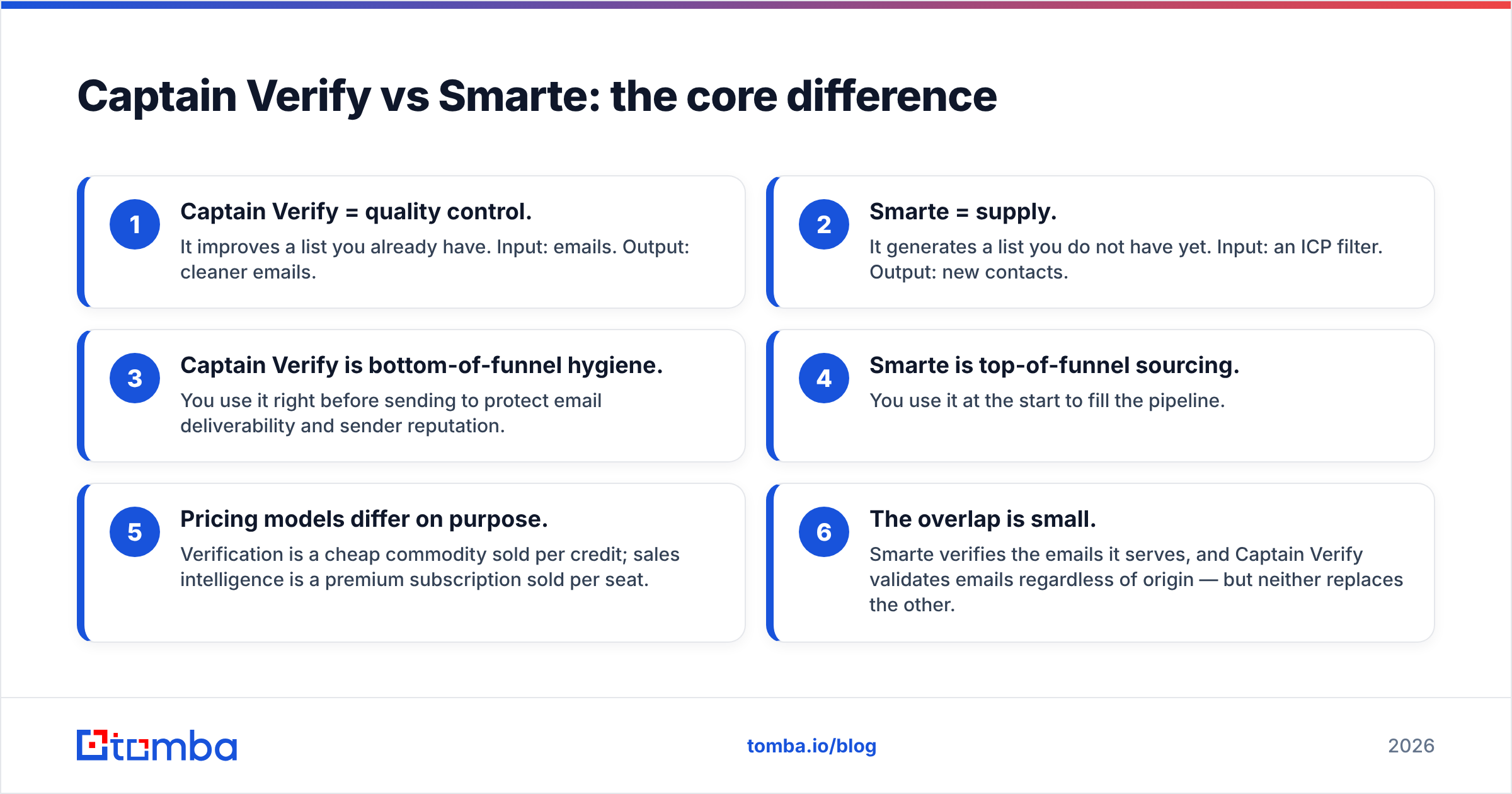
- Captain Verify = quality control. It improves a list you already have. Input: emails. Output: cleaner emails.
- Smarte = supply. It generates a list you do not have yet. Input: an ICP filter. Output: new contacts.
- Captain Verify is bottom-of-funnel hygiene. You use it right before sending to protect email deliverability and sender reputation.
- Smarte is top-of-funnel sourcing. You use it at the start to fill the pipeline.
- Pricing models differ on purpose. Verification is a cheap commodity sold per credit; sales intelligence is a premium subscription sold per seat.
- The overlap is small. Smarte verifies the emails it serves, and Captain Verify validates emails regardless of origin — but neither replaces the other.
If your problem is "my bounce rate is too high," you want a verifier. If your problem is "I have no one to email," you want a data platform. Many teams have both problems, which is the real reason this comparison gets searched.
How do Captain Verify and Smarte compare on features and price?#
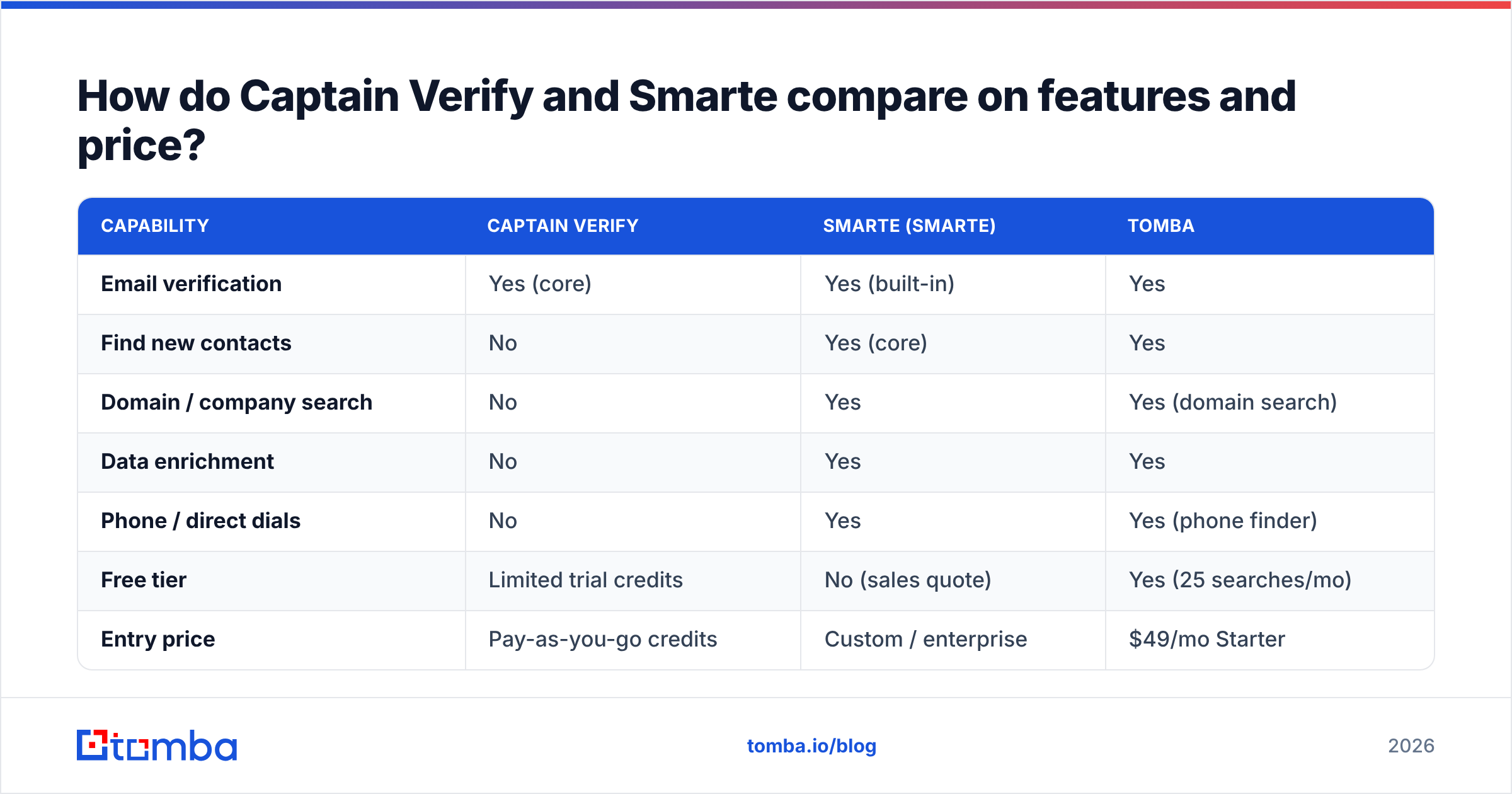
The table below lines up what each tool actually does. Note how few rows have a "yes" in both columns — that empty space is the gap most buyers underestimate.
| Capability | Captain Verify | Smarte (SMARTe) | Tomba |
|---|---|---|---|
| Email verification | Yes (core) | Yes (built-in) | Yes |
| Find new contacts | No | Yes (core) | Yes |
| Domain / company search | No | Yes | Yes (domain search) |
| Data enrichment | No | Yes | Yes |
| Phone / direct dials | No | Yes | Yes (phone finder) |
| Free tier | Limited trial credits | No (sales quote) | Yes (25 searches/mo) |
| Entry price | Pay-as-you-go credits | Custom / enterprise | $49/mo Starter |
| Self-serve signup | Yes | No (demo first) | Yes |
| Best for | List cleaning | ABM / enterprise sourcing | Find + verify in one |
A few honest takeaways:
- Captain Verify wins on price and speed for pure verification. If verification is all you need, you do not need a $99/mo+ subscription.
- Smarte wins on database depth and segmentation. If you run enterprise ABM and need intent data, a credit-based verifier cannot help you.
- Neither is a complete prospecting workflow unless you bolt on a second tool — and that is exactly where consolidation tools earn their keep.
For Tomba's own numbers, the full Tomba pricing page lists Free (25 searches/mo), Starter $49/mo, Growth $99/mo, and Pro $249/mo, with an Enterprise tier for high-volume teams.
When should you choose Captain Verify?#
Choose Captain Verify when you already have the contacts and just need to clean them. Concrete situations:
- You exported 20,000 old CRM records and want to scrub dead addresses before a re-engagement campaign.
- You collected emails from a webinar or lead magnet and need to confirm they are real before adding them to a sequence.
- You bought or inherited a list (risky, but it happens) and need to assess how rotten it is.
- You want a cheap, standalone verification step in an automation, callable via API.
In these cases Captain Verify is appropriate and cost-effective. You are not paying for a database you will not use. Just remember: a verifier confirms an address is deliverable, not that the person is a fit. Clean ≠ qualified.
If you want to sanity-check a single address right now without signing up, a free email checker does the same syntax-and-MX check in your browser.

When should you choose Smarte?#
Choose Smarte when you need net-new contacts at scale with rich firmographic and intent data, and you have the budget for an enterprise data subscription. Typical buyers:
- Mid-market and enterprise outbound teams running account-based marketing.
- RevOps leaders who need to enrich an entire CRM with standardized firmographics.
- Teams in regions where Smarte's data coverage is particularly strong and they have validated it against their territory.
The catch is procurement. Smarte is a sales-led purchase: demos, custom quotes, annual commitments, and per-seat pricing. That is fine for a funded GTM team and frustrating for a solo operator who just wanted 2,000 verified emails this month. Always run a data sample against your own territory before signing — database coverage varies wildly by region and industry, and the only honest accuracy test is your own list. Independent reviews on G2 are a useful sanity check before you commit.
Is there a tool that does both — find and verify?#
Yes, and this is the practical resolution to the captain verify vs smarte dilemma: most teams do not actually want either a pure verifier or an enterprise database. They want to find the right contact and confirm it is valid in one motion, without stitching two subscriptions together.
That is the lane Tomba sits in. Instead of buying Smarte to source and Captain Verify to clean, you can:
- Find emails by company with domain search or by name with the email finder.
- Verify them on the spot with the built-in email verifier, including catch-all verification for tricky domains.
- Enrich the record with titles and company data via data enrichment.
- Do it in bulk through the bulk email finder or programmatically with the Tomba API.
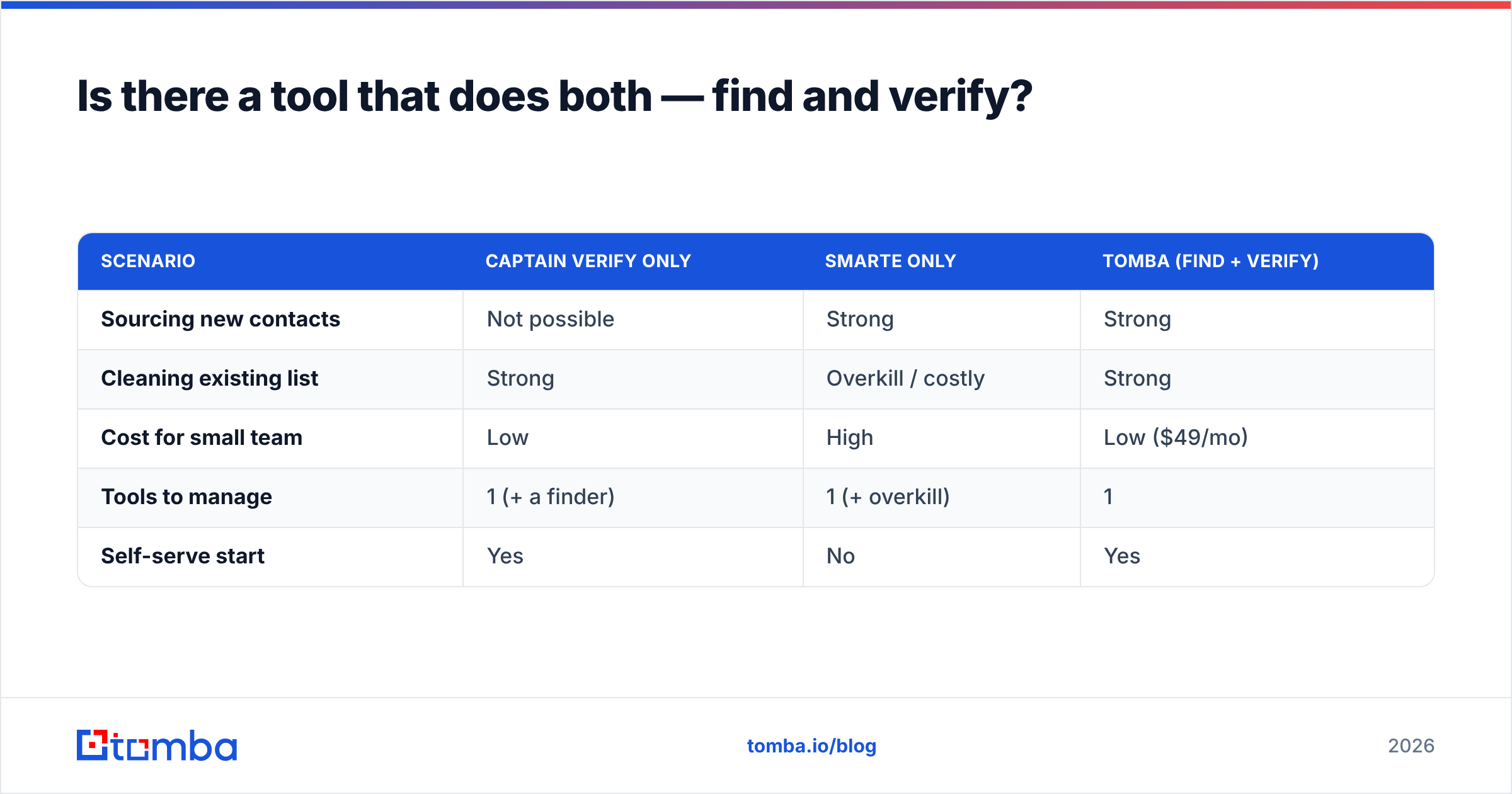
Here is how the three approaches stack up for a typical SMB outbound workflow:
| Scenario | Captain Verify only | Smarte only | Tomba (find + verify) |
|---|---|---|---|
| Sourcing new contacts | Not possible | Strong | Strong |
| Cleaning existing list | Strong | Overkill / costly | Strong |
| Cost for small team | Low | High | Low ($49/mo) |
| Tools to manage | 1 (+ a finder) | 1 (+ overkill) | 1 |
| Self-serve start | Yes | No | Yes |
The point is not that Tomba beats a dedicated verifier on raw verification price — Captain Verify is cheap. The point is total stack cost and workflow simplicity. If you are otherwise about to pay for a finder and a verifier, one tool that does both usually wins on both money and time.
What about data accuracy?#
Accuracy is the metric everyone claims and few prove. Two practical rules:
- For verification, accuracy means correctly classifying valid, invalid, risky, and catch-all addresses. Test it by sending a known list (some good, some dead) through each tool and comparing the verdicts against reality.
- For finding, accuracy means the email actually belongs to the person and is deliverable. Test it by running a sample and measuring bounce rate on a real send.
Do not trust marketing percentages — including ours. Run a 100-contact sample through any tool you are considering and measure it against your own ground truth. Tomba documents where its data comes from so you can judge sourcing rather than take a number on faith. Captain Verify and Smarte both publish accuracy claims too; verify all three the same way.
For the underlying mechanics of why verification matters at all, the email deliverability fundamentals are worth a refresher — bounce rate directly feeds the sender reputation that decides whether your campaigns land in the inbox or spam.
Frequently asked questions#
Is Captain Verify the same as Smarte? No. Captain Verify is an email verification tool that cleans lists you already have. Smarte is a B2B sales-intelligence platform that builds new contact lists. They serve opposite stages of outbound.
Which is cheaper, Captain Verify or Smarte? Captain Verify is far cheaper because verification is a per-credit commodity. Smarte is an enterprise subscription with custom quotes. But cheaper only matters relative to the job — Captain Verify cannot do what Smarte does, and vice versa.
Can I use Captain Verify and Smarte together? You can, but it is redundant — Smarte already verifies the emails it serves. The two-tool combination people actually run is a finder plus a verifier, which is exactly what a single platform like Tomba consolidates.
Do I still need verification if I use a finder? Yes. Even good finders return some risky or catch-all addresses. Verifying before you send protects deliverability. The advantage of an all-in-one is that the verify step is built into the find step.
The bottom line#
Stop framing this as a duel. Captain Verify cleans; Smarte sources. Pick Captain Verify if you only need to scrub a list and want the cheapest reliable option. Pick Smarte if you run enterprise ABM and need a deep database with intent data and have the budget for it.
But if your real situation is "I need to find good contacts and make sure they are valid, without juggling two bills" — that is the common case — consolidate. Start free with the Tomba Email Finder: find professional emails by domain, name, or company, verify them in the same dashboard, and enrich them before they ever reach your sequence. The free tier gives you 25 searches a month to test it against your own list — the only accuracy benchmark that matters. When you are ready to scale, the $49/mo Starter plan keeps the whole find-and-verify workflow under one roof.
Ready to find emails that actually work?
Join 150,000+ professionals who stopped guessing and started sending. Free credits on signup — no credit card required.
Get the Tomba newsletter
Practical outbound tactics and product updates — once every two weeks.
About the author