Centripe Pricing, Reviews, Pros and Cons (2026 Guide)
An honest 2026 breakdown of Centripe pricing, real user reviews, and the pros and cons that matter before you commit budget — plus where leaner email-data tools fit.
TL;DR
- Centripe is a B2B sales-intelligence and outreach platform, so its pricing leans toward custom, quote-based plans rather than a fully public price list — budget for a sales call before you see a number.
- Reviews are mixed but lean positive on data coverage; the most common complaints are onboarding friction, credit limits, and contracts that are hard to downgrade.
- The biggest pro is consolidation (data + outreach in one tool); the biggest con is cost and lock-in for teams that only need a slice of the feature set.
- If you mainly need accurate emails and enrichment, a focused tool like Tomba covers that job at a transparent $49/mo starting price.
- Run a side-by-side trial before signing — match the plan to the workflow you actually use, not the demo you were shown.
If you are evaluating Centripe in 2026, you have probably already noticed that pricing is not splashed across the homepage and that reviews swing from "transformed our pipeline" to "we couldn't get out of the contract fast enough." This guide cuts through that. We will walk through how Centripe pricing tends to work, what real reviews say, the honest pros and cons, and where a leaner alternative makes more sense.
What is Centripe and who is it for?#
Centripe positions itself as an all-in-one B2B revenue platform: contact data, company intelligence, and outbound sequencing bundled together. Think of it like a Swiss Army knife for a sales team — one handle, many blades. That is appealing when you want fewer logins and one invoice, and frustrating when you only needed the screwdriver and paid for the corkscrew too.
The typical buyer is a mid-market sales or revenue-operations team that wants to replace a stack of point tools (a data vendor, a sequencer, and an enrichment service) with a single contract. Solo founders and small teams sometimes find it heavier than they need.
Before you weigh price, it helps to know what categories of work the platform actually touches:
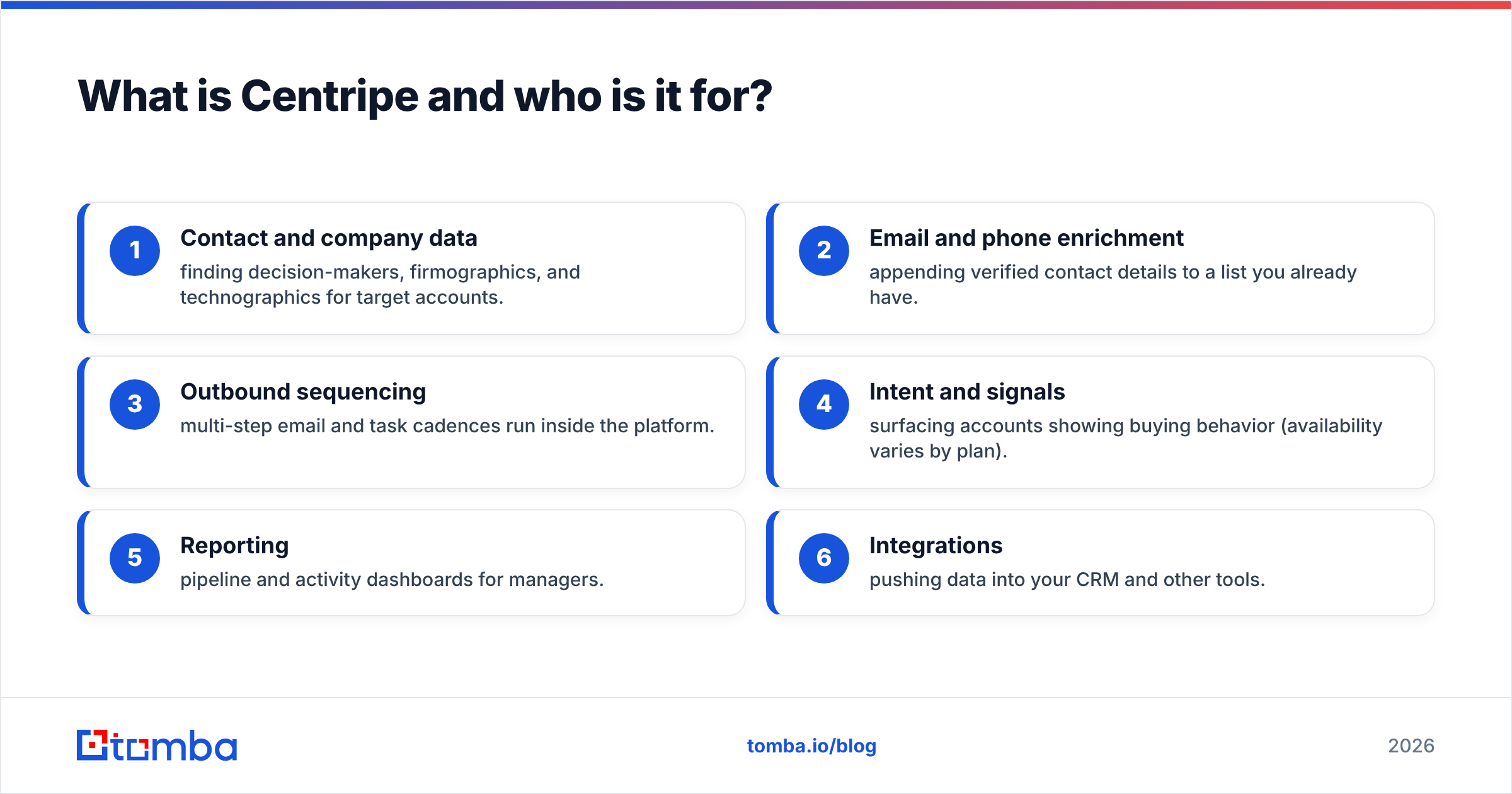
- Contact and company data — finding decision-makers, firmographics, and technographics for target accounts.
- Email and phone enrichment — appending verified contact details to a list you already have.
- Outbound sequencing — multi-step email and task cadences run inside the platform.
- Intent and signals — surfacing accounts showing buying behavior (availability varies by plan).
- Reporting — pipeline and activity dashboards for managers.
- Integrations — pushing data into your CRM and other tools.
The more of those six you genuinely use, the better the value math works. The fewer, the more you are overpaying relative to a specialist tool.
How does Centripe pricing work in 2026?#
The short answer: Centripe uses tiered, mostly quote-based pricing, so the published number you find online is rarely the number you pay. Like many platforms in the B2B data and intelligence space, Centripe gates its real pricing behind a sales conversation, seat counts, and annual-commit discounts. That is normal for the category, but it makes apples-to-apples comparison hard.
Here is how to think about the variables that drive your final quote:
- Seats — per-user licensing is the usual base. More reps, higher cost.
- Credits — data exports, enrichments, and lookups are often metered. Heavy list-building burns credits fast.
- Modules — intent data, advanced sequencing, or premium support frequently sit in higher tiers or as add-ons.
- Contract length — annual commitments unlock discounts but reduce flexibility.
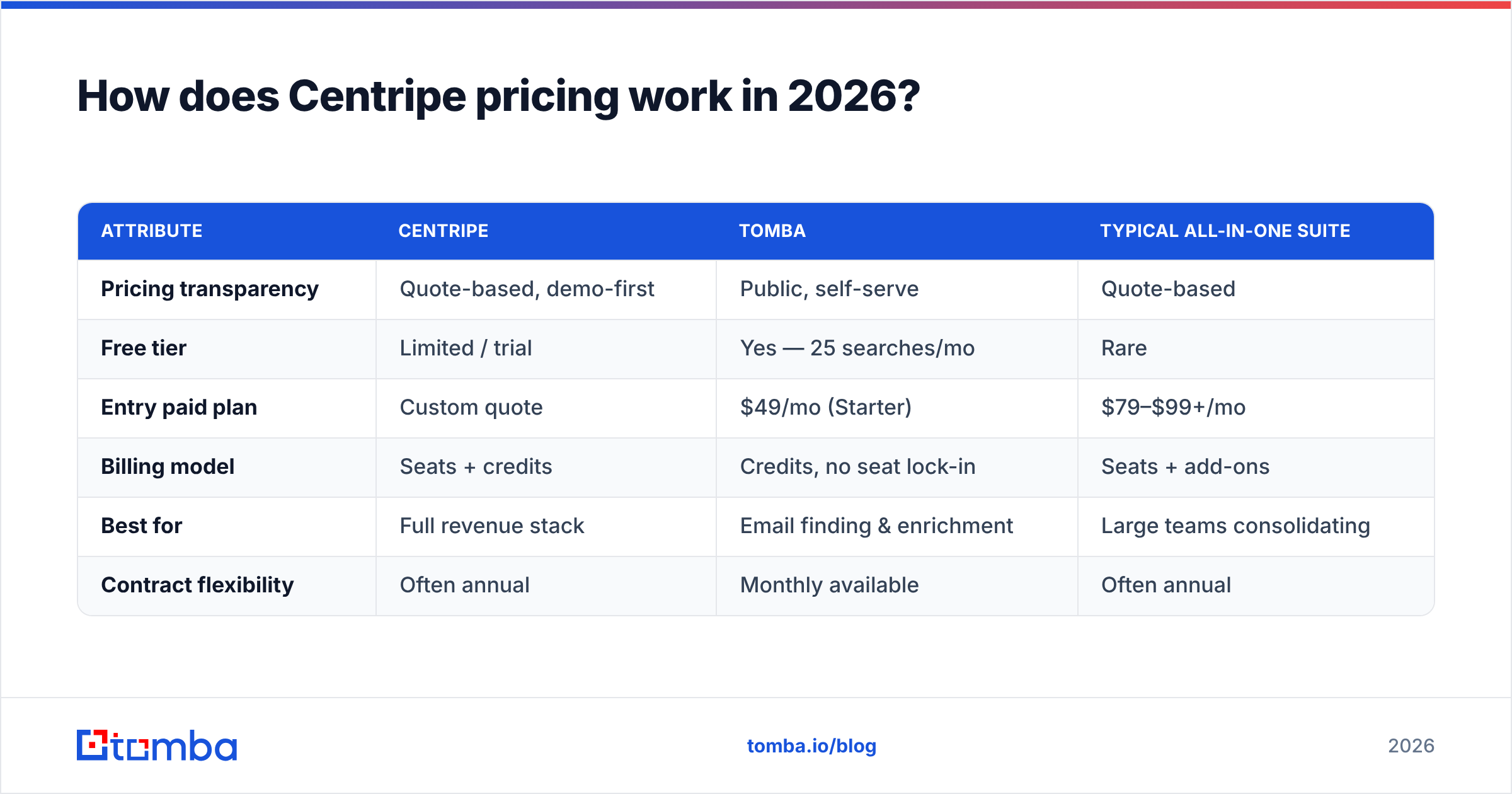
Because exact figures change and are negotiated, treat any specific dollar amount you see in a forum as a data point, not gospel. Always confirm directly. To keep this guide honest, the table below compares the pricing model and transparency rather than inventing precise Centripe numbers — and it sets that against Tomba's published pricing, which is fixed and public.
| Attribute | Centripe | Tomba | Typical all-in-one suite |
|---|---|---|---|
| Pricing transparency | Quote-based, demo-first | Public, self-serve | Quote-based |
| Free tier | Limited / trial | Yes — 25 searches/mo | Rare |
| Entry paid plan | Custom quote | $49/mo (Starter) | $79–$99+/mo |
| Billing model | Seats + credits | Credits, no seat lock-in | Seats + add-ons |
| Best for | Full revenue stack | Email finding & enrichment | Large teams consolidating |
| Contract flexibility | Often annual | Monthly available | Often annual |
The takeaway is not "Centripe is expensive" — it is that Centripe's cost is variable and bundled, so your job is to make sure you are buying capacity you will actually consume.
What do Centripe reviews say?#
Reviews cluster into three themes, and they are worth reading before any demo. Independent review sites like G2 and Capterra are the best places to read unfiltered, verified-user feedback rather than curated case studies.
What reviewers praise:
- Data breadth. Many users report solid coverage for company-level data and decision-maker contacts in core markets.
- Consolidation. Teams that fully adopt the suite like having data and outreach under one roof, with fewer integration headaches.
- Support during onboarding. Several reviews call out hands-on implementation help.
What reviewers criticize:
- Onboarding complexity. The flip side of an all-in-one tool: there is more to learn, and time-to-value can be slow.
- Credit and limit friction. Hitting export or enrichment caps mid-month is a recurring complaint.
- Contract rigidity. The most pointed reviews mention difficulty downgrading or canceling annual commitments.
- Data accuracy variance. Coverage is strong in some regions and roles, thinner in others — a near-universal truth for data vendors, Centripe included.
The pattern is familiar across the category: power users who adopt the whole platform are happy, while teams that bought it for one feature feel the weight of everything else. Verify accuracy claims yourself with a trial against your own target list — vendor-reported match rates rarely survive contact with your specific niche.
What are the pros and cons of Centripe?#
Let's make this concrete. A tool review is only useful if it helps you decide, so here is the balanced ledger.
Pros#
- One platform, one invoice. Real operational simplicity if you use most modules. Fewer integrations to maintain and fewer vendors to manage.
- Decent data coverage for core B2B segments, especially company-level firmographics.
- Built-in outreach means you can go from list to cadence without exporting to a separate sequencer.
- Team-oriented features like shared reporting and manager dashboards suit growing sales orgs.
- Onboarding support that helps larger teams get live.
Cons#
- Opaque, negotiated pricing makes budgeting and comparison harder than with self-serve tools.
- Credit ceilings can throttle heavy list-builders unless you buy up.
- Annual contracts reduce flexibility; downgrading mid-term is often painful.
- Feature overlap you pay for if you only need data or only need sequencing.
- Accuracy is uneven across regions and seniority levels — test before you trust.
Here is the decision rule of thumb: if you will genuinely use four or more of the six capability areas above, the bundle can pay off. If you will use one or two, you are subsidizing the rest. That is the single most important question to answer before a demo, and it is one a slick presentation will not answer for you.
How does Centripe compare to a focused alternative?#
Most teams that look hard at Centripe discover their actual day-one need is narrower than the suite: they want accurate emails and clean enrichment to feed a sequencer or CRM they already have. That is exactly where a specialist tool wins on price and simplicity.
This is the classic "platform vs. point solution" trade. A platform is a department store; a point solution is the specialty shop that does one thing exceptionally well and charges accordingly. If your job is "find verified emails for my prospect list," the specialty shop is faster and cheaper.
A focused option like Tomba covers the data and verification jobs with transparent, self-serve pricing:
- Use the email finder to get professional addresses by name, domain, or company.
- Run results through the email verifier to cut bounces before they hit your sender reputation.
- Pull every address at a target account with domain search.
- Append missing fields with data enrichment and scale it through the bulk email finder.
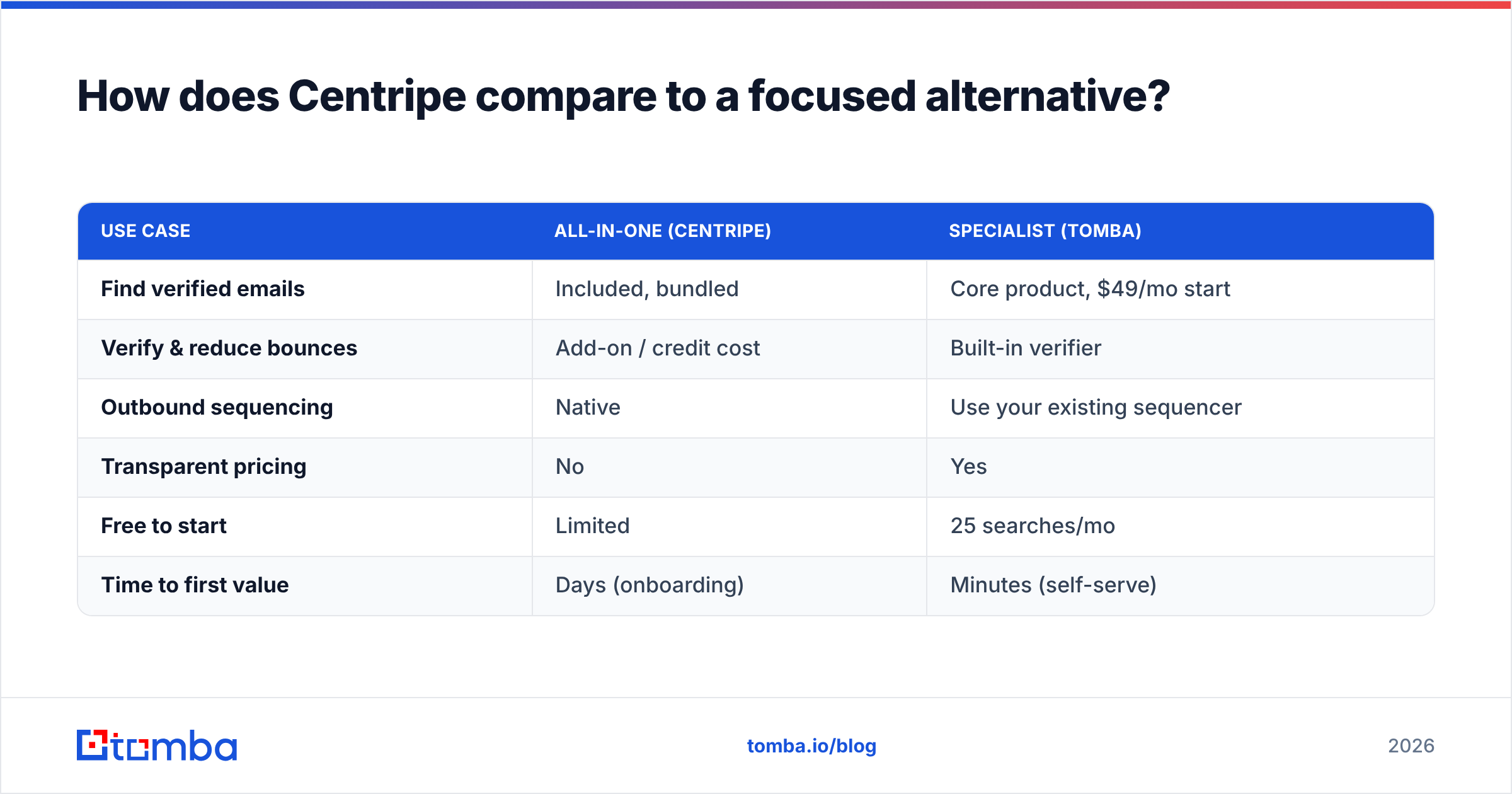
| Use case | All-in-one (Centripe) | Specialist (Tomba) |
|---|---|---|
| Find verified emails | Included, bundled | Core product, $49/mo start |
| Verify & reduce bounces | Add-on / credit cost | Built-in verifier |
| Outbound sequencing | Native | Use your existing sequencer |
| Transparent pricing | No | Yes |
| Free to start | Limited | 25 searches/mo |
| Time to first value | Days (onboarding) | Minutes (self-serve) |
The honest framing: Centripe and Tomba are not direct twins. Centripe is trying to be your whole revenue stack; Tomba is trying to be the most accurate, lowest-friction way to get contact data. If you already own a sequencer and a CRM you like, the specialist path is usually the better spend. If you are starting from zero and want everything in one place, the suite has a real argument — just price it honestly against what you will use.
For deeper validation, review how a vendor sources its records before trusting match rates; Tomba documents its data sources publicly, which is a useful transparency benchmark to hold any vendor to, Centripe included.
How should you decide between Centripe and the alternatives?#
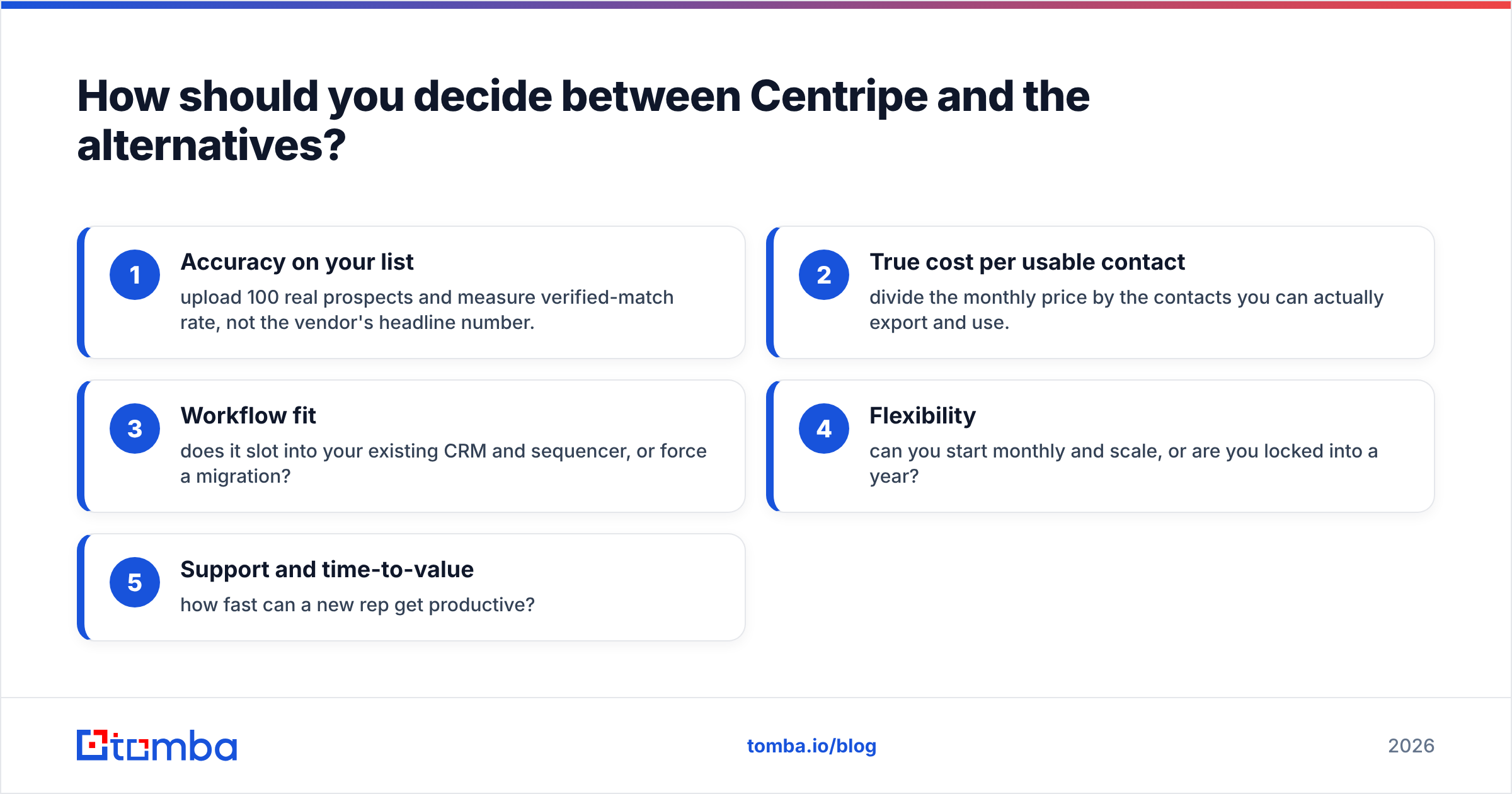
Run a structured evaluation instead of trusting the demo. Score each tool on the same five criteria with your own data:
- Accuracy on your list — upload 100 real prospects and measure verified-match rate, not the vendor's headline number.
- True cost per usable contact — divide the monthly price by the contacts you can actually export and use.
- Workflow fit — does it slot into your existing CRM and sequencer, or force a migration?
- Flexibility — can you start monthly and scale, or are you locked into a year?
- Support and time-to-value — how fast can a new rep get productive?
A platform that scores high on every line for your team is worth the premium. A platform that only wins on "it does everything" while you use one feature is a budget leak. The same checklist applies whether you are comparing Centripe to Tomba, or Centripe to any other Apollo alternative or Clearbit alternative on your shortlist.
One last practical note: read the contract terms, not just the price. The most common Centripe regret in reviews is not the sticker — it is being unable to downgrade when needs change. Negotiate an exit, a downgrade path, or a monthly option before you sign anything annual.
The bottom line#
Centripe is a credible all-in-one B2B revenue platform with real strengths in data coverage and consolidation, balanced by quote-based pricing, credit limits, and contract rigidity that show up consistently in reviews. It is a good fit for teams that will use most of the suite — and an expensive fit for teams that only need a slice.
If your real need is accurate, verified contact data without a sales call or an annual lock-in, start with a specialist. Tomba's email finder gives you professional addresses by name, domain, or company, backed by built-in verification and a free tier (25 searches/mo) before you spend a cent — with public plans starting at $49/mo. Test it against your own prospect list, measure the verified-match rate, and let the numbers — not a demo — make the call.
// get started
Find, verify and enrich your first contacts today
Start on the free plan with 25 searches a month, then scale when your team is ready.
Free plan · No credit card required · GDPR & CCPA
// about the author