The Biggest Challenges in B2B Sales and How to Beat Them in 2026
Longer cycles, bad data, buying committees, and AI noise are crushing quota. Here are the 9 hardest challenges in B2B sales in 2026 — and the fixes that actually move pipeline.
B2B selling got harder, not easier. Buyers do more research alone, committees grew, budgets tightened, and every inbox is now flooded with AI-generated outreach that all sounds the same. If your win rates slipped and your cycles stretched, you are not imagining it — the ground moved.
This guide breaks down the nine biggest challenges in B2B sales in 2026 and gives you a concrete fix for each one. No motivational filler. Just the structural problems and what teams that still hit quota are doing differently.
TL;DR#
- The cycle got longer and more crowded. The average B2B deal now involves 6–10 stakeholders, and most buying happens before a rep is ever contacted.
- Bad data is the silent quota killer. Reps waste up to a third of their week on dead contacts, wrong titles, and bounced emails — fix the data layer first.
- Deliverability now gates everything. Google and Yahoo sender rules mean sloppy outreach never reaches the inbox, so volume without hygiene is wasted spend.
- AI raised the noise floor. Generic personalization no longer works; relevance and timing beat clever copy.
- The fix is the same theme everywhere: fewer, better-targeted touches built on verified data and a tight process — not more activity.
What are the biggest challenges in B2B sales in 2026?#
The short answer: the buyer changed faster than most sales orgs did. Decision-making spread across larger committees, self-serve research replaced early rep conversations, and the tools meant to help (mass automation, AI writers) made inboxes noisier for everyone.
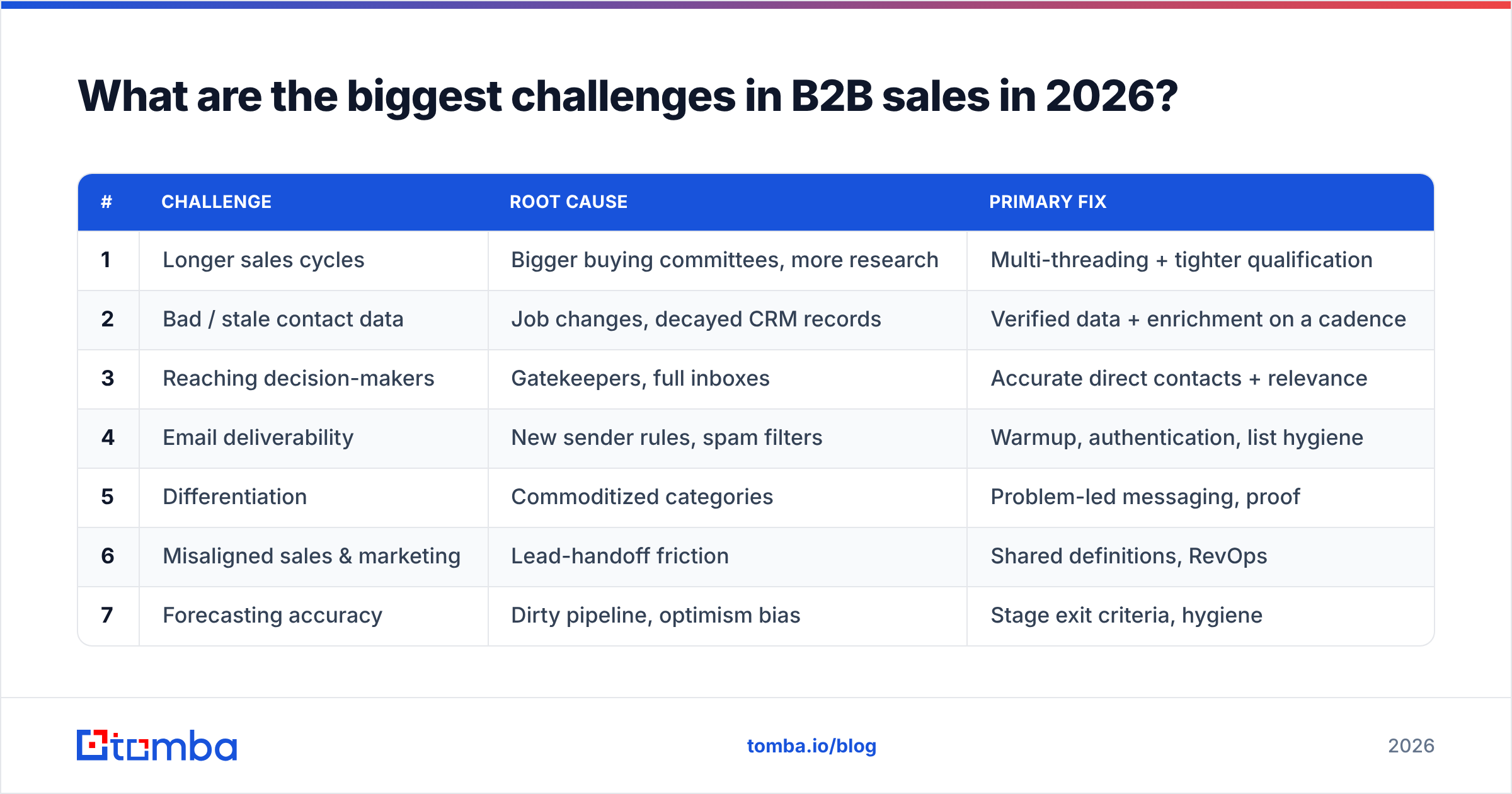
Here are the nine challenges ranked by how much they quietly drain pipeline, with the structural cause behind each one.
| # | Challenge | Root cause | Primary fix |
|---|---|---|---|
| 1 | Longer sales cycles | Bigger buying committees, more research | Multi-threading + tighter qualification |
| 2 | Bad / stale contact data | Job changes, decayed CRM records | Verified data + enrichment on a cadence |
| 3 | Reaching decision-makers | Gatekeepers, full inboxes | Accurate direct contacts + relevance |
| 4 | Email deliverability | New sender rules, spam filters | Warmup, authentication, list hygiene |
| 5 | Differentiation | Commoditized categories | Problem-led messaging, proof |
| 6 | Misaligned sales & marketing | Lead-handoff friction | Shared definitions, RevOps |
| 7 | Forecasting accuracy | Dirty pipeline, optimism bias | Stage exit criteria, hygiene |
| 8 | AI-generated noise | Mass personalization at scale | Timing, signals, human relevance |
| 9 | Rep ramp & retention | Complexity, tool sprawl | Enablement + fewer, better tools |
Notice the pattern: most of these trace back to two things — data quality and process discipline. Solve those and six of the nine ease at once.
Why are B2B sales cycles getting longer?#
Conclusion first: cycles are longer because more people now have to say yes. Gartner has reported for years that a typical B2B purchase involves six to ten decision-makers, each armed with their own research and veto. Every added stakeholder adds a feedback loop, an objection, and a delay.
Three forces stretch the timeline:
- Committee buying. The economic buyer, the user, the security reviewer, the finance gate, and the "champion" all weigh in. Miss one and the deal stalls at the worst moment.
- Self-serve research. Buyers complete most of their journey before talking to sales. By the time they reach you, they have opinions — sometimes wrong ones — formed without you in the room.
- Budget scrutiny. Tighter spending means more approvals, more ROI proof, and more "let's revisit next quarter."
The fix: multi-thread early and qualify harder. Stop running single-threaded deals through one friendly contact. Map the committee in the first two calls, get a verified contact for each role, and confirm budget, authority, need, and timeline before you invest demo hours. A clean B2B database of the right titles at the account makes multi-threading practical instead of aspirational.
How does bad data cause B2B sales challenges?#
Bad data is the most expensive problem nobody puts on the board. People change jobs, companies rebrand, and CRM records rot at roughly 20–30% per year. The result: reps personalize emails to someone who left eight months ago, dial dead numbers, and watch bounce rates climb.
The downstream damage compounds:
- Wasted rep hours researching and re-finding contacts instead of selling.
- Inflated bounce rates that hurt your sender reputation and push future emails to spam.
- Skewed forecasts built on contacts who can't actually buy.
The fix: treat data as infrastructure, not a one-time import. Verify every email before you send, enrich records on a recurring cadence, and re-check accounts before a campaign. Tools like the Tomba Email Finder and an email verifier let you confirm a contact is real and reachable before a rep ever spends time on them. Run lists through a bulk email finder before outreach so you are working live data, not last year's export.
This is the single highest-leverage fix on the list, because clean data improves cycle length, deliverability, decision-maker reach, and forecasting all at once.
Why is it so hard to reach decision-makers?#
Because the people with budget have the most-protected inboxes and the least time. Executives delegate, screen, and ignore anything that reads like a template. Gatekeepers — human and algorithmic — filter the rest.
What works in 2026:
- Accurate direct contacts. A generic info@ address goes nowhere. You need the right person's verified work email and, when appropriate, a direct line. A phone finder plus verified email gives you two channels into the same person.
- Relevance over volume. A message tied to a trigger event — funding, a new hire, a product launch, a job change — earns a reply. A "just checking in" does not.
- Multi-channel sequencing. Email, phone, and LinkedIn together outperform any single channel, especially for senior titles.
The fix: pair verified contact data with a reason to care. Use a domain search to map who's who at a target account, confirm the email, then lead with the buyer's problem — not your feature list.
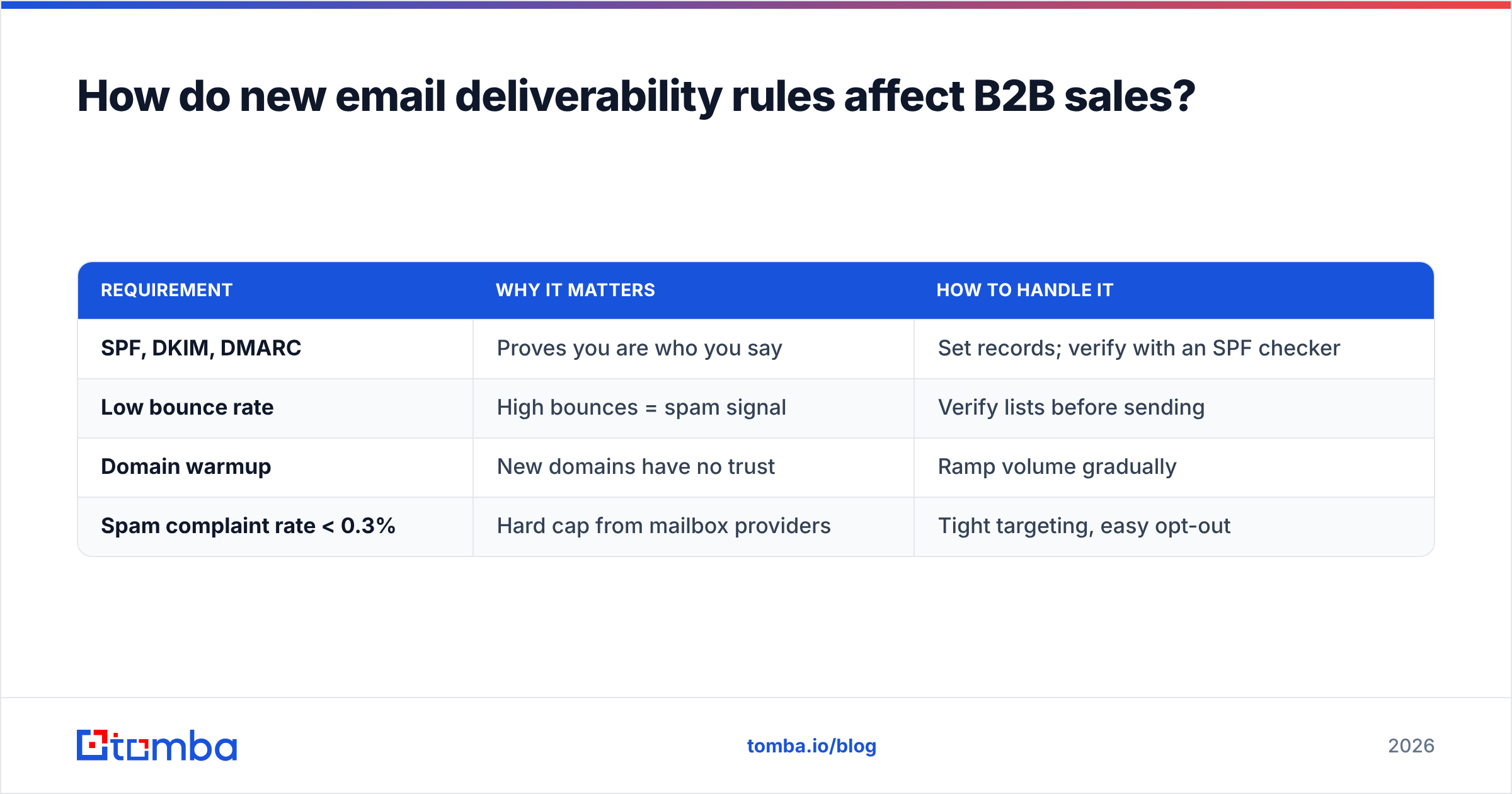
How do new email deliverability rules affect B2B sales?#
Deliverability is now a gate, not a nice-to-have. Since Google and Yahoo tightened bulk-sender requirements, unauthenticated or spammy senders quietly stop reaching inboxes — no error, just silence. You can run a flawless campaign into a wall and never know.
The non-negotiables:
| Requirement | Why it matters | How to handle it |
|---|---|---|
| SPF, DKIM, DMARC | Proves you are who you say | Set records; verify with an SPF checker |
| Low bounce rate | High bounces = spam signal | Verify lists before sending |
| Domain warmup | New domains have no trust | Ramp volume gradually |
| Spam complaint rate < 0.3% | Hard cap from mailbox providers | Tight targeting, easy opt-out |
Strong email deliverability starts with list hygiene. Every invalid address you remove before sending protects the reputation that gets your good emails delivered. Check your domain against blocklists with a blacklist checker and verify reputation before you scale volume.
Authoritative reference: Google publishes its current sender requirements in Postmaster guidelines, and it's worth reading them directly rather than trusting a vendor's summary.
Why is differentiation harder in B2B sales now?#
Because most categories are crowded and your prospects can't tell vendors apart. When ten companies claim the same three benefits, buyers default to price or inertia. "Best-in-class platform" means nothing.
The fix: lead with the buyer's problem, prove the outcome. Replace feature lists with a specific pain you remove and evidence you remove it. Independent proof carries more weight than any claim you make about yourself — point prospects to G2 or Capterra reviews, and bring concrete numbers from comparable customers. Differentiation is rarely about a unique feature; it's about being unmistakably relevant to one buyer's situation.
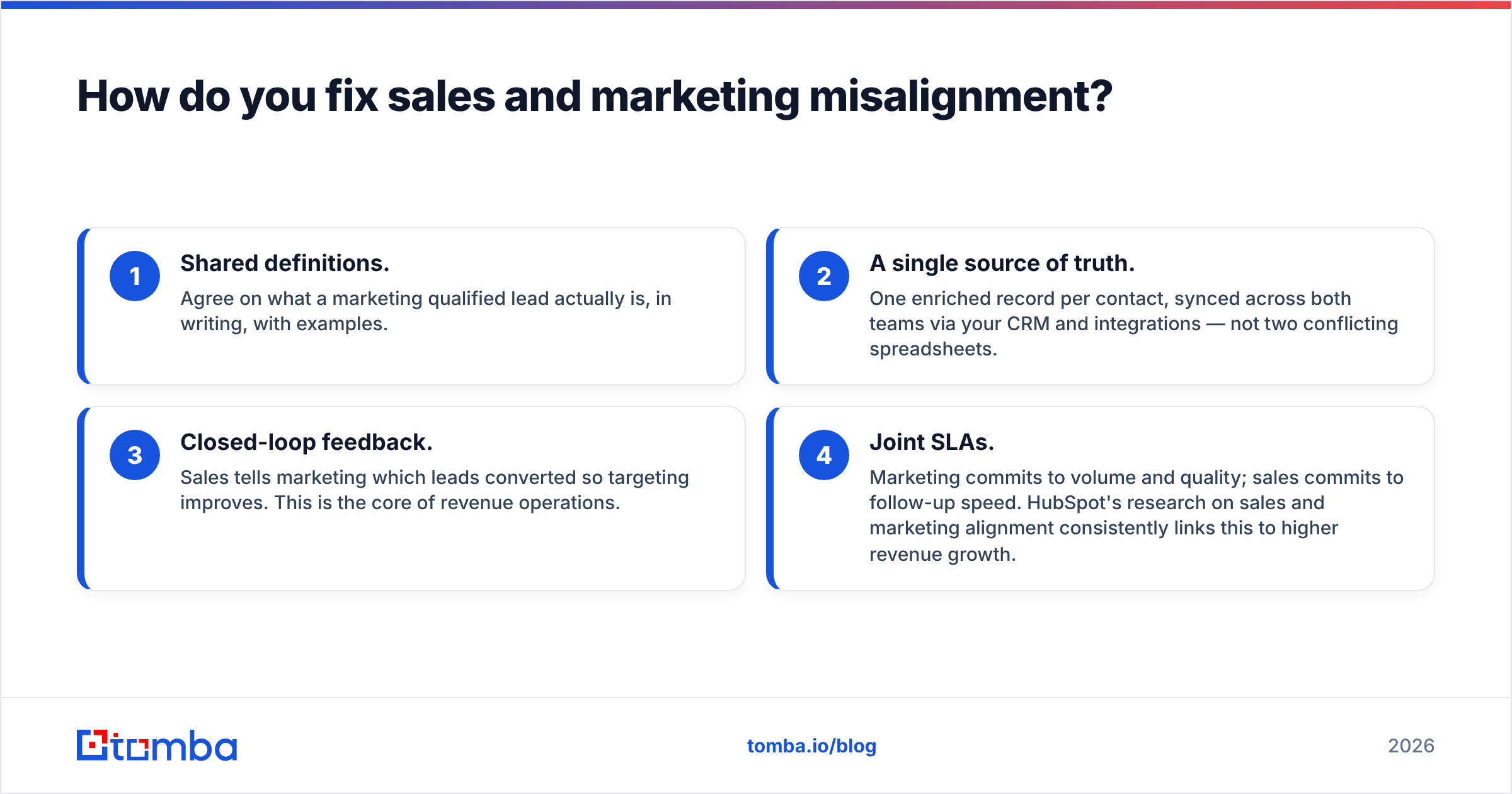
How do you fix sales and marketing misalignment?#
Misalignment shows up as the eternal fight over lead quality: marketing says it sent plenty, sales says none were any good. Both are partly right, and the cost is leaked pipeline at the handoff.
The fixes are organizational, not heroic:
- Shared definitions. Agree on what a marketing qualified lead actually is, in writing, with examples.
- A single source of truth. One enriched record per contact, synced across both teams via your CRM and integrations — not two conflicting spreadsheets.
- Closed-loop feedback. Sales tells marketing which leads converted so targeting improves. This is the core of revenue operations.
- Joint SLAs. Marketing commits to volume and quality; sales commits to follow-up speed. HubSpot's research on sales and marketing alignment consistently links this to higher revenue growth.
Why is forecasting so unreliable in B2B sales?#
Because the pipeline feeding the forecast is dirty, and reps are optimists. Deals sit in "negotiation" for months, "commits" slip, and nobody wants to mark their own deal dead.
The fix: enforce exit criteria per stage. A deal can't move to the next stage until objective conditions are met — verified champion, confirmed budget, agreed timeline. Combine that with regular pipeline hygiene (kill or downgrade stale deals) and your win rate and forecast both get honest. Accurate data underneath the pipeline — current contacts, real titles, reachable buyers — is what makes stage criteria mean something.
How is AI changing the challenges in B2B sales?#
AI cuts both ways. It lets you research and personalize at scale — and it lets everyone else do the same, which raised the noise floor in every inbox. When a buyer gets fifty "personalized" AI emails a week that all reference their recent LinkedIn post, personalization itself stops being a signal.
What still breaks through:
- Timing on real signals. Reaching out the week a prospect changes jobs or raises a round beats any clever line. Use data enrichment to catch those triggers.
- Genuine relevance. A short message that names a real problem the account has, with a specific reason you can help, outperforms a paragraph of AI flattery.
- Human judgment on accounts that matter. Automate the research and list-building; keep a human on the message and the relationship for high-value deals.
The teams winning with AI use it to do less, better — tighter lists, sharper timing, fewer wasted touches — not to blast more volume.
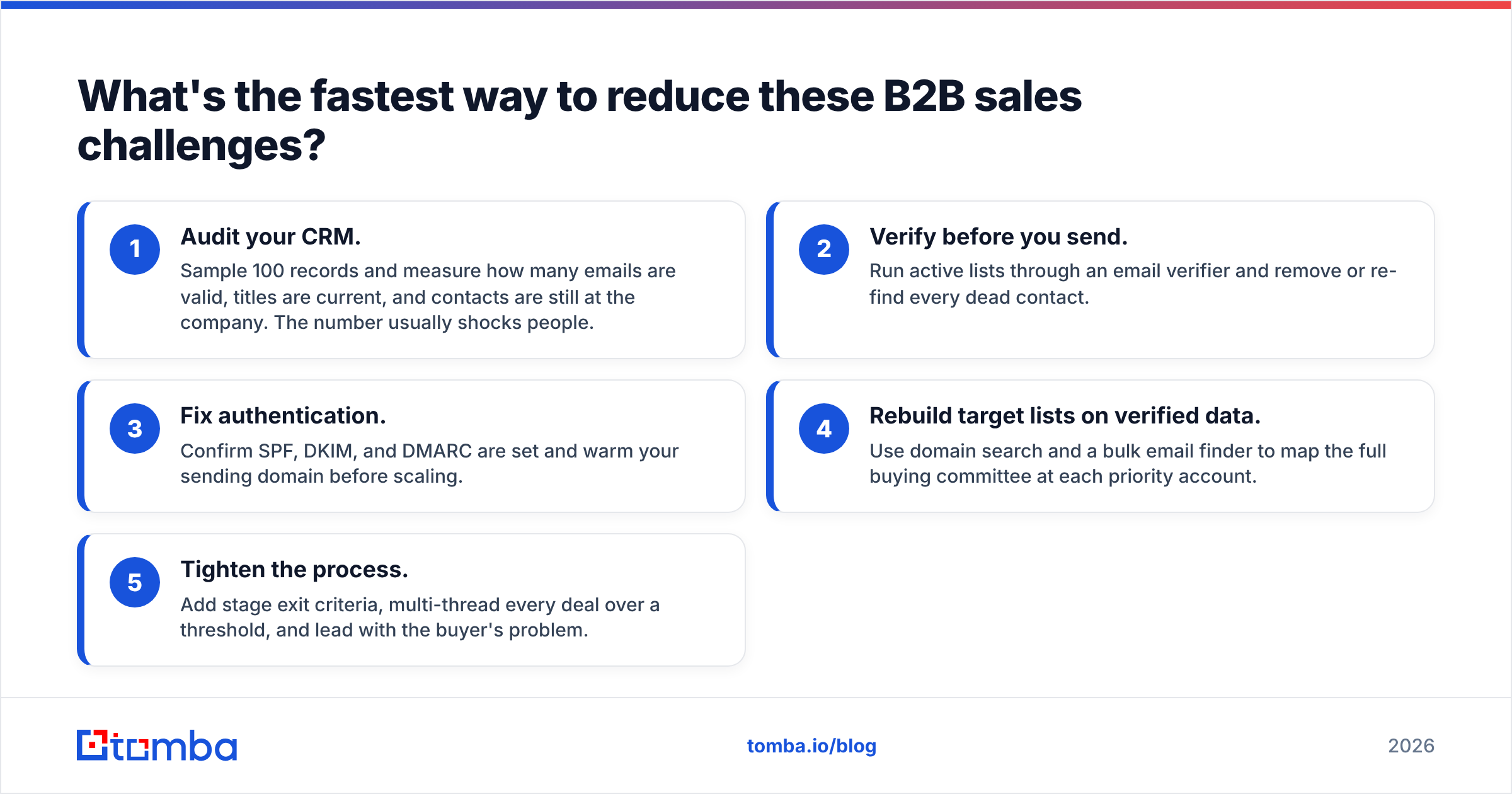
What's the fastest way to reduce these B2B sales challenges?#
Start with the data layer, because it sits underneath six of the nine problems above. Here's a practical 30-day sequence:
- Audit your CRM. Sample 100 records and measure how many emails are valid, titles are current, and contacts are still at the company. The number usually shocks people.
- Verify before you send. Run active lists through an email verifier and remove or re-find every dead contact.
- Fix authentication. Confirm SPF, DKIM, and DMARC are set and warm your sending domain before scaling.
- Rebuild target lists on verified data. Use domain search and a bulk email finder to map the full buying committee at each priority account.
- Tighten the process. Add stage exit criteria, multi-thread every deal over a threshold, and lead with the buyer's problem.
Do this and the compounding problems — bounces, missed decision-makers, bad forecasts, wasted rep time — shrink together. See Tomba pricing for plan options, including a free tier to test the data quality before you commit.
Frequently asked questions#
What is the single biggest challenge in B2B sales right now? Longer, more complex buying cycles driven by larger committees. But the most fixable high-impact challenge is bad contact data, because it quietly degrades everything downstream — deliverability, decision-maker reach, and forecast accuracy.
How do I deal with longer sales cycles? Multi-thread early, qualify hard against budget/authority/need/timeline, and map every stakeholder with a verified contact so a single slow approver can't silently stall the deal.
Does email still work for B2B sales in 2026? Yes, but only with clean lists and proper authentication. Email that bounces or trips spam filters never reaches the inbox, so verification and warmup are now prerequisites, not optional polish.
How much does data quality actually affect results? Heavily. Reps can lose 20–30% of selling time to bad data, and high bounce rates damage the sender reputation that determines whether your good emails get delivered at all.
Pick the right tool and stop fighting bad data#
Most challenges in B2B sales get smaller once your reps work from data that's actually correct. If you're going to fix one thing this quarter, fix the layer everything else sits on: find the right decision-makers, confirm they're reachable, and keep those records current.
The Tomba Email Finder gets you verified professional emails by name, domain, or company — so your team multi-threads real buying committees instead of guessing at info@ addresses. Pair it with the built-in verifier and enrichment, start on the free tier, and move up to a paid plan only once you've seen the bounce rate drop. Cleaner data, fewer wasted touches, and a forecast you can trust.
Ready to find emails that actually work?
Join 150,000+ professionals who stopped guessing and started sending. Free credits on signup — no credit card required.
Get the Tomba newsletter
Practical outbound tactics and product updates — once every two weeks.
About the author