CHAMP Framework: The Sales Qualification Method for 2026
BANT is showing its age. The CHAMP framework flips qualification to lead with the buyer's challenges. Here's how it works, how it beats BANT, and how to run it.
Qualification frameworks decide which deals you chase and which you walk away from. Get it wrong and your pipeline fills with leads that never close. The CHAMP framework fixes the biggest flaw in the old BANT model: it stops you from leading with budget and starts you with the one thing a prospect actually cares about — their problem.
TL;DR#
- CHAMP stands for Challenges, Authority, Money, Prioritization — a sales qualification framework built to replace the dated BANT model.
- It reorders the conversation to start with the buyer's pain, not your need to confirm budget on call one.
- CHAMP works best for inbound-heavy, consultative, and SaaS sales motions where the prospect is researching before they ever talk to you.
- It pairs cleanly with accurate contact data: you can only qualify someone you can actually reach and map to the right account.
- Used well, CHAMP raises win rates by killing bad-fit deals early and protecting rep time for prospects who can buy.
What is the CHAMP framework?#
The CHAMP framework is a sales qualification methodology that scores opportunities across four dimensions — Challenges, Authority, Money, and Prioritization. It was popularized by InsightSquared as a modern answer to BANT, the IBM-era checklist that put Budget first.
The reorder is the whole point. BANT trains reps to open with "Do you have budget?" — a question a prospect can rarely answer before they understand the value, and one that makes you sound like a vendor instead of an advisor. CHAMP starts with the prospect's challenges, because a buyer who has a painful, expensive problem will find budget. A buyer with budget and no real problem will not sign.
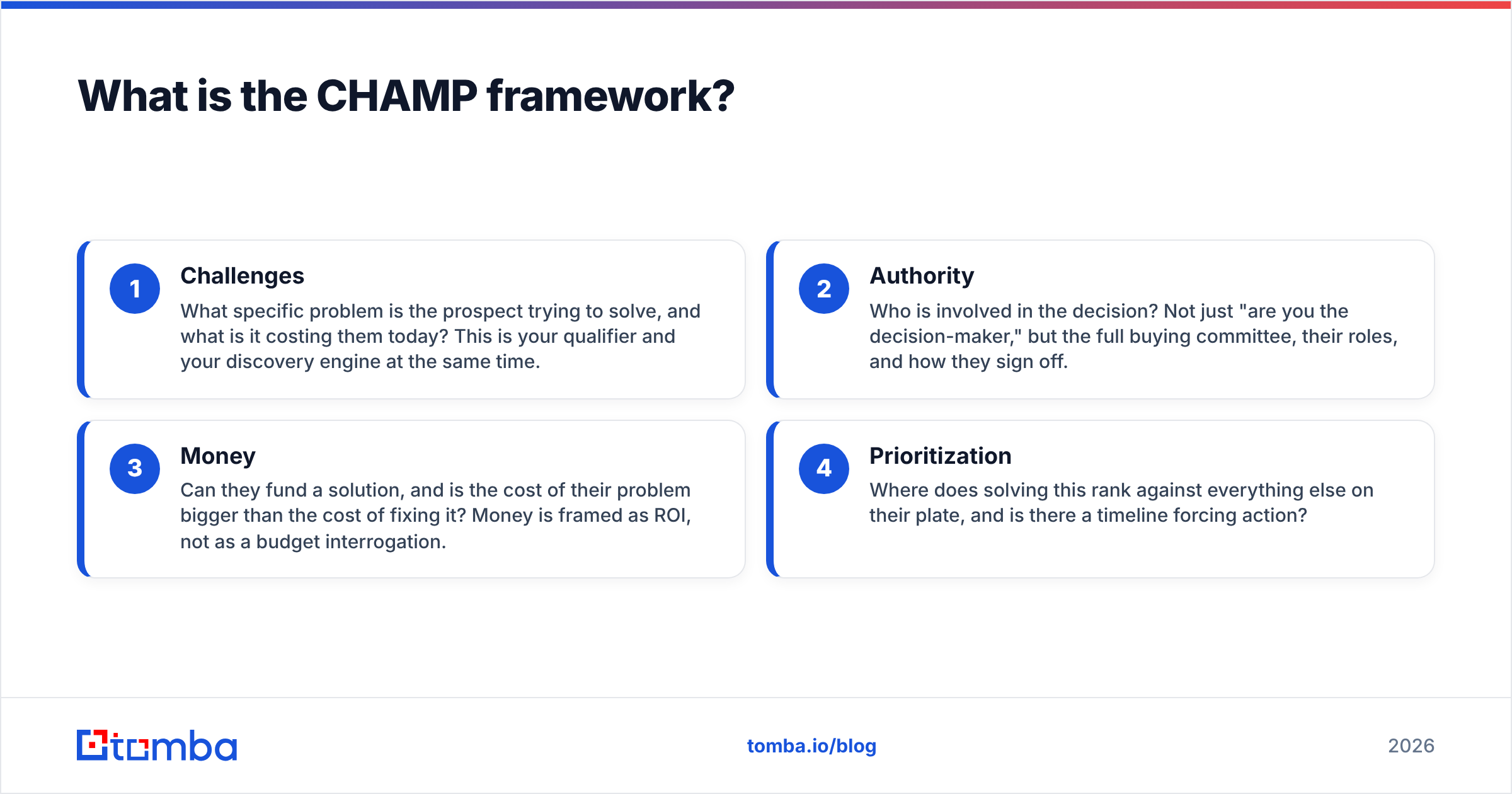
Here is what each letter actually asks you to uncover:
- Challenges — What specific problem is the prospect trying to solve, and what is it costing them today? This is your qualifier and your discovery engine at the same time.
- Authority — Who is involved in the decision? Not just "are you the decision-maker," but the full buying committee, their roles, and how they sign off.
- Money — Can they fund a solution, and is the cost of their problem bigger than the cost of fixing it? Money is framed as ROI, not as a budget interrogation.
- Prioritization — Where does solving this rank against everything else on their plate, and is there a timeline forcing action?
Notice that "Prioritization" replaces BANT's "Timing." It is a sharper question. A deal can have a timeline and still die because it is priority number nine. CHAMP forces you to ask whether this initiative will actually get funded and staffed this quarter.
Why does CHAMP beat BANT?#
BANT isn't broken because the four factors are wrong — budget, authority, need, and timing all matter. It's broken because of the order and the tone. Leading with budget treats the prospect as a transaction before you have earned the right to ask. In a world where buyers complete most of their research before talking to sales, that opener kills momentum.
CHAMP fixes three specific problems:
- It leads with empathy. Opening on challenges signals you care about the outcome, not the contract. That builds the trust consultative selling depends on.
- It reframes money as value. Instead of "what's your budget," you ask "what is this problem costing you." A clear cost of inaction makes pricing feel small.
- It surfaces the real blocker. Prioritization catches the silent deal-killer that BANT's "timing" misses — deals that stall not because of a date, but because nobody internally cares enough to push.
If you want the deeper mechanics of qualification scoring, our B2B glossary breaks down how MQLs feed into frameworks like this one.
How does CHAMP compare to BANT and MEDDIC?#
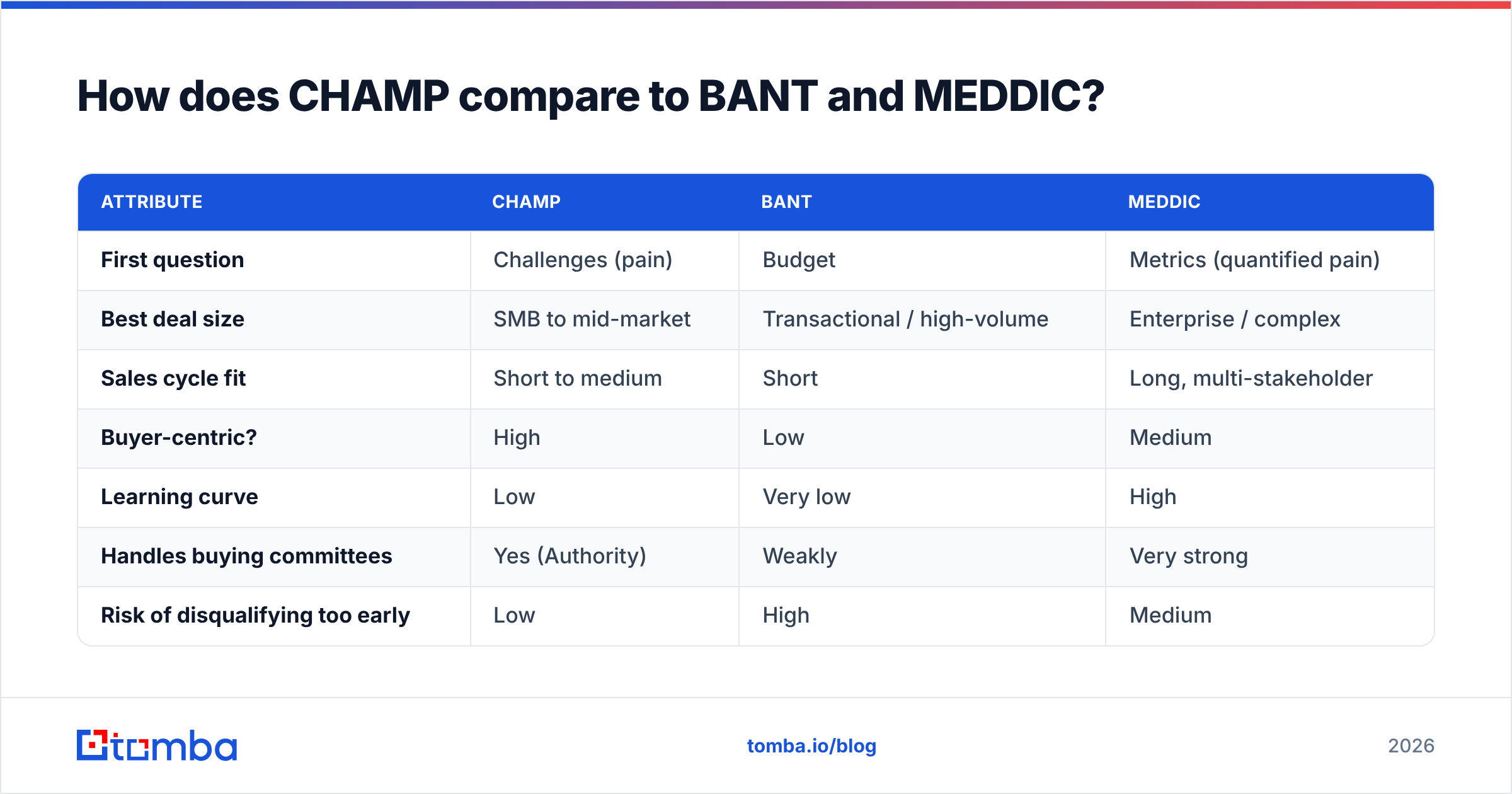
CHAMP isn't the only framework competing with BANT. MEDDIC (Metrics, Economic buyer, Decision criteria, Decision process, Identify pain, Champion) is the heavyweight used in complex enterprise deals. Here's how the three line up.
| Attribute | CHAMP | BANT | MEDDIC |
|---|---|---|---|
| First question | Challenges (pain) | Budget | Metrics (quantified pain) |
| Best deal size | SMB to mid-market | Transactional / high-volume | Enterprise / complex |
| Sales cycle fit | Short to medium | Short | Long, multi-stakeholder |
| Buyer-centric? | High | Low | Medium |
| Learning curve | Low | Very low | High |
| Handles buying committees | Yes (Authority) | Weakly | Very strong |
| Risk of disqualifying too early | Low | High | Medium |
The takeaway: use BANT when you sell something cheap and fast where budget really is the gate. Use MEDDIC when you sell six-figure deals to ten-person committees. Use CHAMP for the broad middle — consultative SaaS, services, and mid-market sales where the prospect needs to feel understood before they'll talk numbers. Many teams even run CHAMP for early discovery and layer MEDDIC's rigor on once a deal is qualified and advancing.
Industry analysts at Gartner have documented how B2B buying has shifted toward self-directed research, which is exactly why a pain-first framework outperforms a budget-first one today.
How do you run CHAMP on a sales call?#
Knowing the letters is easy. Running the framework live without sounding like you're reading a checklist is the skill. Here's a practical sequence.
Step 1 — Open on Challenges. Ask open-ended questions about their current state. "Walk me through how your team handles X today." "What made you take this call?" Let them describe the pain in their words, then quantify it: "How many hours a week does that cost?" You're building the business case with their own data.
Step 2 — Map Authority naturally. Don't ask "are you the decision-maker" — it's insulting and gets a defensive answer. Instead: "When your team has rolled out a tool like this before, who else weighs in?" That surfaces the buying committee without putting anyone on the spot.
Step 3 — Frame Money as ROI. Tie cost-of-problem to cost-of-solution. "If this is costing you roughly $40k a quarter in wasted time, a fix in the low five figures pays for itself fast — does that math track on your side?" Now budget is a conclusion, not an interrogation.
Step 4 — Test Prioritization honestly. Ask where this sits. "Of everything on your roadmap this quarter, where does solving this land?" If it's not top three, you've learned something vital — either help them build the internal urgency or deprioritize the deal yourself.
A strong qualification call doesn't just score the lead; it advances the deal. Each CHAMP question doubles as discovery that you'll use in your proposal and your follow-up. For more on turning qualified conversations into pipeline, see how data enrichment fills in the account context CHAMP assumes you already have.

Where does data fit into the CHAMP framework?#
CHAMP assumes one thing that's easy to overlook: you can actually reach and identify the right people. The Authority step in particular falls apart if you can't find the other stakeholders on the buying committee. You can score a lead perfectly and still lose the deal because you never got to the VP who controls the budget.
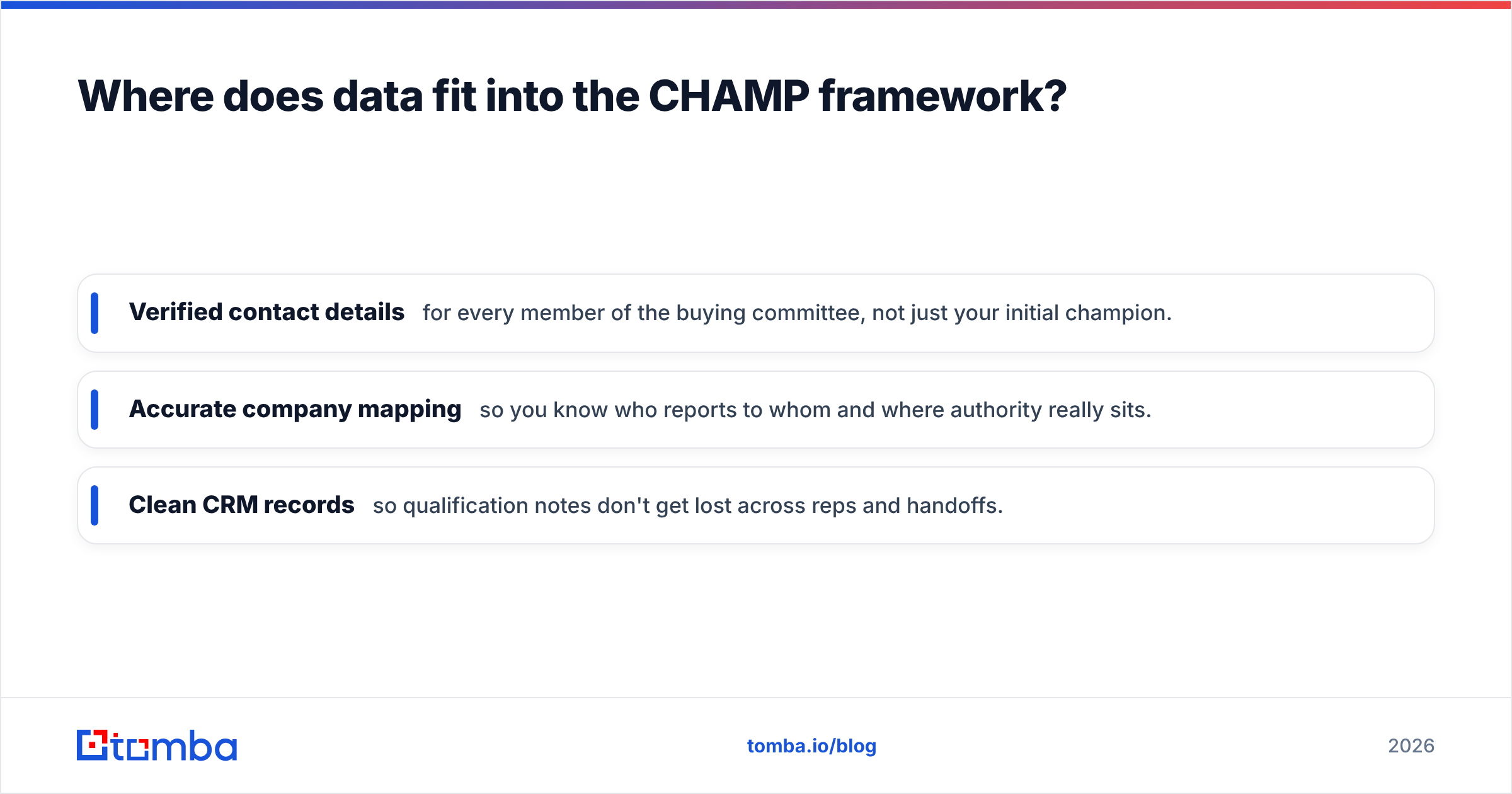
This is where qualification meets prospecting data. To run CHAMP at scale you need:
- Verified contact details for every member of the buying committee, not just your initial champion.
- Accurate company mapping so you know who reports to whom and where authority really sits.
- Clean CRM records so qualification notes don't get lost across reps and handoffs.
If your contact data is stale, the Authority and Prioritization steps become guesswork. A rep chasing a "decision-maker" who left the company six months ago is burning a fully qualified deal on bad data. Finding the current stakeholders by company domain — using a reliable email finder — turns CHAMP's Authority question from a guess into a map. And keeping qualification data consistent inside your CRM means the framework actually compounds across your team instead of living in one rep's notebook.
What are the common mistakes with CHAMP?#
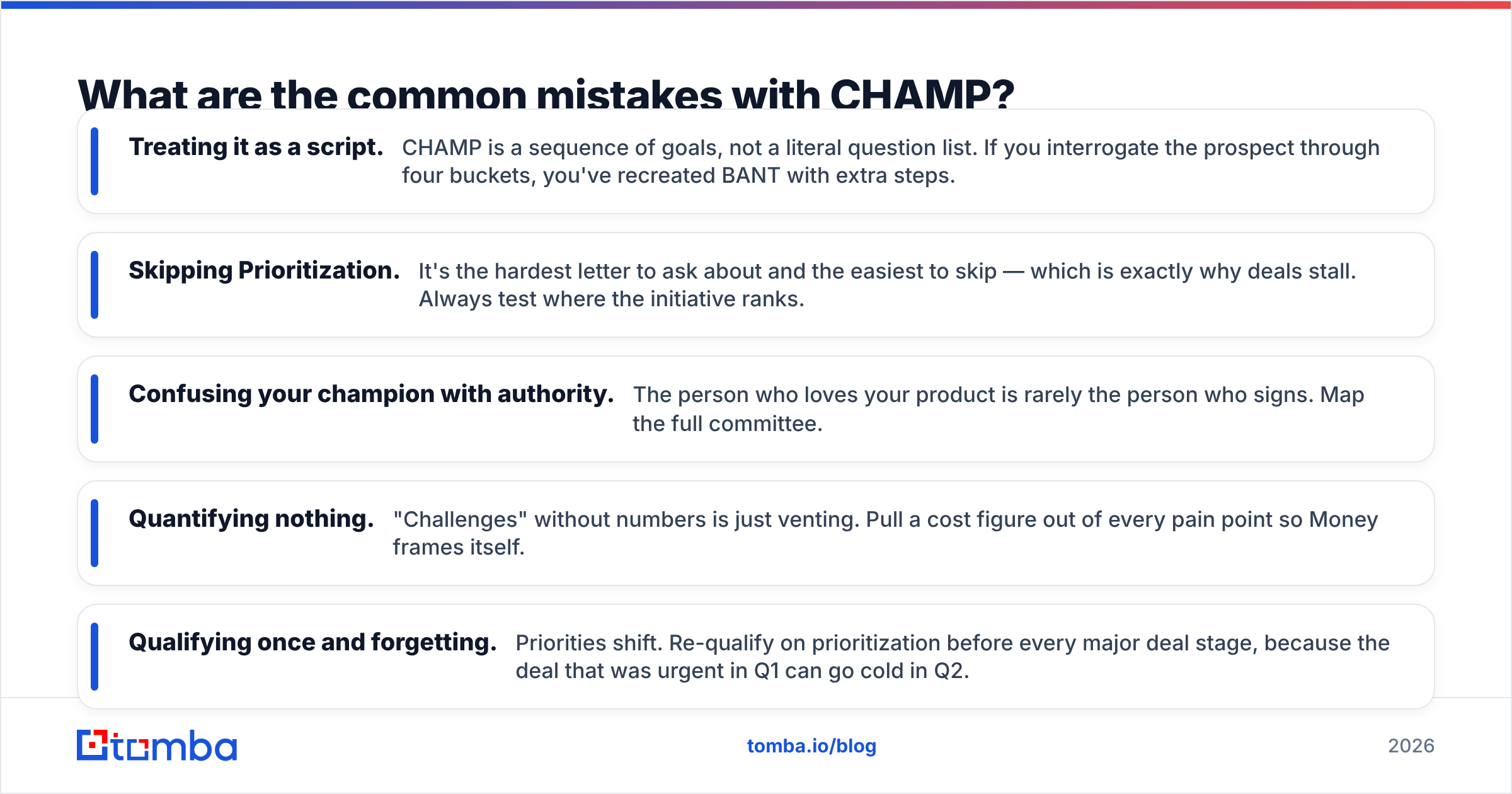
Even teams that adopt CHAMP often run it badly. Watch for these failure modes:
- Treating it as a script. CHAMP is a sequence of goals, not a literal question list. If you interrogate the prospect through four buckets, you've recreated BANT with extra steps.
- Skipping Prioritization. It's the hardest letter to ask about and the easiest to skip — which is exactly why deals stall. Always test where the initiative ranks.
- Confusing your champion with authority. The person who loves your product is rarely the person who signs. Map the full committee.
- Quantifying nothing. "Challenges" without numbers is just venting. Pull a cost figure out of every pain point so Money frames itself.
- Qualifying once and forgetting. Priorities shift. Re-qualify on prioritization before every major deal stage, because the deal that was urgent in Q1 can go cold in Q2.
Tools like HubSpot and Salesforce let you build CHAMP fields directly into your deal records so reps can't skip a step — a small process change that compounds across hundreds of opportunities. Many sales teams also document their qualification stack on review sites like G2 before standardizing, so it's worth seeing what comparable companies run.
Is CHAMP right for your team?#
CHAMP is the right default if you sell consultatively, your buyers research before they engage, and your deals involve more than one stakeholder but don't require enterprise-grade rigor. That covers most SMB and mid-market SaaS and services teams.
It's the wrong choice if your sales motion is genuinely transactional — high volume, low price, fast close — where budget really is the only gate and BANT's speed wins. And it's not enough on its own for true enterprise deals, where you'll want MEDDIC's discipline on top.
The honest answer for most teams in 2026: start with CHAMP because it forces buyer-centric discovery, then graduate qualified deals into a heavier framework as they grow in size and complexity. The frameworks aren't rivals — they're layers.
Run CHAMP on contacts you can actually reach#
CHAMP only works when you can identify and reach the whole buying committee — and that starts with accurate contact data. Tomba's Email Finder finds verified professional emails by domain, name, or company, so the Authority step of your CHAMP qualification is built on real people you can email today, not stale records. Start free with 25 searches a month, or scale to the Starter plan at $49/mo when your pipeline grows — see Tomba pricing for the full breakdown. Qualify smarter, reach the right stakeholders, and stop losing deals to bad data.
Ready to find emails that actually work?
Join 150,000+ professionals who stopped guessing and started sending. Free credits on signup — no credit card required.
Get the Tomba newsletter
Practical outbound tactics and product updates — once every two weeks.
About the author