Channel Partner Strategy: The 2026 B2B Playbook to Scale
A channel partner strategy can multiply your pipeline without multiplying headcount — if you build it right. Here is the 2026 playbook for recruiting, enabling, and scaling partners.
Channel partners can add a revenue engine that scales faster than hiring ever will — but only when your strategy treats them as an extension of your go-to-market, not an afterthought. A loose reseller agreement and a quarterly check-in is not a strategy. A repeatable system for recruiting, enabling, and measuring partners is.
This guide breaks down how to build a channel partner strategy in 2026: the models that work, the enablement that drives adoption, the metrics that tell you if it is working, and the data stack that keeps co-selling profitable instead of chaotic.
TL;DR#
- A channel partner strategy is a structured plan for generating revenue through third parties — resellers, referral partners, MSPs, agencies, and tech alliances — instead of (or alongside) your direct sales team.
- The four dominant models are referral, reseller, managed-service, and technology/co-sell partnerships. Most mature programs run two or more at once.
- Partner programs fail on enablement and economics, not intent. Clear margins, fast onboarding, and shared data decide whether partners actually sell.
- You need clean contact and account data to co-sell. Tools like the Tomba Email Finder and data enrichment keep partner-sourced leads accurate and routable.
- Measure partners on sourced pipeline, influenced revenue, time-to-first-deal, and partner-attach rate — not logo counts.
What is a channel partner strategy?#
A channel partner strategy is the plan that decides which third parties sell, service, or refer your product, how they get paid, and how you support them. Think of it like franchising a restaurant brand: you do not staff every location yourself, but you standardize the recipe, the training, and the supply chain so every operator delivers the same result.
The "channel" is simply any path to the customer that is not your own direct sales rep. In B2B that includes resellers who buy and resell your software, agencies who bundle it into services, managed service providers (MSPs) who run it for clients, and technology vendors who integrate and co-sell alongside you.
The strategic question is not "should we have partners?" It is "which partner motions match our product, margin, and customer-acquisition math?" A $20/month self-serve tool and a $200K enterprise platform need very different channel designs.
What are the main channel partner models?#
Before you recruit anyone, decide which model (or mix) you are building. Each one changes how you price, who owns the customer relationship, and how you forecast revenue.
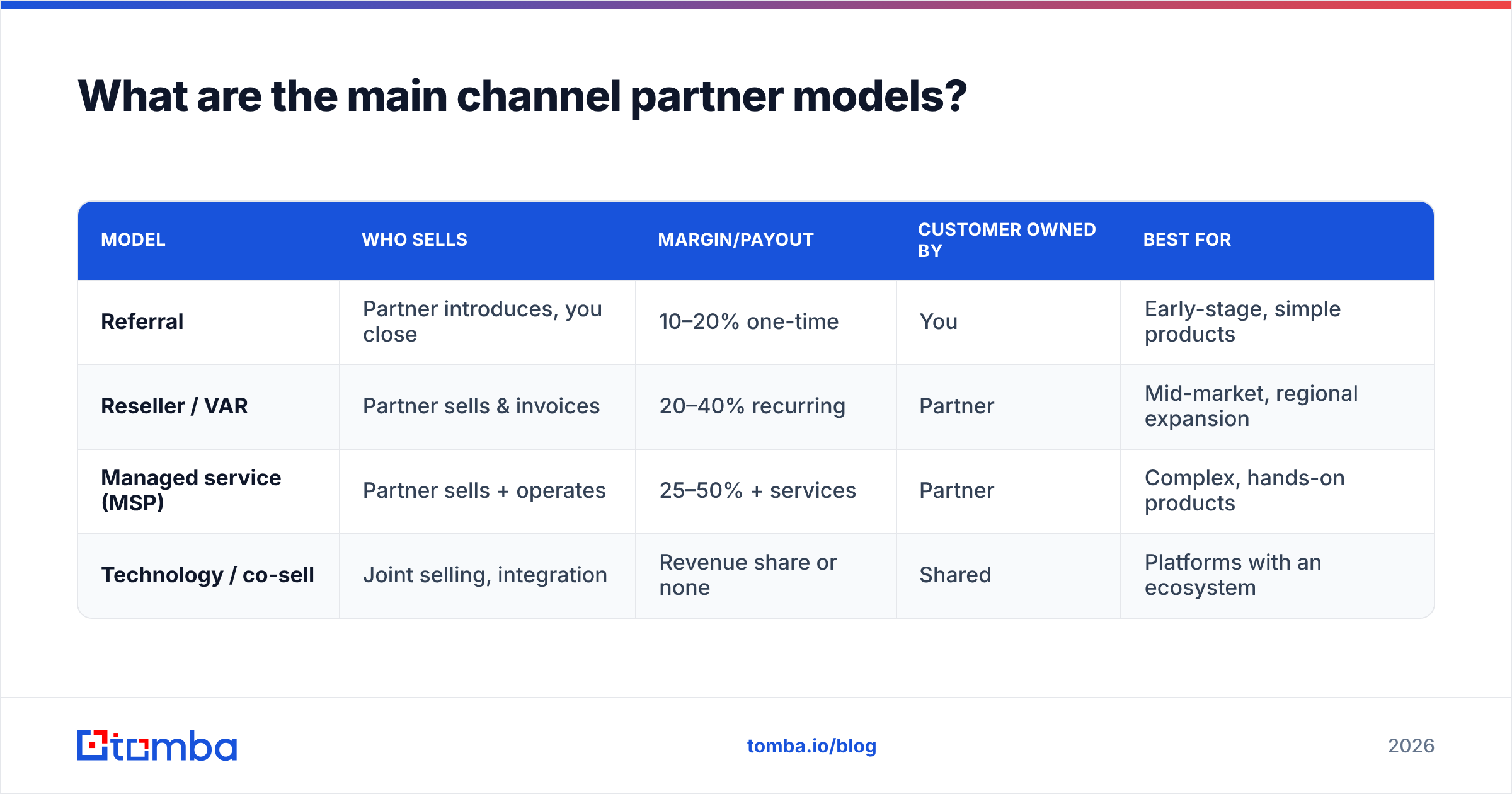
| Model | Who sells | Margin/payout | Customer owned by | Best for |
|---|---|---|---|---|
| Referral | Partner introduces, you close | 10–20% one-time | You | Early-stage, simple products |
| Reseller / VAR | Partner sells & invoices | 20–40% recurring | Partner | Mid-market, regional expansion |
| Managed service (MSP) | Partner sells + operates | 25–50% + services | Partner | Complex, hands-on products |
| Technology / co-sell | Joint selling, integration | Revenue share or none | Shared | Platforms with an ecosystem |
A few principles that hold across all four:
- Referral partners are the easiest to start and the hardest to scale. Low commitment means low predictability. Great for filling early pipeline, weak as a sole strategy.
- Resellers want margin and protection. Deal registration, predictable discounts, and territory clarity matter more than marketing swag.
- MSPs want stickiness. They will champion products that increase their own retention and services revenue.
- Tech/co-sell partners want pipeline, not paperwork. The currency is qualified introductions and integration depth, not commission.
Most companies start with referral or a single reseller tier, then layer in co-sell once the product has an ecosystem worth integrating with. For a deeper look at how channel motions fit into broader revenue operations, align your partner model with the same pipeline stages your direct team uses.
How do you recruit the right channel partners?#
Recruit for fit, not volume. A program with 12 productive partners beats one with 200 logos that never transact. The recruiting funnel looks a lot like outbound sales — and you should run it that way.
Start by defining an Ideal Partner Profile (IPP), the channel equivalent of an ICP. Spell out the partner's customer base, geography, technical capability, existing vendor relationships, and revenue range. A partner whose clients overlap with your ICP but who currently sells an adjacent (not competing) product is gold.
Then source candidates the same way you source prospects:
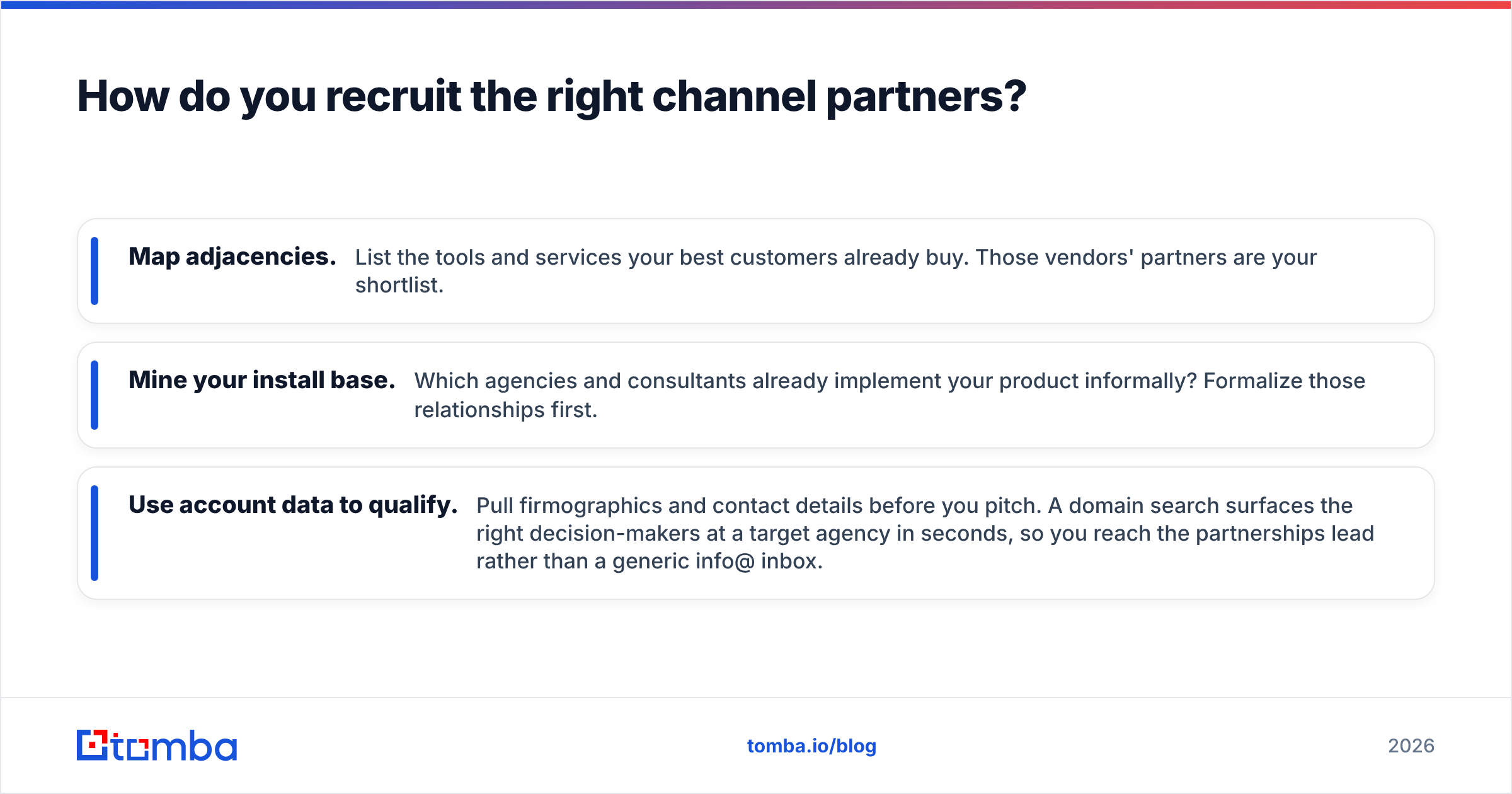
- Map adjacencies. List the tools and services your best customers already buy. Those vendors' partners are your shortlist.
- Mine your install base. Which agencies and consultants already implement your product informally? Formalize those relationships first.
- Use account data to qualify. Pull firmographics and contact details before you pitch. A domain search surfaces the right decision-makers at a target agency in seconds, so you reach the partnerships lead rather than a generic info@ inbox.
Recruiting is outbound. You will research, find the right contact, personalize, and follow up — which means the same prospecting discipline (and the same data hygiene) you apply to customers. If your partner-recruiting list is full of bounced emails and stale titles, your recruiting motion stalls before it starts. Verifying contacts with an email verifier keeps that funnel clean.
How do you enable partners to actually sell?#
Enablement is where most channel partner strategies live or die. Recruiting a partner is a wedding; enablement is the marriage. Partners have limited attention and many vendors competing for it — the one that is easiest to sell wins shelf space.
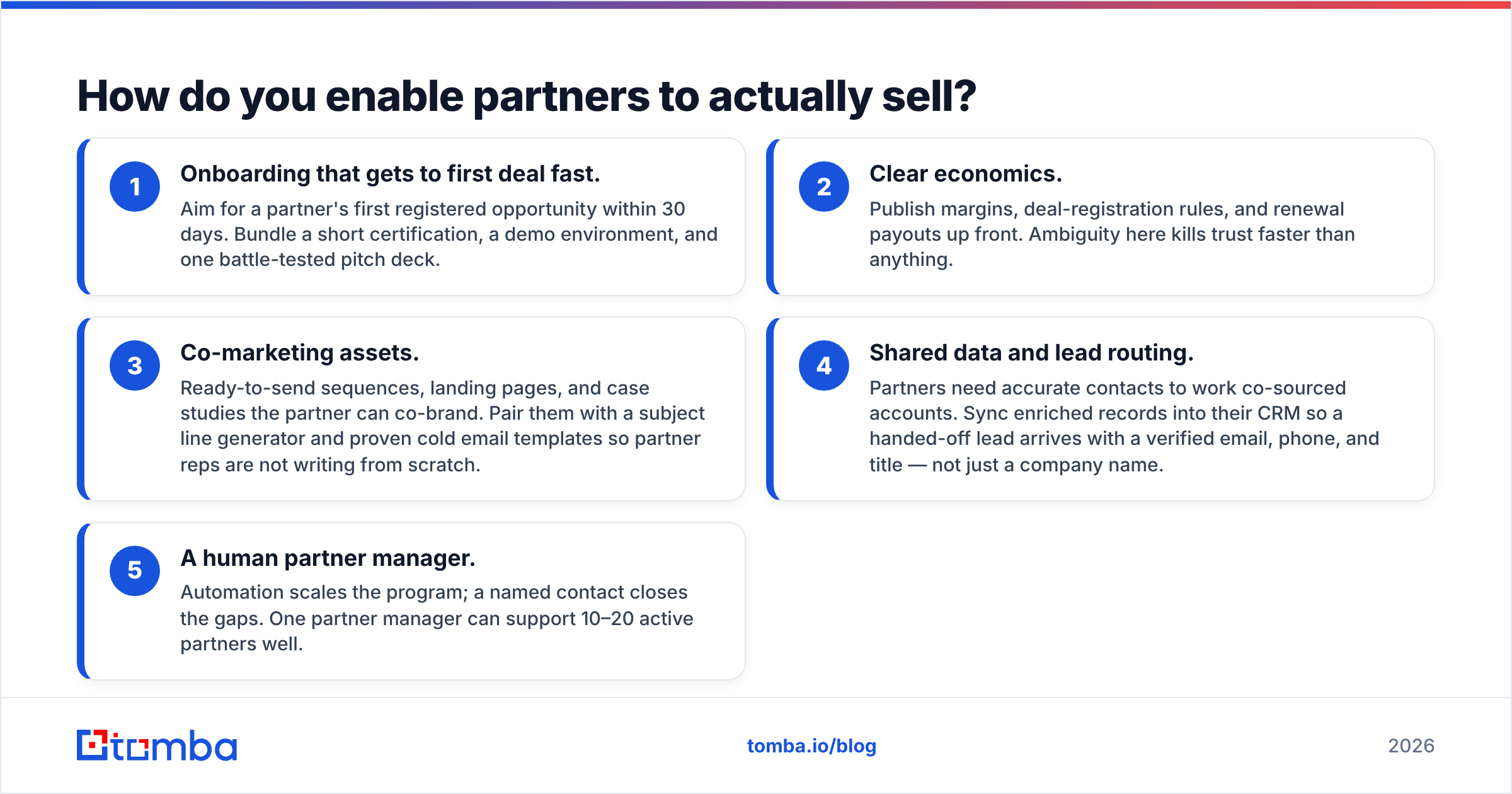
A practical enablement stack has five layers:
- Onboarding that gets to first deal fast. Aim for a partner's first registered opportunity within 30 days. Bundle a short certification, a demo environment, and one battle-tested pitch deck.
- Clear economics. Publish margins, deal-registration rules, and renewal payouts up front. Ambiguity here kills trust faster than anything.
- Co-marketing assets. Ready-to-send sequences, landing pages, and case studies the partner can co-brand. Pair them with a subject line generator and proven cold email templates so partner reps are not writing from scratch.
- Shared data and lead routing. Partners need accurate contacts to work co-sourced accounts. Sync enriched records into their CRM so a handed-off lead arrives with a verified email, phone, and title — not just a company name.
- A human partner manager. Automation scales the program; a named contact closes the gaps. One partner manager can support 10–20 active partners well.

The data layer deserves emphasis. Co-selling breaks when two teams work the same account with different, stale information. Standardize on enriched, verified records so both sides see the same truth. Tomba's bulk email finder and HubSpot integration let you push clean contact data to partners at scale, which removes the single biggest source of co-sell friction: bad data.
How do you measure channel partner performance?#
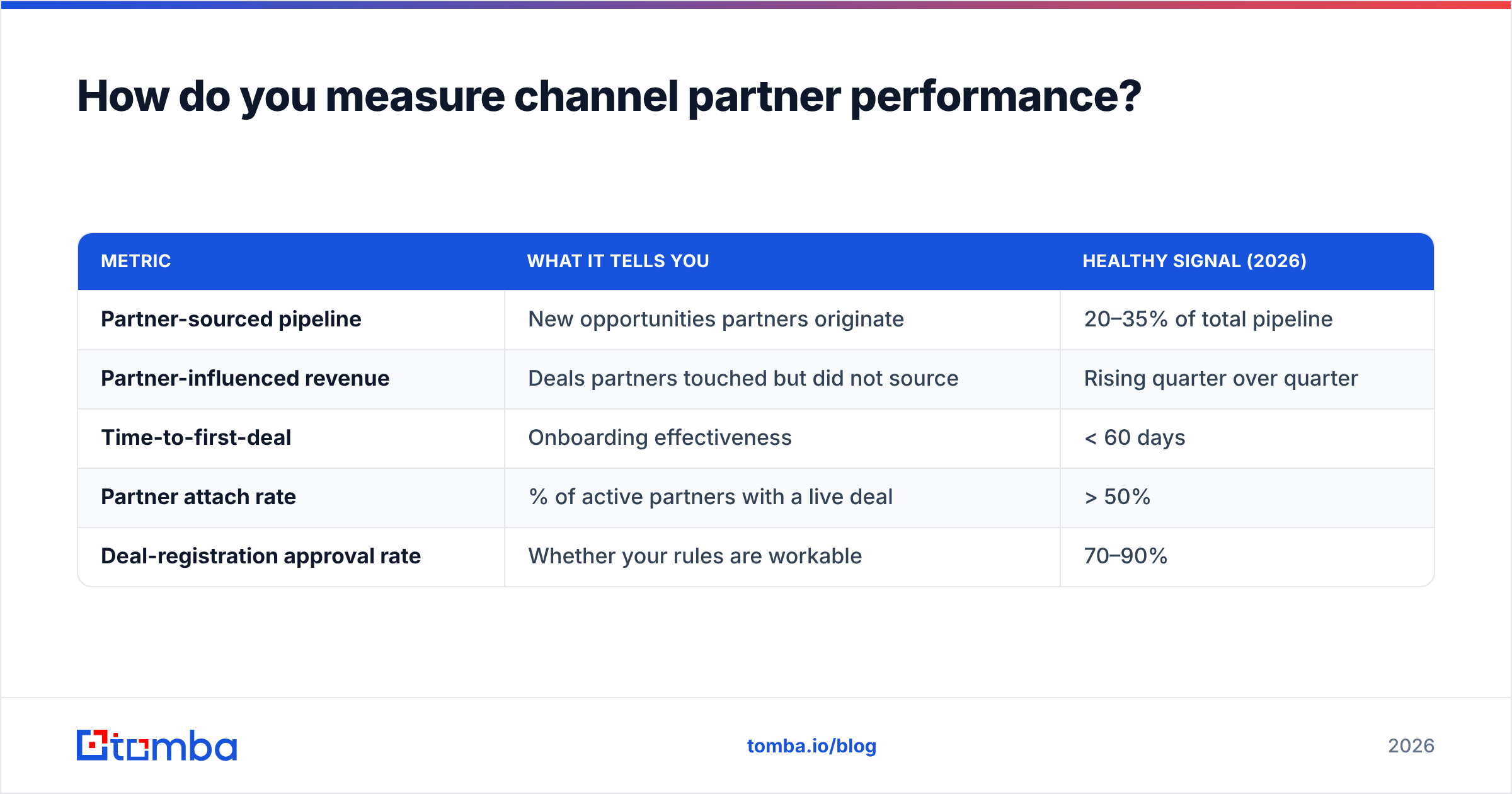
Measure partners on revenue contribution and velocity, not vanity logos. A signed partner who never transacts is a cost, not an asset. Track a tight set of metrics and review them quarterly.
| Metric | What it tells you | Healthy signal (2026) |
|---|---|---|
| Partner-sourced pipeline | New opportunities partners originate | 20–35% of total pipeline |
| Partner-influenced revenue | Deals partners touched but did not source | Rising quarter over quarter |
| Time-to-first-deal | Onboarding effectiveness | < 60 days |
| Partner attach rate | % of active partners with a live deal | > 50% |
| Deal-registration approval rate | Whether your rules are workable | 70–90% |
A common mistake is celebrating "200 partners signed" while only a dozen ever register a deal. The partner attach rate exposes that immediately. If half your roster is dormant, the fix is enablement and economics, not more recruiting.
Tie partner metrics to the same definitions your direct team uses. A partner-sourced marketing qualified lead should mean the same thing whether it came from a rep or a reseller, or your forecasting turns to fiction. For broader pipeline benchmarks, industry analysts like Gartner and Forrester publish annual channel and ecosystem research worth calibrating against.
Is a channel strategy better than direct sales?#
Neither is universally better — the right answer is usually a blend, and the mix depends on your margins and motion. Channel and direct are tools, not religions.
Channel sales wins when you need reach without headcount: new geographies, verticals that demand local trust, or products that require services to deploy. Direct sales wins when you need control: complex enterprise deals, fast product feedback, or high-margin products where you cannot afford to give away 30%.
Here is the honest trade-off:
- Channel pros: faster geographic and vertical expansion, lower fixed cost, built-in customer trust, services attach.
- Channel cons: thinner margins, less control over the customer relationship, slower feedback loops, channel conflict risk.
- Direct pros: full margin, direct customer insight, tight control, faster iteration.
- Direct cons: expensive to scale, slow to enter new markets, capped by hiring.
Most successful B2B companies run a hybrid model with clear rules of engagement to prevent channel conflict: which deals are partner-led, which are direct, and how overlaps get resolved. Platforms like HubSpot and Salesforce scaled precisely by pairing a strong direct motion with a massive partner ecosystem — direct for the core, channel for the long tail.
What does the channel partner data stack look like in 2026?#
The unglamorous truth: most channel friction is data friction. Co-selling means two organizations working shared accounts, and the moment their records diverge, deals slip and partners disengage. A modern channel stack solves for one shared, accurate view.
Your minimum stack should cover:
- A PRM or CRM with partner objects to track deal registration, attribution, and payouts. A native Salesforce integration or Pipedrive integration keeps partner deals in the same pipeline as direct.
- Enrichment and verification so partner-sourced leads arrive complete. Contact enrichment fills in titles, seniority, and verified emails before a lead ever reaches a partner rep.
- Bulk lead tooling for joint campaigns, so a co-marketing push does not bounce against dead inboxes.
- Phone data for partners who sell by phone — a B2B phone numbers source closes the gap for high-touch motions.
When both you and your partner pull from the same enriched, verified dataset, handoffs stop leaking. That is the difference between a channel that compounds and one that quietly decays.
Common channel partner strategy mistakes to avoid#
Even well-funded programs stumble on the same handful of errors:
- Recruiting before enabling. Signing partners you cannot support creates dormant logos and burns reputation.
- Vague economics. If a partner cannot calculate their margin in 30 seconds, they will sell something else.
- No deal registration. Without it, channel conflict poisons partner trust on the first overlapping deal.
- Treating partners as a list, not a relationship. Automation scales support; it does not replace a partner manager.
- Dirty handoff data. Sending partners stale contacts guarantees bounced outreach and finger-pointing over who "owns" the account.
Avoid these and your channel becomes a durable, compounding revenue source. Ignore them and you get a CRM full of inactive partner records and a forecast you cannot trust.
Build a channel partner strategy that scales#
A channel partner strategy is not a side project — it is a second go-to-market engine that, done right, scales revenue faster than headcount ever could. Pick the model that matches your margins, recruit for fit, obsess over enablement, and measure partners on real revenue contribution. Above all, give your partners clean, verified data so co-selling adds pipeline instead of friction.
That data foundation starts with knowing exactly who to reach — at target partners and at the accounts you co-sell into. The Tomba Email Finder gives you and your partners accurate, verified business emails by domain, name, or company, so every recruiting pitch lands and every handed-off lead is reachable. Start on the free tier and see how clean data tightens your channel motion before you scale to a paid Tomba plan.
// get started
Find, verify and enrich your first contacts today
Start on the free plan with 25 searches a month, then scale when your team is ready.
Free plan · No credit card required · GDPR & CCPA
// about the author