Channel Sales Software in 2026: Best Tools to Scale Partners
Channel sales software runs your reseller, referral, and partner programs in one place. Here's how the top platforms compare in 2026 — and where each one fits.
TL;DR
- Channel sales software (often called PRM — partner relationship management) is the system of record for everything your resellers, referral partners, and distributors do: onboarding, deal registration, MDF, content, and commissions.
- The right tool depends on your channel maturity. Early programs need lightweight deal registration; mature programs need tiered portals, co-selling, and revenue attribution.
- Pricing ranges from roughly $500/mo for small-team PRM to $50k+/year for enterprise platforms like PartnerStack, Impartner, and Salesforce PRM.
- No PRM finds contacts for you. You still need clean B2B data to enrich partner-sourced leads — that's where an email finder plugs into the workflow.
- This guide compares seven platforms across features, pricing, and best-fit use cases so you can shortlist in an afternoon.
What is channel sales software?#
Channel sales software is the platform that manages indirect revenue — every deal that closes through a partner instead of your own reps. Think of it as a CRM built specifically for people who don't work for you. Your direct sales team lives in Salesforce or HubSpot; your partners live in the PRM, where they register deals, grab co-branded collateral, and track the commissions they're owed.
The technical name is partner relationship management (PRM). A PRM sits beside your CRM and handles the parts a standard CRM was never designed for: recruiting and vetting partners, controlling who sees which content, splitting credit on shared deals, and paying out referral fees without a spreadsheet war.
Here is what a mature channel sales stack actually does, broken into the jobs it has to cover:
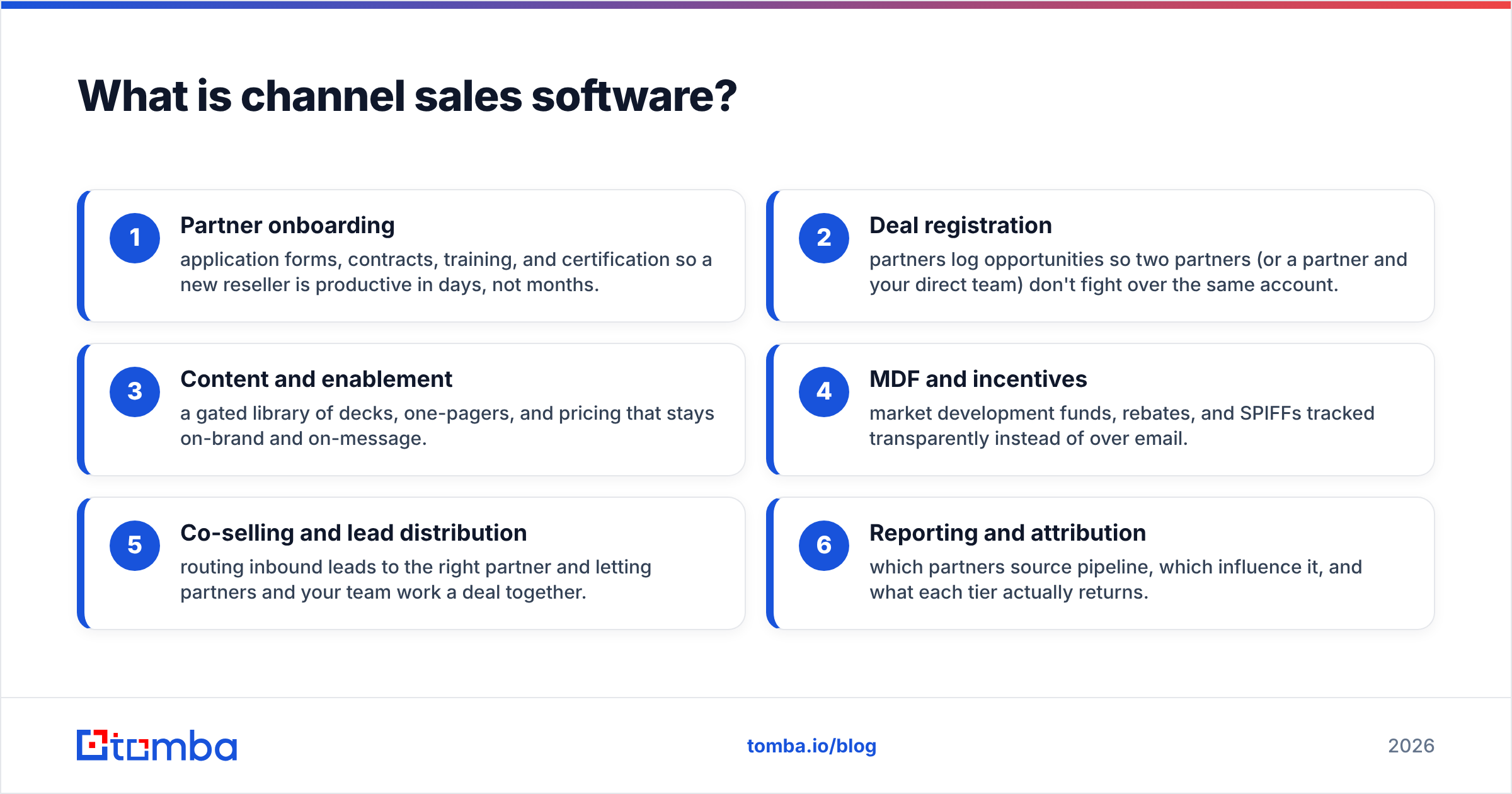
- Partner onboarding — application forms, contracts, training, and certification so a new reseller is productive in days, not months.
- Deal registration — partners log opportunities so two partners (or a partner and your direct team) don't fight over the same account.
- Content and enablement — a gated library of decks, one-pagers, and pricing that stays on-brand and on-message.
- MDF and incentives — market development funds, rebates, and SPIFFs tracked transparently instead of over email.
- Co-selling and lead distribution — routing inbound leads to the right partner and letting partners and your team work a deal together.
- Reporting and attribution — which partners source pipeline, which influence it, and what each tier actually returns.
)
If you only need one or two of those jobs today, a full PRM is overkill. If you need all six, a spreadsheet will quietly cap your channel revenue. According to Salesforce's own channel research, indirect channels drive a large share of B2B revenue for companies that invest in partner infrastructure — and the infrastructure is the software.
Why do you need dedicated channel sales software?#
The short answer: a CRM models your team, and a PRM models your ecosystem. Trying to run partners inside a direct-sales CRM is like running a hotel out of your house's guest room — it works for one guest, not for fifty.
Three problems force the switch:
- Visibility. Without deal registration, you have no idea which deals partners are working until they close (or collide). Channel conflict kills partner trust fast.
- Scale. Manually onboarding partners, emailing them PDFs, and reconciling commissions in Sheets breaks around 15–20 active partners. The admin load grows faster than the revenue.
- Attribution. Finance wants to know the ROI of the channel. If partner-sourced and partner-influenced pipeline isn't tagged at the source, you're guessing — and guessing loses budget at planning time.
A point worth making: channel software manages the relationship and the deal flow, but it does not generate the underlying contact data. When a partner hands you a lead that's just a company name and a first name, you still have to find the decision-maker's email and enrich the record before your team can act. That gap is exactly where a data layer like Tomba's data enrichment sits — more on that below.
What are the best channel sales software tools in 2026?#
There's no single winner; there's a best fit for your channel stage and budget. Below is a comparison of seven widely used platforms. Prices are approximate list figures for 2026 and shift with seat count and modules, so treat them as a starting point for your own quotes.
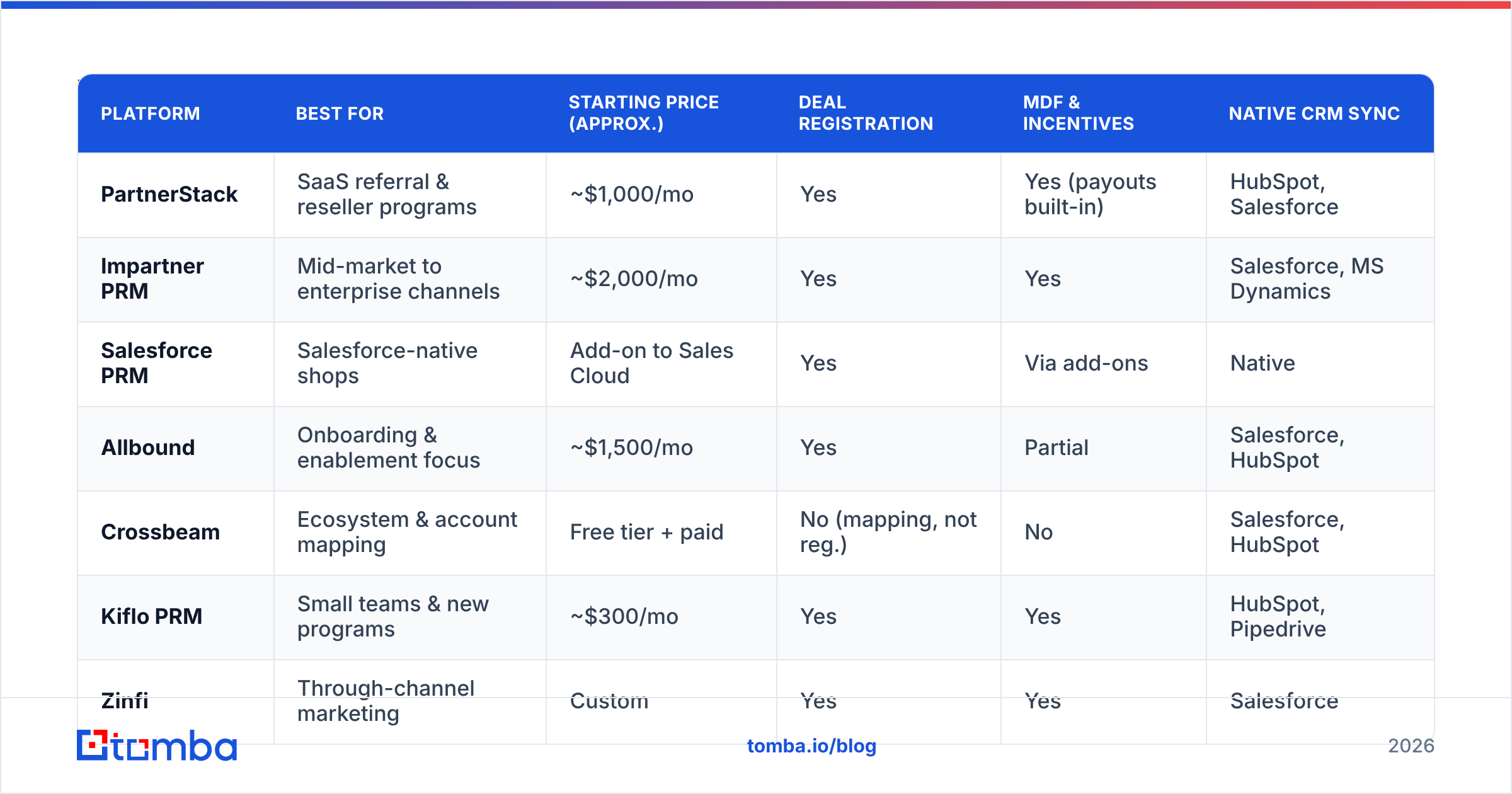
| Platform | Best for | Starting price (approx.) | Deal registration | MDF & incentives | Native CRM sync |
|---|---|---|---|---|---|
| PartnerStack | SaaS referral & reseller programs | ~$1,000/mo | Yes | Yes (payouts built-in) | HubSpot, Salesforce |
| Impartner PRM | Mid-market to enterprise channels | ~$2,000/mo | Yes | Yes | Salesforce, MS Dynamics |
| Salesforce PRM | Salesforce-native shops | Add-on to Sales Cloud | Yes | Via add-ons | Native |
| Allbound | Onboarding & enablement focus | ~$1,500/mo | Yes | Partial | Salesforce, HubSpot |
| Crossbeam | Ecosystem & account mapping | Free tier + paid | No (mapping, not reg.) | No | Salesforce, HubSpot |
| Kiflo PRM | Small teams & new programs | ~$300/mo | Yes | Yes | HubSpot, Pipedrive |
| Zinfi | Through-channel marketing | Custom | Yes | Yes | Salesforce |
A few notes on how to read that table:
- PartnerStack dominates the SaaS referral world because payouts are native — partners get paid without you running a separate billing process. It's the default for product-led companies adding a partner motion.
- Impartner and Salesforce PRM are the enterprise picks. If your direct team already lives in Salesforce, the native PRM keeps everything in one object model, which finance and RevOps will thank you for.
- Crossbeam is a different animal: it's account mapping, not deal registration. You use it to discover overlapping accounts with partners, then push those signals into your real PRM or CRM. Many teams run Crossbeam and a PRM.
- Kiflo is the friendliest on-ramp. If you're below 25 partners and just need clean deal registration plus simple payouts, it's hard to overspend with it.
Cross-check live pricing and verified reviews on G2's PRM category before you commit — vendor list prices and real negotiated prices often diverge by 30% or more.
How do you choose the right channel sales platform?#
Match the tool to your channel stage, not to the longest feature list. A platform you'll grow into in three years is a platform you're overpaying for today.
Use these four questions as a filter:
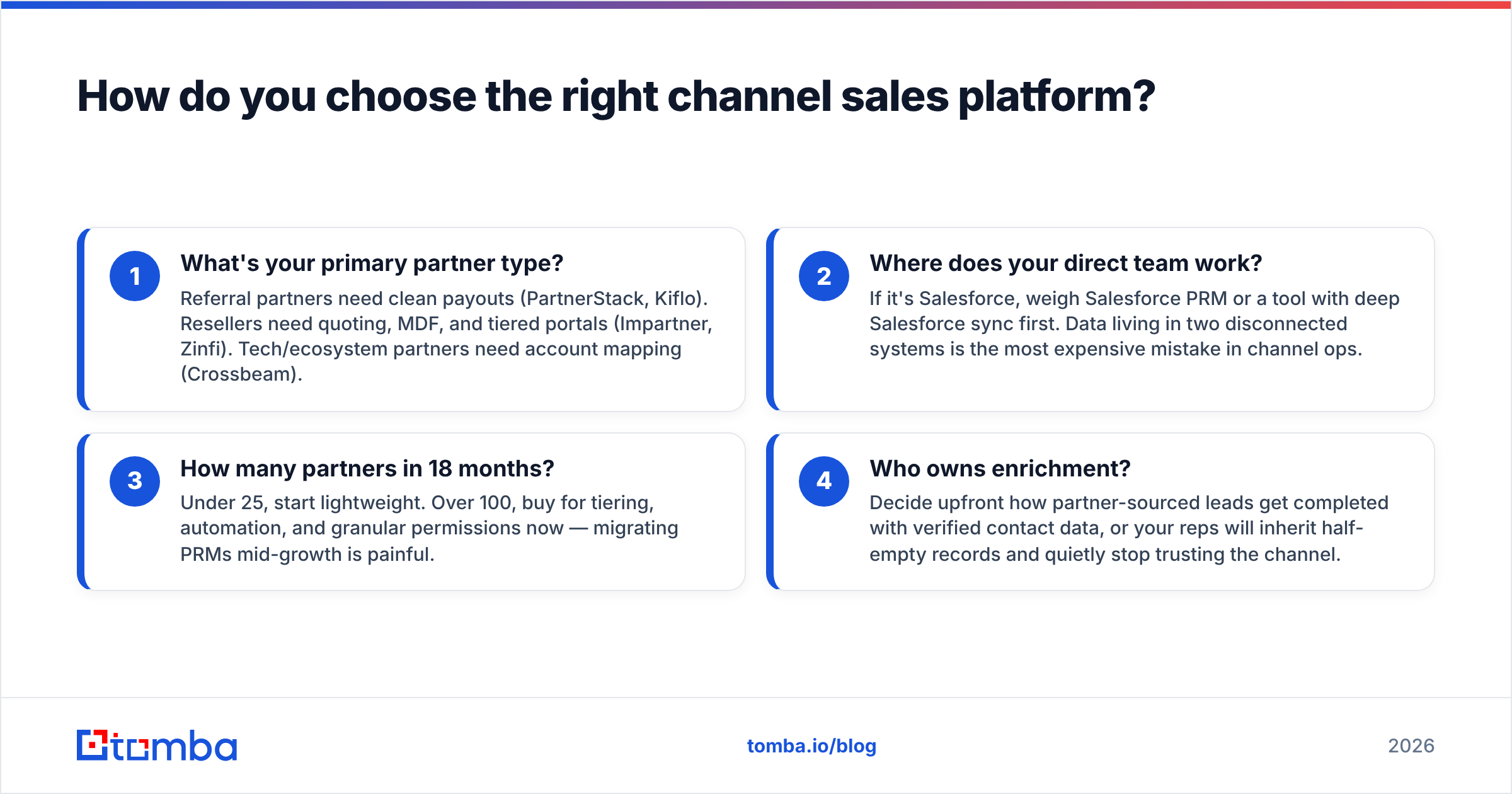
- What's your primary partner type? Referral partners need clean payouts (PartnerStack, Kiflo). Resellers need quoting, MDF, and tiered portals (Impartner, Zinfi). Tech/ecosystem partners need account mapping (Crossbeam).
- Where does your direct team work? If it's Salesforce, weigh Salesforce PRM or a tool with deep Salesforce sync first. Data living in two disconnected systems is the most expensive mistake in channel ops.
- How many partners in 18 months? Under 25, start lightweight. Over 100, buy for tiering, automation, and granular permissions now — migrating PRMs mid-growth is painful.
- Who owns enrichment? Decide upfront how partner-sourced leads get completed with verified contact data, or your reps will inherit half-empty records and quietly stop trusting the channel.
That last point is the one most teams skip. A PRM captures that "Acme Corp is interested." It rarely tells you the email and direct line of the VP who actually signs. You bridge that with an enrichment step — either inside your CRM via an integration or through an API call when a deal registers.
)
How does contact data fit into a channel sales workflow?#
Contact data is the fuel; the PRM is the engine. A beautiful partner portal with empty contact fields still leaves your reps cold-Googling prospects.
Here's the realistic flow. A partner registers a deal: company name, a contact's first name, maybe a title. Your channel manager approves it and routes it to a rep for co-selling. At that moment the record needs three things it usually doesn't have — a verified work email, a direct phone number, and firmographic context (size, industry, tech stack). Without them, the co-sell stalls before the first touch.
This is where a data API earns its keep:
- On deal registration, call an email finder to resolve the decision-maker's address from the company domain and contact name, then verify it so your sender reputation stays clean.
- On partner onboarding, enrich the partner's own company record so your tiering and territory logic has real firmographics to work with.
- On lead handoff, append a direct phone number so co-selling reps can actually reach the buyer.
Because this runs at machine speed, you don't want a human pasting names into a lookup tool one at a time. You want it wired in. Tomba exposes a REST email finder API and a native Salesforce integration, so the enrichment step can fire automatically the moment a partner deal lands in your CRM — no spreadsheet, no copy-paste, no stale records.
The accuracy of that data matters as much as the speed. A verified email that bounces costs you a partner's trust on a deal they sourced. Pairing a PRM's deal flow with a verifier that confirms addresses before send is the difference between a channel that compounds and one that leaks.
What does channel sales software cost in 2026?#
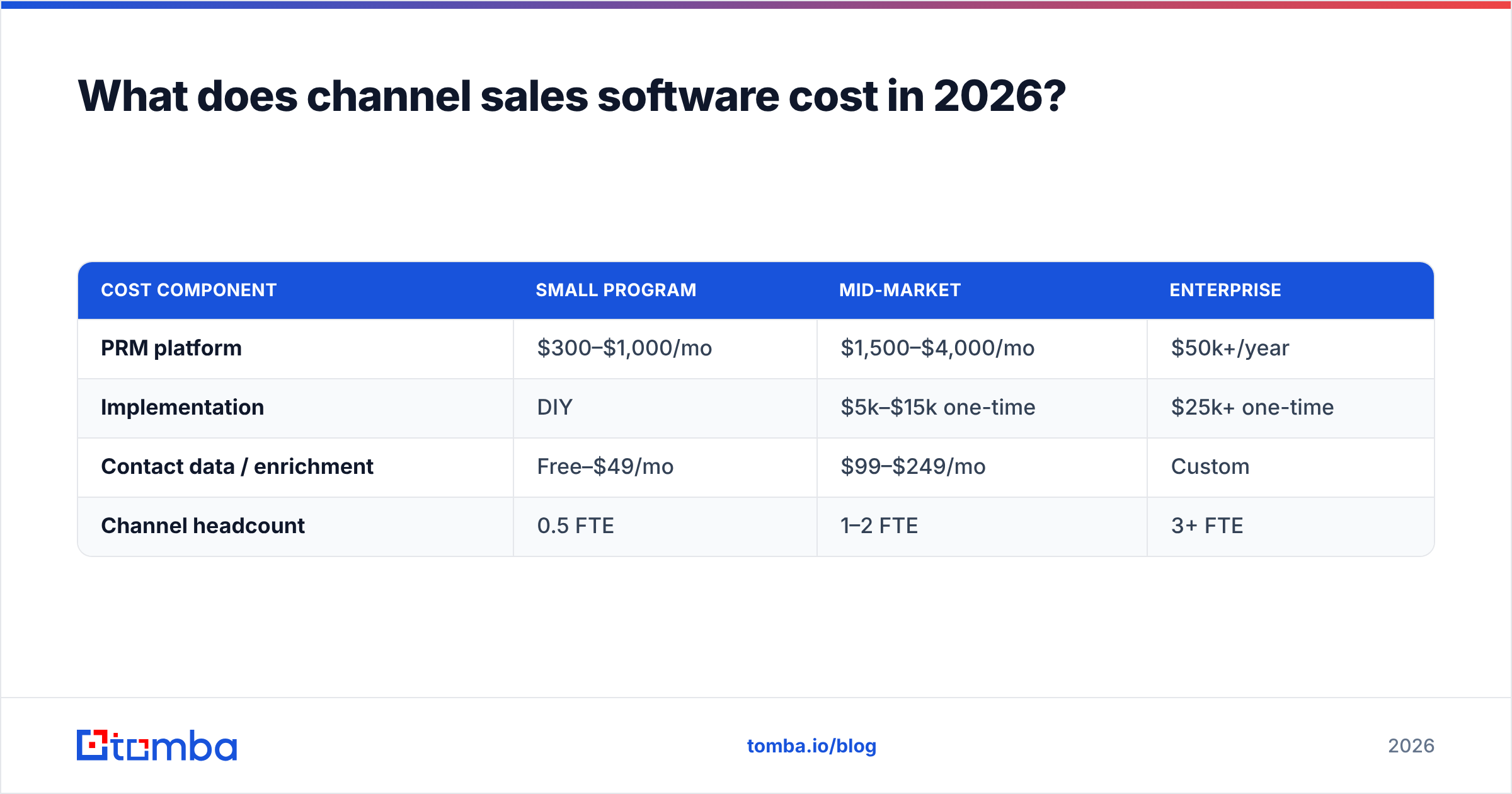
Budget for the platform and the data layer — teams that only fund the PRM end up with a polished system full of incomplete records.
| Cost component | Small program | Mid-market | Enterprise |
|---|---|---|---|
| PRM platform | $300–$1,000/mo | $1,500–$4,000/mo | $50k+/year |
| Implementation | DIY | $5k–$15k one-time | $25k+ one-time |
| Contact data / enrichment | Free–$49/mo | $99–$249/mo | Custom |
| Channel headcount | 0.5 FTE | 1–2 FTE | 3+ FTE |
The data line is the cheapest one and the easiest to under-budget. Tomba's pricing starts free at 25 searches a month, moves to $49/mo for the Starter plan, $99/mo for Growth, and $249/mo for Pro — which covers most channel programs' enrichment needs without touching enterprise budget. Compare that to the PRM line above and it's clear the contact data isn't where the cost lives; the missing contact data is.
One more cost to weigh: switching. PRMs are sticky because partners learn the portal and your commission logic lives inside it. Choose deliberately, because re-onboarding partners onto a new tool is a tax you pay in partner goodwill, not just dollars. Many teams de-risk this by keeping their data layer vendor-neutral — an enrichment API that works the same whether your PRM is Impartner today and PartnerStack next year.
What's the simplest way to start a channel program?#
Start narrow: one partner type, one motion, clean data, and a tool you won't outgrow this quarter. You can layer sophistication later — you can't recover partners who churned because the early experience was a mess.
A pragmatic 30-day rollout:
- Week 1 — Pick a lightweight PRM (Kiflo or PartnerStack) and define exactly one motion, usually referral.
- Week 2 — Wire deal registration to your CRM and set up enrichment so registered deals auto-complete with verified emails.
- Week 3 — Onboard 5–10 design-partner accounts and watch where they get stuck.
- Week 4 — Fix the friction, document it, then open recruiting.
The teams that win at channel treat data quality as a first-class part of the program from day one, not a cleanup project for later.
The bottom line#
Channel sales software organizes your partner ecosystem; it doesn't populate it with usable contacts. Pick the PRM that matches your channel stage — PartnerStack or Kiflo for early referral programs, Impartner or Salesforce PRM for enterprise resale — and pair it with a data layer that keeps every partner-sourced record complete and deliverable.
That's the part Tomba was built for. When a partner registers a deal, Tomba Email Finder resolves and verifies the decision-maker's email from just a name and company domain, so your reps co-sell into a real inbox instead of a guess. Start free with 25 searches a month, connect it to your CRM, and let your channel deals arrive enrichment-ready. Your partners did the hard work of sourcing the deal — don't let a missing email be the reason it stalls.
// get started
Find, verify and enrich your first contacts today
Start on the free plan with 25 searches a month, then scale when your team is ready.
Free plan · No credit card required · GDPR & CCPA
// about the author