Channel Sales Strategy: The 2026 Playbook for Partner Growth
A direct, no-fluff guide to building a channel sales strategy in 2026 — partner models, economics, enablement, and the data that actually drives indirect revenue.
TL;DR
- A channel sales strategy is a plan to sell through third parties — resellers, agencies, VARs, ISVs, and referral partners — instead of (or alongside) your own reps.
- The right model depends on deal size, product complexity, and margin: referral and affiliate for low-touch, reseller and VAR for mid-market, strategic alliances for enterprise.
- Channel programs fail on enablement and economics, not enthusiasm. Partners need margin, leads, and tooling — or they ghost you.
- Clean contact and company data is the hidden fuel: partners can't close accounts they can't reach, and you can't recruit partners you can't find.
- Measure partner-sourced and partner-influenced revenue separately. If you can't attribute it, you can't fund it.
What is a channel sales strategy?#
A channel sales strategy is your plan for generating revenue through other companies' sales teams instead of building every relationship yourself. Think of it like a beverage brand: Coca-Cola doesn't knock on your door — it sells through grocery stores, restaurants, and vending operators who already own the shelf space and the customer. Your product is the syrup; the channel is the distribution.
In B2B software and services, "the channel" covers a spectrum of partner types, each with a different level of involvement and a different cut of the deal. Some partners just send you a warm intro. Others resell your product under their own contract, handle implementation, and own the customer relationship entirely.
The strategic question isn't "should we do channel?" It's "which partners, selling which products, to which customers, for what margin?" Get that wrong and you spend a year recruiting partners who never transact. Get it right and you add a revenue engine that scales without linear headcount growth — the core promise of a strong revenue operations motion.
What are the main channel sales models?#
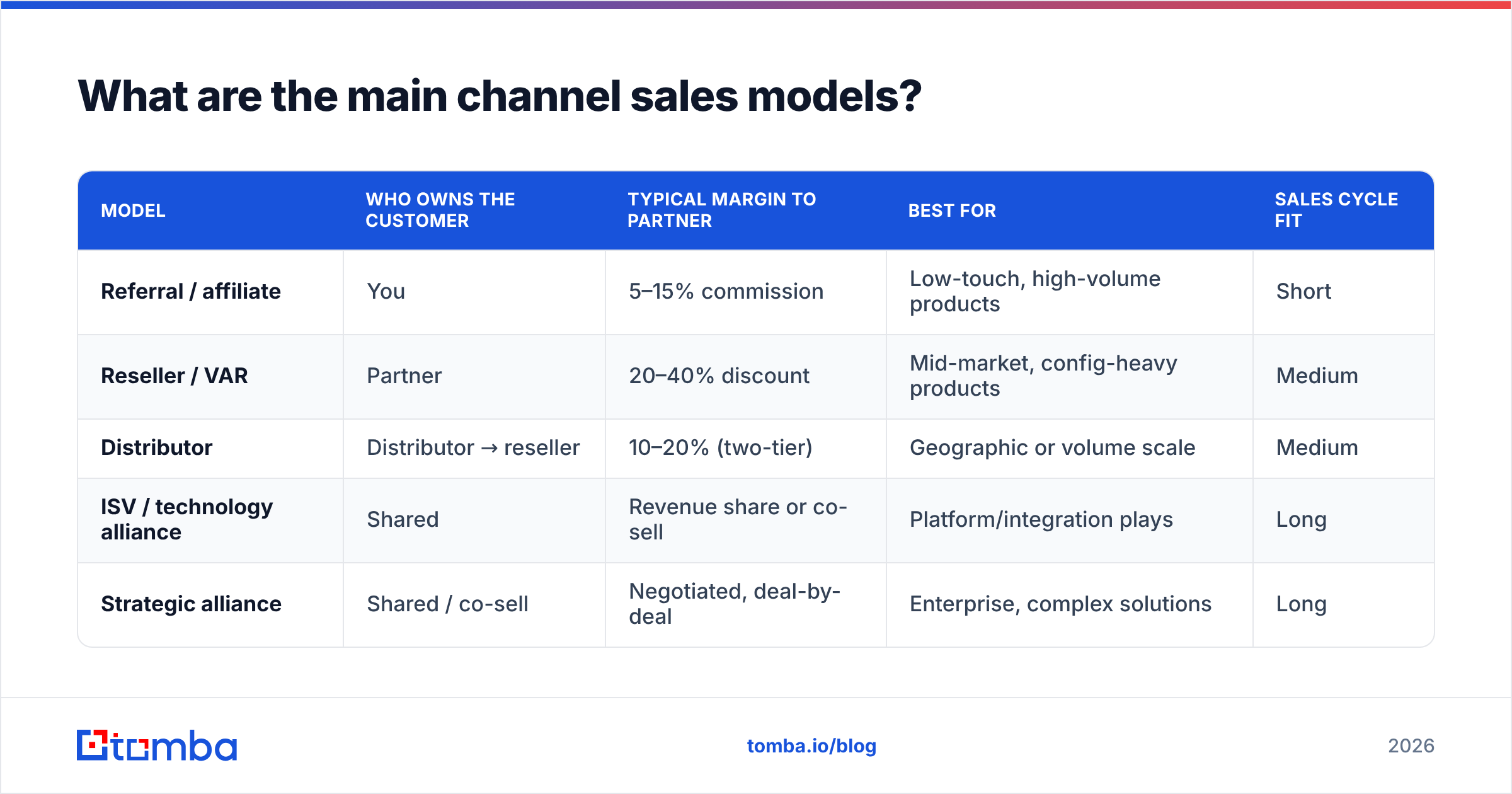
Before you design anything, you need to know the menu. Most channel programs blend two or three of these models rather than betting on one. Here is how the common structures compare on the attributes that actually decide fit.
| Model | Who owns the customer | Typical margin to partner | Best for | Sales cycle fit |
|---|---|---|---|---|
| Referral / affiliate | You | 5–15% commission | Low-touch, high-volume products | Short |
| Reseller / VAR | Partner | 20–40% discount | Mid-market, config-heavy products | Medium |
| Distributor | Distributor → reseller | 10–20% (two-tier) | Geographic or volume scale | Medium |
| ISV / technology alliance | Shared | Revenue share or co-sell | Platform/integration plays | Long |
| Strategic alliance | Shared / co-sell | Negotiated, deal-by-deal | Enterprise, complex solutions | Long |
A few practical notes on reading this table:
- Referral partners are the cheapest to recruit and the easiest to lose. They send leads, you do the work, they get a check. Great for early traction, weak for deep market penetration.
- Resellers and VARs (value-added resellers) take real ownership — quoting, closing, sometimes implementing. You trade margin for leverage. This is the workhorse model for most mid-market software.
- Distributors add a tier. They aggregate many resellers, which is how you scale into new regions without standing up local operations, at the cost of another margin slice and more distance from the end customer.
- ISV and strategic alliances are co-sell motions. Nobody is "reselling" so much as two vendors agreeing that 1 + 1 = 3 for a shared account. These take the longest to mature but produce the stickiest enterprise revenue.
)
How do you choose the right channel model?#
Match the model to your deal economics, not to what a competitor is doing. Three variables drive the decision:
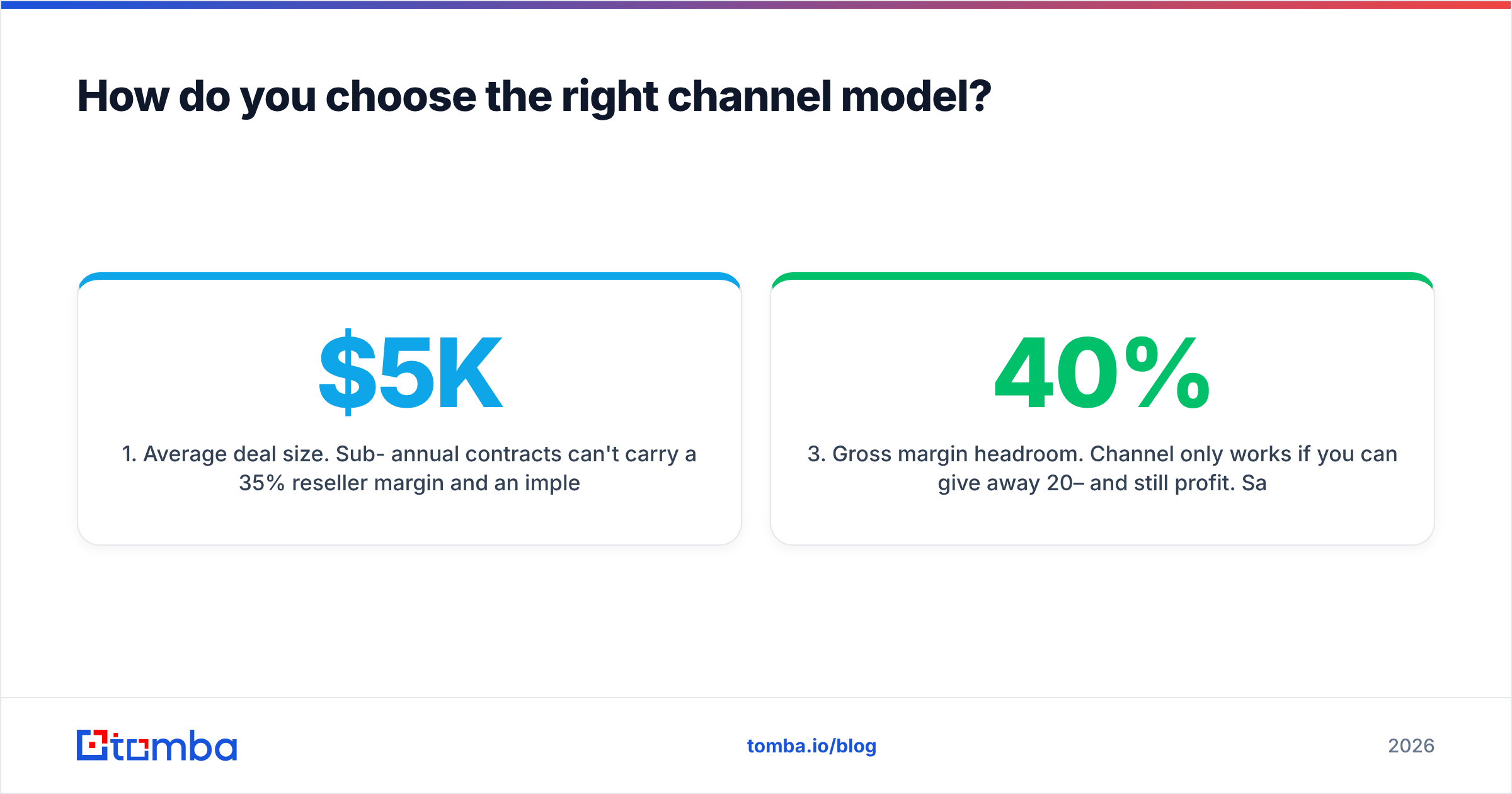
- Average deal size. Sub-$5K annual contracts can't carry a 35% reseller margin and an implementation team. Push those toward referral and affiliate. Six-figure deals can absorb partner margin and benefit from local hands-on selling.
- Product complexity. If a buyer needs configuration, integration, or industry expertise, a VAR earns its margin. If your product is self-serve, a heavy reseller model just adds friction and cost.
- Gross margin headroom. Channel only works if you can give away 20–40% and still profit. SaaS with 80%+ gross margin has room. Hardware or services with thin margins often can't sustain a generous channel.
A useful gut check from Gartner's go-to-market research: indirect channels scale reach but dilute control. The more your differentiation depends on the buying experience, the more carefully you guard the parts of the funnel you hand to partners. You can read more on how analysts frame route-to-market trade-offs at Gartner.
How do you recruit and onboard channel partners?#
Recruiting is a sales motion aimed at companies, not consumers — and it lives or dies on data. You are prospecting for partners the same way your reps prospect for customers: build a target list, find the right person, reach out with a relevant offer.
The mechanics look like this:
- Profile your ideal partner. Adjacent products, overlapping customers, complementary services, the right geography. A HubSpot agency is a natural reseller for marketing software; a Salesforce SI is a natural alliance for a data product.
- Find the partner accounts. Use firmographic filters — industry, headcount, tech stack, region — to build a list of companies that fit the profile.
- Reach the right human. You need the head of partnerships or the practice lead, not a generic info@ inbox. This is where an email finder and a domain search earn their keep: pull verified contacts for partnership decision-makers at every target firm, then sequence them like any other outbound campaign.
- Onboard with a 30-60-90 plan. First deal registered by day 30, first close by day 90. Partners who don't transact in the first quarter rarely ever do.
Onboarding is where most programs quietly leak. A partner who signs an agreement and then waits three weeks for portal access, pricing sheets, and a demo environment has already mentally moved on to the next vendor. Treat the first 90 days like a product launch.
What does channel enablement actually require?#
Enablement is the difference between a partner logo on your website and a partner check in your bank. Partners are not loyal to you — they are loyal to whichever vendor makes them money with the least friction. Your job is to be that vendor.
The non-negotiables:
- Margin they can feel. If the math doesn't beat their other options, nothing else matters.
- Deal registration that protects them. Partners won't invest in a deal they might lose to your direct team or another partner. Clear, fast, fair registration is the foundation of trust.
- Leads, not just permission. The strongest programs hand partners qualified pipeline. This is where your data operation feeds the channel — enriched, verified accounts the partner can work immediately. Tomba's data enrichment and bulk lead generation tools let you package ready-to-work lists instead of dumping raw names on a partner who then has to go find contact details themselves.
- Self-serve content. Pitch decks, battle cards, demo scripts, pricing calculators — available the moment a rep needs them, not after an email request and a two-day wait.
- A partner manager who answers fast. Channel is a relationship business. Response time is a feature.
)
How is channel sales different from direct sales?#
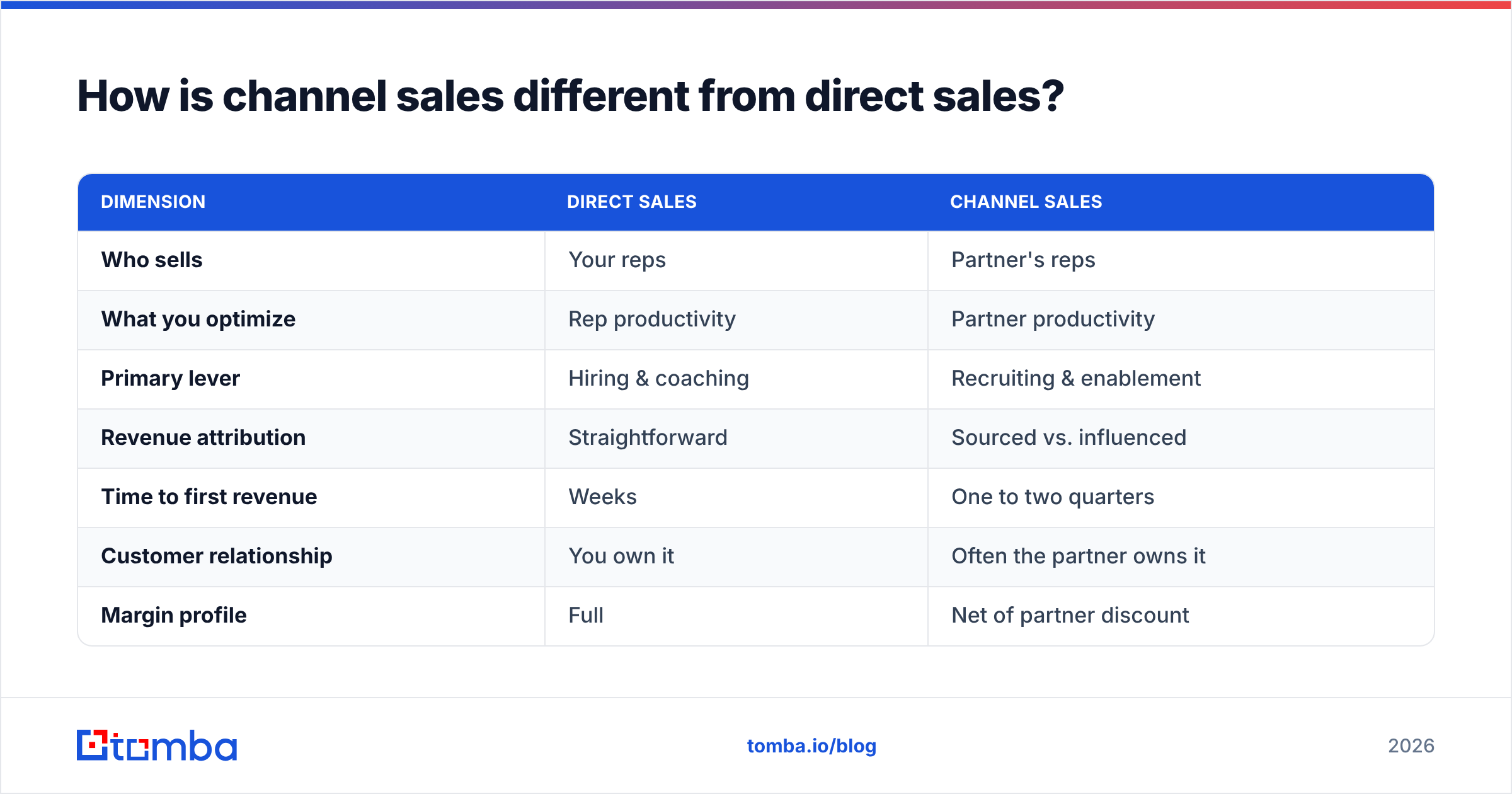
The instinct is to run channel like a second direct team. That instinct is wrong, and it's the most common reason programs stall. The two motions differ on almost every dimension.
| Dimension | Direct sales | Channel sales |
|---|---|---|
| Who sells | Your reps | Partner's reps |
| What you optimize | Rep productivity | Partner productivity |
| Primary lever | Hiring & coaching | Recruiting & enablement |
| Revenue attribution | Straightforward | Sourced vs. influenced |
| Time to first revenue | Weeks | One to two quarters |
| Customer relationship | You own it | Often the partner owns it |
| Margin profile | Full | Net of partner discount |
The mindset shift: in direct sales you manage individuals; in channel you manage a portfolio of businesses, each with its own priorities, P&L, and competing vendor relationships. You influence rather than command. A great channel leader spends their time making partners more profitable, not telling partner reps what to do.
This also changes how you forecast. Direct pipeline is yours to inspect line by line. Channel pipeline lives partly in someone else's CRM, which is why deal registration and partner portals matter so much — they're your only window into demand you don't directly control. Salesforce's own PRM guidance is a reasonable primer on closing that visibility gap.
How do you measure channel sales performance?#
Measure two numbers separately and never conflate them: partner-sourced revenue (the partner originated the deal) and partner-influenced revenue (the partner touched a deal you also worked). Blending them lets everyone claim credit and makes it impossible to decide where to invest.
The metrics that matter:
- Partner-sourced revenue and its share of total bookings. This is the cleanest measure of channel health.
- Partner activation rate — the percentage of signed partners who registered or closed a deal this quarter. A program with 200 partners and 12% activation is really a 24-partner program.
- Average revenue per active partner. Tells you whether to recruit more partners or grow the ones you have.
- Deal registration velocity — how fast registrations move to closed-won. Slow velocity usually signals an enablement gap.
- Partner-sourced win rate versus direct. If partners close materially worse, your enablement or your partner selection is off.
Independent review sites like G2 track how vendors stack up on partner experience, which is a useful outside-in check on whether your program is competitive. If partners consistently rate competing programs higher, your margin and tooling are probably the reason.
What data and tools power a modern channel program?#
A channel strategy is only as good as the data feeding it — on both sides of the equation. You need data to recruit partners, and your partners need data to sell. Starve either and the engine stalls.
On the recruitment side, you are constantly building target lists of partner companies and reaching the decision-makers inside them. A reliable email finder, phone finder, and enrichment stack turn a vague "let's find some agencies" into a sequenced, measurable outbound motion. The same tooling your direct team uses for prospects works for partner recruitment, because partner recruitment is prospecting.
On the selling side, the best thing you can hand a partner is pipeline they can act on today. Raw company names are nearly worthless; a verified contact, a confirmed email verifier pass, and enriched firmographics are gold. Partners reward the vendor that makes their job easy, and "here is a list of accounts with verified contacts and context" is about as easy as it gets.
Here's the practical stack a lean channel team runs:
- A PRM or partner portal for registration, content, and reporting.
- A CRM that tags partner-sourced and partner-influenced deals distinctly.
- A contact-data layer — email finder, verifier, and enrichment — for both recruiting partners and arming them with leads.
- A deal-registration workflow that's fast enough that partners actually use it.
Keep the stack lean. Partners abandon programs buried in tooling overhead, and your own team will too. Check current Tomba pricing if you want to see where the data layer fits — the Free tier covers 25 searches a month for testing the workflow, Starter runs $49/mo, and Growth at $99/mo handles a real recruiting and enablement cadence.
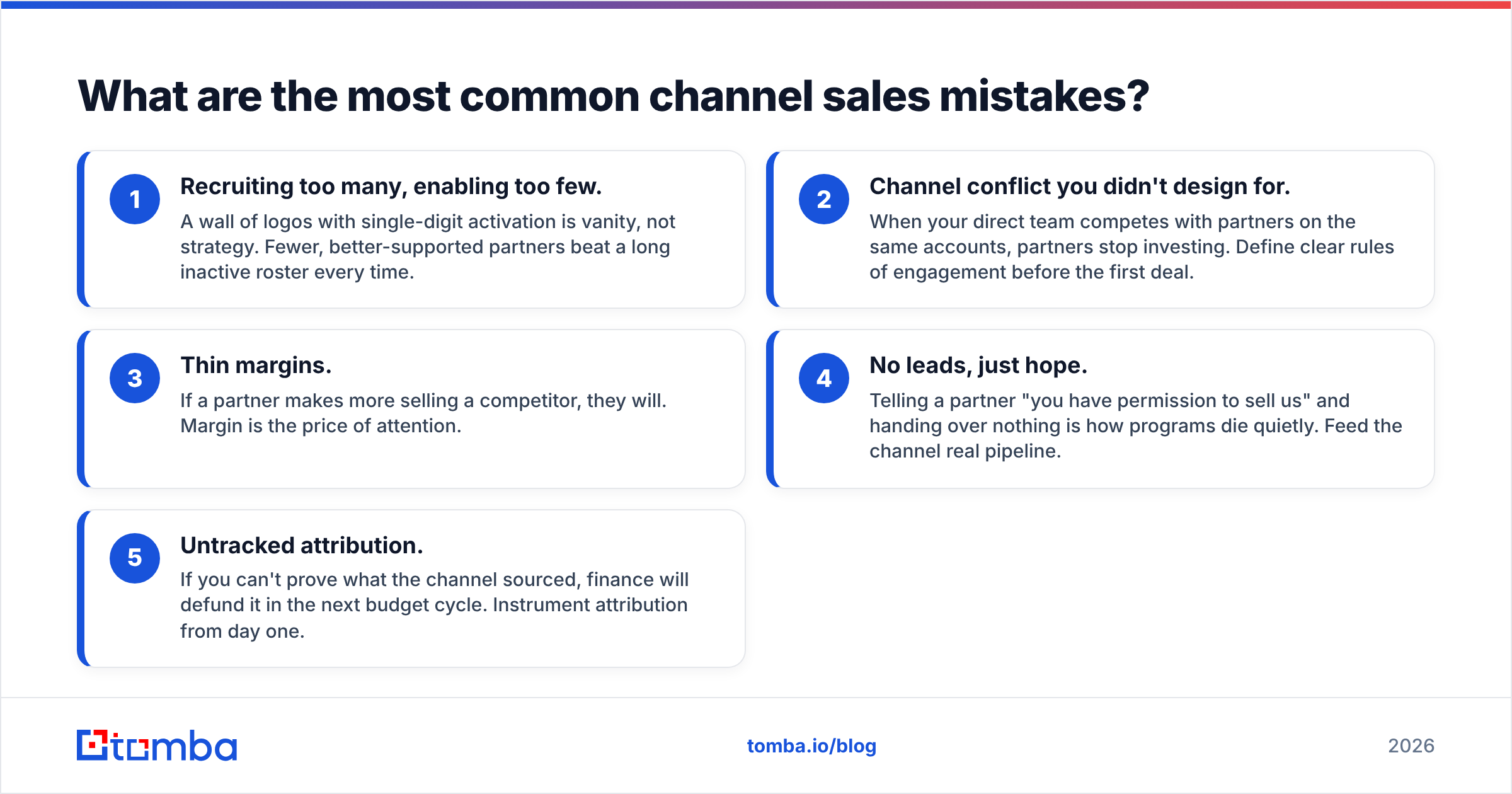
What are the most common channel sales mistakes?#
Five failure modes account for most dead programs:
- Recruiting too many, enabling too few. A wall of logos with single-digit activation is vanity, not strategy. Fewer, better-supported partners beat a long inactive roster every time.
- Channel conflict you didn't design for. When your direct team competes with partners on the same accounts, partners stop investing. Define clear rules of engagement before the first deal.
- Thin margins. If a partner makes more selling a competitor, they will. Margin is the price of attention.
- No leads, just hope. Telling a partner "you have permission to sell us" and handing over nothing is how programs die quietly. Feed the channel real pipeline.
- Untracked attribution. If you can't prove what the channel sourced, finance will defund it in the next budget cycle. Instrument attribution from day one.
Notice the pattern: four of the five are economics and enablement problems, and the fifth is a measurement problem. None of them are solved by recruiting harder.
Build the data engine behind your channel#
A channel sales strategy scales reach, but it runs on contacts — the partners you recruit and the accounts you hand them. That's exactly where Tomba Email Finder fits: build targeted lists of partner companies, pull verified emails for the partnerships leads who actually sign agreements, and package enriched, ready-to-work accounts your partners can close instead of chase. Start free with 25 searches a month, then scale into a recruiting and enablement cadence as your program grows. The strategy gets you partners; the data gets you revenue.
Ready to find emails that actually work?
Join 150,000+ professionals who stopped guessing and started sending. Free credits on signup — no credit card required.
Get the Tomba newsletter
Practical outbound tactics and product updates — once every two weeks.
About the author