How Much Should You Charge for a Lead? 2026 Pricing Guide
Stop guessing what a lead is worth. This 2026 guide breaks down per-lead pricing models, real benchmark rates by industry, and the math that decides what you can profitably charge for a lead.
If you sell leads — or buy them — the single question that decides your margin is brutally simple: what do you charge for a lead? Price too low and you subsidize your buyer's growth out of your own pocket. Price too high and your pipeline dries up while a competitor undercuts you. This guide gives you the models, the benchmark numbers, and the cost math to set a per-lead price you can defend.
TL;DR#
- There is no flat "right" price. A qualified B2B SaaS lead can fetch $50–$200, while a shared local-services lead might sell for $10–$40. Industry, exclusivity, and intent drive the spread.
- Price from value, not cost. The ceiling is set by your buyer's customer lifetime value (LTV) and close rate — not by what it cost you to generate the lead.
- Exclusive leads command 2–4x the price of shared leads. Selling the same lead to five buyers is the fastest way to torch your reputation.
- Data quality is the hidden multiplier. Verified, enriched contacts close more often, which lets you justify a premium per lead. Cheap, unverified lists force you into a race to the bottom.
- Run the unit economics every quarter. Your cost-to-acquire, validation rate, and buyer close rate all drift. Reprice when they do.
What does it mean to "charge for a lead"?#
Charging for a lead means selling a prospect's contact and qualification data to a buyer who will try to convert that prospect into a customer. You're not selling a sale — you're selling a qualified opportunity. That distinction is the whole game.
Think of it like a fishing guide. You don't promise the client a fish; you promise them a stocked spot, the right bait, and a clear shot. Whether they land it depends on their own skill. A lead is the stocked spot. Your price reflects how good the spot is — how likely it is to hold fish, and how few other boats you've told about it.
In practice, "a lead" ranges from a raw email address scraped off a website to a fully enriched contact with verified email, direct phone, job title, company size, and a documented expression of interest. Those are not the same product, and they should never carry the same price.
How do you actually price a lead? Four models#
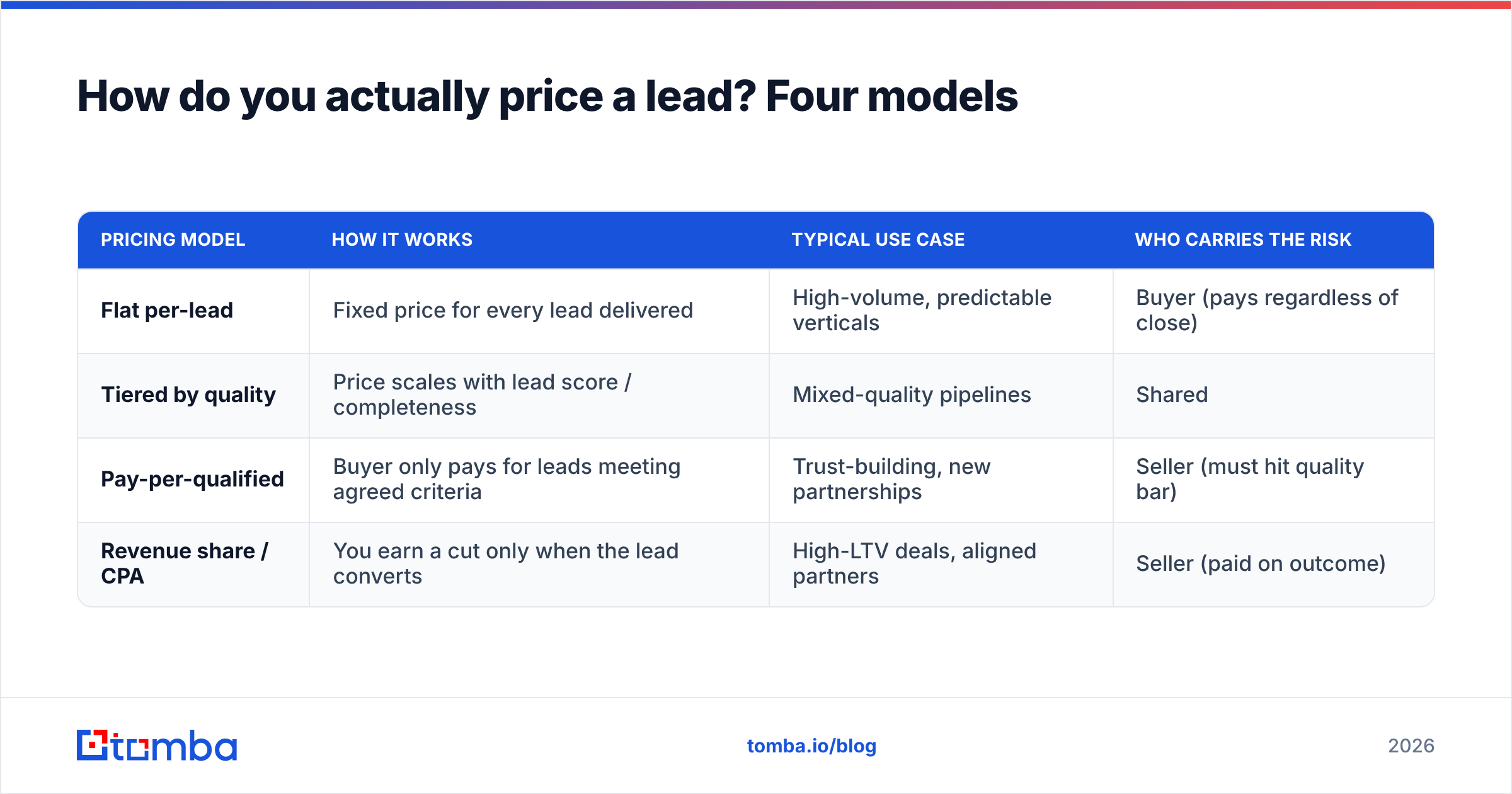
Most lead sellers use one of four pricing structures. Each shifts risk differently between you and the buyer.
| Pricing model | How it works | Typical use case | Who carries the risk |
|---|---|---|---|
| Flat per-lead | Fixed price for every lead delivered | High-volume, predictable verticals | Buyer (pays regardless of close) |
| Tiered by quality | Price scales with lead score / completeness | Mixed-quality pipelines | Shared |
| Pay-per-qualified | Buyer only pays for leads meeting agreed criteria | Trust-building, new partnerships | Seller (must hit quality bar) |
| Revenue share / CPA | You earn a cut only when the lead converts | High-LTV deals, aligned partners | Seller (paid on outcome) |
Flat per-lead is the simplest and most common. You agree on a number — say $35 — and deliver. It works when your quality is consistent and the buyer trusts your sourcing.
Tiered by quality lets you charge more for a lead with a verified direct dial than for one with only a generic email. This is where good data enrichment directly raises your ceiling: the more complete the record, the higher the tier.
Pay-per-qualified moves risk onto you. The buyer defines what "qualified" means (region, company size, budget signal) and only pays for leads that clear the bar. You eat the cost of everything that doesn't. It builds trust fast, but only run it if your validation process is airtight.
Revenue share / CPA ties your income to the buyer's actual sales. Upside is huge on high-LTV deals; downside is you wait for payment and depend on the buyer's sales team not fumbling the handoff.
How much should you charge for a lead in 2026?#
Price from the buyer's economics backward. The formula that sets your hard ceiling:
Max price per lead = (Buyer's average deal value × Lead-to-customer close rate × Acceptable acquisition-cost ratio)
Walk through it. Say your buyer sells a $6,000 annual contract, closes 8% of the qualified leads you send, and is willing to spend up to 25% of first-year revenue acquiring a customer.
- Value per lead to the buyer: $6,000 × 8% = $480
- Acceptable acquisition spend per customer: $6,000 × 25% = $1,500
- Acceptable spend per lead: $1,500 × 8% = $120
So $120 is the absolute ceiling this buyer can pay before the lead stops being profitable for them. Your sustainable price sits comfortably below it — often 40–70% of the ceiling — leaving the buyer margin so they keep coming back. In this example, $50–$85 per lead is a healthy, repeatable range.
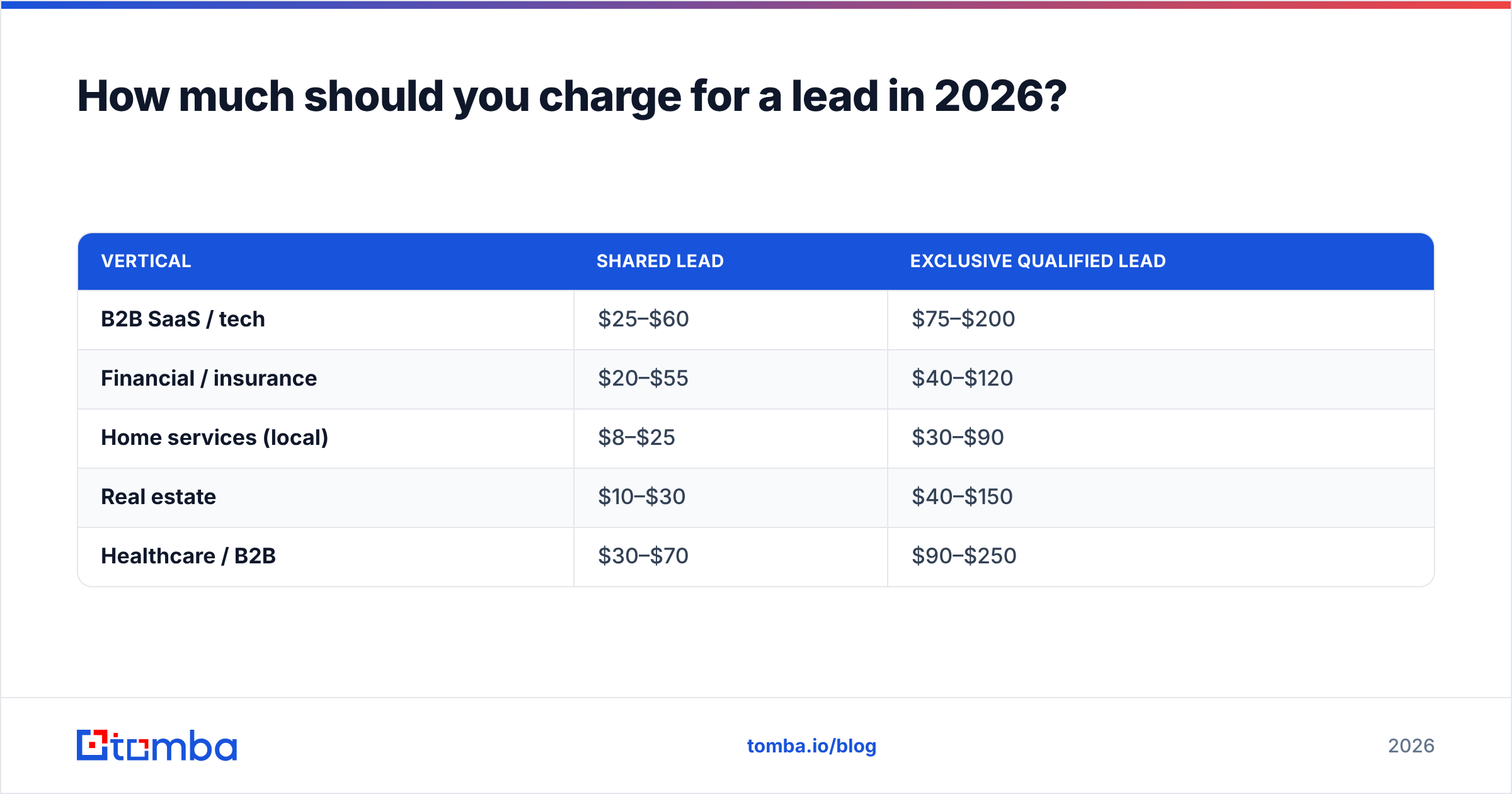
Here are rough 2026 benchmark ranges by category for exclusive, qualified leads. Treat these as starting anchors, not gospel — your local market and lead quality move them.
| Vertical | Shared lead | Exclusive qualified lead |
|---|---|---|
| B2B SaaS / tech | $25–$60 | $75–$200 |
| Financial / insurance | $20–$55 | $40–$120 |
| Home services (local) | $8–$25 | $30–$90 |
| Real estate | $10–$30 | $40–$150 |
| Healthcare / B2B | $30–$70 | $90–$250 |
For context, industry directories like G2 and analyst notes from Gartner consistently show that lead price tracks LTV: the longer and larger the customer relationship a lead can unlock, the more that lead is worth at the top of the funnel.
Exclusive vs shared leads: how much does exclusivity change the price?#
Exclusivity is the biggest single lever on per-lead price after raw quality. An exclusive lead goes to one buyer. A shared lead is sold to several — often three to five — who then race to call first.
- Exclusive leads close at materially higher rates because the prospect isn't getting five identical pitches in an hour. You can charge 2–4x more.
- Shared leads are cheaper to buy and let you monetize the same record multiple times. The trade-off is buyer frustration, faster lead fatigue, and reputational risk when prospects complain about being spammed.
If you sell shared leads, cap the number of buyers and disclose it. Selling a "fresh exclusive lead" that five people already bought is how lead businesses die. The short-term revenue isn't worth the chargebacks and the burned partnerships.
Why does data quality decide what you can charge?#
Quality is the multiplier that sits underneath every other pricing decision. A lead with a verified email and a confirmed direct phone number is worth several times one with a guessed, never-validated address — because it actually reaches a human who actually expressed interest.
Cheap, unverified lists drag you into the lowest tier of the market: high bounce rates, angry buyers, refund requests, and a price you can never raise. Verified, enriched data does the opposite. When your buyer's reps connect on the first dial instead of bouncing off dead inboxes, your leads close better, your reputation compounds, and you earn the right to charge a premium.
This is exactly where a B2B database and an accurate email finder pay for themselves. Every bounce you prevent and every direct dial you confirm raises the close rate on the buyer's end — and close rate is the term in the pricing formula you have the most control over.
What costs do you need to cover before setting a price?#
You can't price a lead profitably until you know your fully loaded cost to produce one. Tally these:
- Sourcing cost — ad spend, content, data tooling, or partner fees that surface the raw prospect.
- Enrichment and verification cost — what you spend to confirm the email, append the phone, and fill in firmographics. Tools like Tomba pricing tiers are predictable here, which makes per-lead cost easy to model.
- Qualification labor — the SDR time or scoring system that confirms intent.
- Validation waste — the leads you generate but discard because they fail your quality bar. If 30% wash out, the surviving 70% must absorb that cost.
- Delivery and overhead — CRM, integrations, support, refunds.
Add them up, divide by the number of sellable leads, and you have your floor. Your price must sit above the floor and below the buyer's ceiling. The gap between those two numbers is your margin — and your negotiating room.
How do data tools change your per-lead margin?#
They widen the gap between floor and ceiling from both directions. Better verification lowers your floor by cutting wasted spend on dead contacts; richer enrichment raises your ceiling by improving the buyer's close rate. Two examples of where the right tooling moves the numbers:
- Bounce reduction. Running every address through an email verifier before delivery cuts the share of leads buyers reject as undeliverable. Fewer refunds, higher trust, higher price.
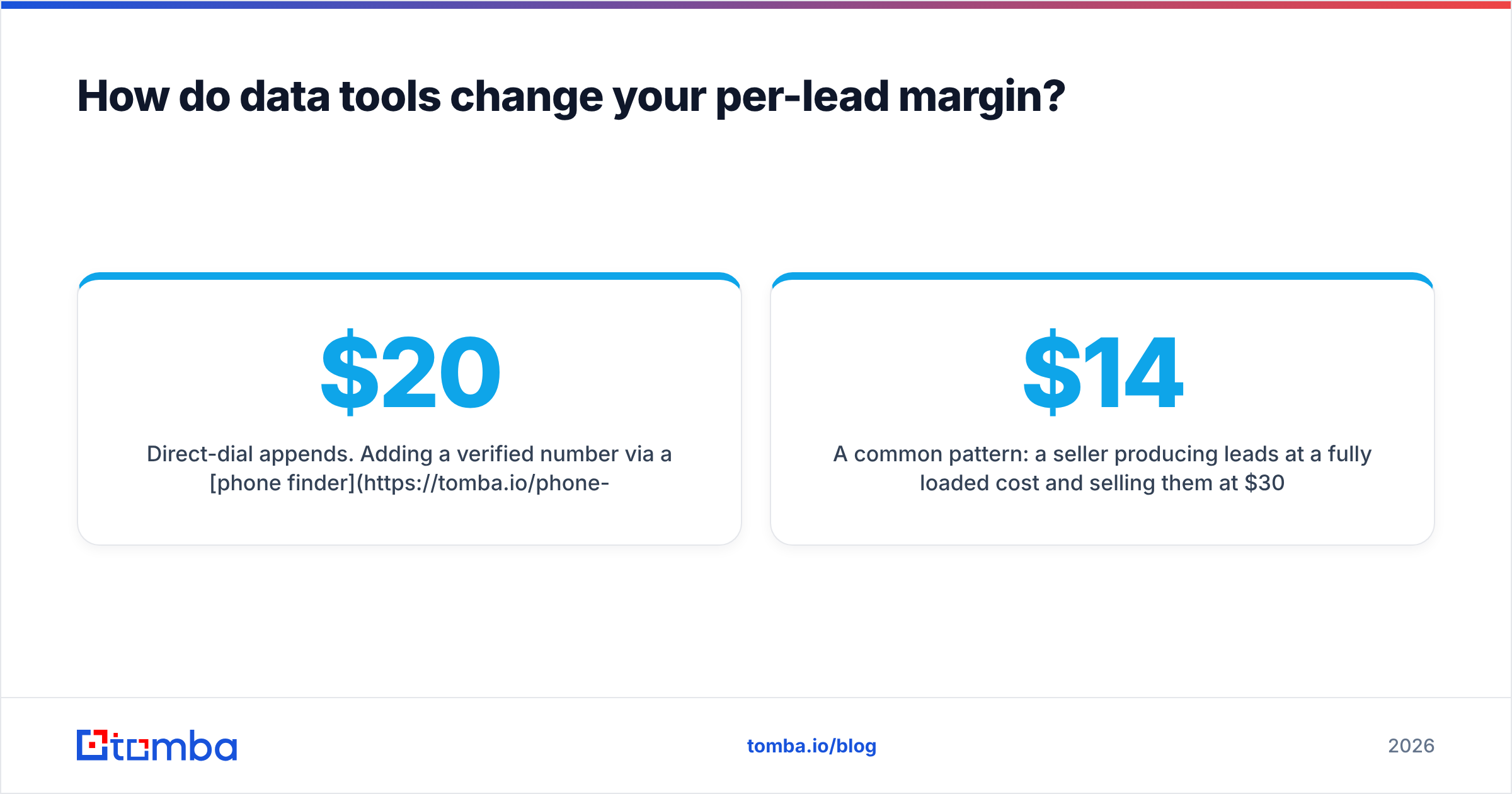
- Direct-dial appends. Adding a verified number via a phone finder bumps a lead into a higher quality tier — often a $20–$50 per-lead price jump in B2B.
A common pattern: a seller producing leads at a $14 fully loaded cost and selling them at $30 shared. After adding verification and enrichment, their cost rises to $18 — but the leads now sell exclusive at $85 because the close rate doubled. The extra $4 of cost unlocked $55 of price. That's the entire argument for treating data quality as an investment, not an expense.
What mistakes kill a lead-pricing strategy?#
- Pricing from cost alone. Cost sets your floor, not your price. If you ignore buyer LTV you'll leave money on the table or price yourself out.
- One price for all quality levels. A flat rate punishes your best leads and overcharges for your worst. Tier it.
- Never repricing. Acquisition costs, validation rates, and buyer close rates drift constantly. Audit your unit economics quarterly.
- Selling unverified data as premium. The fastest way to lose a buyer is a 25% bounce rate on leads you billed as exclusive and qualified.
- Hiding exclusivity terms. Always disclose how many buyers a shared lead goes to. Surprise erodes trust faster than any price.
How do you present and defend your price to a buyer?#
Lead with the buyer's math, not yours. Show them the close rate they can expect, the deal value it unlocks, and where your price sits relative to their acquisition ceiling. When a buyer sees that a $75 lead returns a $480 expected value, the price stops being a cost and becomes an obvious ROI.
Back it with proof: deliverability rates, verification stats, sample enriched records. Buyers pay premiums for certainty, and certainty comes from data you can document. If you can show that 98% of your delivered emails are verified valid and every record carries a direct dial, you've justified the top of your range before the negotiation even starts.
Conclusion: charge for the value you can prove#
What you charge for a lead is a function of three things you control: the buyer's economics, your exclusivity terms, and — above all — your data quality. Nail the unit economics, tier by quality, keep your verification airtight, and reprice as the market moves. Do that and you stop competing on price and start competing on results.
The quality half of that equation starts with accurate, verified contact data. The Tomba Email Finder helps you build and confirm the leads you sell — verified emails, enriched firmographics, and direct contacts that close at rates worth charging a premium for. Start on the free tier (25 searches a month), scale on the $49/mo Starter plan when your volume grows, and turn data quality into the lever that lets you charge what your leads are actually worth.
// get started
Find, verify and enrich your first contacts today
Start on the free plan with 25 searches a month, then scale when your team is ready.
Free plan · No credit card required · GDPR & CCPA
// about the author