ChatGPT for Sales Emails: The 2026 Playbook That Actually Converts
ChatGPT can draft a cold email in seconds, but raw output rarely books meetings. Here is the 2026 framework for prompts, personalization, and the data layer that makes AI sales emails convert.
You can ask ChatGPT to write a cold email and get a usable draft in under ten seconds. The problem is that "usable" and "books a meeting" are two very different bars. This guide shows you how to close that gap in 2026 — the prompts that work, the personalization layer that matters more than the prose, and the deliverability traps that quietly kill AI-generated outreach.
TL;DR#
- ChatGPT writes structure well, but cannot personalize without data. A generic AI email lands in the same ignored pile as a template. The win comes from feeding it real, verified contact data.
- The best prompts give ChatGPT a role, a framework, constraints, and research inputs — not just "write me a sales email."
- Verified emails matter more than clever copy. A flawless message sent to a bouncing address is worth zero. Pair AI drafting with a real email verifier and accurate finding.
- Volume without quality control hurts your domain. AI makes it trivial to send 1,000 emails; deliverability is what decides whether they're seen.
- A repeatable system beats one great prompt. Combine research → draft → verify → send → iterate, and treat ChatGPT as one stage, not the whole pipeline.
Can ChatGPT actually write sales emails that convert?#
Yes — but only when you treat it as a drafting assistant inside a larger system, not a one-click outreach machine. Think of ChatGPT like a talented junior copywriter who has never met your prospect. It can produce clean, on-brand structure instantly. What it cannot do is know that your prospect just raised a Series B, switched CRMs last quarter, or posted about hiring three SDRs. That context is what turns a templated note into a relevant one, and context has to come from you.
The data backs this up: personalized subject lines and openers consistently lift reply rates, and according to HubSpot's sales research, relevance and timing drive engagement far more than polish alone. ChatGPT handles polish. You and your data stack handle relevance.
So the honest answer is that ChatGPT for sales emails works extremely well for the 70% of the email that's structure, tone, and clarity — and fails completely at the 30% that actually earns the reply, unless you supply the raw material.
)
What is the right way to prompt ChatGPT for sales emails?#
The difference between a forgettable AI email and a strong one is almost entirely in the prompt. A weak prompt ("write a cold email selling our software") produces generic filler. A strong prompt supplies four ingredients: a role, a framework, hard constraints, and research inputs.
Here is a prompt skeleton that consistently outperforms the lazy version:
You are an experienced SDR writing to a {{title}} at {{company}}, a {{industry}} company with ~{{headcount}} employees. Write a cold email under 90 words using the PAS (Problem-Agitate-Solve) framework. Reference this trigger event: {{recent_news}}. Our product helps {{value_prop}}. Tone: direct, peer-to-peer, no buzzwords. End with one low-friction CTA asking for interest, not a meeting. Do not use the words "synergy," "leverage," or "revolutionary."
Notice what's happening. You're giving ChatGPT a persona to write from, a structure to write within, limits to write against, and real variables to write about. The model fills the template; you control everything that makes it land.
A few principles that separate good operators from the rest:
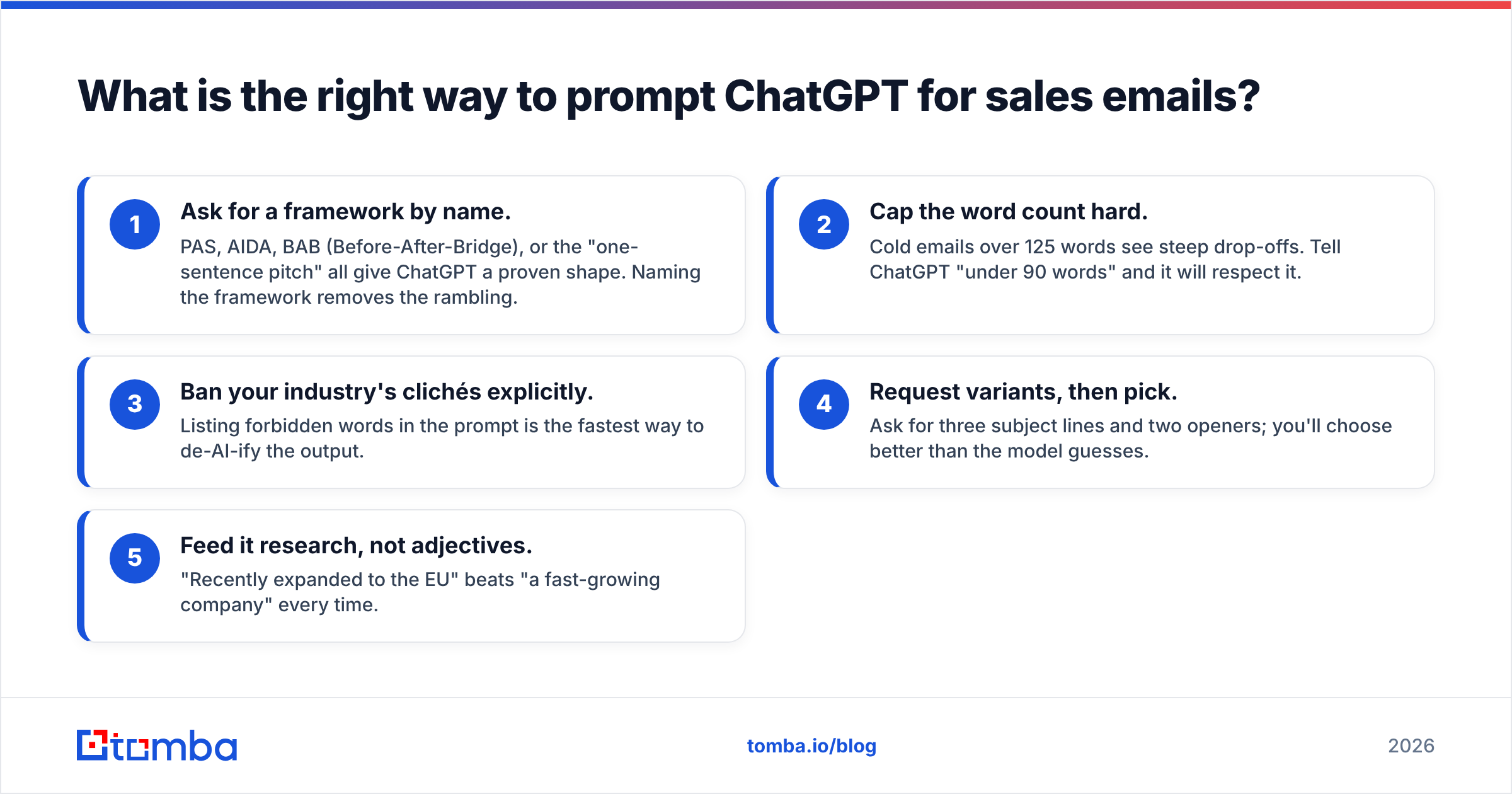
- Ask for a framework by name. PAS, AIDA, BAB (Before-After-Bridge), or the "one-sentence pitch" all give ChatGPT a proven shape. Naming the framework removes the rambling.
- Cap the word count hard. Cold emails over 125 words see steep drop-offs. Tell ChatGPT "under 90 words" and it will respect it.
- Ban your industry's clichés explicitly. Listing forbidden words in the prompt is the fastest way to de-AI-ify the output.
- Request variants, then pick. Ask for three subject lines and two openers; you'll choose better than the model guesses.
- Feed it research, not adjectives. "Recently expanded to the EU" beats "a fast-growing company" every time.
If you want a head start on structure, you can pull from a library of cold email templates and ask ChatGPT to adapt one to your prospect rather than inventing from scratch.
How do you personalize AI sales emails at scale?#
Personalization at scale is a data problem disguised as a writing problem. The writing is easy to automate; the correct, current, verified details about each prospect are the hard part — and the part that decides outcomes.
Here's the mental model. Every personalized email needs three data layers stacked underneath the copy:
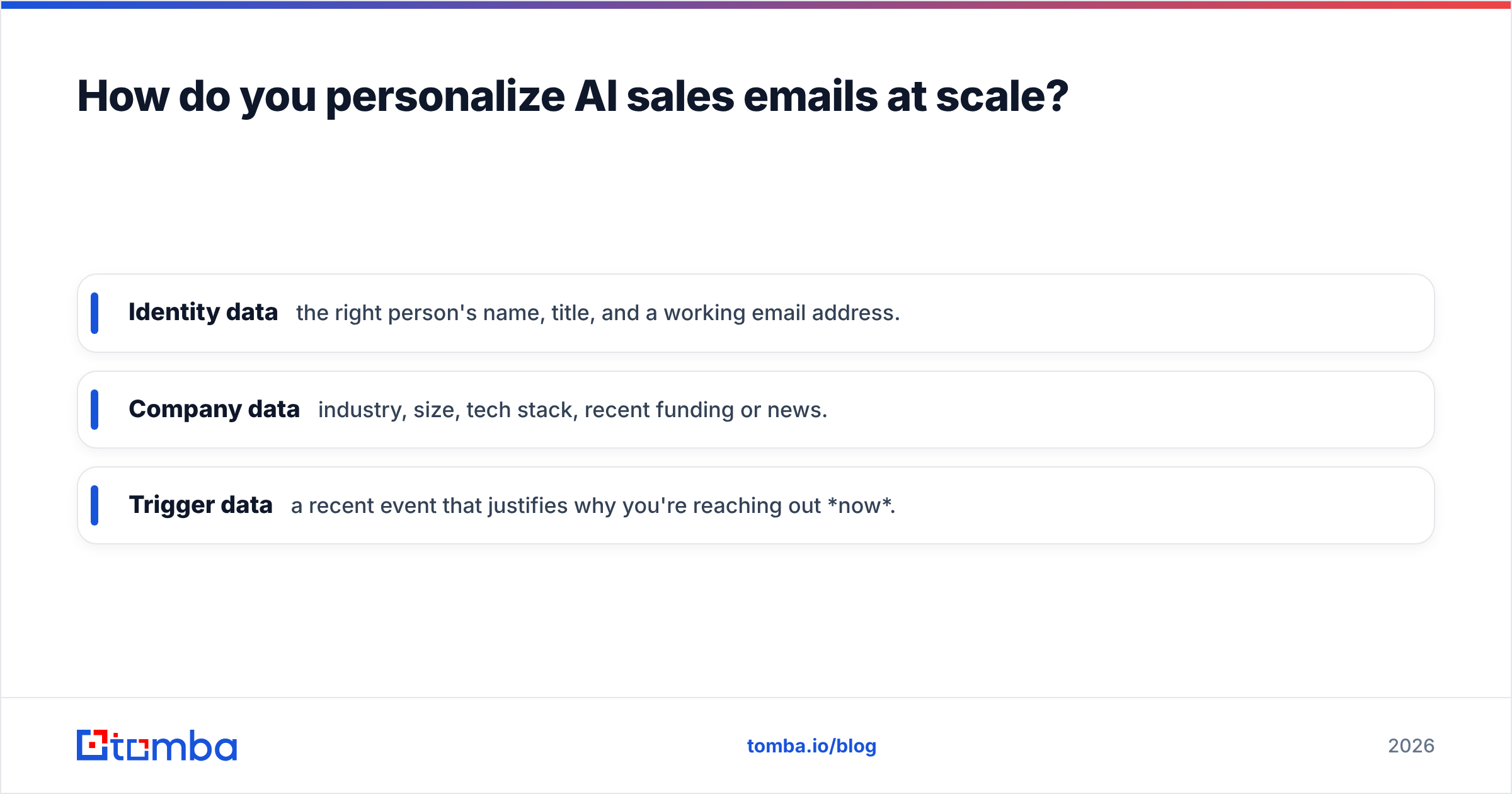
- Identity data — the right person's name, title, and a working email address.
- Company data — industry, size, tech stack, recent funding or news.
- Trigger data — a recent event that justifies why you're reaching out now.
ChatGPT can weave all three into natural prose, but it can't source any of them. This is where your tooling stack does the heavy lifting. You find and verify contacts with an email finder, enrich them with firmographics through data enrichment, and then pass that structured data into your prompt as variables.
A practical workflow looks like this:
- Build a target list with domain search to pull every relevant contact at your target accounts.
- Verify each address so you're not personalizing emails to dead inboxes.
- Enrich rows with title, headcount, and recent signals.
- Merge each row into your ChatGPT prompt template programmatically (via the API or a spreadsheet add-in).
- Generate, lightly human-review, and queue.
The lesson most teams learn the hard way: clever copy on bad data is wasted effort. A perfectly personalized paragraph sent to john@compny.com (typo, bounces) accomplishes nothing — and worse, repeated bounces damage your sender reputation.
)
ChatGPT alone vs. ChatGPT plus a data stack#
The single biggest mistake in 2026 is using ChatGPT as a standalone outreach tool. Here's how the two approaches actually compare on the things that matter.
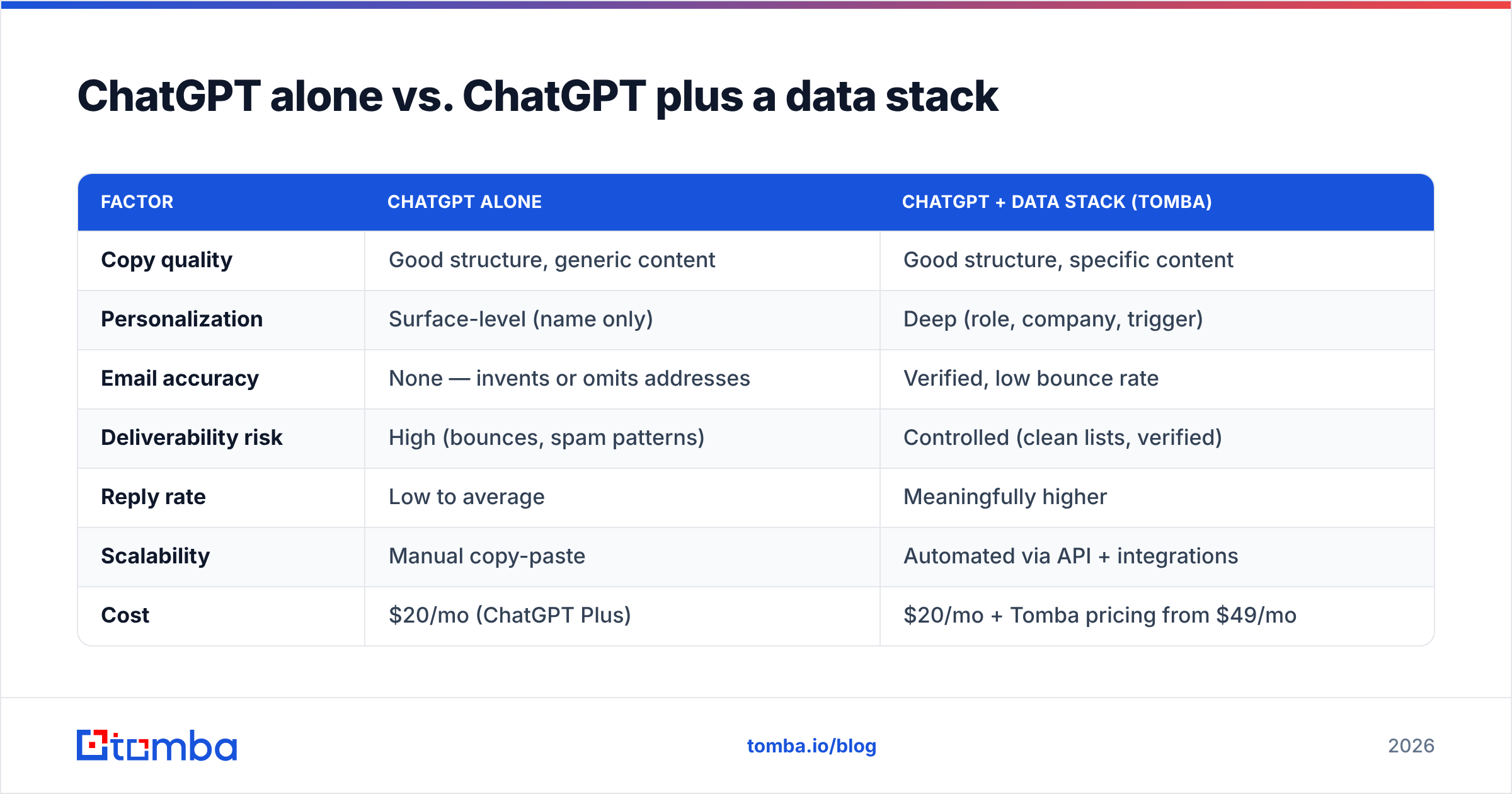
| Factor | ChatGPT alone | ChatGPT + data stack (Tomba) |
|---|---|---|
| Copy quality | Good structure, generic content | Good structure, specific content |
| Personalization | Surface-level (name only) | Deep (role, company, trigger) |
| Email accuracy | None — invents or omits addresses | Verified, low bounce rate |
| Deliverability risk | High (bounces, spam patterns) | Controlled (clean lists, verified) |
| Reply rate | Low to average | Meaningfully higher |
| Scalability | Manual copy-paste | Automated via API + integrations |
| Cost | $20/mo (ChatGPT Plus) | $20/mo + Tomba pricing from $49/mo |
The pattern is clear: ChatGPT improves the writing, but the data stack improves the results. They solve different problems and you need both. Spending $20 a month on an AI writer while skipping the $49 layer that makes the emails deliverable and relevant is optimizing the cheap half of the equation.
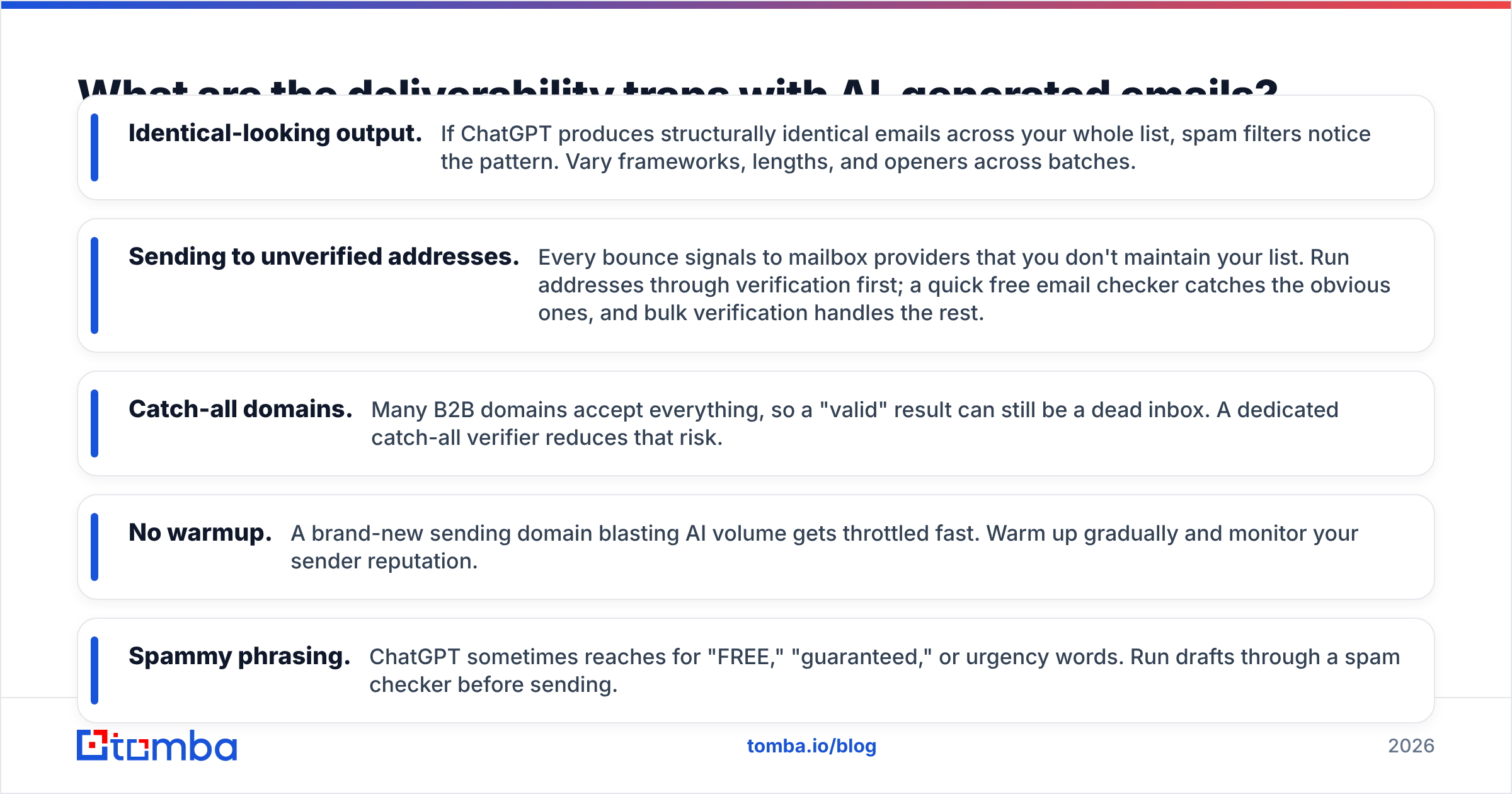
What are the deliverability traps with AI-generated emails?#
AI makes it dangerously easy to send a thousand emails before lunch — which is exactly why deliverability is the discipline that separates sustainable programs from burned domains. A few traps to watch:
- Identical-looking output. If ChatGPT produces structurally identical emails across your whole list, spam filters notice the pattern. Vary frameworks, lengths, and openers across batches.
- Sending to unverified addresses. Every bounce signals to mailbox providers that you don't maintain your list. Run addresses through verification first; a quick free email checker catches the obvious ones, and bulk verification handles the rest.
- Catch-all domains. Many B2B domains accept everything, so a "valid" result can still be a dead inbox. A dedicated catch-all verifier reduces that risk.
- No warmup. A brand-new sending domain blasting AI volume gets throttled fast. Warm up gradually and monitor your sender reputation.
- Spammy phrasing. ChatGPT sometimes reaches for "FREE," "guaranteed," or urgency words. Run drafts through a spam checker before sending.
Deliverability isn't a one-time setup; it's hygiene. The teams that win with AI outreach treat list quality and domain health as seriously as they treat copy — usually more so. For the underlying mechanics, the email deliverability fundamentals are worth a read before you scale volume.
Which sales email types is ChatGPT best at?#
ChatGPT's strength varies sharply by email type. Knowing where it shines lets you spend your editing energy where it's needed.
- Cold outreach openers — Strong. Give it a trigger event and framework and it produces a clean first touch.
- Follow-ups — Excellent. ChatGPT is great at writing a polite, varied follow-up sequence that doesn't repeat itself. Ask for a 4-email sequence with escalating angles.
- Re-engagement / win-back — Good. It handles the "checking back in" tone naturally.
- Replies to objections — Strong, if you paste the prospect's reply. The AI email response angle works well here.
- Highly technical pitches — Weak. It hallucinates specifics; keep a human in the loop.
- Pricing/negotiation emails — Weak. Too much business context and risk; draft these yourself.
The rule of thumb: the more the email depends on facts ChatGPT doesn't have, the more you must supervise it. Top-of-funnel, high-volume, structure-driven emails are its sweet spot. Bottom-of-funnel, high-stakes, fact-dense emails are yours.
How do you build a repeatable ChatGPT sales email system?#
The goal is a system where ChatGPT is one reliable stage, not a creative gamble each time. Here's a framework you can stand up this week.
Step 1 — Standardize your prompts. Save 3–4 proven prompt templates (cold open, follow-up sequence, objection reply, re-engagement). Store the variables each one needs.
Step 2 — Centralize your data. Build verified, enriched contact lists. Use bulk email finder for list building and push results into a CRM or spreadsheet. Tomba's Google Sheets add-on and HubSpot integration keep the data where your team already works.
Step 3 — Automate the merge. Use the Tomba API plus the OpenAI API to generate emails row-by-row, injecting verified data into your saved prompts. This is the step that turns one-off prompting into scale.
Step 4 — Human-review the edge cases. You don't need to read all 500. Spot-check 10%, watch for hallucinated claims, and refine the prompt where the output drifts.
Step 5 — Measure and iterate. Track open, reply, and bounce rates by prompt template. Kill the templates that underperform and double down on winners. Compare against your baseline response rate so you know AI is actually moving the number.
This loop — prompt, data, merge, review, measure — is what turns ChatGPT from a novelty into infrastructure. The teams getting outsized results aren't using a secret prompt; they're running a tighter system around an ordinary one.
For broader context on where AI fits in modern selling, Gartner's sales technology coverage and peer reviews on G2 are useful neutral references when you're evaluating which tools to add to the stack.
Is ChatGPT or a dedicated cold email AI better?#
For most teams, ChatGPT plus a data layer beats a closed cold-email AI — because it's flexible and you control the inputs. Dedicated tools bundle convenience but lock you into their templates and often their data, which may be stale. ChatGPT gives you a general-purpose writer you can steer precisely, and pairing it with your own verified data means the personalization is as good as your sourcing, not as good as a vendor's database refresh cycle.
That said, if you don't want to wire up APIs, a purpose-built cold email AI that already integrates finding and verification can be the faster path. The decision comes down to whether you want control (ChatGPT + stack) or convenience (all-in-one). Neither is wrong; just don't pick the all-in-one and then complain it feels generic — that's the trade-off you chose.
The bottom line#
ChatGPT is a genuine force multiplier for sales emails in 2026 — but only for the parts of the email it can actually control: structure, tone, clarity, and speed. The parts that decide whether you get a reply — relevance, accuracy, and deliverability — live in your data. Get both right and AI outreach compounds. Get only the writing right and you've automated the production of ignored emails.
Start with the foundation: a clean, verified list. ChatGPT can write the best email in the world, but it needs a real person and a working inbox to send it to. Tomba's Email Finder gives you accurate, verified professional emails by name, domain, or company — the data layer that makes your AI-written outreach actually land. Pair it with your ChatGPT prompts, start on the free tier of 25 searches, and scale from $49/mo once the replies start coming in.
// get started
Find, verify and enrich your first contacts today
Start on the free plan with 25 searches a month, then scale when your team is ready.
Free plan · No credit card required · GDPR & CCPA
// about the author