Cheapest Email Verification Service in 2026: Price Compared
Looking for the cheapest email verification service in 2026? We compare per-credit pricing, free tiers, and accuracy across the top tools so you don't overpay for a clean list.
Picking an email verification tool on price alone is how teams end up paying twice: once for the cheap service, and again when a "verified" list still bounces and torches their sender reputation. The cheapest email verification service is not the one with the lowest sticker price — it's the one with the lowest cost per genuinely deliverable email. This guide breaks down what you actually pay, where the hidden costs hide, and which tools give you the best price-to-accuracy ratio in 2026.
TL;DR#
- The lowest per-1,000 price is meaningless if accuracy is low. A $4/1K tool that misclassifies 8% of addresses costs more than a $7/1K tool that nails 99%.
- Free tiers matter more than headline pricing for small senders — most teams verifying under 5,000 emails/month never need to pay.
- Watch for credit expiry, catch-all handling, and minimum spends — these are where "cheap" services quietly get expensive.
- Tomba bundles verification with finding and enrichment at a flat plan price, which beats per-credit pricing once you're verifying and sourcing at volume.
- Our pick for best value: pay-as-you-go for spiky lists, a flat monthly plan once you're verifying consistently.
What makes an email verification service "cheap"?#
Cheap is a ratio, not a number. The honest way to compare is cost per 1,000 correctly classified addresses, which folds three variables into one:
- Headline price per 1,000 verifications — the number every vendor advertises.
- Accuracy rate — what percentage of results are actually correct. A bounce that slips through still costs you a hard bounce against your domain.
- Catch-all resolution — how the tool handles accept-all domains. Many cheap services just label these "unknown" and still bill you, leaving you to guess.
A tool charging $0.004 per email that returns 10% "unknown" results is more expensive than it looks: you either send to those addresses and risk bounces, or you discard them and effectively paid for nothing. Run the math on deliverable results, not raw API calls.

If you want the underlying concept, our email deliverability glossary entry explains why a single percentage point of bounce rate has an outsized effect on inbox placement.
How much should email verification cost in 2026?#
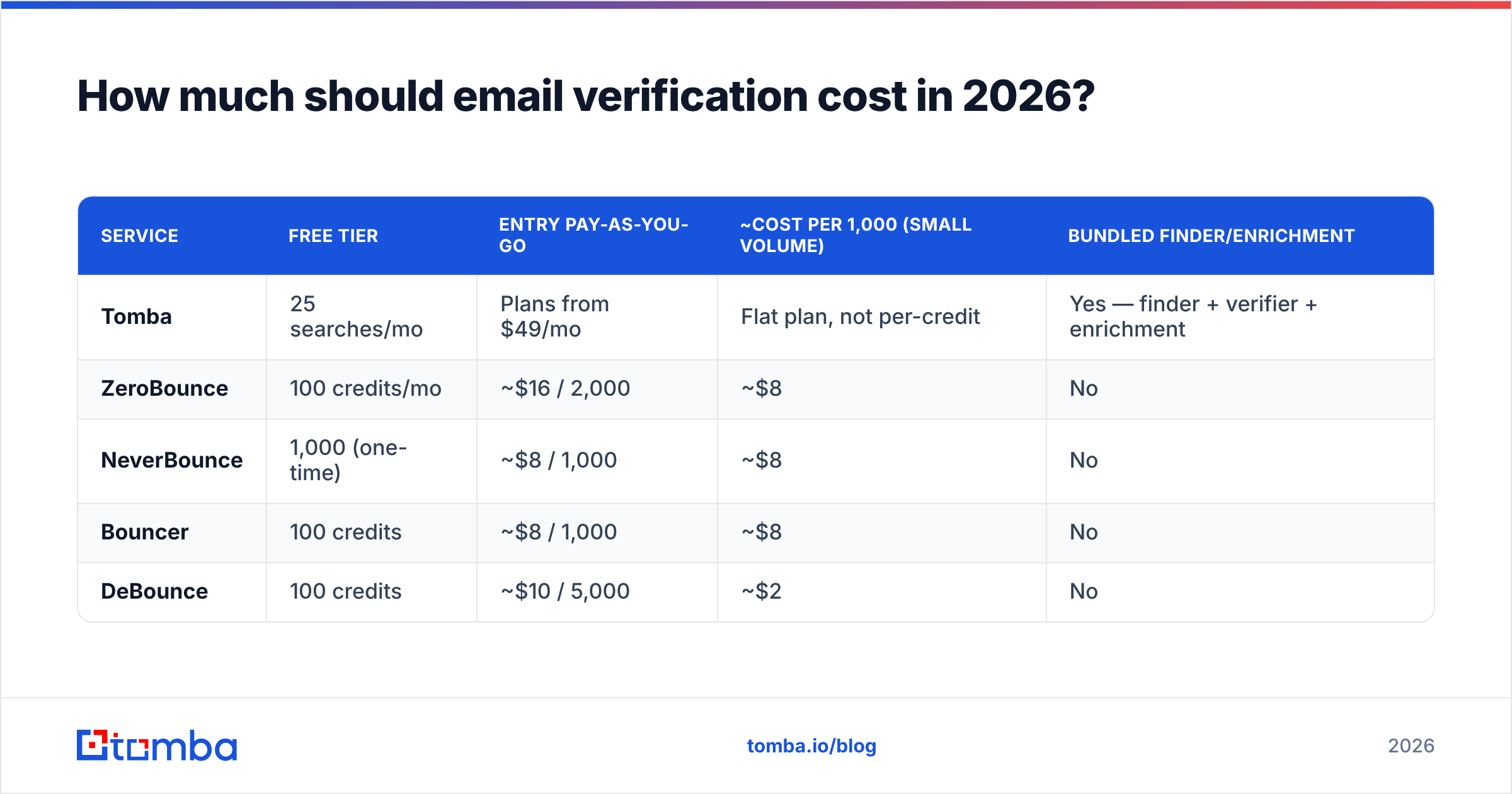
Market pricing has compressed. For pay-as-you-go credits, the going rate sits between $3 and $8 per 1,000 emails at small volumes, dropping toward $1–$2 per 1,000 at high volume (hundreds of thousands). Subscription plans bundle verification with other tooling and usually work out cheaper per email once you're a regular user.
Here's how the main options stack up. Prices are entry-level published rates as of 2026; always confirm on the vendor's own pricing page before buying.
| Service | Free tier | Entry pay-as-you-go | ~Cost per 1,000 (small volume) | Bundled finder/enrichment |
|---|---|---|---|---|
| Tomba | 25 searches/mo | Plans from $49/mo | Flat plan, not per-credit | Yes — finder + verifier + enrichment |
| ZeroBounce | 100 credits/mo | ~$16 / 2,000 | ~$8 | No |
| NeverBounce | 1,000 (one-time) | ~$8 / 1,000 | ~$8 | No |
| Bouncer | 100 credits | ~$8 / 1,000 | ~$8 | No |
| DeBounce | 100 credits | ~$10 / 5,000 | ~$2 | No |
Two things jump out. First, the per-1,000 spread is wide at low volume but converges at scale. Second, only one of these bundles email finding and enrichment with verification — and if you need all three, paying for separate single-purpose tools usually costs more than one platform.
You can see Tomba's full plan breakdown on the Tomba pricing page, including where the email verifier sits inside each tier.
Is the cheapest email verification service always the best value?#
No — and this is the trap. Three hidden costs turn a "cheap" service expensive:
- Credit expiry. Some pay-as-you-go credits expire in 12 months or less. If you buy in bulk for a discount and don't use them, you've overpaid.
- Minimum purchases. A $2/1,000 rate that requires a $50 minimum isn't $2/1,000 for someone verifying 3,000 emails — it's effectively $16/1,000.
- Catch-all guesswork. Cheap services often punt on accept-all domains. If you need certainty there, you'll want a dedicated catch-all verifier, and paying for a second tool erases your savings.
The value calculation should also weigh what else the tool does. If you're verifying lists you also had to build, a platform that finds and verifies in one workflow removes an entire vendor — and an entire invoice. That's the structural reason bundled platforms often beat single-purpose verifiers on total cost even when their per-email rate looks higher.

How do you actually lower your verification bill?#
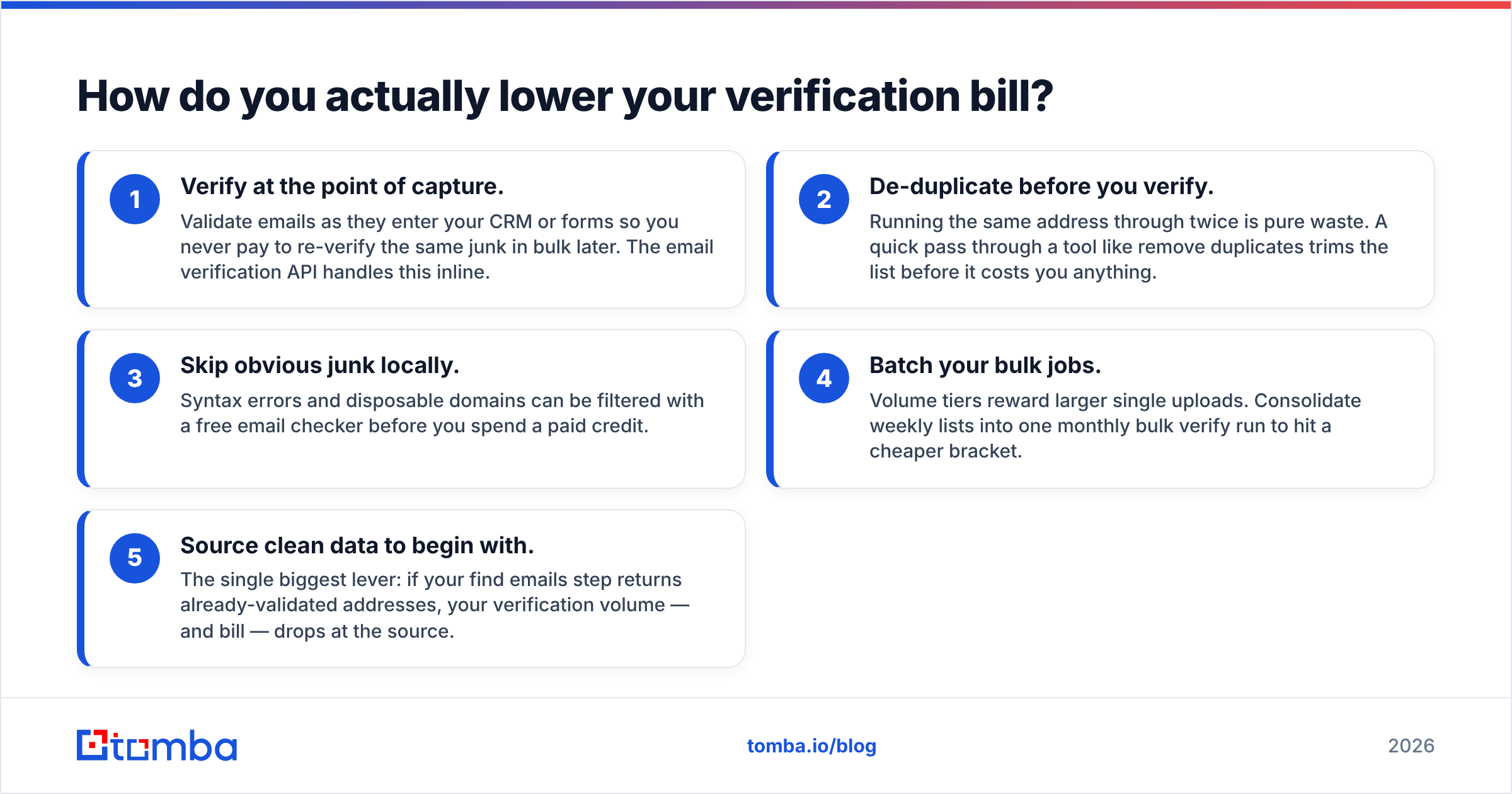
Cutting cost is mostly about verifying fewer, better emails — not just finding a lower rate. Five tactics, in order of impact:
- Verify at the point of capture. Validate emails as they enter your CRM or forms so you never pay to re-verify the same junk in bulk later. The email verification API handles this inline.
- De-duplicate before you verify. Running the same address through twice is pure waste. A quick pass through a tool like remove duplicates trims the list before it costs you anything.
- Skip obvious junk locally. Syntax errors and disposable domains can be filtered with a free email checker before you spend a paid credit.
- Batch your bulk jobs. Volume tiers reward larger single uploads. Consolidate weekly lists into one monthly bulk verify run to hit a cheaper bracket.
- Source clean data to begin with. The single biggest lever: if your find emails step returns already-validated addresses, your verification volume — and bill — drops at the source.
That last point is why combining your finder and verifier matters. According to G2 reviews across the category, teams consistently flag tool sprawl as a hidden cost; consolidating workflows is often a bigger saving than shaving cents off a per-credit rate.
Free vs. paid: when do you actually need to pay?#
Most small senders overbuy. If you verify under roughly 5,000 emails per month and aren't running daily campaigns, free tiers and free tools may cover you entirely. Here's the honest decision framework:
| Your situation | Cheapest correct choice |
|---|---|
| < 1,000 emails/mo, occasional | Stack free tiers + free email checker |
| 1,000–5,000/mo, growing | Pay-as-you-go credits, no subscription |
| 5,000–50,000/mo, recurring | Flat monthly plan (cheaper per email at this volume) |
| Finding + verifying + enriching | Bundled platform — one plan beats three tools |
| Spiky, unpredictable volume | Pay-as-you-go so you never pay for idle months |
The mistake is signing a monthly plan for occasional work, or grinding through pay-as-you-go credits when a flat plan would be half the cost at your real volume. Match the billing model to your pattern, not just the price.
What about accuracy — is cheap verification reliable?#
Reliability comes from data sources and verification depth, not price. A good verifier does real-time SMTP checks, MX record validation, catch-all detection, and disposable/role-account flagging — not just a regex pass. Cheaper tools sometimes cut the expensive steps (live SMTP handshakes cost the vendor money), which is exactly where accuracy slips.
Ask any vendor three questions before you buy:
- Do you do live SMTP verification, or only syntax and MX checks? Syntax-only is cheap because it's shallow.
- How do you handle catch-all domains — flag as unknown, or attempt resolution?
- What's your published accuracy rate, and is it independently measured? Be skeptical of "99.9%" with no methodology.
Tomba's verification draws on the same infrastructure as its finder; you can read about where Tomba gets data to judge the depth for yourself. For the broader principle of why sender trust compounds, HubSpot's deliverability guidance is a solid neutral reference, as is the concept of sender reputation.
Which email verification service is cheapest for you?#
Conclusion first: there is no single cheapest email verification service — there's a cheapest one for your volume and workflow.
- Verifying occasionally, small lists? Free tiers plus free tools will likely cost you nothing.
- Steady pay-as-you-go, build-it-elsewhere? A per-credit verifier in the $2–$8/1,000 range, chosen on accuracy not headline price.
- Finding, verifying, and enriching together at volume? A bundled platform on a flat plan almost always wins on total cost, because it deletes a vendor.
Run your own numbers on cost per deliverable email, not cost per API call, and the rankings often flip from what the pricing pages suggest.
The bottom line#
If you only verify lists someone else built, shop on accuracy-adjusted per-credit price. But if you're also sourcing those contacts — which most B2B teams are — the cheapest path is to find and verify in one place. Tomba's email finder returns addresses that are validated as part of the same workflow, with the email verifier, catch-all finder, and data enrichment all under one flat plan starting at $49/mo — and a free tier to test it before you spend a cent. Start with the free email checker, then move your real volume onto a plan that bundles the whole job. That's how you stop paying for a clean list twice.
// get started
Find, verify and enrich your first contacts today
Start on the free plan with 25 searches a month, then scale when your team is ready.
Free plan · No credit card required · GDPR & CCPA
// about the author