Chief Revenue Officer: Role, Salary & GTM Impact (2026)
What a chief revenue officer actually owns, how the role differs from a VP of Sales or CMO, what they earn in 2026, and the metrics and data stack that make them effective.
The chief revenue officer (CRO) is the executive who owns every dollar of revenue across sales, marketing, and customer success — not just one funnel stage. If your sales, marketing, and post-sale teams each report up to different VPs who optimize for their own numbers, the CRO is the person hired to stop that, align the whole go-to-market motion, and make the revenue number predictable.
This guide breaks down what the role actually does in 2026, how it differs from a VP of Sales or a CMO, what CROs earn, the metrics they live by, and the data infrastructure that separates a CRO who hits plan from one who guesses.
TL;DR#
- A chief revenue officer owns all revenue-generating functions — sales, marketing, customer success, and revenue operations — and is accountable for one unified number, not three siloed ones.
- The CRO is not a glorified VP of Sales. A VP of Sales runs the closing motion; a CRO orchestrates the entire customer lifecycle from first touch to renewal and expansion.
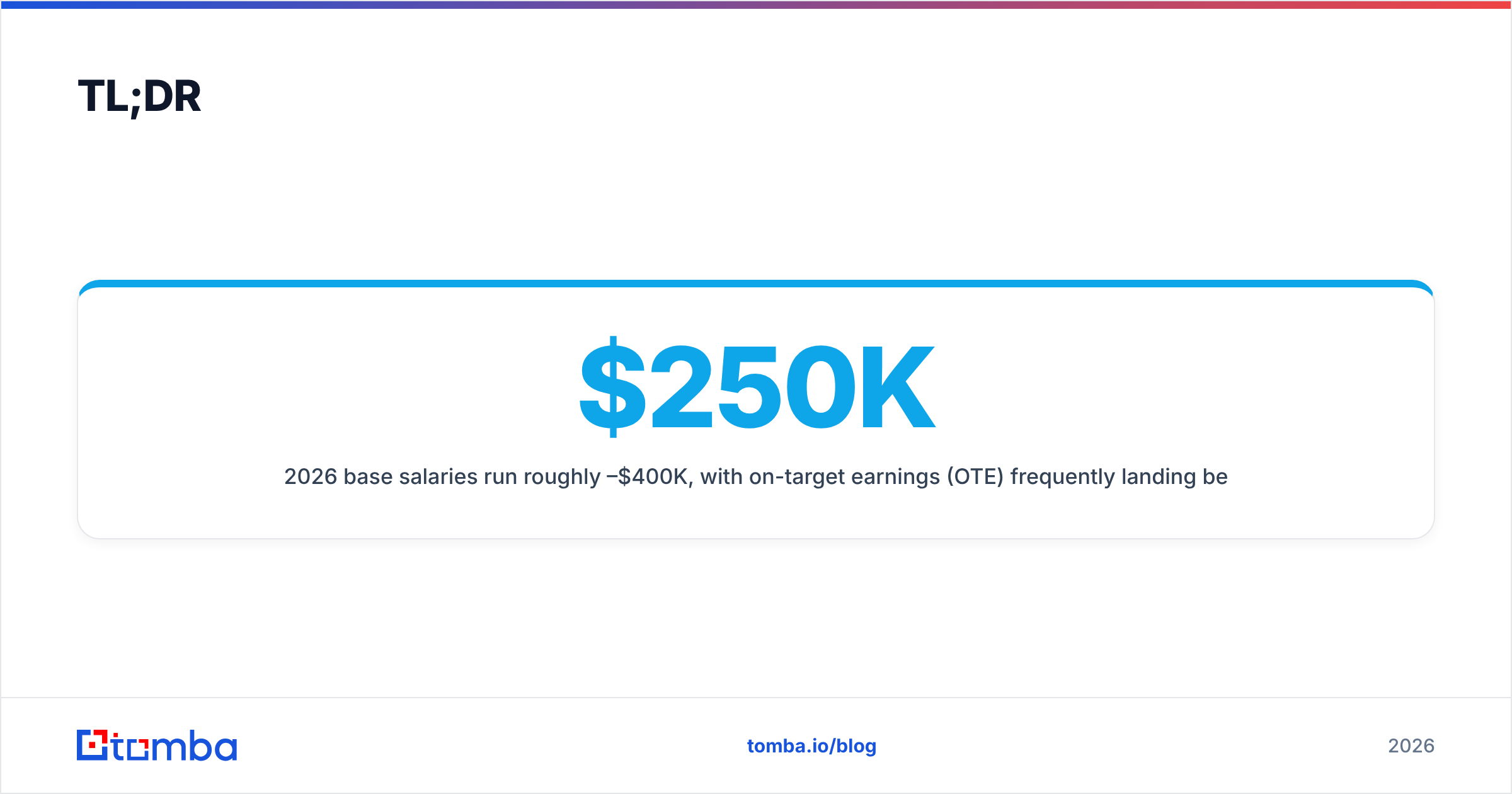
- 2026 base salaries run roughly $250K–$400K, with on-target earnings (OTE) frequently landing between $450K and $700K+ at venture-backed and enterprise companies.
- CROs succeed or fail on data quality. Clean contact data, accurate pipeline, and tight funnel metrics are the foundation; bad data quietly destroys forecast accuracy.
- The role exists to kill misalignment. Companies hire a CRO when growth stalls because marketing, sales, and CS are pulling in different directions.
What is a chief revenue officer?#
A chief revenue officer is a C-suite executive responsible for the strategy, alignment, and performance of all revenue-producing teams. Think of the CRO as the conductor of an orchestra: the sales reps, marketers, and customer success managers are each skilled musicians, but without one person setting tempo and cueing sections, you get noise instead of a symphony. The CRO sets that tempo for revenue.
Functionally, the CRO consolidates what used to be three or four separate fiefdoms — demand generation, sales, revenue operations, and customer success — under a single accountable leader. That consolidation is the entire point. When each function has its own boss and its own definition of success, leads get fumbled at handoffs, marketing celebrates volume while sales complains about quality, and nobody owns net revenue retention.
The role rose to prominence as SaaS and subscription businesses realized that acquiring a customer is only the first of many revenue events. Expansion, renewal, and reducing churn matter as much as the initial close — and those span departments. Someone has to own the whole arc.

Core responsibilities of a CRO#
The day-to-day varies by company stage, but the mandate is consistent. Here are the six areas every effective chief revenue officer owns:
- Revenue strategy and forecasting — Building the model that ties pipeline to bookings to recognized revenue, then defending that forecast to the CEO and board.
- Go-to-market alignment — Making sure marketing's targeting, sales' messaging, and CS's renewal motion describe the same ideal customer and the same value story.
- Pipeline and funnel ownership — Diagnosing where deals stall, what conversion rates are realistic, and where to invest to lift them.
- Pricing and packaging — Partnering with product and finance on how offerings are priced, bundled, and discounted across segments.
- Team building and enablement — Hiring revenue leaders, setting comp plans that drive the right behavior, and running sales automation and enablement programs.
- Data and tooling decisions — Choosing the CRM, enrichment, and analytics stack so that every revenue decision rests on accurate numbers rather than gut feel.
How is a chief revenue officer different from a VP of Sales or CMO?#
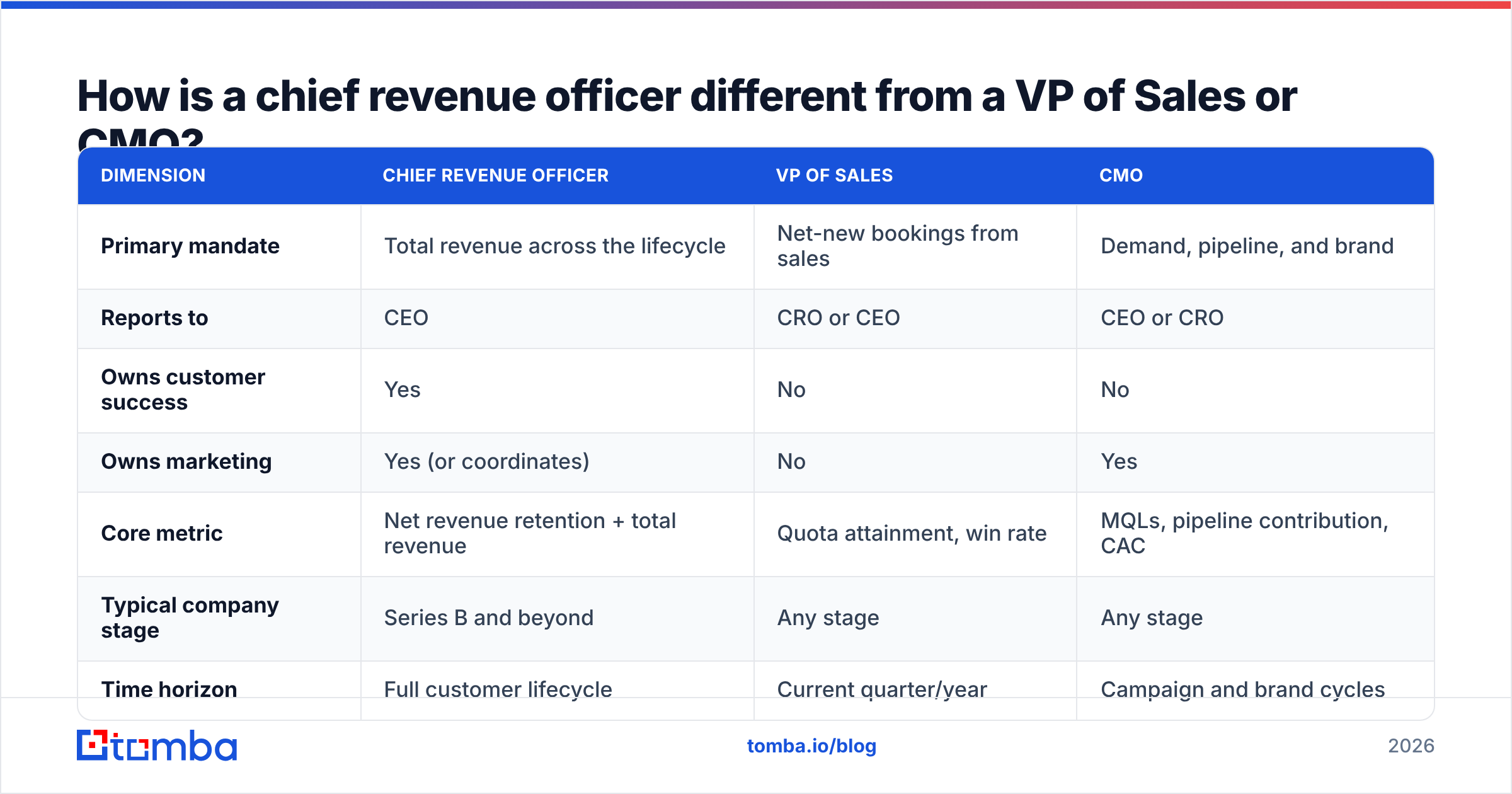
The short answer: scope. A VP of Sales owns the closing motion, a CMO owns demand and brand, and the chief revenue officer owns the connective tissue between all of them plus customer success. The CRO sits above the functional VPs and is measured on total revenue outcomes rather than departmental activity.
This is the distinction that trips up companies. Promoting your best VP of Sales into a "CRO" title without expanding the actual scope just renames the role. A real CRO has marketing and CS leaders reporting in, or at minimum has formal authority over how those functions coordinate.
| Dimension | Chief Revenue Officer | VP of Sales | CMO |
|---|---|---|---|
| Primary mandate | Total revenue across the lifecycle | Net-new bookings from sales | Demand, pipeline, and brand |
| Reports to | CEO | CRO or CEO | CEO or CRO |
| Owns customer success | Yes | No | No |
| Owns marketing | Yes (or coordinates) | No | Yes |
| Core metric | Net revenue retention + total revenue | Quota attainment, win rate | MQLs, pipeline contribution, CAC |
| Typical company stage | Series B and beyond | Any stage | Any stage |
| Time horizon | Full customer lifecycle | Current quarter/year | Campaign and brand cycles |
A useful test: if your VP of Sales and CMO regularly disagree about lead quality and no one can settle it with shared data, you have a structural gap a CRO is built to fill. The CRO forces both sides onto one funnel definition and one source of truth.
When should a company hire a CRO?#
Most companies bring on a chief revenue officer between Series B and Series C, or once they cross roughly $10M–$20M in ARR. Before that, a strong VP of Sales plus a CEO who stays close to revenue is usually enough. The trigger to hire isn't a revenue number, though — it's a coordination problem. You need a CRO when:
- Growth has stalled despite healthy individual functions.
- Handoffs between marketing, sales, and CS are leaking deals.
- The board wants a more predictable, defensible forecast.
- You're expanding into new segments or geographies that require orchestrated GTM motions.
What does a chief revenue officer earn in 2026?#
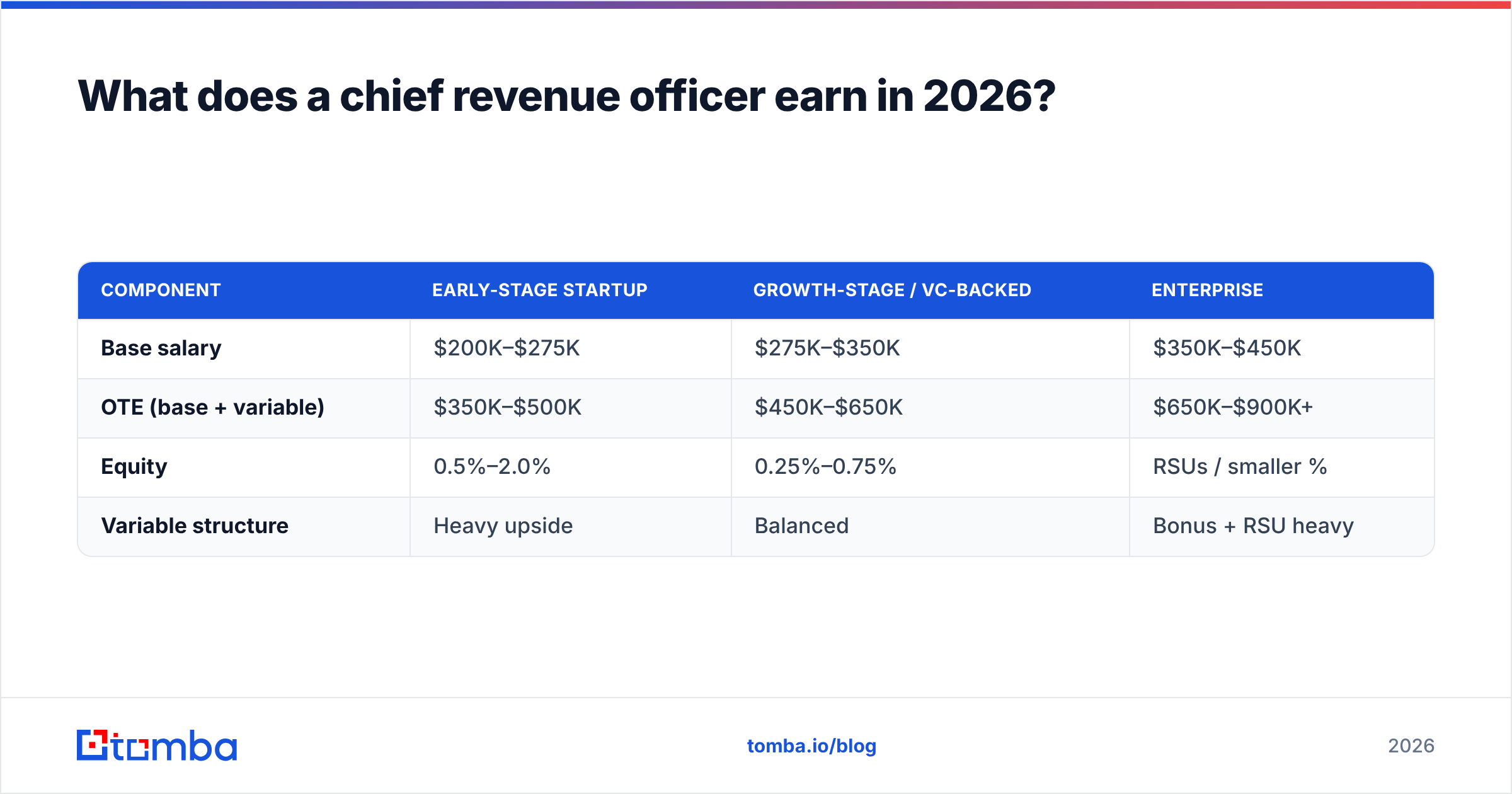
Chief revenue officer compensation is among the highest in the go-to-market org, reflecting the breadth of accountability. Based on aggregated market data, here is the realistic 2026 range. Note that these figures move significantly with company stage, funding, and equity.
| Component | Early-stage startup | Growth-stage / VC-backed | Enterprise |
|---|---|---|---|
| Base salary | $200K–$275K | $275K–$350K | $350K–$450K |
| OTE (base + variable) | $350K–$500K | $450K–$650K | $650K–$900K+ |
| Equity | 0.5%–2.0% | 0.25%–0.75% | RSUs / smaller % |
| Variable structure | Heavy upside | Balanced | Bonus + RSU heavy |
For current, role-specific benchmarks you can cross-reference compensation databases like Glassdoor or industry reports from advisory firms such as Gartner. Treat any single source as directional — CRO packages are heavily negotiated and equity often dwarfs cash at venture-backed companies.
The variable portion almost always ties to total company revenue or net revenue retention rather than a personal sales quota. That structure is deliberate: it forces the CRO to care about churn and expansion, not just new logos.
What metrics does a chief revenue officer own?#
A chief revenue officer is measured on outcomes that span the funnel, not activity within one stage. The metrics below are the ones that show up on a CRO's board slide. If you're stepping into the role — or evaluating one — these are the numbers to master.
- Net revenue retention (NRR) — Revenue from existing customers including expansion, minus churn. The single most-watched SaaS health metric.
- Customer acquisition cost (CAC) and payback period — How efficiently the GTM engine converts spend into customers.
- Pipeline coverage — The ratio of open pipeline to quota, typically 3x–4x, that signals whether the forecast is achievable.
- Win rate — The percentage of qualified opportunities that close, broken down by segment and source.
- Sales cycle length — How long deals take to close, a leading indicator of forecast risk.
- Average contract value (ACV) and expansion revenue — The size and growth of accounts over time.
The hard part isn't picking metrics — it's trusting them. A forecast built on a CRM full of stale contacts, duplicate accounts, and unverified email addresses produces confident numbers that are quietly wrong. This is where a lot of CROs get blindsided.
What does a CRO's data and tooling stack look like?#
The chief revenue officer owns the decision on what powers the revenue engine, and that decision starts with data quality. Everything downstream — forecasting, territory planning, lead routing, comp accuracy — inherits the accuracy (or the rot) of the underlying contact and account data.
Picture the revenue stack as a building. The CRM and analytics tools are the visible floors everyone works on, but contact and account data is the foundation. You can renovate the floors all you want; if the foundation is cracked, the whole structure tilts. Most CROs underinvest in the foundation because it's invisible — until the forecast misses and a postmortem reveals that 30% of the pipeline was built on contacts who left their companies months ago.
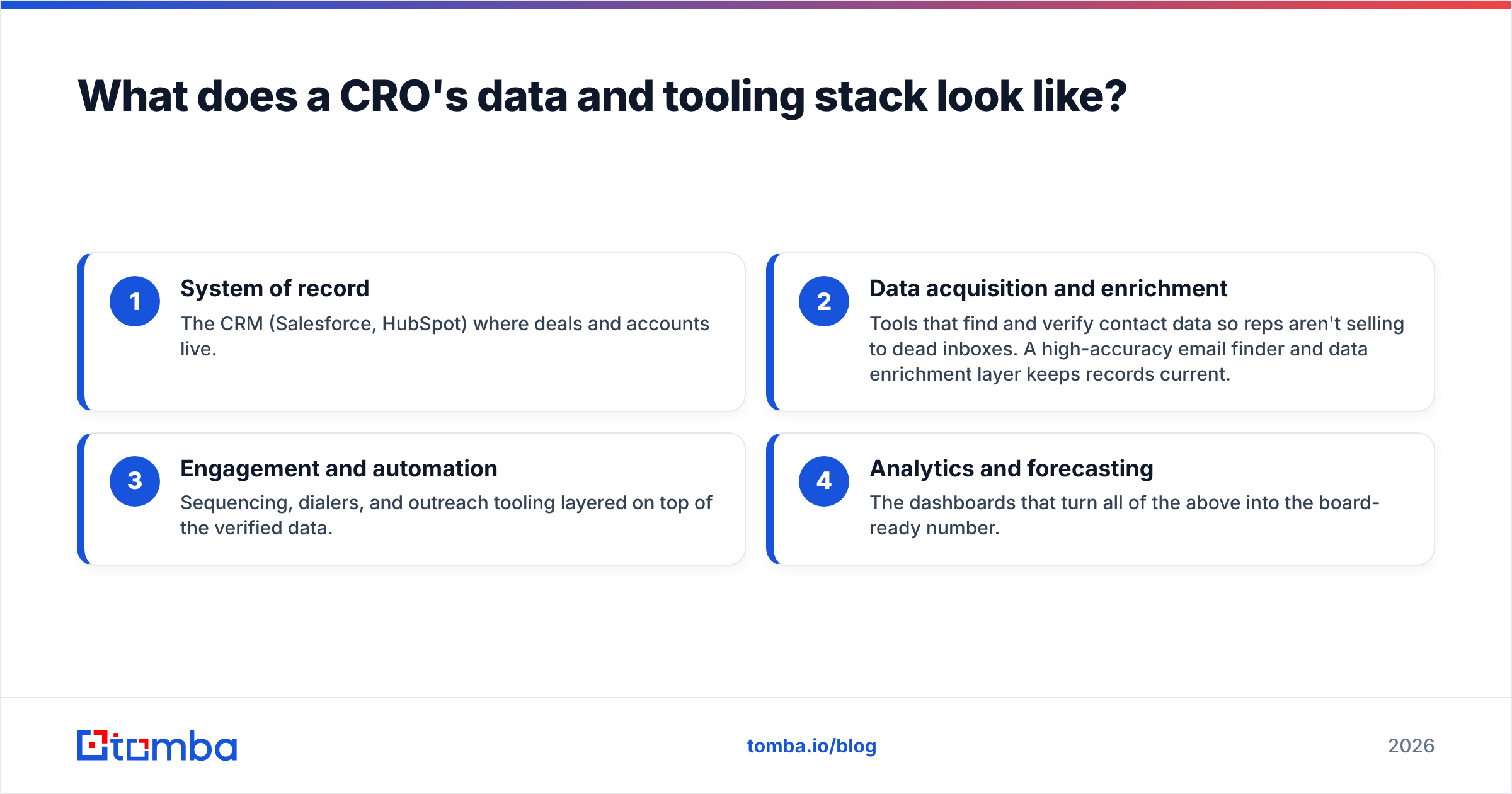
A practical CRO data stack has four layers:
- System of record — The CRM (Salesforce, HubSpot) where deals and accounts live.
- Data acquisition and enrichment — Tools that find and verify contact data so reps aren't selling to dead inboxes. A high-accuracy email finder and data enrichment layer keeps records current.
- Engagement and automation — Sequencing, dialers, and outreach tooling layered on top of the verified data.
- Analytics and forecasting — The dashboards that turn all of the above into the board-ready number.
The second layer is where CROs win or lose forecast accuracy. If reps are spending hours chasing bounced emails and outdated phone numbers, your CAC inflates and your pipeline data lies to you. Verifying every contact before it enters a sequence — with an email verifier and accurate enrichment — protects deliverability and keeps your funnel metrics honest. For teams scaling outbound, pulling clean contacts straight from a company's domain via domain search beats buying stale list data that's wrong on arrival.
For the platform-level decisions — CRM, MAP, and core architecture — research firms like Forrester publish wave reports worth reading before you sign a multi-year contract.
Common CRO mistakes to avoid#
Even experienced revenue leaders fall into predictable traps. Watch for these:
- Treating the CRO role as VP of Sales 2.0 — ignoring marketing and CS and optimizing only for new bookings.
- Forecasting on dirty data — building board commitments on a CRM nobody has cleaned in a year.
- Comp plans that reward the wrong behavior — paying only on new logos when the business lives on retention.
- Over-tooling — buying ten point solutions before fixing the data foundation they all depend on.
- No shared funnel definition — letting marketing and sales count "qualified" differently, so the handoff math never reconciles.
Is the chief revenue officer role here to stay?#
Yes — but it's consolidating. As subscription and usage-based models dominate, the logic of owning the full revenue lifecycle under one executive only gets stronger. What's changing is the toolkit: AI-assisted forecasting, automated enrichment, and tighter RevOps functions are making the CRO's job more data-driven and less reliant on intuition.
The CROs who thrive in 2026 and beyond are the ones who treat data quality as a strategic asset rather than an IT afterthought. The role is fundamentally about removing friction between functions, and most of that friction traces back to inconsistent, inaccurate, or stale information about who your customers and prospects actually are.
Build your revenue engine on data you can trust#
A chief revenue officer's forecast is only as good as the contact data underneath it. Before you invest in another dashboard or sequencing tool, make sure the records feeding your pipeline are real. Tomba's Email Finder helps your revenue teams find and verify professional email addresses by domain, name, or company — so reps reach real people, deliverability stays high, and your funnel metrics reflect reality. Start free with 25 searches a month, then scale on the Starter plan at $49/mo as your outbound grows. Give your CRO a foundation worth forecasting on.
// get started
Find, verify and enrich your first contacts today
Start on the free plan with 25 searches a month, then scale when your team is ready.
Free plan · No credit card required · GDPR & CCPA
// about the author