Chief Revenue Officer Priorities: The 2026 CRO Playbook
The CRO role is being rewritten in 2026. Here are the seven chief revenue officer priorities that separate revenue leaders who hit plan from those who get replaced.
The chief revenue officer job has quietly changed shape. Five years ago a CRO was a glorified VP of Sales with a bigger territory. In 2026 the role owns the entire revenue engine — marketing, sales, customer success, and the operations layer that holds them together. If you are stepping into the seat, reporting to one, or trying to become one, here is what actually matters this year.
TL;DR#
- The modern CRO owns the full funnel, not just closing — marketing, sales, CS, and RevOps now report into a single revenue line.
- Data quality is the #1 silent priority. Most missed quarters trace back to bad contact data, not bad selling.
- Efficiency beats growth-at-all-costs. Boards now grade CROs on net revenue retention and CAC payback, not raw bookings.
- Forecast accuracy is a survival metric. A CRO who misses the number twice rarely gets a third quarter.
- AI and tooling consolidation is a 2026 mandate — fewer point tools, cleaner pipes, measurable ROI.
What does a chief revenue officer actually do in 2026?#
A chief revenue officer is the single executive accountable for all revenue-generating functions. Think of the CRO as the conductor of an orchestra: marketing is the strings, sales is the brass, customer success is the percussion, and revenue operations is the sheet music that keeps everyone in time. The CEO doesn't want four soloists playing different songs — they want one performance, and the CRO is responsible for it.
That consolidation is the defining trend. According to Gartner, more enterprises every year are collapsing siloed VP-of-Sales and CMO roles into a unified revenue leader to kill the finger-pointing that happens at the handoff between teams. When marketing blames sales for not working leads and sales blames marketing for sending junk, revenue leaks out of the seam. The CRO's job is to eliminate that seam.
So the day-to-day isn't selling. It's designing the system that sells: the go-to-market motion, the comp plans, the tech stack, the data, and the metrics everyone is measured on.
What are the top chief revenue officer priorities this year?#
Here are the seven priorities that show up on every serious CRO's 2026 plan, ranked by how often they decide whether a quarter lands.
- Unify the revenue funnel. One pipeline definition, one source of truth, one set of stage gates across marketing, sales, and CS. No more "marketing qualified" meaning three different things.
- Fix the data foundation. Clean, enriched, verified contact and account data feeding the CRM. Everything downstream depends on this.
- Drive efficient growth. Optimize net revenue retention, CAC payback, and magic number — not just top-line bookings.
- Nail the forecast. Build a forecasting process accurate within a tight margin, every quarter, with no hero deals saving the day on the last day.
- Consolidate and prove the stack. Cut redundant tools, measure ROI per platform, and route budget to what moves pipeline.
- Align comp to behavior. Pay people for the outcomes the company needs now, not the ones it needed two years ago.
- Build the bench. Hire, ramp, and retain frontline managers — the layer that actually executes the strategy.
Notice that "sell more" isn't on the list as a standalone item. Selling more is the result when these seven are healthy.
)
Why is data quality the priority CROs underrate?#
Bad data is the most expensive problem no one puts on the board deck. Here's the uncomfortable math: Forrester and other analysts have long estimated that B2B contact data decays by roughly 2–3% per month as people change jobs, companies rebrand, and emails go dark. Over a year, a meaningful slice of your CRM is simply wrong.
When the data is wrong, every layer above it inherits the error. Reps waste hours on dead contacts. Email deliverability craters because you're hitting invalid mailboxes and spam traps. Forecasts drift because the account intelligence underneath them is stale. The CRO sees a revenue miss and assumes it's a selling problem, so they buy more training or more headcount — when the real fix was a clean data layer costing a fraction of a single rep's salary.
This is why smart CROs treat data as infrastructure, not a procurement afterthought. A reliable email verifier and an enrichment process that keeps records fresh do more for pipeline efficiency than another sales kickoff. If your reps are guessing at email formats or buying lists of unverified contacts, you don't have a sales problem — you have a data problem wearing a sales costume.
The CROs who win in 2026 build a standing process: source verified contacts, enrich them with firmographic and role data, verify before every send, and re-verify on a schedule. Tools like a bulk email finder and ongoing data enrichment make that a background utility instead of a fire drill.
How is the CRO role different from a VP of Sales?#
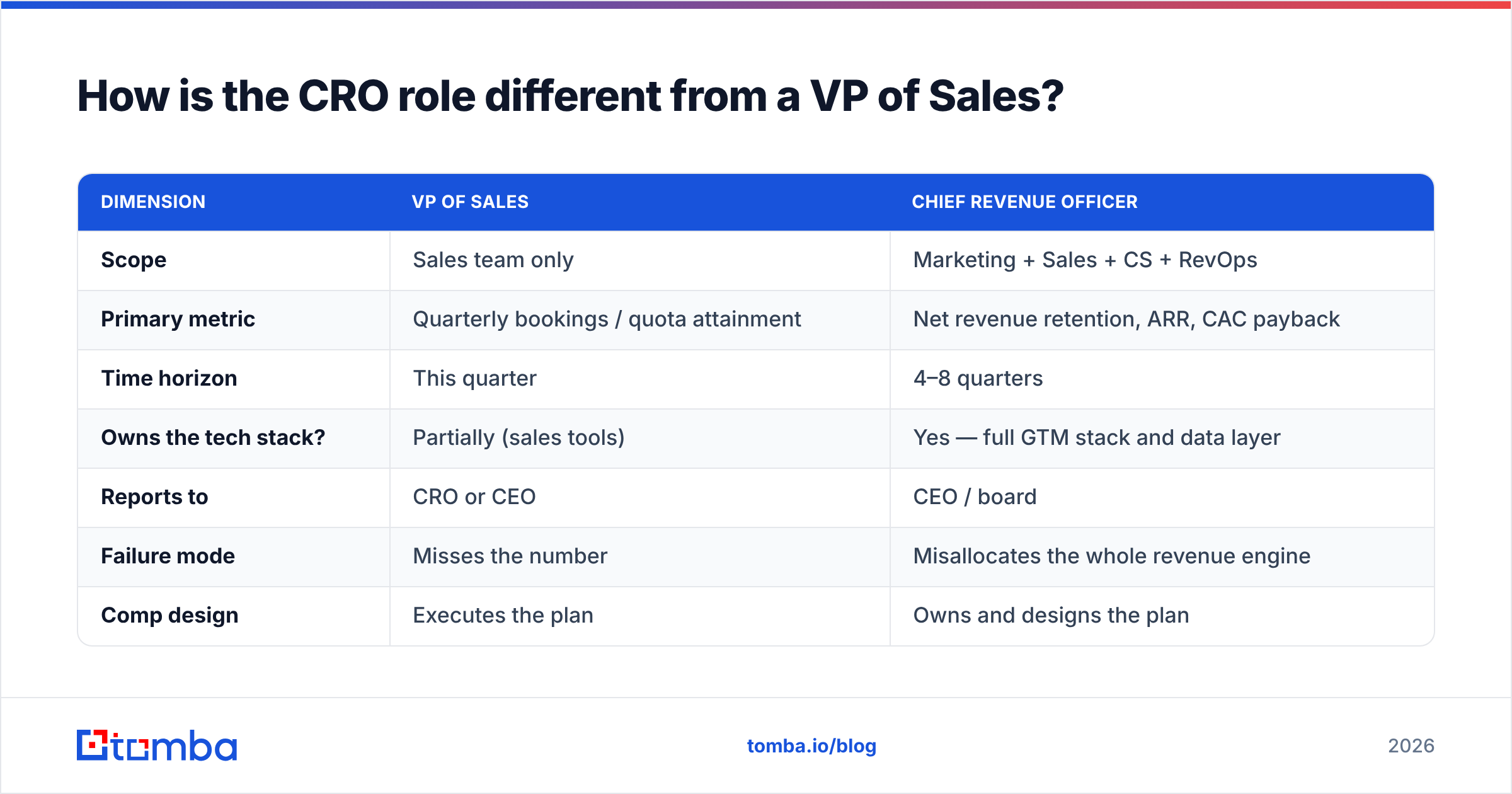
The two roles get conflated constantly, but the scope, time horizon, and metrics are genuinely different. A VP of Sales is measured this quarter on bookings. A CRO is measured this year on the health of the entire revenue system.
| Dimension | VP of Sales | Chief Revenue Officer |
|---|---|---|
| Scope | Sales team only | Marketing + Sales + CS + RevOps |
| Primary metric | Quarterly bookings / quota attainment | Net revenue retention, ARR, CAC payback |
| Time horizon | This quarter | 4–8 quarters |
| Owns the tech stack? | Partially (sales tools) | Yes — full GTM stack and data layer |
| Reports to | CRO or CEO | CEO / board |
| Failure mode | Misses the number | Misallocates the whole revenue engine |
| Comp design | Executes the plan | Owns and designs the plan |
The practical takeaway: if you're a VP of Sales eyeing the CRO seat, the gap you need to close isn't "sell bigger deals." It's learning marketing attribution, customer success economics, and the operations discipline that ties them together. The best CROs are systems thinkers first and closers second.
What metrics does a chief revenue officer own?#
A CRO lives and dies by a small set of numbers. If you can't recite these about your own business from memory, you're not ready for the seat.
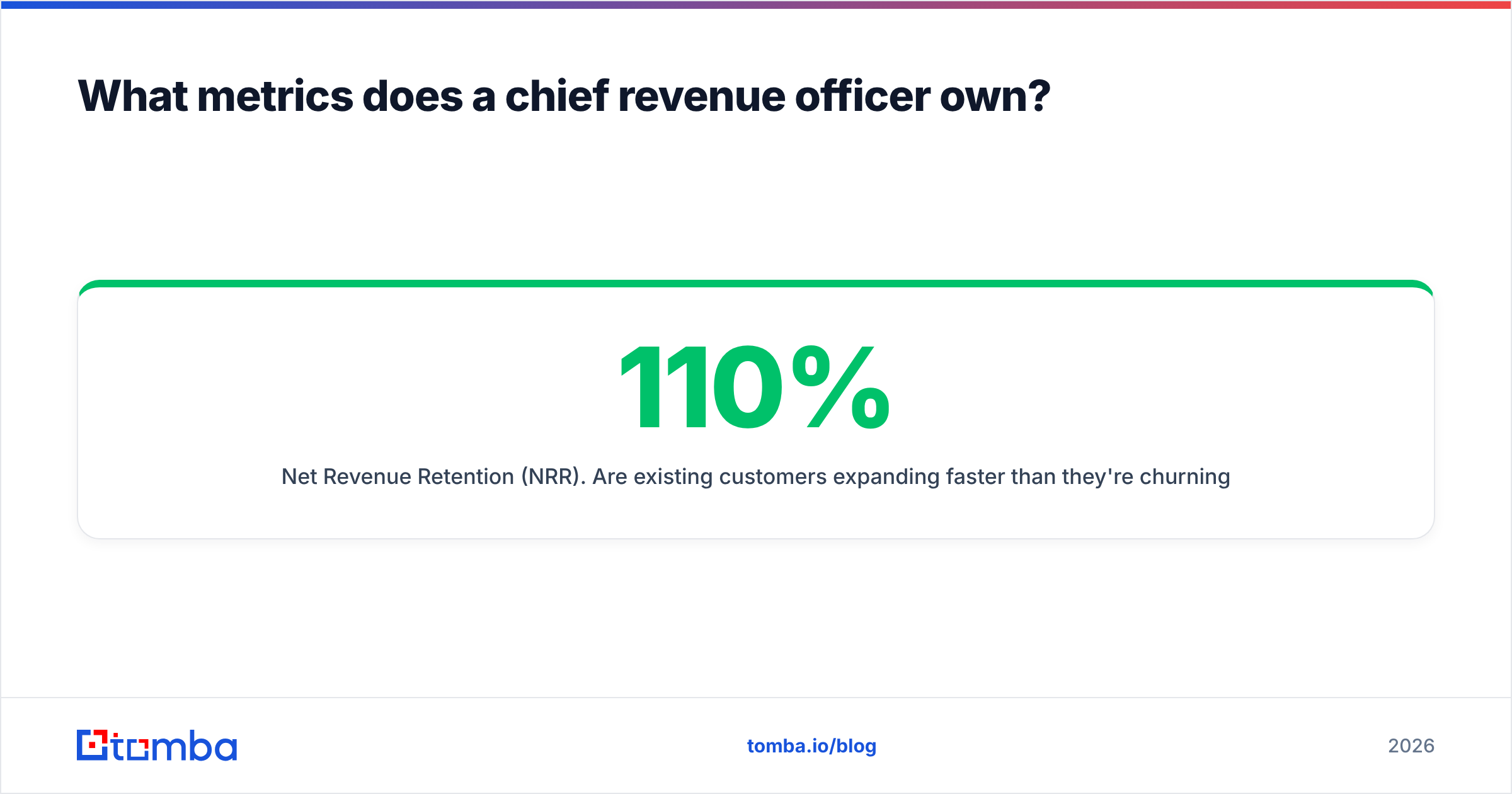
- Net Revenue Retention (NRR). Are existing customers expanding faster than they're churning? Above 110% is healthy for most B2B SaaS; below 100% means you're filling a leaking bucket.
- CAC Payback Period. How many months until a new customer pays back what you spent to acquire them? The shorter, the more efficiently you can grow.
- Pipeline Coverage. Do you have roughly 3–4x your quota in qualified pipeline? Less, and you're praying. More with low conversion, and your qualification is broken.
- Win Rate. Your sales win rate by segment and source tells you where to double down and where to stop spending.
- Forecast Accuracy. How close does the called number land to actual? Boards forgive a miss once; they don't forgive a CRO who can't see it coming.
The throughline: most of these metrics are only as trustworthy as the data feeding them. Pipeline coverage built on unverified contacts is fiction. NRR segmented by stale account data points you at the wrong expansion plays. Garbage in, wrong strategy out.
)
How should a CRO think about the 2026 tech stack?#
The mandate this year is consolidation with proof. The era of buying a new point tool for every problem is over — boards are asking CROs to justify ROI per platform, and "the team likes it" is not an answer.
Start by mapping your stack against the funnel and asking three questions of every tool: Does it move pipeline? Can I measure that? Would the number get worse if I cut it? Anything that fails all three is a candidate for the chopping block, and that freed budget goes to the data and intelligence layer where it compounds.
When you're evaluating tools, lean on independent review sources like G2 rather than vendor decks, and prioritize platforms that play well with your CRM and each other. A connected HubSpot integration or Salesforce integration that keeps your contact data verified and enriched inside the system of record beats a standalone tool that adds another export-import dance.
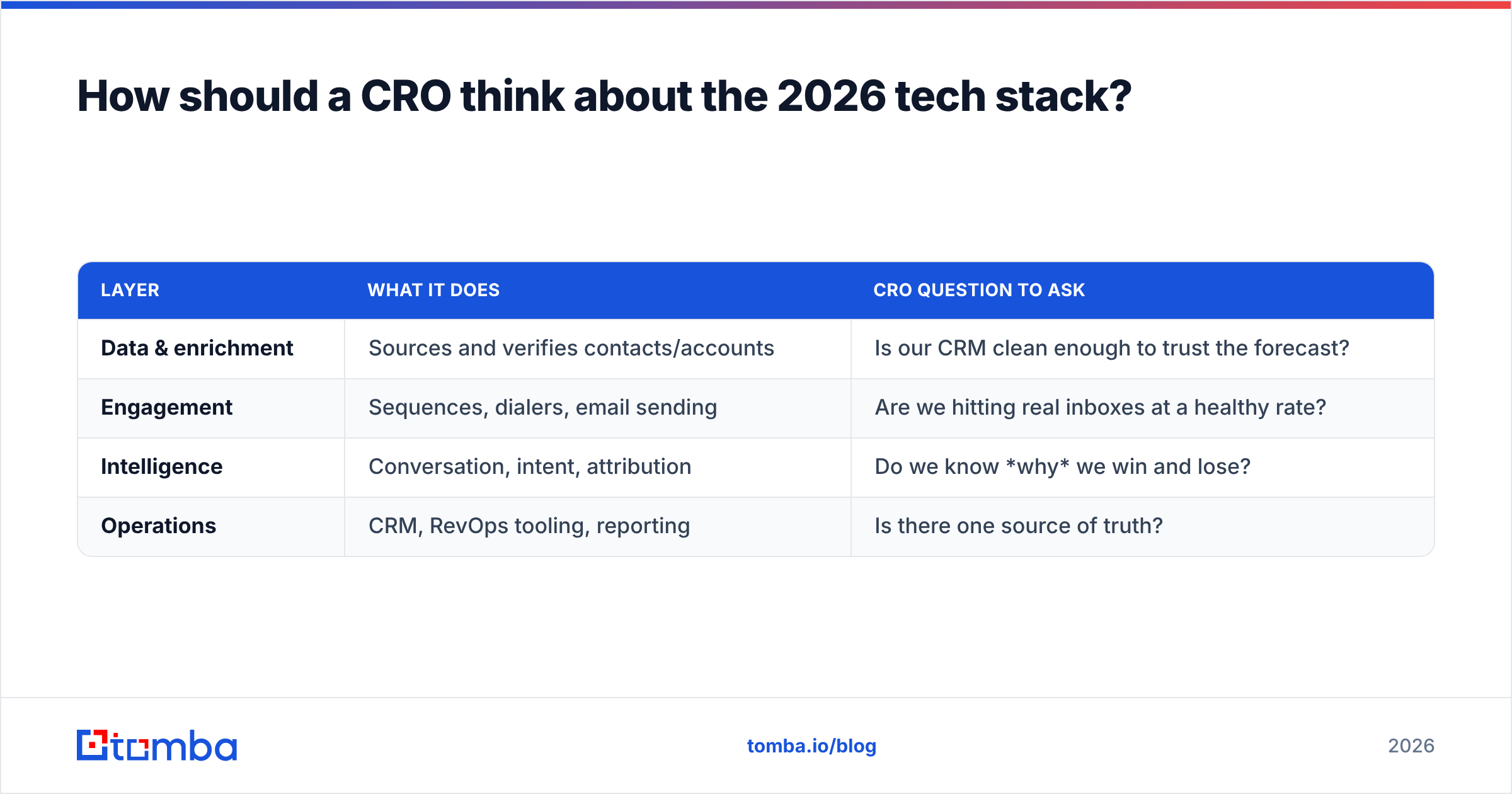
Here's a simple framework for grading the revenue stack:
| Layer | What it does | CRO question to ask |
|---|---|---|
| Data & enrichment | Sources and verifies contacts/accounts | Is our CRM clean enough to trust the forecast? |
| Engagement | Sequences, dialers, email sending | Are we hitting real inboxes at a healthy rate? |
| Intelligence | Conversation, intent, attribution | Do we know why we win and lose? |
| Operations | CRM, RevOps tooling, reporting | Is there one source of truth? |
If the bottom layer — data — is rotten, every dollar you spend on the layers above it is partially wasted. That's why the most disciplined CROs fund the foundation first.
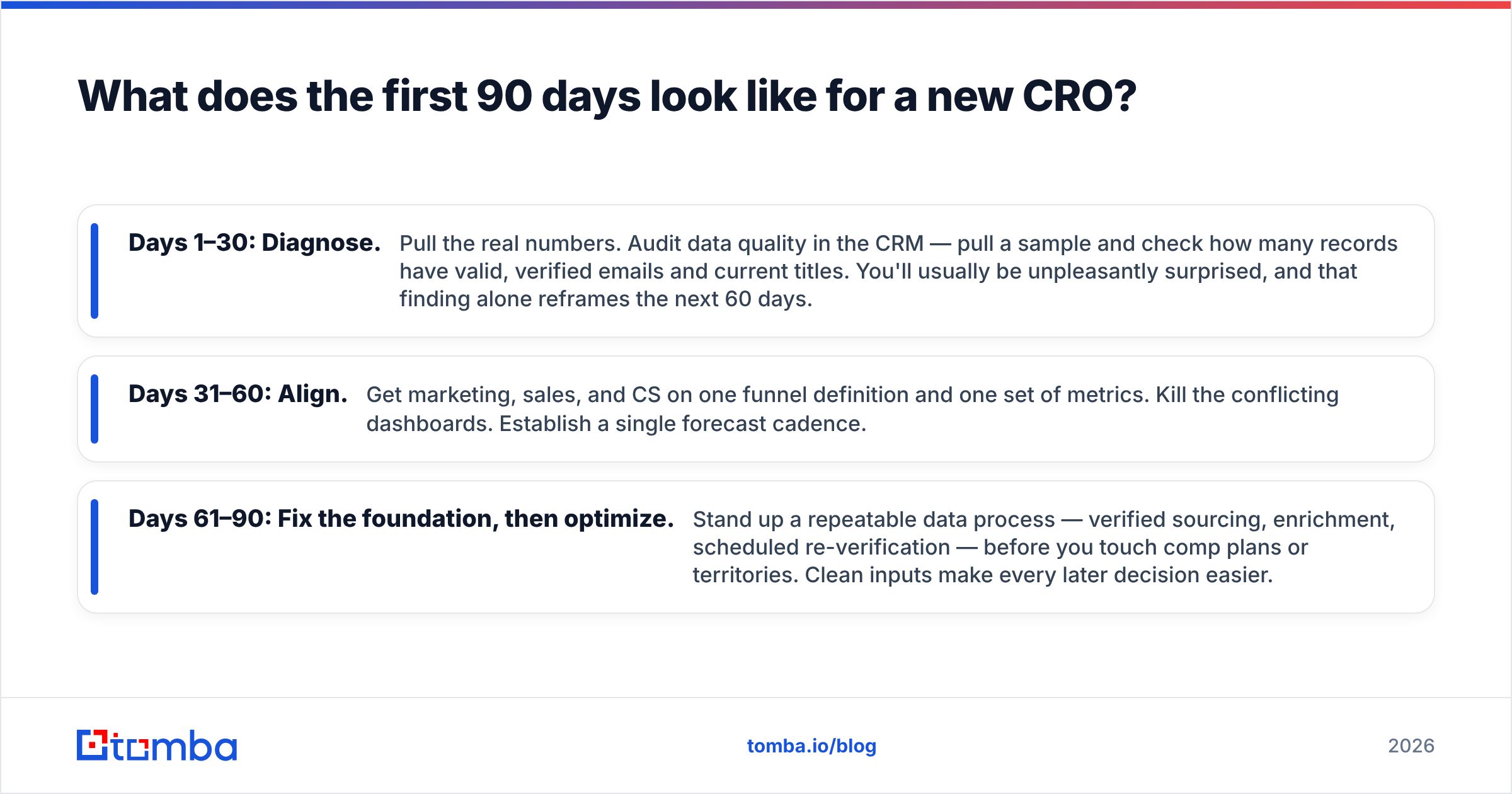
What does the first 90 days look like for a new CRO?#
If you're stepping into the role, resist the urge to ship a big reorg in week one. The pattern that works:
- Days 1–30: Diagnose. Pull the real numbers. Audit data quality in the CRM — pull a sample and check how many records have valid, verified emails and current titles. You'll usually be unpleasantly surprised, and that finding alone reframes the next 60 days.
- Days 31–60: Align. Get marketing, sales, and CS on one funnel definition and one set of metrics. Kill the conflicting dashboards. Establish a single forecast cadence.
- Days 61–90: Fix the foundation, then optimize. Stand up a repeatable data process — verified sourcing, enrichment, scheduled re-verification — before you touch comp plans or territories. Clean inputs make every later decision easier.
The new CROs who stumble almost always skip the data audit and jump straight to motivating the team. You can't motivate your way out of a broken data layer.
Is the CRO role worth the pressure?#
Honestly, it depends on your appetite for accountability. The CRO has the shortest average tenure in the C-suite for a reason: when revenue misses, the buck stops at one desk. But it's also the clearest path to CEO in revenue-driven companies, and the leaders who treat it as a systems problem — clean data, unified funnel, efficient growth, honest forecasts — tend to last and compound their results.
The ones who treat it as "VP of Sales with a fancier title" tend to get 18 months and a goodbye package.
Build your revenue engine on data you can trust#
Every priority on a CRO's 2026 list — accurate forecasting, efficient pipeline, unified funnel, smart tooling — rests on one foundation: knowing your contacts are real, current, and reachable. You can't optimize an engine running on bad fuel.
That's where Tomba's Email Finder earns its place in the revenue stack. Find verified professional emails by domain, name, or company, enrich them with the role and firmographic data your forecast depends on, and push clean records straight into your CRM through native integrations. It starts free with 25 searches a month, and paid plans begin at $49/mo on the Starter tier — a rounding error against the cost of a single rep chasing dead contacts. Check the full Tomba pricing and give your revenue team a foundation worth forecasting on.
// get started
Find, verify and enrich your first contacts today
Start on the free plan with 25 searches a month, then scale when your team is ready.
Free plan · No credit card required · GDPR & CCPA
// about the author