Cience Pricing, Reviews, Pros and Cons: 2026 Buyer's Guide
A neutral 2026 breakdown of Cience pricing, real customer reviews, and the honest pros and cons — plus when a self-serve data stack beats a managed SDR retainer.
Cience is one of the best-known names in outsourced outbound, but its pricing is quote-only and its reviews are genuinely split. If you are weighing a managed SDR retainer against building your own pipeline engine, you need the real numbers, the real complaints, and a clear sense of when each model wins.
TL;DR#
- Cience sells two things: managed lead-generation services (human SDRs running outbound for you) and the CIENCE GO software suite (data, ads, chat, orchestration). Pricing for both is custom and not published.
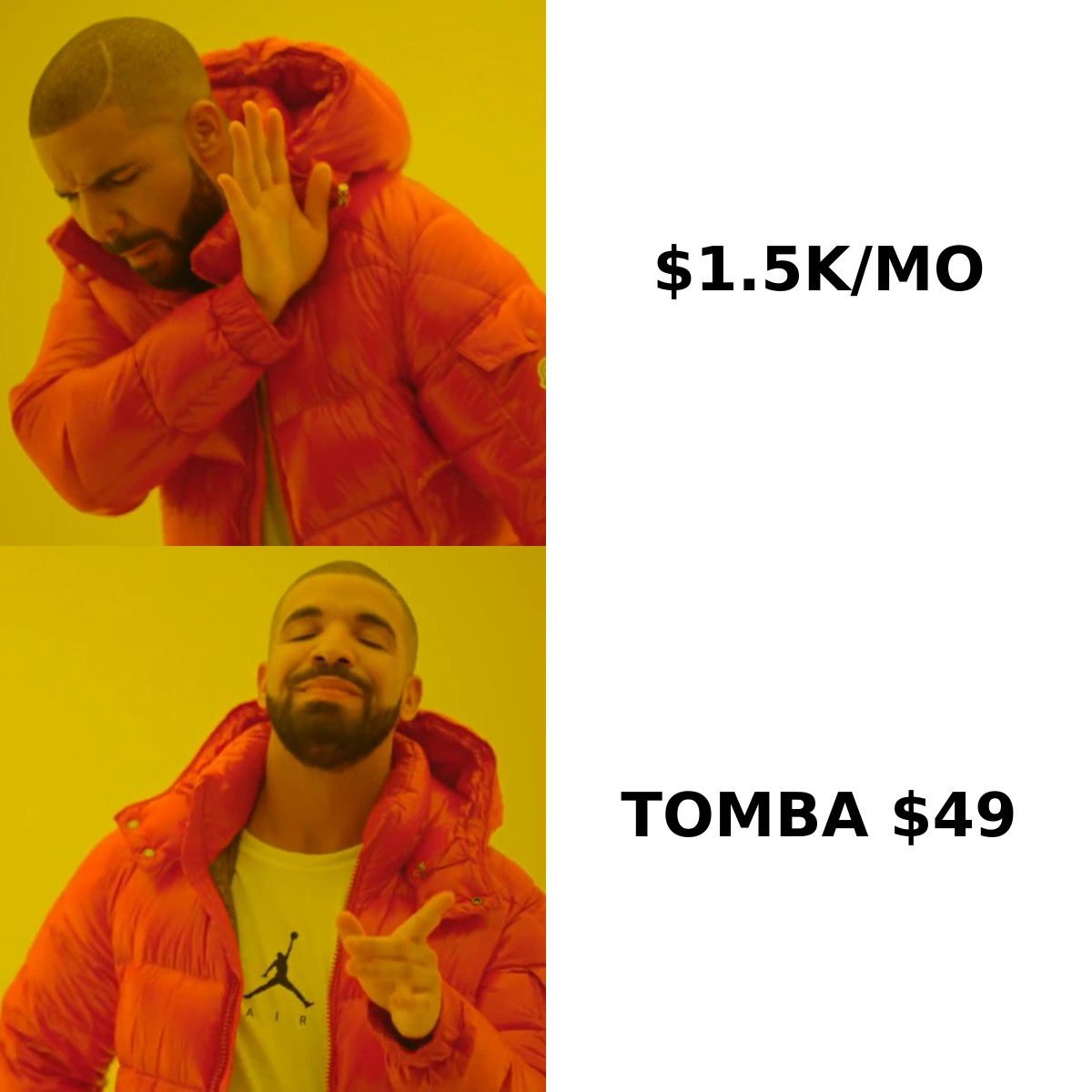
- Expect a real commitment. Managed programs are commonly reported in the low-to-mid four figures per month and up, usually on multi-month contracts — not a $49 tool you cancel anytime.
- Reviews are polarized. Buyers praise the done-for-you setup and US-based research teams; critics cite uneven lead quality, ramp time, and contract rigidity.
- The honest pros and cons come down to control and cost. You outsource effort and gain a team; you give up margin, data ownership, and fast iteration.
- The cheaper path for many teams in 2026 is a self-serve data stack — an email finder, a verifier, and an outreach tool — for a fraction of a managed retainer.
What is Cience and what do you actually pay for?#
Cience is a B2B lead generation company that combines human-run outbound services with a software platform. Founded in 2015, it built its reputation on "People-as-a-Service" — pods of researchers and sales development reps (SDRs) who build lists, write sequences, and book meetings on your behalf. Later it layered on the CIENCE GO product suite so customers could buy data and tooling directly.
When people search cience pricing reviews pros and cons, they are usually deciding between two very different purchases that happen to share a brand:
- Managed outbound (the services business). You hand over your ICP, and Cience staffs a team to run multichannel campaigns — email, calling, LinkedIn, and ads — feeding booked meetings into your calendar.
- CIENCE GO (the software business). A self-serve set of modules: GO Data (contact records), GO Digital (account-based ads), GO Show (website visitor identification), GO Chat, and GO Flow for orchestration.
The two models have completely different cost structures, so treat them separately when you evaluate. Managed services are priced like an agency retainer; the software is priced like a SaaS subscription. Neither number is on the public pricing page — both require a sales call and a quote.
How much does Cience cost in 2026?#
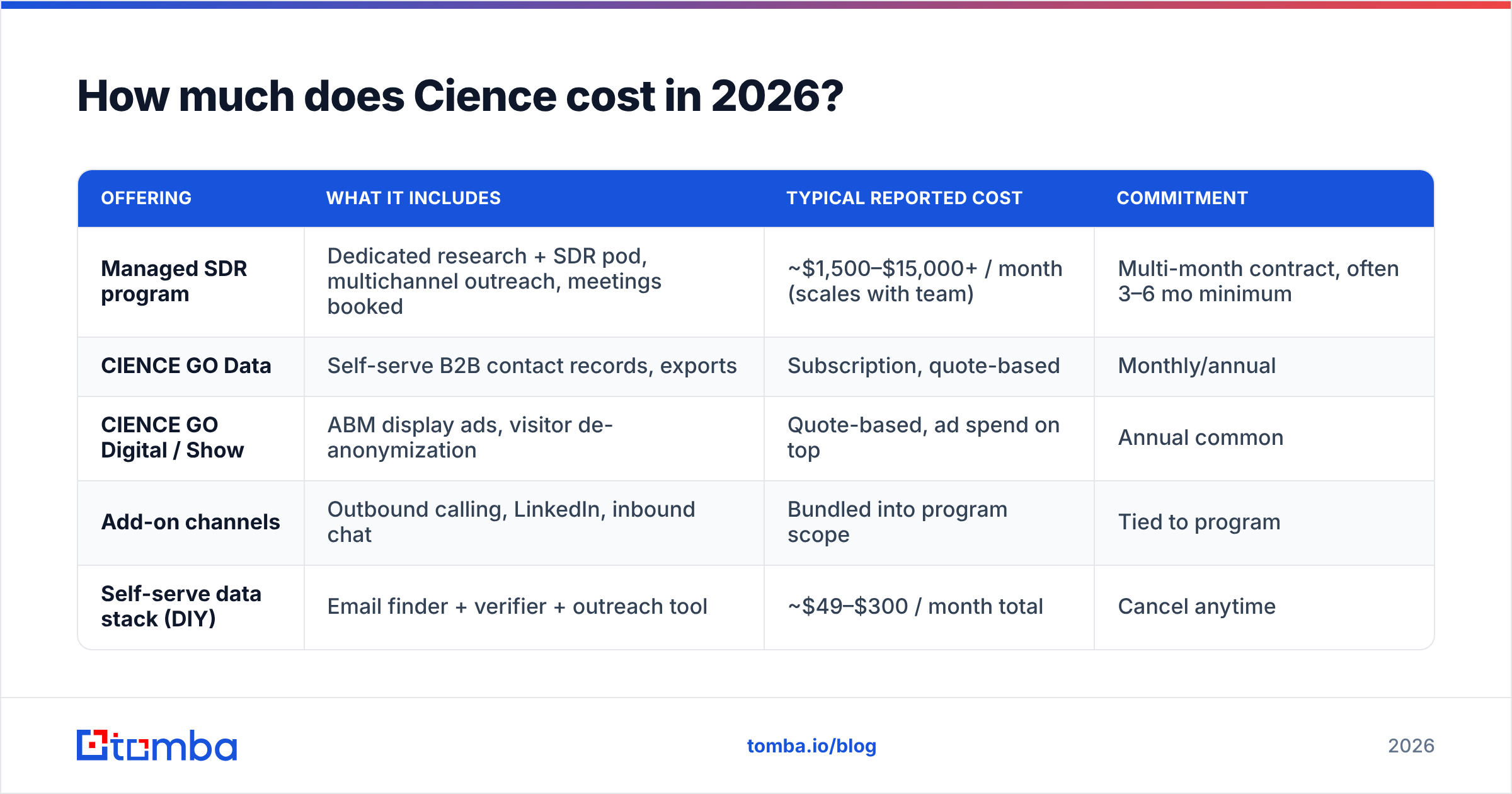
There is no public price list — Cience pricing is quote-based, and what you pay depends on team size, channels, and contract length. Because the company does not publish rates, the figures below are ranges commonly reported by buyers and third-party review sites, not official numbers. Always confirm directly.
| Offering | What it includes | Typical reported cost | Commitment |
|---|---|---|---|
| Managed SDR program | Dedicated research + SDR pod, multichannel outreach, meetings booked | ~$1,500–$15,000+ / month (scales with team) | Multi-month contract, often 3–6 mo minimum |
| CIENCE GO Data | Self-serve B2B contact records, exports | Subscription, quote-based | Monthly/annual |
| CIENCE GO Digital / Show | ABM display ads, visitor de-anonymization | Quote-based, ad spend on top | Annual common |
| Add-on channels | Outbound calling, LinkedIn, inbound chat | Bundled into program scope | Tied to program |
| Self-serve data stack (DIY) | Email finder + verifier + outreach tool | ~$49–$300 / month total | Cancel anytime |
The headline takeaway: a managed program is a people cost, not a software cost. You are paying salaries, management, tooling, and margin. That is why even a modest pod lands in the four-figure-per-month range, and why ROI hinges entirely on how many qualified meetings the team books.
If your goal is simply to find and verify contact data and run outreach yourself, you are buying a far smaller thing — and you can see exactly what that costs on the Tomba pricing page, where the Starter plan is $49/mo and a free tier covers 25 searches a month.
What do Cience reviews actually say?#
Cience holds solid aggregate ratings, but the reviews split sharply between "great team, real meetings" and "slow ramp, inconsistent leads." On platforms like G2 and Clutch, the recurring themes are consistent enough to summarize fairly.
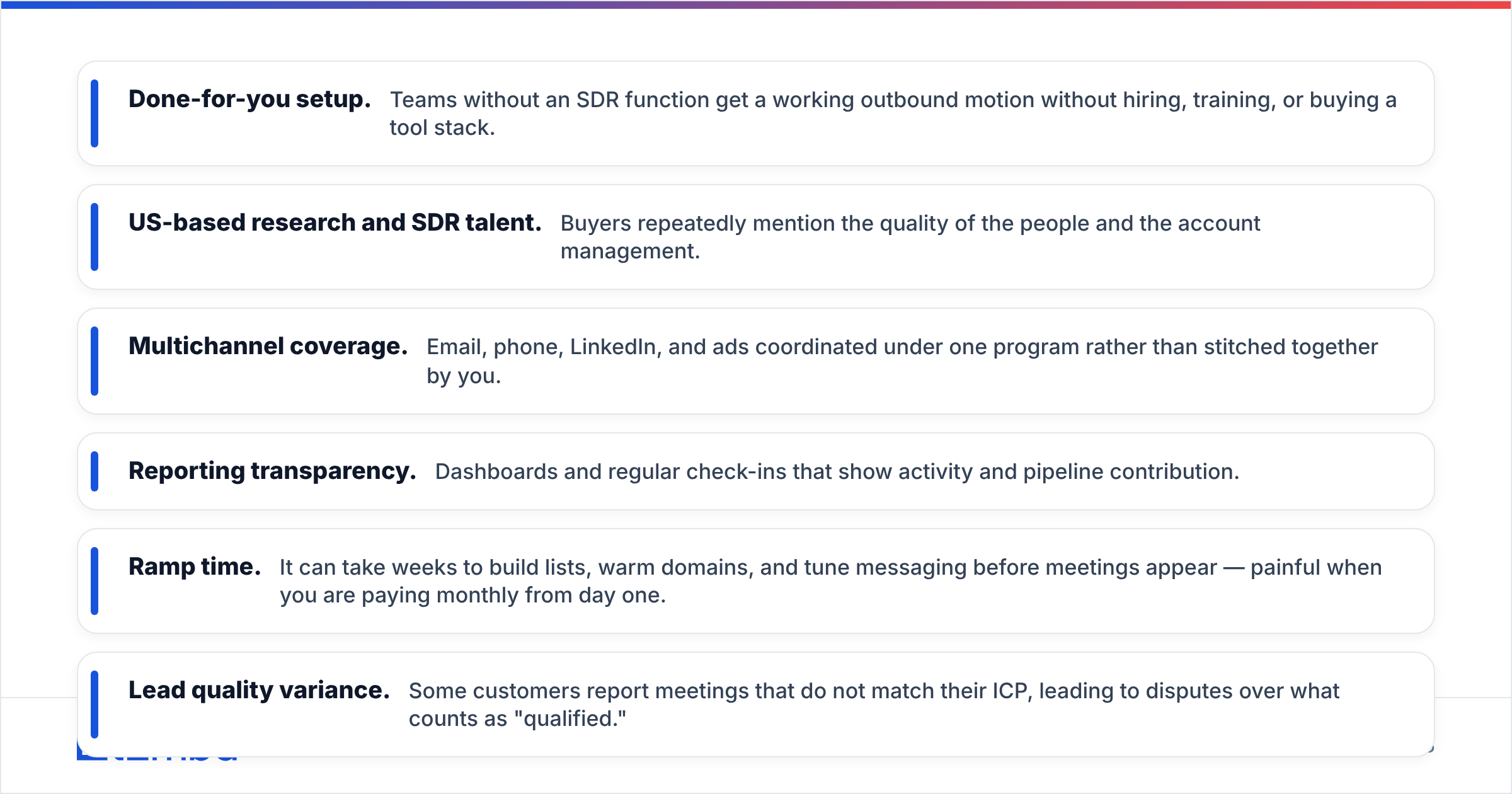
What reviewers praise:
- Done-for-you setup. Teams without an SDR function get a working outbound motion without hiring, training, or buying a tool stack.
- US-based research and SDR talent. Buyers repeatedly mention the quality of the people and the account management.
- Multichannel coverage. Email, phone, LinkedIn, and ads coordinated under one program rather than stitched together by you.
- Reporting transparency. Dashboards and regular check-ins that show activity and pipeline contribution.
What reviewers criticize:
- Ramp time. It can take weeks to build lists, warm domains, and tune messaging before meetings appear — painful when you are paying monthly from day one.
- Lead quality variance. Some customers report meetings that do not match their ICP, leading to disputes over what counts as "qualified."
- Contract rigidity. Minimum terms and notice periods make it hard to exit fast if results lag.
- Data ownership questions. When the agency owns the tooling and lists, offboarding can leave you without the assets you paid to build.
None of this makes Cience a bad vendor — managed outbound is genuinely hard, and these are the standard trade-offs of the model. But the reviews make one thing clear: success depends heavily on a tight ICP, realistic ramp expectations, and disciplined definition of a "qualified" meeting before you sign.
What are the pros and cons of Cience?#
Here is the balanced version, stripped of marketing on either side.
Pros
- Speed to a team, not speed to results. You skip recruiting and onboarding an internal SDR function — valuable if you have budget but no bandwidth.
- Full-stack outbound under one roof. Data, copy, sending infrastructure, calling, and ABM ads are coordinated rather than DIY-assembled.
- Human research. Real people verifying fit on target accounts can outperform pure automation on complex, high-ACV segments.
- Managed deliverability. The agency handles domain warmup, sending reputation, and rotation so you do not learn it the hard way.
Cons
- High fixed cost with delayed payback. You pay full freight during ramp, before pipeline materializes.
- Less control and slower iteration. Changing messaging or targeting goes through an account manager, not a slider you move yourself.
- Margin stacked on commodity data. Much of what you pay for is contact data you could source directly at a fraction of the cost.
- Lock-in and offboarding risk. Contracts, owned tooling, and lists can make leaving expensive.

Is a managed retainer better than a self-serve data stack?#
It depends on whether your constraint is people or budget — managed services solve a staffing problem, while a self-serve stack solves a cost-and-control problem. Most teams that feel burned by an agency were actually a fit for the opposite model, and vice versa.
Choose managed (Cience-style) when:
- You have budget but no SDRs and need pipeline this quarter.
- Your motion is complex, high-ACV, and benefits from human research.
- You want one vendor accountable for the whole funnel.
Choose self-serve when:
- You already have a rep or founder who can send outreach.
- You want to own your data, lists, and learnings.
- You need to keep customer-acquisition cost low and iterate weekly.
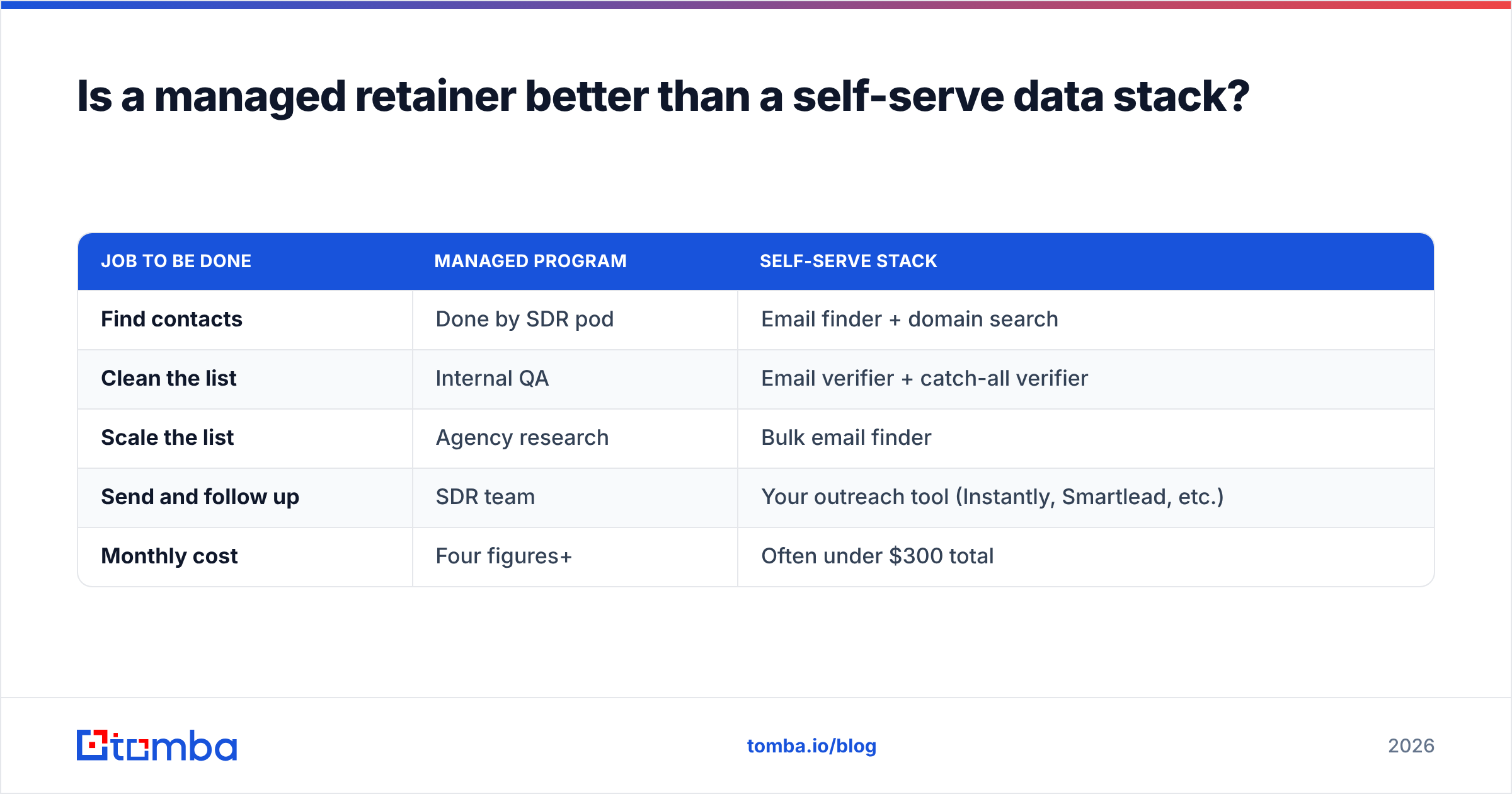
For the self-serve path, the building blocks are simple and cheap. You need accurate contact discovery, verification to protect deliverability, and an outreach tool. A typical stack looks like this:
| Job to be done | Managed program | Self-serve stack |
|---|---|---|
| Find contacts | Done by SDR pod | Email finder + domain search |
| Clean the list | Internal QA | Email verifier + catch-all verifier |
| Scale the list | Agency research | Bulk email finder |
| Send and follow up | SDR team | Your outreach tool (Instantly, Smartlead, etc.) |
| Monthly cost | Four figures+ | Often under $300 total |
The self-serve route shifts the work onto your team, but it also removes the agency margin and gives you assets you keep forever. For many SMB and mid-market teams in 2026, that trade is worth it — especially once a founder or first rep has proven the message.
How does Cience compare to other lead-gen options?#
Cience competes in two adjacent markets at once, which makes a clean comparison tricky. Against other managed providers (Belkins, Martal, CIENCE-style agencies), the differentiators are pod quality, channel breadth, and contract terms. Against software, it competes with data and outreach platforms where you do the driving.
If you are early in research, it helps to compare Cience against the broad category of sales-acceleration tools rather than a single rival. Apollo, for example, bundles data and sequencing in a self-serve product, and many buyers cross-shop it — you can see that side of the market in our Apollo alternative breakdown. The relevant question is always the same: are you buying people who do outbound or tools that let you do outbound?
A quick decision filter:
- Need meetings, have budget, no team → managed (Cience or a peer agency).
- Need data and control, have a sender → self-serve stack (finder + verifier + outreach).
- Need a quality contact database without the retainer → data-first tools you run yourself.
How do you protect ROI if you do hire Cience?#
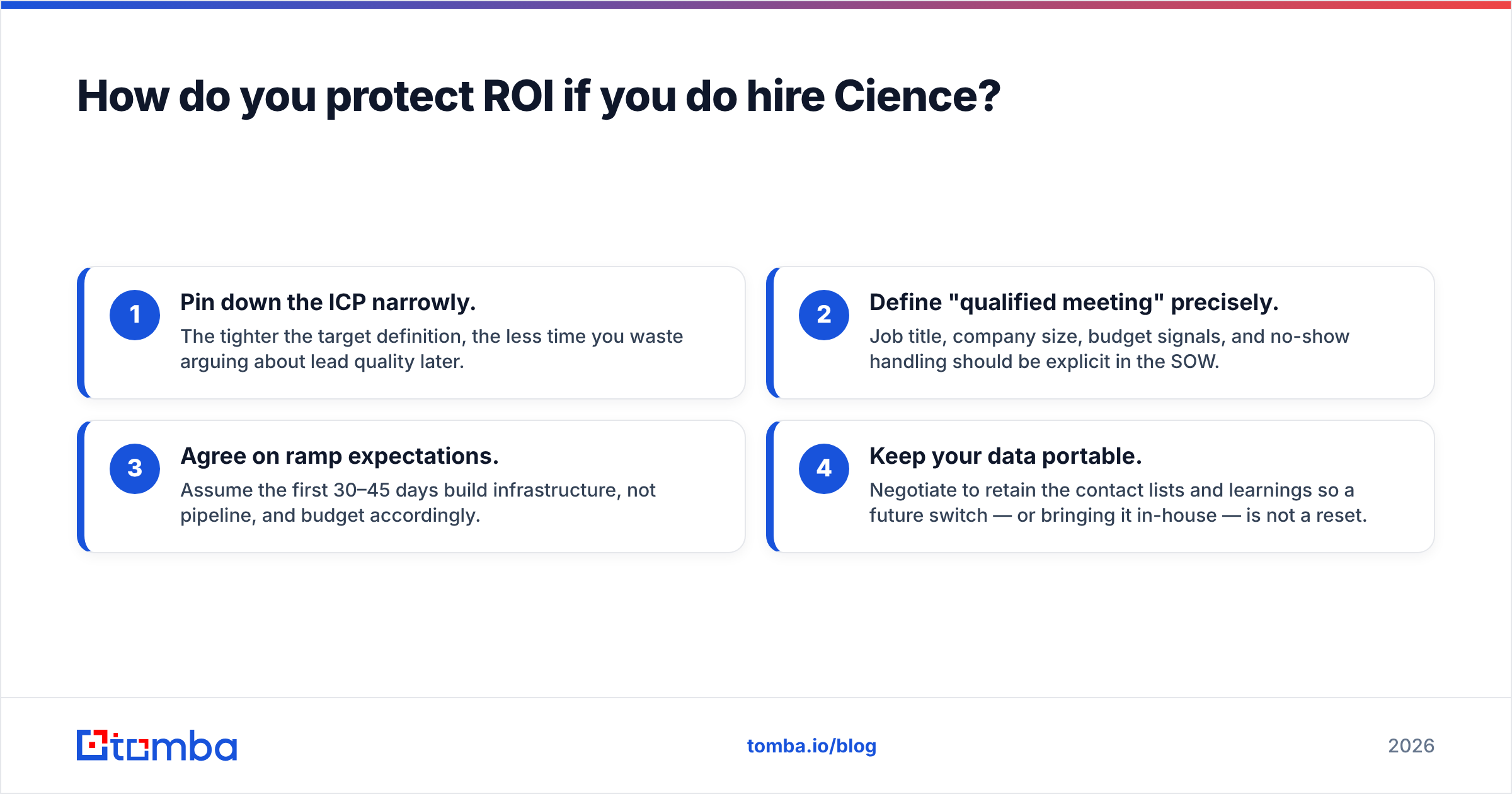
Treat the engagement like a hire, not a subscription — define success in writing before the contract starts. The buyers who report the best experiences tend to do four things:
- Pin down the ICP narrowly. The tighter the target definition, the less time you waste arguing about lead quality later.
- Define "qualified meeting" precisely. Job title, company size, budget signals, and no-show handling should be explicit in the SOW.
- Agree on ramp expectations. Assume the first 30–45 days build infrastructure, not pipeline, and budget accordingly.
- Keep your data portable. Negotiate to retain the contact lists and learnings so a future switch — or bringing it in-house — is not a reset.
Even inside a managed engagement, an independent verification layer is smart. Running booked-contact lists through your own email verification catches deliverability risks before they burn your sending reputation, and gives you a neutral quality check on the data you are paying for. For the broader deliverability picture, the basics of sender reputation apply whether a vendor or your own team is doing the sending.
So is Cience worth it in 2026?#
Cience is worth it if your bottleneck is people and time — not if your bottleneck is budget or control. The pricing is real-money agency pricing, the reviews are good-not-flawless, and the pros and cons map cleanly onto the classic build-vs-buy decision. If you need a working outbound motion fast and can absorb the ramp, a managed program removes a lot of operational pain. If you have someone who can send and you mainly need accurate, verified contact data, you will almost always come out ahead — financially and strategically — running it yourself.
That second path is where most teams start. Find the right people at your target accounts, verify before you send, and scale only what works. The cheapest, fastest way to test that motion is to skip the retainer and start with the data layer. Try the Tomba Email Finder free — 25 searches a month at no cost, $49/mo when you scale — and keep every contact, list, and lesson you build. If managed outbound still makes sense after you have proven the message, you will negotiate that contract from a far stronger position.
// get started
Find, verify and enrich your first contacts today
Start on the free plan with 25 searches a month, then scale when your team is ready.
Free plan · No credit card required · GDPR & CCPA
Get the Tomba newsletter
Product and data updates
// about the author