Cikisi Pricing, Reviews, Pros and Cons: A 2026 Buyer's Guide
A neutral 2026 breakdown of Cikisi's pricing model, real user reviews, and the honest pros and cons — plus how to pair media monitoring with clean contact data.
If you are evaluating Cikisi for media monitoring or competitive intelligence, you want the same three things every buyer wants: what it costs, whether real users like it, and where it falls short. This guide on cikisi pricing reviews pros and cons gives you a neutral, no-spin read so you can decide if it fits your stack in 2026.
TL;DR#
- Cikisi is a media-monitoring and competitive-intelligence platform built around AI-driven web scraping, news aggregation, and content curation — not a contact-data tool.
- Pricing is quote-based, not published as fixed tiers, so expect a sales call and a custom proposal rather than a self-serve checkout.
- Pros: broad source coverage, AI summarization, multilingual monitoring, and white-label newsletters.
- Cons: opaque pricing, a learning curve, and limited public review volume compared with bigger rivals.
- Pair it wisely: Cikisi tells you what the market is saying; you still need a tool like a email finder to reach the people behind those signals.
What is Cikisi and who is it for?#
Cikisi is a Belgium-based SaaS platform for media monitoring, competitive intelligence, and content curation. Think of it as a tireless research assistant that reads thousands of news sites, blogs, forums, and social feeds around the clock, then hands you a tidy digest of what matters.
The platform leans on AI to crawl the open web, cluster duplicate stories, summarize articles, and surface trends. Teams use it to track brand mentions, watch competitors, monitor regulatory changes, and build curated newsletters for internal or client audiences.
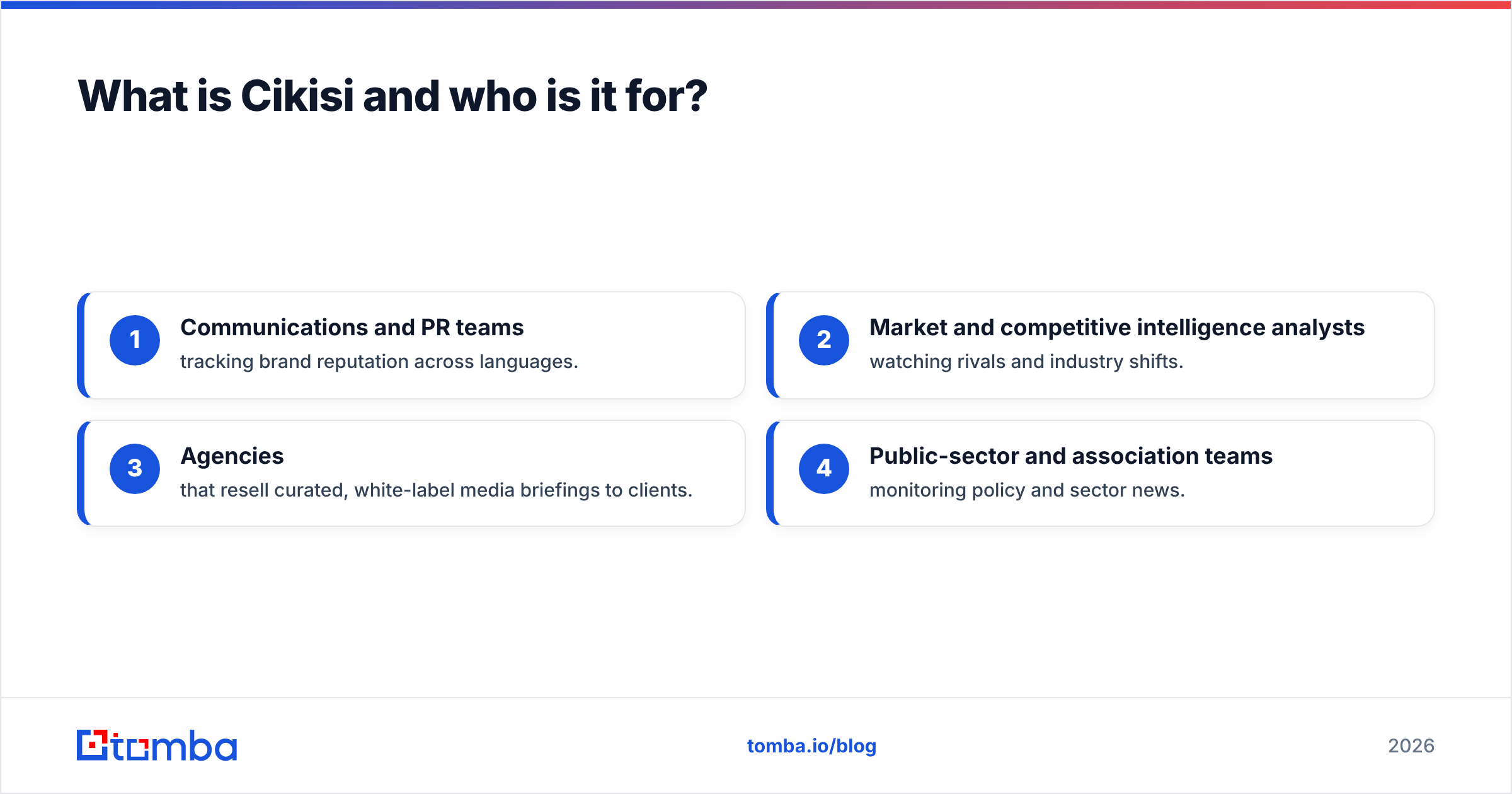
Typical buyers include:
- Communications and PR teams tracking brand reputation across languages.
- Market and competitive intelligence analysts watching rivals and industry shifts.
- Agencies that resell curated, white-label media briefings to clients.
- Public-sector and association teams monitoring policy and sector news.
If your job is to understand the conversation, Cikisi is in the right category. If your job is to act on it — reach out, sell, recruit, or enrich a CRM — you will need complementary tooling, which we cover later.
How does Cikisi pricing work in 2026?#
Cikisi does not publish fixed, self-serve pricing. Like most enterprise media-intelligence vendors, it uses a quote-based model: you book a demo, describe your sources, languages, user seats, and volume, and the team returns a custom proposal. That is standard for this category, but it has real consequences for buyers.
Because monitoring tools scale on factors like number of monitored topics, source breadth, refresh frequency, user seats, and add-ons (newsletters, API access, exports), two companies can pay very different amounts for the "same" product. Always get the proposal itemized.
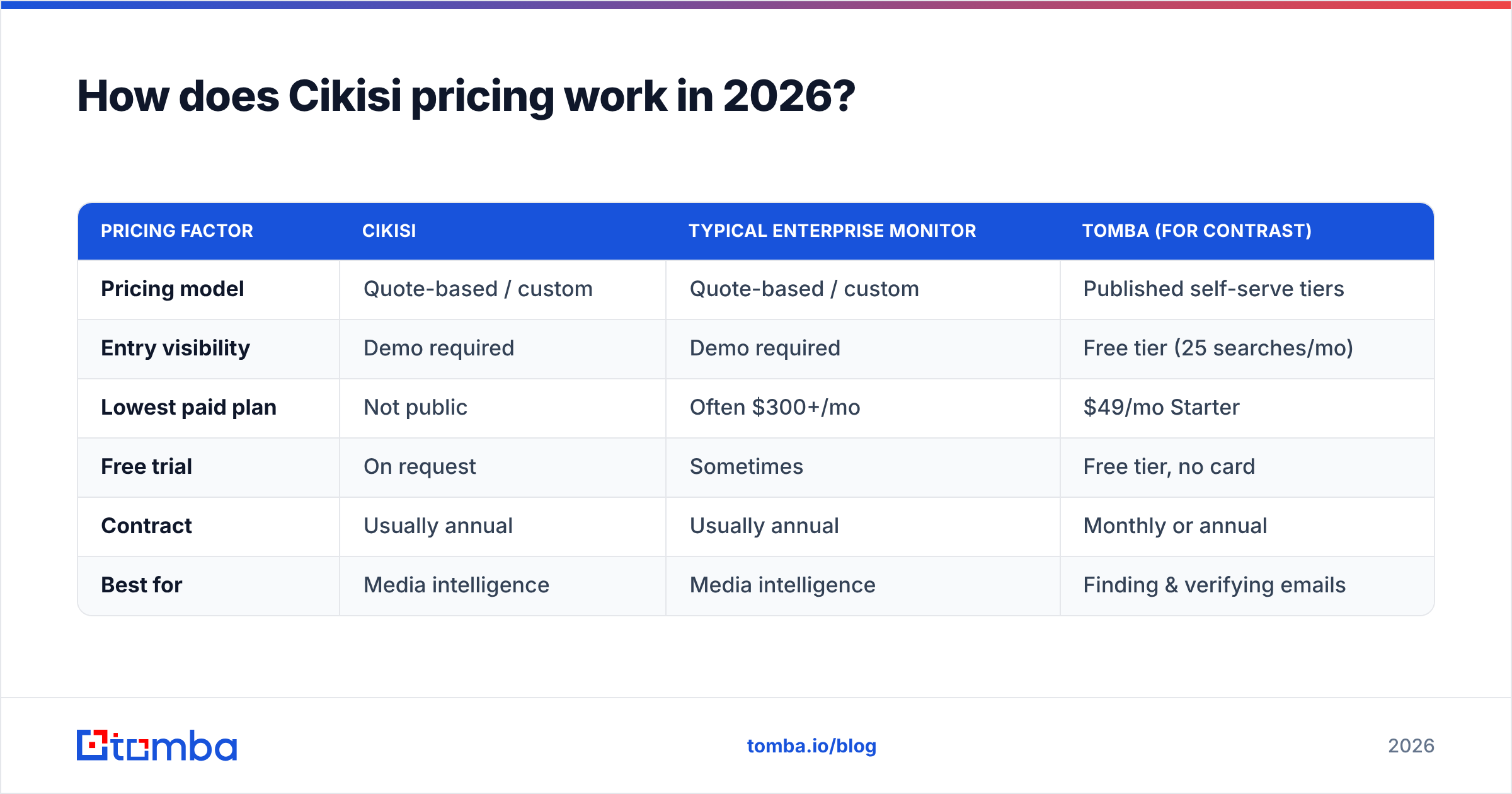
Here is how Cikisi's pricing approach compares with the patterns you see across the media-monitoring market and with a transparent, published-price tool like Tomba in an adjacent category.
| Pricing factor | Cikisi | Typical enterprise monitor | Tomba (for contrast) |
|---|---|---|---|
| Pricing model | Quote-based / custom | Quote-based / custom | Published self-serve tiers |
| Entry visibility | Demo required | Demo required | Free tier (25 searches/mo) |
| Lowest paid plan | Not public | Often $300+/mo | $49/mo Starter |
| Free trial | On request | Sometimes | Free tier, no card |
| Contract | Usually annual | Usually annual | Monthly or annual |
| Best for | Media intelligence | Media intelligence | Finding & verifying emails |
)
A quick reality check: quote-based pricing is not a red flag by itself — it is how most serious monitoring platforms operate, because needs vary so widely. The friction is in budgeting and procurement, not in product quality. If you need a number before a sales call, ask explicitly for a starting price and a sample tier during your demo. For comparison, you can see what fully transparent pricing looks like on the Tomba pricing page.
What do Cikisi reviews say?#
Public review volume for Cikisi is thinner than for mega-vendors like Meltwater or Brandwatch, so weigh each data point carefully and read recent entries first. On directories such as G2 and Capterra, the themes that recur in media-monitoring reviews — and in Cikisi's own positioning — break down like this:
- Praised: breadth of sources, quality of AI summaries, responsiveness of the support team, and the white-label newsletter feature.
- Criticized: onboarding learning curve, occasional false positives in mention matching, and the usual frustration with quote-only pricing.
Because the sample size is smaller, do two things before you trust the average star rating. First, ask the vendor for two or three reference customers in your industry and language footprint. Second, run a paid pilot on your real topics rather than a canned demo — monitoring quality is highly dependent on your specific sources and keywords.
When you read any monitoring review, separate coverage complaints (missed a source) from relevance complaints (too much noise). Coverage is usually fixable with configuration; relevance tuning tells you how much ongoing analyst time the tool will demand.
What are the pros and cons of Cikisi?#
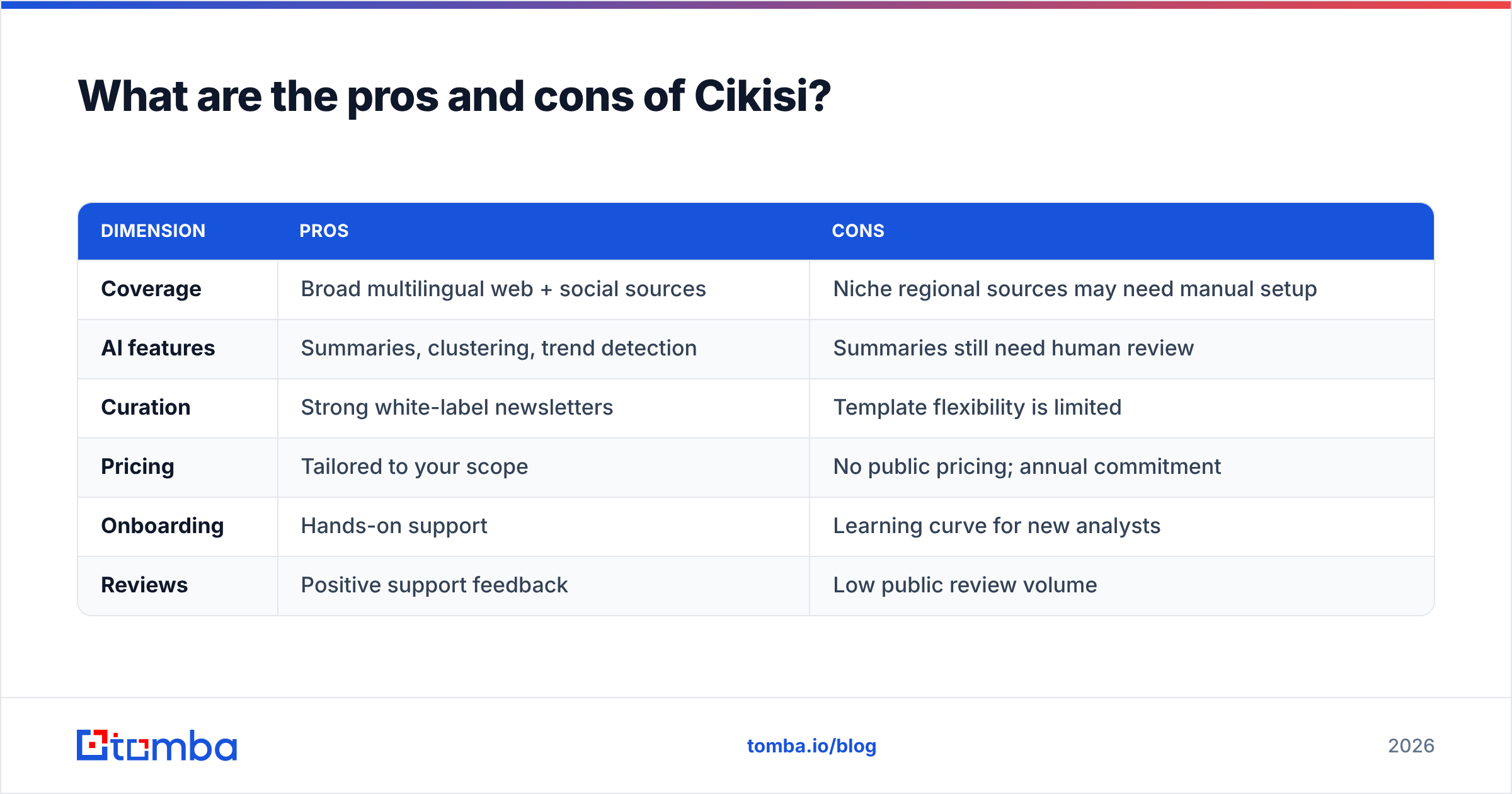
Here is the honest ledger. No tool wins on every axis, and the right call depends on whether monitoring is core to your work or a nice-to-have.
| Dimension | Pros | Cons |
|---|---|---|
| Coverage | Broad multilingual web + social sources | Niche regional sources may need manual setup |
| AI features | Summaries, clustering, trend detection | Summaries still need human review |
| Curation | Strong white-label newsletters | Template flexibility is limited |
| Pricing | Tailored to your scope | No public pricing; annual commitment |
| Onboarding | Hands-on support | Learning curve for new analysts |
| Reviews | Positive support feedback | Low public review volume |
The pros, in plain terms#
- Time saved on reading. The AI digest replaces hours of manual scanning. That is the core value, and Cikisi does it well.
- Multilingual reach. Strong for European and multi-market teams that cannot rely on English-only tools.
- Client-ready output. The newsletter and curation features let agencies package intelligence without extra design work.
The cons, in plain terms#
- Budgeting friction. No public price means slower procurement and harder internal sign-off.
- Noise management. Like all monitoring tools, it needs tuning; expect to invest analyst hours early on.
- Thin social proof. Fewer public reviews means you must do more first-party diligence.
)
How does Cikisi compare to alternatives?#
Cikisi competes in a crowded media-intelligence space. The big incumbents — Meltwater, Brandwatch, Mention, and Talkwalker — offer larger ecosystems but often at higher prices and with heavier sales processes. Cikisi's pitch is a more focused, AI-first, European-friendly alternative.
When you shortlist, score each option on five concrete attributes rather than brand recognition:
- Source coverage in your exact languages and regions.
- Relevance accuracy — how much noise reaches your inbox after tuning.
- Curation and delivery — newsletters, dashboards, API, exports.
- Total cost including seats, add-ons, and overage.
- Support and onboarding quality during your pilot.
A practical rule: shortlist no more than three tools, run identical topics through each for two weeks, and compare the signal-to-noise ratio side by side. The cheapest tool that produces clean, relevant alerts almost always beats a feature-rich tool that buries you in false positives.
Where does Cikisi fit in a go-to-market stack?#
Cikisi answers "what is being said"; it does not answer "who do I contact and how." That gap is the most important thing to understand before you buy, because monitoring without action is just expensive reading.
A monitoring signal — a competitor's funding round, a prospect's product launch, a journalist covering your space — is only valuable if you can route it to a person and reach them. That is where contact-data tooling closes the loop:
- Cikisi surfaces a company making news. You then run a domain search to find the right people at that company.
- You capture a decision-maker's name from an article and need their address — an email finder resolves it.
- Before you send, you protect your sender reputation by running addresses through an email verifier.
- For ongoing campaigns, you keep records current with data enrichment so your CRM reflects reality, not last quarter.
Think of it like a weather station and a delivery fleet. Cikisi is the station that tells you a storm of opportunity is forming. The contact-data layer is the fleet that actually gets your message to the right doorstep before the window closes.
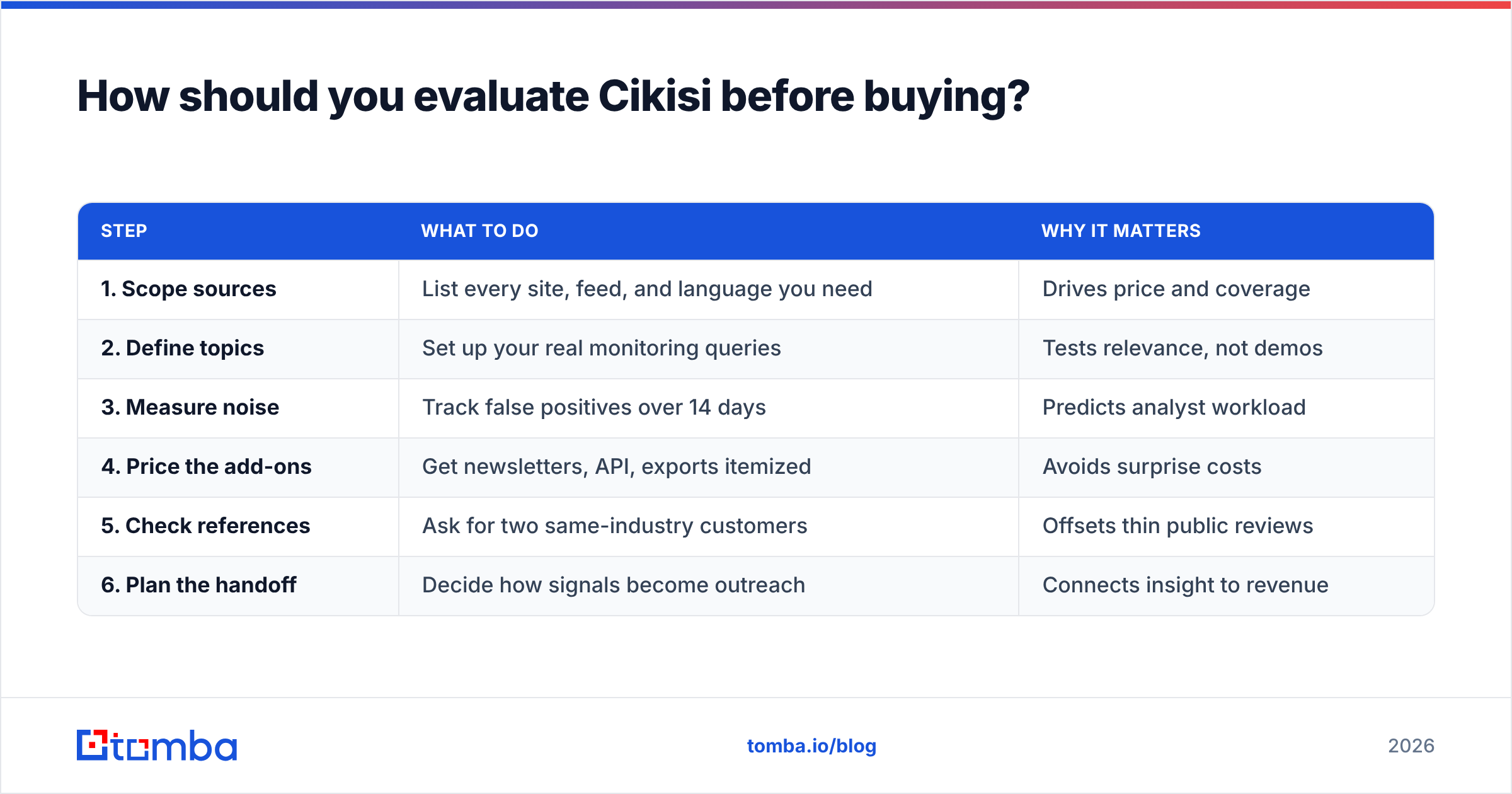
How should you evaluate Cikisi before buying?#
Run this checklist during your trial so you do not over-pay or under-scope:
| Step | What to do | Why it matters |
|---|---|---|
| 1. Scope sources | List every site, feed, and language you need | Drives price and coverage |
| 2. Define topics | Set up your real monitoring queries | Tests relevance, not demos |
| 3. Measure noise | Track false positives over 14 days | Predicts analyst workload |
| 4. Price the add-ons | Get newsletters, API, exports itemized | Avoids surprise costs |
| 5. Check references | Ask for two same-industry customers | Offsets thin public reviews |
| 6. Plan the handoff | Decide how signals become outreach | Connects insight to revenue |
If you complete all six, you will know whether Cikisi's quote justifies its value for your team — and you will have a plan to turn its intelligence into pipeline rather than into a read-only dashboard.
Frequently asked questions#
Is Cikisi expensive? It is positioned as a mid-market to enterprise tool, and because pricing is custom, "expensive" depends on your scope. Smaller teams may find published-price competitors easier to budget, while larger teams often value the tailored proposal.
Does Cikisi replace a CRM or an email finder? No. It is a monitoring and curation tool. You still need separate systems for outreach, contact data, and pipeline management.
Are the reviews trustworthy? The positive feedback on support and AI summaries is consistent, but the public sample is small. Treat reviews as a starting point and validate with a paid pilot and references.
Can I monitor in multiple languages? Yes — multilingual coverage is one of Cikisi's stronger points, which matters for European and multi-market teams.
The bottom line#
Cikisi is a capable, AI-first media-monitoring platform with genuine strengths in source breadth, multilingual coverage, and client-ready curation. The main trade-offs are opaque, quote-based pricing and a thinner public review record — both manageable if you scope carefully and run a real pilot. On the question of cikisi pricing reviews pros and cons, the honest answer is: strong product, do your procurement homework, and plan the handoff to action before you sign.
And that handoff is where most teams leave value on the table. Monitoring tells you the moment; you still have to reach the person. Tomba's email finder turns the companies and names you discover into verified, deliverable contacts in seconds — start free with 25 searches a month, scale to the Starter plan at $49/mo when you are ready, and you can pull your data sources and accuracy details before you commit. Pair Cikisi's intelligence with Tomba's contacts, and your insights finally turn into conversations.
Ready to find emails that actually work?
Join 150,000+ professionals who stopped guessing and started sending. Free credits on signup — no credit card required.
Get the Tomba newsletter
Practical outbound tactics and product updates — once every two weeks.
About the author