Clari Pricing Reviews Pros and Cons: 2026 Buyer Guide
A straight-talking 2026 breakdown of Clari pricing, real user reviews, and the pros and cons every RevOps team should weigh before signing a quote-based contract.
Clari is one of the best-known revenue platforms on the market, but its pricing is famously hard to pin down. There is no public price page, no self-serve tier, and no "start free" button. If you are evaluating Clari in 2026, you are really evaluating a sales call, a custom quote, and a multi-year commitment. This guide gives you the numbers people actually report, the honest pros and cons, and where a leaner stack makes more sense.
TL;DR#
- Clari pricing is quote-only. Most mid-market buyers report annual contracts landing somewhere between $24,000 and $120,000+, billed per user with platform minimums.
- What you pay for: AI-driven forecasting, pipeline inspection, and revenue intelligence — not contact data or email finding.
- Biggest pro: forecast accuracy and pipeline visibility that finance and sales leadership both trust.
- Biggest con: opaque pricing, long implementation, and steep cost that prices out smaller teams.
- If you mainly need accurate contact data and lead generation, a focused tool like a dedicated email finder costs a fraction of a Clari seat.
What is Clari and who is it for?#
Clari is a revenue operations and forecasting platform. Think of it as the dashboard your CRM always promised to be but never delivered. Salesforce or HubSpot stores your deals; Clari sits on top, pulls signal from email, calendar, and activity data, and tells leadership which deals will actually close this quarter.
It is built for VP of Sales, RevOps, and CFO-level buyers at companies with real pipeline complexity — usually 20+ reps, multi-stage enterprise deals, and a board that wants a defensible forecast number. If you are a five-person startup running outbound, Clari is overkill. If you are a 300-person sales org missing forecast by 15% every quarter, Clari is the kind of tool that pays for itself.
It is worth being clear about what Clari is not: it is not a prospecting or data enrichment tool. It does not find you new contacts or verify emails. It analyzes the pipeline you already have. That distinction matters a lot when you compare cost.
)
How much does Clari actually cost in 2026?#
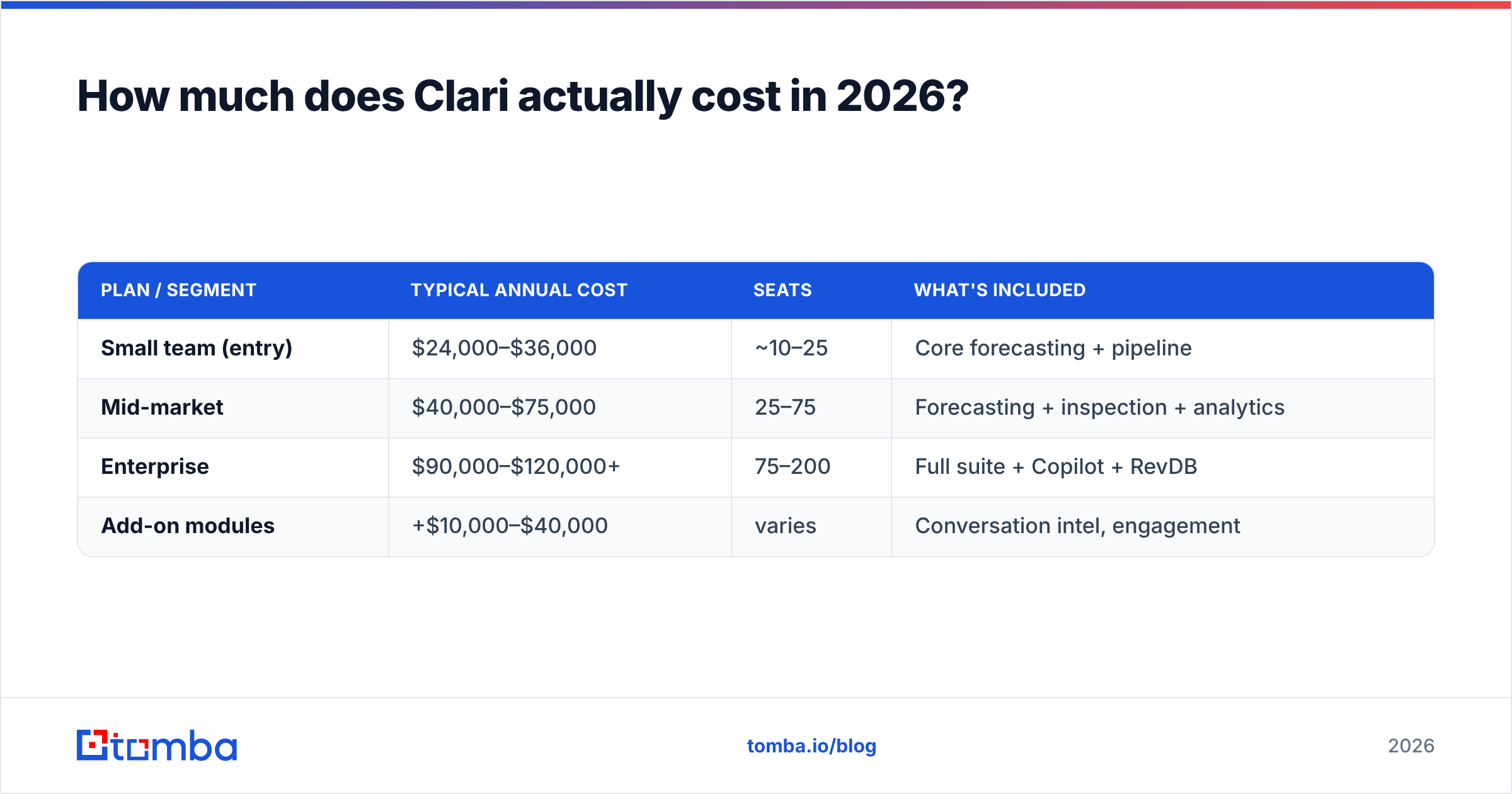
Short answer: Clari does not publish pricing, and your number depends on seat count, modules, and negotiation. Clari sells per-user licenses bundled with platform fees, and the modules (Forecasting, RevDB, Groove for engagement, Copilot/Wingman for conversation intelligence) are often priced separately.
Based on publicly shared reviews on G2 and procurement marketplaces, here is the range buyers commonly report:
| Plan / Segment | Typical annual cost | Seats | What's included |
|---|---|---|---|
| Small team (entry) | $24,000–$36,000 | ~10–25 | Core forecasting + pipeline |
| Mid-market | $40,000–$75,000 | 25–75 | Forecasting + inspection + analytics |
| Enterprise | $90,000–$120,000+ | 75–200 | Full suite + Copilot + RevDB |
| Add-on modules | +$10,000–$40,000 | varies | Conversation intel, engagement |
A few things to keep in mind about these numbers:
- Per-seat pricing scales fast. Most reports cluster around $1,000–$1,500 per user per year, but volume discounts kick in above 50 seats.
- Platform minimums exist. Even a small team rarely gets out the door under ~$24k annually.
- Multi-year deals are the norm. Clari pushes 2–3 year contracts; the headline discount usually requires the longer term.
- Implementation is extra. Onboarding, data mapping, and admin enablement can add a one-time fee or weeks of internal time.
Compare that to predictable, published Tomba pricing — a Free tier with 25 searches, Starter at $49/mo, Growth at $99/mo, and Pro at $249/mo — and you can see why the two tools occupy completely different budget conversations.
What do Clari reviews say? (Pros and cons)#
Clari holds strong ratings on review sites, but the praise and complaints are consistent enough to summarize honestly. Here is what real users repeat.
The pros users mention most#
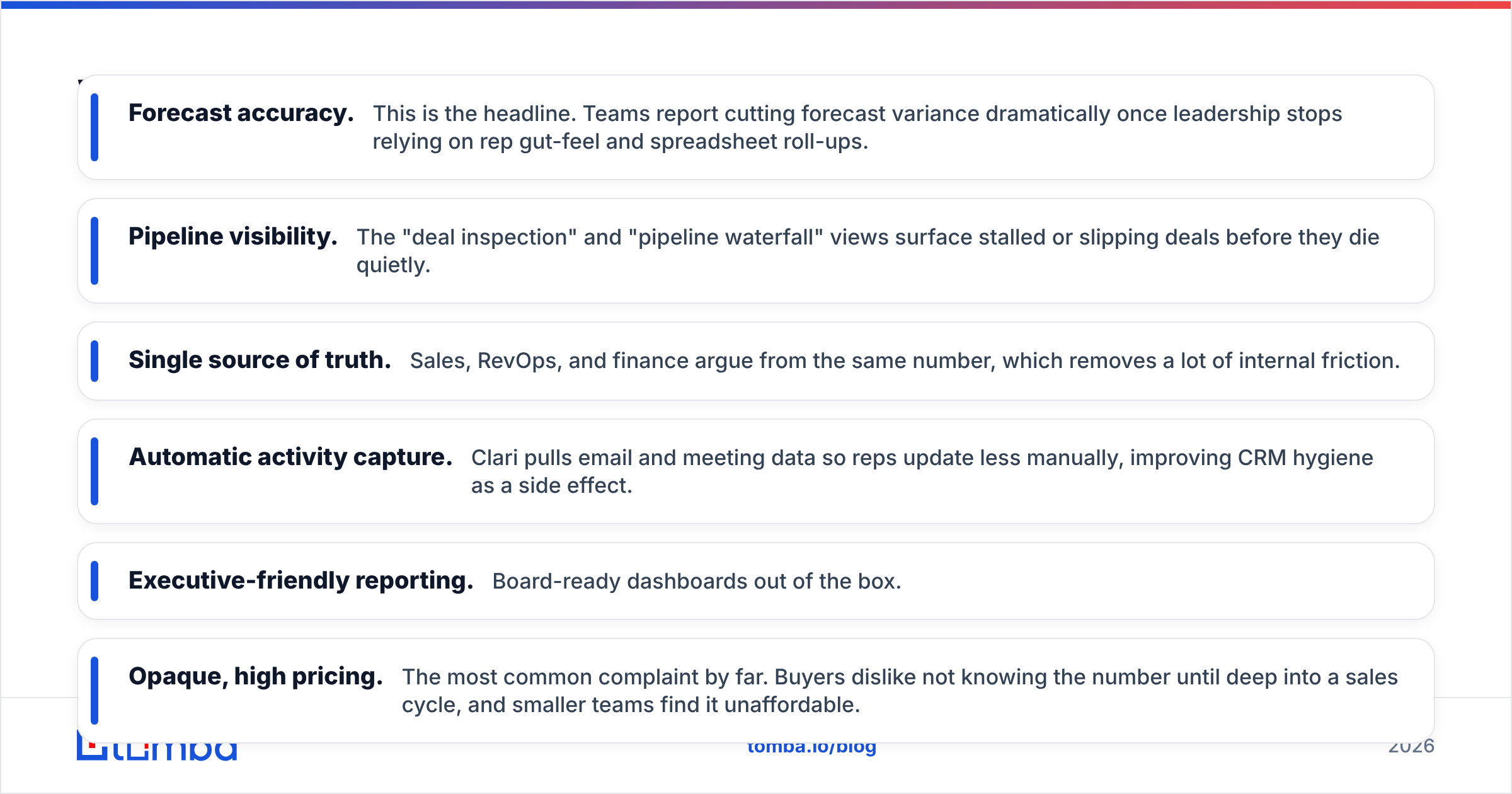
- Forecast accuracy. This is the headline. Teams report cutting forecast variance dramatically once leadership stops relying on rep gut-feel and spreadsheet roll-ups.
- Pipeline visibility. The "deal inspection" and "pipeline waterfall" views surface stalled or slipping deals before they die quietly.
- Single source of truth. Sales, RevOps, and finance argue from the same number, which removes a lot of internal friction.
- Automatic activity capture. Clari pulls email and meeting data so reps update less manually, improving CRM hygiene as a side effect.
- Executive-friendly reporting. Board-ready dashboards out of the box.
The cons users mention most#
- Opaque, high pricing. The most common complaint by far. Buyers dislike not knowing the number until deep into a sales cycle, and smaller teams find it unaffordable.
- Steep implementation. Time-to-value is measured in weeks or months, not days. You need clean CRM data first.
- Learning curve. Admins and reps both need enablement; the depth that makes Clari powerful also makes it complex.
- Overkill for simple pipelines. If your sales motion is transactional or low-volume, you pay for capability you never use.
- Contract lock-in. Multi-year terms make it hard to walk away if priorities change.
The pattern is clear: Clari is loved by the teams that genuinely need enterprise forecasting and resented by teams that bought it before they were ready.
Is Clari worth the price?#
Yes — if forecasting accuracy is a board-level problem and you have the scale to absorb the cost. No — if your real bottleneck is earlier in the funnel.
Here is the honest test. Ask what is actually broken:
- "We can't predict the quarter." Clari is built exactly for this. Worth it.
- "Reps don't update the CRM." Clari helps, but a cheaper activity-capture tool might too.
- "We don't have enough pipeline." Clari will not fix this. It analyzes pipeline; it does not create it. You need prospecting and data, not forecasting.
That third case is where most growth-stage teams actually live. You do not have a forecasting problem yet — you have a pipeline generation problem. Spending $40k on Clari to forecast an empty pipeline is the classic mis-buy.
)
How does Clari compare to alternatives and a leaner stack?#
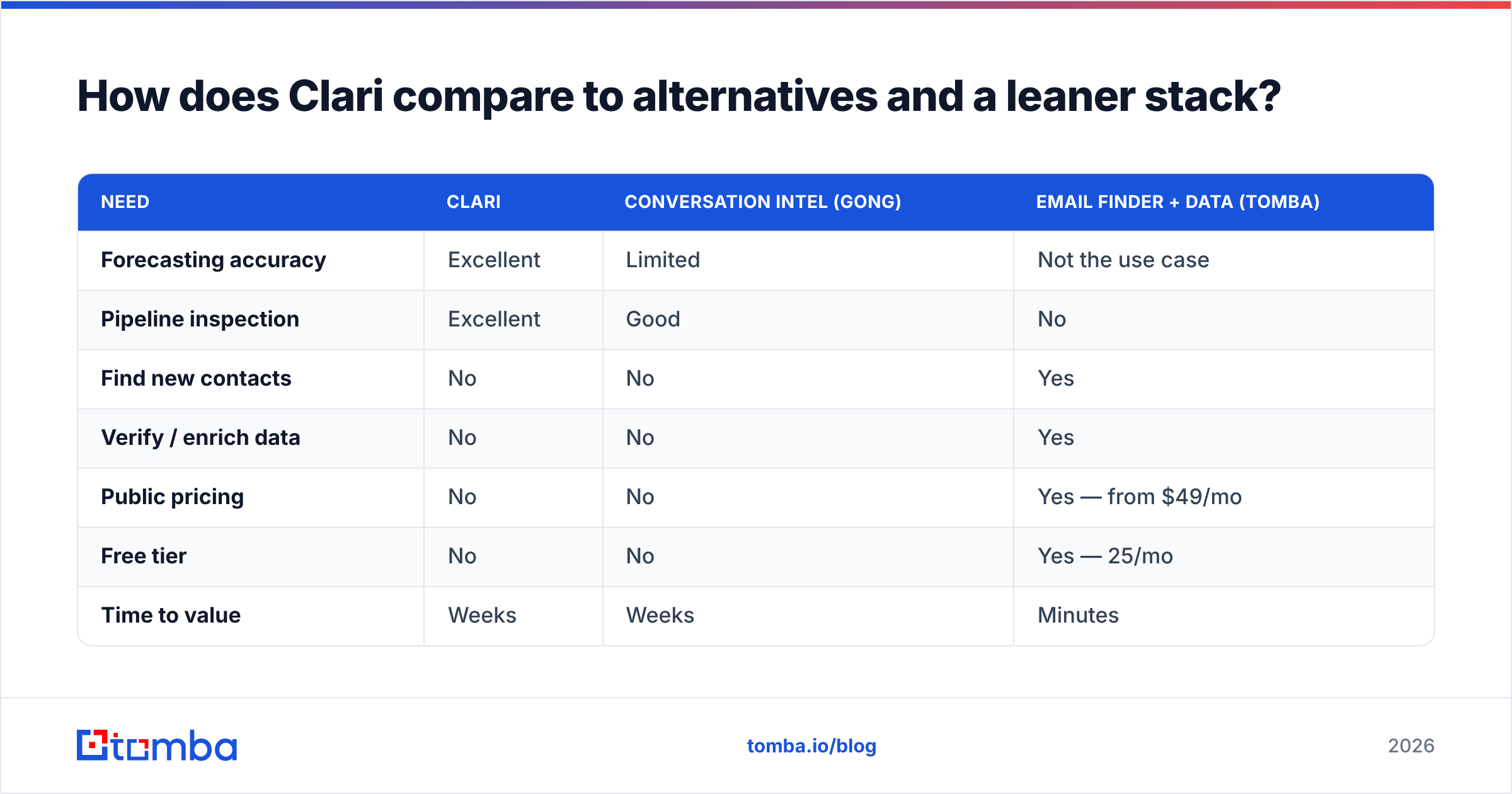
Clari competes with Gong, Aviso, BoostUp, and Salesforce's own forecasting tools at the high end. But for many teams the real question is not "Clari vs Gong" — it is "do we need an enterprise revenue platform at all, or do we need better top-of-funnel data?"
| Need | Clari | Conversation intel (Gong) | Email finder + data (Tomba) |
|---|---|---|---|
| Forecasting accuracy | Excellent | Limited | Not the use case |
| Pipeline inspection | Excellent | Good | No |
| Find new contacts | No | No | Yes |
| Verify / enrich data | No | No | Yes |
| Public pricing | No | No | Yes — from $49/mo |
| Free tier | No | No | Yes — 25/mo |
| Time to value | Weeks | Weeks | Minutes |
The point is not that Tomba replaces Clari — they solve different problems. The point is that many teams buy a revenue platform when what they're missing is reliable contact data feeding the top of the funnel. A good B2B database and a fast email verifier keep your CRM full of real, reachable people — which is the raw material any forecasting tool depends on.
If you are still early, the smart sequence is: build pipeline first, then buy forecasting. Garbage data in your CRM makes even the best forecast engine wrong.
What should you ask before signing a Clari contract?#
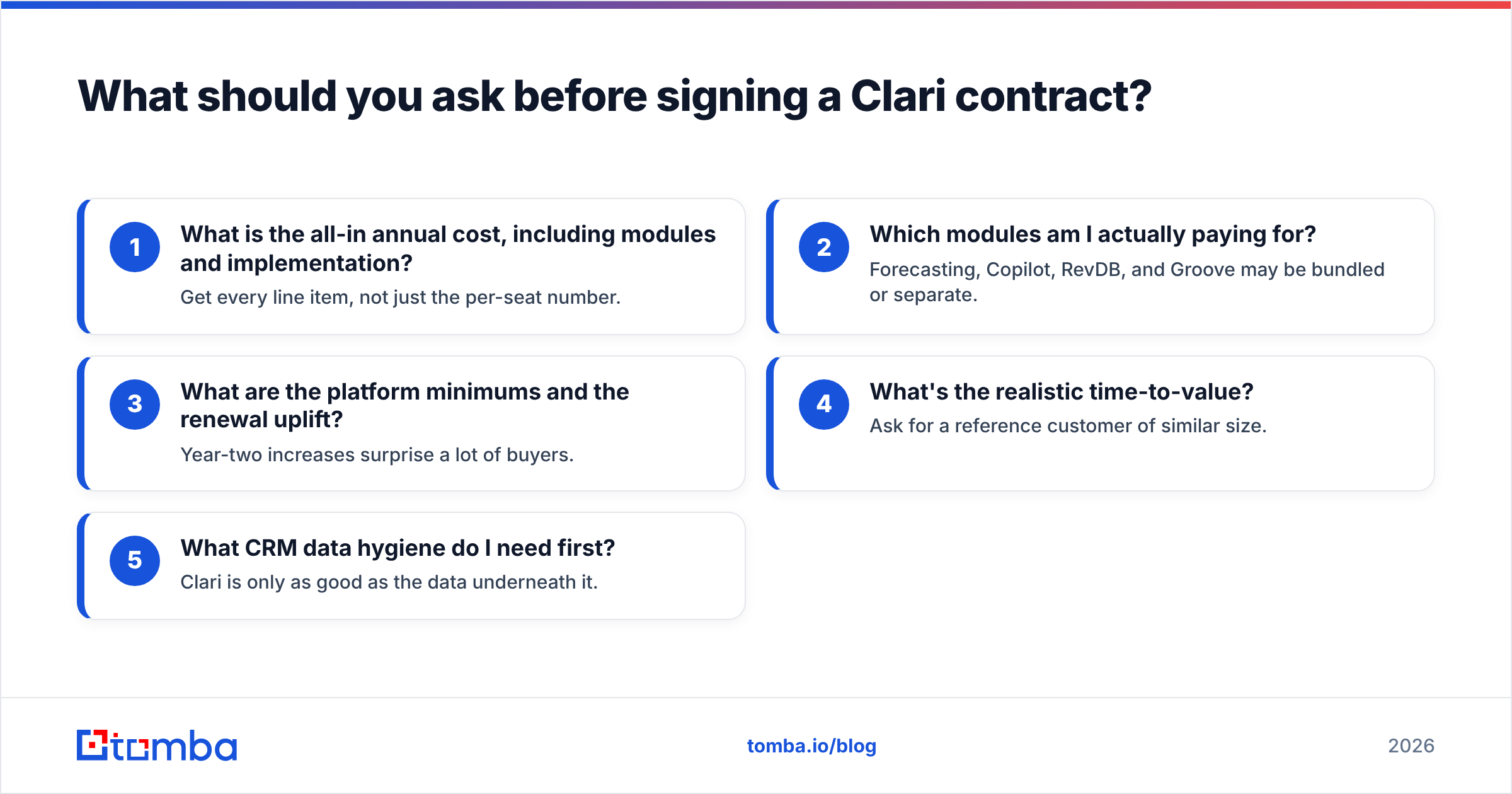
If you do move forward, treat the sales process like the negotiation it is. Walk in with these questions:
- What is the all-in annual cost, including modules and implementation? Get every line item, not just the per-seat number.
- Which modules am I actually paying for? Forecasting, Copilot, RevDB, and Groove may be bundled or separate.
- What are the platform minimums and the renewal uplift? Year-two increases surprise a lot of buyers.
- What's the realistic time-to-value? Ask for a reference customer of similar size.
- What CRM data hygiene do I need first? Clari is only as good as the data underneath it.
That last point loops back to fundamentals. Before any revenue platform can forecast well, your contact data has to be clean and current. Tools like a bulk email verifier and ongoing contact enrichment are the unglamorous foundation that makes a $90k Clari deal actually perform.
The bottom line on Clari pricing, pros, and cons#
Clari is a genuinely strong revenue platform with quote-based pricing that typically starts around $24k/year and climbs into six figures for enterprise. The pros — forecast accuracy, pipeline visibility, a shared source of truth — are real and valued by the teams that need them. The cons — opaque pricing, long implementation, contract lock-in, and overkill for smaller orgs — are equally real and explain most of the negative reviews.
The deciding question is whether your problem is forecasting or pipeline. If it is forecasting at scale, Clari earns its price. If it is pipeline, you will get far more leverage — and keep far more budget — by fixing your top-of-funnel data first.
That is exactly where a focused tool beats a heavyweight platform on cost. Use the Tomba Email Finder to turn names and domains into verified, reachable contacts in seconds, fill your CRM with real pipeline, and prove out your motion — all starting free, with transparent plans from $49/mo. Build the pipeline first; buy the forecasting engine when the deals are real. See full Tomba pricing and start finding contacts today.
// get started
Find, verify and enrich your first contacts today
Start on the free plan with 25 searches a month, then scale when your team is ready.
Free plan · No credit card required · GDPR & CCPA
// about the author