Clari vs Outreach 2026: Forecasting vs Sales Engagement
Clari forecasts revenue; Outreach executes the outreach. Here's how the two platforms actually differ in 2026 - and where each one fits your sales stack.
TL;DR
- Clari is a revenue platform: forecasting, pipeline inspection, and deal risk analytics for RevOps and sales leaders. Outreach is a sales engagement platform: sequences, dialer, and rep workflow execution.
- They are not really competitors. Clari answers "will we hit the number?" Outreach answers "did the rep send the next touch?"
- Outreach starts cheaper and lands faster with frontline reps. Clari costs more and earns its keep at the VP/CRO and board-deck level.
- Both are only as good as the contact and account data feeding them. Garbage records in your CRM poison forecasts and sequences alike.
- If you are picking between them, decide whether your bleak is visibility (Clari) or activity (Outreach) - then fix your data layer underneath either one.
What is the real difference between Clari and Outreach?#
Clari and Outreach get lumped together because both wear the "revenue" badge, but they live in different parts of the funnel. Clari sits at the top of the org chart - it ingests CRM and activity signals to produce forecasts, roll-ups, and deal-risk scores that a CRO takes into the boardroom. Outreach sits on the rep's screen - it fires multi-step sequences, logs calls, books meetings, and nudges sellers to make the next touch.
Think of it like a hospital. Outreach is the nursing staff running rounds, administering treatment, and recording vitals every hour. Clari is the chief of medicine reading the charts to predict which patients recover and which need intervention. You need both functions, but you would never ask one to do the other's job.
That distinction matters because buyers waste weeks running a head-to-head "clari vs outreach" bake-off as if one will replace the other. In most stacks they coexist: reps execute in Outreach, the activity data flows to the CRM, and Clari reads that data to forecast. The question is rarely "which one," it is "which gap am I solving first."

What does Clari actually do?#
Clari is built for forecasting and revenue intelligence. Its core jobs:
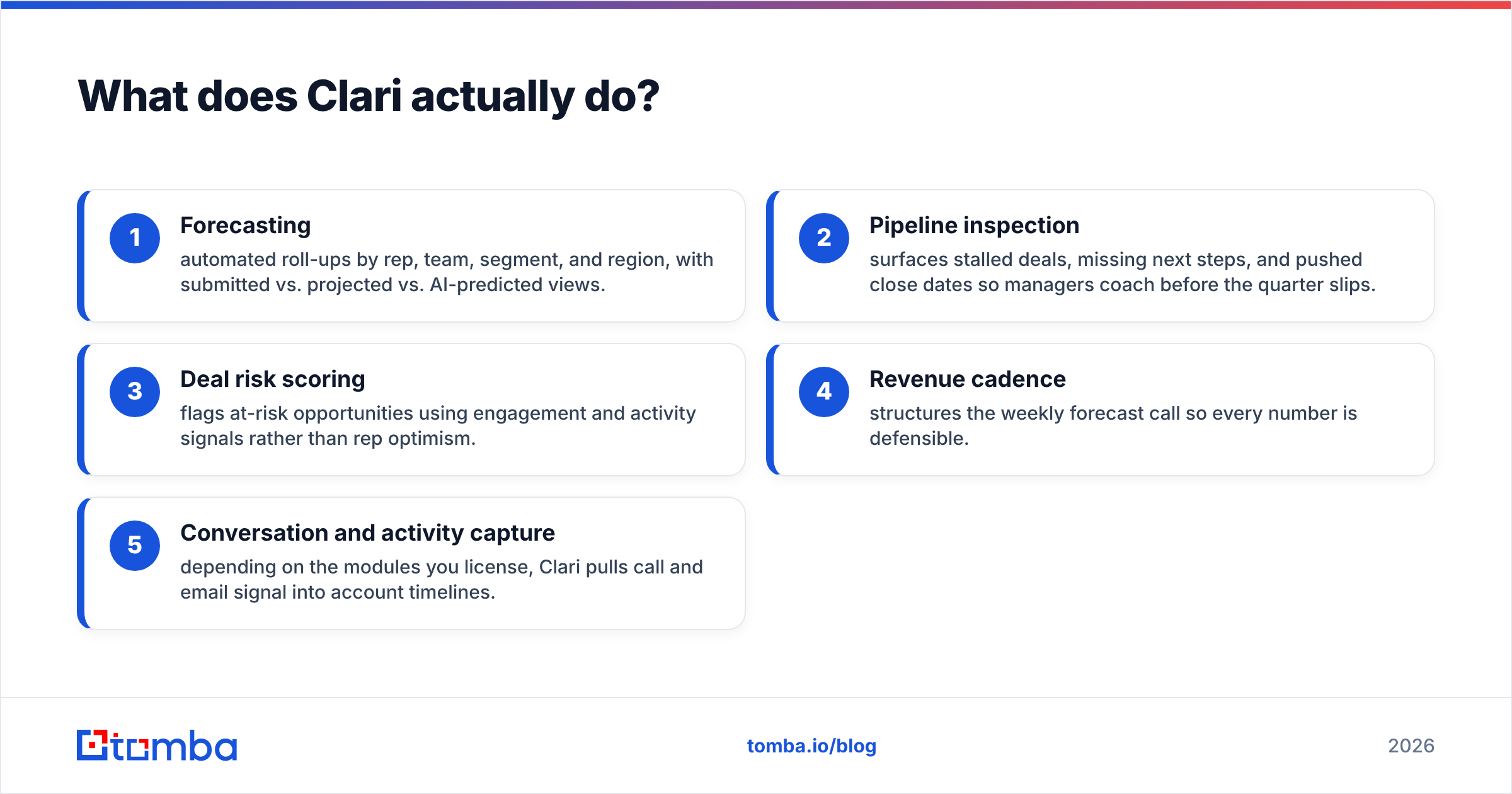
- Forecasting - automated roll-ups by rep, team, segment, and region, with submitted vs. projected vs. AI-predicted views.
- Pipeline inspection - surfaces stalled deals, missing next steps, and pushed close dates so managers coach before the quarter slips.
- Deal risk scoring - flags at-risk opportunities using engagement and activity signals rather than rep optimism.
- Revenue cadence - structures the weekly forecast call so every number is defensible.
- Conversation and activity capture - depending on the modules you license, Clari pulls call and email signal into account timelines.
Clari's buyer is the RevOps leader, the VP of Sales, and the CRO. Its output is a number leadership can trust. You can read more about how this fits the broader revenue operations function, which is where Clari typically gets championed.
What does Outreach actually do?#
Outreach is a sales engagement platform aimed at the people doing the outreach. Its core jobs:
- Sequences - multi-touch cadences across email, call, and LinkedIn tasks that keep reps on schedule.
- Dialer - click-to-call with logging, local presence, and voicemail drop.
- Inbox and scheduling - reply handling, meeting booking, and calendar coordination inside the rep's flow.
- Sales automation - triggers and rules that move prospects between stages without manual data entry. See how this connects to broader sales automation strategy.
- Analytics for reps and managers - which sequences book meetings, which messaging converts, where deals stall in the rep's day.
Outreach's buyer is the frontline sales manager and the enablement lead. Its output is consistent rep activity at volume.
Clari vs Outreach: the side-by-side comparison#
Here is the honest breakdown of where each platform leads. Note that pricing for both is quote-based and varies heavily by seat count and modules, so treat the ranges as directional.
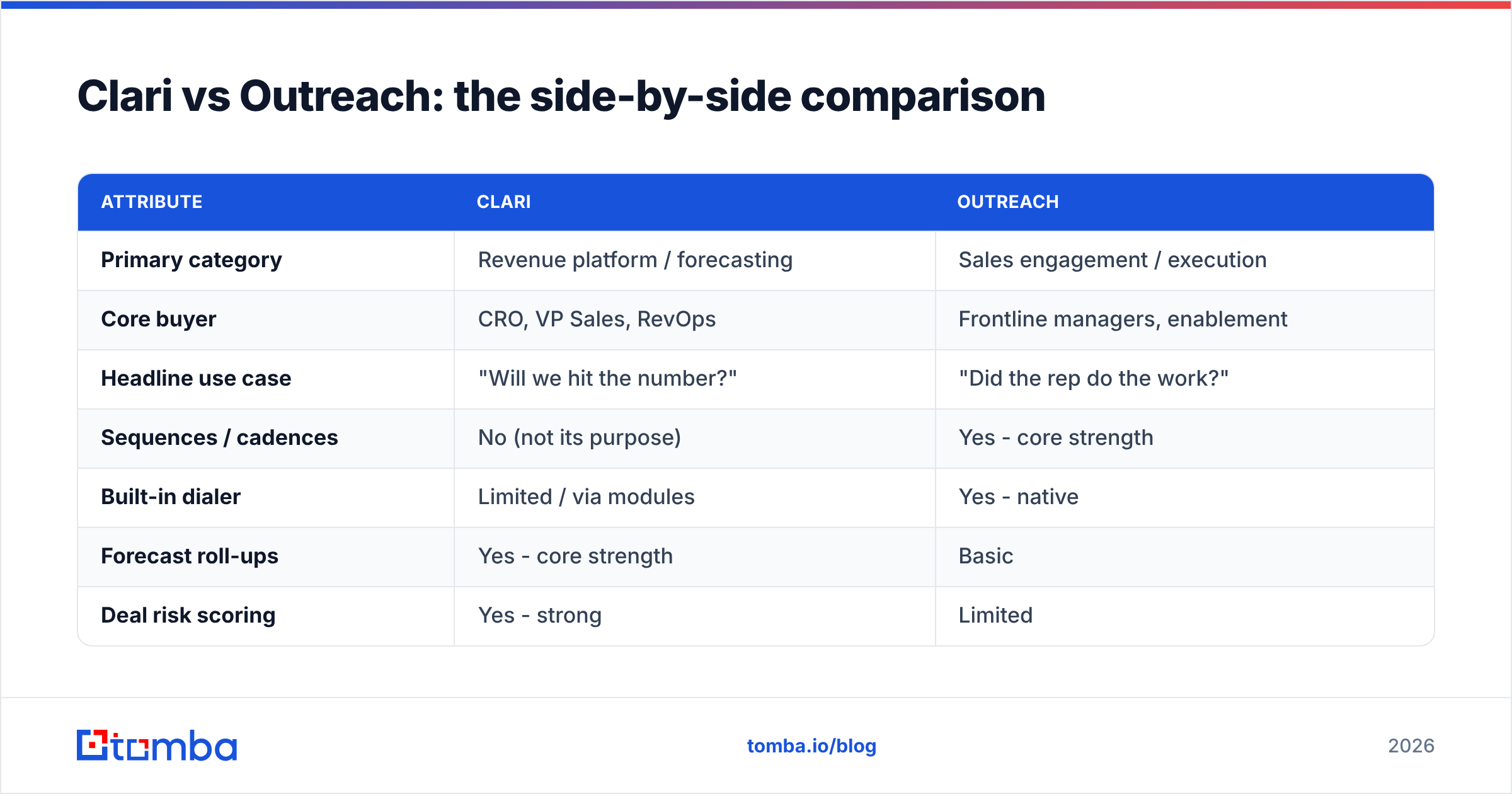
| Attribute | Clari | Outreach |
|---|---|---|
| Primary category | Revenue platform / forecasting | Sales engagement / execution |
| Core buyer | CRO, VP Sales, RevOps | Frontline managers, enablement |
| Headline use case | "Will we hit the number?" | "Did the rep do the work?" |
| Sequences / cadences | No (not its purpose) | Yes - core strength |
| Built-in dialer | Limited / via modules | Yes - native |
| Forecast roll-ups | Yes - core strength | Basic |
| Deal risk scoring | Yes - strong | Limited |
| Typical entry price | Higher (enterprise-first) | Lower (per-seat, mid-market up) |
| Time to first value | Weeks (data modeling) | Days (reps run sequences) |
| Best for company stage | Series C+ / enterprise | SMB through enterprise |
The pattern is clear. Outreach earns trust bottom-up because a rep feels the value on day one. Clari earns trust top-down because a CRO finally gets a forecast that does not embarrass them on the board call.
Is Clari better than Outreach?#
Neither is "better" - they solve different problems, and the right answer depends on your bottleneck. Ask which symptom hurts more.
Choose Clari first if:
- Your forecast is a spreadsheet guess and leadership is missing the number with no early warning.
- Deals slip at end of quarter and nobody saw it coming.
- You have RevOps maturity and enough deal volume to model.
- The board is asking for forecast accuracy, not more dials.
Choose Outreach first if:
- Reps are inconsistent on follow-up and pipeline creation is the gap.
- You need cadence discipline and call volume, fast.
- You are scaling an SDR/BDR motion and want sequences standardized.
- Time-to-value matters more than enterprise forecasting depth.
A useful rule: if your problem is seeing revenue, lean Clari. If your problem is generating activity, lean Outreach. Most growth-stage teams adopt Outreach earlier and add Clari once the pipeline is big enough that forecasting becomes the constraint.
What both platforms get wrong without good data#
Here is the part the vendor demos skip: both tools assume your CRM is full of accurate, complete, deliverable contact records. They are not data providers. Clari forecasts on the deals and contacts already in Salesforce. Outreach sequences the email addresses already on the lead. Feed either one stale, missing, or wrong data and you get confident garbage.
The failure modes are predictable:
- Outreach burns sender reputation blasting sequences to invalid addresses, tanking email deliverability for your whole domain.
- Clari forecasts on contacts who left the buying committee six months ago, so deal-risk scores miss the real risk.
- Both inflate "activity" metrics that mean nothing because the touches never reached a real human.

This is the layer Tomba sits underneath both tools. Before a contact ever enters an Outreach sequence or a Clari forecast, you want it found, verified, and enriched. Tomba's email finder locates professional addresses by name and domain, the email verifier confirms they are deliverable, and data enrichment fills the firmographic gaps that make forecasts and sequences accurate. The Tomba API wires this directly into your CRM so records are clean before Clari or Outreach ever touch them.
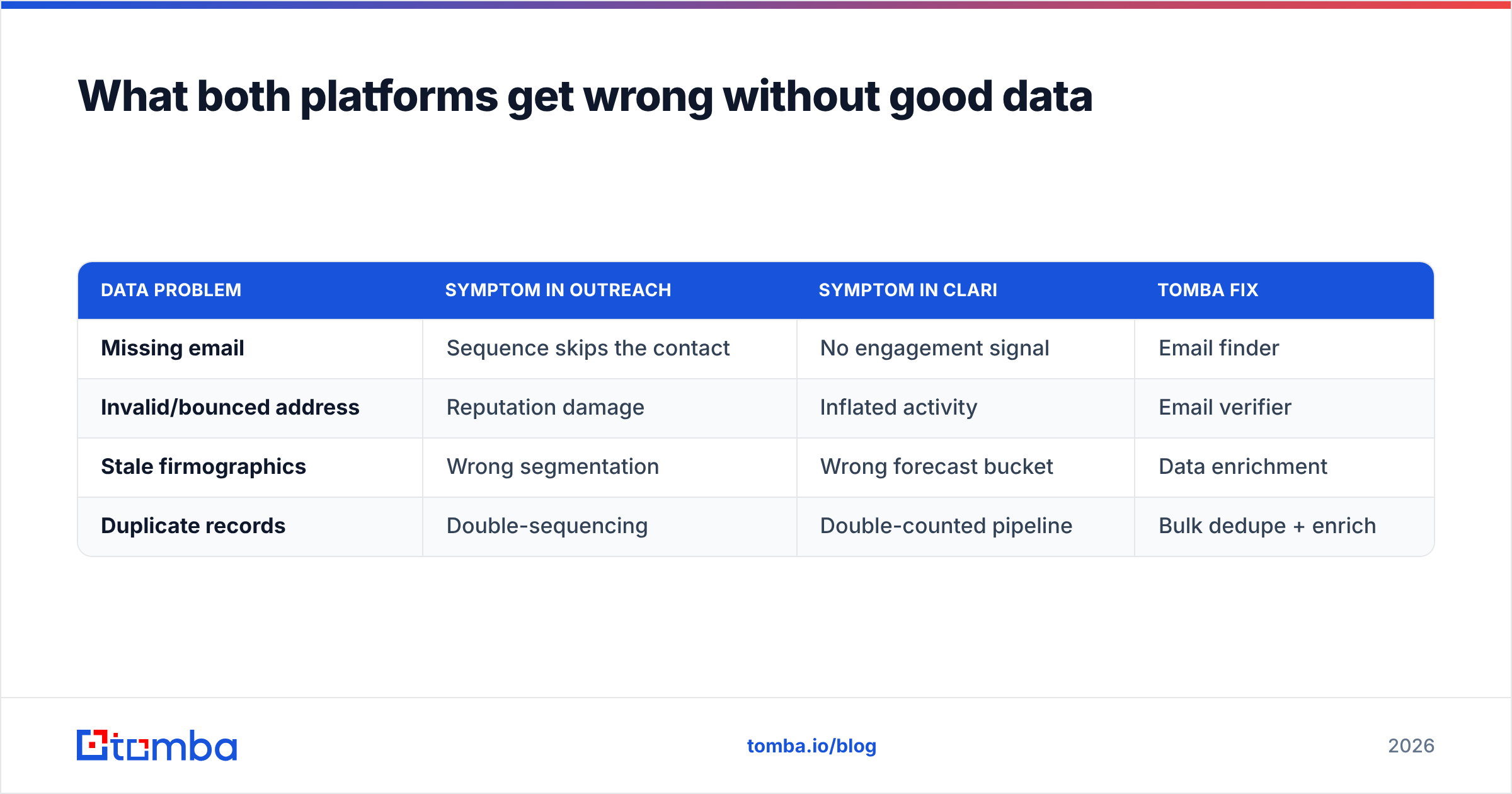
| Data problem | Symptom in Outreach | Symptom in Clari | Tomba fix |
|---|---|---|---|
| Missing email | Sequence skips the contact | No engagement signal | Email finder |
| Invalid/bounced address | Reputation damage | Inflated activity | Email verifier |
| Stale firmographics | Wrong segmentation | Wrong forecast bucket | Data enrichment |
| Duplicate records | Double-sequencing | Double-counted pipeline | Bulk dedupe + enrich |
How do Clari and Outreach fit together in one stack?#
The mature setup uses both, and they hand off cleanly. Reps execute cadences in Outreach. Every call, email, and reply is captured and synced to the CRM. Clari reads that CRM and activity data to score deals and build the forecast. The CRO runs the forecast call in Clari; the manager runs the activity review in Outreach.
The connective tissue is your CRM and the data quality inside it. If you run Salesforce, both platforms plug into it, which means a single source of contact truth serves both. That is exactly why teams standardize enrichment at the CRM layer rather than trusting each tool to clean its own inputs - you fix the data once and both the execution layer and the forecasting layer benefit.
A practical sequencing for a growing team:
- Stage one - Outreach for cadence discipline and pipeline creation.
- Stage two - a verified, enriched contact layer (Tomba) so neither tool runs on bad data.
- Stage three - Clari once pipeline volume makes forecasting the real constraint.
What about pricing and total cost?#
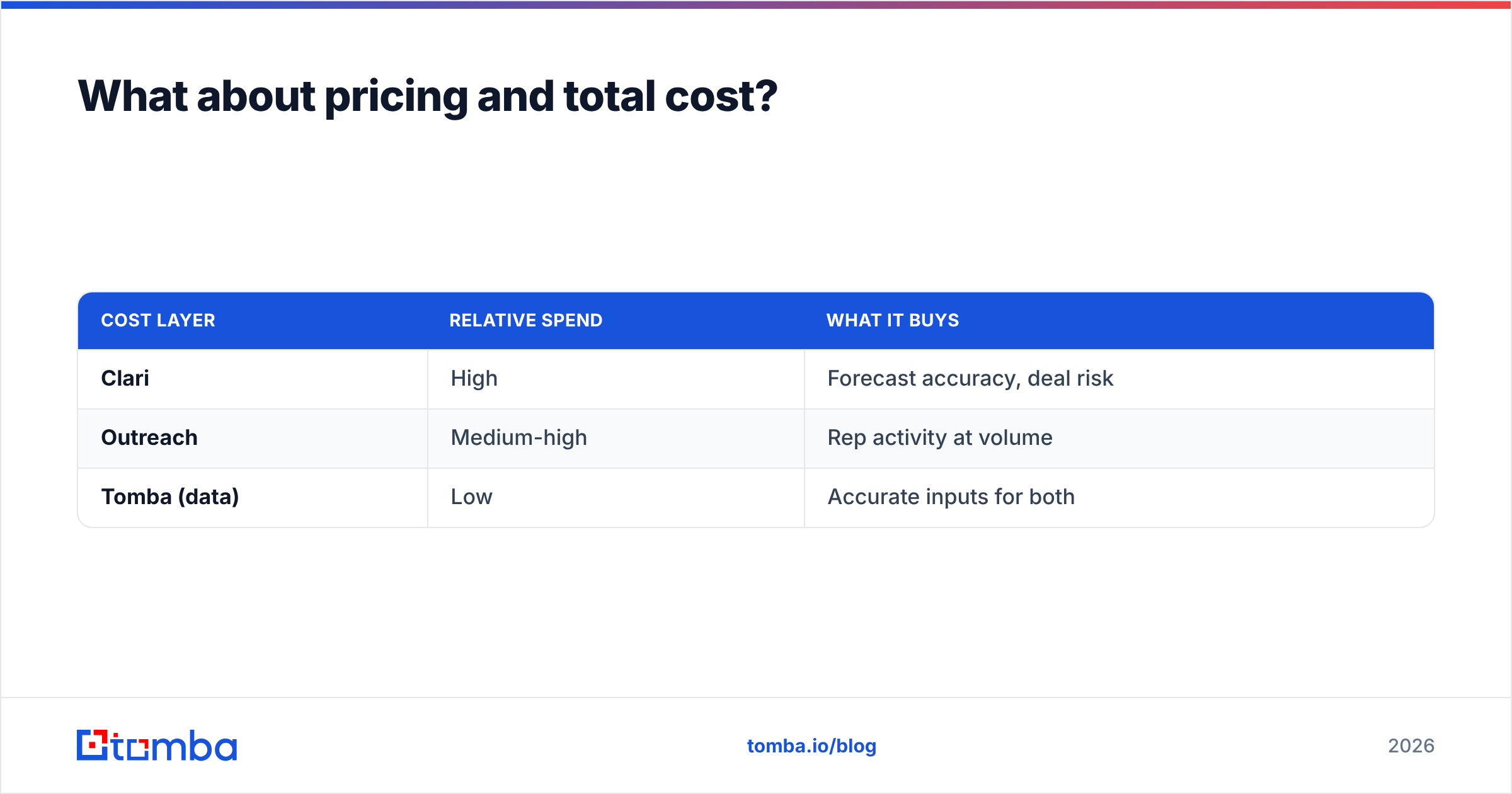
Both Clari and Outreach are quote-based and skew enterprise, so published numbers are scarce and seat-dependent. Outreach generally enters lower on a per-seat basis and scales with your rep count. Clari prices higher and is typically sold as a platform commitment to organizations with real forecasting complexity. Neither publishes transparent self-serve tiers the way a tool like Tomba does.
That cost asymmetry is worth naming. You can spend five or six figures a year on Outreach and Clari and still get bad output if the contact data is wrong - and that data layer is comparatively cheap to fix. Tomba's plans run from a free tier (25 searches/month) to Starter at $49/month, Growth at $99/month, and Pro at $249/month, with full Tomba pricing published openly. Clean data is the highest-ROI line item in this entire stack because it multiplies the value of every expensive seat above it.
| Cost layer | Relative spend | What it buys |
|---|---|---|
| Clari | High | Forecast accuracy, deal risk |
| Outreach | Medium-high | Rep activity at volume |
| Tomba (data) | Low | Accurate inputs for both |
Which should you choose in 2026?#
Conclusion first: most teams do not choose between Clari and Outreach - they choose which to adopt first, and they fix the data underneath both. Pick Outreach first if your gap is rep activity and pipeline creation. Pick Clari first if your gap is forecast visibility and end-of-quarter surprises. Either way, the platform only performs if the contacts and accounts feeding it are real.
The mistake to avoid is treating this as an either/or replacement decision. Clari will not run your sequences and Outreach will not give your CRO a defensible forecast. They are complements that share one dependency: trustworthy data.
That is where to start regardless of which platform you license first. Find and verify your contacts with the Tomba Email Finder, confirm they are deliverable before a single sequence fires, and enrich your accounts so your forecast reflects reality. Spin up the free tier, connect it to your CRM through the Tomba API, and give both your execution layer and your forecasting layer the clean inputs they were never designed to produce on their own.
// get started
Find, verify and enrich your first contacts today
Start on the free plan with 25 searches a month, then scale when your team is ready.
Free plan · No credit card required · GDPR & CCPA
// about the author