Clari vs Salesloft 2026: Forecasting vs Sales Engagement
Clari forecasts revenue; Salesloft runs the outreach that creates it. Here's how the two platforms actually differ in 2026 — features, pricing, and which one your team needs first.
TL;DR
- Clari and Salesloft solve different problems. Clari is a revenue operations and forecasting platform; Salesloft is a sales engagement (outreach execution) platform. Comparing them head-to-head is really a question of which gap in your funnel hurts more right now.
- Pick Salesloft if reps need a system to run cadences, calls, and email sequences at volume and you want activity-level visibility.
- Pick Clari if leadership can't trust the forecast, deals slip without warning, and you need pipeline inspection and conversation intelligence across the whole funnel.
- Plenty of teams run both — Salesloft drives the activity, Clari reads the signal. They integrate rather than replace each other.
- Neither finds or verifies contact data. Both assume your CRM already has accurate emails and phone numbers — which is where a tool like Tomba Email Finder sits upstream of both.
What is the real difference between Clari and Salesloft?#
Think of your revenue engine like a car. Salesloft is the engine and pedals — it's what reps press to make outreach happen: sequences, dials, emails, follow-ups. Clari is the dashboard and the GPS — it tells leadership how fast you're actually going, whether you'll reach the destination this quarter, and which deals are about to break down on the side of the road.
That's the core distinction, and it matters because buyers often frame this as "Clari vs Salesloft" when they're really asking two separate questions: How do my reps execute outreach? (Salesloft) and Can I trust what my pipeline is telling me? (Clari).
Salesloft is a sales engagement platform. Its job is to make rep activity efficient and measured — multi-step cadences across email, phone, LinkedIn, and SMS, with built-in dialer and email tracking. Clari is a revenue operations platform. Its job is forecasting accuracy, pipeline inspection, and surfacing risk in deals before they slip.
Both have crept toward the middle over the years — Salesloft acquired conversation intelligence (Drift, and earlier its own analytics), and Clari owns Wingman for call recording. But their centers of gravity haven't moved. Salesloft optimizes the doing; Clari optimizes the knowing.
What does Salesloft do best?#
Salesloft is built for the rep's day. If your team lives in a queue of accounts to touch, Salesloft is the cockpit they work from.
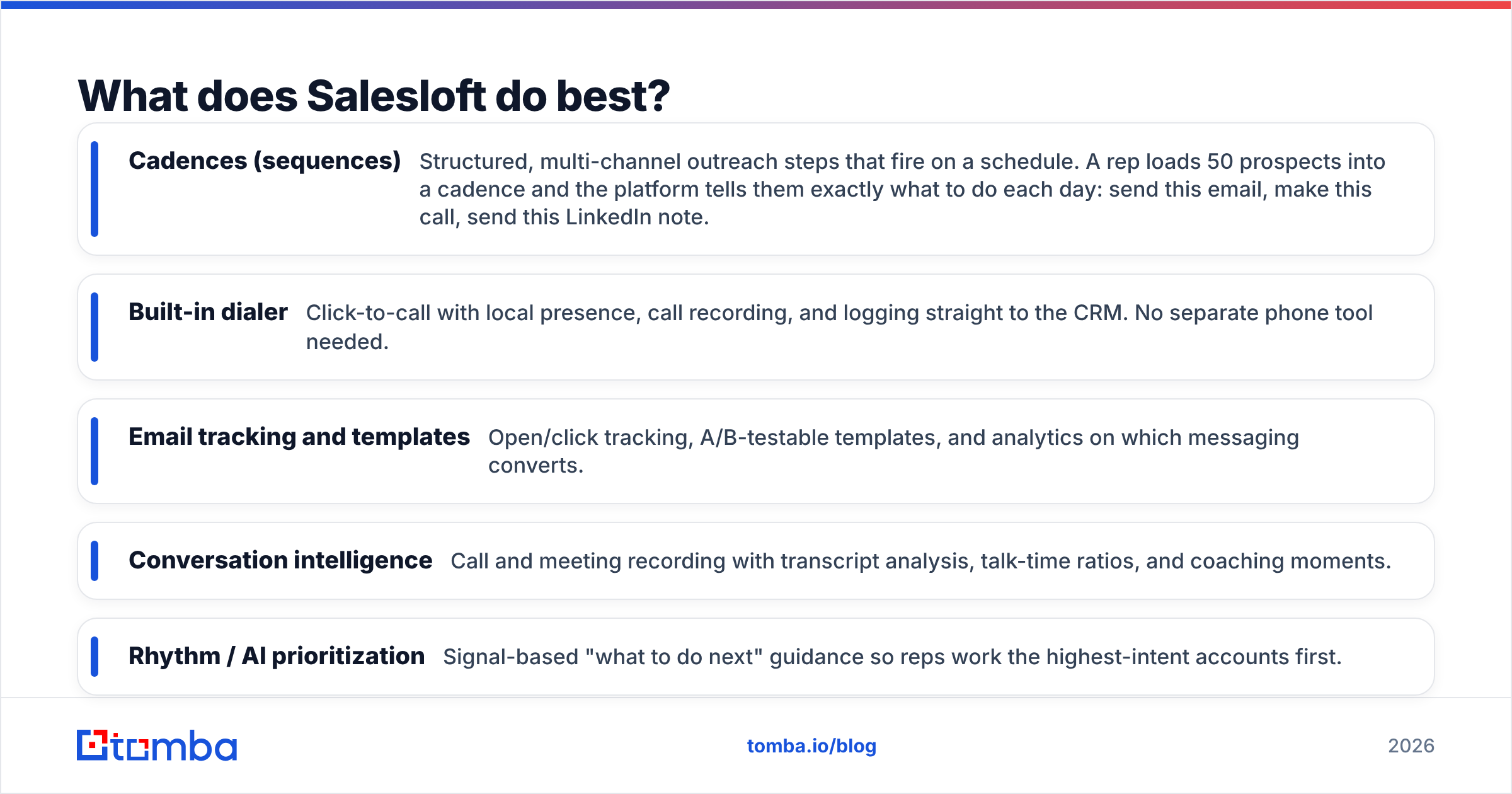
Its strongest features:
- Cadences (sequences) — Structured, multi-channel outreach steps that fire on a schedule. A rep loads 50 prospects into a cadence and the platform tells them exactly what to do each day: send this email, make this call, send this LinkedIn note.
- Built-in dialer — Click-to-call with local presence, call recording, and logging straight to the CRM. No separate phone tool needed.
- Email tracking and templates — Open/click tracking, A/B-testable templates, and analytics on which messaging converts.
- Conversation intelligence — Call and meeting recording with transcript analysis, talk-time ratios, and coaching moments.
- Rhythm / AI prioritization — Signal-based "what to do next" guidance so reps work the highest-intent accounts first.
Salesloft shines for outbound-heavy SDR and AE teams running high activity volume. It's the operational layer where prospecting actually happens. If you want to understand the broader category, our breakdown of sales automation covers where engagement platforms fit.
Where Salesloft is weaker: it is not a forecasting tool. It reports on activity and rep-level outcomes, but it won't give a CRO a defensible, roll-up forecast across segments and regions, nor deep deal-by-deal risk scoring.
What does Clari do best?#
Clari is built for the revenue leader's quarter. Its center is the forecast call and the question every CRO dreads: "Are we going to hit the number?"
Its strongest features:
- Forecasting — AI-driven roll-up forecasts with submitted vs. projected vs. closed views, by rep, team, and segment. This is Clari's flagship.
- Pipeline inspection — Surfaces stalled deals, pushed close dates, and deals with no recent activity so managers can intervene early.
- RevDB / activity capture — Auto-captures emails and meetings against opportunities so the CRM reflects reality without rep data entry.
- Conversation intelligence (Wingman) — Call recording and deal-context analysis tied to specific opportunities.
- Revenue cadence — A structured weekly operating rhythm for forecast and deal reviews.
Clari shines for RevOps teams and sales leadership who need forecast accuracy and early-warning signals across a complex funnel. If "revenue operations" is a new function in your org, our primer on RevOps explains why platforms like Clari exist.
Where Clari is weaker: it doesn't run outreach. Reps don't prospect from Clari. It reads and analyzes the activity that tools like Salesloft (and your CRM) generate.
Clari vs Salesloft: side-by-side comparison#
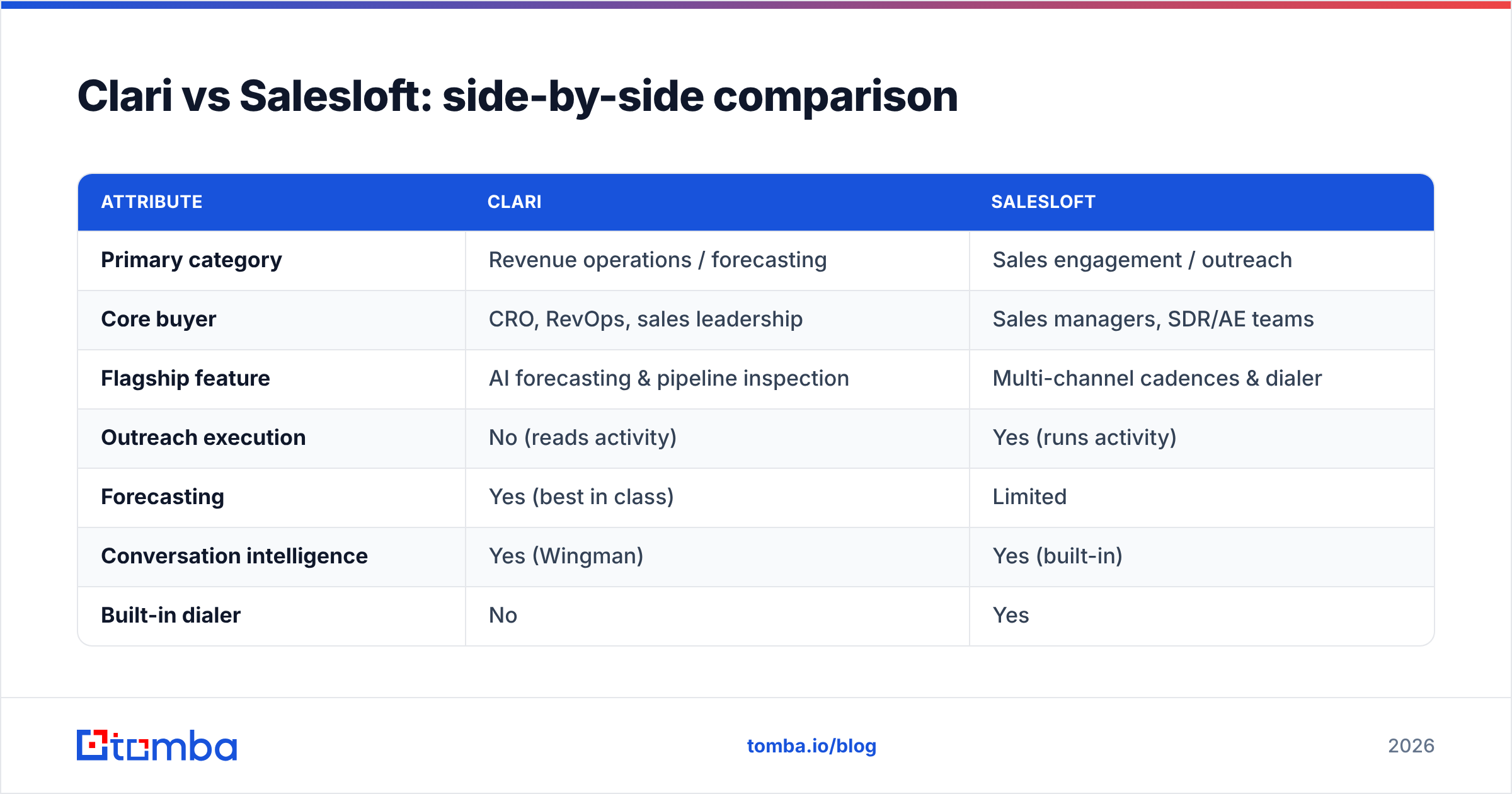
Here's the head-to-head on the attributes that actually drive a buying decision. Pricing for both is quote-based and seat-dependent; the figures below reflect commonly reported ranges for 2026 and should be confirmed with each vendor.
| Attribute | Clari | Salesloft |
|---|---|---|
| Primary category | Revenue operations / forecasting | Sales engagement / outreach |
| Core buyer | CRO, RevOps, sales leadership | Sales managers, SDR/AE teams |
| Flagship feature | AI forecasting & pipeline inspection | Multi-channel cadences & dialer |
| Outreach execution | No (reads activity) | Yes (runs activity) |
| Forecasting | Yes (best in class) | Limited |
| Conversation intelligence | Yes (Wingman) | Yes (built-in) |
| Built-in dialer | No | Yes |
| Activity auto-capture | Yes (RevDB) | Yes (CRM sync) |
| Typical pricing model | Per-seat, annual, quote-based | Per-seat, annual, quote-based |
| Indicative entry cost | ~$1,200+/user/year | ~$1,000+/user/year |
| Best for | Trusting the forecast | Scaling the outreach |
The pattern is clear: there's surprisingly little true overlap. They touch the same data and both record calls, but one platform exists to generate pipeline activity and the other to interpret it.
For a wider field of options and verified user sentiment, G2's sales engagement and revenue operations categories are a useful neutral cross-reference — both tools rate highly but with very different reviewer profiles (reps vs. leaders).
Is Clari better than Salesloft?#
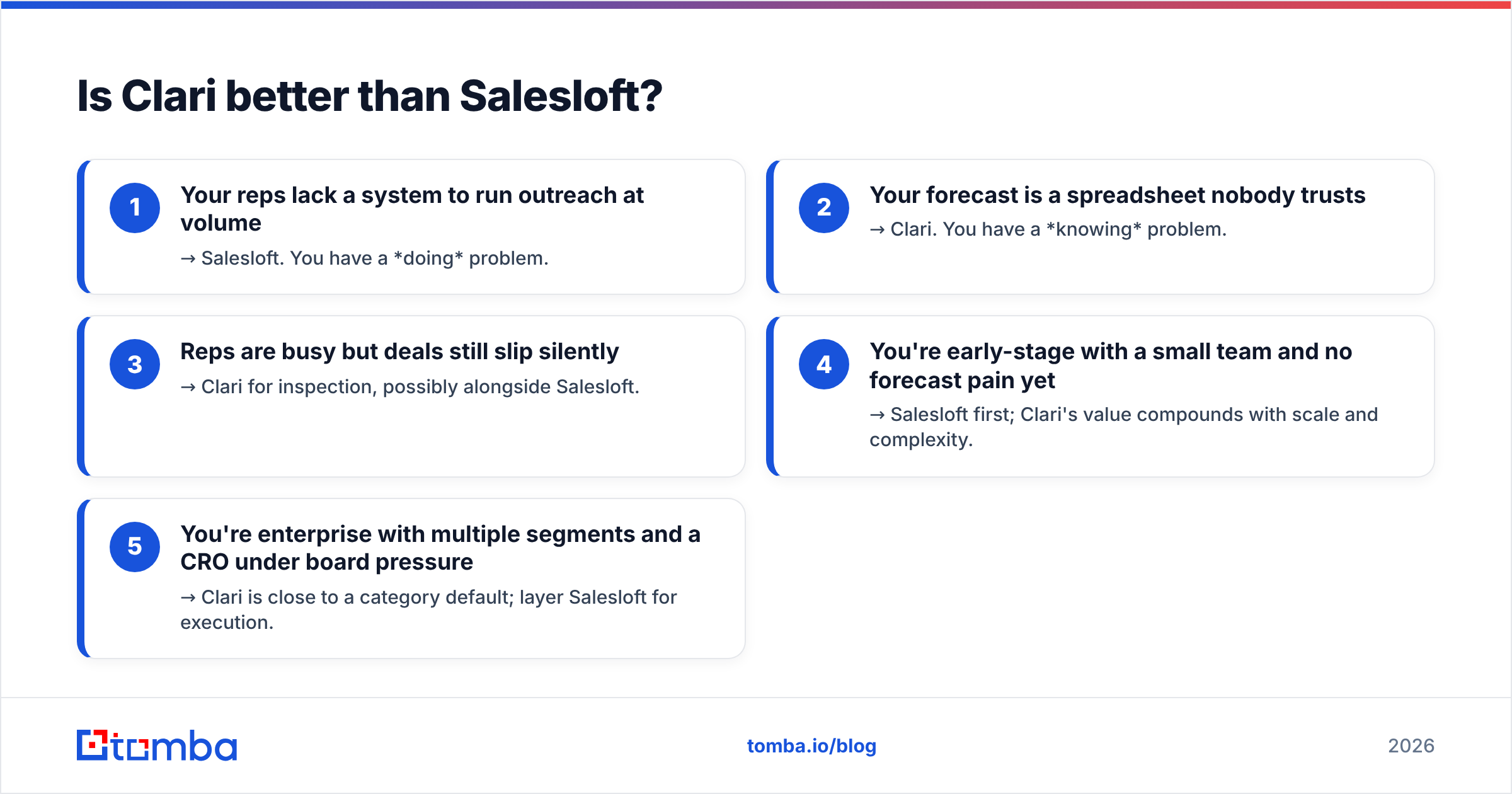
Neither is "better" — they're answers to different questions. The honest framing is a decision tree, not a winner.
- Your reps lack a system to run outreach at volume → Salesloft. You have a doing problem.
- Your forecast is a spreadsheet nobody trusts → Clari. You have a knowing problem.
- Reps are busy but deals still slip silently → Clari for inspection, possibly alongside Salesloft.
- You're early-stage with a small team and no forecast pain yet → Salesloft first; Clari's value compounds with scale and complexity.
- You're enterprise with multiple segments and a CRO under board pressure → Clari is close to a category default; layer Salesloft for execution.
If budget forces one choice, map it to whichever stage of your funnel is actively bleeding. Most sub-50-rep teams feel the execution gap before the forecasting gap, which is why Salesloft tends to land earlier in a company's life and Clari arrives as forecasting complexity grows.
It's also worth saying: both are premium, annual-contract platforms. If you're comparing them mainly on price, you may be earlier in maturity than either tool is designed for — and a lighter engagement tool plus a clean CRM could serve you better for now. We keep a running list of Salesloft alternatives for exactly that scenario.
Can you use Clari and Salesloft together?#
Yes — and a large share of mid-market and enterprise revenue teams do exactly that. They're complementary layers, not competitors, in a mature GTM stack.
A common architecture looks like this:
- CRM (Salesforce / HubSpot) — the system of record.
- Salesloft — the execution layer where reps run cadences and calls.
- Clari — the intelligence layer that reads CRM + activity data to forecast and inspect.
Salesloft pushes activity and outcomes into the CRM; Clari ingests that to produce forecasts and risk scores. The integration is well-trodden. The catch is cost: running both is a serious per-seat investment, so the combined stack usually makes sense once you have a dedicated RevOps function and enough deal volume that forecast errors cost real money.
One thing neither platform does, no matter how you combine them: source or verify the contact data they run on.
What neither Clari nor Salesloft fixes: your data#
Here's the gap both buyers consistently underestimate. Clari and Salesloft are only as good as the contact data flowing through them. A flawless cadence sent to a stale email bounces. A pristine forecast built on duplicate or wrong-contact opportunities is precise nonsense.
Salesloft will dutifully send to a dead inbox. Clari will faithfully forecast a deal whose primary contact left the company six months ago. Garbage in, confident garbage out — and that's a problem that lives upstream of both tools.
This is where contact-data quality earns its keep. Before a record ever enters a Salesloft cadence or a Clari forecast, it should be found and verified:
- Find email addresses by name and company domain instead of guessing formats.
- Verify emails to strip bounces before they hurt your sender reputation and pollute engagement metrics.
- Enrich leads with firmographic and role data so your forecast segments are actually clean.
- Find B2B phone numbers so the Salesloft dialer reaches real people, not disconnected lines.
None of this competes with Clari or Salesloft — it feeds them. The cleanest forecast and the sharpest cadence both start with a contact record you can trust. If your CRM is full of unverified data (and most are), fixing the CRM layer first will do more for your numbers than either platform's newest AI feature.
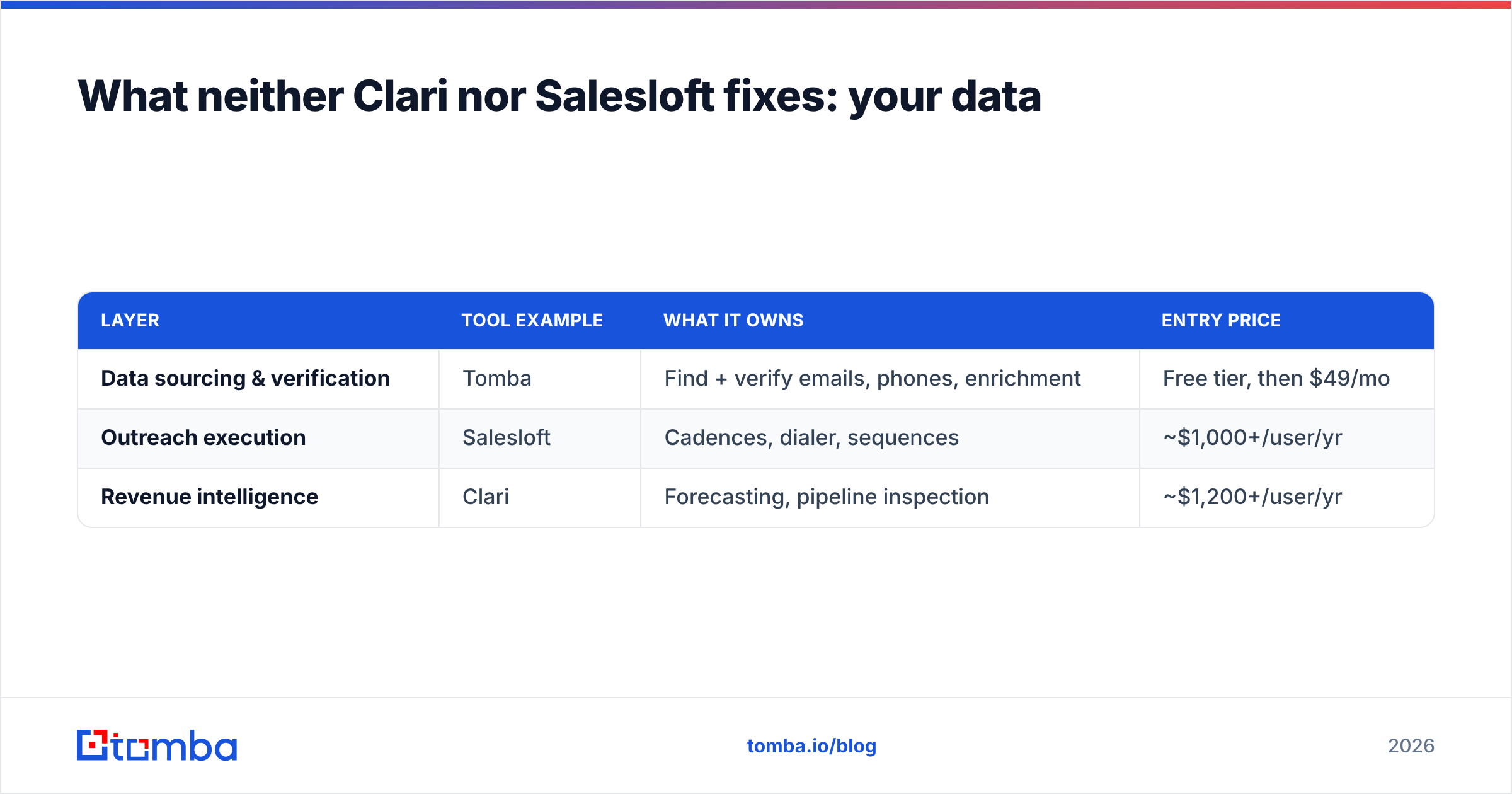
Here's how the upstream data layer compares to the two platforms in scope:
| Layer | Tool example | What it owns | Entry price |
|---|---|---|---|
| Data sourcing & verification | Tomba | Find + verify emails, phones, enrichment | Free tier, then $49/mo |
| Outreach execution | Salesloft | Cadences, dialer, sequences | ~$1,000+/user/yr |
| Revenue intelligence | Clari | Forecasting, pipeline inspection | ~$1,200+/user/yr |
The price asymmetry is the point: data hygiene is the cheapest layer in the stack and the one with the highest leverage over the other two.
Which should you buy first in 2026?#
Buy in the order your pain shows up. For most teams that sequence is: clean data → execution → intelligence.
- Stage 1 — Foundation. Get accurate, verified contacts into your CRM. This is non-negotiable and the least expensive fix. Tomba's free tier (25 searches/mo) lets you test data quality before committing; paid plans start at $49/mo — see Tomba pricing for the full breakdown.
- Stage 2 — Execution. Once reps have good data and enough volume, Salesloft turns scattered outreach into a measurable system.
- Stage 3 — Intelligence. When you have multiple segments, real deal volume, and a CRO accountable to a board, Clari makes the forecast defensible.
Buying Clari before you have clean data and consistent rep activity is like installing a high-end speedometer in a car with no engine — you'll get a very accurate reading of zero. And buying any premium platform on top of dirty data just makes you confidently wrong, faster.
The bottom line#
Clari and Salesloft aren't rivals so much as neighbors on the revenue assembly line: Salesloft generates the activity, Clari interprets it, and both depend on contact data neither one creates. Choose based on which gap is costing you deals this quarter — execution or forecasting — and don't be surprised if the honest answer eventually involves both.
But start where the leverage is highest and the cost is lowest. Before you spend five or six figures making outreach and forecasting smarter, make sure the contacts underneath are real. Start free with the Tomba Email Finder — find and verify the emails and phone numbers that every cadence and every forecast quietly depends on, then let Salesloft and Clari do their jobs on data you can actually trust.
// get started
Find, verify and enrich your first contacts today
Start on the free plan with 25 searches a month, then scale when your team is ready.
Free plan · No credit card required · GDPR & CCPA
// about the author