Clay vs Lemlist 2026: Which B2B Tool Wins for GTM Teams?
Clay automates data enrichment and Lemlist runs the outreach. Here's an honest 2026 breakdown of features, pricing, and where each tool actually fits your stack.
Clay and Lemlist get compared constantly, but they solve different halves of the same problem. Clay builds and enriches your lead list. Lemlist sends the emails. If you're trying to pick one as a replacement for the other, you'll end up disappointed — they're complements more often than competitors. This breakdown shows where each one earns its price, where they overlap, and how to wire them together without overpaying.
TL;DR#
- Clay is a data orchestration tool. It pulls from 100+ enrichment sources, runs waterfalls, and uses AI to research accounts. It is not primarily a sender.
- Lemlist is a cold outreach platform. Multichannel sequences (email + LinkedIn + calls), built-in warmup, and deliverability tooling are its core.
- They overlap only at the edges — Lemlist has light enrichment, Clay can trigger sends — but neither replaces the other cleanly.
- Pricing scales very differently: Clay charges by credits that disappear fast on enrichment; Lemlist charges per sending seat.
- The best stack is usually both, plus a dedicated email-finder to keep verified contacts cheap and accurate before either tool touches them.
What is Clay and who is it for?#
Clay is a spreadsheet-shaped automation canvas for go-to-market data. You drop in a list of companies or people, then chain together "enrichment" steps — find the email, pull the headcount, scrape the latest funding round, ask an AI to summarize the prospect's last LinkedIn post — and Clay fills the cells automatically.
Its signature feature is the waterfall: instead of relying on one data provider, Clay queries several in sequence until one returns a hit. That raises match rates, but every provider call burns credits.
Clay fits teams that:
- Build custom lead lists from messy inputs (a list of domains, a CSV of names, a scraped audience).
- Run account research at scale — AI prompts that read a website and score fit.
- Have a RevOps or growth engineer who enjoys building workflows rather than clicking through a UI.
It is overkill if you just want to load 500 known contacts and email them. That's where the confusion with Lemlist starts.

What is Lemlist and who is it for?#
Lemlist is a cold outreach platform built around multichannel sequences. You write an email, add a LinkedIn connection step, maybe a call task, and Lemlist drips them out on a schedule with conditional logic ("if they reply, stop; if they open twice, send a follow-up").
What sets Lemlist apart from a generic sequencer:
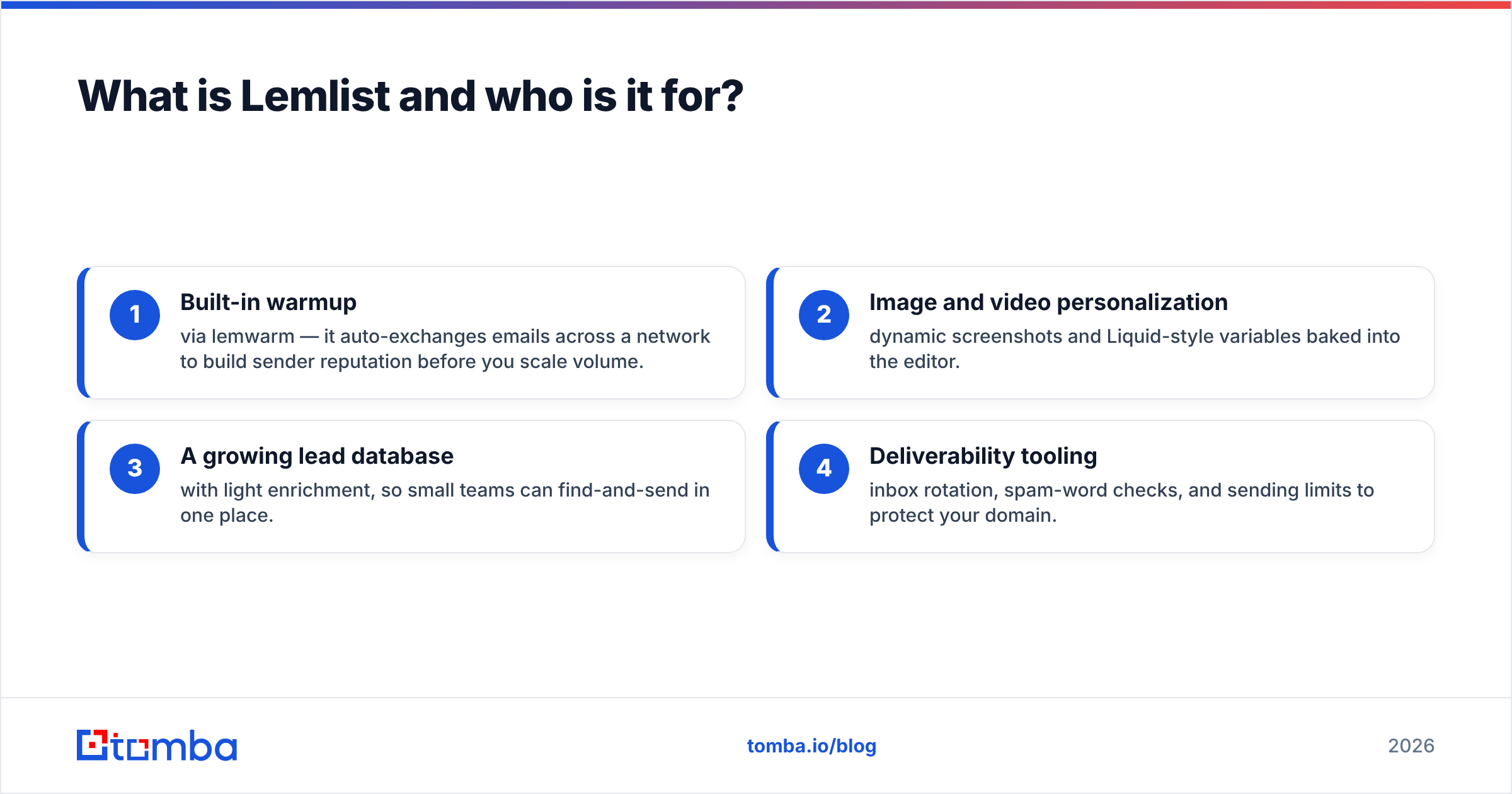
- Built-in warmup via lemwarm — it auto-exchanges emails across a network to build sender reputation before you scale volume.
- Image and video personalization — dynamic screenshots and Liquid-style variables baked into the editor.
- A growing lead database with light enrichment, so small teams can find-and-send in one place.
- Deliverability tooling — inbox rotation, spam-word checks, and sending limits to protect your domain.
Lemlist fits founders and SDR teams who already know who they want to reach and need a reliable, personalized way to contact them. It is weak as a data engine — its enrichment is convenient, not comprehensive.
Clay vs Lemlist: the core comparison#
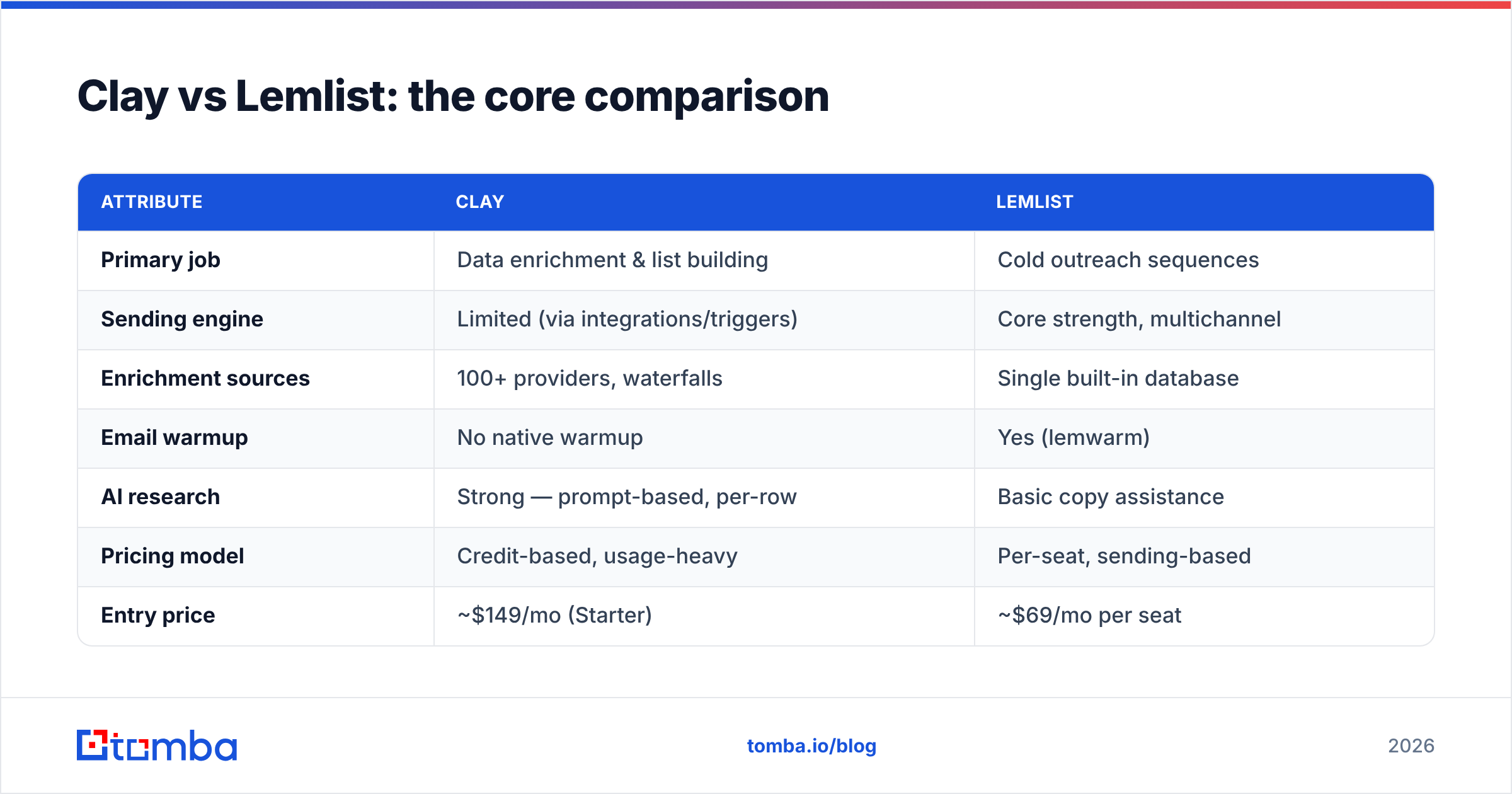
Here's the honest side-by-side. Note that several rows are "not the point" rather than "bad" — each tool is strong exactly where the other is thin.
| Attribute | Clay | Lemlist |
|---|---|---|
| Primary job | Data enrichment & list building | Cold outreach sequences |
| Sending engine | Limited (via integrations/triggers) | Core strength, multichannel |
| Enrichment sources | 100+ providers, waterfalls | Single built-in database |
| Email warmup | No native warmup | Yes (lemwarm) |
| AI research | Strong — prompt-based, per-row | Basic copy assistance |
| Pricing model | Credit-based, usage-heavy | Per-seat, sending-based |
| Entry price | ~$149/mo (Starter) | ~$69/mo per seat |
| Best for | RevOps, growth engineers | SDRs, founders, agencies |
| Learning curve | Steep | Gentle |
The takeaway: if your bottleneck is finding and qualifying leads, Clay wins. If your bottleneck is contacting them at volume without landing in spam, Lemlist wins. For pricing transparency on a finder-and-verifier alternative, compare both against Tomba pricing before you commit budget.
Is Clay better than Lemlist for finding leads?#
Yes — for raw data work, Clay is in a different weight class. Its waterfall enrichment, native integrations with sources like the major B2B databases, and per-row AI make it the better choice when you're constructing a list from scratch or enriching an account map.
But "better at data" comes with two costs:
- Credit burn is real. A waterfall that queries five providers per row can drain a monthly allotment in a single large list. Teams routinely underestimate this.
- Complexity. Clay is powerful because it's programmable, which means someone has to program it. Non-technical reps stall.
Lemlist's enrichment exists, but it's a convenience layer, not a serious data engine. If you tried to replace Clay with Lemlist's database, your match rates and field coverage would drop noticeably.
A cheaper middle path for the "just get me verified emails" job is a dedicated finder. Tomba's email finder and data enrichment cover the find-and-verify step at a flat, predictable price, so you reserve Clay credits for the genuinely creative enrichment that only Clay can do.
Is Lemlist better than Clay for sending campaigns?#
Yes, and it isn't close. Clay can trigger sends through integrations, but it has no warmup, no inbox rotation, and no deliverability guardrails. Sending cold volume straight from Clay is a fast way to torch a domain.
Lemlist was built for this. lemwarm, sending limits, spam checks, and multichannel steps are the entire point. According to peer reviews on G2, deliverability and ease of use are its most-cited strengths.
That said, no sender saves you from a bad list. Lemlist will faithfully deliver your email to an address that bounces — and bounces destroy email deliverability faster than almost anything. Which is why list hygiene belongs upstream, before Lemlist ever sees the contact. Run your addresses through an email verifier first; a sub-2% bounce rate is the difference between the inbox and the spam folder.
How do Clay and Lemlist pricing compare in 2026?#
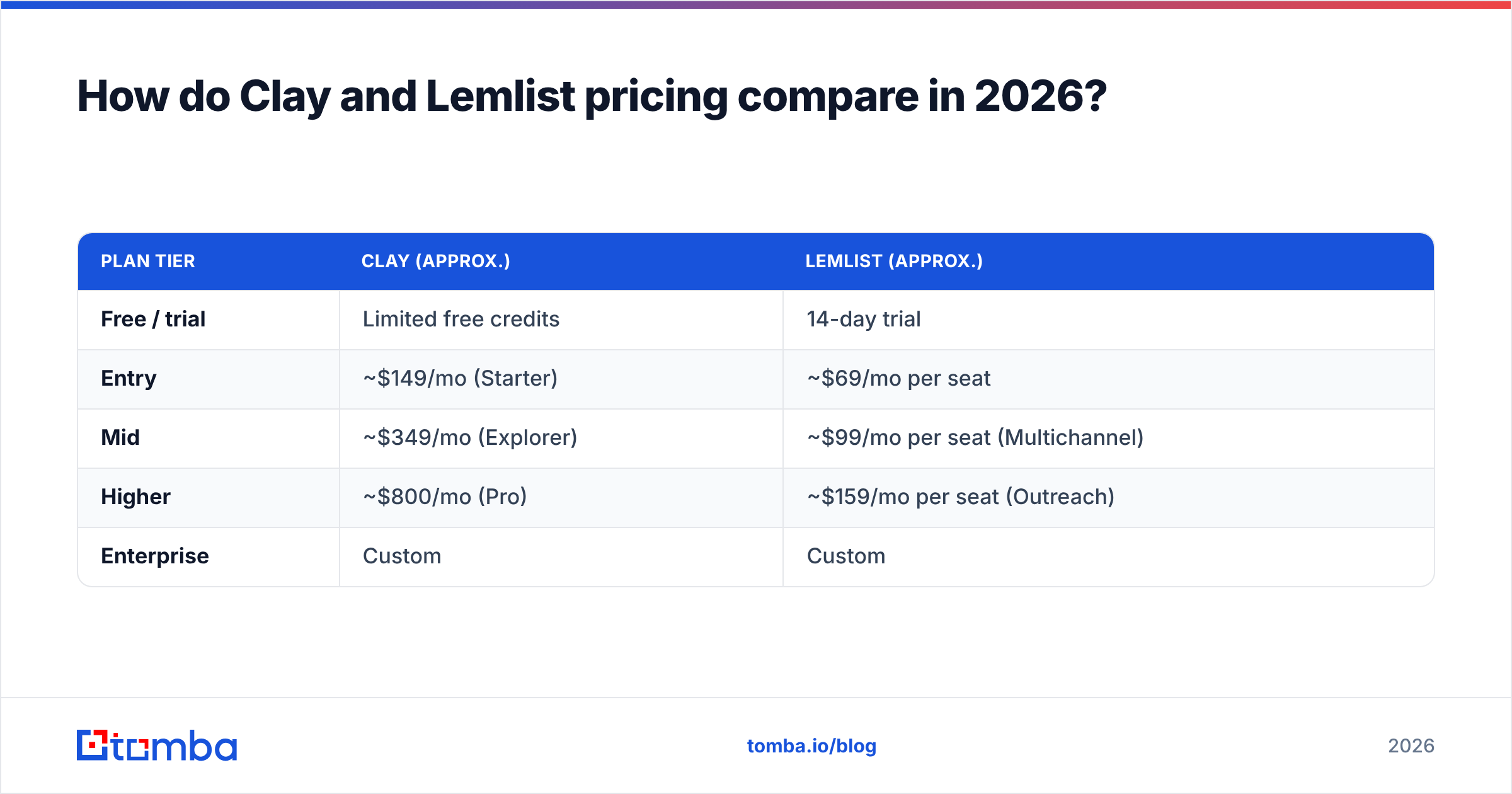
This is where teams get surprised, so let's be concrete. The two tools price on completely different axes.
| Plan tier | Clay (approx.) | Lemlist (approx.) |
|---|---|---|
| Free / trial | Limited free credits | 14-day trial |
| Entry | ~$149/mo (Starter) | ~$69/mo per seat |
| Mid | ~$349/mo (Explorer) | ~$99/mo per seat (Multichannel) |
| Higher | ~$800/mo (Pro) | ~$159/mo per seat (Outreach) |
| Enterprise | Custom | Custom |
Two things to internalize:
- Clay's cost is variable. Your bill is really a function of how many enrichment calls you make. Heavy users on a "cheap" tier can still run out of credits mid-month and need to top up.
- Lemlist's cost is linear per seat. Five reps means five seats. Predictable, but it climbs with headcount.
Neither price includes a serious dedicated finder/verifier. If you bolt one on at a flat rate, you stop paying premium per-credit prices for the most basic data operation — finding a verified email. That's the economic argument for keeping a tool like Tomba in the stack regardless of which of these two you choose.
Should you use Clay and Lemlist together?#
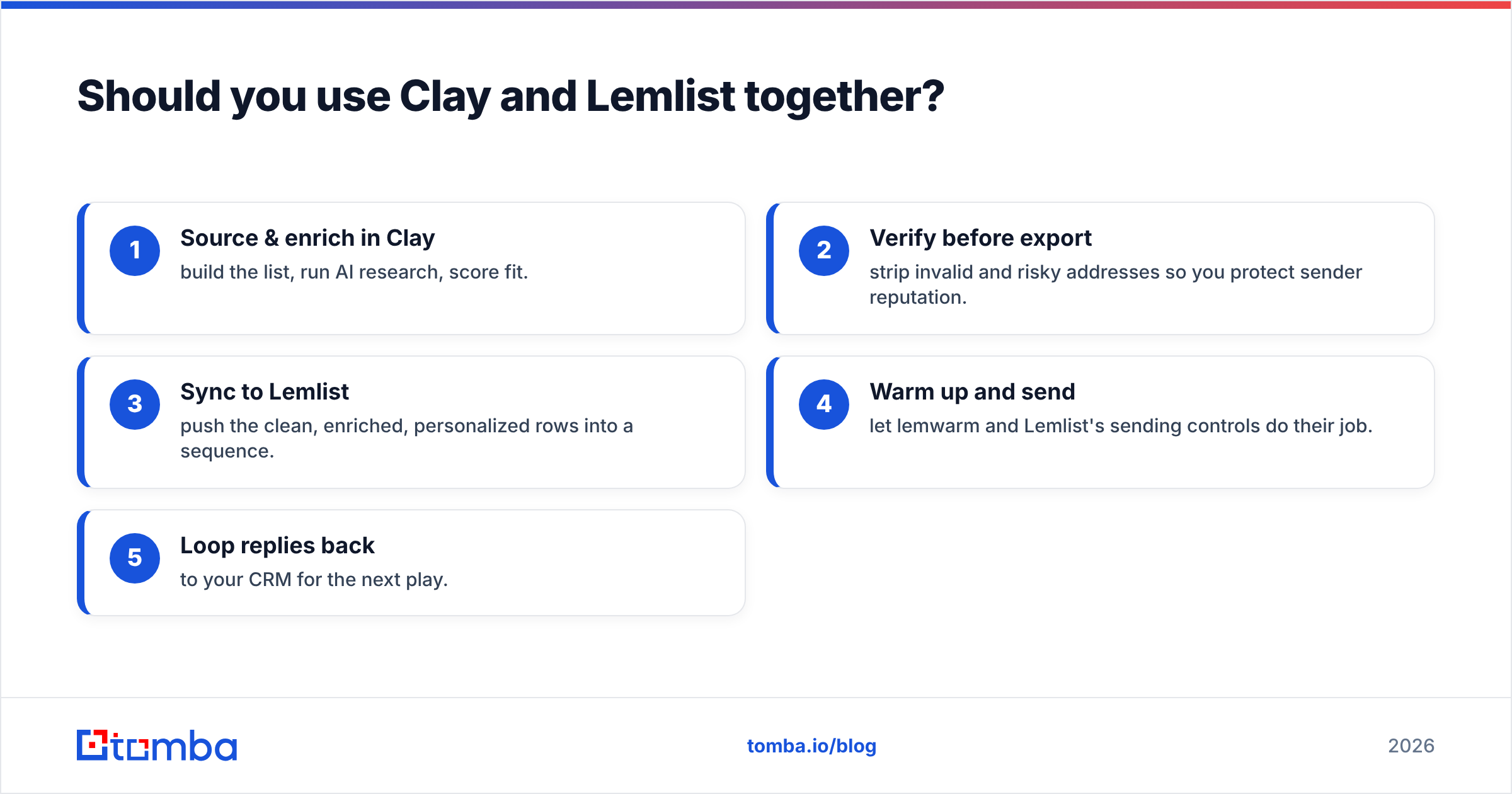
For most growth teams, the answer is yes — they form a pipeline, not a rivalry:
- Source & enrich in Clay — build the list, run AI research, score fit.
- Verify before export — strip invalid and risky addresses so you protect sender reputation.
- Sync to Lemlist — push the clean, enriched, personalized rows into a sequence.
- Warm up and send — let lemwarm and Lemlist's sending controls do their job.
- Loop replies back to your CRM for the next play.
The friction point is usually step 2. Clay can find emails, but verification quality and cost vary by source, and Lemlist will happily mail an unverified address. Inserting a dedicated finder/verifier between them keeps bounce rates low without paying Clay credit prices for routine lookups. For teams replacing a heavier all-in-one, the Apollo alternative and Clearbit alternative breakdowns show how a lean finder-plus-verifier setup compares on cost.
What are the main weaknesses of each tool?#
Buying well means knowing the downsides going in.
Clay's weak spots:
- Credit anxiety. The pricing model punishes experimentation; people hesitate to build because every run costs.
- Steep ramp. Without a technical owner, Clay sits half-used.
- Not a sender. No warmup, no deliverability safety net.
Lemlist's weak spots:
- Thin data. Its enrichment can't match a dedicated provider for coverage or accuracy.
- Per-seat cost scales with team size, not value.
- Personalization can over-promise — dynamic images are great until they feel gimmicky and hurt replies.
Neither flaw is fatal. They're just reasons the "pick one" framing fails — you end up patching the other tool's gap with something else anyway.
Which should you choose?#
Decide by your actual bottleneck, not by feature lists:
- You can't build good lists → start with Clay, add a finder/verifier to control cost.
- You have lists but poor reply and inbox rates → start with Lemlist, fix list hygiene upstream.
- You're a small team that wants both cheaply → a dedicated finder + a simple sequencer often beats paying full freight for both Clay and Lemlist on day one.
Both Clay and Lemlist are legitimately good at their core jobs. The mistake is expecting either to be the whole pipeline. Clay without a sender can't reach anyone; Lemlist without clean data mails into the void.
Where Tomba fits in this stack#
Whichever side you land on, the find-and-verify step sits underneath both tools — and it's the cheapest place to fix accuracy. Tomba handles exactly that layer: the Tomba Email Finder returns professional, verifiable email addresses by domain, name, or company at a flat, predictable price, so you stop spending Clay credits or Lemlist seats on basic lookups. Pair it with Tomba's verifier to keep bounce rates under control before Lemlist ever hits send. Start on the free tier (25 searches/month), then scale to Starter at $49/mo when your pipeline grows — and let Clay and Lemlist do what they each do best.
Sources and further reading: clay.com, lemlist.com, and verified user reviews on G2.
// get started
Find, verify and enrich your first contacts today
Start on the free plan with 25 searches a month, then scale when your team is ready.
Free plan · No credit card required · GDPR & CCPA
// about the author