8 Best Clearbit Alternatives for B2B Data Enrichment in 2026
Clearbit got folded into HubSpot and pricing went opaque. Here are the 8 best Clearbit alternatives for 2026, compared on data accuracy, enrichment depth, and price.
Clearbit Alternatives: The 8 Best B2B Enrichment Tools for 2026
TL;DR
- Clearbit is now "Breeze Intelligence" inside HubSpot. Standalone access, transparent pricing, and the old self-serve API are gone — which is why so many teams are shopping for Clearbit alternatives.
- If you mostly need accurate work emails and firmographics, a focused tool like Tomba (from $49/mo) covers 80% of what teams used Clearbit for at a fraction of the cost.
- For full enrichment + intent + ABM, look at ZoomInfo, Apollo, or Demandbase — but expect annual contracts and four-figure minimums.
- The right pick depends on one question: do you need a data point (email, company size) or a data platform (intent, scoring, workflows)?
- Always test accuracy on your own list before you commit. Vendor-published match rates rarely survive contact with your ICP.
Why are people looking for Clearbit alternatives in 2026?#
The short answer: Clearbit stopped being Clearbit. After HubSpot acquired it, the product was rebranded as Breeze Intelligence and pulled deeper into the HubSpot ecosystem. If you're not a HubSpot customer — or you want a standalone enrichment API with public pricing — the old Clearbit experience effectively no longer exists.
That triggered three practical problems for teams who relied on it:
- Pricing went opaque. The transparent, usage-based tiers were replaced by credit bundles tied to HubSpot plans. Budgeting got harder.
- Standalone API access shrank. Developers who used Clearbit purely as an enrichment endpoint now have to route through HubSpot's product surface.
- Lock-in increased. Your enrichment is now most valuable only if your CRM is also HubSpot, which is exactly the kind of dependency RevOps teams try to avoid.
None of that means the underlying data was bad. Clearbit's firmographic and technographic data was genuinely strong. But "strong data trapped inside one vendor's suite" is a different value proposition than "best-in-class enrichment I can plug in anywhere." So let's look at what you can plug in anywhere.

What should a Clearbit alternative actually do?#
Before comparing logos, get clear on the job. "Enrichment" is a bucket word covering at least four distinct tasks, and most teams only need two or three of them.
- Email finding — turn a name + domain (or a LinkedIn profile) into a verified work email. This is the highest-frequency, highest-ROI job for most outbound teams.
- Company / firmographic enrichment — fill in industry, employee count, revenue, location, and tech stack from a domain.
- Person enrichment — append title, seniority, department, and social profiles to a contact you already have.
- Intent & ABM signals — surface which accounts are researching your category right now. This is the expensive, platform-tier capability.
A focused tool nails the first three cheaply. A data platform bundles all four but charges platform prices and usually demands an annual contract. Map your needs to that split and the shortlist gets short fast. If most of your pipeline starts with "I have a name and a company, I need a real email," you're shopping for an email finder, not a six-figure intelligence suite.
What are the best Clearbit alternatives? (Comparison table)#
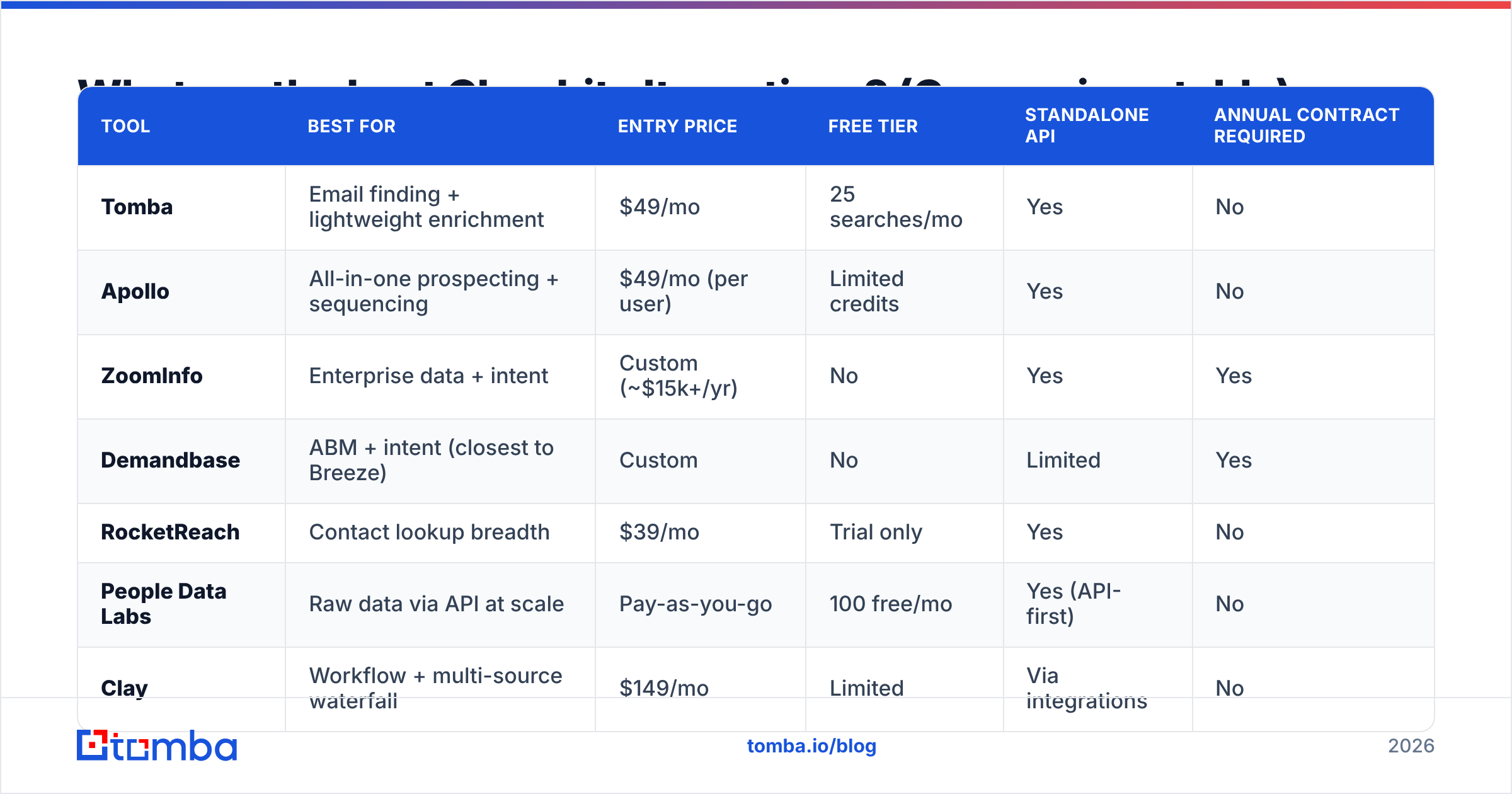
Here's the field, ranked by how well each fits the most common Clearbit use cases. Prices are list prices for the entry paid tier as of mid-2026; enterprise quotes vary.
| Tool | Best for | Entry price | Free tier | Standalone API | Annual contract required |
|---|---|---|---|---|---|
| Tomba | Email finding + lightweight enrichment | $49/mo | 25 searches/mo | Yes | No |
| Apollo | All-in-one prospecting + sequencing | $49/mo (per user) | Limited credits | Yes | No |
| ZoomInfo | Enterprise data + intent | Custom (~$15k+/yr) | No | Yes | Yes |
| Demandbase | ABM + intent (closest to Breeze) | Custom | No | Limited | Yes |
| RocketReach | Contact lookup breadth | $39/mo | Trial only | Yes | No |
| People Data Labs | Raw data via API at scale | Pay-as-you-go | 100 free/mo | Yes (API-first) | No |
| Clay | Workflow + multi-source waterfall | $149/mo | Limited | Via integrations | No |
| FullContact | Identity resolution | Custom | Trial | Yes | Sometimes |
A few honest notes on this table:
- Tomba and Apollo both start at $49 but solve different problems. Tomba is a precision email-and-data layer you can call from anywhere; Apollo is a full sales-engagement platform that happens to include a database.
- ZoomInfo and Demandbase are the "platform" answer — richest data, intent included, but you'll sign a contract and onboard for weeks.
- People Data Labs and Clay are builder tools: PDL gives you raw data via API, Clay orchestrates many sources into a waterfall. Powerful, but you're assembling the solution yourself.
Tomba vs Clearbit: the focused-tool case#
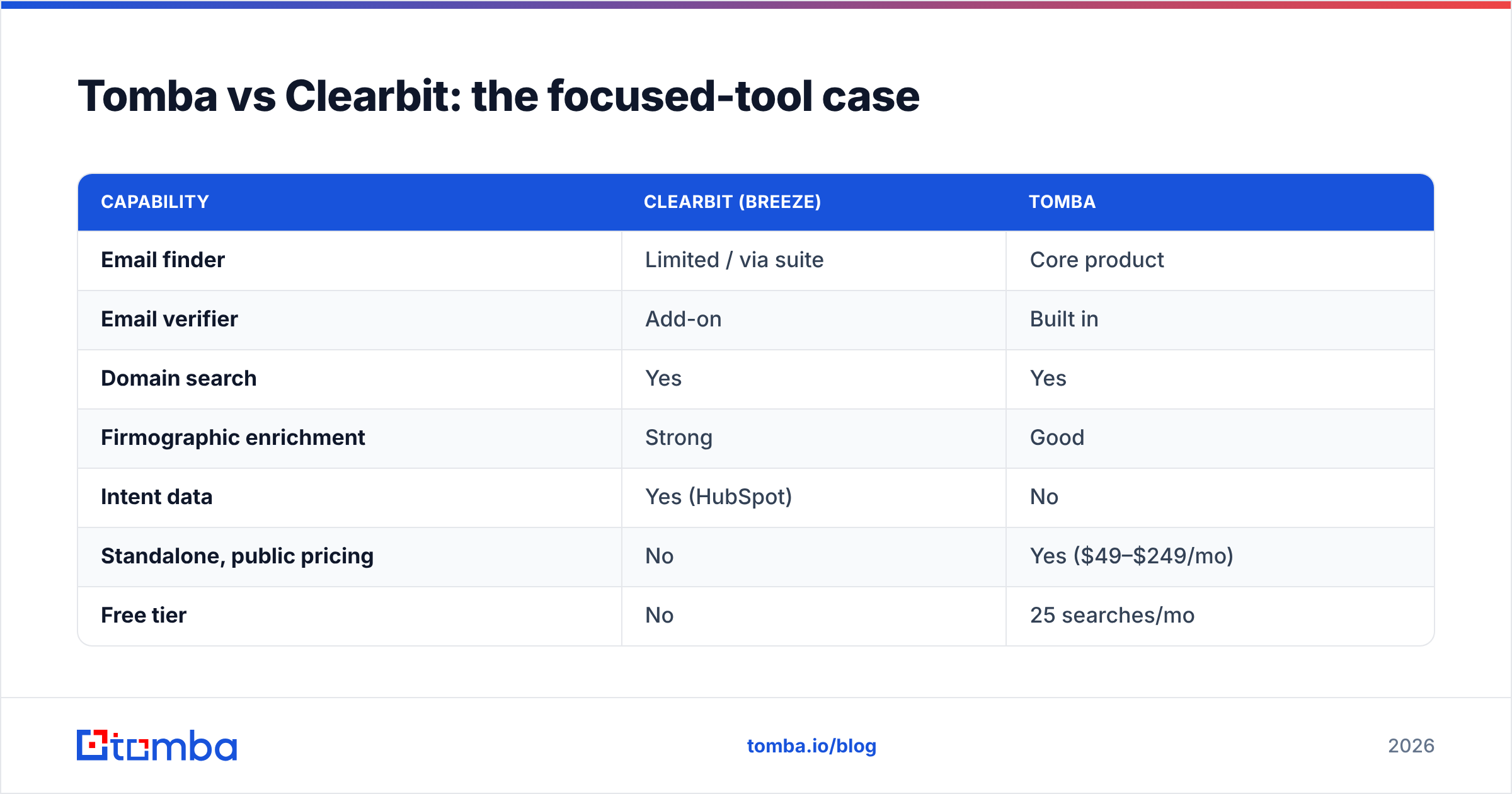
If your real need is "accurate emails plus enough company data to personalize," Tomba is the most direct Clearbit replacement. It does the high-frequency jobs — find emails, verify emails, and run domain search across a company — without making you adopt a CRM or sign an annual deal.
| Capability | Clearbit (Breeze) | Tomba |
|---|---|---|
| Email finder | Limited / via suite | Core product |
| Email verifier | Add-on | Built in |
| Domain search | Yes | Yes |
| Firmographic enrichment | Strong | Good |
| Intent data | Yes (HubSpot) | No |
| Standalone, public pricing | No | Yes ($49–$249/mo) |
| Free tier | No | 25 searches/mo |
| CRM lock-in | HubSpot-centric | None |
The trade is straightforward: you give up native intent data and a deep ABM layer. In exchange you get transparent Tomba pricing, a clean email finder API, and no obligation to live inside one CRM. For outbound and lead-gen teams, that trade is usually a win — intent data is the part of Clearbit most teams paid for but rarely operationalized.
You can also fold in data enrichment and bulk lead generation when you need to process a list rather than a single contact, which covers the "enrich my whole CRM" job that sent people to Clearbit in the first place.
How accurate is the data, really?#
Accuracy is where comparisons get slippery, because every vendor quotes a flattering number against a list that favors them. Treat published match rates as marketing until you've run your own test.
Here's a fair way to benchmark any Clearbit alternative before you buy:
- Pull a sample of 100–200 real contacts from your ICP — not random names, your actual target personas.
- Run them through each tool's finder/enricher using the free tier or trial.
- Measure two things separately: coverage (how many got any result) and accuracy (how many results were correct on verification).
- Cross-check emails by sending a verification pass — a tool that returns a syntactically valid but dead address is worse than one that returns nothing.
- Weight by recency. B2B data decays ~2–3% per month as people change jobs, so a tool that re-verifies frequently beats one with a bigger but staler database.
The reason this matters: a 95% "coverage" stat means nothing if a third of those addresses bounce. What you actually care about is deliverable hits. Tools that pair finding with email verification and catch-all verification tend to win on that real-world metric, even when their headline coverage number looks lower than a competitor's. For more on how providers source and refresh records, vendor transparency pages like Tomba's data sources explainer are worth reading before you commit.

When is a full platform (ZoomInfo, Demandbase) worth it?#
Sometimes you genuinely need the platform, not the data point. Pick a heavyweight when:
- You run account-based marketing and need intent signals to prioritize accounts in real time. This is Demandbase and 6sense territory, and it's the closest match to what Breeze Intelligence is becoming.
- You have a large RevOps team that will actually build scoring models, territory plans, and routing on top of the data. Per G2 reviews, platforms shine when there's a dedicated operator; they gather dust otherwise.
- Compliance and data provenance are board-level concerns. Enterprise vendors offer contractual data-sourcing guarantees that smaller tools may not.
The cost of that power is real: expect annual commitments starting in the low five figures, multi-week onboarding, and seat-based pricing that punishes you for adding light users. If you can't name the specific workflow that justifies it, you probably don't need it yet. Most teams over-buy here — they pay platform prices for a job a focused enrichment layer would have done.
What about Apollo, RocketReach, and Clay?#
These three come up constantly in Clearbit alternative searches, so a quick orientation:
- Apollo is the popular all-in-one. Database + sequencing + dialer in one seat-priced product. Great if you want one tool for the whole motion; less ideal if you want a clean data layer you can pipe into your own stack. See how a focused finder compares as an Apollo alternative.
- RocketReach is strong on contact breadth, especially personal and direct-dial coverage. Pricing starts low but scales by lookups. Compare it as a RocketReach alternative if email accuracy is your priority.
- Clay isn't a database — it's an orchestration layer that runs a "waterfall" across many providers (including some on this list) and picks the best result per row. Incredibly flexible, but you're paying to assemble and maintain the workflow yourself, and per-credit costs add up.
A common, cost-effective pattern in 2026: use Clay (or your own scripts) to orchestrate, and plug a precise, affordable finder like Tomba in as one of the waterfall sources via the email finder API. You get platform-style flexibility without platform-style invoices.
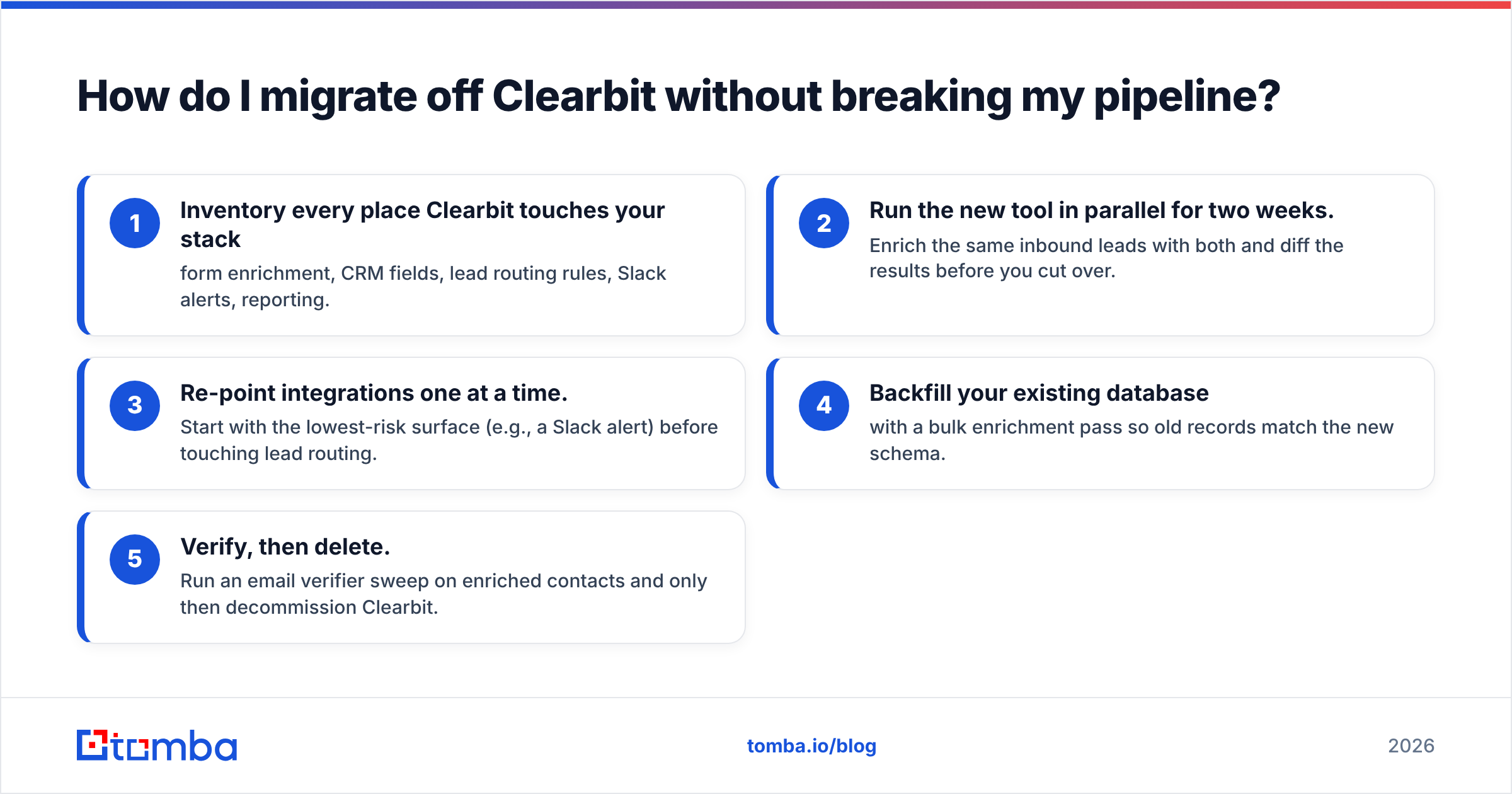
How do I migrate off Clearbit without breaking my pipeline?#
Switching enrichment providers sounds scary because it touches your CRM, your forms, and your routing. It doesn't have to be. A safe migration looks like this:
- Inventory every place Clearbit touches your stack — form enrichment, CRM fields, lead routing rules, Slack alerts, reporting.
- Run the new tool in parallel for two weeks. Enrich the same inbound leads with both and diff the results before you cut over.
- Re-point integrations one at a time. Start with the lowest-risk surface (e.g., a Slack alert) before touching lead routing.
- Backfill your existing database with a bulk enrichment pass so old records match the new schema.
- Verify, then delete. Run an email verifier sweep on enriched contacts and only then decommission Clearbit.
If you use HubSpot, Tomba's HubSpot integration and Zapier integration make re-pointing those workflows a configuration task rather than an engineering project. The whole migration is usually a few days of careful work, not a quarter-long project.
Which Clearbit alternative should you choose?#
Decide by job, not by brand:
- You need accurate emails + light enrichment, cheaply, with no lock-in → start with Tomba.
- You want one tool for finding and sending → Apollo.
- You need enterprise data + intent and have the team to use it → ZoomInfo or Demandbase.
- You're a builder who wants raw data or a custom waterfall → People Data Labs or Clay.
For the overwhelming majority of outbound, demand-gen, and RevOps teams, the honest answer is that Clearbit was always over-scoped for the job they actually did with it — finding and verifying business contacts. A focused tool does that better, cheaper, and without trapping your data inside someone else's CRM.
If that's you, the fastest way to find out is to test it on your own list. Spin up the free tier of the Tomba Email Finder — 25 searches a month, no card — run it against the contacts Clearbit used to enrich, and compare the deliverable hits side by side. If the accuracy holds up on your ICP (it usually does), you've just replaced an opaque platform contract with a transparent $49/mo line item. Start there, and scale into verification, domain search, and the API as your needs grow.
// get started
Find, verify and enrich your first contacts today
Start on the free plan with 25 searches a month, then scale when your team is ready.
Free plan · No credit card required · GDPR & CCPA
// about the author