Clearbit Email Verification: 2026 Guide & Alternatives
Clearbit changed a lot after the HubSpot acquisition. Here's how Clearbit email verification actually works in 2026, where it falls short, and the alternatives worth testing.

Clearbit Email Verification: What Still Works in 2026
If you bookmarked Clearbit three years ago as your go-to for cleaning a contact list, the product you remember no longer exists in the same form. Clearbit was acquired by HubSpot in late 2023 and now ships as Breeze Intelligence, folded into the HubSpot platform. That changes how — and whether — you can use Clearbit for standalone email verification today.
This guide breaks down what Clearbit email verification can and can't do in 2026, how its accuracy compares to dedicated verifiers, what it costs now that it's inside HubSpot, and which alternatives make more sense if you just need clean, deliverable email data.
TL;DR#
- Clearbit is now HubSpot Breeze Intelligence. Standalone Clearbit verification as a separate product has effectively been absorbed into HubSpot's ecosystem.
- Clearbit was always an enrichment-first tool, not a purpose-built email verifier — it infers and appends data rather than running deep SMTP checks on every address.
- For pure verification accuracy, dedicated tools like a focused email verifier generally catch more invalid and catch-all addresses.
- Pricing moved upmarket. Breeze Intelligence runs on HubSpot credits, which is overkill if all you want is to validate a list.
- Best move for most teams: use a dedicated finder-plus-verifier stack and reserve heavy enrichment platforms for when you genuinely need firmographics.
What is Clearbit email verification?#
Clearbit verification is best understood as a side effect of enrichment, not the main event. Think of it like a background check that happens to confirm your address along the way — the goal is the dossier, and the address confirmation comes free with it.
Clearbit's core job has always been enrichment: you hand it an email or a domain, and it returns company size, industry, role, location, tech stack, and social profiles. As part of building that profile, it cross-references the email against its dataset and signals whether the address looks legitimate and deliverable. That's different from a tool whose only job is to ping the mail server and tell you "this inbox exists, this one bounces."
Since the HubSpot acquisition, this capability lives inside Breeze Intelligence rather than the old standalone Clearbit dashboard and API many teams integrated years ago. If you're evaluating it fresh in 2026, you're really evaluating a HubSpot feature.

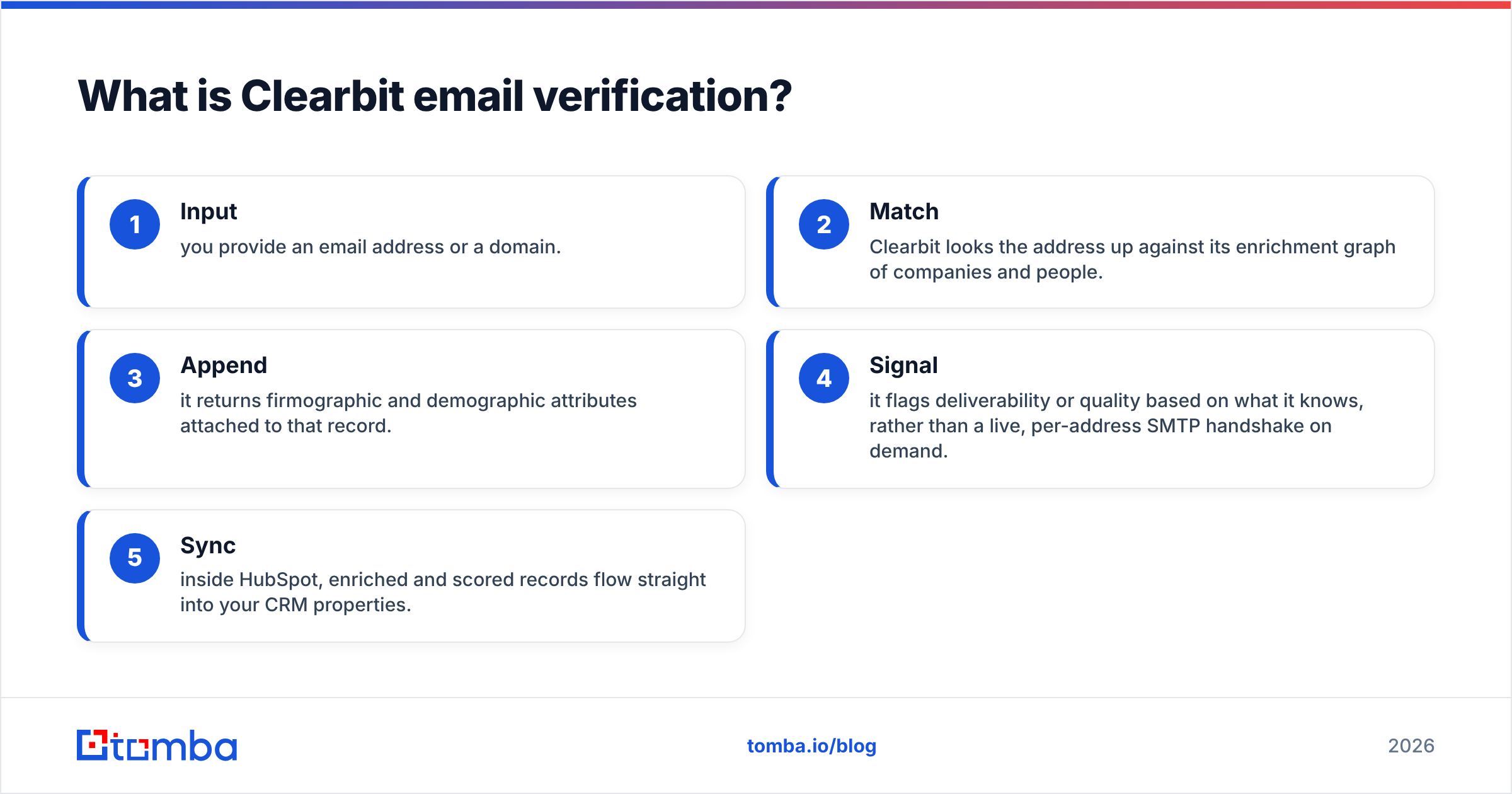
How Clearbit verification actually works#
Here are the mechanics in plain terms:
- Input — you provide an email address or a domain.
- Match — Clearbit looks the address up against its enrichment graph of companies and people.
- Append — it returns firmographic and demographic attributes attached to that record.
- Signal — it flags deliverability or quality based on what it knows, rather than a live, per-address SMTP handshake on demand.
- Sync — inside HubSpot, enriched and scored records flow straight into your CRM properties.
The strength is breadth of context. The weakness, for verification specifically, is that inference is not the same as a live mailbox check. An address can sit in an enrichment graph and still bounce today because the person left the company last week.
Is Clearbit accurate for email verification?#
Short answer: Clearbit is strong at who someone is and weaker at whether their inbox will accept mail right now. For enrichment accuracy it remains a respected name; for raw bounce-rate protection, dedicated verifiers tend to win because that single task is their entire product.
The gap matters most in three scenarios:
- Catch-all domains. Many corporate domains accept every address at the SMTP layer, so a naive check returns "valid" for inboxes that don't exist. Catching these reliably needs a specialized catch-all verifier, not a general enrichment signal.
- Recently changed roles. Enrichment graphs lag reality. Someone promoted, fired, or moved companies can stay "valid" in a dataset for weeks.
- Cold lists you didn't source. When you import a purchased or scraped list, you want live verification on each row before you ever send, not a confidence score derived from historical data.

If your deliverability depends on the result, treat any enrichment-derived "valid" flag as a starting point and run a true verification pass on top of it. Bounces above roughly 2-3% start dragging your sender reputation, and once that slides, even your good emails land in spam.
How much does Clearbit cost now?#
This is where the post-acquisition reality bites. Clearbit no longer publishes the simple per-credit verification pricing some teams used years ago. Breeze Intelligence is sold through HubSpot, priced in HubSpot credits, and is most economical when you're already a paying HubSpot customer using it for enrichment and scoring — not for one-off list cleaning.
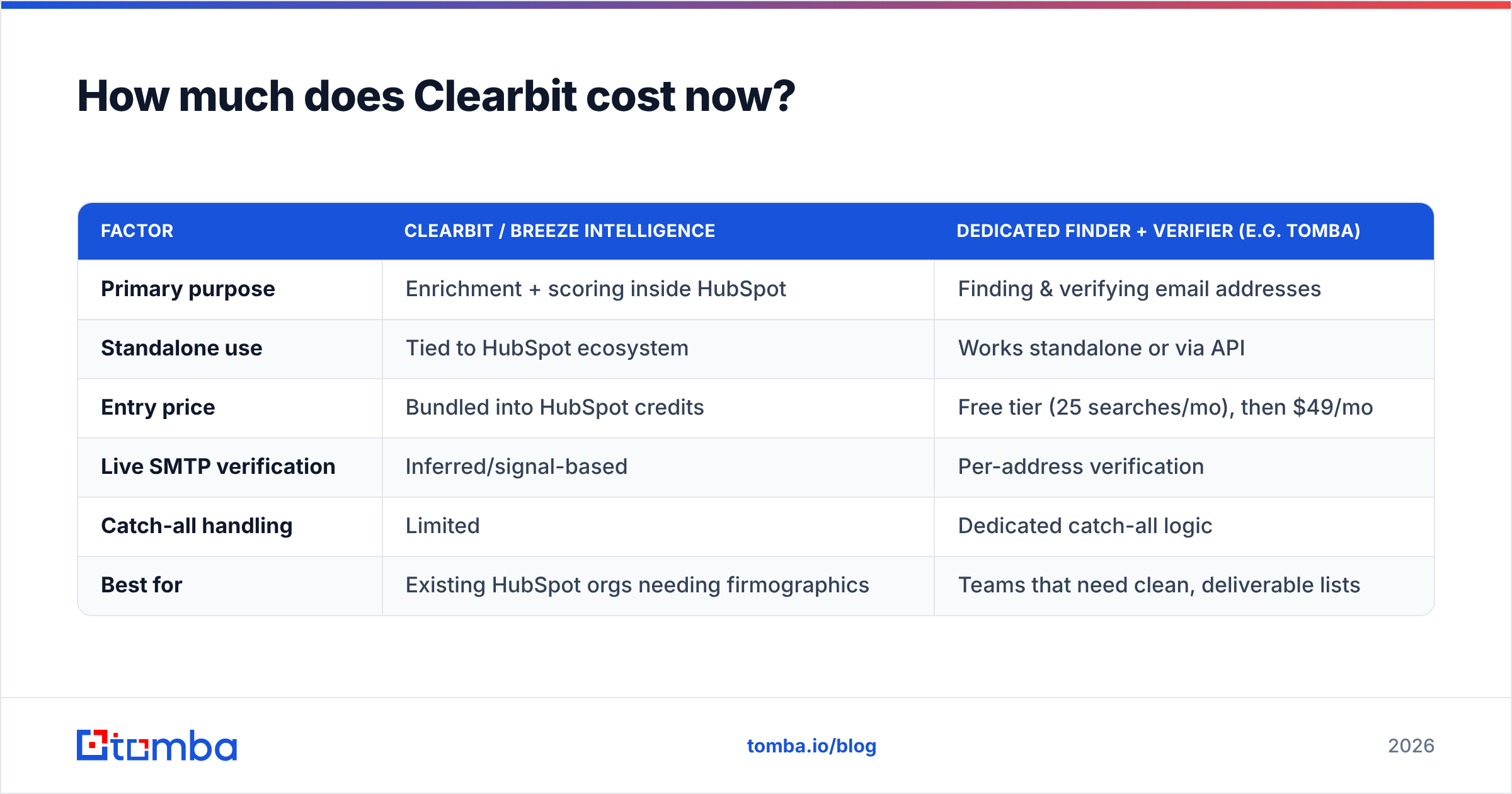
Here's how the value proposition compares for a team whose primary goal is finding and verifying B2B email addresses:
| Factor | Clearbit / Breeze Intelligence | Dedicated finder + verifier (e.g. Tomba) |
|---|---|---|
| Primary purpose | Enrichment + scoring inside HubSpot | Finding & verifying email addresses |
| Standalone use | Tied to HubSpot ecosystem | Works standalone or via API |
| Entry price | Bundled into HubSpot credits | Free tier (25 searches/mo), then $49/mo |
| Live SMTP verification | Inferred/signal-based | Per-address verification |
| Catch-all handling | Limited | Dedicated catch-all logic |
| Best for | Existing HubSpot orgs needing firmographics | Teams that need clean, deliverable lists |
The takeaway is not that Clearbit is bad — it's that you're paying for an enrichment platform whether or not you use the enrichment. If verification is 90% of what you need, you're overbuying.
What are the best Clearbit email verification alternatives?#
The right alternative depends on which job you're actually hiring the tool for. Splitting "find the address" from "verify the address" from "enrich the record" usually gets you a cheaper, more accurate stack than one platform doing all three at medium quality.
Pick by the job to be done:
- You need to find emails by name or domain. A focused email finder returns verified professional addresses from a person's name and company, with confidence scoring on each result.
- You need to validate a list you already have. A standalone email verifier runs syntax, MX, SMTP, and catch-all checks per row — this is the direct replacement for Clearbit's verification signal.
- You need every address at a company. A domain search returns the full set of known addresses and the company's email pattern in one pass.
- You genuinely need firmographics. That's where enrichment platforms like Clearbit/Breeze, Apollo, or others still earn their seat — keep them for context, not for bounce protection.
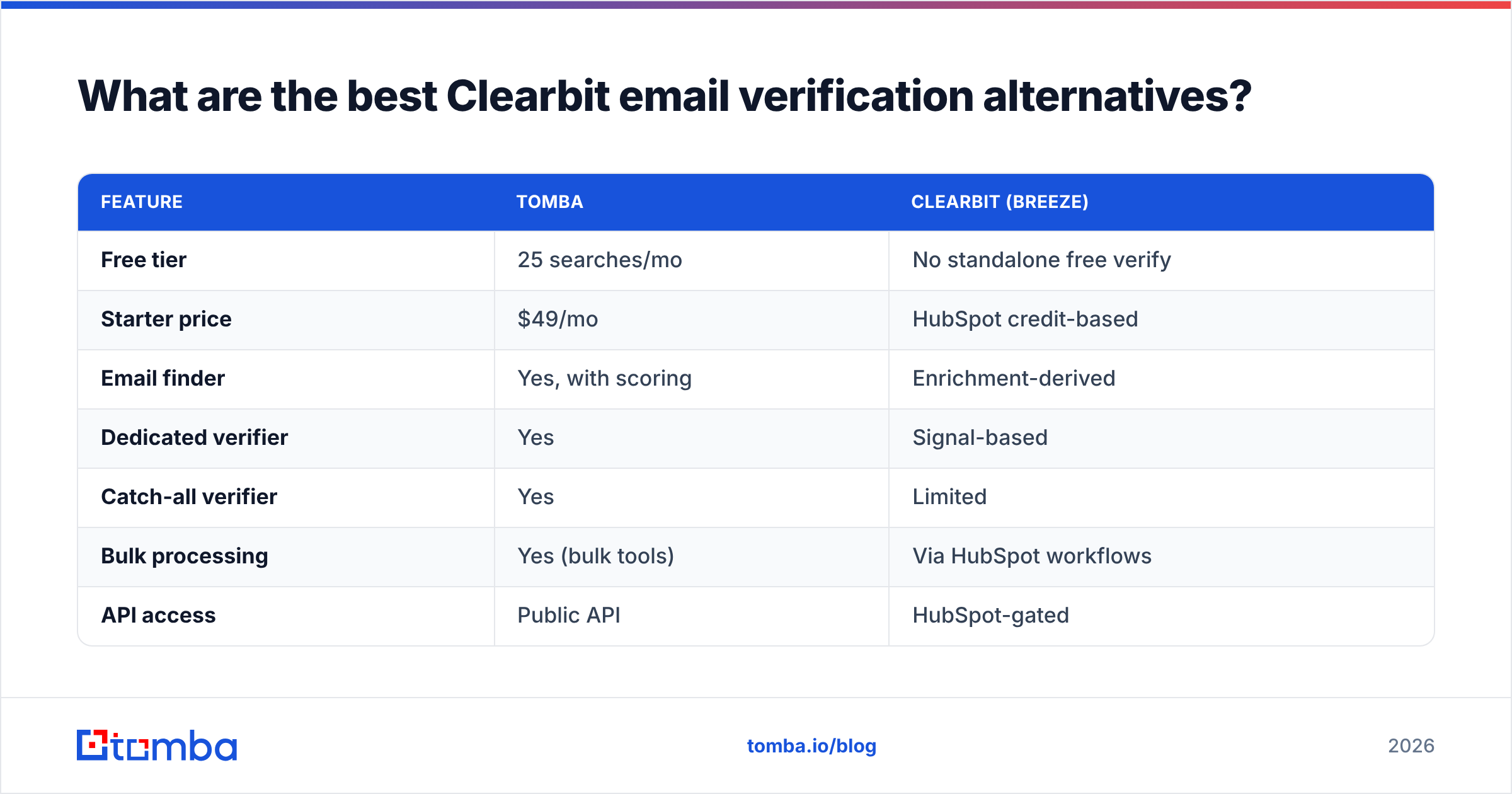
Tomba vs Clearbit at a glance#
| Feature | Tomba | Clearbit (Breeze) |
|---|---|---|
| Free tier | 25 searches/mo | No standalone free verify |
| Starter price | $49/mo | HubSpot credit-based |
| Email finder | Yes, with scoring | Enrichment-derived |
| Dedicated verifier | Yes | Signal-based |
| Catch-all verifier | Yes | Limited |
| Bulk processing | Yes (bulk tools) | Via HubSpot workflows |
| API access | Public API | HubSpot-gated |
| Standalone (no CRM lock-in) | Yes | Tied to HubSpot |

For a deeper side-by-side, the Clearbit alternative breakdown walks through migration specifics. And if you're cross-shopping enrichment-heavy platforms, the Apollo alternative comparison covers that lane.
When should you still use Clearbit?#
Clearbit/Breeze Intelligence is the right call in a narrow but real set of cases. Use it when all of these are true:
- You live in HubSpot. Your CRM, marketing, and reporting already run there, so credits are sunk cost.
- You need firmographics, not just deliverability. You're scoring leads by company size, industry, or tech stack — context an email verifier can't give you.
- You want enrichment on inbound. Form fills auto-enriched on submission is a genuinely strong Breeze use case.
- Verification is a nice-to-have, not the core need. You're fine treating the deliverability signal as one input among many.
If even two of those don't hold, you're better served by a purpose-built stack. The honest framing: Clearbit is an enrichment tool that signals deliverability, not a verifier that happens to enrich. Buy it for the first job, not the second.
How do you build a clean verification workflow without Clearbit?#
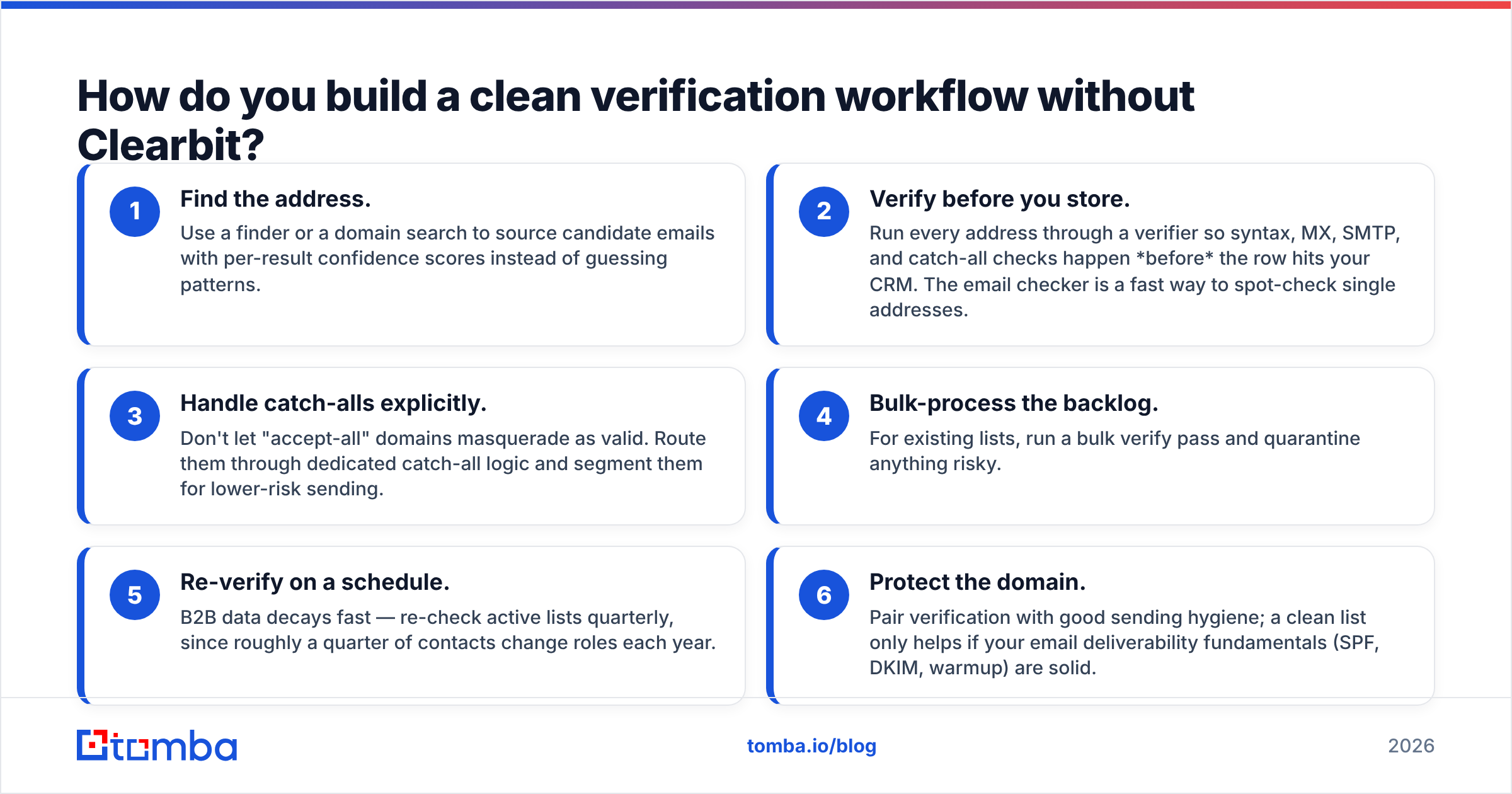
Here's a practical, vendor-neutral workflow that gives you cleaner lists than relying on an enrichment signal alone:
- Find the address. Use a finder or a domain search to source candidate emails with per-result confidence scores instead of guessing patterns.
- Verify before you store. Run every address through a verifier so syntax, MX, SMTP, and catch-all checks happen before the row hits your CRM. The email checker is a fast way to spot-check single addresses.
- Handle catch-alls explicitly. Don't let "accept-all" domains masquerade as valid. Route them through dedicated catch-all logic and segment them for lower-risk sending.
- Bulk-process the backlog. For existing lists, run a bulk verify pass and quarantine anything risky.
- Re-verify on a schedule. B2B data decays fast — re-check active lists quarterly, since roughly a quarter of contacts change roles each year.
- Protect the domain. Pair verification with good sending hygiene; a clean list only helps if your email deliverability fundamentals (SPF, DKIM, warmup) are solid.
This separation is what keeps bounce rates low. You're not trusting a single black-box "valid" flag — you're running the actual checks that mail servers run.
How accurate does verification need to be?#
Aim for a verified bounce rate under 2%. Mailbox providers like Google and Microsoft watch bounce and complaint rates closely, and the standard guidance from sources like Google's Postmaster documentation is to keep your lists clean and your spam complaints minimal. A verifier that reliably catches invalids and flags catch-alls is what gets you there; an enrichment confidence score, on its own, usually doesn't.
You can sanity-check vendor claims against third-party reviews on G2 before committing — look specifically for verification accuracy and bounce-rate feedback, not just enrichment praise, since those are different jobs.
Frequently asked questions#
Is Clearbit still available in 2026? Yes, but as part of HubSpot's Breeze Intelligence rather than the standalone product many teams integrated years ago. If you want a standalone, CRM-agnostic verifier, you'll likely look elsewhere.
Can Clearbit verify a bulk email list? Within HubSpot workflows and enrichment, yes, but it's not designed as a one-off bulk list-cleaning tool. A dedicated bulk email finder and verifier is a better fit for that task.
Does Clearbit catch catch-all domains? Its handling is limited compared to a tool with dedicated catch-all verification. If catch-all domains are common in your market, test this specifically before relying on it.
What's the cheapest way to verify emails without HubSpot? A standalone verifier with a free tier. You can validate a sample at no cost using the email verifier, then scale on a paid plan only if needed. See the full Tomba pricing for the tiers.
The bottom line#
Clearbit email verification in 2026 is really HubSpot Breeze Intelligence verification — excellent for enrichment and lead context if you already run HubSpot, but overbuilt and over-priced if your actual need is clean, deliverable email lists. The accuracy gap on live bounces and catch-all domains is the part that bites cold senders.
If verification and finding are the core of what you do, run a purpose-built stack. Start free with the Tomba Email Finder to source verified professional addresses by name or domain, layer the dedicated verifier on top to keep bounces under control, and bring in heavy enrichment platforms only when you genuinely need firmographics. You'll spend less, bounce less, and stop paying for an enrichment graph you weren't using.
// get started
Find, verify and enrich your first contacts today
Start on the free plan with 25 searches a month, then scale when your team is ready.
Free plan · No credit card required · GDPR & CCPA
// about the author