Clearbit vs 6sense (2026): Which B2B Data Tool Wins?
Clearbit enriches your data, 6sense predicts buyer intent — but they solve different problems at very different prices. Here's the honest 2026 breakdown of which fits your GTM stack, and where a leaner tool beats both.
Clearbit vs 6sense: Which B2B Data Platform Actually Fits Your 2026 Stack?
You are not really choosing between two versions of the same product. Clearbit and 6sense get lumped together because both sell "B2B data," but one enriches the records you already have and the other predicts which accounts are about to buy. Picking the wrong one wastes a five-figure contract on a problem you didn't have.
This breakdown cuts through the category noise so you can decide with your eyes open.
TL;DR#
- Clearbit (now Breeze Intelligence, owned by HubSpot) is a data enrichment and reveal layer — it fills in firmographics, identifies anonymous web traffic, and is cheapest if you already live in HubSpot.
- 6sense is an account-based intent and predictive platform — it tells you which accounts are in-market and where they are in the buying journey, at enterprise pricing.
- They overlap less than the comparison suggests. Clearbit answers "who is this?"; 6sense answers "who is ready to buy?"
- Pricing gap is enormous: Clearbit/Breeze scales from HubSpot credit packs, while 6sense typically lands in the $60k–$120k+/year range for full intent and orchestration.
- If your real need is finding and verifying contact data to start outreach, a focused tool like the Tomba Email Finder covers it for a fraction of either platform's cost.
What Is Clearbit (Breeze Intelligence) in 2026?#
Clearbit is a data enrichment engine. Think of it as a librarian who takes a half-filled index card — just a work email or a company domain — and returns the full record: company size, industry, revenue, tech stack, role, seniority, and social profiles.
Since HubSpot acquired Clearbit, the product has been folded into Breeze Intelligence, HubSpot's native data layer. That move tells you who Clearbit is really for now: HubSpot customers who want enrichment to happen automatically inside their CRM without bolting on a separate vendor.
Clearbit's three core jobs:
- Enrichment — append firmographic and demographic data to contacts and companies you already have.
- Reveal — de-anonymize website visitors by matching IP to company, so you can see which accounts browsed even if they never filled a form.
- Forms / data capture — shorten forms by auto-filling fields from the email a prospect types.
It is real-time, API-friendly, and accurate on company-level data. What it does not do is tell you whether an account is actively shopping. It describes accounts; it does not score their intent to buy.

For deeper context on how enrichment feeds your funnel, the difference between enrichment and discovery matters — see how data enrichment layers onto records you've already captured versus tools that generate net-new contacts.
What Is 6sense and How Is It Different?#
6sense is a predictive ABM platform. Where Clearbit describes an account, 6sense forecasts behavior. It ingests intent signals — third-party research activity, anonymous site visits, keyword surges, and engagement data — then uses machine learning to predict which accounts are entering a buying cycle and which stage they're in.
The analogy: Clearbit is a detailed dossier on every company. 6sense is a weather radar showing which storms are forming and where they'll hit next.
6sense's pillars:
- Intent data — aggregated signals showing accounts researching your category (and competitors).
- Predictive scoring — AI models ranking accounts by buying-stage probability.
- Orchestration — triggering ads, sales alerts, and sequences when an account heats up.
- Advertising — running account-targeted display campaigns inside the platform.
This is a revenue operations and demand-gen tool, not a data-cleanup tool. It earns its price when you have a defined total addressable market and a sales team large enough to act on prioritized accounts in real time.
Clearbit vs 6sense: The Head-to-Head Comparison#
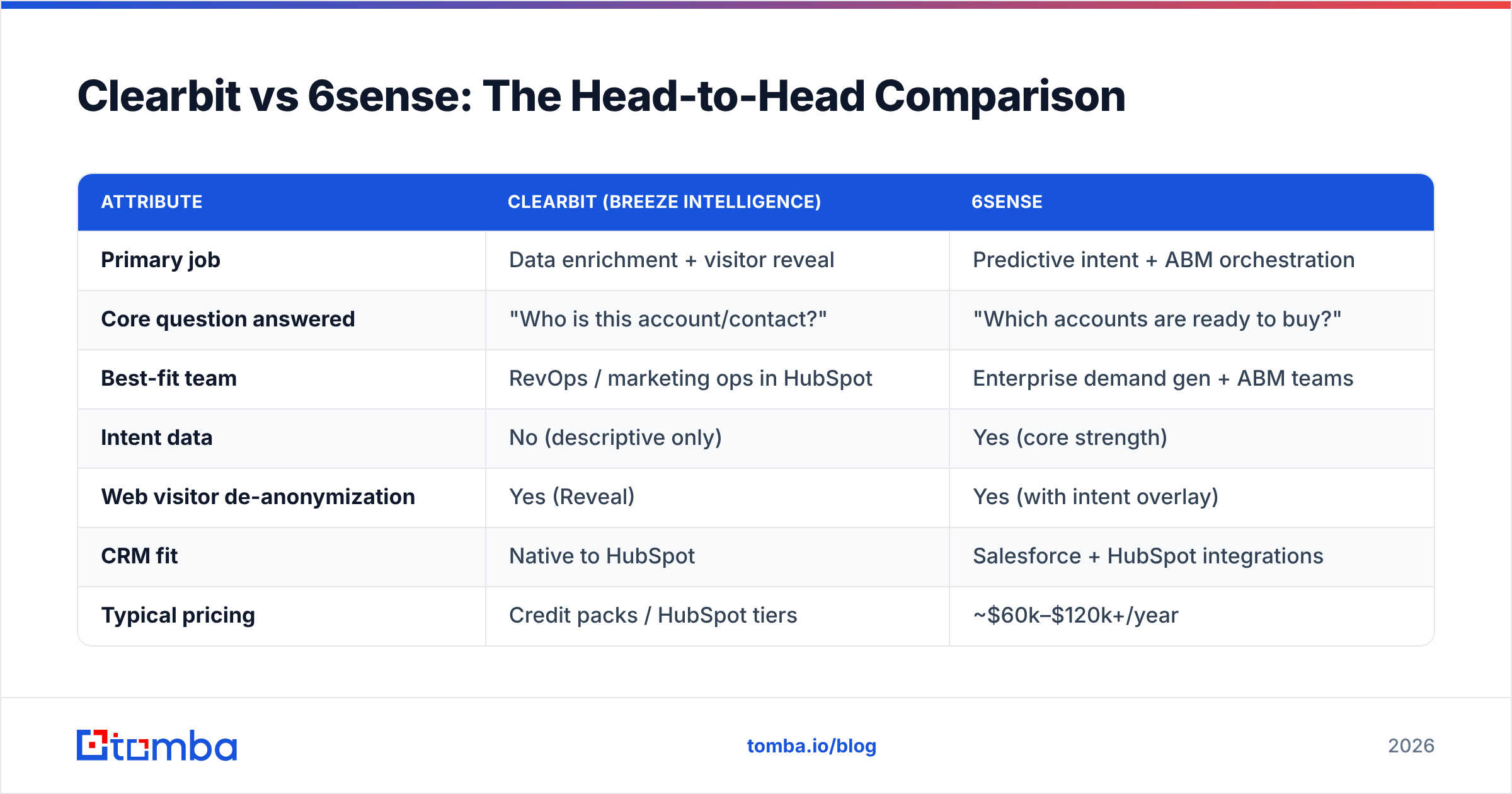
Here is where the two genuinely diverge. Read this table by your primary job-to-be-done, not by feature count.
| Attribute | Clearbit (Breeze Intelligence) | 6sense |
|---|---|---|
| Primary job | Data enrichment + visitor reveal | Predictive intent + ABM orchestration |
| Core question answered | "Who is this account/contact?" | "Which accounts are ready to buy?" |
| Best-fit team | RevOps / marketing ops in HubSpot | Enterprise demand gen + ABM teams |
| Intent data | No (descriptive only) | Yes (core strength) |
| Web visitor de-anonymization | Yes (Reveal) | Yes (with intent overlay) |
| CRM fit | Native to HubSpot | Salesforce + HubSpot integrations |
| Typical pricing | Credit packs / HubSpot tiers | ~$60k–$120k+/year |
| Time to value | Days | Weeks to months (onboarding heavy) |
| Learning curve | Low | High |
| Free / low-cost entry | Limited via HubSpot | No |
The honest read: if you put these side by side expecting a winner, you've already made a category error. A team that buys 6sense for enrichment is overpaying by 10x. A team that buys Clearbit for intent will be disappointed it has none.
Wait — let me restate that image properly so it renders:
Which One Is More Accurate?#
Accuracy depends on the data type, and this is where buyers get burned.
Clearbit is strong on firmographic and company-level data — domain, size, industry, and tech stack are reliable because they come from public and structured sources. Contact-level email accuracy is decent but not its headline feature; you'll still want to verify emails before sending at volume, because even good enrichment data decays roughly 2–3% per month as people change jobs.
6sense accuracy is a different metric entirely. Its value isn't "is this email correct" — it's "is this prediction directionally right." Intent models are probabilistic. They surface accounts showing research signals, but a percentage of those signals are noise, and the platform's value rests on whether its predictions improve your prioritization over random chance. Most teams report it does, but only when they have enough pipeline volume to validate the model.
So the accuracy question isn't "which is more accurate" — it's "accurate at what?" Clearbit: descriptive facts. 6sense: behavioral predictions. Neither replaces basic contact verification.
For a neutral third-party view of how these platforms rank on data quality, G2's enrichment and ABM categories aggregate verified user reviews worth scanning before you commit.
How Much Do Clearbit and 6sense Cost?#
Cost is the cleanest dividing line between these tools.
Clearbit / Breeze Intelligence moved to HubSpot's pricing model. You buy Breeze credits or get enrichment bundled into higher HubSpot tiers. For a mid-market team, that often lands in the low-to-mid four figures per year — predictable and credit-metered.
6sense is enterprise SaaS. Public pricing is rare because deals are negotiated, but real-world contracts for full intent, predictive scoring, and orchestration commonly run $60,000 to $120,000+ per year, with onboarding and a multi-month ramp. There's a free "6sense Free" tier with limited intent, but it's a sampler, not a working deployment.
Put plainly: the annual 6sense contract can exceed a full year of a sales rep's tooling budget. That's justifiable for an enterprise ABM motion. It's indefensible for a 10-person team that mostly needs accurate contacts to email.
This is the moment to ask the uncomfortable question: do you need a platform, or do you need contacts?
Where Does a Focused Tool Beat Both?#
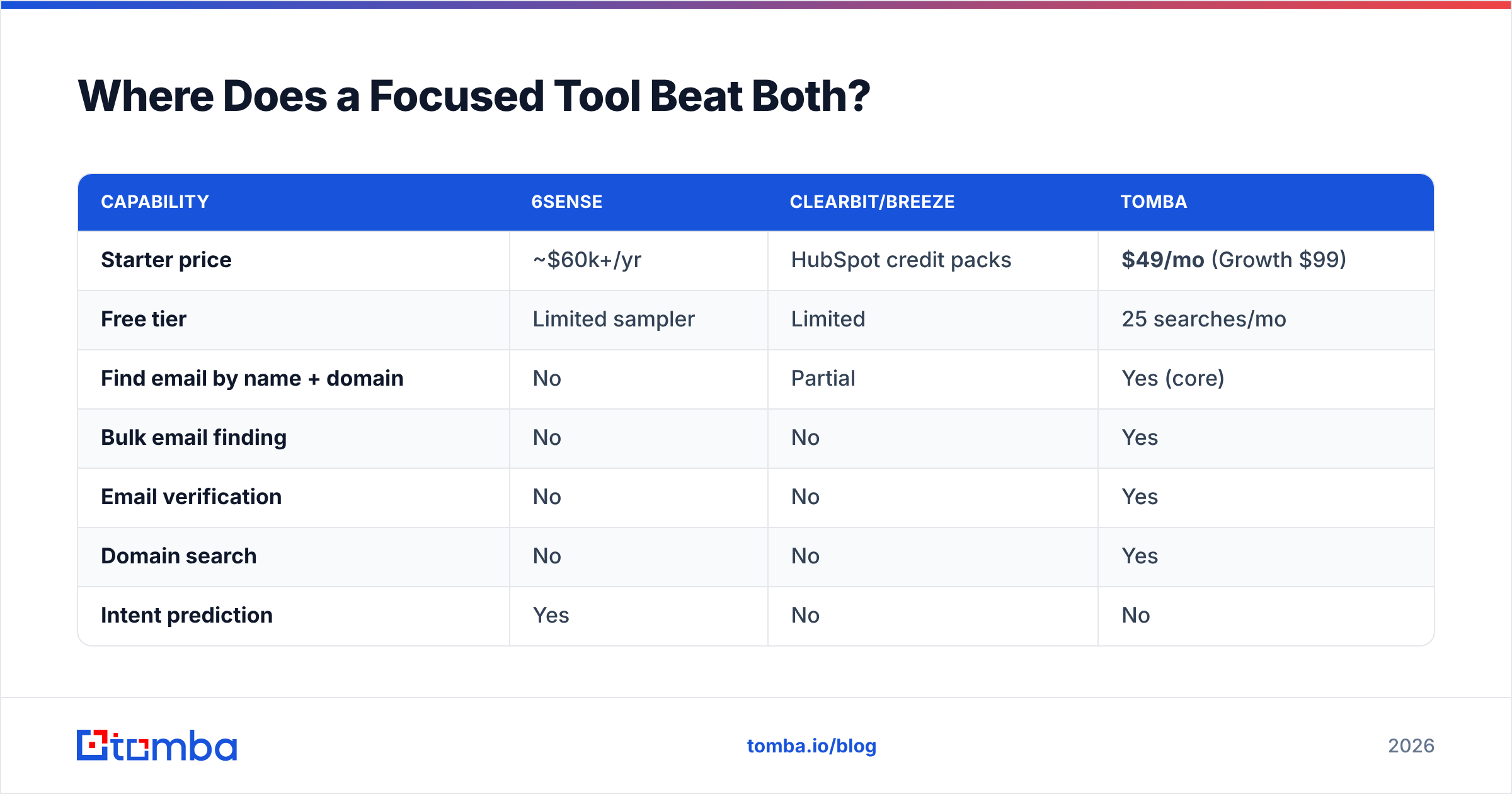
Most teams comparing Clearbit vs 6sense are actually trying to solve a more basic problem: get verified contact data so we can start conversations. Neither platform is the cheapest or fastest answer to that.
If your bottleneck is "I have a list of target companies and I need the right person's verified email," you don't need predictive intent or a HubSpot-native enrichment subscription. You need a precise, pay-for-what-you-use email finder.
That's the gap tools like Tomba fill. Compare the entry economics:
| Capability | 6sense | Clearbit/Breeze | Tomba |
|---|---|---|---|
| Starter price | ~$60k+/yr | HubSpot credit packs | $49/mo (Growth $99) |
| Free tier | Limited sampler | Limited | 25 searches/mo |
| Find email by name + domain | No | Partial | Yes (core) |
| Bulk email finding | No | No | Yes |
| Email verification | No | No | Yes |
| Domain search | No | No | Yes |
| Intent prediction | Yes | No | No |
| Time to first result | Weeks | Days | Minutes |
The point isn't that Tomba does what 6sense does — it doesn't, and shouldn't pretend to. The point is that a large share of buyers shopping these platforms have a contact-data problem dressed up as a "data intelligence" problem. Solve the cheap problem cheaply first.
When Should You Actually Choose 6sense?#
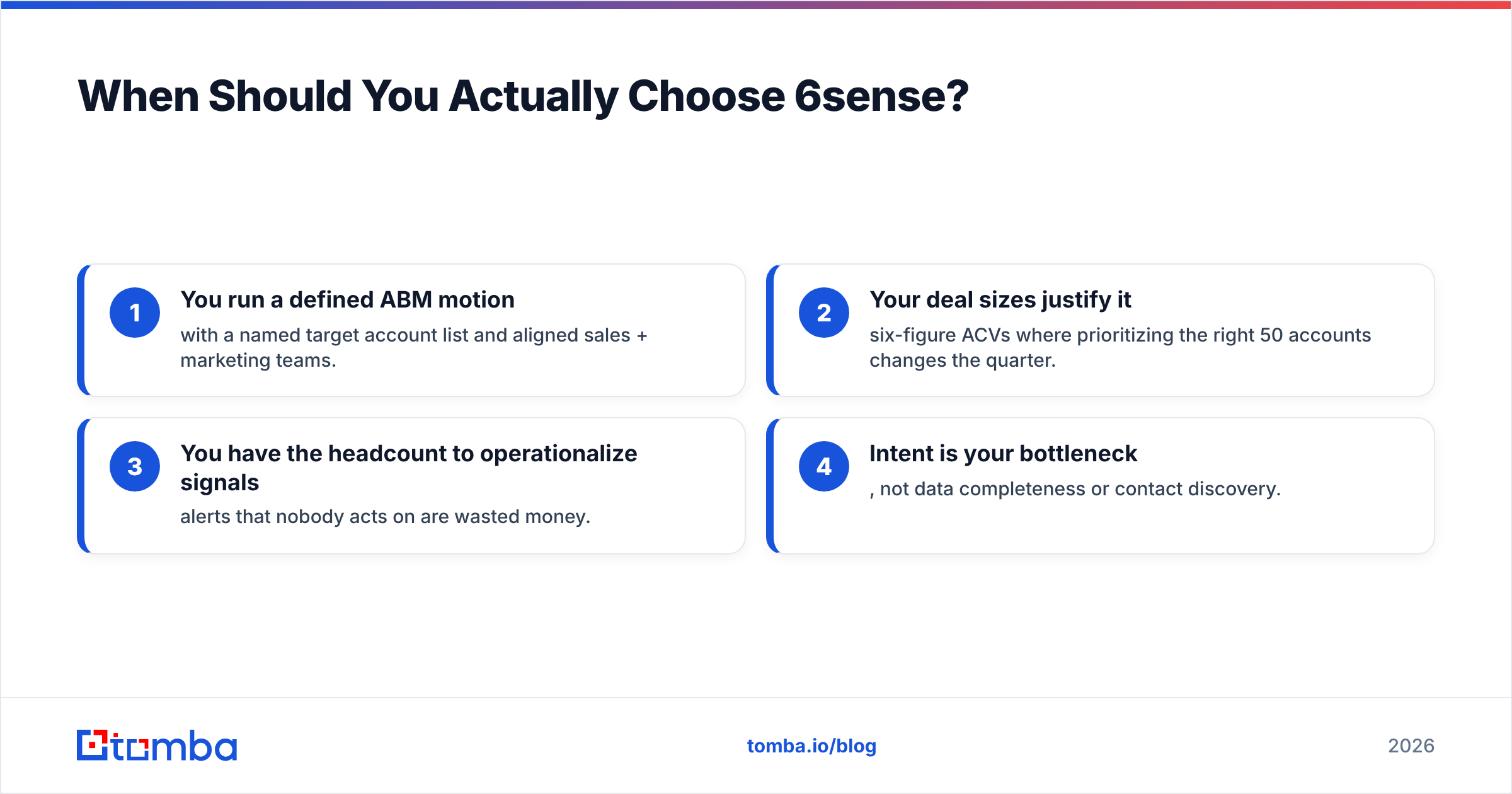
Buy 6sense when all of these are true:
- You run a defined ABM motion with a named target account list and aligned sales + marketing teams.
- Your deal sizes justify it — six-figure ACVs where prioritizing the right 50 accounts changes the quarter.
- You have the headcount to operationalize signals — alerts that nobody acts on are wasted money.
- Intent is your bottleneck, not data completeness or contact discovery.
If you can't check all four, 6sense will sit underused while the invoice recurs.
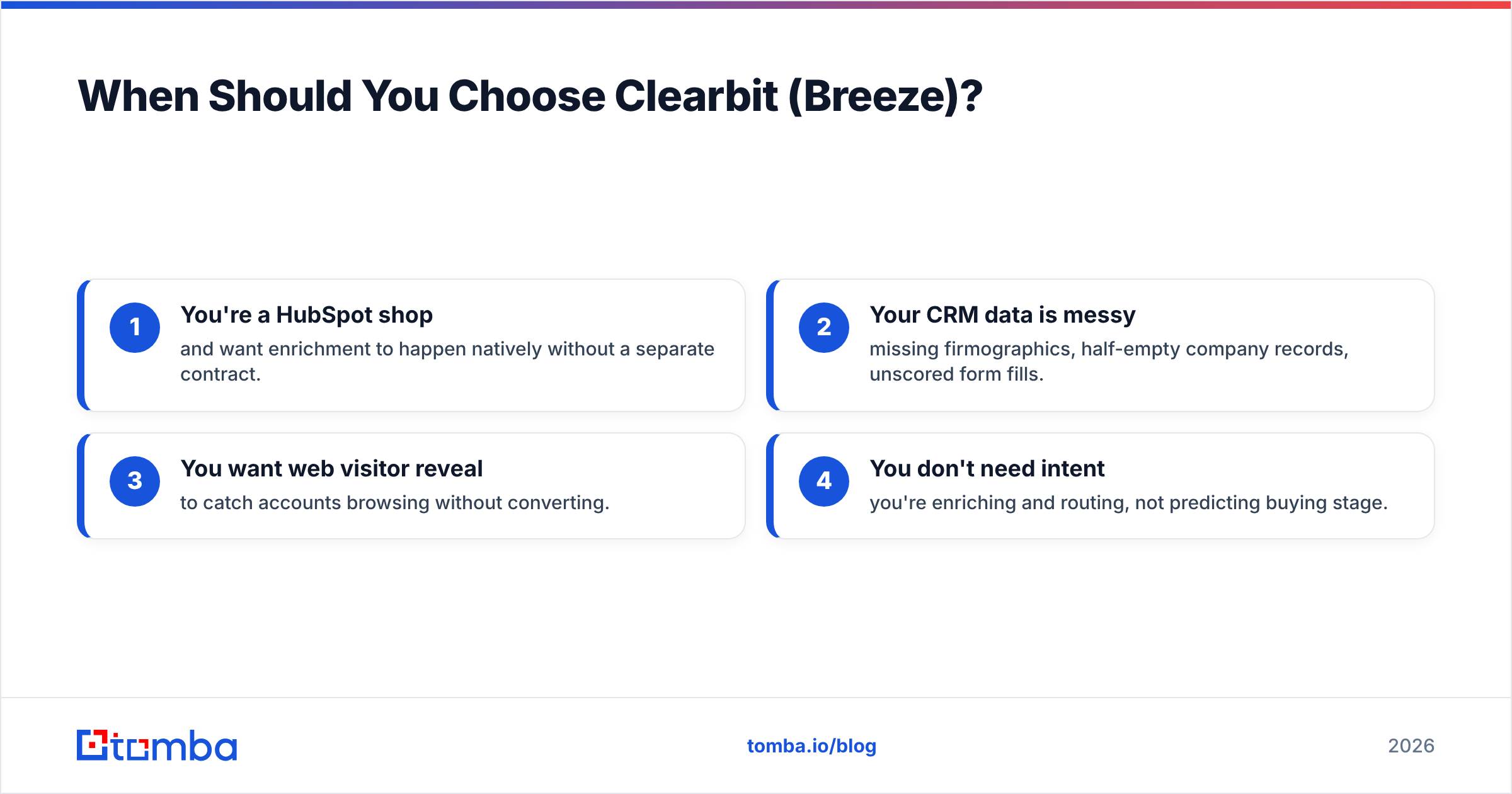
When Should You Choose Clearbit (Breeze)?#
Choose Clearbit / Breeze Intelligence when:
- You're a HubSpot shop and want enrichment to happen natively without a separate contract.
- Your CRM data is messy — missing firmographics, half-empty company records, unscored form fills.
- You want web visitor reveal to catch accounts browsing without converting.
- You don't need intent — you're enriching and routing, not predicting buying stage.
HubSpot's own documentation on Breeze Intelligence is the authoritative source on current credit pricing and limits, since the product changes faster than third-party guides.
Can You Use Them Together — or With a Cheaper Stack?#
Yes, and many enterprises do: 6sense surfaces in-market accounts, Clearbit/Breeze enriches the records, and a CRM routes them. But that's a mature, well-funded stack.
A leaner, more common 2026 setup looks like this:
- Discovery + verification: Tomba's email finder and email verifier to build and clean target contact lists.
- CRM: HubSpot or Pipedrive for pipeline.
- Enrichment (optional): Breeze if you're already in HubSpot; skip if your finder returns enough.
- Intent (optional, later): add 6sense only once you've outgrown manual prioritization.
This sequence keeps cash in the business until the expensive layers actually pay back. You can wire it together through Tomba's integrations — Zapier, HubSpot, Salesforce, and Sheets — without a six-month implementation.
The Bottom Line on Clearbit vs 6sense#
Clearbit and 6sense both belong to the B2B data world, but they answer different questions at wildly different prices. Clearbit (now Breeze Intelligence) is your enrichment and visitor-reveal layer, ideal if you live in HubSpot. 6sense is your predictive ABM engine, justified only when you run a serious account-based motion with the budget and headcount to act on intent signals.
Most teams reading this comparison don't yet need either. They need verified contacts to start the conversation — and that's a problem you can solve this afternoon, not next quarter.
Start With the Data You Can Actually Use Today#
Before you sign a five- or six-figure platform contract, prove you can fill your pipeline with accurate contacts. The Tomba Email Finder finds and verifies professional emails by name, domain, or company — starting free with 25 searches a month and scaling at a transparent $49/mo, with bulk lead generation when you're ready to grow. Build the list, start the outreach, and add Clearbit or 6sense later only when the data proves you've outgrown the basics.
// get started
Find, verify and enrich your first contacts today
Start on the free plan with 25 searches a month, then scale when your team is ready.
Free plan · No credit card required · GDPR & CCPA
// about the author