Clearout vs Apollo.io 2026: Email Data Tools Compared
Clearout vs Apollo.io in 2026: one verifies and finds emails, the other is a full prospecting engine. See accuracy, pricing, and which fits your stack.
Clearout vs Apollo.io: Which Email Data Tool Should You Run in 2026?
You are not really choosing between two versions of the same product. Clearout and Apollo.io solve different problems that happen to overlap on one screen: getting a working email address into your sequence. Pick the wrong one and you either overpay for a database you don't use, or you bolt a verification tool onto a prospecting job it was never built for.
This breakdown compares both on accuracy, data coverage, pricing, and the specific workflows each one wins. It also shows where a focused email-finding stack beats both.
TL;DR#
- Clearout is a verification-first tool. Its email verifier is its strongest feature, with a real-time SMTP check and catch-all handling. Finding emails is secondary.
- Apollo.io is an all-in-one prospecting platform: a 270M+ contact database, sequences, dialer, and CRM features. Email finding is one module among many.
- Accuracy: Clearout wins on verification confidence; Apollo wins on raw coverage but ships more stale and guessed records.
- Pricing: Clearout sells credits (pay-as-you-go available); Apollo sells per-seat plans that get expensive fast once you add export limits.
- Best fit: Clearout for cleaning lists, Apollo for building a full outbound motion, and a dedicated email finder when accuracy-per-dollar is the whole game.
What is Clearout?#
Clearout is an email verification and email-finding tool built around list hygiene. Think of it as the quality-control inspector at the end of an assembly line: it doesn't build your prospect list from scratch as well as it inspects one you already have and tells you which addresses will bounce.
Its core engine runs a multi-step validation: syntax, domain and MX records, a live SMTP handshake, and catch-all detection. That last part matters. Catch-all domains accept any address at the SMTP layer, so most tools either guess or flag them as "unknown." Clearout assigns a confidence score instead of throwing up its hands, which is why teams reach for it when a list has to be clean before it touches a sending domain.
The email-finder side exists, but it's lighter. You give it a name and domain and it returns the most likely address with a verification status attached. Useful, but it's not pulling from a deep proprietary database the way a prospecting platform does.
)
What is Apollo.io?#
Apollo.io is a full go-to-market platform. It pairs a large B2B contact database (270M+ contacts, by Apollo's own numbers) with sequencing, a dialer, email sending, deal management, and enrichment. The email finder is a feature inside a much bigger machine.
If Clearout is the inspector, Apollo is the whole factory: it sources the raw material (contacts), assembles the product (sequences and tasks), and ships it (sending and calling) from one dashboard. That breadth is the selling point and the trap. You're paying for a platform, and the email data quality rides along with everything else rather than being the thing the company obsesses over.
Apollo's database is crowd-enriched and community-sourced, which means coverage is broad but freshness varies. You'll find contacts that other tools miss, alongside records that haven't been touched in 18 months.
How do Clearout and Apollo.io compare at a glance?#
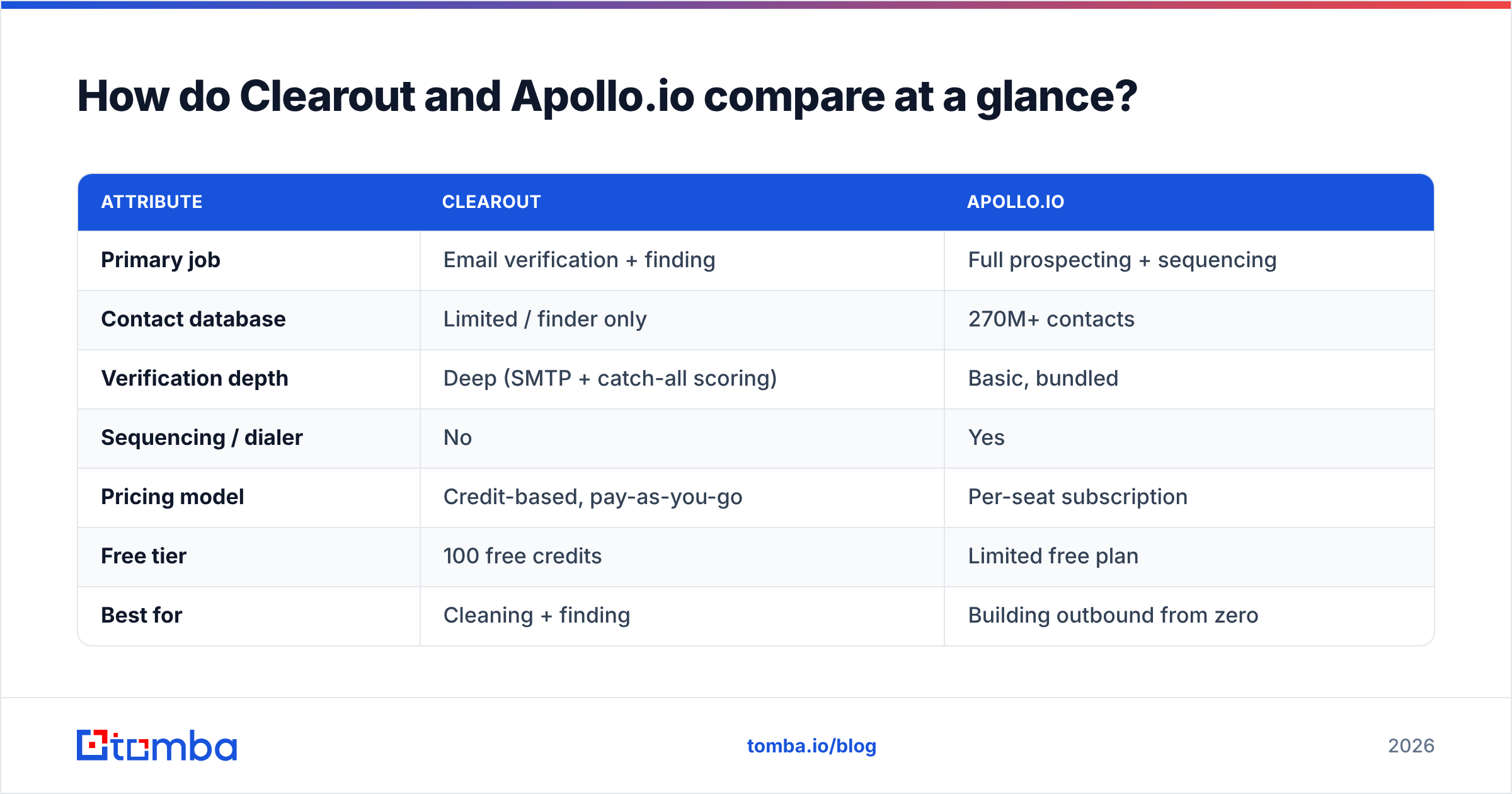
| Attribute | Clearout | Apollo.io |
|---|---|---|
| Primary job | Email verification + finding | Full prospecting + sequencing |
| Contact database | Limited / finder only | 270M+ contacts |
| Verification depth | Deep (SMTP + catch-all scoring) | Basic, bundled |
| Sequencing / dialer | No | Yes |
| Pricing model | Credit-based, pay-as-you-go | Per-seat subscription |
| Free tier | 100 free credits | Limited free plan |
| Best for | Cleaning + finding | Building outbound from zero |
| Weak spot | Thin database for sourcing | Stale records, per-seat cost |
| API | Yes | Yes |
The pattern is clear: Clearout goes deep on one job, Apollo goes wide across many. Neither is "better" in the abstract — it depends on whether your bottleneck is finding more people or not burning your domain on bad addresses.
Which tool has better email accuracy?#
Clearout wins on verification accuracy; Apollo wins on coverage but at a lower hit rate per record.
Accuracy is two different questions hiding in one word. The first is "how many real contacts can you surface?" — that's coverage, and Apollo's giant database wins outright. The second is "of the emails you got, how many actually land?" — that's deliverable accuracy, and a verification-first tool like Clearout pulls ahead because every address goes through a real SMTP check before you trust it.
Here's the operational reality: Apollo will hand you 500 contacts for a target account list where Clearout's finder returns 200. But a chunk of Apollo's 500 are guessed patterns or aged records. If you don't run them through a separate verifier, your bounce rate climbs, and once you cross roughly 3% bounces your sender reputation starts taking damage. Many teams literally pay for Apollo to find and then pay for a verifier to clean — which is two line items doing what a single accuracy-focused finder does in one pass.

If accuracy-per-dollar is your real metric, this is where a dedicated email verifier or a finder that verifies at the source changes the math. You stop paying twice for one clean address.
How does pricing compare?#
Pricing is where the two diverge hardest, because they sell on different axes.
Clearout sells credits. You can buy pay-as-you-go packs or subscriptions, and one verification or one find typically consumes credits at a published rate. The appeal is that you only pay for what you process — good for spiky workloads like cleaning a quarterly list dump.
Apollo.io sells per-seat subscriptions with tiered export and credit caps. The headline price looks reasonable, but the real cost shows up in export limits: the cheaper tiers throttle how many records you can pull per month, and lifting that cap means jumping a tier or buying credit add-ons. For a 3-person team, the annual number is materially higher than a credit tool.
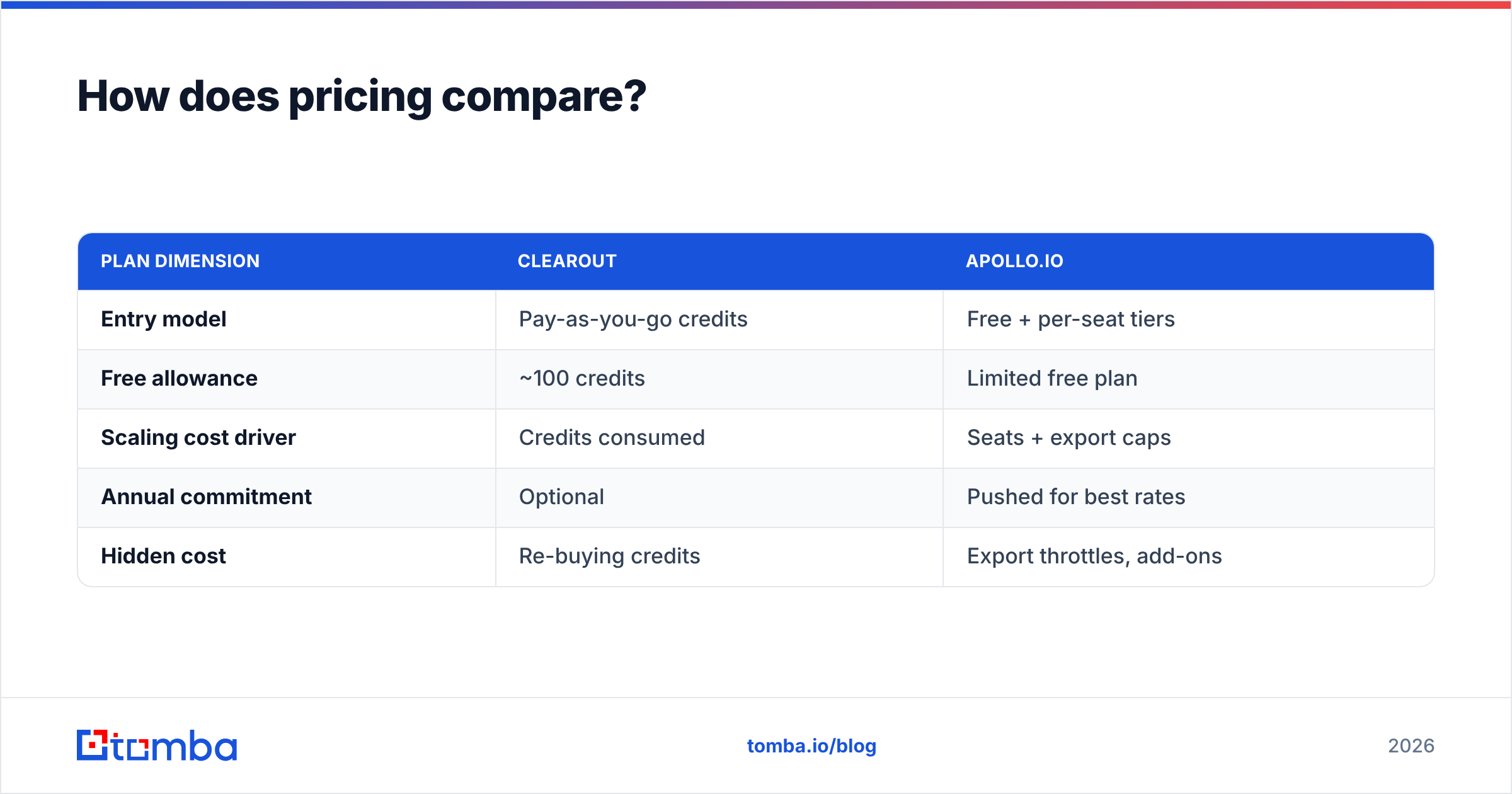
| Plan dimension | Clearout | Apollo.io |
|---|---|---|
| Entry model | Pay-as-you-go credits | Free + per-seat tiers |
| Free allowance | ~100 credits | Limited free plan |
| Scaling cost driver | Credits consumed | Seats + export caps |
| Annual commitment | Optional | Pushed for best rates |
| Hidden cost | Re-buying credits | Export throttles, add-ons |
Neither publishes a flat "this is what you'll pay" number because both scale with usage. The honest takeaway: if you process emails in bursts, Clearout's credit model is cheaper; if you need a always-on outbound machine for a team, Apollo's bundle can justify itself — provided you actually use the sequencing and dialer you're paying for.
For comparison, a focused finder like Tomba runs a Free tier (25 searches/mo), then Starter at $49/mo, Growth at $99/mo, and Pro at $249/mo — you can see the full Tomba pricing breakdown without per-seat math.
)
What are the real use cases for each?#
Match the tool to the bottleneck, not the brand.
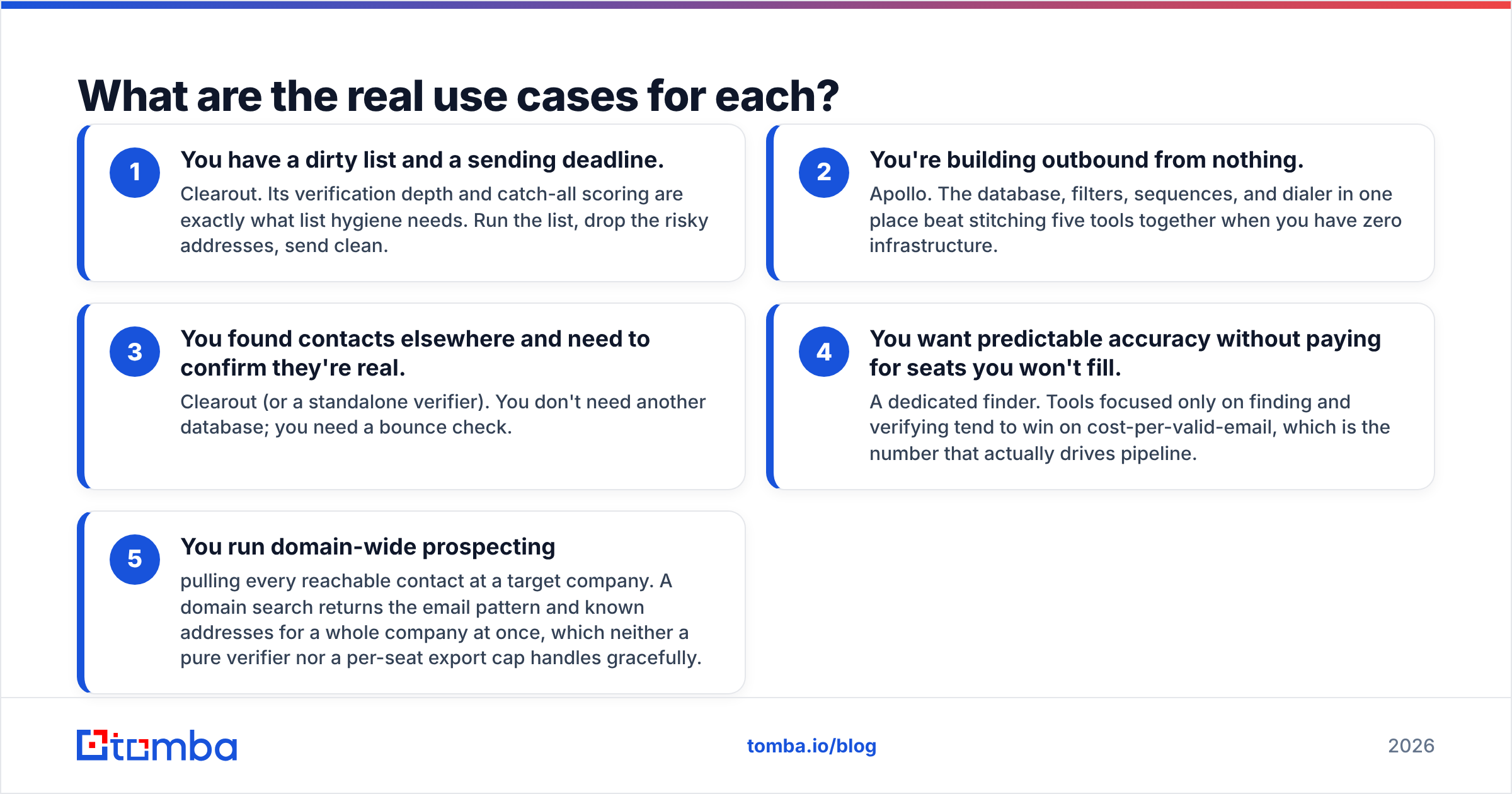
You have a dirty list and a sending deadline. Clearout. Its verification depth and catch-all scoring are exactly what list hygiene needs. Run the list, drop the risky addresses, send clean.
You're building outbound from nothing. Apollo. The database, filters, sequences, and dialer in one place beat stitching five tools together when you have zero infrastructure.
You found contacts elsewhere and need to confirm they're real. Clearout (or a standalone verifier). You don't need another database; you need a bounce check.
You want predictable accuracy without paying for seats you won't fill. A dedicated finder. Tools focused only on finding and verifying tend to win on cost-per-valid-email, which is the number that actually drives pipeline.
You run domain-wide prospecting — pulling every reachable contact at a target company. A domain search returns the email pattern and known addresses for a whole company at once, which neither a pure verifier nor a per-seat export cap handles gracefully.
Where do Clearout and Apollo.io fall short?#
Clearout's gap is sourcing. It verifies brilliantly and finds adequately, but if your job is "fill the top of the funnel with 5,000 net-new contacts this month," its finder won't carry that load. You'll need a database alongside it.
Apollo's gaps are freshness and cost structure. Community-sourced data ages, and Apollo doesn't verify aggressively before handing records over, so the burden of cleaning falls back on you. The per-seat-plus-export-cap pricing also punishes small teams that need volume more than they need ten seats. That's why "Apollo alternative" is such a common search — plenty of teams like the data but not the bill. If that's you, a side-by-side of Apollo alternatives is worth ten minutes.
There's also a deliverability angle both tools underplay. Finding and verifying are upstream of the part that actually matters: whether your message lands in the inbox. Even a perfectly valid address bounces or spams out if your sending domain has a reputation problem. Treat email deliverability as a separate discipline from data quality — clean data is necessary but not sufficient.
How do they handle catch-all and bulk work?#
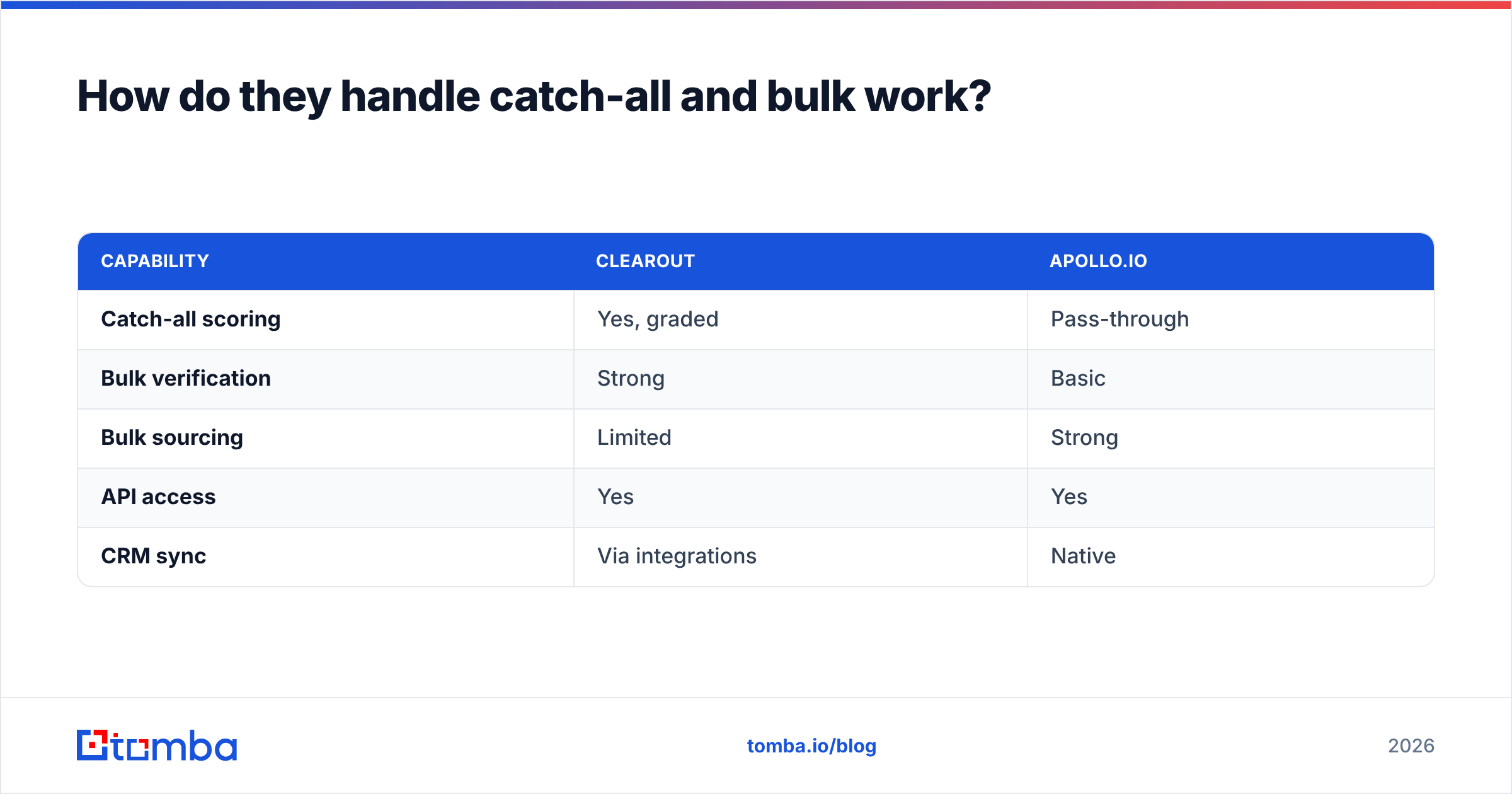
Catch-all domains are the stress test, and it's where Clearout earns its reputation. Instead of flagging every catch-all as "unknown," it scores them, so you can make a risk call rather than discarding half your list. Apollo largely passes catch-alls through without that nuance — you get the address, no judgment attached.
For bulk operations, both offer batch processing and APIs, but the philosophies differ. Clearout's bulk flow is built around verification throughput: upload a CSV, get a graded list back. Apollo's bulk is built around export: pull thousands of contacts into your sequences. If your bulk job is "clean what I have," Clearout. If it's "give me more," Apollo. A purpose-built bulk email finder splits the difference by finding and verifying in the same batch pass, which is the workflow most outbound teams actually want.
| Capability | Clearout | Apollo.io |
|---|---|---|
| Catch-all scoring | Yes, graded | Pass-through |
| Bulk verification | Strong | Basic |
| Bulk sourcing | Limited | Strong |
| API access | Yes | Yes |
| CRM sync | Via integrations | Native |
Clearout vs Apollo.io: which should you pick?#
Choose Clearout if your problem is data quality and you already have a source of contacts. Choose Apollo if your problem is building an entire outbound operation and you don't yet have the tooling for sequencing, calling, and sourcing. That's the clean split.
But notice what neither answer is: "the most accurate net-new emails at the lowest cost." Clearout under-sources; Apollo under-verifies and over-charges per seat. If your core need is finding correct, deliverable email addresses — by name, by company, or across a whole domain — and you don't want to pay for sequencing modules or re-buy verification credits, a focused finder is the tool that's actually shaped like your job.
You can sanity-check any of these claims on neutral ground: read user reviews on G2, and compare the official feature lists at apollo.io and clearout.io before you commit a budget.
The Bottom Line#
Clearout and Apollo.io aren't really rivals — they're specialists at opposite ends of the same pipeline. Clearout cleans; Apollo sources. Most teams that buy one eventually pay for something that does the other, which is the hidden cost nobody quotes upfront.
If the job you're solving is "get me correct, verified email addresses without the per-seat tax or the second verification bill," start with a tool built for exactly that. The Tomba Email Finder finds professional emails by name, company, or domain and verifies them in the same step, on a Free tier you can test today and a $49/mo Starter plan with no per-seat math. Run your toughest target list through it and compare the deliverable hit rate — that's the only benchmark that ends up on your pipeline report.
// get started
Find, verify and enrich your first contacts today
Start on the free plan with 25 searches a month, then scale when your team is ready.
Free plan · No credit card required · GDPR & CCPA
// about the author