Click Rate Formula in Email Marketing: The 2026 Guide
Learn the exact click rate formula in email marketing, how it differs from CTOR, what counts as a good benchmark in 2026, and how to lift every number.
You can A/B test subject lines for a year, but if you are calculating your email click rate wrong, every decision you make on top of that number is built on sand. This guide fixes that.
TL;DR — The Click Rate Formula in 90 Seconds#
- Click rate (CTR) = (unique clicks ÷ emails delivered) × 100. It measures clicks against your whole audience, not just openers.
- Click-to-open rate (CTOR) = (unique clicks ÷ unique opens) × 100. It isolates how persuasive the email body was after the open.
- A "good" 2026 email click rate sits around 2–5%, while a healthy CTOR is 10–15% — but benchmarks vary wildly by industry.
- Apple Mail Privacy Protection has made open-based metrics noisy, so click rate is now the more trustworthy north-star metric for most senders.
- The fastest way to raise CTR is rarely "better copy" alone — it is sending to verified, accurate contacts so your emails reach a real human inbox in the first place.
What Is the Click Rate Formula in Email Marketing?#
The click rate formula in email marketing is straightforward:
Click Rate (CTR) = (Unique Clicks ÷ Number of Delivered Emails) × 100
Think of it like a store. If 1,000 flyers land in mailboxes and 30 people walk through your door because of one, your "click rate" is 3%. You measure interest against everyone who received the flyer, not just the people who happened to glance at it.
Worked example: you send a campaign to 10,000 subscribers. 200 bounce, so 9,800 are delivered. Of those, 294 unique recipients click at least one link. Your click rate is:
(294 ÷ 9,800) × 100 = 3.0%
Two details trip people up:
- Delivered, not sent. Always divide by delivered emails (sent minus bounces). Using "sent" understates your real performance and hides deliverability problems.
- Unique clicks, not total clicks. If one excited reader clicks your link six times, that is one engaged human, not six. Total clicks inflate the number and tell you nothing about reach.
)
CTR vs CTOR: Which Click Metric Should You Actually Track?#
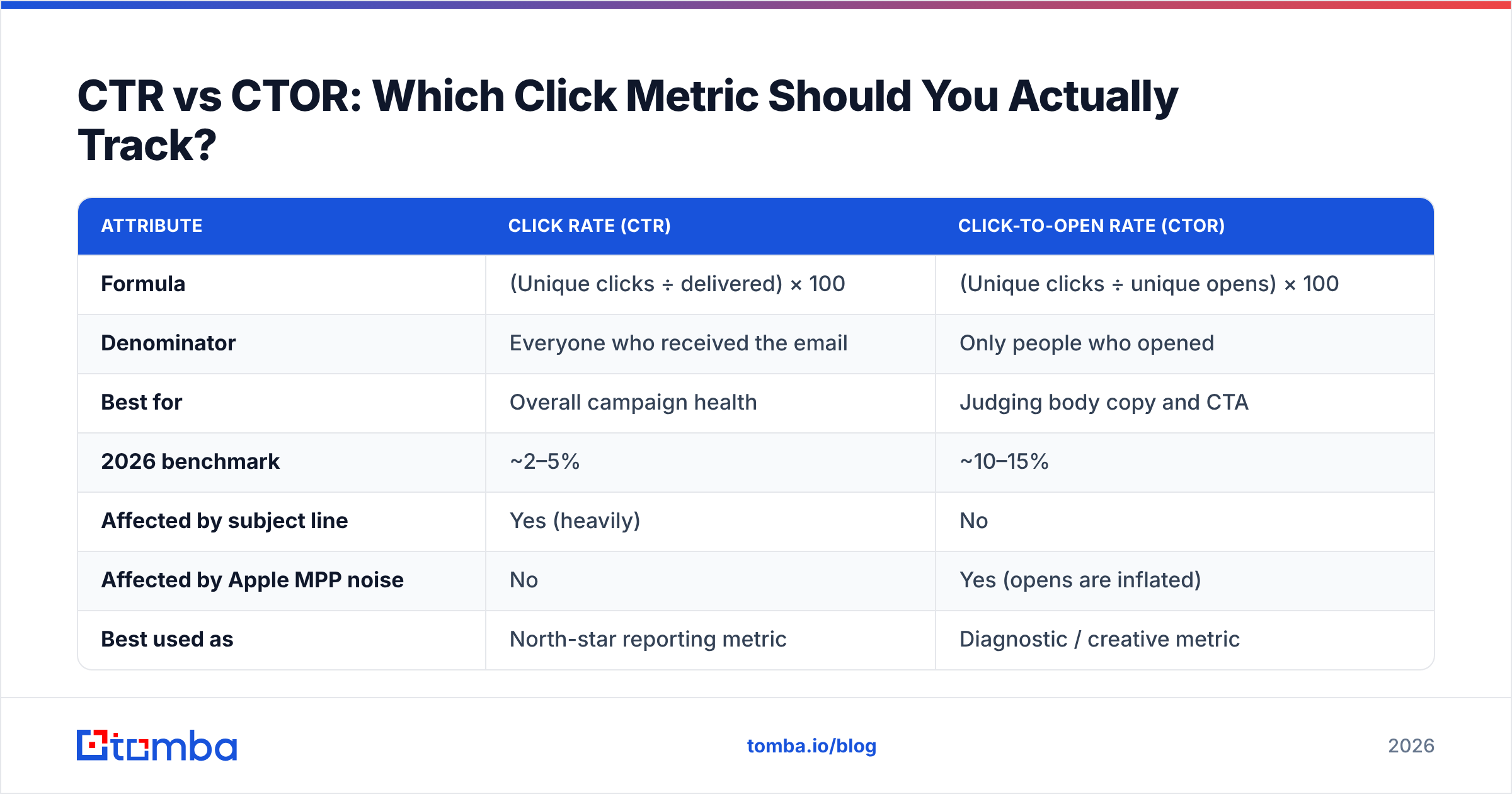
Here is the conclusion first: track both, but anchor your reporting to CTR and use CTOR to diagnose copy. They answer different questions.
- Click rate (CTR) answers: "Of everyone I reached, how many took action?" It blends list quality, subject line, send time, and body copy into one number.
- Click-to-open rate (CTOR) answers: "Of the people who opened, how compelling was the email itself?" It strips out subject-line and deliverability effects, leaving you with a cleaner read on creative and offer strength.
Use this structured breakdown to decide what a movement in each metric is telling you:
- CTR up, CTOR flat — Your subject line or send timing improved (more people opened), and the body held its ground. Good top-of-funnel win.
- CTR flat, CTOR up — Fewer opens, but the people who opened loved the content. Your copy is working; fix your subject lines or deliverability.
- Both down — Suspect list decay, spam placement, or an offer that missed. Start with list hygiene.
- Both up — Replicate everything about this campaign. Document the subject, segment, and CTA.
- CTOR very high, CTR very low — A tiny, hyper-engaged audience is opening. Your reach is the bottleneck, not your message.
- CTR high, conversions low — Clicks are not the finish line. Your landing page or offer breaks the promise the email made.
Side-by-side comparison#
| Attribute | Click Rate (CTR) | Click-to-Open Rate (CTOR) |
|---|---|---|
| Formula | (Unique clicks ÷ delivered) × 100 | (Unique clicks ÷ unique opens) × 100 |
| Denominator | Everyone who received the email | Only people who opened |
| Best for | Overall campaign health | Judging body copy and CTA |
| 2026 benchmark | ~2–5% | ~10–15% |
| Affected by subject line | Yes (heavily) | No |
| Affected by Apple MPP noise | No | Yes (opens are inflated) |
| Best used as | North-star reporting metric | Diagnostic / creative metric |
Because Apple's Mail Privacy Protection auto-loads images and fires false "opens," CTOR's denominator is now unreliable for the chunk of your list on Apple Mail. That is the single biggest reason click rate has overtaken open rate as the metric serious teams report on in 2026.
What Is a Good Email Click Rate in 2026?#
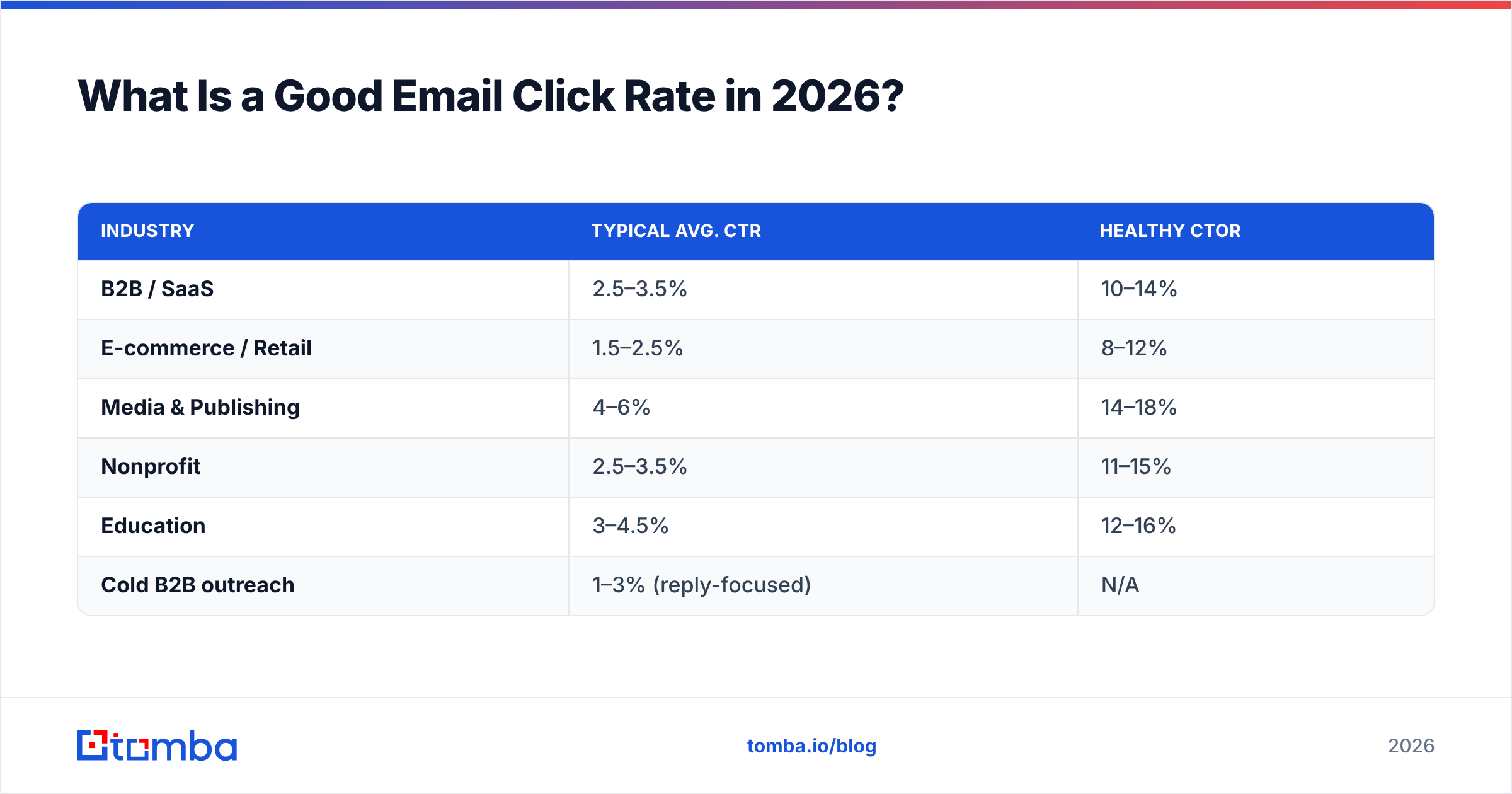
A good email click rate in 2026 generally falls between 2% and 5%, but "good" is meaningless without your industry context. A B2B SaaS newsletter and a flash-sale retailer live in completely different worlds.
| Industry | Typical Avg. CTR | Healthy CTOR |
|---|---|---|
| B2B / SaaS | 2.5–3.5% | 10–14% |
| E-commerce / Retail | 1.5–2.5% | 8–12% |
| Media & Publishing | 4–6% | 14–18% |
| Nonprofit | 2.5–3.5% | 11–15% |
| Education | 3–4.5% | 12–16% |
| Cold B2B outreach | 1–3% (reply-focused) | N/A |
Treat these as gravity, not law. Mailchimp and HubSpot both publish regularly updated benchmark reports — check HubSpot's email marketing benchmarks against your own numbers rather than chasing a single universal target. Your most useful benchmark is your own trailing 6-month average. Beating last quarter matters more than matching a stranger's spreadsheet.
One caveat that quietly wrecks comparisons: if your competitor counts clicks against "sent" while you count against "delivered," their CTR looks lower for no real reason. Always confirm the denominator before you benchmark.
Why Is Your Click Rate Lower Than It Should Be?#
Most low click rates are not a copywriting problem. They are a plumbing problem. Before you rewrite a single CTA, walk this chain:
- Deliverability. If 15% of your "delivered" emails are silently landing in spam, your real reachable audience is far smaller than your denominator suggests. Strong email deliverability and a clean sender reputation are prerequisites for any CTR work.
- List accuracy. Sending to stale, mistyped, or guessed addresses inflates bounces and tanks reach. Every dead address in your denominator drags the formula down. This is where a proper email verifier pays for itself.
- Segmentation. A single blast to your whole list averages your hottest segment against your coldest. Sending the right message to the right slice almost always lifts CTR.
- Single, obvious CTA. Emails with one primary action consistently out-click emails with five competing links. Decision fatigue kills clicks.
- Mobile rendering. More than half of opens happen on phones. A button that is unreadable or untappable on a 390px screen is a click you will never get.
)
Notice that three of the five fixes happen before the email is even written. The click rate formula rewards reach and relevance first, cleverness second.
How Do You Improve Your Email Click Rate?#
Conclusion first: improve the inputs to the formula — a larger real denominator of reachable, relevant people and a stronger numerator of genuine clicks. Here is the playbook.
1. Clean and verify your list before every major send#
A 3% click rate on a list that is 20% invalid is actually a much higher true click rate hiding behind bad data. Run your contacts through verification so your delivered count reflects real inboxes. If you build lists from scratch, sourcing accurate addresses with a reliable email finder means you start from clean data instead of cleaning up later. For large campaigns, bulk verify before you press send.
2. Write for the click, not the impression#
- Lead with the reader's outcome, not your announcement.
- Use one primary CTA. If you must include secondary links, make them visually subordinate.
- Make link text descriptive ("See the 2026 benchmark data") instead of vague ("Click here").
- Keep the click promise and the landing page identical. Mismatched promises spike clicks but destroy trust and conversions.
3. Segment so relevance does the heavy lifting#
Split by behavior (recent openers vs. dormant), lifecycle stage, or declared interest. A relevant email to 2,000 people frequently beats a generic email to 20,000 on both CTR and revenue.
4. Test one variable at a time#
Subject line, CTA copy, button color, send time — change one, measure, keep the winner. If you change three things and CTR moves, you have learned nothing about why.
5. Optimize for mobile and dark mode#
Tappable buttons (44px minimum height), high-contrast colors that survive dark mode, and short paragraphs. Preview on a real phone, not just desktop.
Quick formula reference#
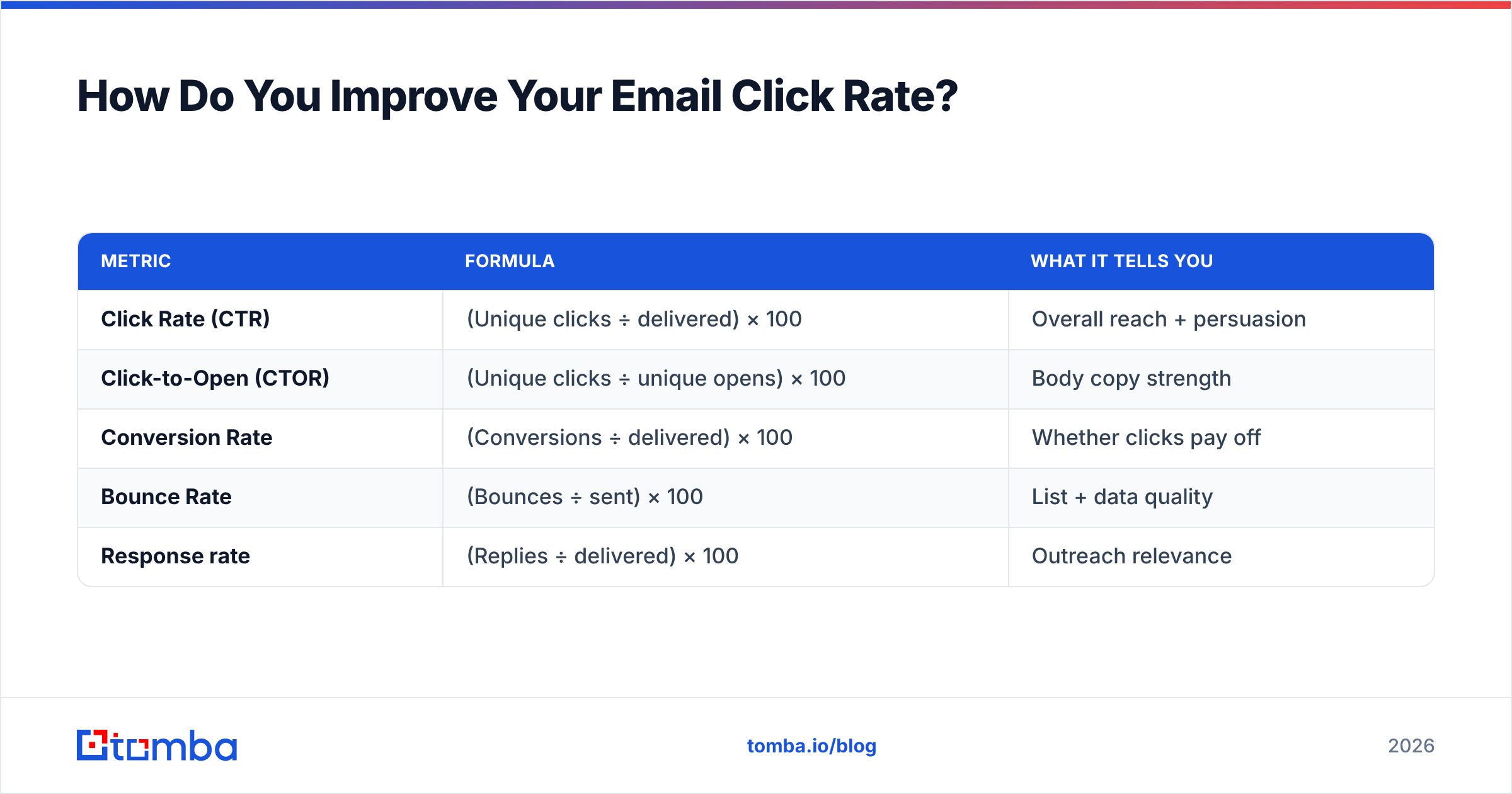
| Metric | Formula | What it tells you |
|---|---|---|
| Click Rate (CTR) | (Unique clicks ÷ delivered) × 100 | Overall reach + persuasion |
| Click-to-Open (CTOR) | (Unique clicks ÷ unique opens) × 100 | Body copy strength |
| Conversion Rate | (Conversions ÷ delivered) × 100 | Whether clicks pay off |
| Bounce Rate | (Bounces ÷ sent) × 100 | List + data quality |
| Response rate | (Replies ÷ delivered) × 100 | Outreach relevance |
How Does Click Rate Connect to Revenue?#
Clicks are a means, not an end. A click rate that climbs while conversions stay flat is a flashing warning light, not a victory. The honest funnel looks like this: delivered → opened → clicked → converted → revenue. Click rate is the hinge in the middle — it is the first hard signal of genuine intent.
That is why data quality compounds. If your delivered number is polluted with invalid addresses, every downstream metric — CTR, CTOR, conversion rate — is calculated on a fictional audience. Tools like data enrichment and domain search help you build that audience from accurate, current information so the entire funnel rests on solid ground. Garbage in, garbage CTR.
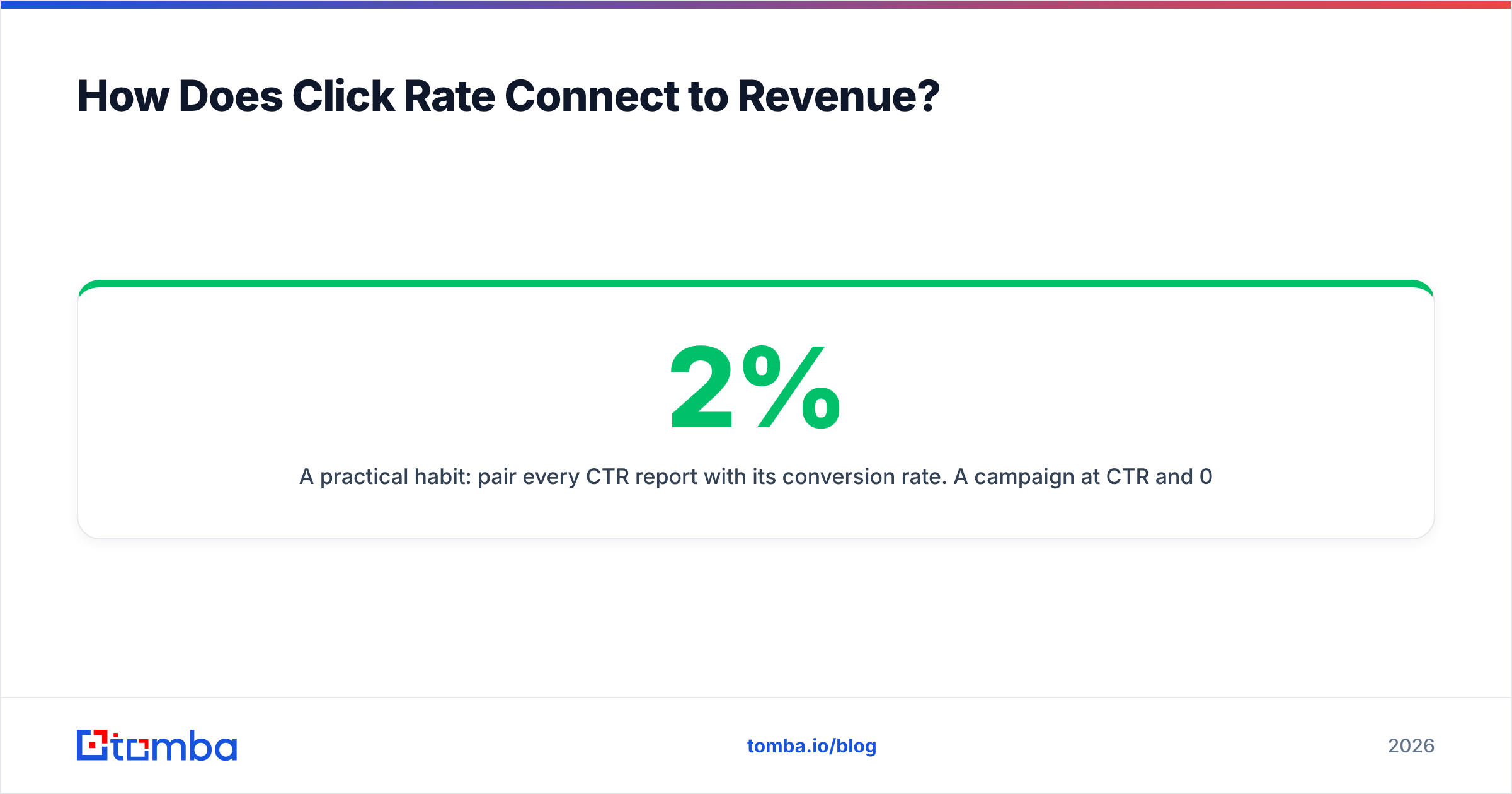
A practical habit: pair every CTR report with its conversion rate. A campaign at 2% CTR and 0.8% conversion is healthier than one at 5% CTR and 0.1% conversion. The first is reaching the right people; the second is collecting curious clickers who never intended to buy.
Common Mistakes That Distort the Click Rate Formula#
- Dividing by "sent" instead of "delivered." This silently masks deliverability rot.
- Counting total clicks, not unique. One enthusiastic clicker should never count as ten.
- Comparing across different denominators. Your numbers and your competitor's are only comparable if the formula is identical.
- Ignoring Apple MPP. If you still report open rate as a primary KPI, you are reporting partly fictional data. Shift weight to CTR.
- Treating a single send as a trend. One campaign is an anecdote. Use rolling averages.
- Optimizing CTR in isolation. A clickbait subject can spike clicks and crater trust. Always read CTR alongside conversions and unsubscribes.
Frequently Asked Questions#
Is click rate the same as click-through rate? Mostly yes — in email marketing, "click rate" and "click-through rate" are used interchangeably and both refer to unique clicks divided by delivered emails. Just confirm which denominator a given report uses before comparing.
Should I use unique or total clicks in the formula? Use unique clicks for click rate. Unique clicks measure how many distinct people acted; total clicks measure raw activity and overstate engagement.
Why did my click rate drop after Apple Mail Privacy Protection? It usually did not drop — your open rate became inflated by false opens, which made CTOR look worse while CTR stayed honest. This is exactly why CTR is the more reliable metric in 2026.
What is a realistic click rate for cold outreach? Cold B2B outreach typically sees 1–3% link clicks, but for cold email you should optimize for replies, not clicks — a reply is worth more than any link tap.
The Bottom Line#
The click rate formula in email marketing is simple — unique clicks divided by delivered emails — but its accuracy depends entirely on the quality of that "delivered" number. Clean data, a single clear CTA, tight segmentation, and honest denominators will move your CTR further than any clever subject line trick.
If your click rate is being dragged down by bounced, guessed, or stale addresses, fix the input before the copy. Tomba's Email Finder helps you build campaigns on accurate, verified contacts so your delivered count reflects real inboxes — and your click rate finally reflects real interest. Start on the free tier with 25 searches a month, then scale to Starter ($49/mo) when your list outgrows it. Better data in, better click rate out.
Ready to find emails that actually work?
Join 150,000+ professionals who stopped guessing and started sending. Free credits on signup — no credit card required.
Get the Tomba newsletter
Practical outbound tactics and product updates — once every two weeks.
About the author