Clickback vs Leadzenai 2026: Which B2B Lead Tool Wins?
Clickback chases cold-email volume; Leadzen.ai sells contact intelligence. Here's an honest 2026 breakdown of pricing, data quality, and which one actually fills your pipeline.
Clickback vs Leadzenai: Which B2B Lead Tool Actually Fills Your Pipeline in 2026?
Choosing between Clickback and Leadzen.ai feels harder than it should, because the two tools barely play the same sport. One is a cold-email sending engine built to email purchased B2B lists at scale. The other is a contact-intelligence database that hands you phone numbers, emails, and firmographics to feed your own outreach. Picking the "winner" depends entirely on whether you need a megaphone or a phone book.
This breakdown cuts through the marketing copy. You'll get a side-by-side on pricing, data accuracy, compliance risk, and the specific outbound motions each tool serves — plus where a focused email finder beats both for the one job they're weakest at.
TL;DR#
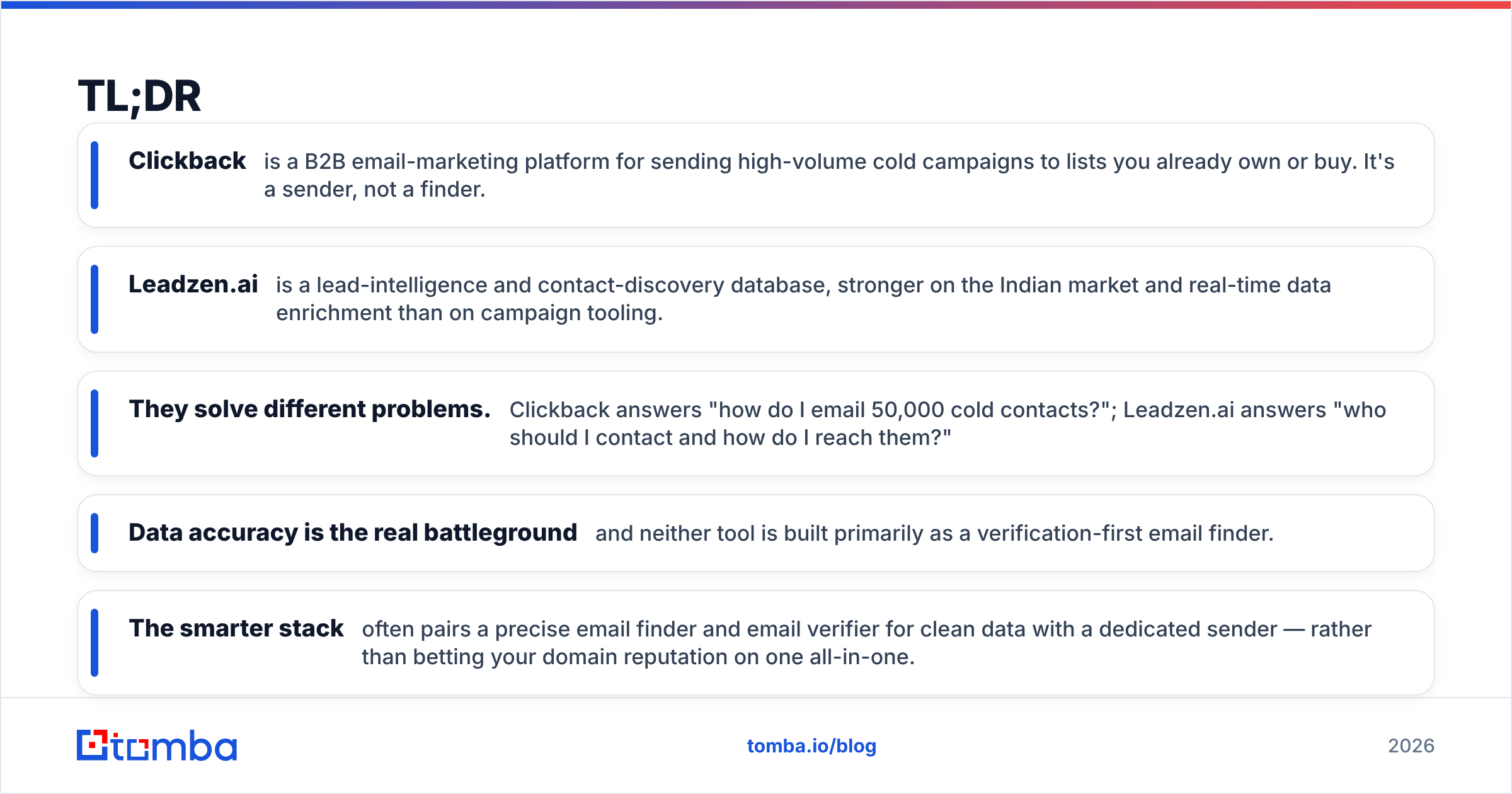
- Clickback is a B2B email-marketing platform for sending high-volume cold campaigns to lists you already own or buy. It's a sender, not a finder.
- Leadzen.ai is a lead-intelligence and contact-discovery database, stronger on the Indian market and real-time data enrichment than on campaign tooling.
- They solve different problems. Clickback answers "how do I email 50,000 cold contacts?"; Leadzen.ai answers "who should I contact and how do I reach them?"
- Data accuracy is the real battleground — and neither tool is built primarily as a verification-first email finder.
- The smarter stack often pairs a precise email finder and email verifier for clean data with a dedicated sender — rather than betting your domain reputation on one all-in-one.
What is Clickback?#
Clickback is a cold-email marketing platform aimed at B2B teams that want to email large purchased or rented lists. Its signature pitch is sending to contacts who never opted in — something most mainstream ESPs like Mailchimp explicitly forbid. Clickback wraps that capability in list hygiene, spam-filter testing, and engagement tracking so the campaigns don't immediately torch your domain.
Think of Clickback as a freight truck. It's built to move a heavy load of cold messages down the highway. It does not, on its own, tell you who belongs in the truck — you supply the list, or buy one, and Clickback handles delivery and reporting. That makes it powerful for high-volume top-of-funnel plays and risky for teams without a clean, compliant data source feeding it.
The trade-off is reputation exposure. Emailing cold, unverified lists at volume is the fastest way to wreck email deliverability if the underlying data is dirty. Clickback's tooling mitigates this, but it can't manufacture accuracy that isn't in your source list.
What is Leadzen.ai?#
Leadzen.ai is a lead-generation and contact-intelligence tool. It focuses on discovery: search by company, role, industry, or intent signals and pull back contact details — emails, mobile numbers, and firmographic context. It has notable strength in the Indian B2B market, where local mobile-number coverage is harder to find from US-centric databases.
If Clickback is the freight truck, Leadzen.ai is the phone book plus a research analyst. It surfaces prospects and their coordinates, then expects you to run outreach in your own sequencer or CRM. It leans on real-time lookups and a browser extension workflow rather than a static, pre-scraped dump, which can mean fresher records — but also more variable coverage depending on the target geography and seniority.
Where Leadzen.ai gets thinner is campaign execution and bulk verification. It's a data source, not a sending platform, so you still need somewhere to put that data and a way to confirm those addresses are deliverable before you hit send.
Clickback vs Leadzenai: How do they compare?#
Here's the honest side-by-side. Note that pricing for both leans toward custom or quote-based tiers, which is common in this category and makes upfront budgeting harder than with transparent self-serve tools.
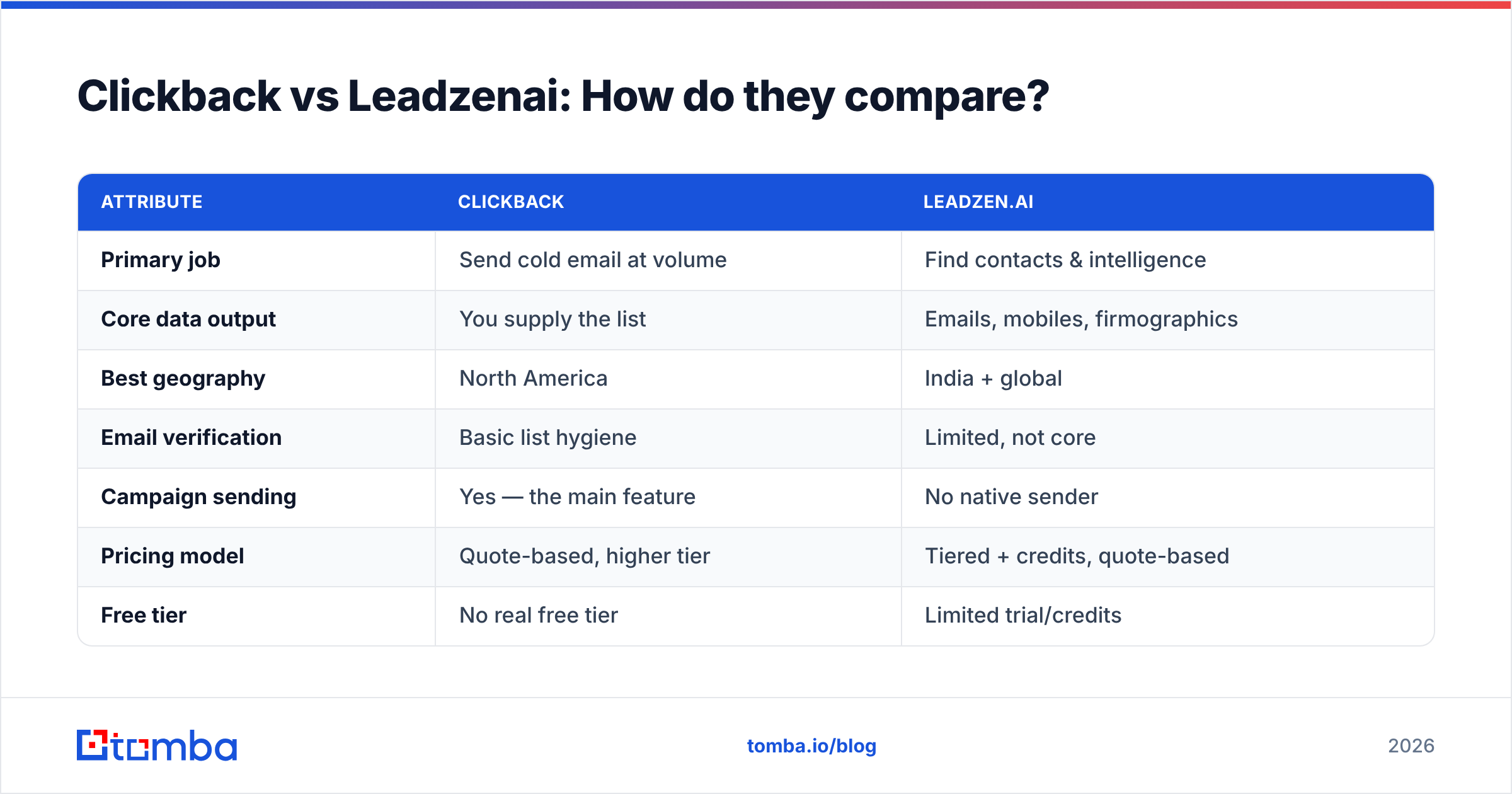
| Attribute | Clickback | Leadzen.ai |
|---|---|---|
| Primary job | Send cold email at volume | Find contacts & intelligence |
| Core data output | You supply the list | Emails, mobiles, firmographics |
| Best geography | North America | India + global |
| Email verification | Basic list hygiene | Limited, not core |
| Campaign sending | Yes — the main feature | No native sender |
| Pricing model | Quote-based, higher tier | Tiered + credits, quote-based |
| Free tier | No real free tier | Limited trial/credits |
| Compliance posture | Cold-list-focused, higher risk | Discovery-focused |
| Best for | High-volume outbound blasts | Targeted prospect research |
The pattern is clear: these are complementary categories, not direct substitutes. A team running Clickback often needs a discovery tool like Leadzen.ai upstream to build lists — and both need a verification layer in between to protect deliverability.
When Clickback makes sense#
- You run high-volume cold campaigns. If your motion is emailing tens of thousands of cold B2B contacts monthly, Clickback is purpose-built for it where general ESPs will ban you.
- You already own clean lists. Clickback shines when fed accurate, compliant data — it's an amplifier, not a data source.
- North American B2B is your market. Its compliance framing and data assumptions are tuned for US/Canada outreach.
- You have deliverability discipline. Teams with warmup, SPF/DKIM, and rotation in place get the most out of it without nuking their domain.
When Leadzen.ai makes sense#
- You need to build lists from scratch. Leadzen.ai's discovery and enrichment is its reason to exist.
- You're targeting the Indian market. Local mobile and contact coverage is a genuine differentiator here.
- You want phone plus email. If cold calling is part of your motion, the mobile-number coverage matters.
- You run outreach elsewhere. It assumes you bring your own CRM or sequencer to act on the data.
Which tool has more accurate data?#
Neither tool is engineered as a verification-first email finder, and that's the crux. Clickback's value is sending; its data hygiene is defensive, designed to scrub an existing list, not to source and validate emails from a name and domain. Leadzen.ai's value is discovery; its records are reasonably fresh, but bulk deliverability verification isn't its headline feature.
Accuracy matters because every bad address compounds. A 15% bounce rate on a cold campaign signals spam-trap exposure to inbox providers, drags your sender reputation down, and can land your domain on a blacklist that's slow to escape. This is exactly where a dedicated finder-plus-verifier layer earns its keep — confirming addresses against live SMTP checks and catching the catch-all domains that wreck open-rate math before you send a single message.

If your bounce rate is the metric keeping you up at night, the fix usually isn't a bigger sender or a broader database — it's a tighter verification step. Run discovery in whichever tool fits your geography, then clean the output before it touches a campaign.
What about compliance and deliverability risk?#
Clickback carries the higher inherent risk of the two, simply because emailing cold, non-opted-in lists is its whole premise. That's legal in many B2B contexts under frameworks like CAN-SPAM, but it lives in a grayer zone under GDPR and similar regimes. If you sell into the EU, the cold-list model needs careful legal review — Clickback gives you the tool, not the lawyer.
Leadzen.ai's discovery model spreads risk differently: you're sourcing contact data, and how you use it determines your exposure. Pulling a mobile number isn't the same as blasting a non-consented inbox, but data-sourcing has its own privacy obligations depending on jurisdiction.
The deliverability lesson applies to both. No tool, all-in-one or not, survives sending to dirty data. Pair any sender with disciplined warmup, correct authentication records, and pre-send verification. You can sanity-check your own setup fast with a free SPF checker and a blacklist checker before you scale volume.
Clickback vs Leadzenai vs a focused email finder#
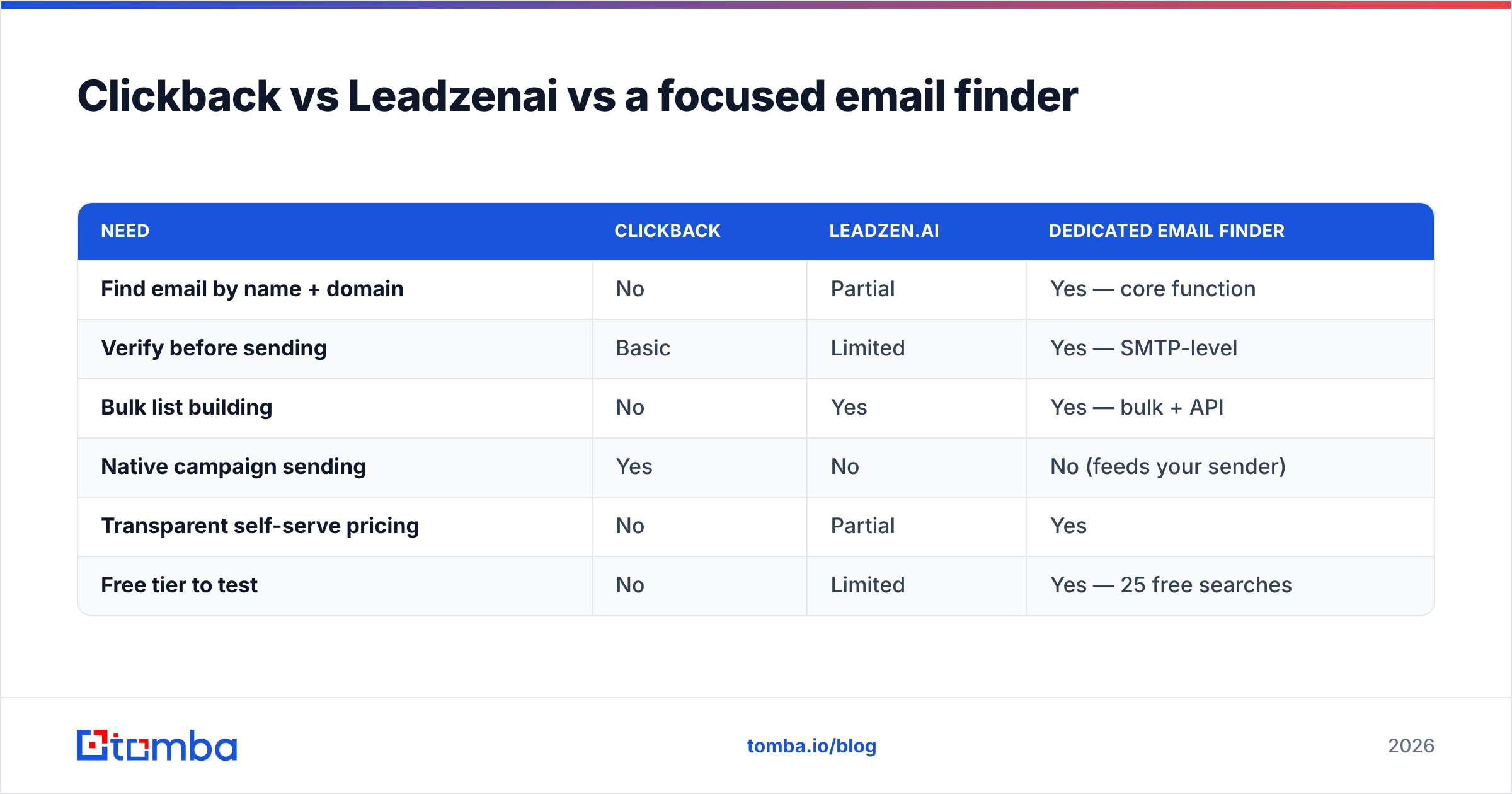
Here's the angle the "X vs Y" framing usually misses: for many teams, neither tool is the missing piece. The missing piece is accurate, verified email data that any sender or CRM can consume.
| Need | Clickback | Leadzen.ai | Dedicated email finder |
|---|---|---|---|
| Find email by name + domain | No | Partial | Yes — core function |
| Verify before sending | Basic | Limited | Yes — SMTP-level |
| Bulk list building | No | Yes | Yes — bulk + API |
| Native campaign sending | Yes | No | No (feeds your sender) |
| Transparent self-serve pricing | No | Partial | Yes |
| Free tier to test | No | Limited | Yes — 25 free searches |
A focused finder slots in upstream of Clickback and alongside Leadzen.ai. You use domain search to map every reachable contact at a target account, verify the addresses, and only then load them into your sender. The result is lower bounce rates, healthier domains, and pricing you can actually predict. Tomba's pricing, for example, runs a free tier at 25 searches/month, Starter at $49/mo, Growth at $99/mo, and Pro at $249/mo — transparent numbers instead of "contact sales."
This isn't an argument that finders replace senders or databases. It's that the accuracy layer both Clickback and Leadzen.ai treat as secondary is the layer that most directly moves your reply rate. Treating it as a first-class step, with bulk verification and an email finder API wired into your workflow, tends to outperform bolting more volume onto unverified data.
Which should you choose?#
Choose Clickback if you run genuine high-volume cold-email campaigns to North American B2B contacts, you already have or can buy compliant lists, and you have the deliverability discipline to send aggressively without self-destructing. It does a specific, hard-to-find job well.
Choose Leadzen.ai if your bottleneck is finding prospects — especially in the Indian market — and you want phone plus email discovery to feed outreach you'll run somewhere else. It's a solid intelligence source, not a campaign tool.
Choose neither as a complete answer if your real problem is data quality. The fastest, cheapest pipeline improvement for most outbound teams isn't a heavier sender or a broader database — it's verifying that the emails you already have actually land. Build your lists wherever they're freshest, then pass everything through a verification step before it touches a campaign.
For deeper category context, vendor specifics are worth checking directly on Clickback's site, Leadzen.ai, and third-party reviews on G2 before committing budget — pricing and features in this space shift quarterly.
The bottom line#
Clickback and Leadzen.ai aren't really competitors; they're two halves of an outbound stack — one finds, one sends — and both lean on data accuracy they don't fully own. Before you pay for either, make sure the email addresses underneath are real.
That's the gap Tomba Email Finder closes. Find professional emails by domain, name, or company, verify them at the SMTP level, and export clean lists straight into your sender or CRM through the Tomba API — starting with 25 free searches and transparent plans from $49/mo. Fix the accuracy layer first, and whichever tool you choose downstream works better. Start free and feed your pipeline data you can actually trust.
// get started
Find, verify and enrich your first contacts today
Start on the free plan with 25 searches a month, then scale when your team is ready.
Free plan · No credit card required · GDPR & CCPA
// about the author