Client Acquisition Definition: The 2026 Playbook for B2B Teams
Client acquisition is the repeatable process of turning strangers into paying customers. Here's the 2026 definition, the funnel stages, the metrics, and the stack that makes it predictable.
TL;DR
- Client acquisition is the repeatable, measurable process of turning strangers into paying clients — from first awareness through to a signed deal and onboarding.
- It is not the same as marketing or sales alone; it's the system that connects both, governed by one number: Customer Acquisition Cost (CAC).
- A healthy B2B acquisition engine has four stages — attract, capture, convert, retain — each with its own metric and owner.
- The single biggest lever in 2026 is data quality at the top of the funnel: accurate contact data lowers CAC more than any clever subject line.
- Tools matter, but sequence matters more. Get your targeting and contact data right with an email finder before you spend on ads or automation.
What is the client acquisition definition?#
Client acquisition is the end-to-end process a business uses to attract prospects, convert them into customers, and bring them onboard — done in a way that is repeatable and measurable. The word that matters most in that sentence is repeatable. Closing one client through a lucky referral is not acquisition; building a process that reliably produces new clients month after month is.
Think of it like a water system for a city. Anyone can carry one bucket from the river (a one-off sale). Client acquisition is the pipes, pumps, and reservoirs that deliver water on demand to every household, predictably, at a known cost per liter. Technically, it's the coordinated set of marketing and sales activities — plus the data and tooling behind them — that move a contact from "never heard of you" to "active paying client."
Three things separate real client acquisition from random selling:
- It's a system, not an event. Each new client follows a defined path you can describe, measure, and improve.
- It has a cost you can calculate. If you can't state your CAC, you don't have an acquisition process — you have hope.
- It spans the whole journey. Acquisition doesn't end at "yes." It includes onboarding, because a client who churns in month two was never truly acquired.
How is client acquisition different from lead generation and marketing?#
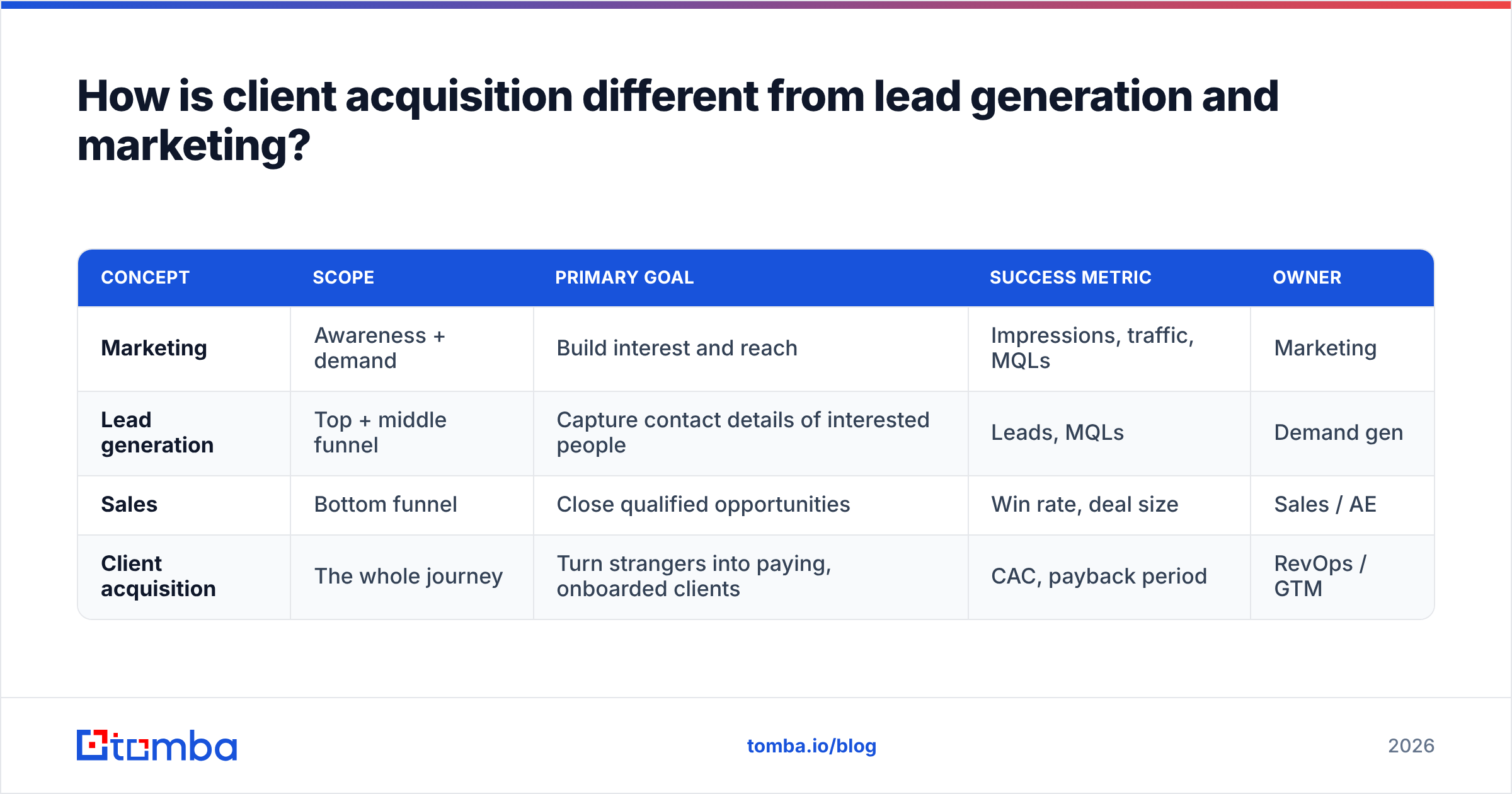
These terms get used interchangeably, and that confusion costs companies money. They sit at different layers of the same funnel.
| Concept | Scope | Primary goal | Success metric | Owner |
|---|---|---|---|---|
| Marketing | Awareness + demand | Build interest and reach | Impressions, traffic, MQLs | Marketing |
| Lead generation | Top + middle funnel | Capture contact details of interested people | Leads, MQLs | Demand gen |
| Sales | Bottom funnel | Close qualified opportunities | Win rate, deal size | Sales / AE |
| Client acquisition | The whole journey | Turn strangers into paying, onboarded clients | CAC, payback period | RevOps / GTM |
Client acquisition is the umbrella. Marketing fills the top, lead generation captures intent in the middle, and sales converts at the bottom — but acquisition is the discipline that connects all three and holds them accountable to one economic outcome. When marketing celebrates traffic while sales complains about lead quality, you're looking at an organization that optimizes stages in isolation instead of managing acquisition as a single system.
What are the stages of the client acquisition funnel?#
Every durable acquisition engine, regardless of industry, runs on four stages. Naming them clearly is what lets you find the leak when growth stalls.
- Attract — Get the right strangers to notice you. Channels: SEO, content, paid ads, outbound prospecting, events. The job here is reach with relevance, not reach for its own sake.
- Capture — Convert attention into a known contact. A name, a verified work email, a phone number. This is where anonymous traffic becomes a workable lead, and where data accuracy starts to compound.
- Convert — Move the captured lead through qualification, demos, proposals, and negotiation into a signed deal. This is where your sales process and pipeline discipline live.
- Retain — Onboard the new client and deliver early value so they stay. Retention belongs in acquisition because CAC only pays back over time; a fast churner is a loss disguised as a win.
The mistake most teams make is over-investing in stage one and starving stages two and three. You don't have a traffic problem — you have a conversion-and-data problem. Doubling your ad spend to fix a 1% capture rate is like pouring more water into a leaking bucket.
Why contact data sits at the center of every stage#
Here's the unglamorous truth: the quality of your contact data quietly determines the cost of every other stage. If 30% of the emails you push into a sequence bounce, you didn't just waste those sends — you damaged your sender reputation, which lowers deliverability for the valid contacts too. Bad data taxes the whole funnel.
That's why teams running serious outbound start with a verified source of truth. Pulling clean, role-specific contacts from a domain search or enriching an inbound list before it ever reaches a rep keeps CAC down by killing waste at the root.
How do you calculate client acquisition cost (CAC)?#
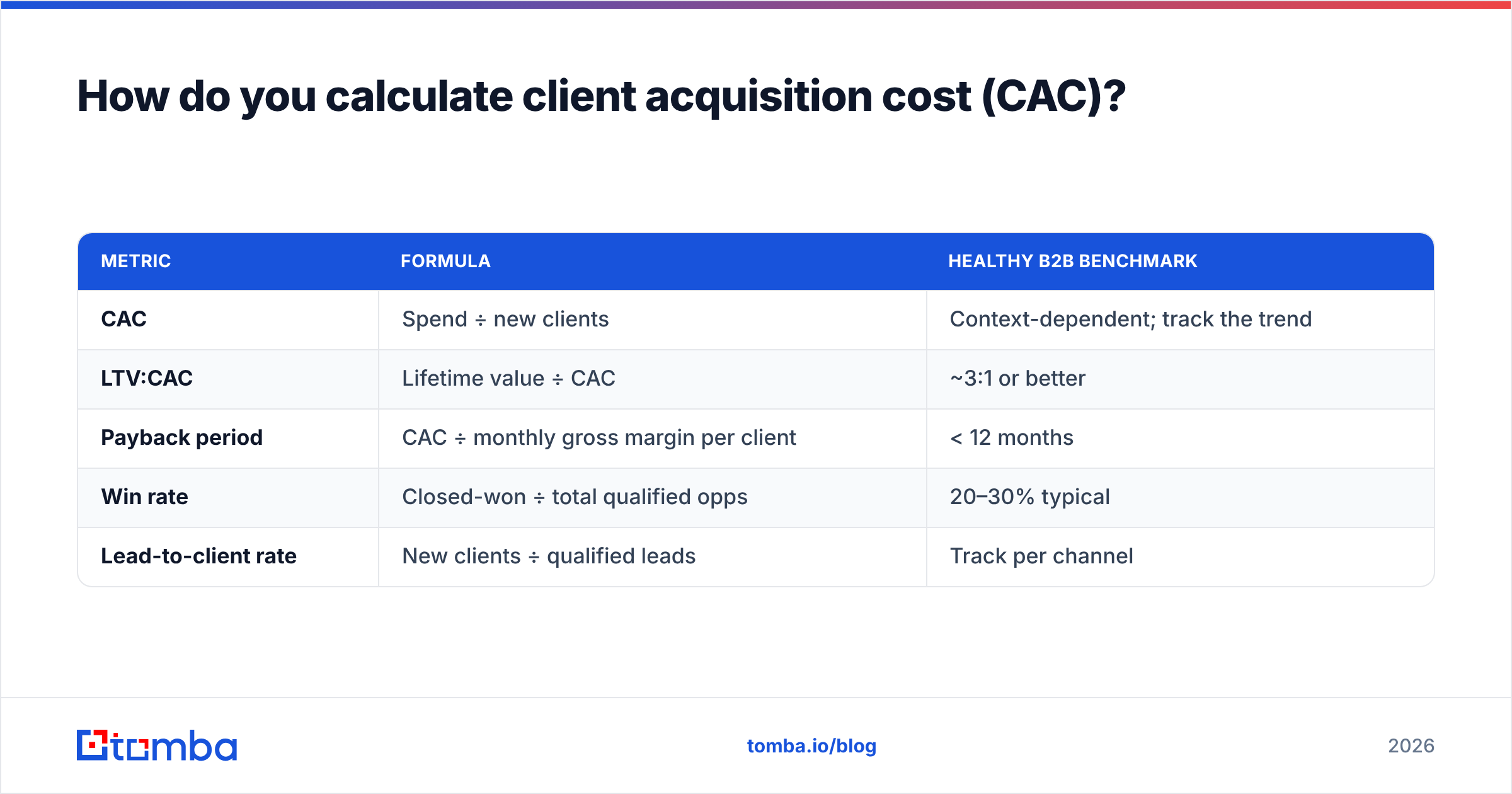
CAC is the total cost of sales and marketing divided by the number of new clients acquired in the same period. The formula is simple; the discipline is in counting honestly.
CAC = (Total sales + marketing spend in a period) ÷ (New clients acquired in that period)
If you spent $50,000 across ads, tooling, and salaries last quarter and signed 25 clients, your CAC is $2,000. But the number only means something next to two companions:
- LTV:CAC ratio — Lifetime value divided by CAC. A healthy B2B SaaS target is roughly 3:1. Below that, you're buying revenue too expensively. Far above it, you're probably under-investing in growth.
- CAC payback period — How many months of gross margin it takes to recover CAC. Under 12 months is strong for most B2B models; 12–18 is workable; beyond that, cash flow gets painful.
| Metric | Formula | Healthy B2B benchmark |
|---|---|---|
| CAC | Spend ÷ new clients | Context-dependent; track the trend |
| LTV:CAC | Lifetime value ÷ CAC | ~3:1 or better |
| Payback period | CAC ÷ monthly gross margin per client | < 12 months |
| Win rate | Closed-won ÷ total qualified opps | 20–30% typical |
| Lead-to-client rate | New clients ÷ qualified leads | Track per channel |
For deeper benchmarking on how these ratios behave across software businesses, the public data from firms like Gartner and peer-review platforms such as G2 is a more honest reference point than vendor marketing.
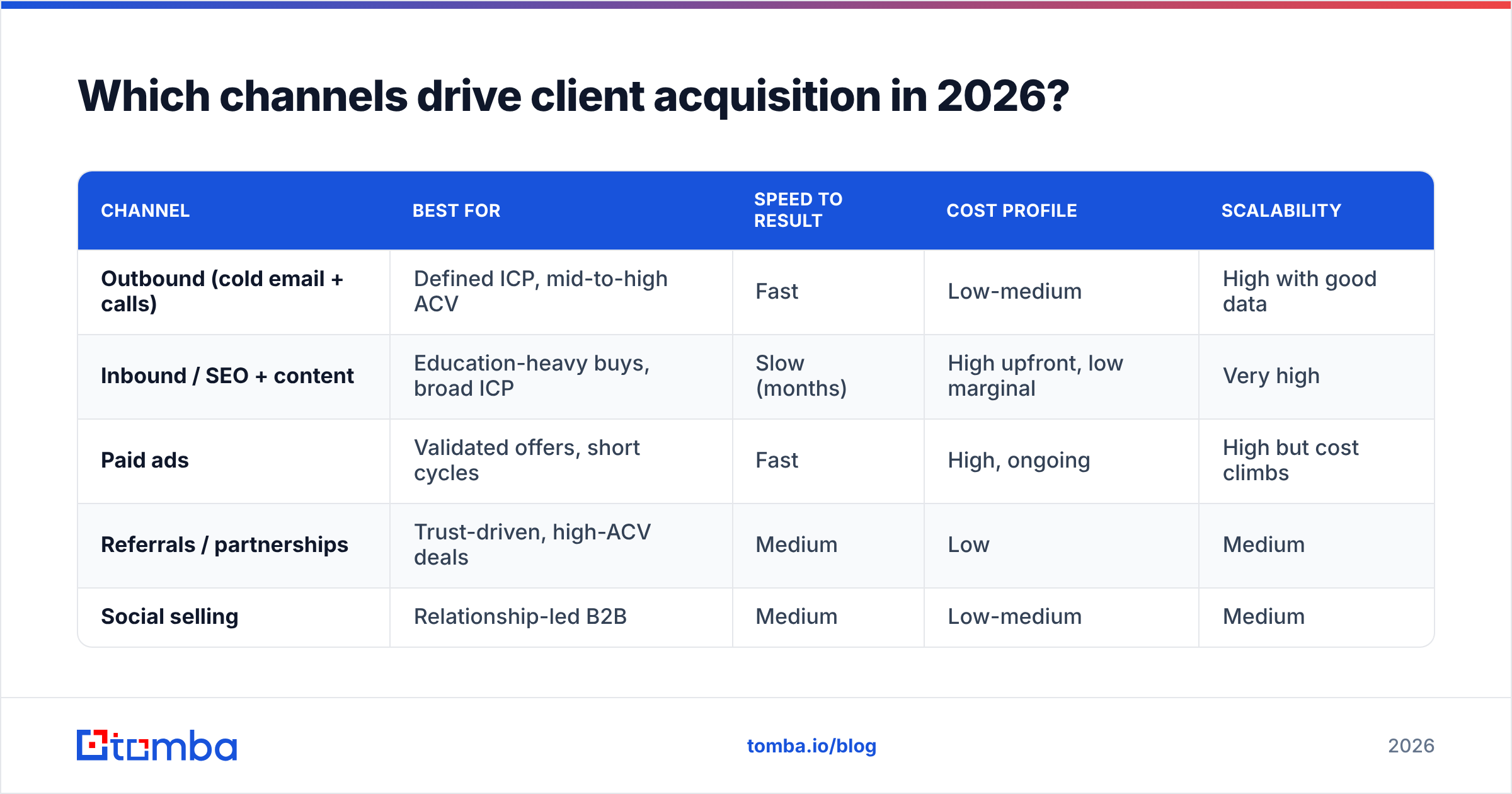
Which channels drive client acquisition in 2026?#
There is no single best channel — there's the right mix for your motion, average deal size, and sales cycle. Here's how the main options trade off.
| Channel | Best for | Speed to result | Cost profile | Scalability |
|---|---|---|---|---|
| Outbound (cold email + calls) | Defined ICP, mid-to-high ACV | Fast | Low-medium | High with good data |
| Inbound / SEO + content | Education-heavy buys, broad ICP | Slow (months) | High upfront, low marginal | Very high |
| Paid ads | Validated offers, short cycles | Fast | High, ongoing | High but cost climbs |
| Referrals / partnerships | Trust-driven, high-ACV deals | Medium | Low | Medium |
| Social selling | Relationship-led B2B | Medium | Low-medium | Medium |
Most companies under $10M in revenue over-rotate on one channel and call it strategy. The stronger play is a primary channel plus one compounding channel: outbound for predictable near-term pipeline, content for a moat that lowers CAC over time. Outbound funds the present; inbound funds the future.
The reason outbound deserves a seat even in a content-led plan is control. You decide exactly who hears from you. That precision is only as good as your targeting data, which is why outbound and contact-data quality are inseparable. A perfectly written cold email sent to a stale, unverified list is just spam with good grammar.

What does a modern client acquisition stack look like?#
You don't need 40 tools. You need coverage across four jobs: find the right people, reach them, manage the relationship, and measure the whole thing. A lean 2026 stack looks like this:
- Targeting and contact data — Identify accounts that match your ICP and get accurate, verified contact details. This is the foundation; everything downstream inherits its quality. A combination of an email finder and an email verifier keeps bounce rates low and deliverability high.
- Outreach and engagement — Sequencing tools for email and calls, plus LinkedIn outreach for relationship-led plays.
- CRM and pipeline — Your system of record for every opportunity. Whether you run HubSpot, Salesforce, or Pipedrive, the CRM is where acquisition becomes measurable.
- Analytics and attribution — Connect spend to signed clients so you can compute CAC per channel and kill what doesn't pay back.
The trap is buying the flashy engagement tools first and treating data as an afterthought. It's backwards. Garbage contacts make even the best sequencing software underperform, while clean data makes a modest stack punch above its weight. Fix the foundation, then layer on automation.
A practical sequence to stand up acquisition from scratch#
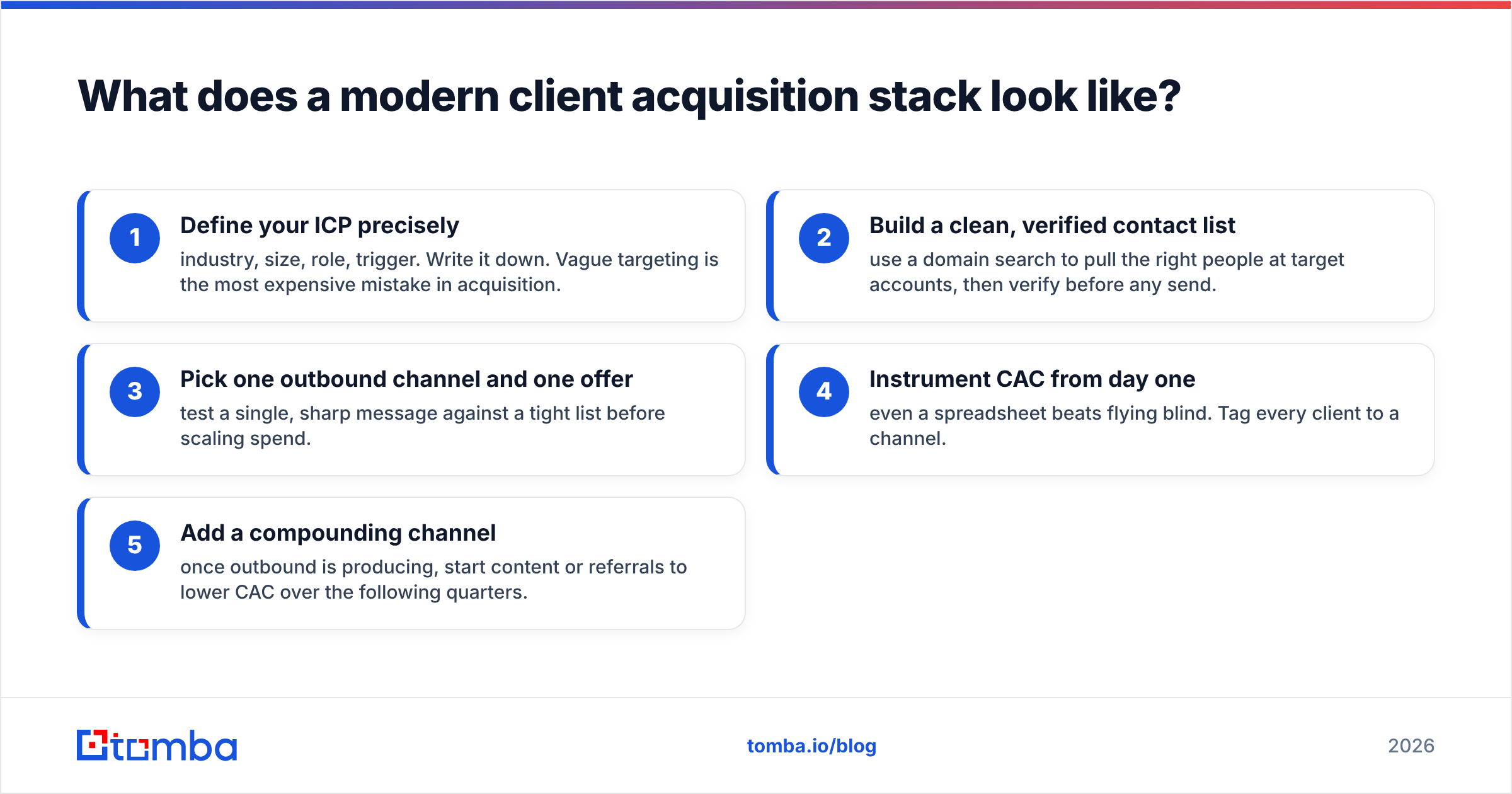
If you're building this for the first time, resist the urge to do everything at once. Run it in order:
- Define your ICP precisely — industry, size, role, trigger. Write it down. Vague targeting is the most expensive mistake in acquisition.
- Build a clean, verified contact list — use a domain search to pull the right people at target accounts, then verify before any send.
- Pick one outbound channel and one offer — test a single, sharp message against a tight list before scaling spend.
- Instrument CAC from day one — even a spreadsheet beats flying blind. Tag every client to a channel.
- Add a compounding channel — once outbound is producing, start content or referrals to lower CAC over the following quarters.
You can review what each tier of tooling costs and where the free limits sit on the Tomba pricing page before committing budget — starting on a free tier to validate your list quality is smarter than paying for volume you can't yet convert.
How do you measure whether client acquisition is working?#
Acquisition is working when CAC is stable or falling while client quality holds or improves. Watch these signals together, never in isolation:
- CAC trend — Flat or declining over several periods means your system is getting more efficient. A rising CAC with flat conversion means you're scaling waste.
- Channel-level CAC — Blended CAC hides everything. The channel breakdown tells you where to lean in and where to cut.
- Lead-to-client conversion — If this drops as you add volume, your top-of-funnel targeting or data quality is slipping.
- Payback period — The cash-flow reality check. Long payback can sink a profitable-on-paper business.
- Early retention / churn — Clients lost in the first 90 days expose an acquisition process that's selling to the wrong fit.
The discipline that separates teams who scale from teams who stall is acting on the unit economics, not the vanity metrics. Traffic, impressions, and even raw lead counts can all rise while the business gets less healthy. CAC, LTV:CAC, and payback are the numbers that tell the truth.
Common client acquisition mistakes to avoid#
- Optimizing one stage in isolation. A 5x increase in leads with no conversion improvement just raises your costs. Manage the funnel as one system.
- Ignoring data hygiene. Bouncing emails wreck deliverability and inflate CAC silently. Verify before you send, every time.
- Confusing activity with progress. More calls and more sends feel productive, but unqualified volume burns reps and reputation.
- Skipping retention. If you don't onboard well, you re-acquire the same revenue every year and your real CAC is far higher than you think.
- No channel attribution. Without per-channel CAC, you'll keep funding whatever shouts loudest rather than whatever pays back fastest.
Where should you start?#
Start where the leverage is highest: your data and your targeting. Most acquisition problems that look like "we need more traffic" are actually "we're spending on the wrong people with bad contact details." Get the foundation right and every downstream channel gets cheaper.
That's the case for beginning with a precise, verified contact layer. The Tomba Email Finder lets you find accurate professional emails by name, company, or domain — so your outbound starts from clean, deliverable data instead of guesses. Pair it with the built-in email verifier to keep bounce rates low and your sender reputation intact, and you've solved the part of client acquisition that quietly determines the cost of everything else. Try it on the free tier, validate your list quality against a real campaign, and scale spend only once the unit economics check out.
Client acquisition isn't a growth hack. It's a system — and systems built on accurate data are the ones that keep producing clients long after the clever tactics stop working.
// get started
Find, verify and enrich your first contacts today
Start on the free plan with 25 searches a month, then scale when your team is ready.
Free plan · No credit card required · GDPR & CCPA
// about the author