Client Engagement in 2026: A Practical B2B Playbook
Client engagement is the difference between a renewal and a churn notice. Here is how B2B teams measure it, lift it, and turn it into pipeline in 2026.
Client engagement is the clearest leading indicator of revenue you have — and most B2B teams still track it by gut feel. A client who opens your updates, replies to your check-ins, and shows up to the QBR is a client who renews. One who goes quiet for 60 days is usually already shopping. This guide breaks down what client engagement actually means in 2026, how to measure it without drowning in vanity metrics, and the workflow that turns engagement signals into retained and expanded accounts.
TL;DR#
- Client engagement is the sum of meaningful interactions a customer has with your product, content, and team — and it predicts retention better than NPS or CSAT alone.
- Track a small set of behavioral signals (product usage, response rate, meeting attendance, stakeholder breadth) rather than one composite score.
- The biggest engagement killer is stale contact data: you cannot engage a champion who changed jobs three months ago.
- A repeatable engagement motion = clean data + segmented outreach + timely triggers + measured follow-up.
- Tools matter less than cadence. Pick a stack that keeps contact records accurate and surfaces at-risk accounts early.
What is client engagement, really?#
Client engagement is how consistently and meaningfully a customer interacts with your business across its lifecycle. Think of it like a friendship: it is not one grand gesture but the steady rhythm of calls returned, messages answered, and time spent together. A client who replies within a day and joins your roadmap webinar is engaged. One whose last login was in March is not — no matter how much they paid in January.
Technically, engagement is a composite of behavioral signals: logins, feature adoption, email replies, support conversations, event attendance, and the number of distinct stakeholders involved. It sits upstream of the outcomes leaders actually care about — retention, expansion, and advocacy. Gartner's research on customer retention consistently shows that proactive, multi-threaded engagement reduces churn risk more than reactive support ever can (gartner.com).
The mistake teams make is treating engagement as a feeling instead of a measurement. "They seem happy" is not a metric. The accounts that blindside you with a cancellation almost always showed declining engagement first — you just weren't watching the right numbers.
Why does client engagement matter more in 2026?#
Three shifts make engagement the metric of the year.
- Acquisition got expensive. With CAC up across most B2B categories, keeping and expanding an existing account is far cheaper than landing a new one. Engagement is the early-warning system that protects that base.
- Buying committees grew. The average B2B deal now involves multiple decision-makers. If you are engaged with one champion and they leave, the account is exposed. Breadth of engagement is now a risk metric.
- Self-serve raised the bar. Customers expect proactive, relevant touchpoints — not quarterly "just checking in" emails. Generic outreach reads as noise and actively lowers engagement.
The companies winning renewals treat engagement as an operating discipline, not a customer-success afterthought. They instrument it, review it weekly, and act on dips before they become escalations.
How do you measure client engagement?#
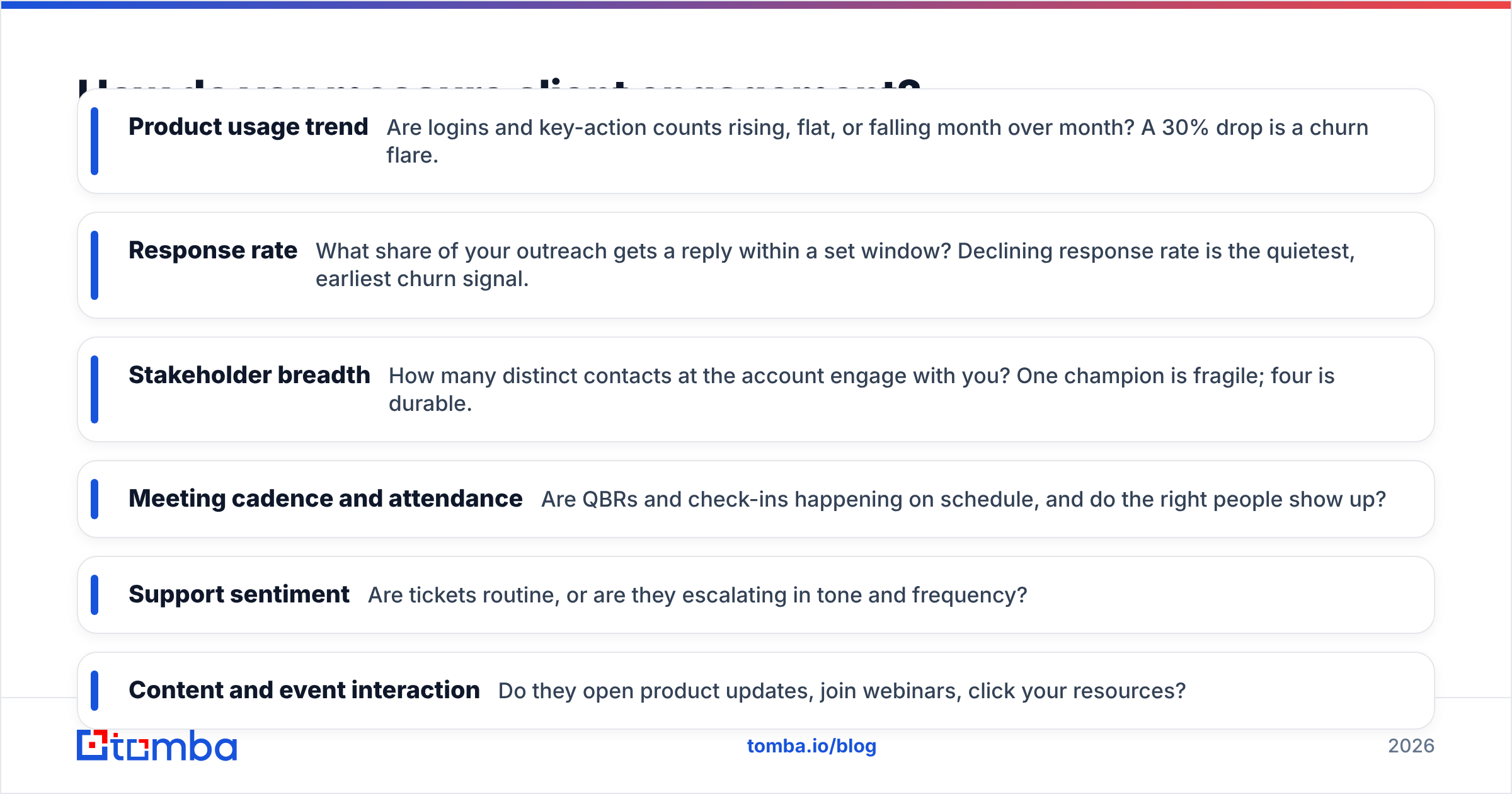
Conclusion first: track four to six behavioral signals, not one magic score. A single composite number hides the thing you need to act on. Here is a practical signal set with what each one tells you.
- Product usage trend — Are logins and key-action counts rising, flat, or falling month over month? A 30% drop is a churn flare.
- Response rate — What share of your outreach gets a reply within a set window? Declining response rate is the quietest, earliest churn signal.
- Stakeholder breadth — How many distinct contacts at the account engage with you? One champion is fragile; four is durable.
- Meeting cadence and attendance — Are QBRs and check-ins happening on schedule, and do the right people show up?
- Support sentiment — Are tickets routine, or are they escalating in tone and frequency?
- Content and event interaction — Do they open product updates, join webinars, click your resources?
Plug these into your CRM and you get an account health view that is actually actionable. The goal is not a dashboard you admire — it is a list of accounts that need a human this week.
What's the difference between engagement, satisfaction, and loyalty?#
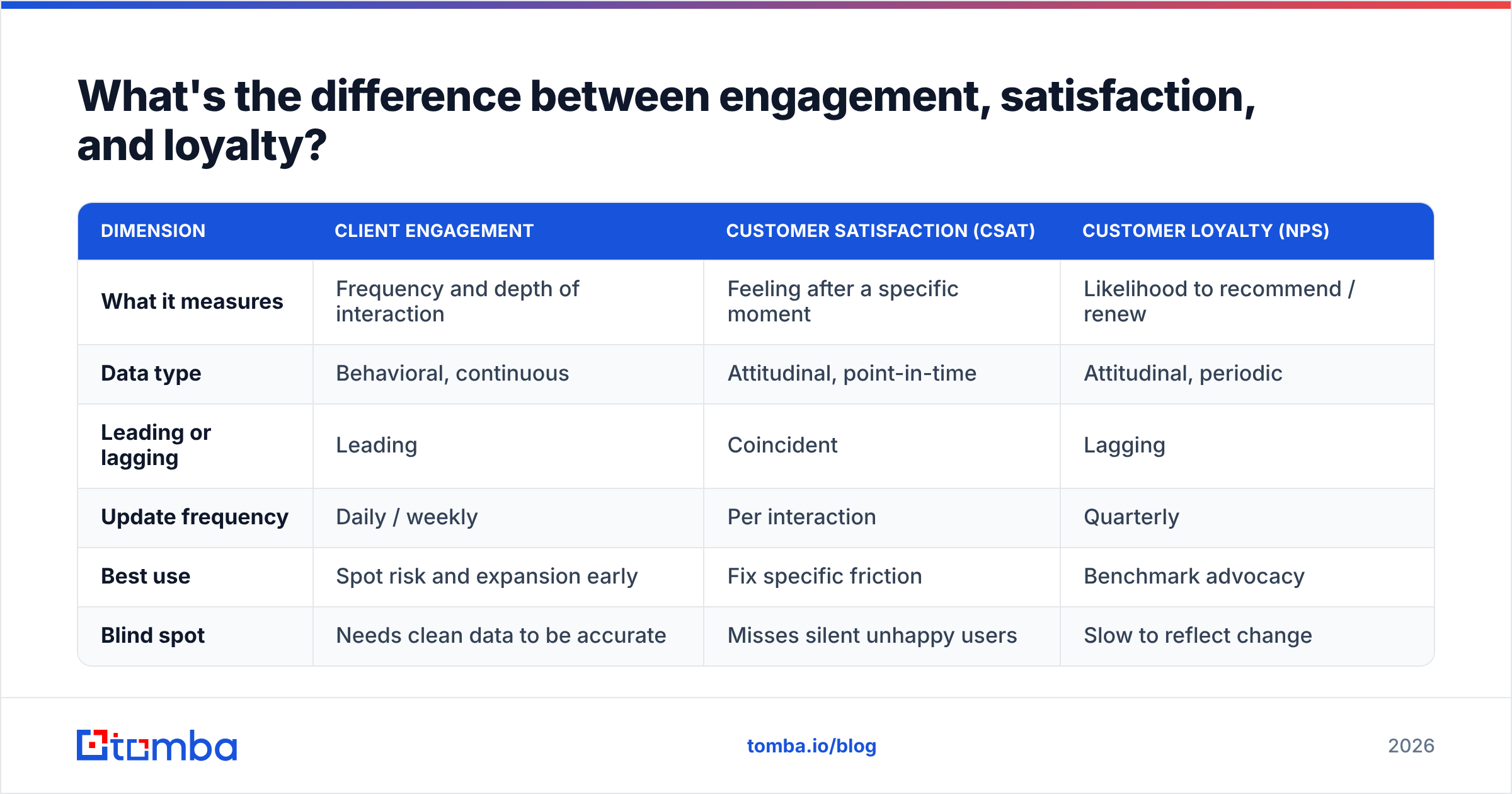
These three get used interchangeably and they should not be. Engagement is behavioral (what they do), satisfaction is attitudinal (how they feel right now), and loyalty is predictive (what they'll do next). Here is how they compare across the dimensions that matter.
| Dimension | Client Engagement | Customer Satisfaction (CSAT) | Customer Loyalty (NPS) |
|---|---|---|---|
| What it measures | Frequency and depth of interaction | Feeling after a specific moment | Likelihood to recommend / renew |
| Data type | Behavioral, continuous | Attitudinal, point-in-time | Attitudinal, periodic |
| Leading or lagging | Leading | Coincident | Lagging |
| Update frequency | Daily / weekly | Per interaction | Quarterly |
| Best use | Spot risk and expansion early | Fix specific friction | Benchmark advocacy |
| Blind spot | Needs clean data to be accurate | Misses silent unhappy users | Slow to reflect change |
The takeaway: engagement is your steering wheel because it moves first. CSAT and NPS are your rearview mirror — useful, but they confirm what engagement already told you weeks earlier.
How do you actually improve client engagement?#
Improving engagement is a workflow, not a campaign. The motion that works for high-performing teams looks like this:
1. Start with clean, complete contact data. You cannot engage a person who left the company. When a champion switches jobs, your beautifully personalized sequence lands in a dead inbox and your engagement metrics quietly tank — through no fault of your messaging. Keeping records current with ongoing data enrichment is the unglamorous foundation everything else sits on. If you are not regularly re-verifying decision-maker emails and finding the new contact when someone moves, your funnel is leaking before the first touch.
2. Segment by engagement tier, not just by plan. Treat your most engaged accounts as expansion candidates and your least engaged as save targets. Same product, completely different motions.
3. Trigger outreach on behavior, not the calendar. A usage drop, a new hire on the buying committee, a renewal 90 days out — these are reasons to reach out. "It's the first of the month" is not.
4. Multi-thread deliberately. Map every account to at least three stakeholders and engage each on what they care about. When you find a new exec contact, enrich them and bring them into the relationship before you need them. The Tomba Email Finder and a quick domain search make it trivial to find the right people at an account you already own.
5. Measure the follow-up, then tighten the loop. Track which triggers produced replies and renewals, kill the ones that don't, and double down on what works.

Which client engagement tools fit which job?#
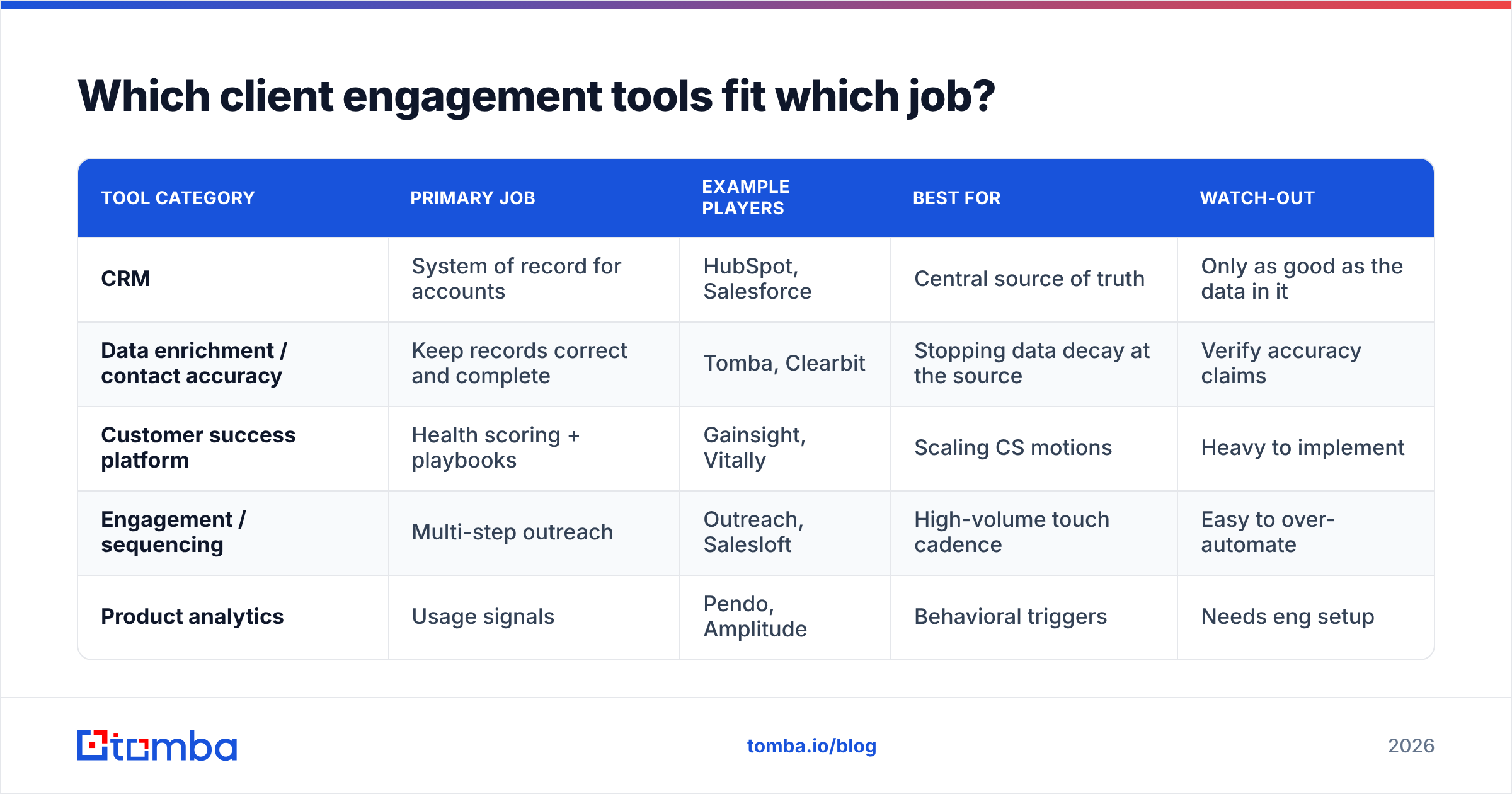
There is no single "engagement tool" — there is a stack, and each layer does a distinct job. Here is how the common categories compare so you can spend on the right layer first.
| Tool category | Primary job | Example players | Best for | Watch-out |
|---|---|---|---|---|
| CRM | System of record for accounts | HubSpot, Salesforce | Central source of truth | Only as good as the data in it |
| Data enrichment / contact accuracy | Keep records correct and complete | Tomba, Clearbit | Stopping data decay at the source | Verify accuracy claims |
| Customer success platform | Health scoring + playbooks | Gainsight, Vitally | Scaling CS motions | Heavy to implement |
| Engagement / sequencing | Multi-step outreach | Outreach, Salesloft | High-volume touch cadence | Easy to over-automate |
| Product analytics | Usage signals | Pendo, Amplitude | Behavioral triggers | Needs eng setup |
Notice the foundation: every other layer assumes your contact data is accurate. A CRM full of bounced emails produces broken health scores; a sequencing tool firing at dead addresses inflates "sent" while tanking real engagement. That is why teams increasingly start with the accuracy layer. Tomba's Tomba plans — Free (25 searches/mo), Starter at $49/mo, Growth at $99/mo, and Pro at $249/mo — slot in as the affordable foundation that keeps the expensive tools above it honest. For teams already standardized on HubSpot, the HubSpot integration pushes verified contacts straight into the record so engagement scoring stays trustworthy.
If you are weighing platforms, lean on independent review sites like G2 for category comparisons, and read each vendor's own documentation — for example HubSpot's customer engagement resources (hubspot.com) — rather than trusting any single sales deck.
What metrics signal an account is about to churn?#
Conclusion first: declining engagement almost always precedes churn by 30–90 days, which is exactly enough time to save the account if you are watching. The specific red flags:
- Login frequency falls and stays down for two-plus consecutive months.
- Response rate craters — your champion who used to reply same-day now goes silent for weeks.
- Single-threading — every conversation runs through one person, and that person stops responding.
- Skipped QBRs — the strategic meeting gets rescheduled twice, then quietly dropped.
- Support tone shifts from collaborative to transactional or frustrated.
- No expansion conversations — the account never asks about new features, seats, or use cases.
Any one of these is a yellow flag. Two or more together is a fire drill. The teams that retain best assign every red-flag account an owner and a 48-hour outreach SLA — and they make sure the contact they reach out to still works there before they hit send.
How does data accuracy connect to engagement?#
Directly and unforgivingly. Engagement is built on reaching the right human at the right moment, and B2B contact data decays fast — people change roles, companies, and inboxes constantly. Every stale record is an engagement opportunity that silently fails.
Picture the closing routine of a restaurant: if the kitchen never restocks, the next service collapses no matter how good the chef is. Contact data is your restock. When a buying-committee member moves on, you need to (a) detect it, (b) find their replacement, and (c) re-establish the relationship — fast. That is where keeping a verified pipeline pays off: a quick re-verify with an email verifier before a campaign, a bulk email finder pass to refresh a whole account list, or enrichment to fill gaps in titles and seniority. Salesforce's own guidance on data management echoes the point — clean data is the precondition for any reliable customer engagement program (salesforce.com).
Skip this layer and every downstream engagement metric is corrupted. You will "improve engagement" by sending more emails, watch the open rate fall, and never realize half your list no longer exists.
What does a weekly client engagement routine look like?#
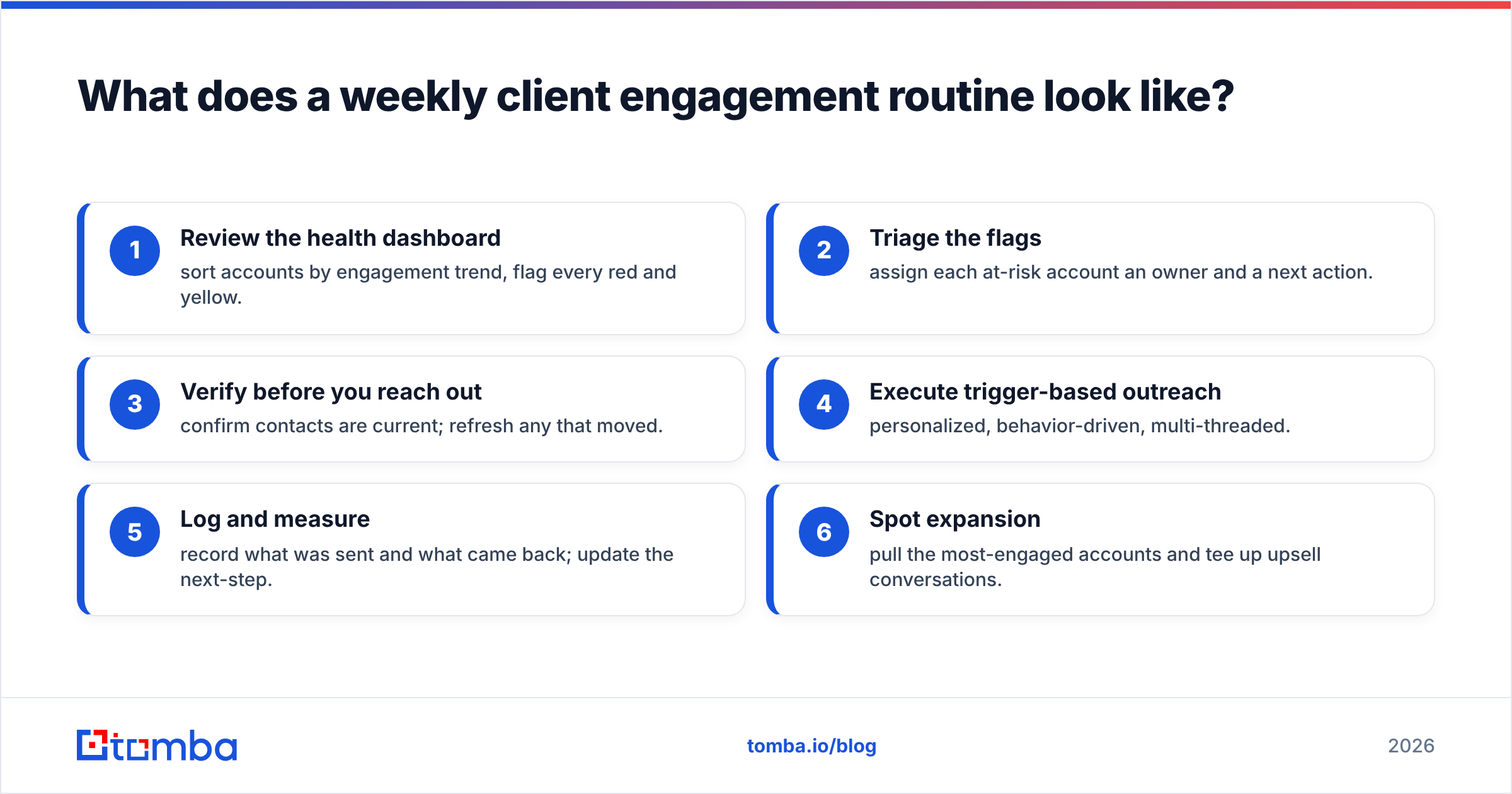
Keep it tight and repeatable. A workable weekly cadence for a CS or account team:
- Review the health dashboard — sort accounts by engagement trend, flag every red and yellow.
- Triage the flags — assign each at-risk account an owner and a next action.
- Verify before you reach out — confirm contacts are current; refresh any that moved.
- Execute trigger-based outreach — personalized, behavior-driven, multi-threaded.
- Log and measure — record what was sent and what came back; update the next-step.
- Spot expansion — pull the most-engaged accounts and tee up upsell conversations.
Do this every week and engagement stops being a quarterly surprise and becomes a managed number. The discipline matters more than the tooling — but the tooling is what makes the discipline scale.
The bottom line#
Client engagement is the leading indicator that quietly decides your retention and expansion numbers months before they hit the board deck. Measure it with a handful of behavioral signals, act on dips within days, and — most importantly — build it on contact data you can trust. The flashiest engagement playbook in the world fails the moment it targets people who no longer work there.
If your engagement program keeps stalling on bounced emails and outdated records, start at the foundation. Use the Tomba Email Finder to find and verify the right decision-makers at every account you already own, refresh stakeholders the moment someone moves, and keep your CRM clean enough that your engagement metrics actually mean something. Spin up the free tier, run your at-risk account list through it this week, and see how many "engaged" relationships were really just stale data wearing a green badge.
// get started
Find, verify and enrich your first contacts today
Start on the free plan with 25 searches a month, then scale when your team is ready.
Free plan · No credit card required · GDPR & CCPA
// about the author