Client Retention in 2026: Strategies, Metrics and Tools
Acquiring a client costs 5x more than keeping one. Here's how to measure, improve, and automate client retention in 2026 — without bloating your stack.
TL;DR
- Client retention measures how many customers stay with you over a set period — and it's the cheapest growth lever you have. Keeping a client costs roughly 5x less than winning a new one.
- A 5% lift in retention can raise profit 25–95%, according to research popularized by Bain & Company.
- The metrics that matter: retention rate, churn rate, net revenue retention (NRR), and customer lifetime value (CLV).
- Retention is a system, not a department: onboarding, proactive support, QBRs, and accurate contact data all feed it.
- Clean, enriched contact records are the unglamorous backbone — you can't retain people you can't reliably reach.
What is client retention and why does it matter in 2026?#
Client retention is the percentage of customers who keep buying from you over a defined window instead of churning. Think of it like a bucket with a hole in the bottom: acquisition pours water in, churn leaks it out. You can pour faster (spend more on ads and outbound) or you can patch the hole. In 2026, with ad costs up and budgets tighter, patching the hole is the smarter math.
The numbers back this up. The classic finding — repeated across Bain, Harvard Business Review, and countless SaaS post-mortems — is that acquiring a new customer costs five to twenty-five times more than retaining an existing one, and a modest 5% retention improvement can lift profits dramatically. Existing clients also buy more: they already trust you, so upsells and cross-sells close faster and cheaper.
Retention is no longer a "customer success problem." It's a revenue strategy that touches sales, marketing, product, and operations. The companies winning in 2026 treat it as a first-class metric next to pipeline and bookings.
How do you measure client retention?#
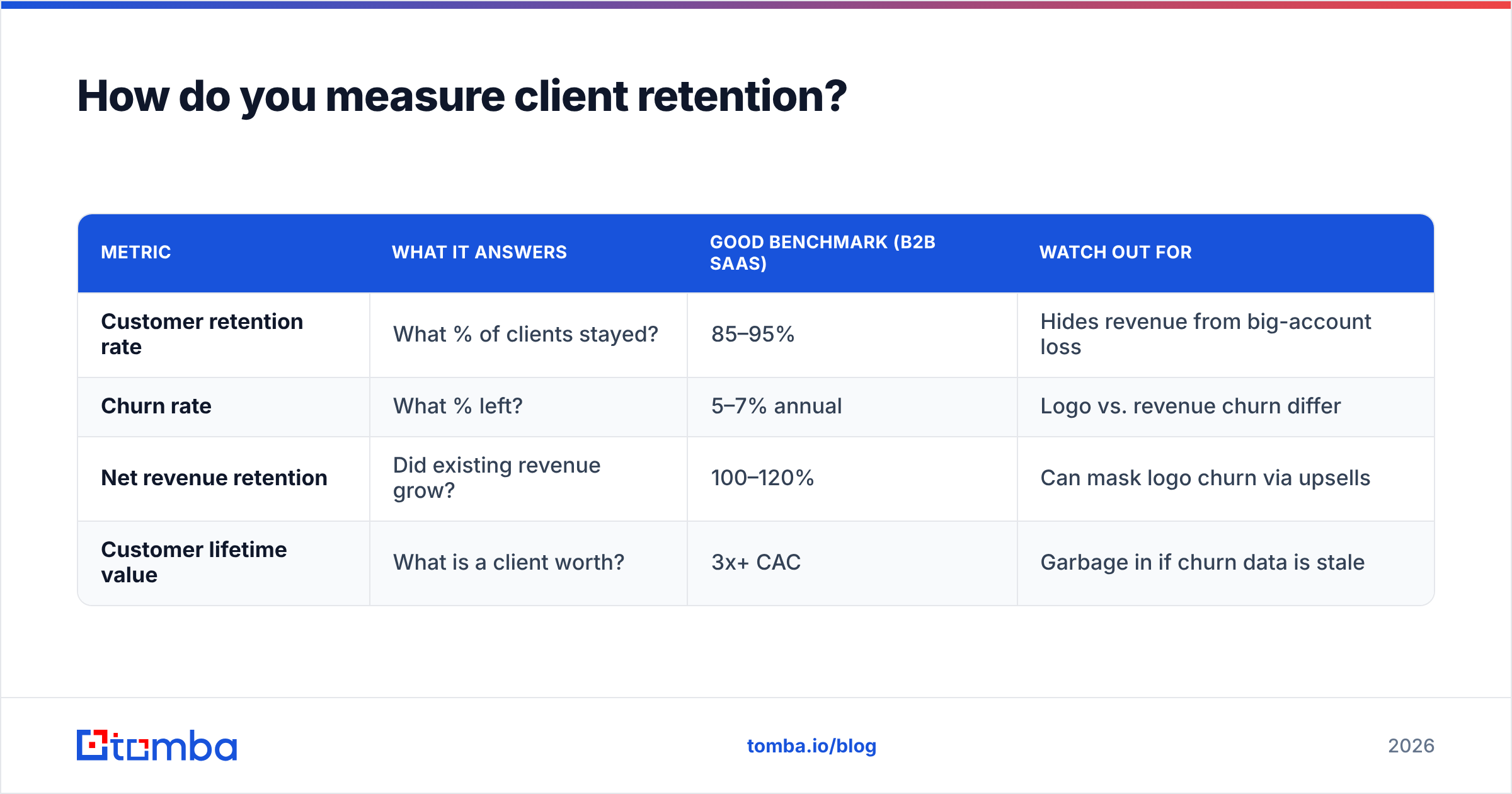
You measure it with four core metrics. Tracking one in isolation lies to you — track all four together.
- Customer retention rate (CRR) — the share of clients you kept across a period. Formula:
((Customers at end − New customers acquired) ÷ Customers at start) × 100. A 90% rate means you lost one in ten. - Churn rate — the inverse: the percentage who left. Logo churn counts customers; revenue churn counts dollars. A few large accounts leaving can wreck revenue churn while logo churn looks fine.
- Net revenue retention (NRR) — revenue from existing customers including expansion, minus churn and contraction. Above 100% means your existing base grows even if you sign zero new logos. NRR is the metric investors obsess over.
- Customer lifetime value (CLV) — total profit from a client across the relationship. Retention is the biggest input; longer relationships compound value.
Here's how they relate at a glance:
| Metric | What it answers | Good benchmark (B2B SaaS) | Watch out for |
|---|---|---|---|
| Customer retention rate | What % of clients stayed? | 85–95% | Hides revenue from big-account loss |
| Churn rate | What % left? | 5–7% annual | Logo vs. revenue churn differ |
| Net revenue retention | Did existing revenue grow? | 100–120% | Can mask logo churn via upsells |
| Customer lifetime value | What is a client worth? | 3x+ CAC | Garbage in if churn data is stale |
If you only have bandwidth for one north star, use NRR — but pair it with logo churn so expansion revenue doesn't disguise a leaky base.
Why do clients churn in the first place?#
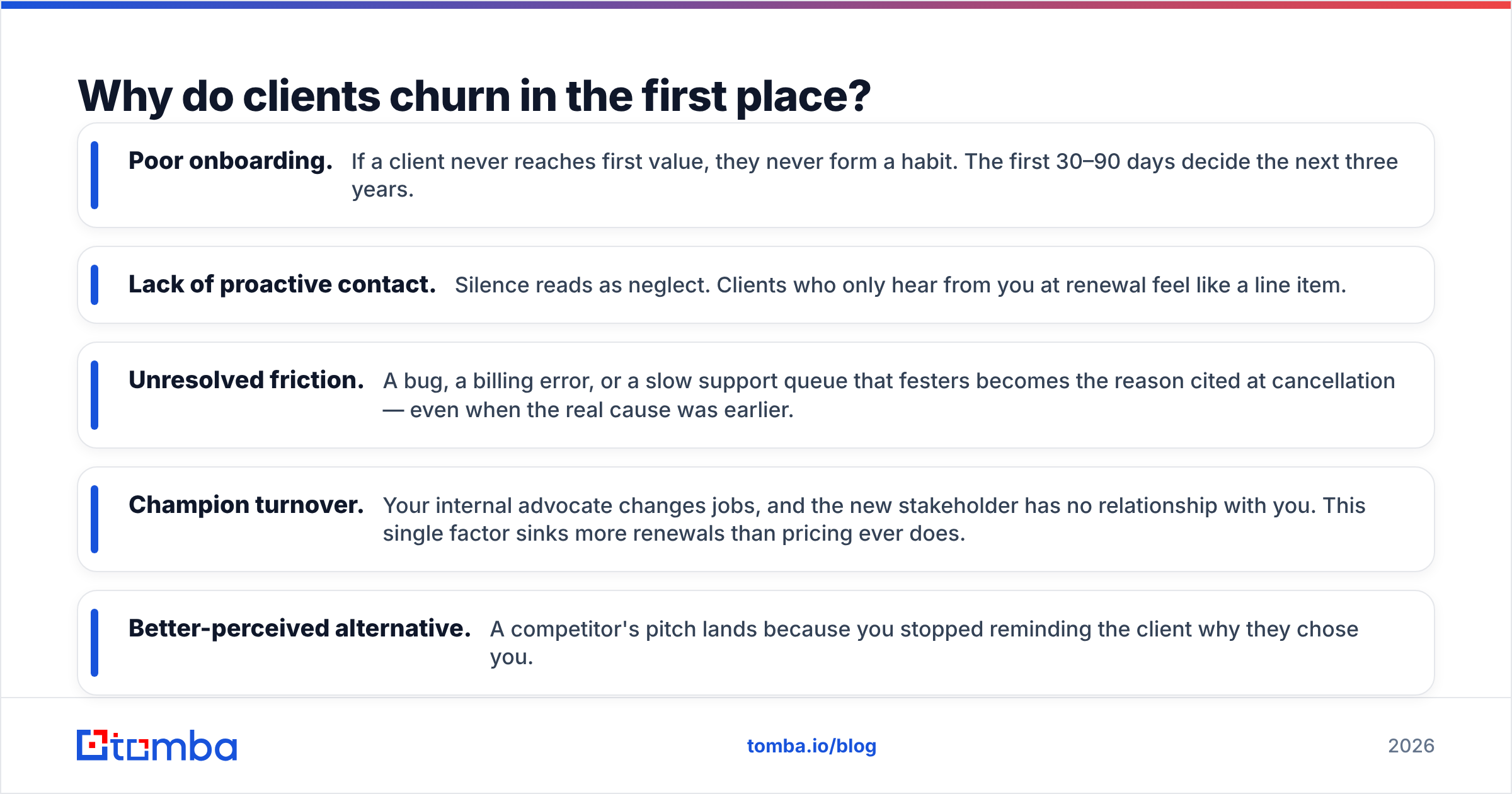
Clients leave for predictable reasons, and most are preventable. In rough order of frequency:
- Poor onboarding. If a client never reaches first value, they never form a habit. The first 30–90 days decide the next three years.
- Lack of proactive contact. Silence reads as neglect. Clients who only hear from you at renewal feel like a line item.
- Unresolved friction. A bug, a billing error, or a slow support queue that festers becomes the reason cited at cancellation — even when the real cause was earlier.
- Champion turnover. Your internal advocate changes jobs, and the new stakeholder has no relationship with you. This single factor sinks more renewals than pricing ever does.
- Better-perceived alternative. A competitor's pitch lands because you stopped reminding the client why they chose you.
Notice how many of these come down to communication and data. When your champion leaves and you don't know who replaced them — or you have a dead email on file — you find out at renewal, which is too late.
What strategies actually improve client retention?#
The strategies below are ordered by leverage. Start at the top.
1. Nail onboarding to first value. Map the shortest path to the outcome the client bought, then remove every step that doesn't serve it. Set a measurable activation milestone (first report generated, first integration live, first deal closed) and track time-to-value as religiously as you track time-to-close.
2. Run proactive check-ins, not reactive firefighting. Quarterly business reviews (QBRs) for high-value accounts, automated health-check emails for the long tail. The goal is to surface problems before the client does.
3. Build a customer health score. Combine product usage, support tickets, NPS, and engagement into a single signal. Accounts trending down get human attention before they cancel. HubSpot and other CRMs document repeatable frameworks for this — see their customer retention resources for a starting template.
4. Track champions and decision-makers continuously. People change roles constantly. When your contact leaves, you need the replacement's details fast. This is where keeping enriched, current contact records — refreshed with data enrichment — turns a silent churn risk into a warm re-introduction.
5. Close the loop on feedback. Collecting NPS and doing nothing with it is worse than not asking. Show clients you acted on what they told you.
6. Make leaving expensive (in a good way). Deepen integrations, build shared workflows, and embed your product into the client's daily operations. Switching cost, earned honestly through value, is a retention moat.
Which tools support a client retention program?#
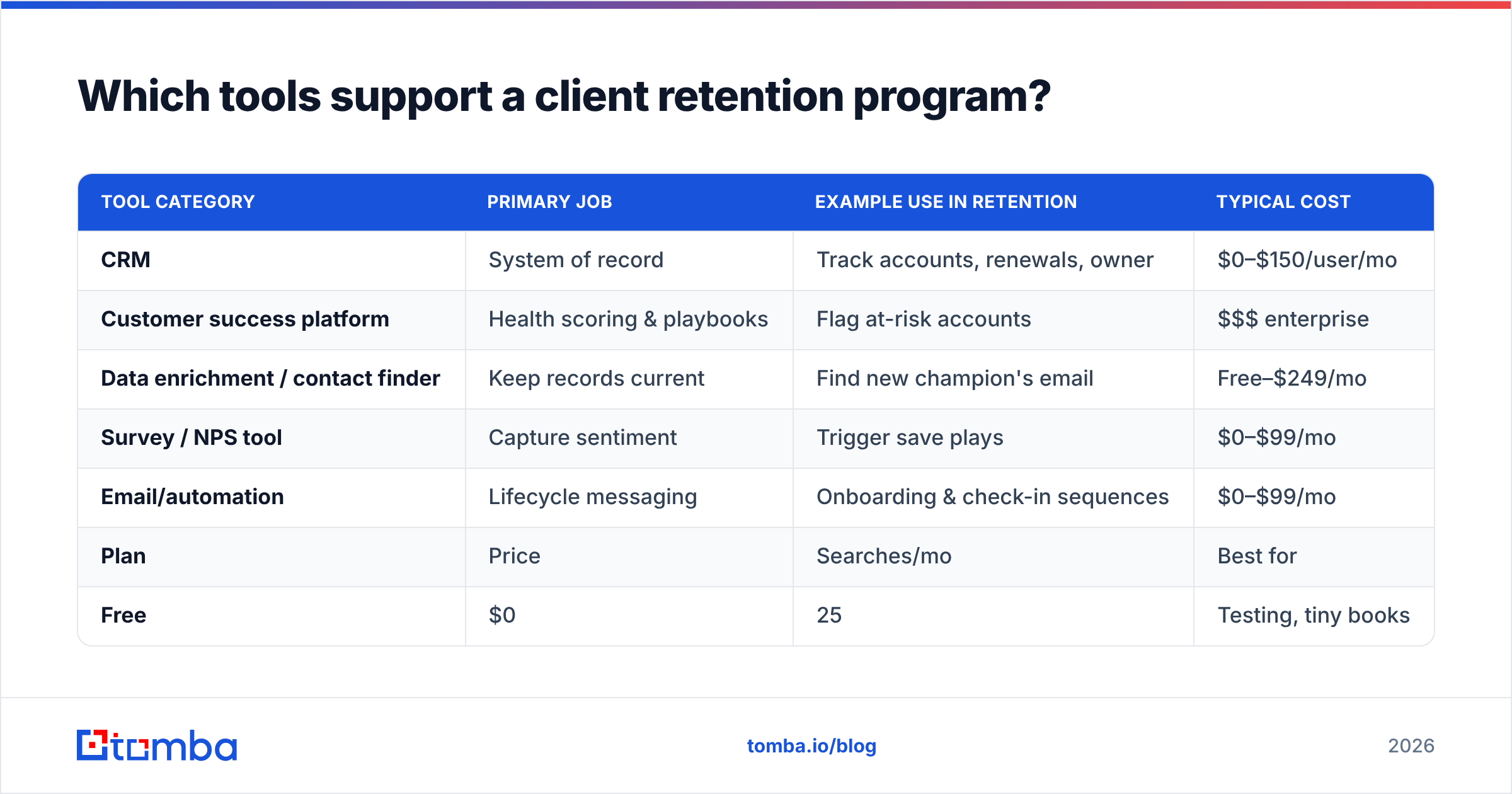
No single tool "does retention" — it's a stack working together. Here's how the categories compare and where each fits.
| Tool category | Primary job | Example use in retention | Typical cost |
|---|---|---|---|
| CRM | System of record | Track accounts, renewals, owner | $0–$150/user/mo |
| Customer success platform | Health scoring & playbooks | Flag at-risk accounts | $$$ enterprise |
| Data enrichment / contact finder | Keep records current | Find new champion's email | Free–$249/mo |
| Survey / NPS tool | Capture sentiment | Trigger save plays | $0–$99/mo |
| Email/automation | Lifecycle messaging | Onboarding & check-in sequences | $0–$99/mo |
The category most teams under-invest in is data enrichment. Your CRM is only as good as the contacts inside it, and B2B data decays at roughly 22–30% per year as people switch jobs. When a record goes stale, your retention playbook misfires — the renewal reminder bounces, the QBR invite never lands.
This is exactly where a tool like Tomba earns its keep. When a key contact leaves an account, you can use the domain search to find their replacement at the same company, verify the new address with the email verifier, and re-establish the relationship before the renewal date. It's not glamorous, but a verified email is the difference between a saved account and a surprise cancellation.
Tomba's pricing keeps this affordable for retention work specifically — you're not enriching thousands of cold leads, you're keeping a known book of business current:
| Plan | Price | Searches/mo | Best for |
|---|---|---|---|
| Free | $0 | 25 | Testing, tiny books |
| Starter | $49/mo | Higher volume | SMB CS teams |
| Growth | $99/mo | More volume + seats | Scaling teams |
| Pro | $249/mo | High volume | RevOps at scale |
See full Tomba pricing for credit details. Compared with general-purpose B2B databases that charge enterprise minimums, a focused finder-and-verifier is the lean choice for keeping an existing account list accurate.
How is client retention different from customer loyalty?#
Retention is behavioral; loyalty is emotional. A client can be retained because switching is painful (a long contract, a deep integration) while feeling no loyalty at all — and that client churns the instant a smoother option appears. A loyal client actively advocates for you, tolerates the occasional mistake, and expands without being sold to.
The practical takeaway: don't let high retention numbers lull you. Measure loyalty separately through NPS, referral rate, and expansion behavior. High retention plus low loyalty is a warning sign, not a victory. You want clients who stay because they want to, not because they're trapped.
What does a 90-day retention plan look like?#
If you're starting from scratch, here's a concrete sequence.
Days 1–30 — Instrument. Pick your four metrics and get them on a dashboard. Audit your CRM for stale contacts and dead emails; clean the worst offenders first. Define what "activated" means for a new client.
Days 31–60 — Intervene. Build a basic health score (even a manual red/yellow/green works). Stand up an onboarding sequence and a quarterly check-in cadence. Identify your top 20% of accounts by revenue and schedule QBRs.
Days 61–90 — Automate and review. Wire up automated re-enrichment so departing champions trigger a "find the replacement" task. Launch an NPS pulse and commit to a follow-up loop. Review your first cohort's retention rate and iterate.
The teams that win don't run heroic save plays at renewal. They build a quiet system that makes churn rare in the first place — and accurate contact data is the foundation that holds it all up.
Frequently asked questions#
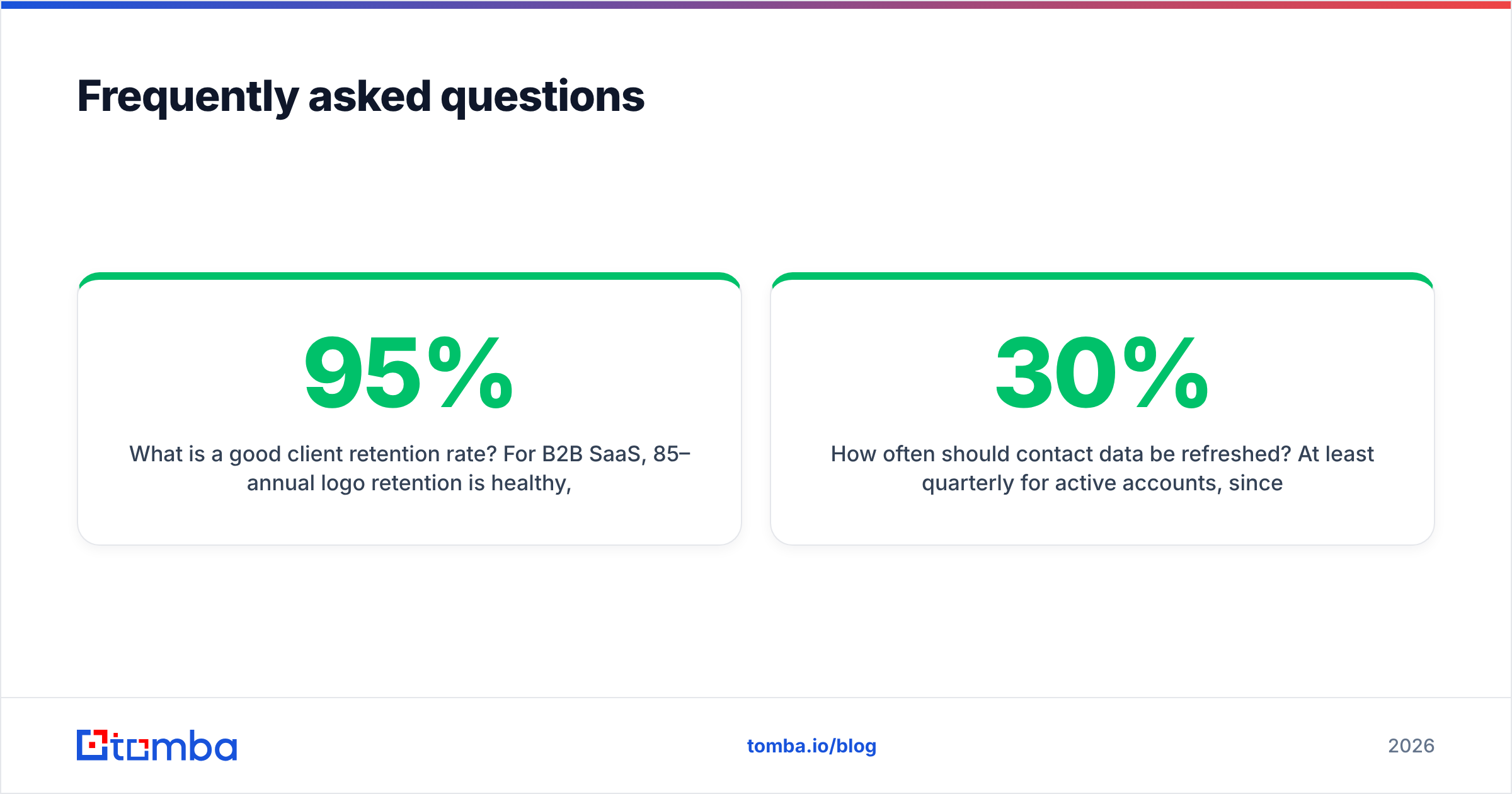
What is a good client retention rate? For B2B SaaS, 85–95% annual logo retention is healthy, and net revenue retention above 100% is the gold standard. Lower benchmarks apply to transactional or SMB-heavy businesses.
Is retention or acquisition more important? Both matter, but retention is cheaper and compounds. A leaky bucket can't be filled by acquisition alone — fix retention first, then scale acquisition.
How often should contact data be refreshed? At least quarterly for active accounts, since B2B contacts decay 22–30% per year. Trigger an immediate refresh whenever a known champion shows signs of leaving.
Keep the clients you already won#
Retention is the highest-ROI growth lever you have, and most of it comes down to one unglamorous habit: always being able to reach the right person at the account. When champions move, accounts go dark — and dark accounts churn. Use the Tomba Email Finder to instantly locate and verify the new decision-maker's contact details the moment your old champion leaves, so every renewal conversation starts on time and lands in the right inbox. Start free with 25 searches a month, then scale to Starter at $49/mo when retention work becomes routine. Your existing clients are your cheapest revenue — make sure you never lose touch with them.
For more on the underlying numbers, the widely cited Bain & Company research on retention economics is summarized well on G2 and across the HBR archives.
Ready to find emails that actually work?
Join 150,000+ professionals who stopped guessing and started sending. Free credits on signup — no credit card required.
Get the Tomba newsletter
Practical outbound tactics and product updates — once every two weeks.
About the author