Client Retention Strategies That Cut Churn in 2026
Acquisition gets the budget, but retention pays the bills. Here are the client retention strategies that actually move net revenue retention in 2026 — with a playbook you can run this quarter.
Client Retention Strategies That Cut Churn in 2026
Winning a new customer costs five to seven times more than keeping one you already have. Yet most go-to-market teams still pour the majority of their budget into the top of the funnel and treat retention as an afterthought the customer success team handles "later." That math is backwards, and in 2026 it's getting more expensive to ignore.
This guide breaks down the client retention strategies that actually shift net revenue retention — not vague advice about "delighting customers," but a concrete playbook you can assign owners to this quarter.
TL;DR#
- Retention is a revenue lever, not a support function. A 5% lift in retention can raise profit by 25–95%, so treat it like pipeline.
- Churn is usually predictable. Most accounts signal risk weeks before they cancel — usage drops, champions leave, support tickets spike.
- Onboarding decides the renewal. The first 30–90 days set the ceiling for the entire relationship.
- Clean contact data quietly powers retention. When a champion changes jobs, your renewal walks out the door unless you can re-find and re-engage them fast.
- Segment your effort. High-touch QBRs for enterprise, automated nurture for the long tail — one playbook does not fit every account.
What Are Client Retention Strategies, Really?#
Client retention strategies are the deliberate, repeatable actions you take to keep existing customers paying, expanding, and advocating — instead of churning. Think of it like a garden. Acquisition is planting seeds; retention is the watering, weeding, and feeding that decides whether anything actually grows. Skip it and you're constantly replanting just to stay even.
Technically, retention is measured through a handful of metrics that belong on every revenue dashboard:
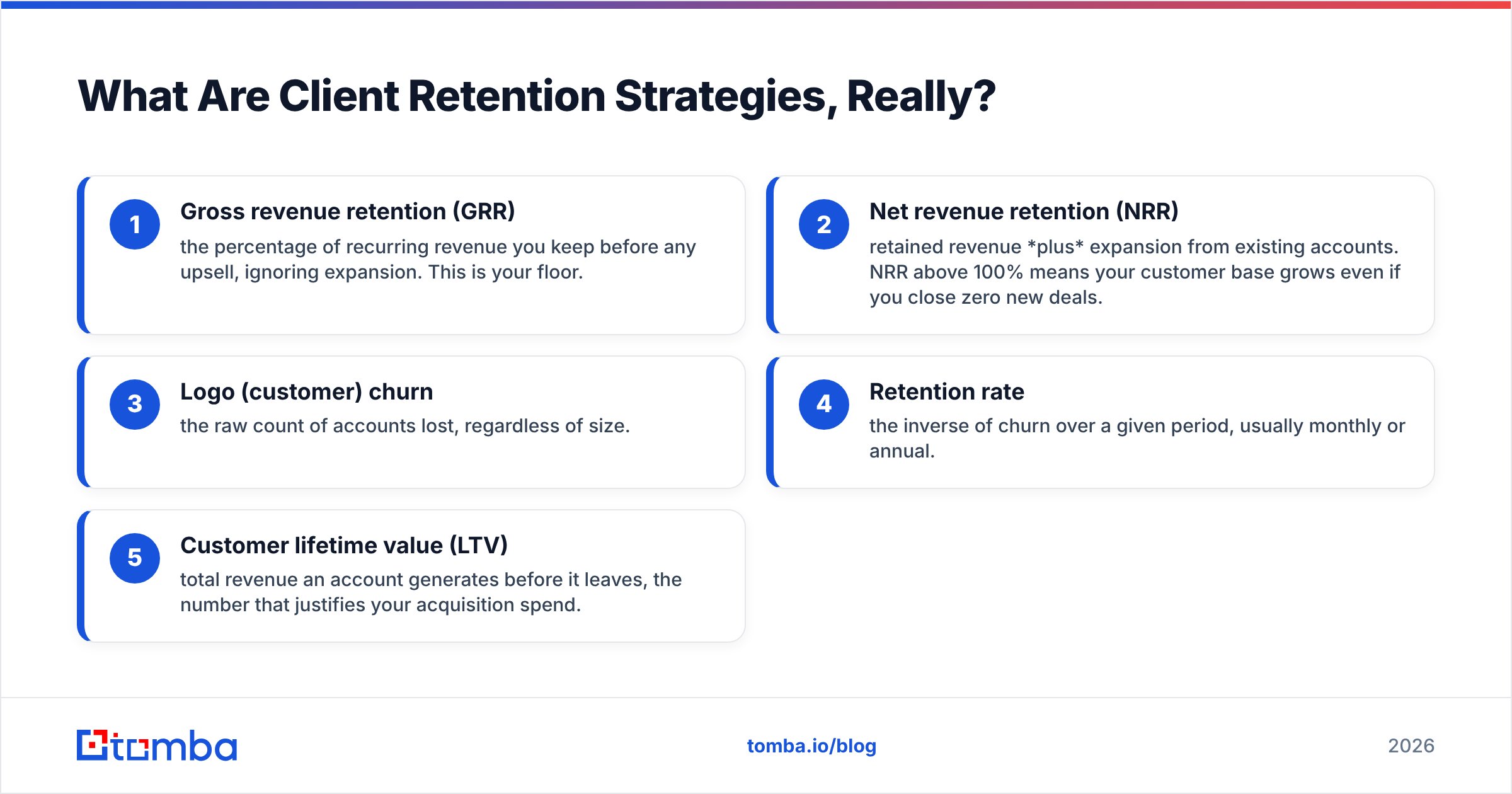
- Gross revenue retention (GRR) — the percentage of recurring revenue you keep before any upsell, ignoring expansion. This is your floor.
- Net revenue retention (NRR) — retained revenue plus expansion from existing accounts. NRR above 100% means your customer base grows even if you close zero new deals.
- Logo (customer) churn — the raw count of accounts lost, regardless of size.
- Retention rate — the inverse of churn over a given period, usually monthly or annual.
- Customer lifetime value (LTV) — total revenue an account generates before it leaves, the number that justifies your acquisition spend.
If you only track one, track NRR. It's the metric investors and boards have rallied around because it captures whether your existing book of business is healthy without the noise of new logos. The best SaaS companies run NRR of 120% or higher, which means a great retention engine can grow the business faster than the sales team alone.
)
Why Do Customers Actually Churn?#
Customers rarely leave for the reason they state on the cancellation form. "Too expensive" is often code for "I never got enough value to justify the price." Before you fix retention, you need an honest map of the failure modes:
- Weak onboarding. They never reached first value, so the product became a line item nobody could defend at renewal.
- Champion turnover. Your internal advocate got promoted, switched companies, or was laid off — and nobody knew until the renewal stalled. According to Gartner research on B2B buying, the typical purchase involves six to ten stakeholders, so losing one can quietly kill momentum.
- Unmet expectations. Sales over-promised, the product under-delivered, and trust eroded one missed feature at a time.
- Silent dissatisfaction. Most unhappy customers never complain — they just stop logging in and don't renew.
- Better-fit competitor. A rival solved a pain you ignored, and switching costs weren't high enough to keep them.
Notice how many of these are preventable with information you could have had. Champion turnover, for example, is a data problem as much as a relationship problem. If you know within days that your main contact left and can immediately find the new decision-maker, the risk becomes a re-engagement campaign instead of a lost account.
What Are the Most Effective Client Retention Strategies?#
Here's the core playbook, ordered by how much leverage each tactic gives you relative to the effort.
1. Nail the First 90 Days#
The single highest-ROI retention strategy is onboarding that drives customers to a concrete "first value" milestone fast. Define what success looks like for each segment — a first campaign sent, a first report generated, a first integration connected — and instrument it. Accounts that hit that milestone in week one renew at dramatically higher rates than those who don't. Map the path, remove every step that isn't essential, and have a human check in before the customer has a chance to get stuck.
2. Build a Churn Early-Warning System#
Stop treating renewals as a surprise. Combine product usage, support sentiment, NPS, and engagement into a health score, then route at-risk accounts to a defined save play. The goal is to intervene 60–90 days before the renewal, not the week of. A simple red/yellow/green score that triggers a human outreach is worth more than a sophisticated model nobody acts on.
3. Keep Your Contact and Account Data Fresh#
A retention motion built on stale data fails quietly. When your champion changes roles, your CRM still shows their old email and you keep emailing a dead inbox. The fix is ongoing data enrichment so contact records refresh automatically, plus a way to quickly find the replacement stakeholder. Pair that with regular email verification so your renewal and QBR invites actually land instead of bouncing into a spam folder and tanking your sender reputation.
4. Run Real Quarterly Business Reviews#
For your high-value accounts, a QBR isn't a status meeting — it's a value-proof and expansion conversation. Show the outcomes the customer achieved, benchmark them against goals, and surface the next opportunity. Tie it back to the metrics they care about, not your feature roadmap.
5. Make Expansion Part of Retention#
NRR above 100% comes from existing customers spending more. Identify expansion signals — seat growth, usage nearing plan limits, new use cases — and build motions to capture them. Expansion and retention are the same muscle: a customer who's expanding is a customer who isn't churning.
)
High-Touch vs. Tech-Touch: Which Retention Model Fits?#
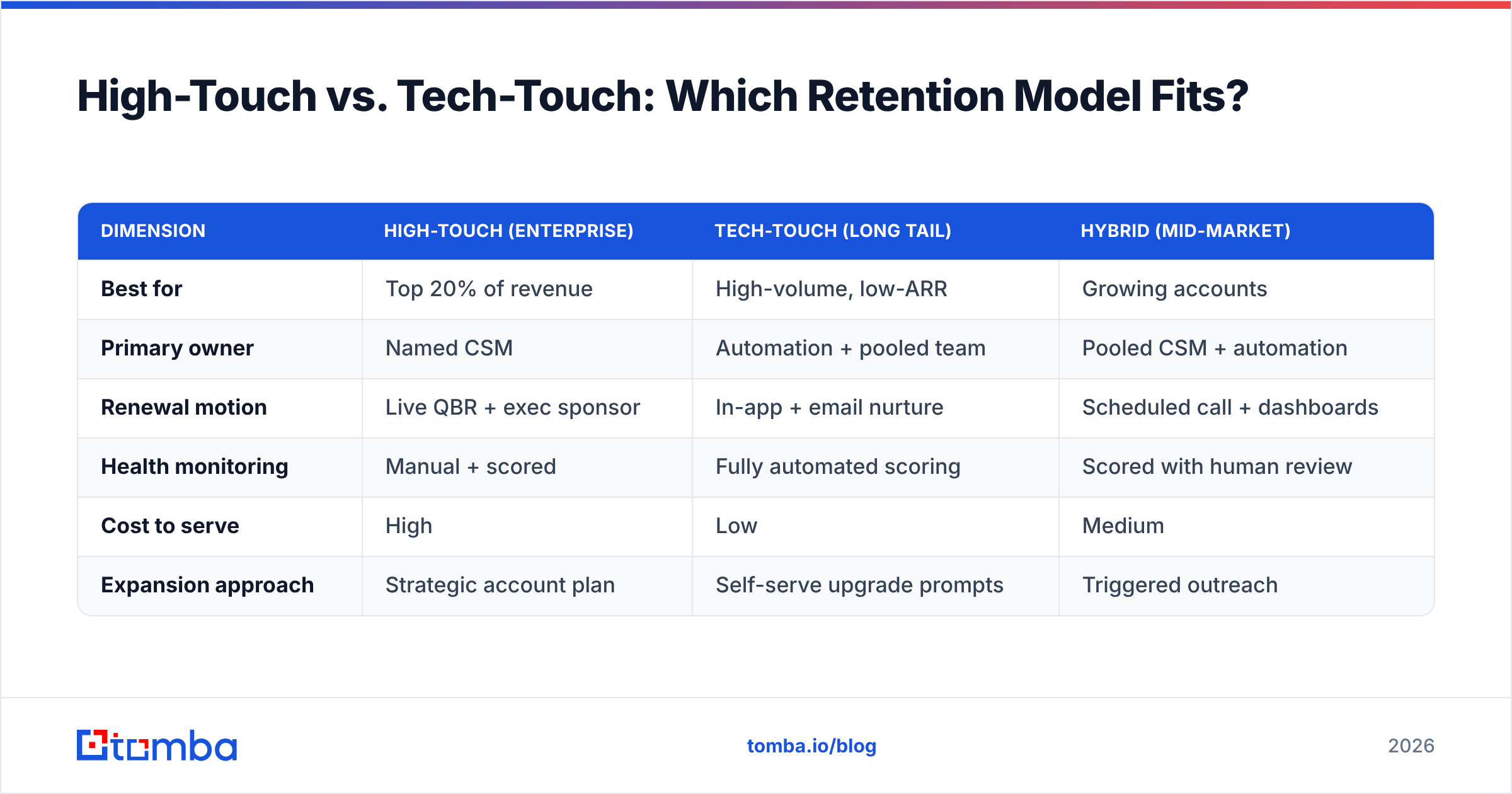
Not every account deserves the same effort. The mistake teams make is applying one model to their entire base — either drowning small accounts in human attention you can't afford, or leaving enterprise accounts to fend for themselves in an automated nurture. Segment by account value and complexity, then match the model.
| Dimension | High-Touch (Enterprise) | Tech-Touch (Long Tail) | Hybrid (Mid-Market) |
|---|---|---|---|
| Best for | Top 20% of revenue | High-volume, low-ARR | Growing accounts |
| Primary owner | Named CSM | Automation + pooled team | Pooled CSM + automation |
| Renewal motion | Live QBR + exec sponsor | In-app + email nurture | Scheduled call + dashboards |
| Health monitoring | Manual + scored | Fully automated scoring | Scored with human review |
| Cost to serve | High | Low | Medium |
| Expansion approach | Strategic account plan | Self-serve upgrade prompts | Triggered outreach |
The hybrid column is where most B2B companies should concentrate, because mid-market accounts are big enough to justify some human attention but numerous enough that you need automation to scale it. The key is letting data — not gut feel — decide which accounts graduate from tech-touch to high-touch.
How Do You Measure Retention the Right Way?#
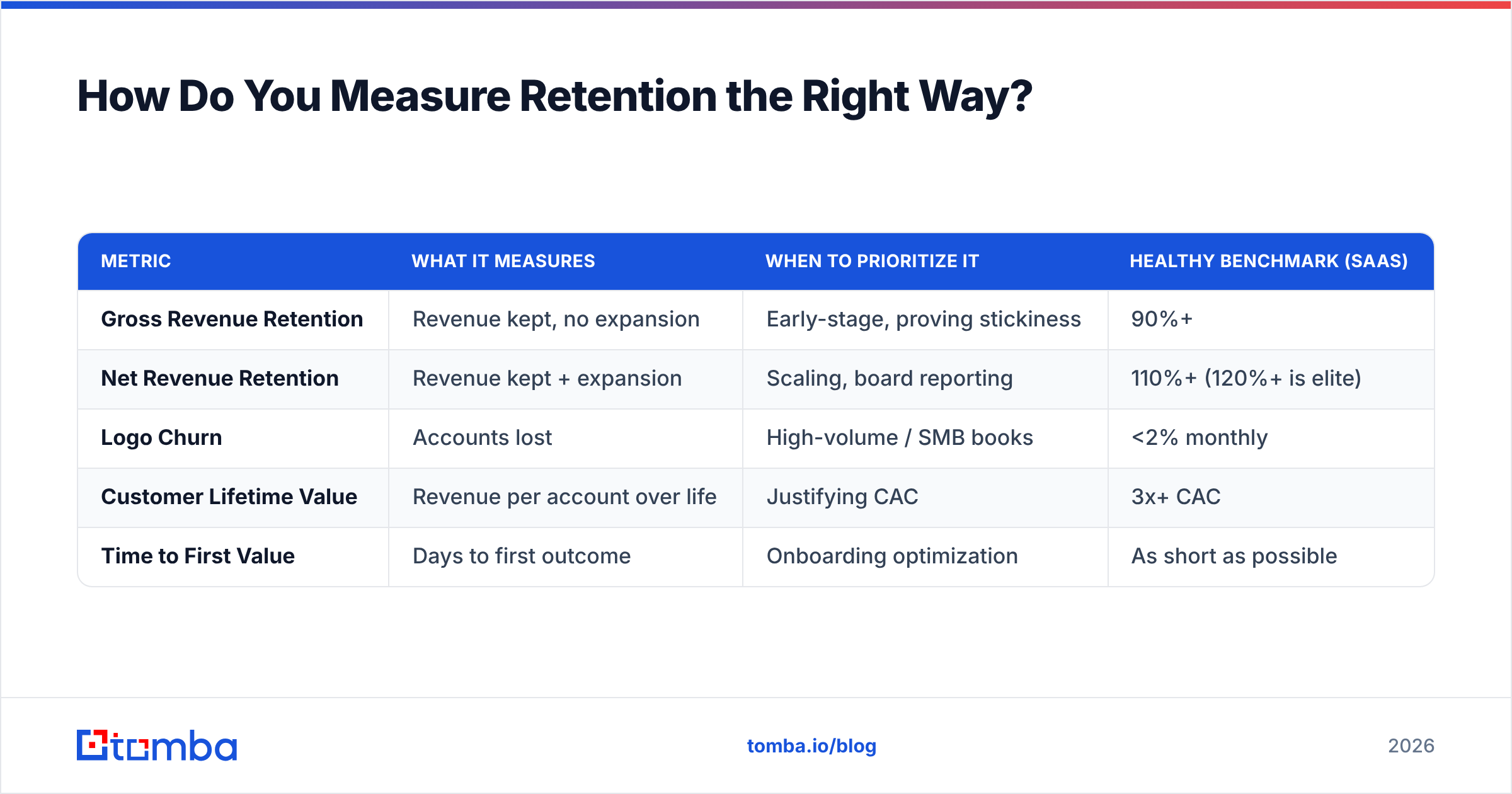
Pick a small set of metrics and review them on a fixed cadence. Here's a comparison of the core ones and when each matters most.
| Metric | What It Measures | When to Prioritize It | Healthy Benchmark (SaaS) |
|---|---|---|---|
| Gross Revenue Retention | Revenue kept, no expansion | Early-stage, proving stickiness | 90%+ |
| Net Revenue Retention | Revenue kept + expansion | Scaling, board reporting | 110%+ (120%+ is elite) |
| Logo Churn | Accounts lost | High-volume / SMB books | <2% monthly |
| Customer Lifetime Value | Revenue per account over life | Justifying CAC | 3x+ CAC |
| Time to First Value | Days to first outcome | Onboarding optimization | As short as possible |
A practical rule: GRR tells you if the product is sticky, NRR tells you if the business is healthy, and time-to-first-value tells you whether next quarter's renewals are already at risk. Track all three and you'll see churn coming instead of explaining it after the fact. For definitions your whole team can align on, keep a shared B2B glossary so "retention" means the same thing in finance, sales, and customer success.
What Role Does Your CRM and Data Stack Play?#
Retention lives or dies on whether your systems give you a single, current view of each account. If usage data sits in the product, contracts in billing, and conversations in someone's inbox, no one can act on risk in time.
The fix is integration plus clean data:
- Connect your tools. Pipe product usage and support data into your CRM so health scores are visible where reps and CSMs already work. A native HubSpot integration or similar removes the copy-paste tax that kills adoption.
- Keep records current. Decay is relentless — B2B contact data degrades roughly 30% per year as people change jobs. Schedule enrichment so your account records don't quietly rot.
- Re-find lost champions fast. When a key contact disappears, use a domain search to surface the new stakeholders at that company and reopen the relationship before the renewal lapses.
- Protect your sender reputation. Verified contacts mean your retention emails — renewal reminders, QBR invites, check-ins — actually reach the inbox instead of bouncing.
Industry reviews on platforms like G2 consistently show that the retention winners aren't the teams with the fanciest playbooks — they're the ones whose data and systems let them act fast. A brilliant save play is worthless if it fires three weeks too late or lands in a dead inbox.
How Do You Build a Retention Culture, Not Just a Process?#
Tactics fade; culture compounds. The companies with the best retention treat it as everyone's job, not a department.
Start by making retention metrics as visible as new-bookings metrics. If your weekly revenue meeting only celebrates closed-won deals and never mentions NRR, you've told the organization what actually matters. Put churn and retention on the same dashboard as pipeline and review them with the same seriousness.
Then close the loop on churn. Every lost account should trigger a short, blameless post-mortem: what was the real reason, when was the first warning sign, and what would have caught it earlier? Feed those answers back into onboarding, product, and your early-warning system. Companies like HubSpot built entire growth philosophies — the flywheel — around the idea that happy, retained customers are the cheapest source of new revenue through referrals and expansion.
Finally, give customer-facing teams the authority and tools to act. A CSM who spots risk but has to file three approvals to offer a fix will lose the account while waiting. Empower the front line, arm them with current data, and measure them on retention outcomes.
A 90-Day Retention Action Plan#
If you want to start tomorrow, here's a sequenced plan:
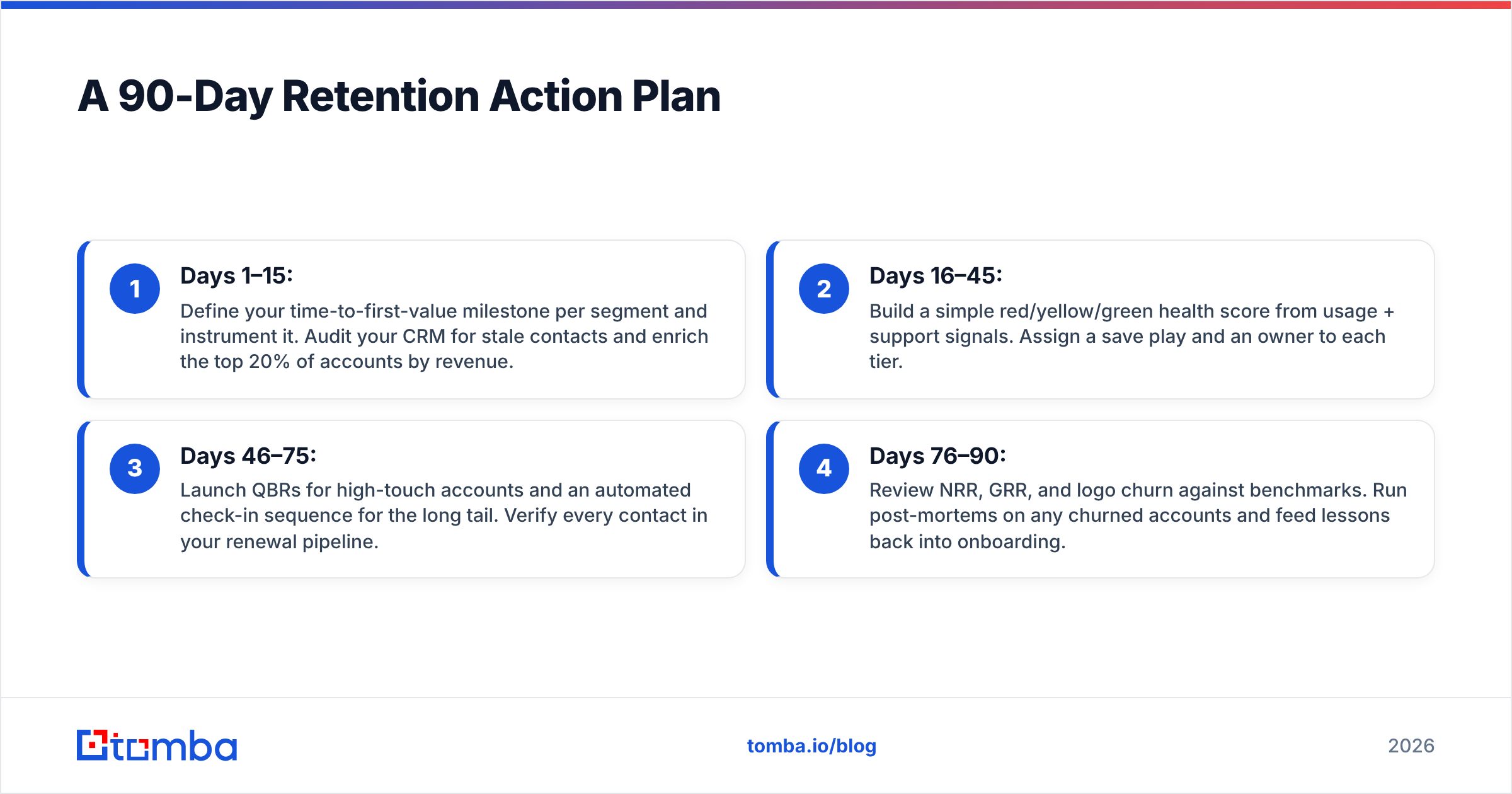
- Days 1–15: Define your time-to-first-value milestone per segment and instrument it. Audit your CRM for stale contacts and enrich the top 20% of accounts by revenue.
- Days 16–45: Build a simple red/yellow/green health score from usage + support signals. Assign a save play and an owner to each tier.
- Days 46–75: Launch QBRs for high-touch accounts and an automated check-in sequence for the long tail. Verify every contact in your renewal pipeline.
- Days 76–90: Review NRR, GRR, and logo churn against benchmarks. Run post-mortems on any churned accounts and feed lessons back into onboarding.
None of this requires a new headcount or a six-figure platform. It requires owners, a cadence, and data you can trust.
Keep the Revenue You Already Earned#
The best client retention strategies all share one foundation: knowing who your customers are, reaching the right people, and acting before risk turns into churn. That starts with contact data you can rely on. When a champion moves on, Tomba Email Finder lets you instantly find the new decision-maker's verified email by company or domain — so a stakeholder change becomes a re-engagement play instead of a lost renewal. Start free with 25 searches a month, then scale on the Starter plan at $49/mo once retention becomes a system you run, not a fire you fight. Keep the revenue you already worked so hard to win.
// get started
Find, verify and enrich your first contacts today
Start on the free plan with 25 searches a month, then scale when your team is ready.
Free plan · No credit card required · GDPR & CCPA
// about the author