Clodura.ai Pricing 2026: Plans, Costs, and Real Alternatives
A no-spin breakdown of Clodura.ai pricing in 2026 — every plan, what credits actually cost, hidden limits, and where a leaner stack beats it.
Clodura.ai Pricing 2026: Plans, Costs, and Real Alternatives
You came here for one number and left with a quote form. That is the usual Clodura.ai pricing experience, so this guide does the math the marketing page avoids: what each plan actually costs per month, how many usable contacts you get, where the credit limits bite, and when a smaller, pay-for-what-you-touch stack wins.
TL;DR#
- Clodura.ai pricing in 2026 spans four tiers — Free, Prospect, Growth, and Pro/Enterprise — and the headline monthly prices climb fast once you add seats and credits.
- Credits are the real cost. Email and direct-dial reveals burn credits, and the cheaper plans run dry well before a full prospecting month ends.
- Annual contracts are where the "discount" lives. Month-to-month pricing is noticeably higher, so the advertised low number usually assumes a yearly commitment.
- It is a suite, not a finder. You pay for sequencing, intent, and a database you may not use — fine if you want everything in one login, wasteful if you only need verified emails.
- A focused alternative like a dedicated email finder plus an email verifier often covers the same outreach job for less, with a real free tier.
What is Clodura.ai?#
Clodura.ai is an all-in-one sales prospecting and intelligence platform. Think of it as a department store for outbound: a B2B contact database, an email and phone finder, buyer-intent signals, technographics, and a built-in email sequencer all under one roof. You search for accounts, pull contacts, and launch cadences without leaving the tool.
That breadth is the selling point and the catch. A department store is convenient when you need ten things at once, but you still pay for the floor space whether you walk it or not. If your team only needs accurate emails for a CRM you already love, you are renting aisles you never visit.
The platform positions itself against the heavyweight data vendors. You can see how buyers weigh those trade-offs on review sites like G2, where the recurring themes are generous database size, a learning curve on the sequencer, and credit limits that surprise new users.
)
How much does Clodura.ai pricing cost in 2026?#
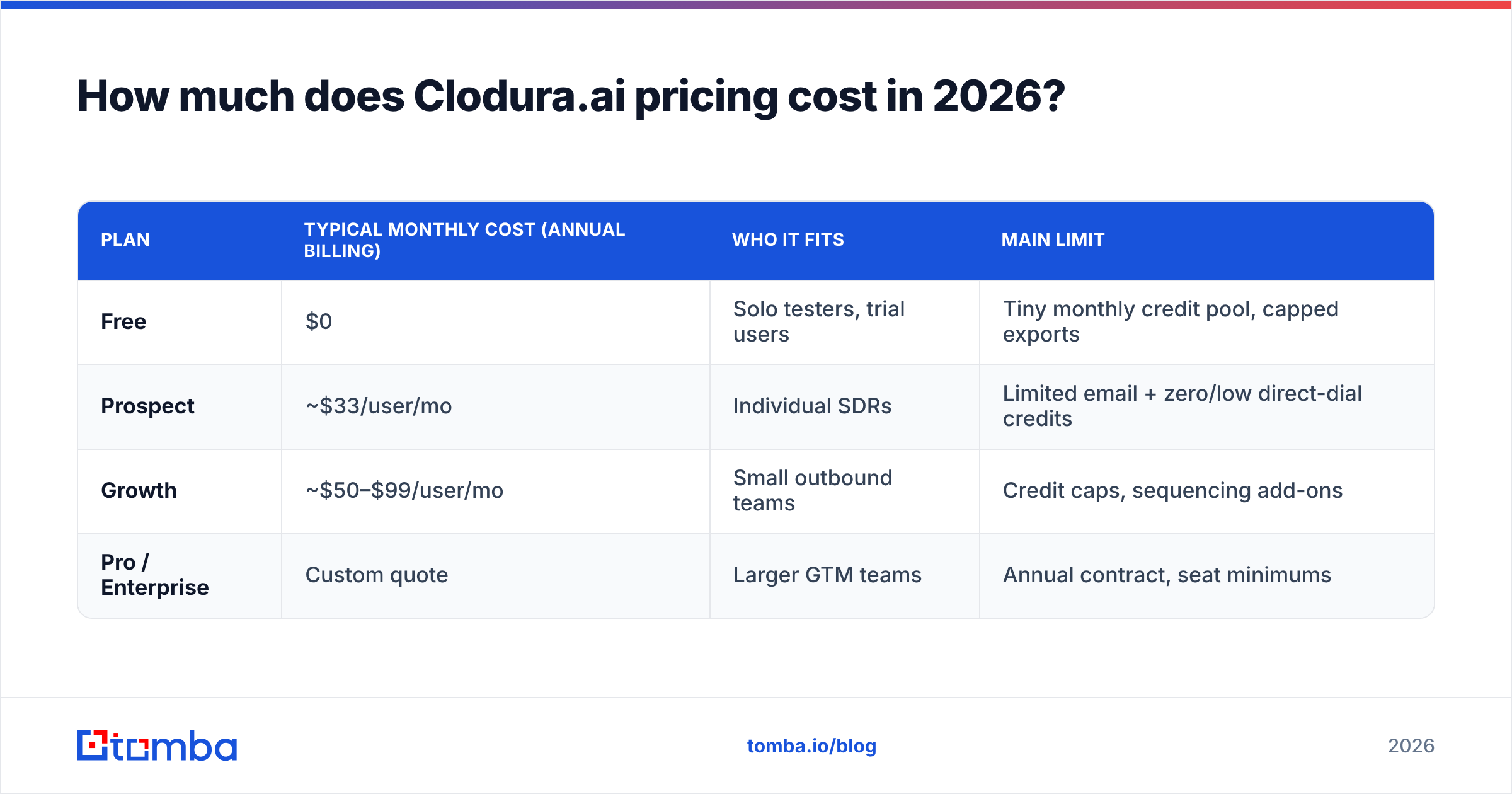
Short answer: from free up to several hundred dollars per user per month, depending on tier, seats, and how many credits you bolt on. Clodura.ai uses a tiered model where the base subscription unlocks features and a monthly credit pool unlocks data.
Because exact numbers shift with promotions and annual-versus-monthly billing, treat the table below as the shape of the pricing rather than a contract. Always confirm live figures on the official Clodura.ai pricing page before you buy.
| Plan | Typical monthly cost (annual billing) | Who it fits | Main limit |
|---|---|---|---|
| Free | $0 | Solo testers, trial users | Tiny monthly credit pool, capped exports |
| Prospect | ~$33/user/mo | Individual SDRs | Limited email + zero/low direct-dial credits |
| Growth | ~$50–$99/user/mo | Small outbound teams | Credit caps, sequencing add-ons |
| Pro / Enterprise | Custom quote | Larger GTM teams | Annual contract, seat minimums |
Two things drive the real bill. First, per-seat pricing — every rep is a separate subscription, so a five-person team multiplies the sticker price. Second, credit consumption — revealing a verified email or a mobile number spends from a monthly allowance that resets but does not roll over. Run out mid-month and you either wait or pay for a top-up.
Why the advertised price is rarely the price you pay#
- Annual lock-in. The low monthly figure almost always assumes you prepay for a year. Month-to-month is higher.
- Direct dials cost more. Phone reveals typically burn more credits than emails, so dialer-heavy teams drain pools faster.
- Feature gating. Intent data, advanced filters, and higher sequencing volume often sit on the upper tiers, nudging you up a plan to unlock one feature.
- Seat minimums on Enterprise. Custom quotes frequently carry a floor on users, so a three-person team may be priced like five.
What do you actually get for the money?#
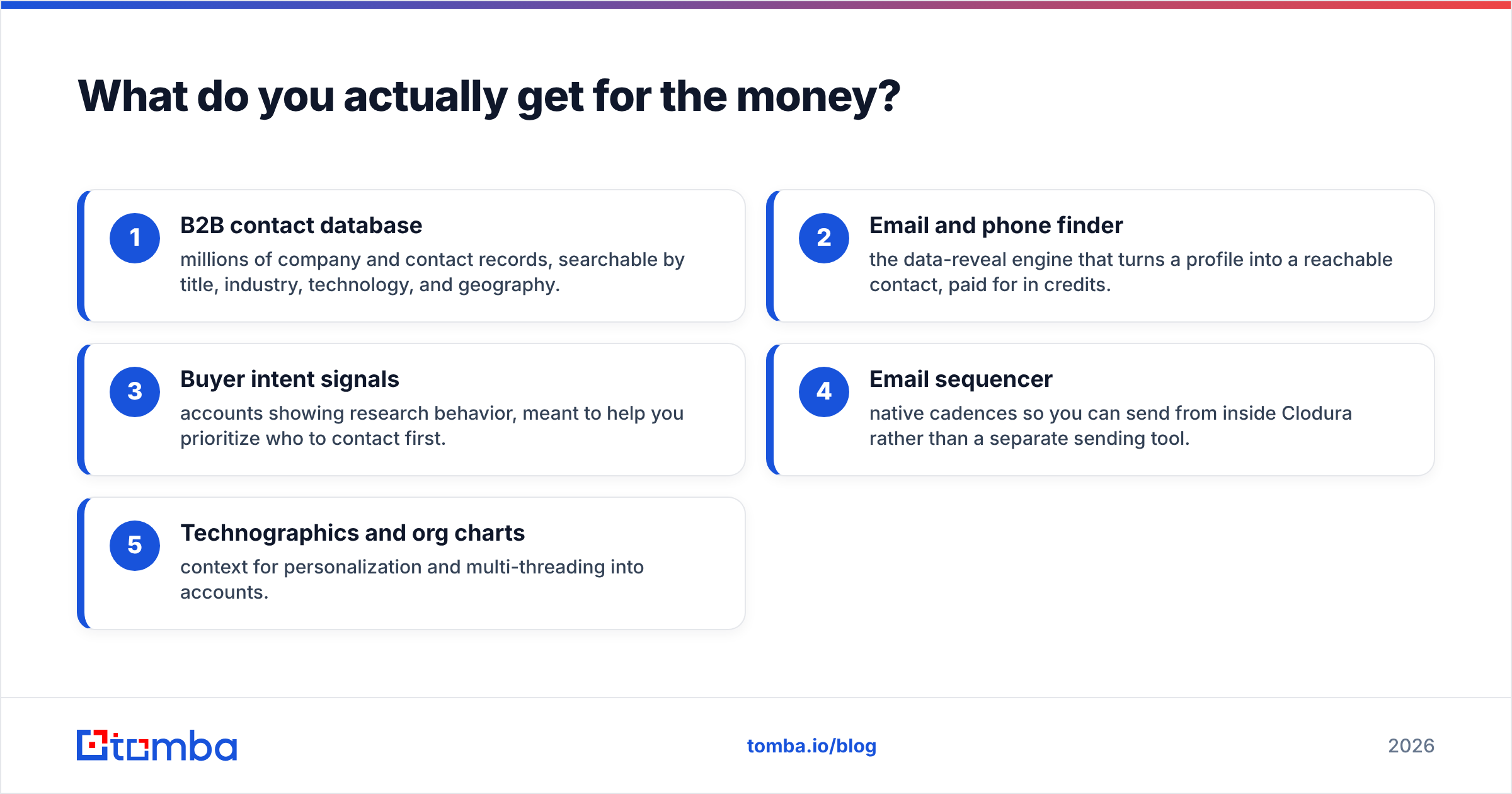
A lot — on paper. The value question is whether you will use it. Here is the honest breakdown of the suite you are funding:
- B2B contact database — millions of company and contact records, searchable by title, industry, technology, and geography.
- Email and phone finder — the data-reveal engine that turns a profile into a reachable contact, paid for in credits.
- Buyer intent signals — accounts showing research behavior, meant to help you prioritize who to contact first.
- Email sequencer — native cadences so you can send from inside Clodura rather than a separate sending tool.
- Technographics and org charts — context for personalization and multi-threading into accounts.
If your motion genuinely uses four or five of those, the bundled price can beat buying each piece separately. But many teams already own a CRM, a sending platform, and a data enrichment layer. For them, Clodura's sequencer and intent modules are shelfware, and the only line item they truly need is accurate contact data.
Is Clodura.ai pricing worth it versus a focused stack?#
It depends on whether you are buying a platform or buying outcomes. The platform is worth it when consolidation is the goal: one vendor, one invoice, one login for the whole SDR workflow. It is overkill when your actual job is "get verified emails into our existing system and send from a tool we already pay for."
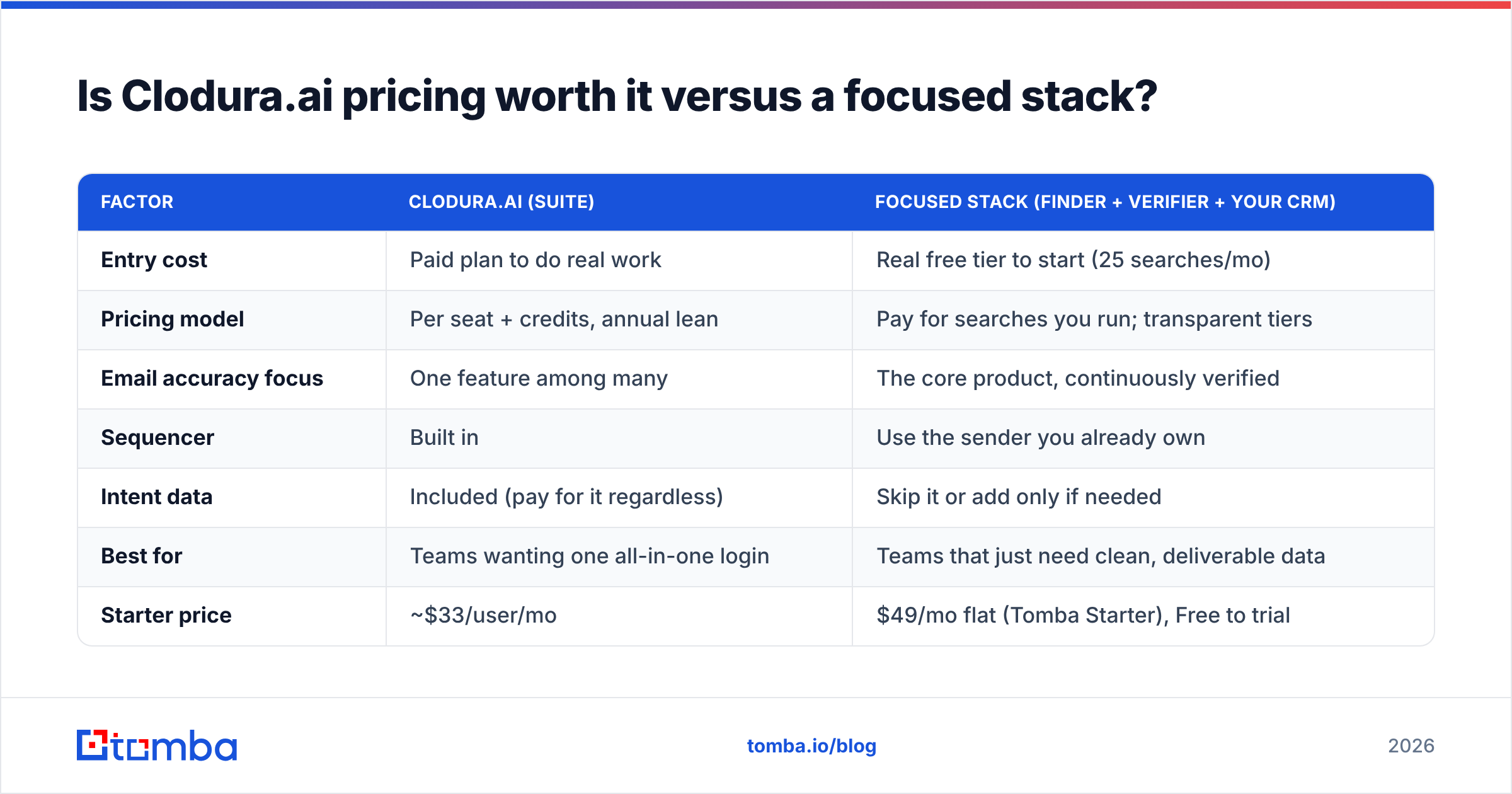
Here is the comparison that matters — a full suite against a lean, finder-first stack built around a dedicated email tool and your current CRM.
| Factor | Clodura.ai (suite) | Focused stack (finder + verifier + your CRM) |
|---|---|---|
| Entry cost | Paid plan to do real work | Real free tier to start (25 searches/mo) |
| Pricing model | Per seat + credits, annual lean | Pay for searches you run; transparent tiers |
| Email accuracy focus | One feature among many | The core product, continuously verified |
| Sequencer | Built in | Use the sender you already own |
| Intent data | Included (pay for it regardless) | Skip it or add only if needed |
| Best for | Teams wanting one all-in-one login | Teams that just need clean, deliverable data |
| Starter price | ~$33/user/mo | $49/mo flat (Tomba Starter), Free to trial |
The pattern is familiar across this category: suites win on breadth, focused tools win on cost-per-outcome and on data quality because that one thing is all they do. If deliverability is your KPI, a tool whose entire reputation rests on accuracy — and which pairs naturally with email verification and a catch-all verifier — tends to age better than a megasuite where data is one tab of twelve.
)
How do the credits really work?#
Credits are the meter, and understanding them is the difference between a predictable bill and a nasty surprise. Think of credits like data on a phone plan: the subscription is your line rental, and credits are the gigabytes. Stream all month and you throttle; sip carefully and you have leftovers you cannot bank.
Practical rules to budget against:
- One reveal, one or more credits. Pulling a verified email usually costs a credit; a direct-dial mobile number often costs more.
- Bulk work drains fast. Exporting a list of a few thousand contacts can swallow a month's pool in a single afternoon, which is exactly when teams discover their tier is too small.
- No meaningful rollover. Unused credits typically vanish at the reset, so you are incentivized to overbuy "just in case" — a quiet upsell built into the model.
- Top-ups cost premium rates. Buying credits outside your plan is the most expensive way to get data, so right-sizing the tier up front matters.
If your volume is spiky — heavy at quarter-end, quiet otherwise — a credit model punishes you. You either pay for a big plan you under-use most months or constantly buy expensive top-ups during crunch. A bulk email finder with straightforward per-search economics is easier to forecast because you pay for what you process, not for a pool you race to spend.
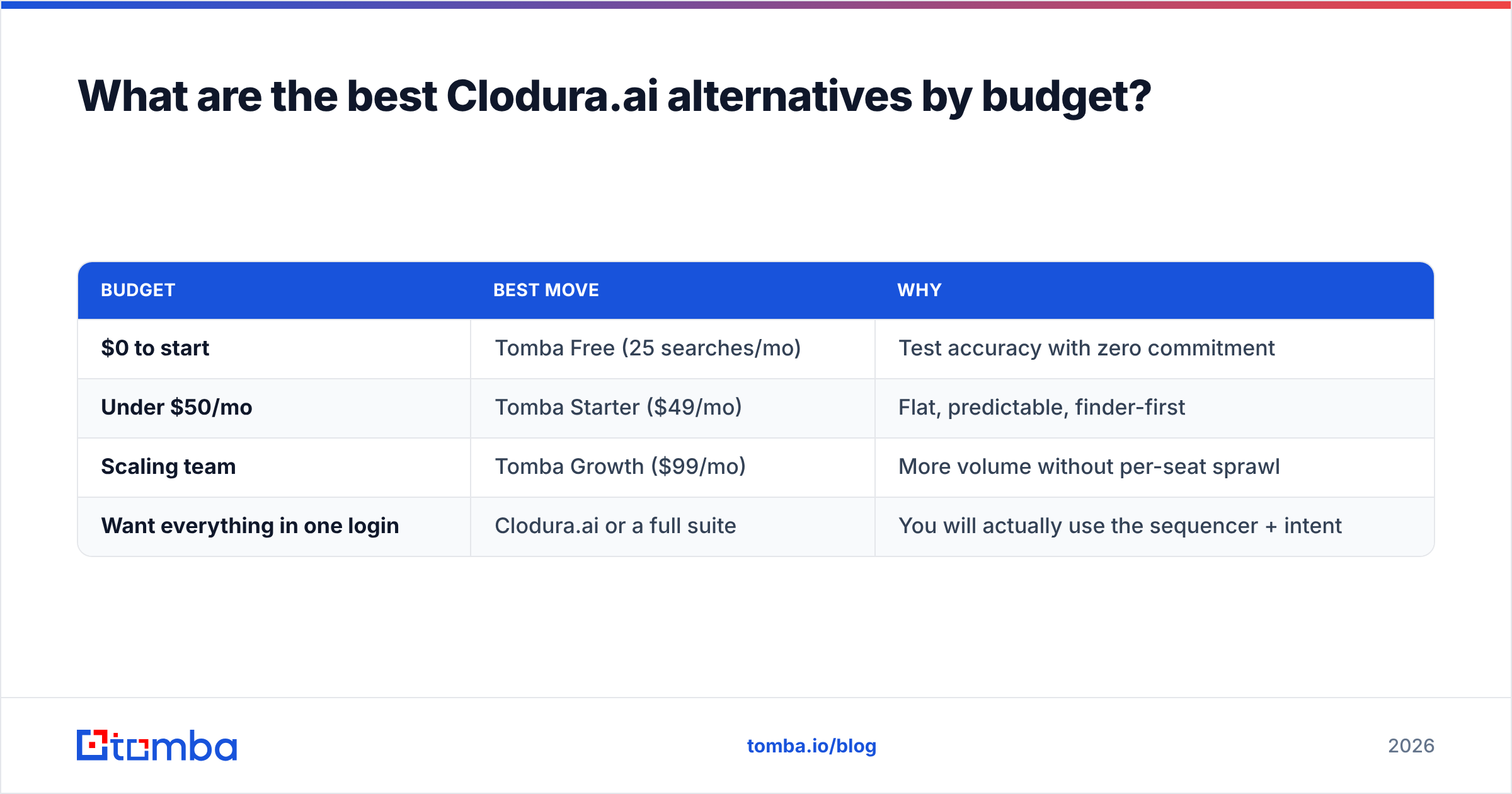
What are the best Clodura.ai alternatives by budget?#
Different budgets point to different tools. Below is the quick map, then the reasoning.
| Budget | Best move | Why |
|---|---|---|
| $0 to start | Tomba Free (25 searches/mo) | Test accuracy with zero commitment |
| Under $50/mo | Tomba Starter ($49/mo) | Flat, predictable, finder-first |
| Scaling team | Tomba Growth ($99/mo) | More volume without per-seat sprawl |
| Want everything in one login | Clodura.ai or a full suite | You will actually use the sequencer + intent |
The logic is simple. If you are validating a channel and cannot justify an annual contract, start free. The platforms that hide pricing behind a demo make experimentation expensive; a tool with a genuine free tier lets you prove ROI before you spend. Compare the transparent Tomba pricing — Free, Starter at $49/mo, Growth at $99/mo, Pro at $249/mo — against a custom Enterprise quote and the budgeting story tells itself.
For teams that want the suite experience but are negotiating, the alternative tools list — including dedicated Apollo alternative and RocketReach alternative breakdowns — shows where each platform's data and pricing actually land. Use those as leverage; vendors discount hard when you arrive with a credible second option.
Who should still pick Clodura.ai?#
Be fair: there is a clear buyer for whom Clodura.ai pricing makes sense.
- Consolidation-minded teams. You are tired of stitching five tools together and want one vendor to own database, dialing, sequencing, and intent.
- Heavy intent users. If buyer-intent signals genuinely change who your reps call first, you are using a module that lean finders do not offer.
- Workflow-in-one-place SDRs. Reps who live inside a single platform all day benefit from not context-switching, even at a premium.
If that is you, the bundle can be cheaper than buying each capability à la carte. The waste only appears when you pay for aisles you never walk — which, for outreach teams whose real bottleneck is deliverable data, is most of the store.
How do you decide in five minutes?#
Run this checklist before any demo call:
- List the features you will use weekly. Fewer than three from the suite list? You are overbuying.
- Estimate monthly reveals. Multiply by the credit cost and compare to a flat finder plan.
- Check your sending stack. Already own a sequencer? Clodura's is redundant spend.
- Demand month-to-month pricing. If the only good price is annual, factor the lock-in risk.
- Trial the data first. Start with a free tool, verify a sample against your own known-good contacts, and judge accuracy before committing dollars.
That last step is the one buyers skip and regret. Data quality is not a feature you can read off a pricing page — you have to test it. A free, finder-first tool makes that test cost nothing.
The bottom line#
Clodura.ai pricing in 2026 is the price of a full prospecting suite: reasonable if you use the whole thing, expensive if you only need clean emails. The credit model rewards heavy, steady usage and punishes spiky, finder-only motions. Map your real workflow before you sign an annual contract, and price the bundle against a focused stack — because for many teams the only line item that drives pipeline is accurate contact data.
If that describes you, start with the part that actually moves revenue. The Tomba Email Finder gives you verified professional emails by name, company, or domain, pairs with built-in verification to protect deliverability, and starts free — 25 searches a month, no demo call, no annual lock-in. Test the data against your own list first; upgrade to the $49/mo Starter only when the accuracy has already earned it. That is how you buy outcomes instead of aisles.
// get started
Find, verify and enrich your first contacts today
Start on the free plan with 25 searches a month, then scale when your team is ready.
Free plan · No credit card required · GDPR & CCPA
// about the author