Clodura.ai vs Apollo.io (2026): Which Sales Tool Wins?
Clodura.ai and Apollo.io both promise an all-in-one prospecting stack — but they win on very different fronts. Here's the honest 2026 breakdown on data, pricing, and deliverability.
Choosing between Clodura.ai and Apollo.io is really a choice between two philosophies: a tightly focused sales-intelligence-plus-cadence tool built for mid-market outbound teams, versus a sprawling all-in-one go-to-market platform with one of the largest contact databases on the market. Both want to be the only tab your SDRs keep open. Only one will fit your budget, your data needs, and your deliverability requirements.
This is the honest 2026 comparison. No vendor cheerleading — just where each tool actually earns its keep, where it falls short, and what to do when neither covers your data accuracy needs on its own.
TL;DR — Clodura.ai vs Apollo.io at a glance#
- Apollo.io has the bigger database (270M+ contacts), a generous free tier, and a deeper feature set spanning data, sequences, dialer, and deal management. Best for teams that want everything in one login.
- Clodura.ai is leaner and often cheaper at the entry tiers, with a strong focus on verified direct dials, an org chart / "buyer group" view, and built-in cadence. Best for mid-market outbound teams in specific regions.
- Data accuracy is the real battleground. Both databases decay fast, and neither verifies every email at send time the way a dedicated tool does.
- Deliverability is where all-in-one platforms quietly hurt you — shared sending infrastructure and unverified lists tank inbox placement.
- The pragmatic 2026 stack: use either platform for discovery, then verify and enrich the export with a specialist like Tomba before you send a single email.
What is Clodura.ai?#
Clodura.ai is a sales prospecting and engagement platform aimed at B2B teams that want lead discovery, contact data, and email cadence in one place. Its pitch centers on "actionable intelligence" — not just a contact record, but the org structure around a buyer, technographic signals, and direct-dial phone numbers.
In practice, sales teams reach for Clodura.ai for three things: a searchable database of companies and decision-makers, an email sequencing engine, and an emphasis on verified mobile numbers for outbound calling. It positions itself as more affordable than the enterprise data giants while still offering a meaningful chunk of their functionality.
The catch is breadth. Clodura.ai's database, while solid in certain regions, is smaller than the megaplatforms, and its sequencing and reporting features are functional rather than best-in-class. You're trading some depth for a cleaner, cheaper package.
What is Apollo.io?#
Apollo.io is a full go-to-market platform built around a 270M+ contact database. It bundles prospecting, email and call sequences, a dialer, meeting scheduling, deal tracking, and a Chrome extension that surfaces contact data directly on LinkedIn and company sites. For many startups and SMB teams, Apollo.io is the first and only sales tool they buy.
The strength is obvious: one platform, one bill, and enough surface area to run an entire outbound motion without stitching tools together. The free tier alone gives you a real taste, which is why Apollo has spread bottom-up through sales orgs.
The weakness is just as real. A database that large is a database that decays — Apollo's contact accuracy varies widely by region and seniority, and the platform's native email sending shares infrastructure that can drag down deliverability if you're not careful. Big surface area also means a steeper learning curve and more features you'll pay for but never touch.

Clodura.ai vs Apollo.io: the core comparison#
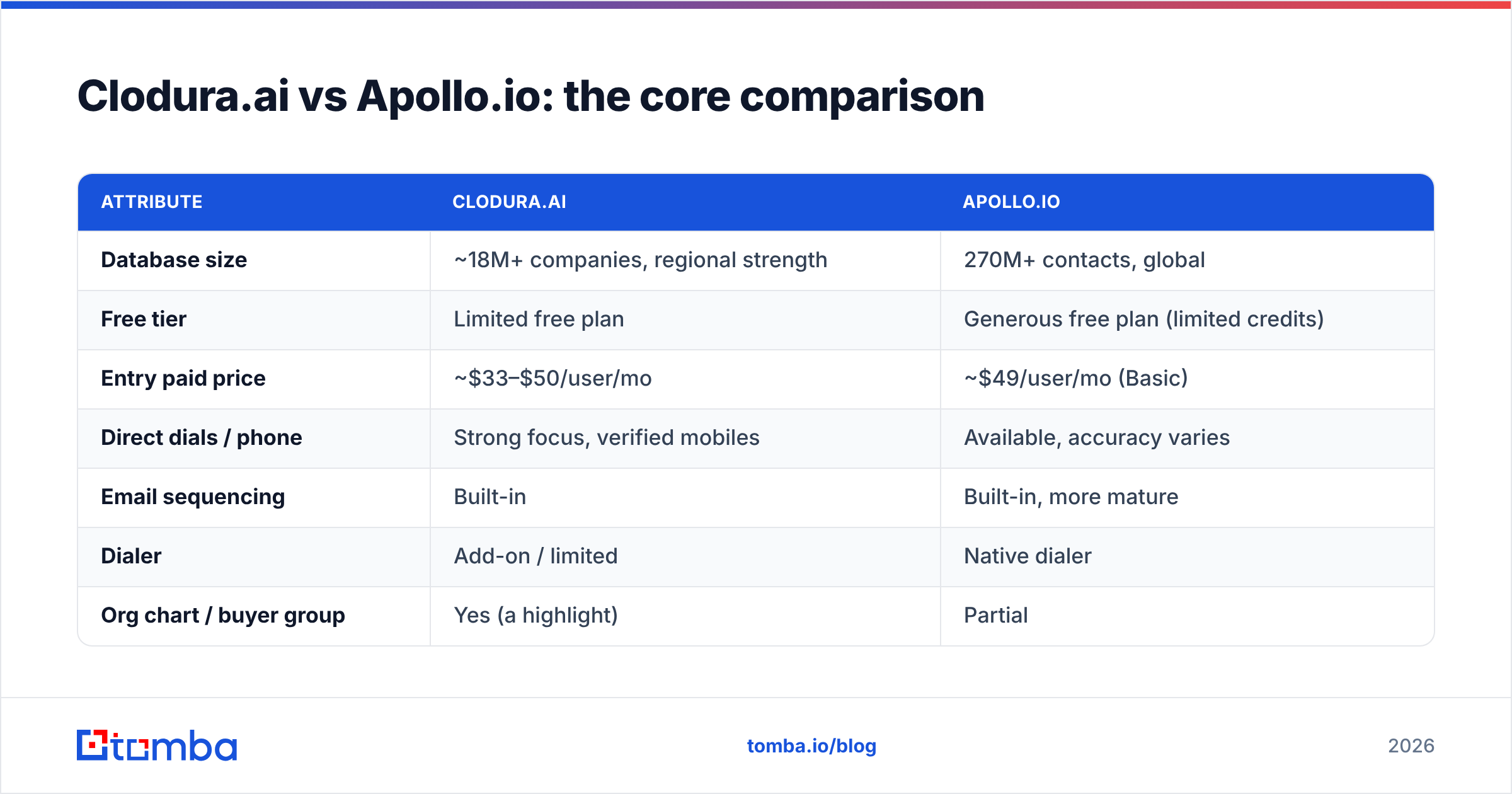
Here's the side-by-side that matters when you're actually signing a contract.
| Attribute | Clodura.ai | Apollo.io |
|---|---|---|
| Database size | ~18M+ companies, regional strength | 270M+ contacts, global |
| Free tier | Limited free plan | Generous free plan (limited credits) |
| Entry paid price | ~$33–$50/user/mo | ~$49/user/mo (Basic) |
| Direct dials / phone | Strong focus, verified mobiles | Available, accuracy varies |
| Email sequencing | Built-in | Built-in, more mature |
| Dialer | Add-on / limited | Native dialer |
| Org chart / buyer group | Yes (a highlight) | Partial |
| Chrome extension | Yes | Yes (very widely used) |
| Best fit | Mid-market regional outbound | SMB to mid-market all-in-one |
A few honest takeaways from the table:
- Apollo wins on raw scale and feature depth. If you want a dialer, deal stages, and sequences without buying three tools, Apollo covers more ground out of the box.
- Clodura wins on focus and sometimes on price. Its org-chart view and direct-dial emphasis are genuinely useful for account-based calling motions.
- Both lose on guaranteed accuracy. Neither tool's database is a substitute for verifying contacts at the moment you send.
- Free tiers favor Apollo for evaluation, but free credits run out fast once you start real prospecting.
Which has better data accuracy?#
Neither platform should be trusted blind — and that's not a knock specific to these two. It's true of every large B2B database. Contact data decays at roughly 2–3% per month as people change jobs, companies rebrand, and emails get deprecated. A database advertised at "95% accurate" is a snapshot, not a guarantee for the lead you pull today.
Apollo's sheer size means more coverage but also more stale records, especially for non-US contacts and senior titles. Clodura.ai's narrower, more curated set can be fresher in its core regions but will leave gaps when you prospect outside them.
The fix is the same regardless of which you choose: treat the platform export as a candidate list, then run it through a dedicated email verifier before sending. A real-time verification pass catches the dead addresses that any static database carries, and that single step does more for your reply rates than switching vendors ever will. You can also cross-check formats with a focused email finder when a critical contact is missing or looks wrong.
If you want to see how independent buyers rate the underlying data, the review profiles on G2 are a better signal than any vendor's own accuracy claim.
Which is better for deliverability?#
This is the question most comparison posts skip, and it's the one that quietly decides whether your campaign works. All-in-one platforms that send email natively often route through shared infrastructure, and they'll happily let you blast an unverified list — both of which torch your sender reputation.
Two rules hold no matter which tool you pick:
- Never send to an unverified list. Bounces above 2–3% signal mailbox providers that you're a spammer. Verify first, every time.
- Warm your domain and watch your reputation. Deliverability lives and dies on sender reputation, not on which platform's logo is in your toolbar.
Clodura.ai and Apollo.io both give you sequencing, but neither replaces disciplined list hygiene. If anything, the convenience of "import and send" makes it easier to skip the step that protects your inbox placement. Build verification into your workflow before the data ever reaches the sequencer.
Pricing: how do Clodura.ai and Apollo.io compare?#
Both tools price per user per month with credit-based limits on exports and enrichment. Apollo's free tier is the most generous on the market for getting started; its paid plans scale from a Basic tier around $49/user/mo up through Professional and Organization tiers that unlock the dialer, advanced sequences, and higher credit ceilings.
Clodura.ai typically lands a little lower at entry and bundles its org-chart and direct-dial features earlier in the tier ladder, which is part of its appeal to budget-conscious mid-market teams.
But list price is rarely your true cost. The hidden line item is wasted sends and wasted SDR hours chasing bounced or wrong-number contacts. A cheaper seat that feeds your reps stale data costs more than a slightly pricier one that doesn't — and either way, a small verification budget on top pays for itself in protected deliverability.
For teams that mainly need accurate contact discovery rather than a full cadence suite, a focused finder-and-verifier stack can come in well under either platform. Tomba's own pricing starts with a free tier (25 searches/mo), then Starter at $49/mo, Growth at $99/mo, and Pro at $249/mo — sized for data accuracy rather than seat sprawl.
Clodura.ai vs Apollo.io: which should you choose?#
Pick based on your actual motion, not the longest feature list.
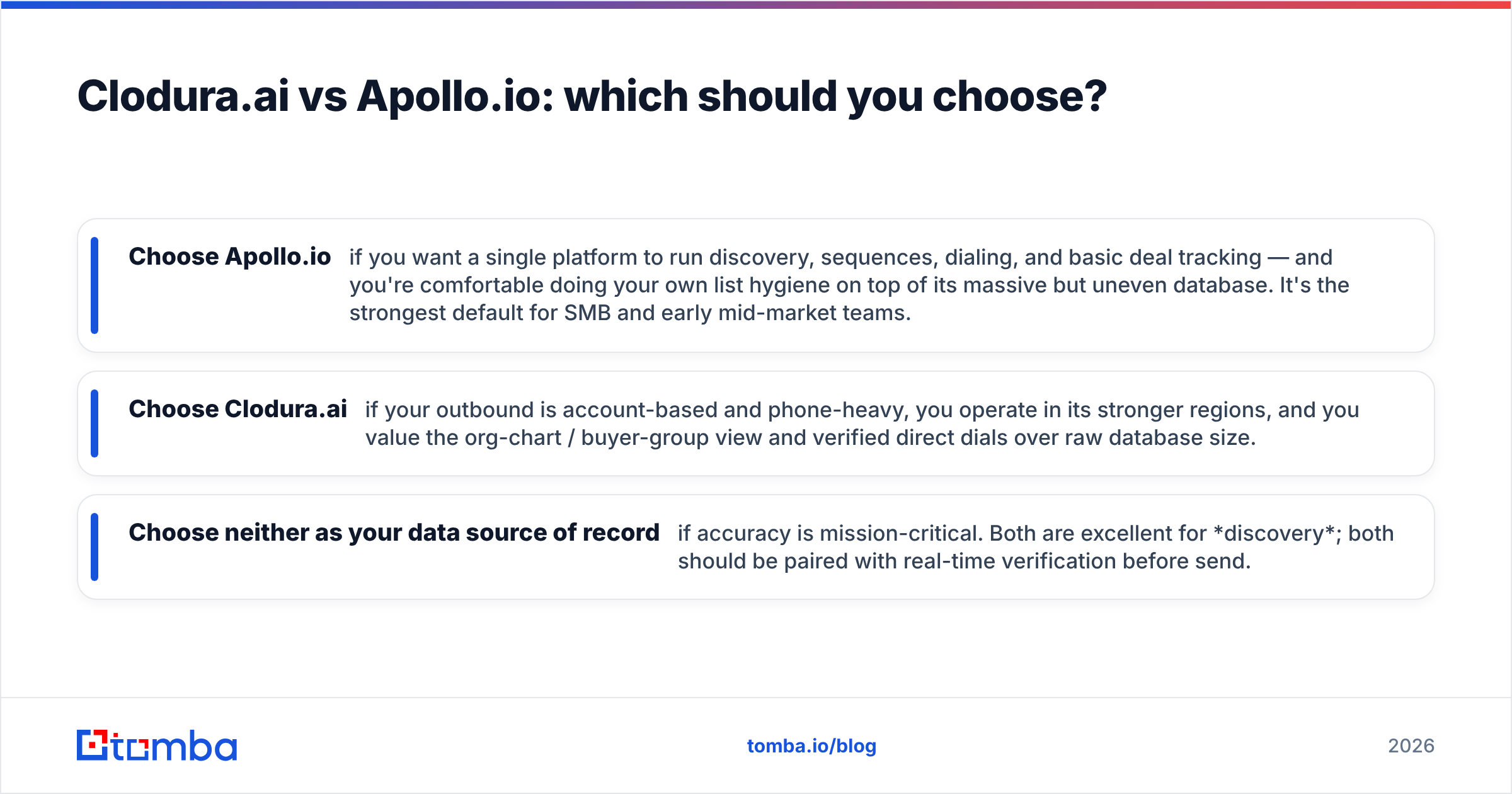
- Choose Apollo.io if you want a single platform to run discovery, sequences, dialing, and basic deal tracking — and you're comfortable doing your own list hygiene on top of its massive but uneven database. It's the strongest default for SMB and early mid-market teams.
- Choose Clodura.ai if your outbound is account-based and phone-heavy, you operate in its stronger regions, and you value the org-chart / buyer-group view and verified direct dials over raw database size.
- Choose neither as your data source of record if accuracy is mission-critical. Both are excellent for discovery; both should be paired with real-time verification before send.
If your bottleneck is finding and confirming the right email — not managing a cadence — you may not need a heavyweight platform at all. A dedicated finder plus verifier, wired into your existing CRM and outreach tool, is faster, cheaper, and cleaner. That's also the case if you're actively shopping for an Apollo alternative because the all-in-one bundle is more than you need.
How to build a 2026 stack that actually converts#
Whatever you land on, the winning pattern is the same:
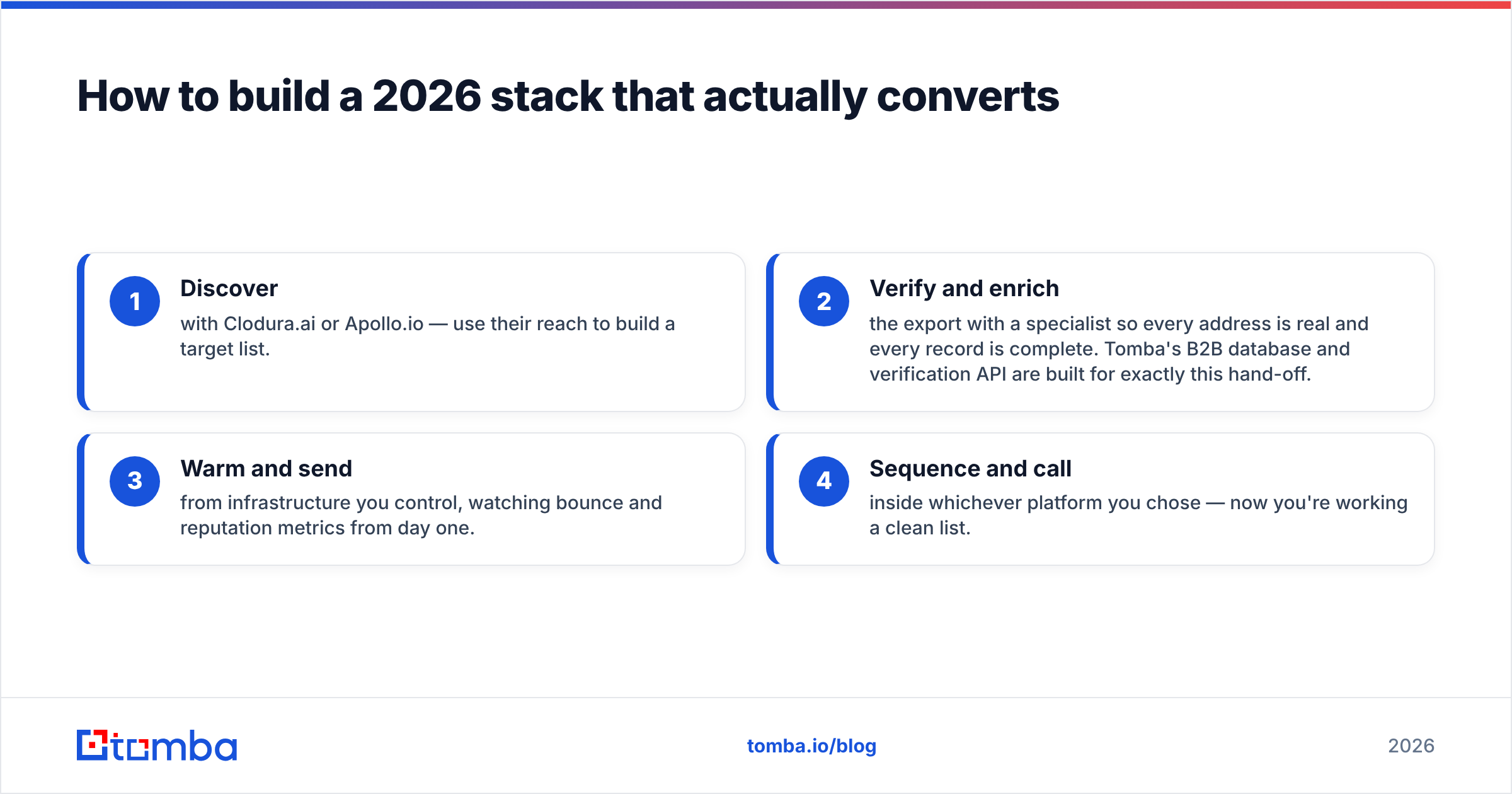
- Discover with Clodura.ai or Apollo.io — use their reach to build a target list.
- Verify and enrich the export with a specialist so every address is real and every record is complete. Tomba's B2B database and verification API are built for exactly this hand-off.
- Warm and send from infrastructure you control, watching bounce and reputation metrics from day one.
- Sequence and call inside whichever platform you chose — now you're working a clean list.
This split keeps you from paying enterprise prices for data you'd have to clean anyway, and it protects the one asset no platform can sell back to you: your sending reputation.
The bottom line#
Apollo.io is the broader, bigger-database, do-everything choice; Clodura.ai is the leaner, often cheaper, phone-and-org-chart-focused alternative. Both are genuinely good at finding prospects and genuinely limited at guaranteeing the data is still accurate when you hit send. That gap is universal to large databases — and it's exactly where most outbound campaigns leak.
Before you commit to either seat, close the accuracy gap first. Run your prospecting exports through the Tomba Email Finder and verifier to confirm every address, fill in the missing ones, and enrich the records your sequences depend on. Start free with 25 searches a month, and let your platform of choice do discovery while Tomba keeps your list — and your deliverability — clean.
// get started
Find, verify and enrich your first contacts today
Start on the free plan with 25 searches a month, then scale when your team is ready.
Free plan · No credit card required · GDPR & CCPA
// about the author