Clodura.ai vs CSVGO 2026: Which B2B Prospecting Tool Wins?
Clodura.ai and CSVGO both promise B2B contact data, but they solve different problems. Here's an honest 2026 breakdown of pricing, accuracy, and where each one actually fits your outbound stack.
Clodura.ai vs CSVGO 2026: Which B2B Prospecting Tool Wins?
Choosing between Clodura.ai and CSVGO comes down to one question most comparison posts dodge: do you need a full sales-intelligence platform, or do you need clean, verified contact data that you can drop straight into your sequencer? They are not the same purchase, and buying the wrong one wastes a quarter.
TL;DR — Clodura.ai vs CSVGO at a glance#
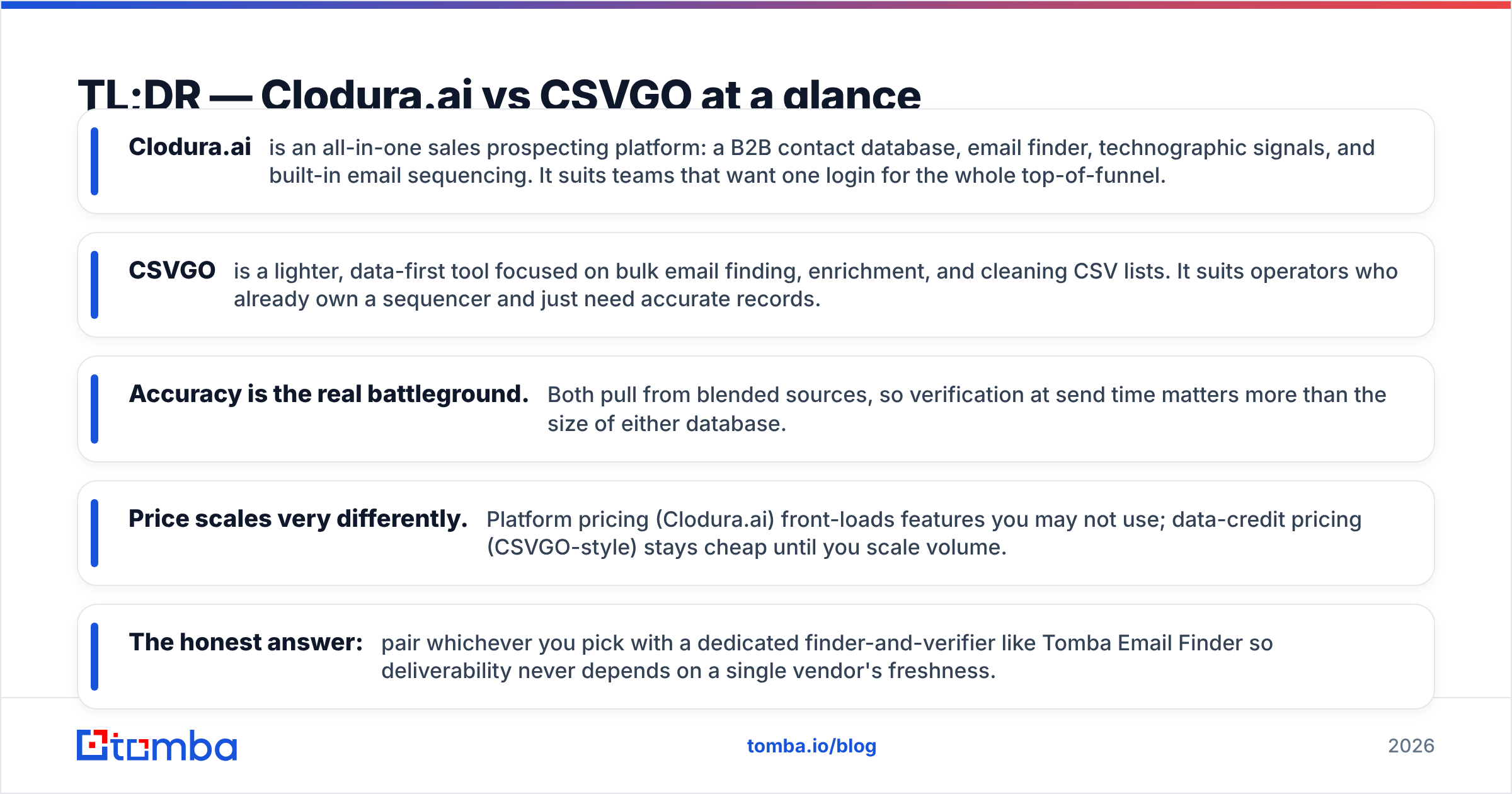
- Clodura.ai is an all-in-one sales prospecting platform: a B2B contact database, email finder, technographic signals, and built-in email sequencing. It suits teams that want one login for the whole top-of-funnel.
- CSVGO is a lighter, data-first tool focused on bulk email finding, enrichment, and cleaning CSV lists. It suits operators who already own a sequencer and just need accurate records.
- Accuracy is the real battleground. Both pull from blended sources, so verification at send time matters more than the size of either database.
- Price scales very differently. Platform pricing (Clodura.ai) front-loads features you may not use; data-credit pricing (CSVGO-style) stays cheap until you scale volume.
- The honest answer: pair whichever you pick with a dedicated finder-and-verifier like Tomba Email Finder so deliverability never depends on a single vendor's freshness.
What is Clodura.ai?#
Clodura.ai is a B2B sales-intelligence platform aimed at outbound teams that want prospecting, data, and outreach under one roof. Think of it like a Swiss Army knife: a database of company and contact records, direct-dial and email discovery, buying-intent and technographic signals, and a sequencing engine to actually send the emails you build.
That breadth is the pitch. Instead of stitching together a finder, an enrichment vendor, and a sending tool, an SDR logs into one dashboard, builds a list, and launches a campaign. For a small team without a RevOps function, consolidation is genuinely valuable.
The trade-off is also classic Swiss Army knife: every blade is fine, none is best-in-class. The database leans toward certain regions, the sequencer is less mature than a dedicated outreach tool, and you pay for the whole bundle even if you only live in one module.
What is CSVGO?#
CSVGO sits at the opposite end of the spectrum. It is a data-first utility: you bring a list of names, domains, or companies, and it returns found emails, enriched fields, and cleaned rows. The name is the tell — it is built around the CSV workflow that most growth operators actually run.
The mental model here is a high-pressure hose, not a Swiss Army knife. It does one job — turning messy inputs into usable contact data — and it does that job at volume without forcing you into a sequencer or a CRM you did not ask for. You keep your existing stack and just plug in better data.
The limitation is obvious in reverse: there is no intent layer, no native outreach, and fewer "platform" niceties. If you want dashboards, signals, and a place to run campaigns, CSVGO is not trying to be that.
How do Clodura.ai and CSVGO compare on features and pricing?#
Here is the side-by-side that matters before you talk to a sales rep. Treat exact figures as directional — vendors reprice constantly, so confirm on their pages — but the shape of each offer is stable.
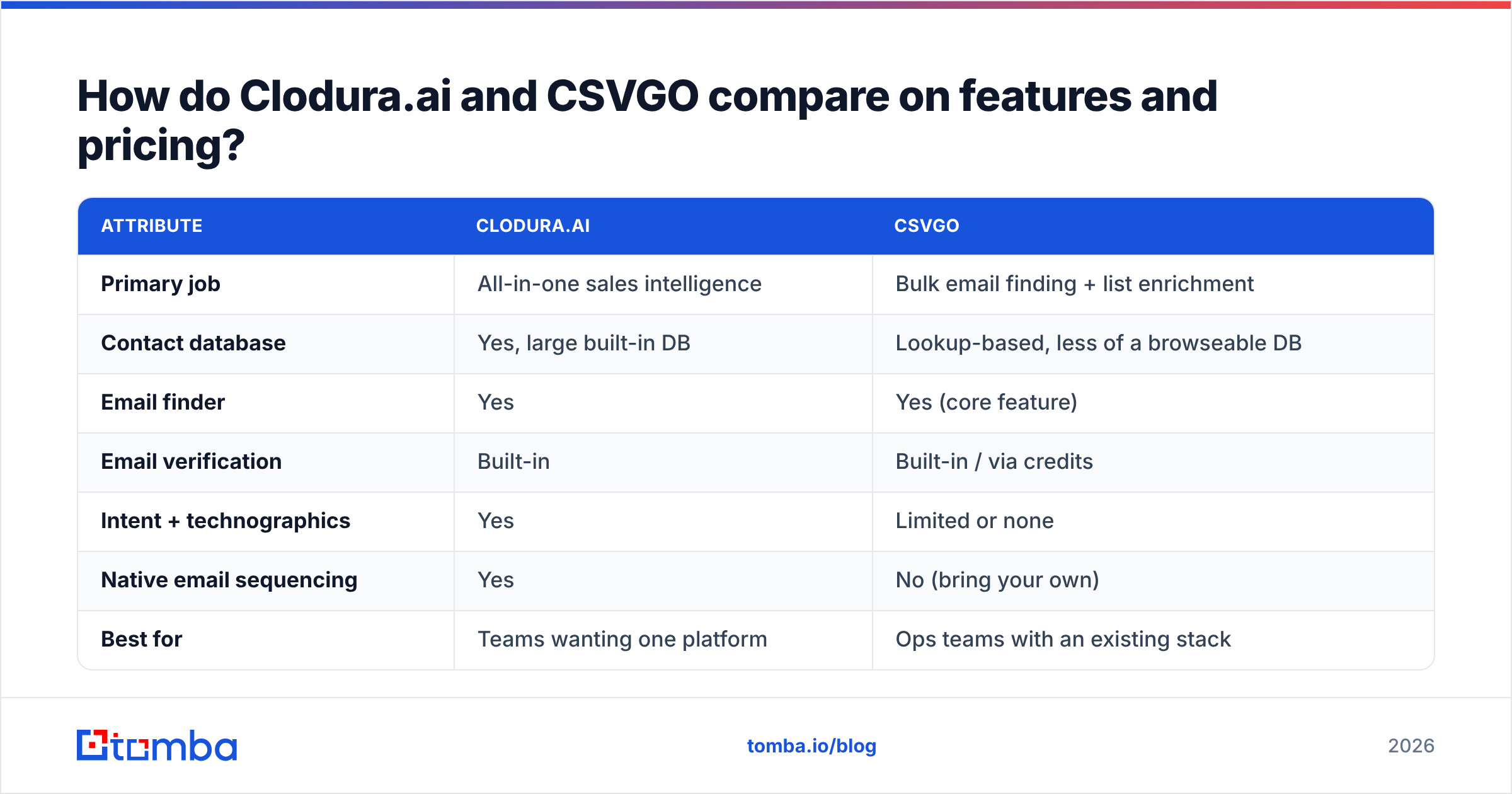
| Attribute | Clodura.ai | CSVGO |
|---|---|---|
| Primary job | All-in-one sales intelligence | Bulk email finding + list enrichment |
| Contact database | Yes, large built-in DB | Lookup-based, less of a browseable DB |
| Email finder | Yes | Yes (core feature) |
| Email verification | Built-in | Built-in / via credits |
| Intent + technographics | Yes | Limited or none |
| Native email sequencing | Yes | No (bring your own) |
| Best for | Teams wanting one platform | Ops teams with an existing stack |
| Pricing model | Platform tiers / seats | Credit / volume based |
| Free option | Limited free plan | Often credit-based trial |
The decision usually splits on a single axis: do you want a platform or a pipe? Clodura.ai is the platform — more surface area, higher floor price, fewer integrations to babysit. CSVGO is the pipe — cheaper to start, more flexible, but it assumes you already own the rest of the funnel.
Four questions settle most evaluations:
- Do you already own a sequencer? If yes, a platform's sending module is dead weight — lean data-first.
- Is intent data part of your motion? If buying signals drive your targeting, the platform side wins; a pure finder won't deliver that.
- What's your monthly contact volume? Credit pricing is cheaper at low-to-mid volume and gets expensive at scale; seat pricing is the reverse.
- Who maintains the stack? No RevOps headcount favors consolidation; a strong ops team extracts more value from modular tools.
How accurate is the data — and why does verification matter more than database size?#
Neither tool's headline database number tells you what lands in the inbox. B2B contact data decays roughly 2–3% per month as people change jobs, so a record that was perfect in January can bounce by June. That decay, not raw record count, is what kills cold campaigns.

This is the single most important point in the whole comparison: a found email is a hypothesis, not a fact. Whatever Clodura.ai or CSVGO returns, you should verify it against live mail-server signals before you send, because a 5% bounce rate is enough to drag your domain into spam folders for weeks. Independent reviews on G2 consistently show that real-world deliverability tracks verification quality far more than database scale.
That's why a layered approach beats brand loyalty. Use the finder for discovery, then run results through a dedicated email verifier that performs real SMTP and catch-all checks. If you're pulling thousands of rows, a bulk email finder with built-in verification removes the manual cleanup step entirely. The point isn't to distrust either vendor — it's that no single source stays fresh enough to skip the check.

When should you choose Clodura.ai?#
Pick Clodura.ai when consolidation is worth more to you than best-in-class depth in any one area. Concrete situations where it's the right call:
- You're a small team with no separate sequencer. One login that finds and sends is genuinely simpler, and simplicity has a real dollar value when nobody's job is "manage the tool stack."
- Intent and technographic signals shape your targeting. If you prioritize accounts by what software they run or whether they're in-market, a platform that bakes that in beats bolting it on.
- You want a browseable database. Building lists by filtering a large built-in DB is faster for some workflows than feeding a finder one company at a time.
Where it disappoints: heavy senders who already love their outreach tool, teams that find the regional data coverage thin for their market, and anyone who resents paying platform prices to use a single module.
When should you choose CSVGO?#
Pick CSVGO — or any data-first finder — when you already have a sequencer and a CRM, and you just want the data layer to be accurate and cheap. The strongest cases:
- Your motion is list-driven. You export from one tool, enrich in another, and push to a third. A focused finder that respects the CSV workflow slots in without friction.
- You're cost-sensitive at low-to-mid volume. Credit pricing means you pay for what you pull, which beats per-seat platform fees when only one or two people prospect.
- You value flexibility over consolidation. Keeping modular tools lets you swap any one component without re-platforming your whole funnel.
Where it disappoints: teams that want intent signals, anyone hoping for a native place to run campaigns, and buyers who'd rather have one vendor to call when something breaks.
Is there a better-value alternative to both?#
Often, yes — and it's not about replacing your whole stack. The smartest setup for most outbound teams in 2026 is a precise finder-and-verifier feeding the platform you already like, rather than betting everything on one vendor's freshness.
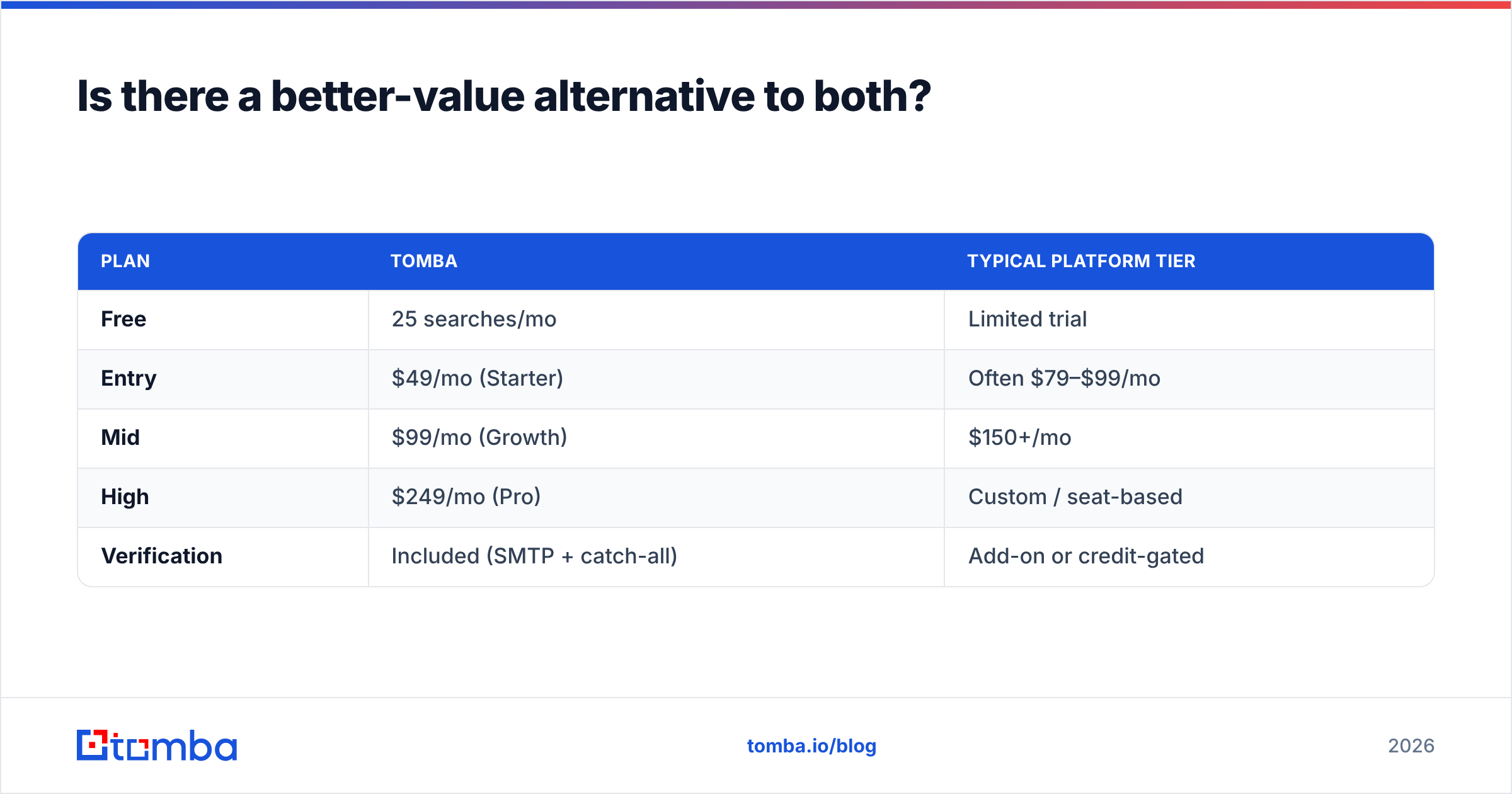
That's the gap a focused tool like Tomba fills. Instead of paying platform rates for modules you don't touch, you pay for accurate discovery and verification, then route clean data into Clodura.ai's sequencer, CSVGO's CSV flow, or your existing outreach tool. Here's how the value math compares.
| Plan | Tomba | Typical platform tier |
|---|---|---|
| Free | 25 searches/mo | Limited trial |
| Entry | $49/mo (Starter) | Often $79–$99/mo |
| Mid | $99/mo (Growth) | $150+/mo |
| High | $249/mo (Pro) | Custom / seat-based |
| Verification | Included (SMTP + catch-all) | Add-on or credit-gated |
A few things stand out. Tomba's pricing starts at $49/mo for Starter — not the $39 some recaps misquote — and the free tier gives you 25 searches a month to test accuracy before paying. Verification, including catch-all handling, is part of the core product rather than a credit you burn separately. And because Tomba exposes a finder, verifier, domain search, and enrichment through a single API, you can wire it into whatever sequencer or CRM you've standardized on.
The broader principle: don't treat "Clodura.ai vs CSVGO" as a winner-take-all fight. The teams with the best deliverability run a finder for discovery, an independent verifier at send time, and a sequencer they actually enjoy — three jobs, chosen on merit, instead of one bundle chosen on convenience.
How do you actually run the evaluation?#
Don't trust any vendor's marketing number, including the ones above. Run the same 200-row test list through each tool and measure four things:
- Match rate — what percentage of rows return an email at all.
- Bounce rate — send a small verified batch and watch your sequencer's hard-bounce count.
- Cost per usable contact — total spend divided by verified emails, not found emails.
- Workflow friction — how many manual steps from "list in" to "campaign out."
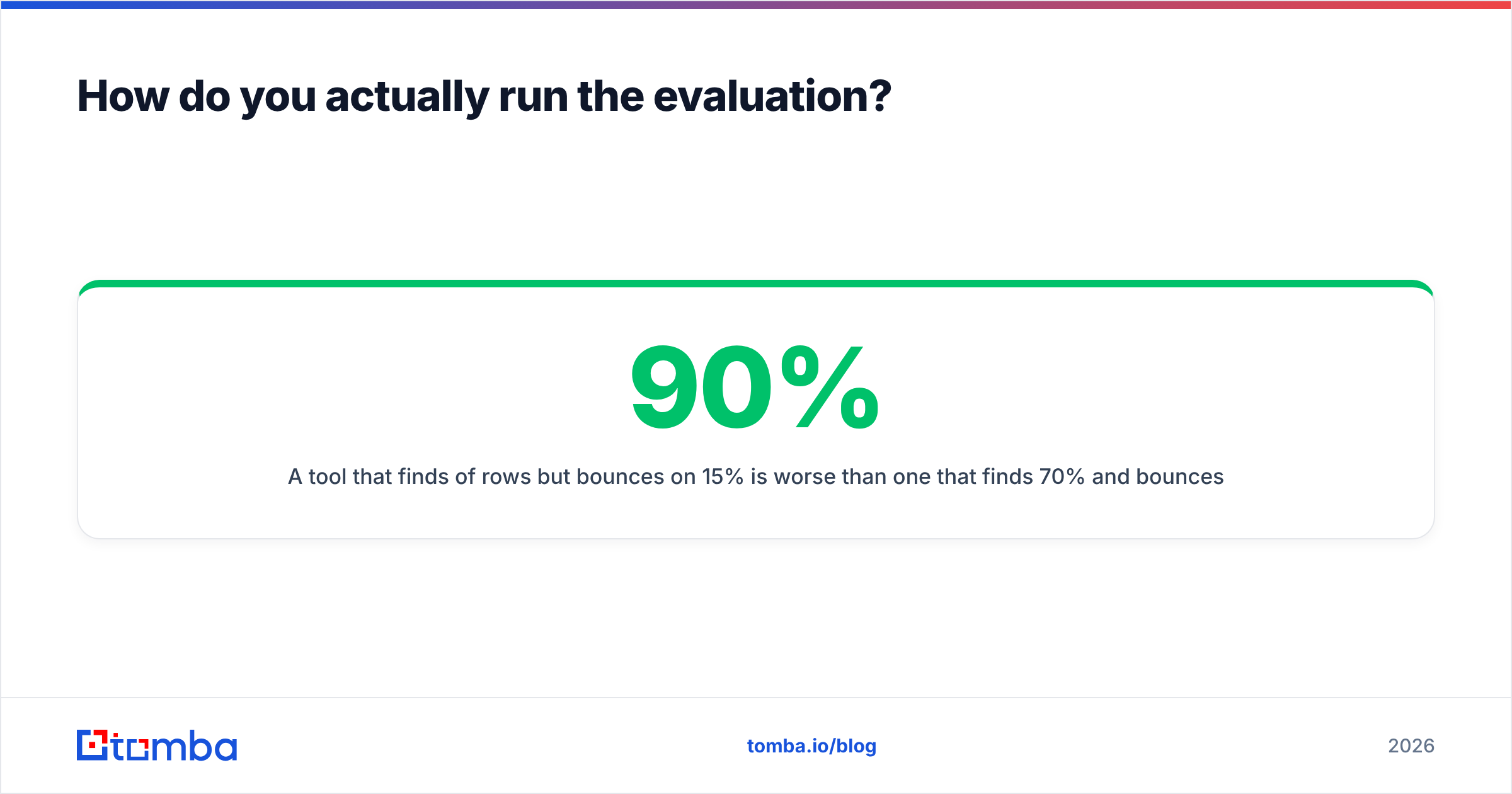
A tool that finds 90% of rows but bounces on 15% is worse than one that finds 70% and bounces on 1%. Cost per usable contact is the only metric that survives contact with a real domain reputation. You can read more on how data sources affect that number on the Tomba data page, and you can cross-check any vendor's claims against user reviews on Capterra before you commit budget.
The bottom line#
Clodura.ai wins when you want one platform to find, signal, and send — best for lean teams without a sequencer. CSVGO wins when you already own your stack and just want cheap, flexible, data-first enrichment. Neither is "more accurate" in the abstract, because accuracy is decided at verification time, not in the database.
Whatever you choose for discovery, give yourself a verification safety net so your domain reputation never rides on a single vendor's refresh cycle. Start free with the Tomba Email Finder — 25 searches a month, SMTP and catch-all verification built in, and an API that drops into Clodura.ai, CSVGO, or whatever sequencer you already run. Find the emails, verify before you send, and let the bounce rate — not the brochure — pick your winner.
Ready to find emails that actually work?
Join 150,000+ professionals who stopped guessing and started sending. Free credits on signup — no credit card required.
Get the Tomba newsletter
Practical outbound tactics and product updates — once every two weeks.
About the author