CloduraAI vs Dun & Bradstreet (2026): B2B Data Compared
Clodura.AI vs Dun & Bradstreet in 2026: pricing, data freshness, contact depth, and intent signals compared — plus where each platform actually fits.
CloduraAI vs Dun & Bradstreet usually comes down to one question. Do you need a prospecting engine that hands reps ready-to-call contacts? Or a corporate-grade database built for credit, risk, and data governance? People lump them together as "B2B data" tools. Yet they solve very different problems.
This guide compares both platforms in plain terms. We weigh pricing, data freshness, contact depth, intent signals, and real-world fit. The aim is simple: help you pick the right tool without a three-month buying cycle.
TL;DR#
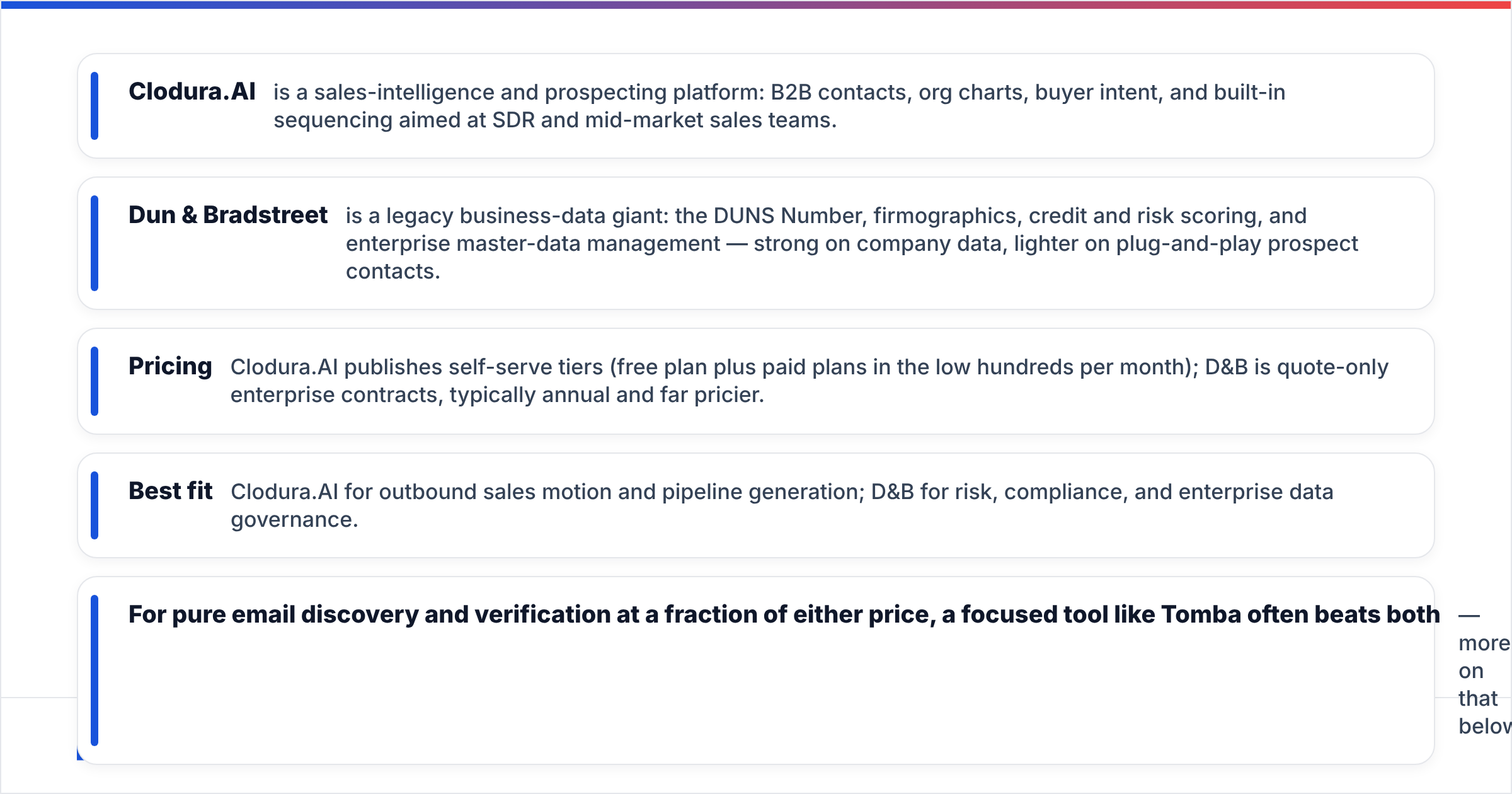
- Clodura.AI is a sales-intelligence and prospecting platform: B2B contacts, org charts, buyer intent, and built-in sequencing aimed at SDR and mid-market sales teams.
- Dun & Bradstreet is a legacy business-data giant: the DUNS Number, firmographics, credit and risk scoring, and enterprise master-data management — strong on company data, lighter on plug-and-play prospect contacts.
- Pricing: Clodura.AI publishes self-serve tiers (free plan plus paid plans in the low hundreds per month); D&B is quote-only enterprise contracts, typically annual and far pricier.
- Best fit: Clodura.AI for outbound sales motion and pipeline generation; D&B for risk, compliance, and enterprise data governance.
- For pure email discovery and verification at a fraction of either price, a focused tool like Tomba often beats both — more on that below.
What is Clodura.AI?#
Clodura.AI is a B2B sales-intelligence platform built around prospecting. Think of it as a sales rep's prep kit: it gives you a company list, the people inside those companies, their likely email and phone, an org chart, and signals about which accounts are showing buying interest. It then layers on sequencing tools so you can email those contacts without leaving the platform.
Its database covers tens of millions of companies and several hundred million contacts, with direct dials and verified business emails as a core selling point. The platform leans into "actionable" data — technographics, hiring signals, funding events, and intent topics — so reps can prioritize accounts that are warming up rather than blasting a cold list.
The audience is clear: SDRs, account executives, and growth teams at startups through mid-market who want pipeline now and don't want to stitch together five tools.
What is Dun & Bradstreet?#
Dun & Bradstreet sits at the opposite end of the B2B data spectrum. It is a 180-year-old institution. Its data underpins credit decisions, supply-chain risk, and enterprise analytics worldwide. Its signature asset is the DUNS Number, a unique nine-digit identifier assigned to business entities that has become a global standard for company identity.
D&B's strength is depth and authority on the company: firmographics, corporate family trees (parent/subsidiary linkage), financial stability scores, payment behavior, and compliance data. Products like D&B Hoovers add a sales-intelligence layer on top, but the company's center of gravity is risk, finance, and master data — not handing an SDR a list of 200 dials before lunch.
If your finance team vets vendors, your compliance team screens for sanctions, or your RevOps team needs a single source of truth to dedupe a CRM, D&B is built for that. The trade-off is cost, contract complexity, and contact-level data that often feels thinner than a prospecting-first tool.
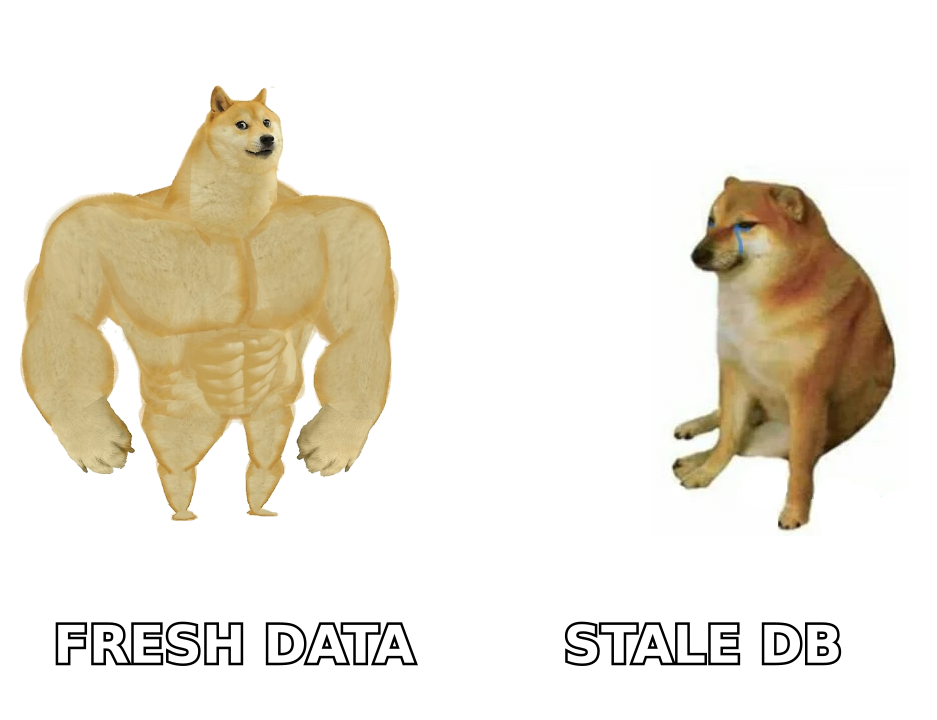
CloduraAI vs Dun & Bradstreet: how do they compare at a glance?#
Here's the head-to-head on the attributes that actually drive a buying decision.
| Attribute | Clodura.AI | Dun & Bradstreet |
|---|---|---|
| Primary use case | Outbound prospecting & pipeline | Risk, credit, enterprise data |
| Core asset | Verified contacts + intent | DUNS Number + firmographics |
| Contact depth (emails/dials) | High — built for reps | Moderate — company-first |
| Buyer intent signals | Included | Add-on / Hoovers tier |
| Built-in email sequencing | Yes | No |
| Pricing model | Self-serve, free tier + paid | Quote-only, annual contracts |
| Typical buyer | SDR / mid-market sales | Enterprise RevOps / finance |
| Time to value | Days | Weeks (procurement) |
| Data governance / compliance | Basic | Enterprise-grade |
The pattern is consistent. Clodura.AI optimizes for speed-to-pipeline. D&B optimizes for authority and governance. Neither is "better" in the abstract — they answer different questions.
Which platform has more accurate data?#
Accuracy depends on what you measure. For company-level truth, D&B is the reference standard. Think legal entity, corporate hierarchy, and financial health. Entire industries are built on its identifiers. For contact-level freshness, prospecting-first tools tend to win. They re-verify contacts more often against live signals. The test is simple: is this person still in this role, and is this email deliverable today?
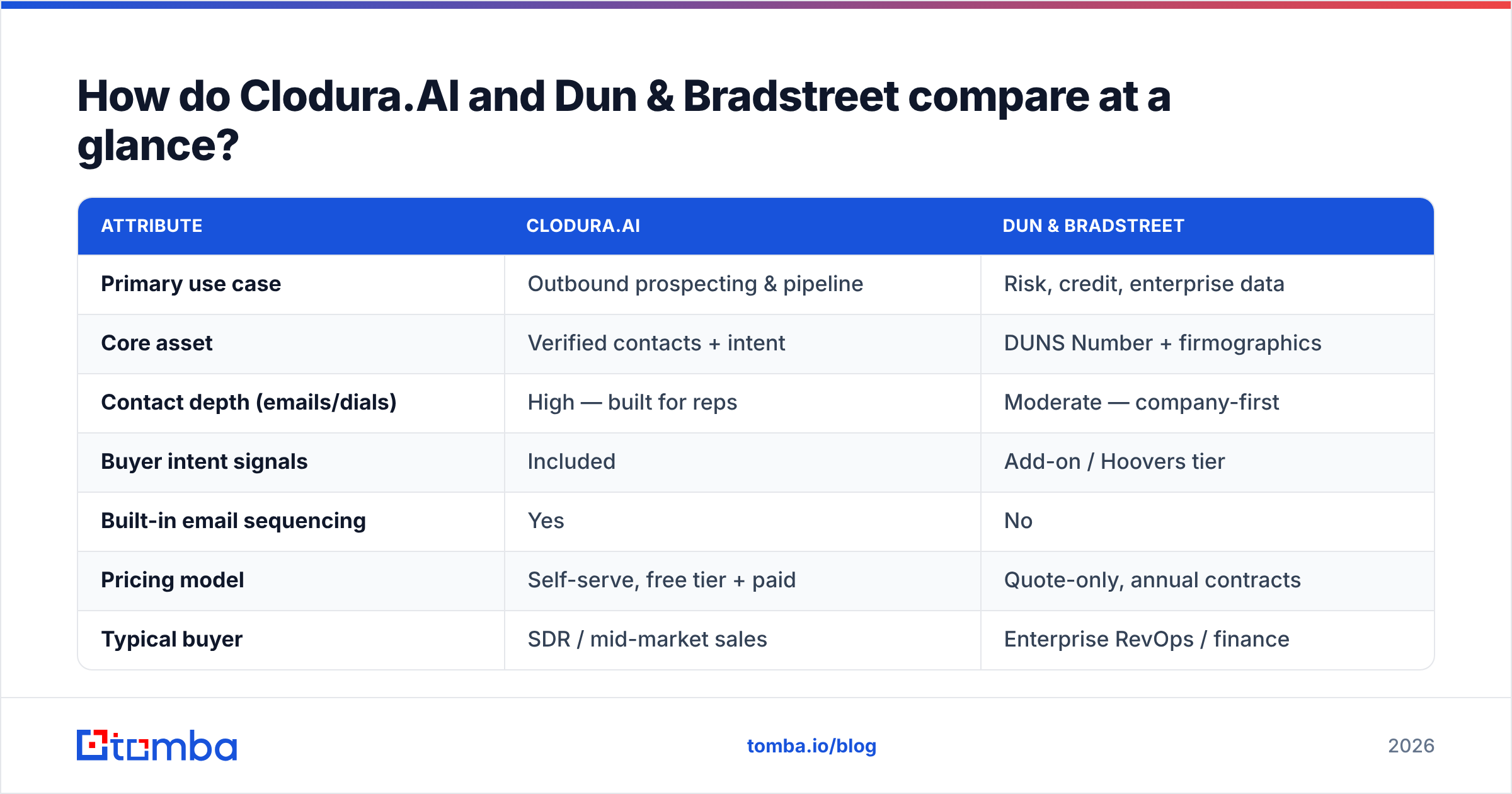
The catch with any large database, D&B included, is decay. B2B data goes stale fast. People change jobs, companies merge, and domains shift. Industry estimates put B2B contact decay around 2–3% per month. That compounds to roughly a quarter of your list per year. A DUNS Number doesn't decay, but the VP of Sales attached to it absolutely does.
This is why mature teams treat any data vendor — Clodura.AI, D&B, or anyone else — as a source rather than a guarantee, and run a verification pass before outreach. A quick run through an email verifier before a campaign protects your sender reputation far better than trusting a vendor's "verified" label. The mechanics of email deliverability make the reason clear. Even a 5% bounce rate can throttle an entire domain's inbox placement.
How does pricing compare?#
This is where the two diverge most sharply.
Clodura.AI uses transparent, self-serve pricing. There's a free tier to test the database. Paid plans scale into the low hundreds of dollars per month, depending on credits and seats. You can sign up, run searches, and start a sequence the same day. For a startup or a small SDR team, the math is simple and the commitment is low.
Dun & Bradstreet is quote-only. Pricing is negotiated, almost always annual, and usually lands in the four- to five-figure range per year once you account for seats, data volume, and modules. You'll talk to a sales rep, scope your use case, and likely sign a multi-year master agreement. That fits enterprise risk infrastructure. It is overkill if you just need contacts for a cold-email campaign.
A practical way to frame it: if your question is "which accounts can I extend net-60 terms to," D&B's price is justified. If your question is "who do I email this quarter," you're overpaying for governance you won't use.
What about contact discovery and intent signals?#
Clodura.AI bundles intent and sequencing into the core product, which is its biggest differentiator versus D&B. You can filter for accounts showing intent on a topic, pull the relevant decision-makers, and drop them straight into an email cadence. For a sales team, that compresses the prospecting workflow into one screen.
D&B offers intent and sales-intelligence through D&B Hoovers and partnerships, but it's a layered, higher-cost path rather than a default. The contact records are solid for enterprise accounts but can feel sparse for SMB and mid-market targets where D&B's coverage thins out.
If your motion is account-based and you want to know which companies to chase, both can help. If your motion is high-volume outbound and you need the actual person's email, a prospecting tool — or a dedicated finder — gets you there faster.
Where does a dedicated email finder fit in?#
Here's the honest gap both platforms share: neither is built primarily as a fast, accurate, pay-for-what-you-use email finder. Clodura.AI bundles email into a broader suite you may not fully use; D&B is enterprise infrastructure you commit to for a year.
If your real need is "find and verify professional emails by name, company, or domain — at volume, without a contract," a focused tool is more efficient and far cheaper. That's the niche Tomba fills.
Consider the practical differences:
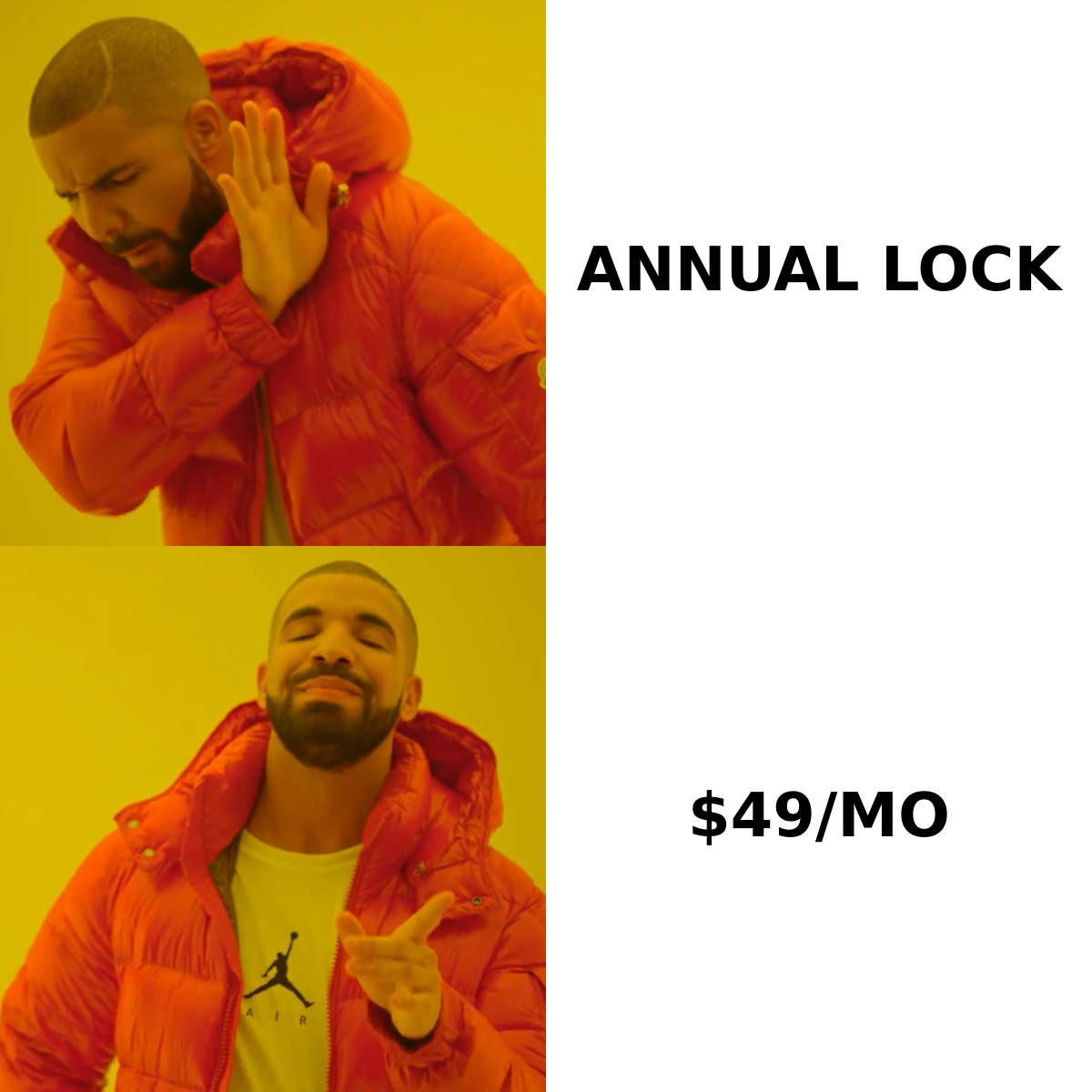
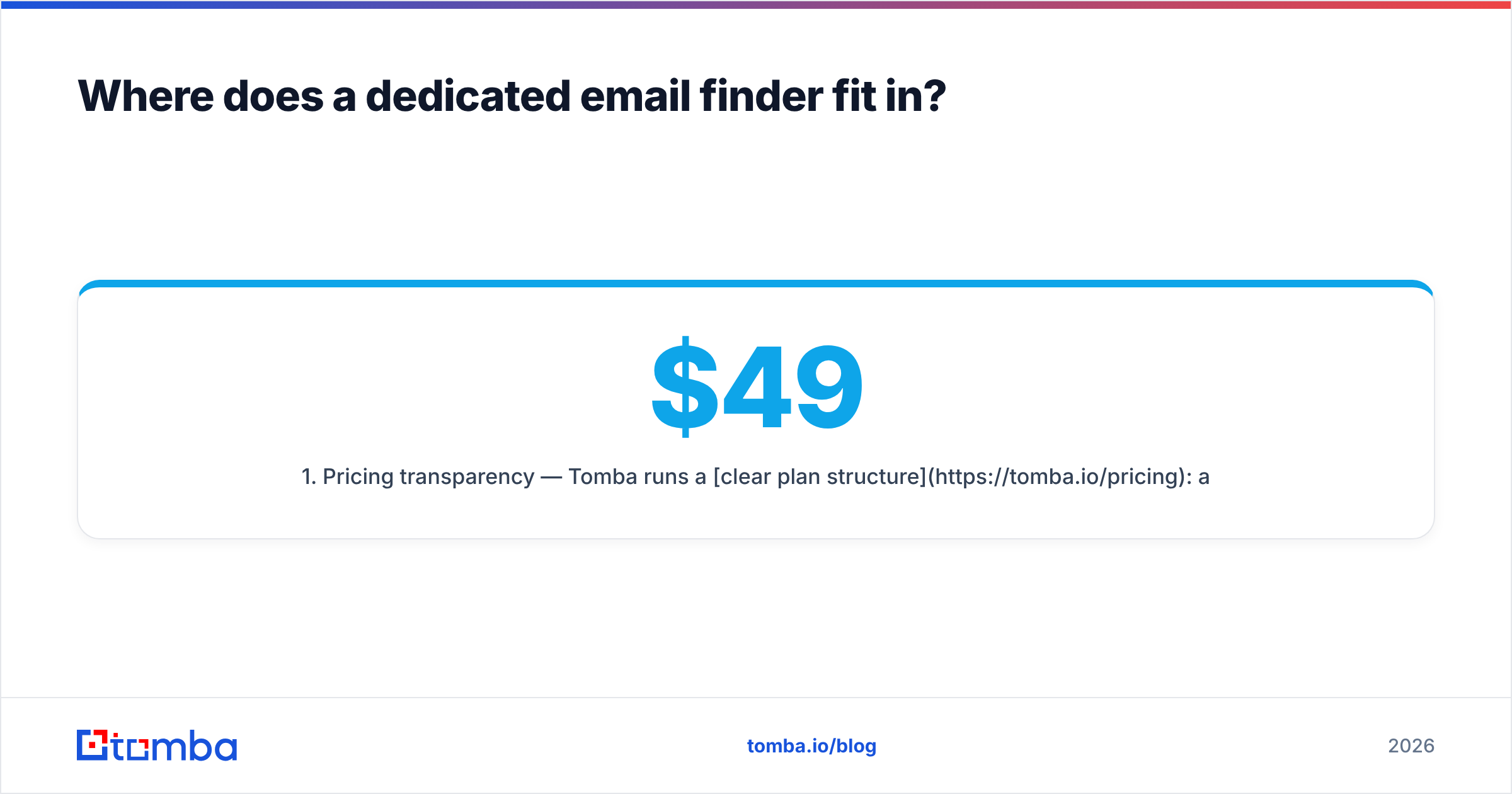
- Pricing transparency — Tomba runs a clear plan structure: a free tier with 25 searches/month, Starter at $49/mo, Growth at $99/mo, Pro at $249/mo, and custom Enterprise. No annual lock-in to get started.
- Purpose-built discovery — the email finder resolves emails from a name and domain, and domain search pulls every public address at a company in one query.
- Built-in verification — discovery and verification live in the same workflow, so you're not exporting to a second tool to clean the list.
- Developer access — a documented email finder API, plus a Chrome extension and Google Sheets add-on, so the data goes where your team already works.
You can also stack it: use D&B for company truth and risk, use Clodura.AI for intent, and use a finder to fill contact gaps cheaply. The tools aren't mutually exclusive.
How do you choose between them?#
Match the tool to the job, not the brand.
Pick Clodura.AI if you're a startup-to-mid-market sales team that wants pipeline this week, values transparent pricing, and likes having contacts, intent, and sequencing in one place. It's a strong Apollo alternative class tool for teams that want an all-in-one prospecting cockpit.
Pick Dun & Bradstreet if you're an enterprise that needs authoritative company data for credit, risk, compliance, or master-data management — and contact prospecting is a secondary concern. The DUNS standard and corporate-family data are genuinely hard to replicate.
Pick a dedicated finder (like Tomba) if your core need is email discovery and verification, you want usage-based pricing, and you'd rather not pay for a suite or an enterprise contract to get a contact's address.
For reference points beyond vendor marketing, cross-check verified user reviews on G2 and feature breakdowns on Capterra before committing — both platforms' real-world ratings tell a more nuanced story than their landing pages.
What's the verdict for 2026?#
CloduraAI vs Dun & Bradstreet isn't really a head-to-head fight. They are tools for different teams. Clodura.AI wins on speed, price, and prospecting workflow. It suits sales orgs that live in outbound. D&B wins on authority, governance, and risk data. It suits enterprises that treat data as infrastructure. Forcing a choice often means one tool is simply wrong for your problem.
And if your problem is specifically finding and verifying the right email addresses — without an annual contract or a suite you'll half-use — that's a third, simpler answer.
Ready to find verified emails without the enterprise contract?#
If your bottleneck is contact discovery, skip the procurement cycle. The Tomba Email Finder turns a name and company domain into a verified professional email in seconds, with a free tier to test it and Starter plans from $49/mo when you're ready to scale. Pair it with built-in verification and you've got a lean, accurate prospecting stack — no DUNS Number required. Start free, run your first searches today, and only pay for the volume you actually use.
// get started
Find, verify and enrich your first contacts today
Start on the free plan with 25 searches a month, then scale when your team is ready.
Free plan · No credit card required · GDPR & CCPA
// about the author