Clodura.ai vs Forager 2026: Which B2B Lead Tool Wins?
Clodura.ai bundles a full sales-intelligence suite; Forager is a lean email finder. Here's an honest 2026 breakdown of features, pricing, accuracy, and the best fit for your pipeline.
Choosing between Clodura.ai and Forager comes down to one question: do you need an all-in-one sales intelligence platform, or a focused email finder that does one job well? This guide breaks down both tools by feature depth, pricing, data accuracy, and the buyer they actually fit — without the marketing gloss.
TL;DR#
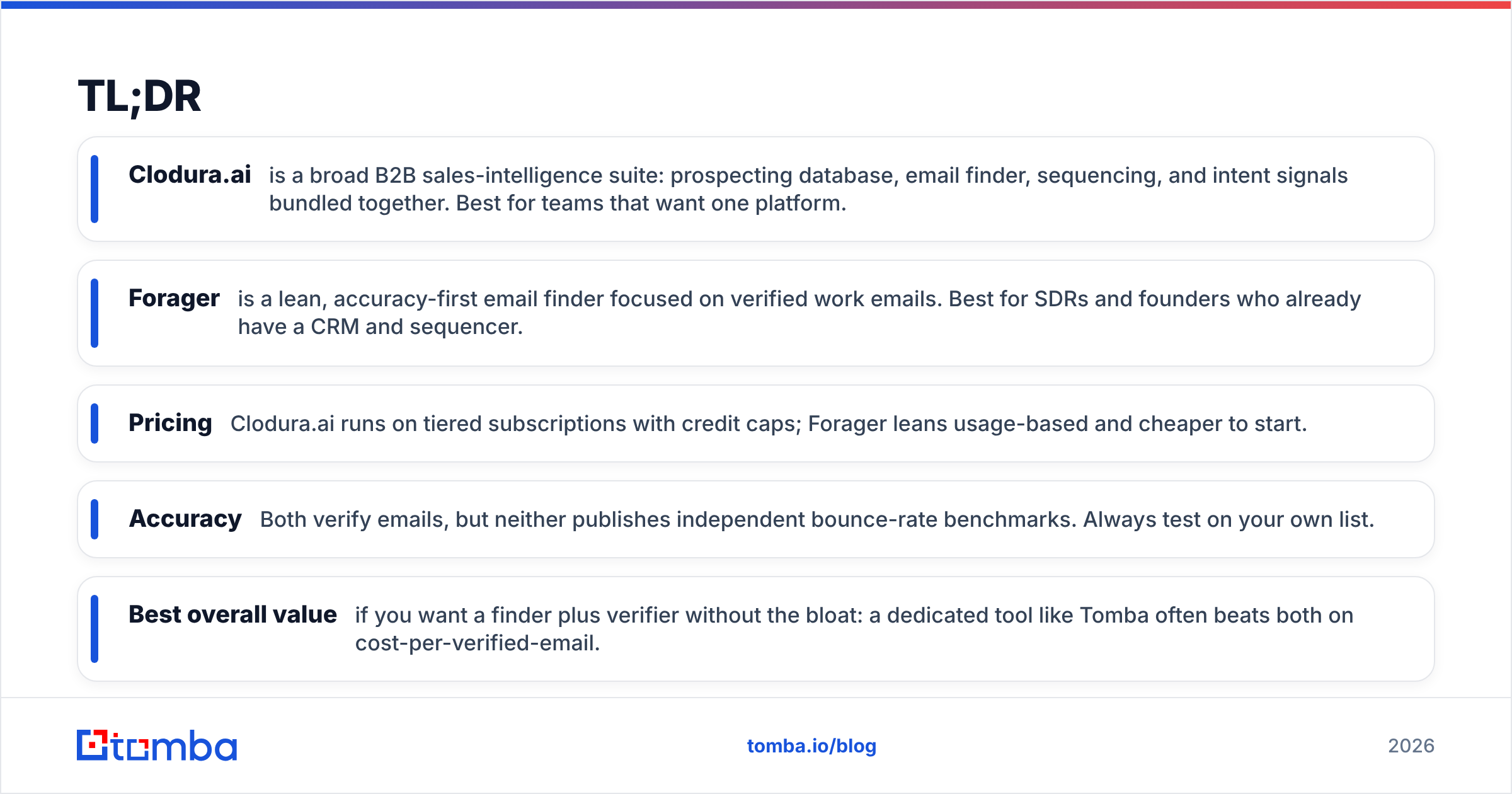
- Clodura.ai is a broad B2B sales-intelligence suite: prospecting database, email finder, sequencing, and intent signals bundled together. Best for teams that want one platform.
- Forager is a lean, accuracy-first email finder focused on verified work emails. Best for SDRs and founders who already have a CRM and sequencer.
- Pricing: Clodura.ai runs on tiered subscriptions with credit caps; Forager leans usage-based and cheaper to start.
- Accuracy: Both verify emails, but neither publishes independent bounce-rate benchmarks. Always test on your own list.
- Best overall value if you want a finder plus verifier without the bloat: a dedicated tool like Tomba often beats both on cost-per-verified-email.
What is Clodura.ai?#
Clodura.ai is a B2B sales-intelligence and prospecting platform. Think of it as a Swiss Army knife: it ships a contact database (tens of millions of records), an email finder, direct-dial discovery, email sequencing, and buyer-intent signals under a single login. The pitch is consolidation — instead of stitching together a finder, a verifier, and a sequencer, you do everything in one tab.
That breadth is the selling point and the catch. You pay for the whole suite even if you only need two features, and platforms this wide rarely match a specialist on any single dimension. If your team genuinely uses sequencing and intent data daily, the bundle math works. If you just need clean emails, you are subsidizing modules you will never open.

What is Forager?#
Forager is a focused email finder built around one promise: verified, deliverable work emails with minimal noise. It strips out the database-browsing, sequencing, and intent layers and concentrates on the find-and-verify loop. You feed it a name and domain (or a LinkedIn profile, depending on workflow), and it returns an email with a confidence signal.
The philosophy is the opposite of Clodura.ai. Where Clodura wants to be your whole prospecting stack, Forager wants to be the one node in your stack that finds emails reliably and gets out of the way. For teams that already run Apollo, Outreach, or a CRM, that single-purpose design is a feature, not a limitation.
Clodura.ai vs Forager: How do they compare?#
Here is the head-to-head on the attributes that actually change your workflow and your bill.
| Attribute | Clodura.ai | Forager |
|---|---|---|
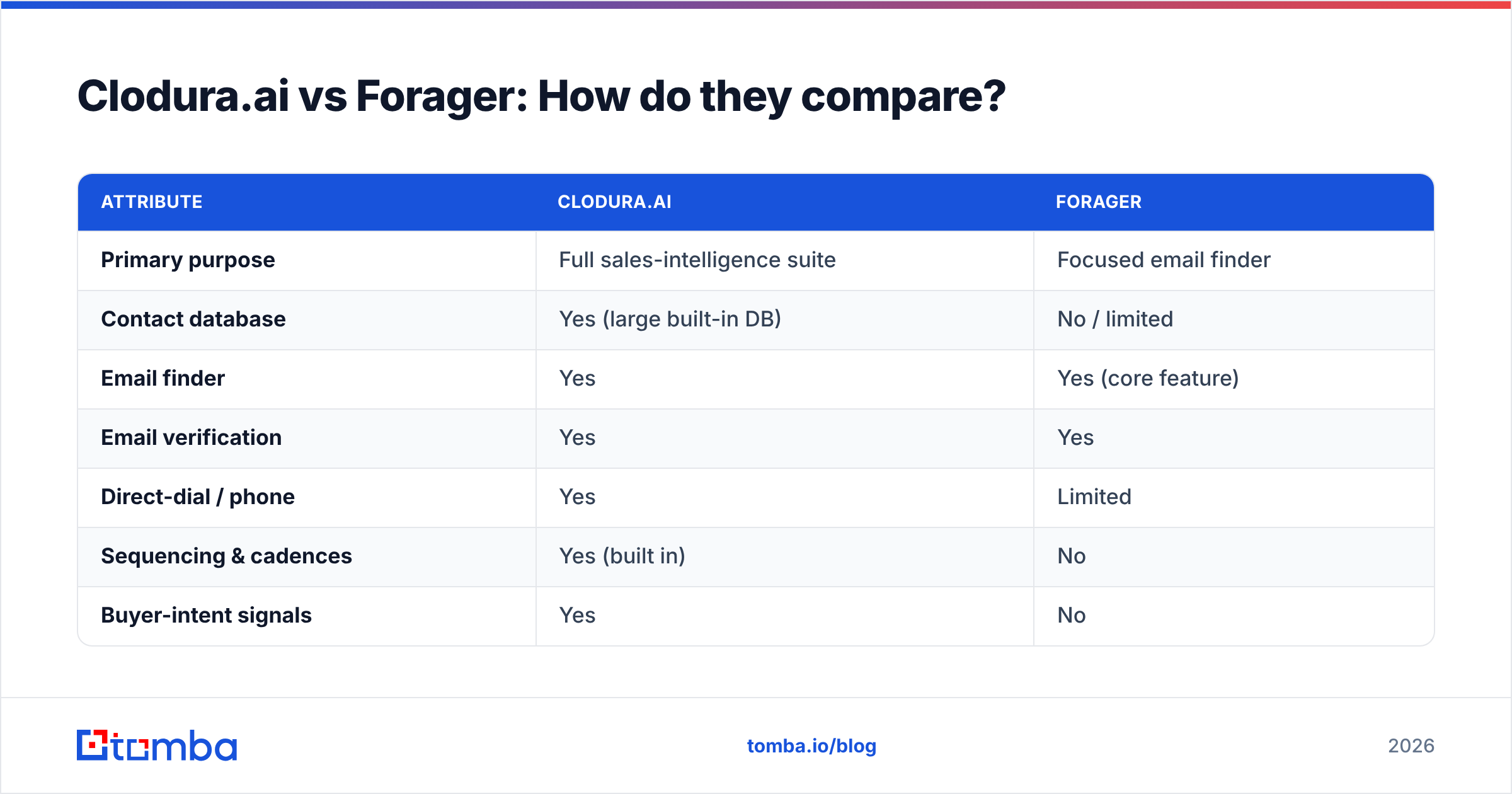
| Primary purpose | Full sales-intelligence suite | Focused email finder |
| Contact database | Yes (large built-in DB) | No / limited |
| Email finder | Yes | Yes (core feature) |
| Email verification | Yes | Yes |
| Direct-dial / phone | Yes | Limited |
| Sequencing & cadences | Yes (built in) | No |
| Buyer-intent signals | Yes | No |
| Best for | Teams wanting one platform | SDRs/founders with an existing stack |
| Pricing model | Tiered subscription + credits | Usage-friendly, lower entry |
| Learning curve | Higher (more modules) | Low (single workflow) |
The pattern is clear. Clodura.ai wins on breadth — if you score every feature box, it checks more of them. Forager wins on focus and likely on cost-per-email for low-to-mid volume. Neither is "better" in the abstract; they answer different buying questions.
Which has better email accuracy?#
Accuracy is where every email tool lives or dies, and it is also where honest reporting gets thin. Both Clodura.ai and Forager verify emails before returning them, and both will tell you their data is high quality. What neither publishes is an independent, repeatable bounce-rate benchmark on a neutral test list — so treat vendor accuracy claims as marketing until you run your own test.
A practical way to judge any finder: pull 100 contacts you can independently confirm, run them through the tool, then push the results through a separate email verifier and measure the real bounce rate. Catch-all domains are the usual trap — many tools mark catch-all addresses as "valid" when they are genuinely unverifiable, which is why a dedicated catch-all verifier matters for enterprise targets.

The benchmark above shows why cross-checking matters: accuracy varies widely by provider and by the type of domain you are targeting. A tool that nails US tech companies may struggle with European SMBs or catch-all-heavy enterprises. Test on your ICP, not on a generic sample.
How does pricing compare?#
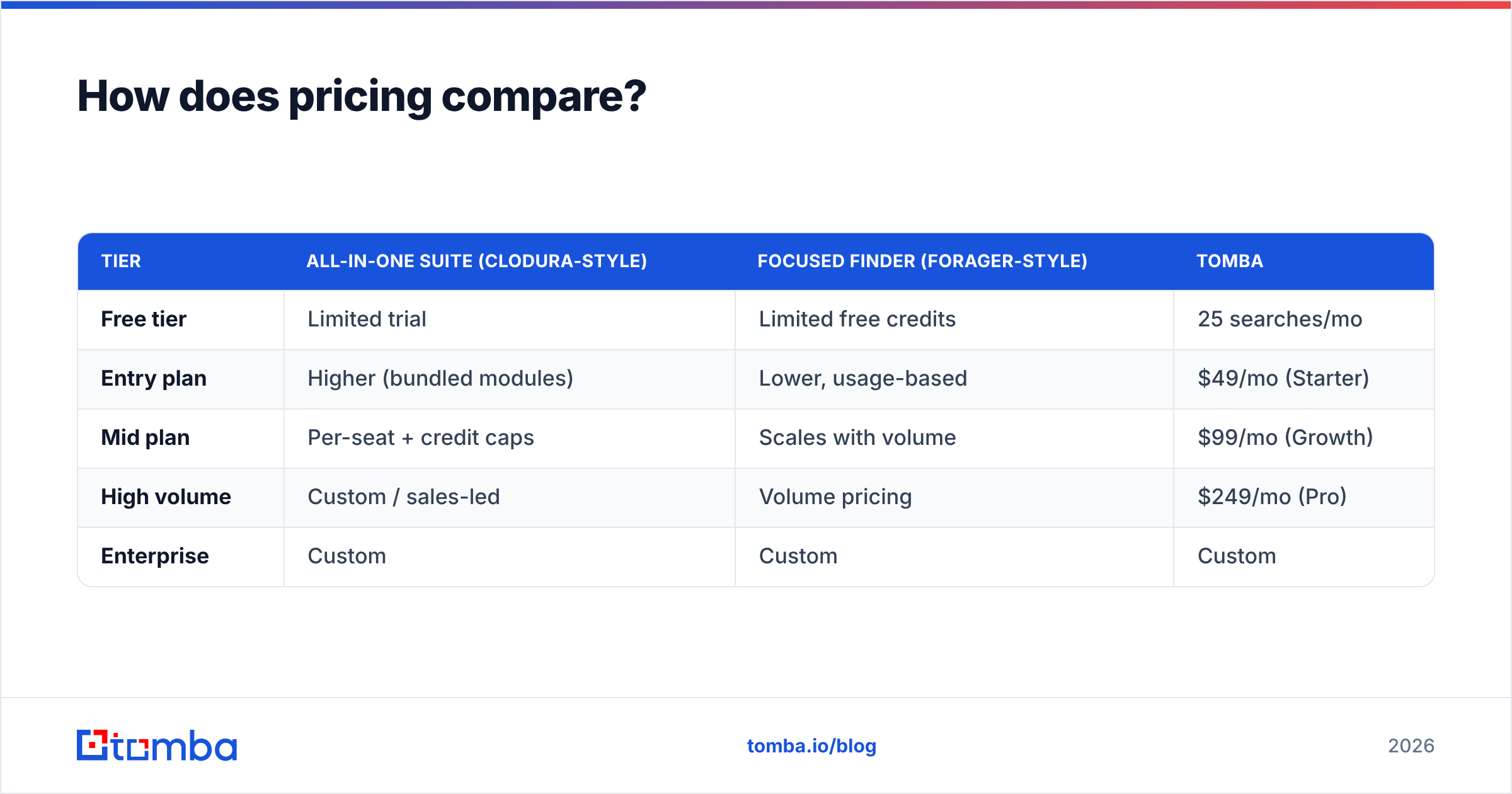
Pricing is the clearest practical difference. Clodura.ai uses tiered subscriptions where higher plans unlock more credits and more modules — you are buying a platform, so the floor reflects that. Forager leans toward a lighter, usage-friendly model that is cheaper to start and easier to scale down when prospecting slows.
Below is a representative shape of how all-in-one suites, focused finders, and dedicated finder-plus-verifier tools tend to price. Always confirm live numbers on each vendor's pricing page before you commit, since tiers change.
| Tier | All-in-one suite (Clodura-style) | Focused finder (Forager-style) | Tomba |
|---|---|---|---|
| Free tier | Limited trial | Limited free credits | 25 searches/mo |
| Entry plan | Higher (bundled modules) | Lower, usage-based | $49/mo (Starter) |
| Mid plan | Per-seat + credit caps | Scales with volume | $99/mo (Growth) |
| High volume | Custom / sales-led | Volume pricing | $249/mo (Pro) |
| Enterprise | Custom | Custom | Custom |
A few buying notes:
- Watch the credit math. Suites often quote a low headline price, then meter every email, every reveal, and every export against a shared credit pool. Map your monthly volume to credits before you sign.
- Per-seat costs compound. Platform tools usually charge per user; a focused finder may not. For a 5-person SDR team that gap is real money.
- Don't pay for unused modules. If you won't touch sequencing or intent data, the suite premium is pure waste.
- Free tiers reveal confidence. A usable free tier (like Tomba's 25 searches/month) lets you test accuracy before paying. You can compare full Tomba pricing against any suite's bundled cost.
For a deeper look at where these vendors source records and how that affects coverage, the data sources breakdown is a useful reference point when evaluating any provider's claims.
Which tool should you choose?#
The decision is mostly about how much of your stack you want one vendor to own.
Choose Clodura.ai if: you are a growing sales team that wants prospecting, finding, verifying, and sequencing in one platform, you will actively use intent signals, and you prefer one invoice over five. The breadth pays off only when you use the breadth.
Choose Forager if: you already have a CRM and a sequencer you like, you want the cleanest possible email finding without learning a new platform, and you would rather pay for one job done well than ten jobs done adequately.
Consider a dedicated alternative if: your real need is "find verified emails and phone numbers at a fair price." This is the most common case, and it is where a specialist tool tends to beat both. A focused stack — an email finder, a verifier, a domain search for company-wide lookups, and a phone finder — covers most outbound workflows without suite overhead.
What about a third option?#
Neither Clodura.ai nor Forager is the only way to solve the find-and-verify problem, and you do not have to pick a side. If your priority is verified contact data at a transparent price, Tomba covers the same core jobs — email finding, verification, domain search, catch-all checks, phone discovery, and data enrichment — without forcing you into a full-suite subscription or limiting you to email-only.
That matters for two reasons. First, transparent per-tier pricing (Free, $49, $99, $249) makes the credit math predictable instead of a surprise on your next invoice. Second, integrations let the data flow where you already work — a HubSpot integration, Google Sheets add-on, Chrome extension, and a full email finder API for engineering teams. You get specialist-grade accuracy with the integration breadth that usually only comes from a suite.
For independent reviews of all three categories of tool, G2 and Capterra are the most reliable third-party sources — read the recent verified reviews, not just the star average, and weight feedback from companies that match your size and region.
Frequently asked questions#
Is Clodura.ai better than Forager? Not universally. Clodura.ai is better if you want an all-in-one sales platform with sequencing and intent data. Forager is better if you want a focused, lower-cost email finder to plug into an existing stack. Match the tool to your workflow, not to a feature count.
Which has more accurate emails? Both verify emails, but neither publishes neutral, independent benchmarks. Run a 100-contact test on your own ICP and measure the real bounce rate through a separate verifier before trusting either claim.
Are there cheaper alternatives? Yes. Dedicated finder-plus-verifier tools like Tomba start at $49/month with a free tier, and usually beat all-in-one suites on cost-per-verified-email when you don't need sequencing or intent modules.
Can I use these tools with my CRM? Forager is designed to slot into an existing CRM and sequencer. Clodura.ai includes its own sequencing but also integrates outward. Tomba connects to HubSpot, Salesforce, Pipedrive, Sheets, and more via native integrations.
The bottom line#
Clodura.ai and Forager solve different problems: one bundles your whole prospecting stack, the other perfects a single step of it. Score your actual workflow before you buy — most teams overpay for modules they never open.
If what you really need is verified emails and phone numbers at a price you can predict, start with the Tomba Email Finder. The free tier gives you 25 searches a month to test accuracy on your own list — no credit math, no suite lock-in, just clean contact data you can push straight into your CRM. Run the same 100-contact test on all three tools and let the bounce rate decide.
// get started
Find, verify and enrich your first contacts today
Start on the free plan with 25 searches a month, then scale when your team is ready.
Free plan · No credit card required · GDPR & CCPA
// about the author