Clodura.ai vs Goava 2026: Best B2B Sales Tool Compared
Clodura.ai vs Goava in 2026: a neutral, feature-by-feature breakdown of pricing, data coverage, intent signals, and which sales intelligence tool actually fits your pipeline.
Choosing between Clodura.ai and Goava usually comes down to one question: do you want an all-in-one outbound engine, or a smart recommendation layer that tells you who to call next? Both promise to fill your pipeline, but they solve different halves of the prospecting problem. This breakdown cuts through the marketing and shows you exactly where each tool wins, where it falls short, and how to plug the gaps.
TL;DR — Clodura.ai vs Goava at a glance#
- Clodura.ai is an all-in-one B2B prospecting platform: a contact database, email finder, sequences, and a built-in dialer aimed at outbound teams that want everything in one login.
- Goava is a sales intelligence and recommendation engine, strong in the Nordics, that scores and suggests accounts your reps should prioritize — it assumes you already have outreach tooling.
- Pick Clodura.ai if you need contacts plus execution in a single tool; pick Goava if you have a CRM and sequencer but lack account prioritization and signals.
- Data accuracy is the deciding factor for both — and it's the one area where a dedicated email verifier earns its keep no matter which platform you choose.
- Neither tool is a pure email finder, so don't buy either expecting best-in-class email accuracy out of the box.
What is Clodura.ai?#
Clodura.ai is a sales prospecting platform that bundles a B2B contact database (it advertises hundreds of millions of contacts and direct dials) with the tools to act on that data: email sequencing, a power dialer, buyer-intent signals, and technographic filters. The pitch is consolidation. Instead of stitching together a data vendor, a sequencer, and a dialer, you log into one dashboard and run the whole motion.
That makes Clodura.ai attractive to small and mid-market outbound teams who feel nickel-and-dimed by point solutions. You search for accounts, pull contacts, load them into a sequence, and dial — all without exporting a CSV. It also surfaces "sales triggers" like job changes, funding, and tech installs so reps can time their outreach.
The trade-off with any all-in-one is depth. When a single vendor owns data, deliverability, and dialing, each module tends to be good-enough rather than best-in-class. Email accuracy in particular varies by region and seniority, which is why experienced teams still run found addresses through an independent check before sending.
What is Goava?#
Goava is a Swedish sales intelligence platform built around recommendations. Rather than just handing you a searchable database, Goava analyzes your existing customers and ICP, then ranks accounts by how likely they are to buy. It's strongest on Nordic and European company data, pulling in financials, growth signals, and firmographics that are hard to get from US-centric databases.
The core idea: your reps waste time deciding who to contact. Goava removes that guesswork by scoring accounts and pushing prioritized lists into your CRM. It positions itself as a layer on top of your stack, not a replacement for it. You still need a way to find contact details and a way to send outreach.
That focus is Goava's strength and its limit. If you sell into Sweden, Norway, Denmark, or Finland and want disciplined account prioritization, few tools match its regional depth. If you sell globally or need contact data and sending built in, you'll be assembling the rest of the stack yourself.
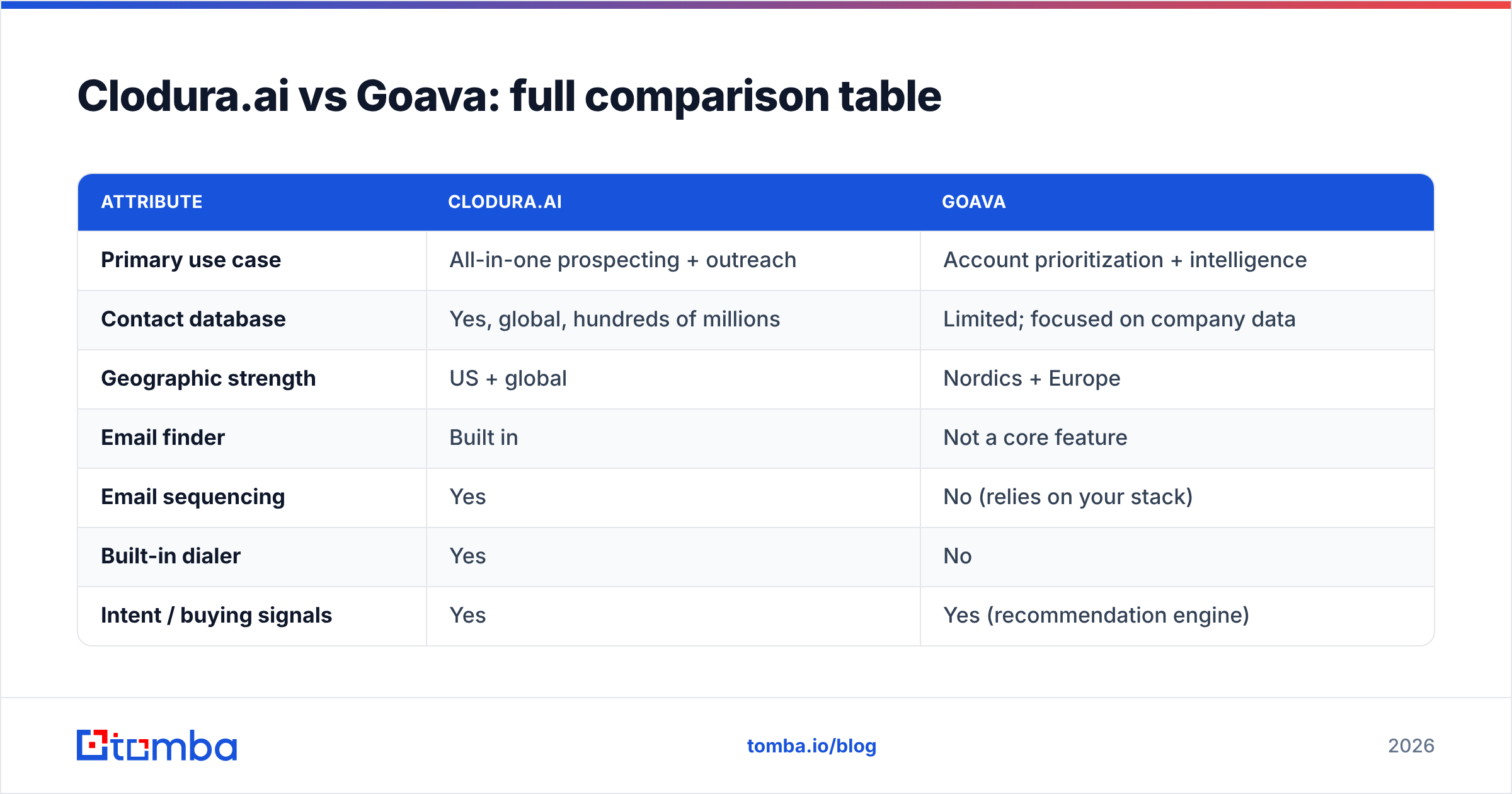
Clodura.ai vs Goava: full comparison table#
Here's the side-by-side. Pricing reflects publicly listed plans at the time of writing — always confirm current numbers on each vendor's site, since sales-tool pricing changes often.
| Attribute | Clodura.ai | Goava |
|---|---|---|
| Primary use case | All-in-one prospecting + outreach | Account prioritization + intelligence |
| Contact database | Yes, global, hundreds of millions | Limited; focused on company data |
| Geographic strength | US + global | Nordics + Europe |
| Email finder | Built in | Not a core feature |
| Email sequencing | Yes | No (relies on your stack) |
| Built-in dialer | Yes | No |
| Intent / buying signals | Yes | Yes (recommendation engine) |
| CRM integrations | HubSpot, Salesforce, Pipedrive | Salesforce, HubSpot, others |
| Free trial | Yes (limited credits) | Demo-based |
| Best for | SMB/mid-market outbound teams | Nordic-focused sales teams |
Is Clodura.ai better than Goava?#
It depends on what you're missing. Clodura.ai wins when you need a complete outbound motion in one tool and you sell across global markets. Goava wins when your prioritization is the bottleneck and your accounts sit in Europe.
Think of it like buying a vehicle. Clodura.ai is a van — it carries everything you need for the job in one trip. Goava is a high-end GPS — it won't move you anywhere, but it tells you precisely where to go so you stop wasting fuel. A team without a sequencer needs the van. A team that already drives well but gets lost needs the GPS.
For most growing outbound teams, the all-in-one footprint of Clodura.ai is the more practical starting point because it removes integration overhead. But "fewer tools" is not the same as "better data," and that distinction matters more than either vendor's homepage admits.
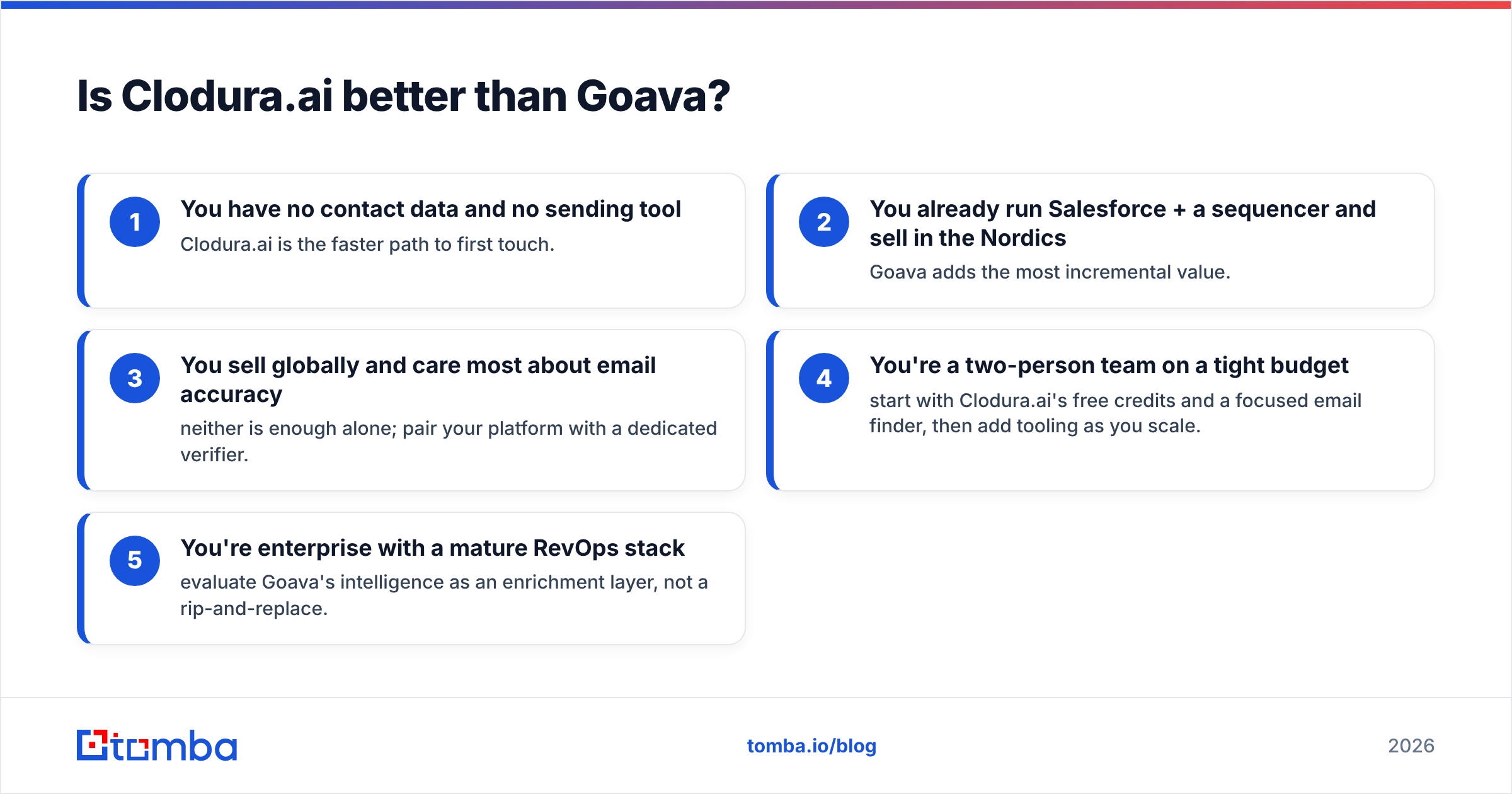
Here's how the decision usually breaks down:
- You have no contact data and no sending tool — Clodura.ai is the faster path to first touch.
- You already run Salesforce + a sequencer and sell in the Nordics — Goava adds the most incremental value.
- You sell globally and care most about email accuracy — neither is enough alone; pair your platform with a dedicated verifier.
- You're a two-person team on a tight budget — start with Clodura.ai's free credits and a focused email finder, then add tooling as you scale.
- You're enterprise with a mature RevOps stack — evaluate Goava's intelligence as an enrichment layer, not a rip-and-replace.
How accurate is the data in each tool?#
Data decay is the quiet killer in both platforms. B2B contact data goes stale fast — people change jobs, companies rebrand, and email patterns shift. Industry estimates from sources like HubSpot put B2B data decay at roughly 22–30% per year, and review sites like G2 show wide variance in user-reported accuracy for nearly every prospecting database.
Clodura.ai's email accuracy depends heavily on role seniority and region. Common, well-staffed companies return clean addresses; smaller or non-US firms see more guesses and catch-all domains. Goava, by design, leans on company-level intelligence rather than personal email accuracy, so you'll often need a separate source for the actual contact's address.
This is the gap a dedicated verification layer fills. Running every address through an independent check before it hits a sequence protects your sender reputation and keeps bounce rates low. A high bounce rate doesn't just waste sends — it actively damages email deliverability for every campaign that follows.
What does each tool cost?#
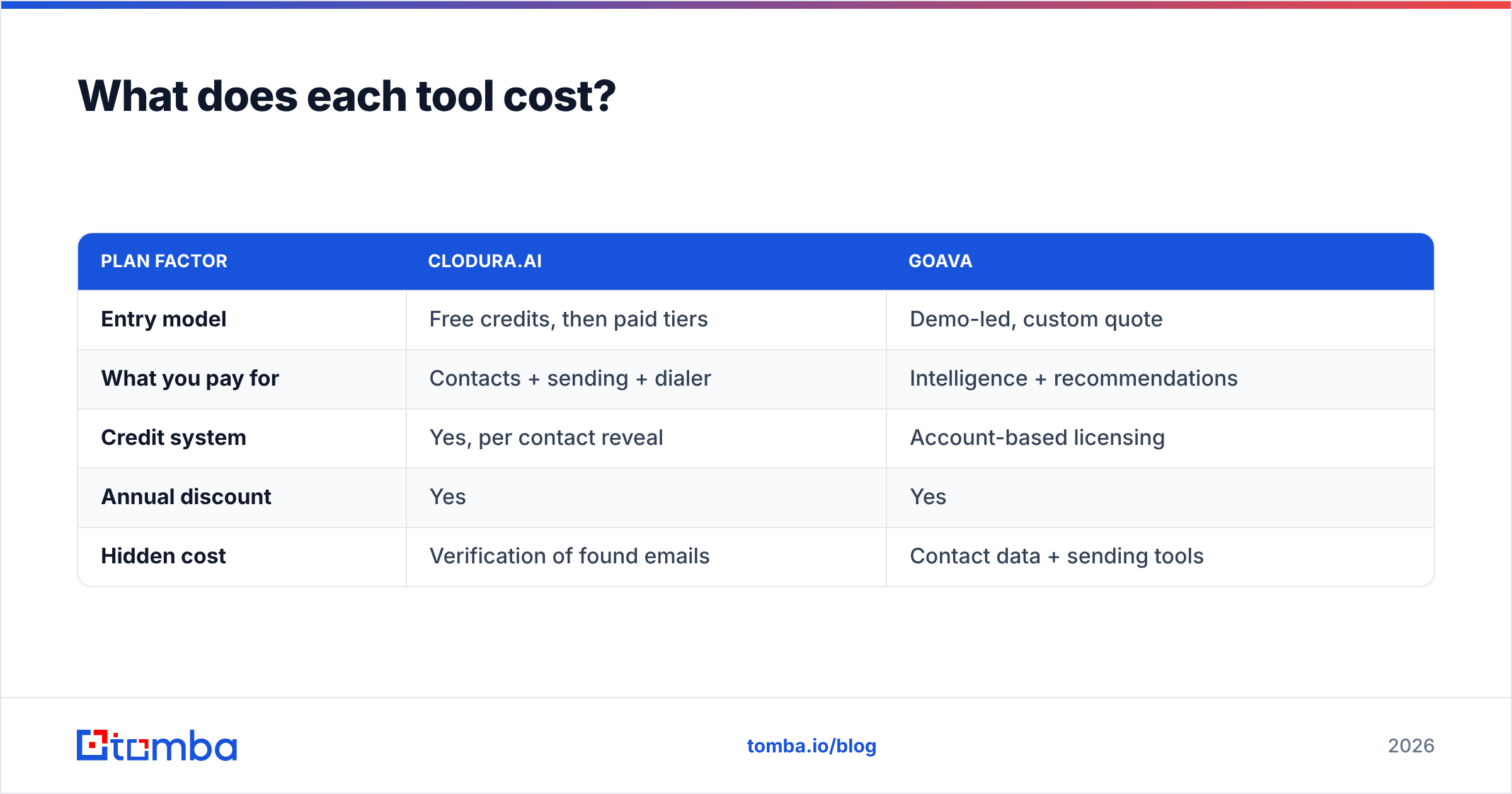
Neither vendor publishes simple, fixed pricing for every tier, and both push annual contracts for serious volume. The summary below is directional — treat it as a framework for what you're paying for, not a quote.
| Plan factor | Clodura.ai | Goava |
|---|---|---|
| Entry model | Free credits, then paid tiers | Demo-led, custom quote |
| What you pay for | Contacts + sending + dialer | Intelligence + recommendations |
| Credit system | Yes, per contact reveal | Account-based licensing |
| Annual discount | Yes | Yes |
| Hidden cost | Verification of found emails | Contact data + sending tools |
The hidden costs are the real story. With Clodura.ai, budget for cleaning the data you pull. With Goava, budget for the contact-finding and sending tools it doesn't include. In both cases, a low-cost finder and verifier closes the gap cheaply — Tomba's Free tier gives you 25 searches a month, with Starter at $49/mo and Growth at $99/mo if you scale.
When should you add a dedicated email finder?#
Add one the moment bounce rates climb above 3–5% or you start sending into a new region. All-in-one platforms optimize for breadth; a focused finder optimizes for accuracy on the exact contact you're chasing.
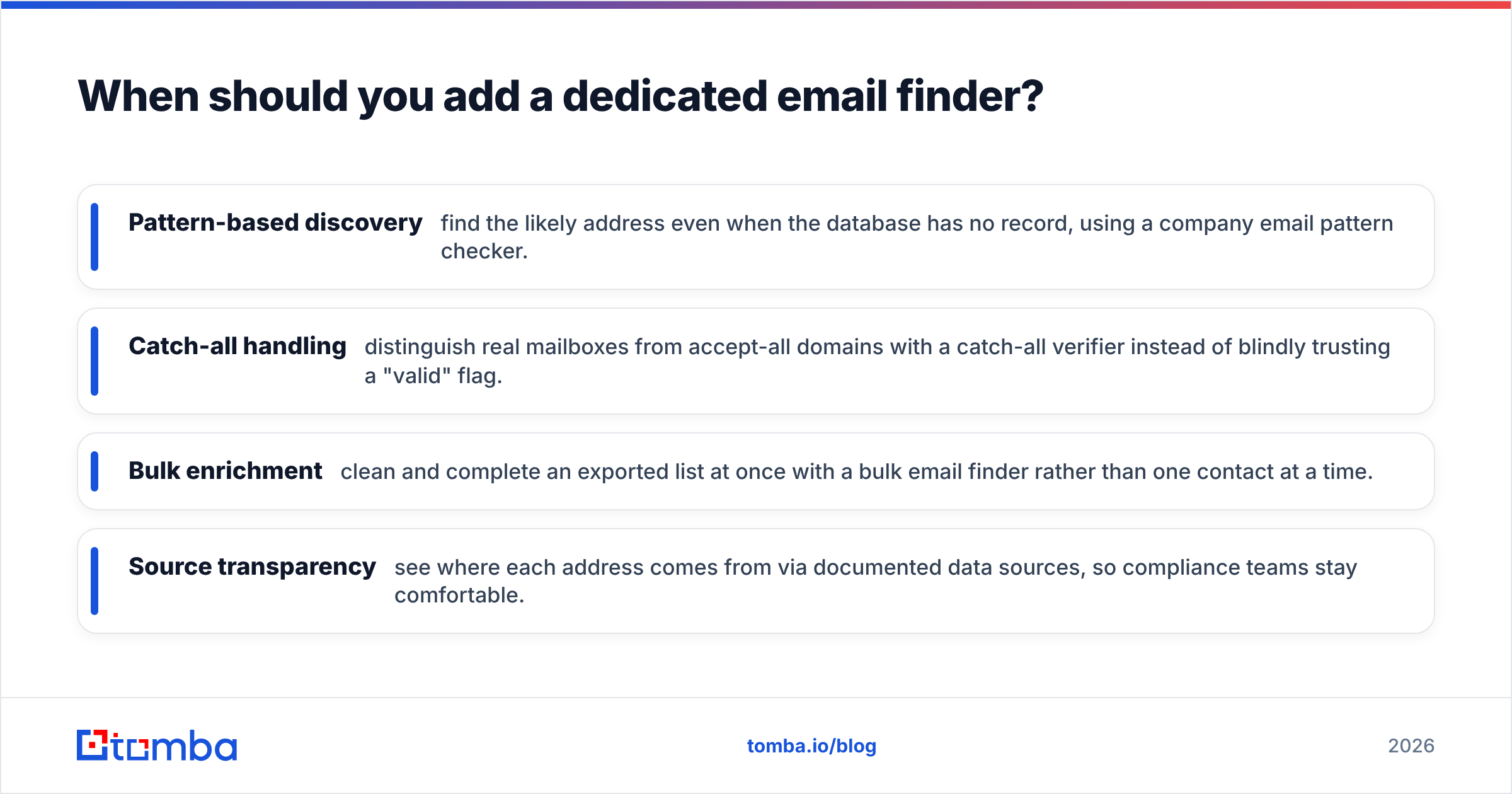
A specialized tool gives you several things neither Clodura.ai nor Goava fully covers:
- Pattern-based discovery — find the likely address even when the database has no record, using a company email pattern checker.
- Catch-all handling — distinguish real mailboxes from accept-all domains with a catch-all verifier instead of blindly trusting a "valid" flag.
- Bulk enrichment — clean and complete an exported list at once with a bulk email finder rather than one contact at a time.
- Source transparency — see where each address comes from via documented data sources, so compliance teams stay comfortable.
This is the layer that makes either platform safe to send from. Clodura.ai gets you contacts; Goava tells you which accounts matter; a finder-plus-verifier makes sure the email you actually press send on lands in an inbox.
Which tool fits which team?#
Match the tool to your actual bottleneck, not to the longest feature list.
- Early-stage SMB, no stack: Clodura.ai. You need execution in one place, and the free credits let you test before committing.
- Nordic mid-market with a CRM: Goava. Its regional data and prioritization are genuinely differentiated where US databases thin out.
- Global outbound at scale: Either platform as your base, plus an independent finder and verifier so deliverability holds across regions.
- RevOps-led enterprise: Goava as an intelligence layer feeding scored accounts into existing systems; Clodura.ai only if you want to consolidate point tools.
If you're still torn, run a small bake-off. Pull 100 target accounts through each tool, find and verify the contacts, then send an identical sequence. Measure bounce rate, reply rate, and time-to-first-meeting. The winner on your data is the only benchmark that matters — vendor case studies rarely reflect your ICP.
How do you keep your data clean over time?#
Buying the tool is step one; maintaining the list is the ongoing job. Set a quarterly re-verification cadence so stale records don't quietly tank your metrics. Pull job-change signals (both platforms offer these) and re-enrich movers, because a contact who switched companies is both a dead address and a warm new opportunity at their next employer.
Feed clean data back into your CRM through native integrations so reps never work from a stale export. The discipline is boring but decisive: teams that re-verify on a schedule consistently outperform teams that buy a database once and let it rot. Treat your contact data like a product with a maintenance plan, not a one-time purchase, and either platform will return far more pipeline.
The bottom line#
Clodura.ai and Goava aren't really competitors — they're answers to different questions. Clodura.ai consolidates your outbound stack; Goava sharpens your targeting. The mistake is expecting either one to also be a best-in-class email finder, because that's not what they're built for.
Whichever you choose, the contact data still has to be accurate or none of it matters. Start with the Tomba Email Finder to find and verify professional email addresses by domain, name, or company — then layer it under Clodura.ai or Goava so every contact you reveal is one you can actually reach. Spin up the free tier, run your toughest 25 accounts through it, and let the bounce rate make the decision for you.
Ready to find emails that actually work?
Join 150,000+ professionals who stopped guessing and started sending. Free credits on signup — no credit card required.
Get the Tomba newsletter
Practical outbound tactics and product updates — once every two weeks.
About the author